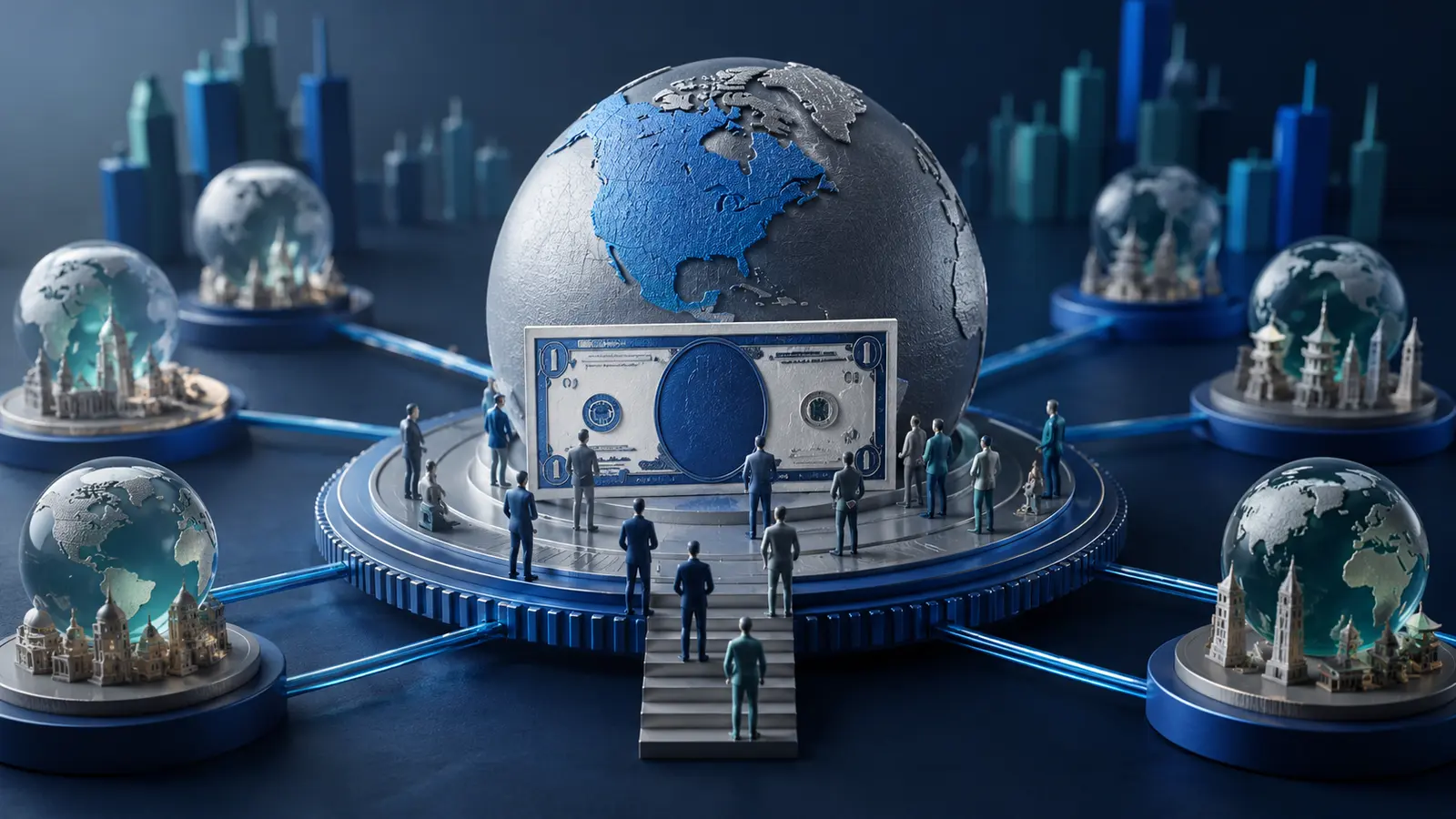
The U.S. dollar is central to foreign-exchange trading, international financing, and many cross-border payments. Its role reflects deep markets, established networks, and the availability of dollar assets and funding, rather than a single rule requiring every transaction to use it. Different measures capture different parts of that role. Currency trading, central-bank reserves, trade invoicing, and international borrowing should not be combined into one statistic.
How the Dollar Took the Throne
The dollar didn't just stumble into global supremacy overnight. Its dominance is a cocktail of history, wartime aftermath, industrial might, and plain old pragmatism. By the end of World War II, the United States was uniquely positioned to write the rules for a battered global economy.
In 1944, delegates from 44 nations met in Bretton Woods, New Hampshire, to figure out what came next. Europe and Japan were in ruins. The U.S., meanwhile, was sitting on intact infrastructure, booming factories, and a large chunk of the world’s gold. It offered the one thing everyone was desperate for: stability.
The resulting agreement hardwired the dollar into the global system. Other currencies were officially pegged to the dollar, and the dollar was pegged to gold. Washington effectively gave the world a financial anchor to help it rebuild.
Of course, the gold standard didn't last forever. In 1971, President Richard Nixon severed the dollar's tie to gold, killing the Bretton Woods system. You'd think that would be the exact moment the dollar lost its crown. If it wasn't backed by gold anymore, why should anyone trust it?
Oddly enough, the dollar only tightened its grip. For one, the U.S. economy was an absolute behemoth with unmatched financial markets and liquid government bonds. Then there was the geopolitical masterstroke: oil. Because the modern world's most critical commodity ended up priced almost entirely in dollars, any country that wanted to keep its lights on needed a steady supply of greenbacks. Demand moved beyond mere trust—it became a mechanical necessity of global trade.
This is the superpower of a reserve currency. Once it infiltrates trade, banking, and borrowing at a deep level, it becomes self-sustaining. People use it simply because everyone else does. Breaking that kind of momentum is sharply difficult.
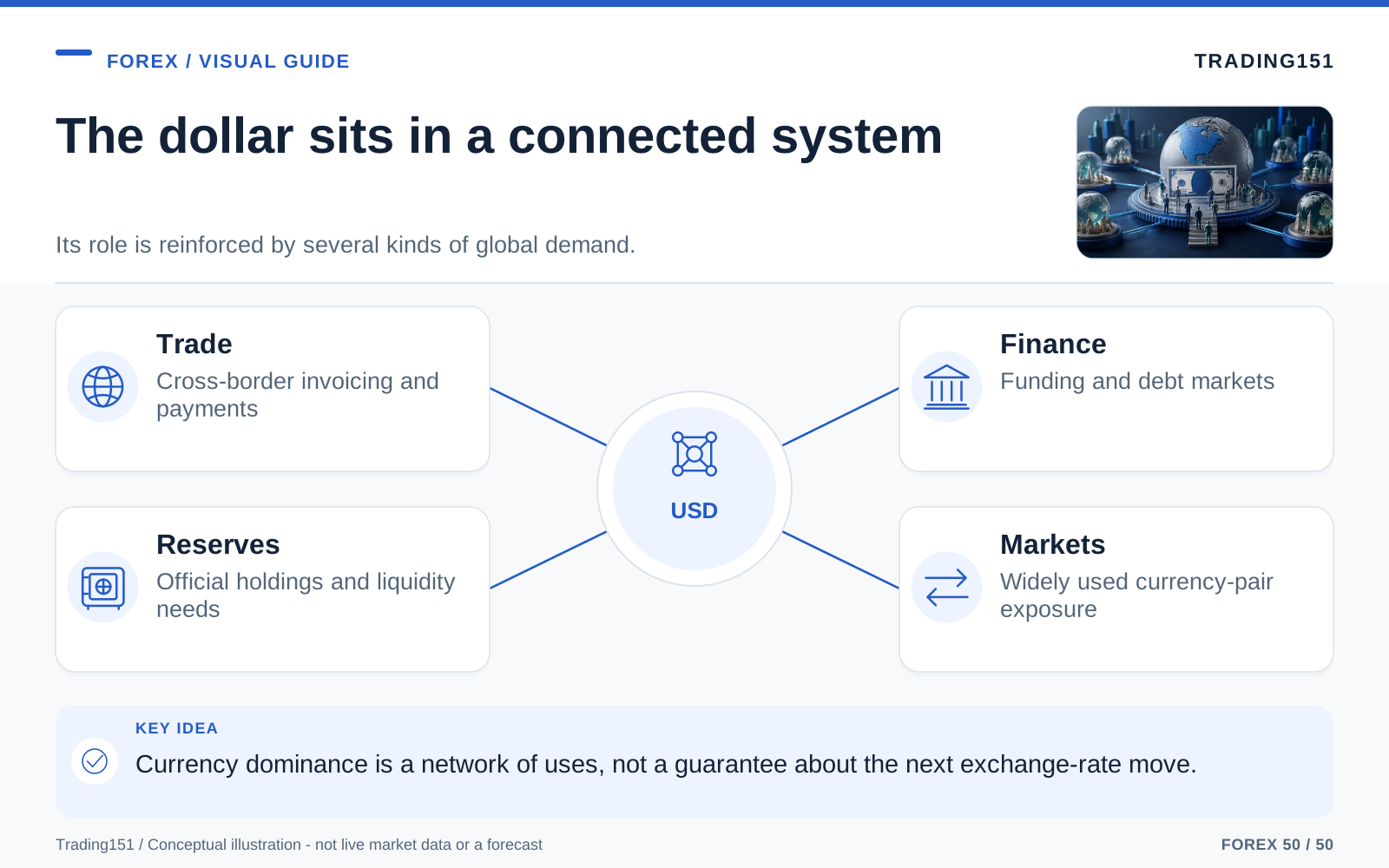
Read this diagram as text
- Trade
- Cross-border invoicing and payments
- Finance
- Funding and debt markets
- Reserves
- Official holdings and liquidity needs
- Markets
- Widely used currency-pair exposure
Why Forex Keeps Revolving Around the Dollar
The BIS's final April 2025 turnover tables, released in June 2026, show the dollar on one side of roughly 89% of foreign-exchange transactions. This is an FX turnover measure, not its share of central-bank reserves or world trade invoices. Currency shares sum to 200% because each transaction involves two currencies. The figure illustrates the dollar's role in trading without measuring every other form of international use.
Think about a Chilean company buying heavy machinery from South Korea. In a perfect world, they’d just trade Chilean pesos directly for South Korean won. But in reality, that direct market is clunky, illiquid, and expensive. There probably aren't enough buyers and sellers to make a clean, cheap trade exactly when it's needed. So, they use a middleman.
- Sell Chilean pesos and buy U.S. dollars.
- Sell U.S. dollars and buy South Korean won.
Traders call this a vehicle currency. The dollar is the financial superhighway that makes obscure trades fast and cheap. The more traffic it gets, the smoother the road becomes, making it even more appealing for the next driver.
It all comes down to liquidity. A highly liquid market means you can buy or dump large amounts of an asset instantly without drastically shifting the price. In a world where multinational companies pay global invoices and central banks juggle national reserves, that kind of depth is non-negotiable. The dollar delivers it on a scale nobody else can touch.
Because of this, the dollar feels less like a king demanding tribute and more like an interstate highway—even if you wanted to take the scenic route, you inevitably end up merging onto it.
Trust, Fear, and the Strange Psychology of the Dollar
There’s a weird psychological quirk to the dollar, too, which explains why it sometimes surges even when the U.S. itself is the epicenter of a crisis. Traders call this the Dollar Smile Theory. The concept shows that the dollar's strength is often less about global approval of U.S. policy and more about basic financial survival and the mechanics of collateral.
Imagine a graph shaped like a smile. On the left side, the global economy is melting down. Panic is in the air, risk is a dirty word, and investors are scrambling for cover. On the right side, the U.S. economy is booming, leaving the rest of the world in the dust, and capital is flooding into American assets to chase growth. The dollar wins in both scenarios.
- Left side of the smile: When things get ugly—a market crash, a geopolitical shock, a sudden panic—investors panic-buy the safest, most liquid assets they can find. Unfailingly, that means rushing into U.S. dollars and Treasuries.
- Right side of the smile: When American growth and interest rates outpace the rest of the world, foreign money pours in to grab a piece of the action. Stronger yields pull capital from across the globe, driving the dollar's value up.
The only time the dollar tends to sag is in the middle of that smile—when the U.S. economy is sluggish but the rest of the globe is humming along nicely. But those goldilocks periods never seem to last. Cycles turn. Shocks happen. And when the anxiety creeps back in, muscle memory takes over: buy dollars.
Finance isn’t just math and spreadsheets; it’s crowd psychology. Traders react to what they assume everyone else will do. Decades of conditioning have baked a single reflex into the market's DNA: when in doubt, hold greenbacks.
The Dollar as the World’s Debt Meter
The dollar’s reach goes way beyond trading terminals. It’s heavily baked into global debt, which is where its power goes from impressive to dangerous for a lot of countries. Dollar debt is a double-edged sword. A strong dollar crushes borrowers who earn their money in a different currency, and when those borrowers scramble to find dollars to pay their debts, they only drive the dollar's value higher. This is exactly when central banks step in with emergency swap lines—not to fix the economy, but simply to unclog the plumbing.
Governments and corporations in emerging markets love to borrow in dollars. At first glance, it’s a no-brainer. The interest rates are often lower, international investors are far more willing to lend, and local capital markets might be too tiny to handle the large loans they need.
But this sets a trap. Say a Brazilian logistics company takes out a $10 million loan when the exchange rate is 5 reals to the dollar. That’s a 50 million real debt. Fast forward a year, the dollar surges, and the rate jumps to 6 reals. The company hasn't changed. They didn’t borrow an extra dime. Yet, overnight, their debt balloons to 60 million reals.
When a rising dollar squeezes thousands of companies or even entire nations like this simultaneously, the fallout is severe. Financial conditions tighten, inflation spikes, capital flees the country, and economies can spiral into full-blown crises.
Federal Reserve decisions can affect global financing through dollar yields, exchange rates, and credit conditions. The direction and size of a market response depend on what was already expected and on developments elsewhere. A rate increase does not mechanically weaken every other currency or raise every borrower's cost by the same amount.
That’s the harsh reality of dollar dominance. The U.S. isn’t just steering its own economy; it has its hands on everyone else's steering wheel, too.
The Network Effect No One Can Easily Escape
If you want to know why the dollar is so sticky, look at network effects. Just like a social media app is useless if none of your friends are on it, a currency's value scales with its user base.
The dollar dominates largely because it’s already dominant. It sounds like a circular argument, but it’s just the truth. Banks hold it because central banks hold it. Central banks stockpile it because global trade requires it. Trade requires it because commodity markets demand it. Corporations use it because their suppliers expect it. Investors park their money in it because the market is endlessly deep and familiar.
This ecosystem is held up by a few large pillars:
- Global payments infrastructure: A huge chunk of the financial infrastructure clearing international wires relies on the dollar as its baseline.
- Commodity pricing: Oil, metals, grain, natural gas—the raw materials of the modern world almost exclusively trade in dollars.
- Foreign exchange reserves: Central banks park their rainy-day funds in dollars because they need cash they can deploy instantly in a crisis without crashing the market.
- U.S. Treasury markets: Simply put, there is no other safe-haven asset pool big enough to absorb the world's savings.
Trying to swap out the dollar means replacing all these interlocking systems at once. A challenger can't just be a big economy. It has to offer strong legal credibility, entirely open capital markets, large liquidity, and total convertibility. That is an unusually high bar.
Economists call this Washington’s “exorbitant privilege.” Because there’s a bottomless global appetite for dollars, the U.S. gets to play by different rules. It can run large deficits and borrow aggressively without suffering the severe market blowback that other nations would face. American financial life is essentially subsidized by the rest of the world’s need for its currency.
But what feels like a sweet perk in D.C. often feels like a chokehold everywhere else.
Can Anyone Really Replace the Dollar?
It seems like every other year, a new wave of think pieces announces the imminent death of the dollar. The catalyst is always changing: soaring U.S. debt, crippling inflation, the weaponization of sanctions, the rise of China, or the dawn of crypto. The narrative evolves, but the prediction stays the same.
Yet, the dollar is still here, still running the board, acting as the undisputed center of financial gravity.
That doesn't mean there aren't challengers. There are. But dig into any of them, and you quickly see why they aren't ready to take over the job on a global scale.
The euro is the most credible runner-up in terms of volume and reserve use. It has the backing of a large economic zone and highly trusted institutions. But it has a fatal flaw: it’s a shared currency without a fully unified government. The eurozone is a patchwork of substantially different economies—some powerhouses, some deeply in debt. When a crisis hits, that lack of political unity makes investors very nervous.
The Chinese yuan gets a lot of hype because of China's absolute dominance in global manufacturing. But a true global reserve currency has to flow freely across borders. Beijing still keeps a tight leash on capital leaving the country, and its financial system isn't open enough to foster total global trust. Until that changes, the yuan remains geographically handicapped.
A BRICS alternative sounds great in press releases. But getting a group of vastly different nations—with distinct inflation problems, political systems, and strategic rivalries—to agree on a unified currency is a logistical nightmare. Announcing a shared monetary unit is easy; building the trusted institutions to manage it is a generational task.
Cryptocurrencies and stablecoins are undeniably fascinating, especially for speeding up cross-border payments. But moving a few niche transactions is very different from underwriting global trade. Large volatility, regulatory crackdowns, and a lack of true institutional scale hold them back. The world's reserve currency needs to be boring. It has to hold its ground on a terrible day, not just soar on a speculative one.
So the real question isn’t whether a single hero will suddenly overthrow the dollar. It’s whether the global system will slowly fracture into a multipolar world—one where the dollar is still first, but its lead is much narrower.
The Slow Drift Toward a More Multipolar System
We’re starting to see that drift happen around the edges. More countries are quietly settling bilateral trade in their local currencies. Central banks are slightly diversifying their reserves. Gold is having a major renaissance. Governments have realized that relying entirely on a currency controlled by a rival superpower comes with a large strategic risk. All of this can happen slowly without one single currency taking over. Regional systems will grow, but deep capital markets and trusted legal frameworks take decades to build.
Sanctions have definitely accelerated this conversation. When countries watch the U.S. freeze another nation's dollar reserves or cut them off from payment networks, they take notes. It’s not that they think the dollar is suddenly weak; they just realize that relying on it 100% is a large political liability.
But hedging bets isn’t the same as a total replacement. The world can slowly shift toward a multipolar setup without dethroning the dollar. In fact, that's the most likely scenario: alternative payment systems grab a little market share around the margins, while the dollar remains the undisputed king of deep liquidity and crisis management.
The financial world moves much slower than the 24-hour news cycle wants you to believe. Reserve currencies don't die just because people get bored of them. They fade over decades, and only when a younger, fitter alternative is fully ready to take the reins. That kind of changing of the guard is rare.
Why It Matters Even If You Never Trade Forex
It’s tempting to write all this off as Wall Street jargon—the kind of thing macro traders and central bankers debate on financial TV while the rest of us tune out. But the dollar's status dictates the reality of everyday life.
If you live in America, the dollar’s supremacy quietly subsidizes your lifestyle. Because the world constantly needs to buy U.S. debt, the government can fund itself cheaper. It keeps imports affordable and makes traveling abroad feel like a bargain compared to what it would cost under a weaker currency.
If you live outside the U.S., the dollar's shadow is equally profound, though rarely as helpful. A surging greenback can make importing fuel painfully expensive. It crushes countries relying on external borrowing. It forces local businesses to hike prices, importing inflation directly to the supermarket aisle. It backs local central banks into terrible corners, forcing them to hike interest rates just to protect their own currency.
You don't need a brokerage account for the dollar to mess with your life. It shapes the price of airline tickets, your grocery bill, the cost of heating your home, and the interest rate on your mortgage. It’s an abstract concept that eventually hits you right in the wallet.
A trading share is not the same as a reserve share
In the BIS survey for April 2025, the dollar was on one side of about 89% of OTC foreign-exchange trades. Currency shares in that measure add to 200%, because every transaction contains two currencies. The figure does not mean the dollar held 89% of official reserves or that 89% of all world trade was invoiced in dollars.
Network effects help explain persistence. When many counterparties already quote, fund, and hedge in dollars, using the same currency can reduce some transaction and coordination costs. Deep markets and established infrastructure reinforce that convenience. This is an economic advantage, not proof that the dollar's role can never change.
Dollar funding can also matter to entities outside the United States. A business earning local-currency revenue but owing dollar debt can face pressure when the dollar strengthens or funding becomes more expensive. That exposure is different from a simple view about the U.S. economy. It helps explain why dollar conditions can affect markets far beyond U.S. borders.
Assess claims of de-dollarization against a specified measure and period. A bilateral settlement agreement, a change in reserve composition, and a shift in derivatives turnover do not demonstrate the same development. Look for sustained changes in actual activity rather than treating every announcement as either the end of dollar dominance or proof that nothing is changing. The subject is best understood through separate datasets, each with its own scope and limitations.
Distinguish the dollar's roles
The dollar can be used as a trading intermediary, a contract currency, a funding currency, a reserve asset denomination, or a unit for invoicing goods. Those roles reinforce one another, but they are measured by different statistics. A change in one share does not automatically establish the same change in all the others. A careful discussion identifies the measure, its date, and its coverage before drawing a conclusion about international monetary influence. 1, 2, 3
Conclusion: The Currency Everyone Keeps Coming Back To
Despite the endless chorus of doom, the U.S. dollar is still the backbone of the modern financial world. It isn't flawless. America certainly isn't immune to toxic politics, spiraling debt, or policy blunders. And yes, alternatives exist. But the dollar rules because nobody else offers the full package: unmatched scale, endless liquidity, a strong legal framework, and a half-century head start at the center of global trade.
This dominance is a luxury for Washington and a headache for everyone else. It can inject calm into a panicking market, but it also forces the globe to swallow American policy decisions. It streamlines international trade, but deepens the world's reliance on a single nation. It acts as the global financial anchor, while constantly reminding everyone else exactly who is holding the rope.
Maybe decades from now, the financial map will look vastly different. Regional networks might handle the bulk of their own trade. Alternative payment rails will likely grow. But right now? In the relentless, daily grind of global Forex trading and large cross-border commerce, the reality remains unchanged. The dollar is the currency everyone loves to complain about, yet it’s the only one they trust when the chips are down.
That’s the secret to its staying power. It isn't just a symbol of authority; it works. And in the world of money, extreme usefulness eventually hardens into dominance. For anyone watching the Forex markets, it means that even if a trade doesn't directly involve the USD, the dollar’s gravity is still pulling the strings. You don’t have to assume the dollar will always go up, but you do have to respect that it’s the heartbeat of global finance.
Sources and further reading
- BIS: April 2025 FX turnover, September 2025 preliminary release
- CFTC: Eight things to know before trading forex
- BIS: Final April 2025 FX Turnover Tables, June 2026
Editorial revision: 7 October 2026. Numerical scenarios are hypothetical unless identified as historical. References support the added explanations and selected corrections; rules and product terms should be checked again before acting.