
Geopolitical events affect currencies through changes in trade, funding, inflation, confidence, and policy expectations. The connection is rarely as simple as bad news causing one currency to fall. The same event can help an exporter, hurt an importer, and change demand for financing elsewhere. A useful analysis identifies those channels before trying to predict a direction.
The Psychology of Money: Why Fear Moves Faster Than Optimism
There’s a dramatic but accurate old saying in finance: capital is a coward. Money doesn’t just chase high returns; it runs at the very first sign of danger. When things get uncertain, that flight-or-fight instinct becomes overwhelming.
But "safe-haven" status isn't a permanent title—it’s highly conditional. A currency might draw investors because it's highly liquid or because people are rapidly unwinding risky bets. Yet, if a crisis hits a safe-haven country's own backyard, investors will scatter just as fast. Historical patterns give us clues, not guarantees, which is why smart position sizing is always your best defense against the unknown.
Whether it's a large hedge fund, a multinational corporation, or a sovereign wealth manager, big money is constantly juggling two goals: growing capital and protecting it. In quiet times, they’ll take a swing at higher risks. But the second tension fills the air, survival mode kicks in. This shift in mindset can move exchange rates at a concerning speed.
We usually talk about this emotional whiplash as being risk-on or risk-off.
Risk-On: When the global mood is calm, investors are happy to hold currencies tied to growth, commodities, or higher interest rates—think the Australian Dollar, the Mexican Peso, or the South African Rand. The market is essentially kicking back and saying, "The world looks fine right now. Let’s chase a little extra yield."
Risk-Off: But when a war erupts, a world leader threatens economic payback, or a large geopolitical bombshell drops, that bravery vanishes. Investors aggressively dump vulnerable positions and sprint toward assets they think are safe. The market stops asking, "How much can I make?" and starts screaming, "Where can I hide?"
This emotional pivot is arguably the strongest force in currency trading. It’s rarely perfectly logical, and it doesn't wait for all the facts to come out. It happens on the fly, driven by raw instinct and incomplete news alerts. Because of this, Forex can look completely unhinged in the short term, even while operating on a deeper, self-preservation logic.
The Safe Haven Club
When panic sets in, a few specific currencies tend to attract a flood of terrified money. Over decades—and sometimes centuries—they’ve built strong reputations for stability, deep liquidity, and institutional trust.
- The US Dollar (USD): Despite all the political theater in Washington, the Dollar remains the anchor of the global financial system. International trade, debt markets, and payment infrastructures are all heavily reliant on it. When panic hits, investors buy Dollars—not because America is perfect, but because the entire financial world is built on its currency.
- The Swiss Franc (CHF): Switzerland practically invented the brand of financial neutrality and prudence. When Europe is going through a rough patch, money floods into Swiss assets. The Franc is basically shorthand for caution and reliability.
- The Japanese Yen (JPY): The Yen often trips up beginners because Japan has struggled with low growth and zero inflation for years. But its safe-haven status comes from its large domestic financial system and its role as a major global creditor. When global stress spikes, Japanese cash usually rushes back home, driving the currency up.
These money flows aren't just digits moving on a screen; they are a real-time measure of trust. A currency is only as strong as the system backing it up. When the world feels fragile, trust comes at a premium—and safe-haven currencies surge because that’s where trust goes to wait out the storm.
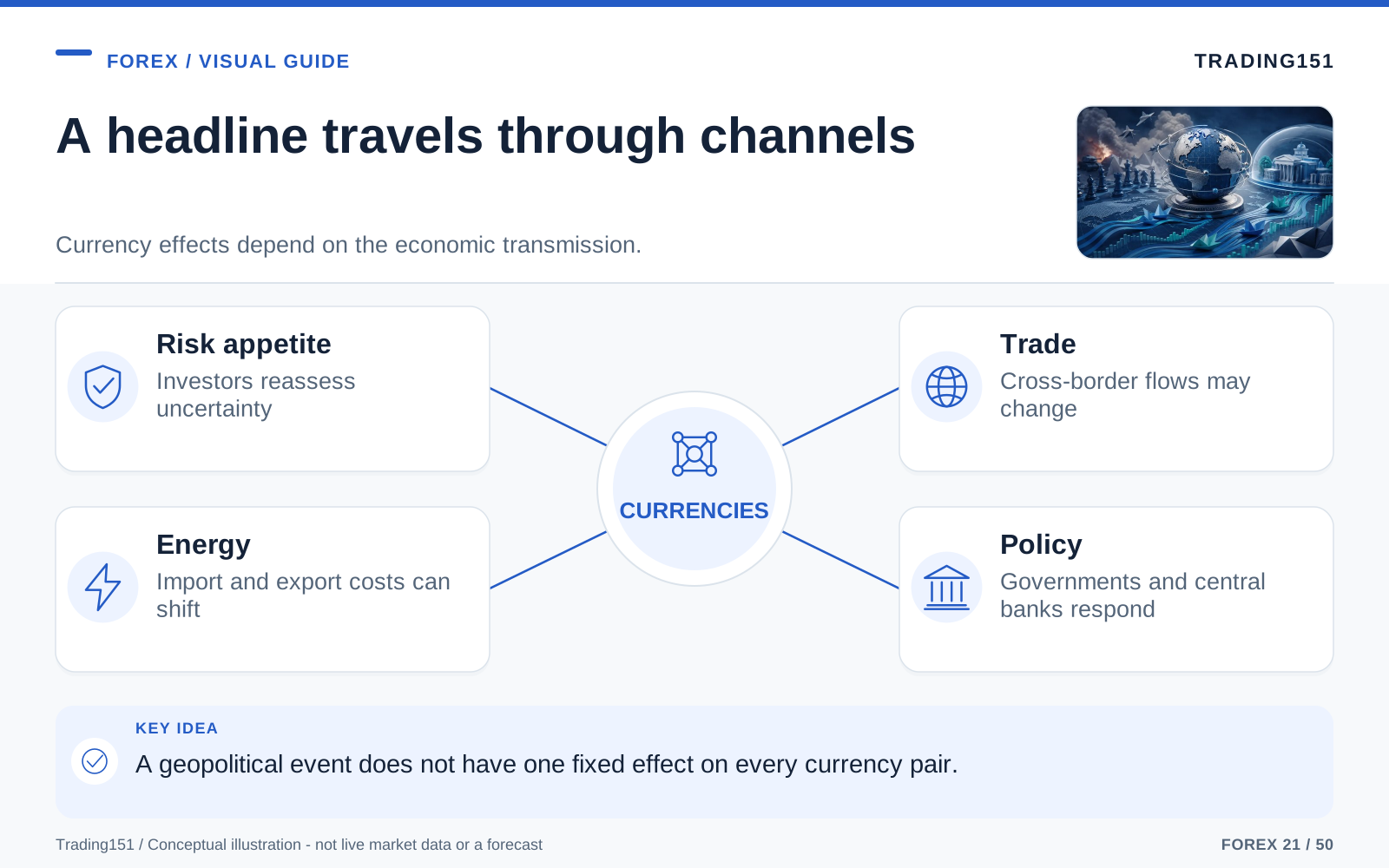
Read this diagram as text
- Risk appetite
- Investors reassess uncertainty
- Trade
- Cross-border flows may change
- Energy
- Import and export costs can shift
- Policy
- Governments and central banks respond
How Geopolitics Turns Into Price
It’s easy to say "politics moves currencies," but the real question is how. How does a diplomatic spat, an election, or a surprise sanction move the needle on a trading screen?
It happens through very specific pipelines: trade flows, energy supplies, capital controls, inflation outlooks, fiscal spending, and the likelihood of central bank intervention. It's much more helpful to pinpoint exactly which channel is being hit rather than chalking it up to vague "geopolitical risk." Naming the specific channel helps you figure out if a scary headline will change a country's cash flow, or if it's just dramatic noise that won't really impact the currencies you're trading.
Sometimes the connection is obvious. Sometimes it’s a slow burn. But it almost always finds its way into the price.
1. Trade Wars, Tariffs, and Broken Supply Chains
Trade policies can totally rewrite a currency's value in a matter of days because they change how goods, profits, and investments move around the globe. Tariffs drive up costs. Export bans break supply chains. Tit-for-tat trade wars leave everyone guessing who will suffer the most.
During a major trade spat, currencies act a lot like live scoreboards. If one country is heavily exposed to a new tariff, its currency usually takes a hit. If another country is holding all the leverage, its currency stays strong. But it’s a messy game. Markets also have to guess if a tariff will spark local inflation and force a central bank to step in. Forex pricing basically turns into a large, real-time debate over who will feel the pain first and who will ultimately blink.
And the fallout rarely stays contained to the two countries fighting. Because supply chains are completely globalized, a dispute between two giants can drag down the currencies of countries that export commodities, handle shipping, or manufacture the parts.
2. Central Bank Independence and Political Pressure
Currencies don't just reflect what an economy is doing today; they reflect what investors believe policymakers will do tomorrow. That’s why central banks are so important. When investors trust that a central bank is independent and disciplined, the currency thrives. The second that independence looks compromised, trust vanishes.
Ideally, central banks make choices based on hard data—inflation, jobs, and long-term stability. But politicians operate on a different clock. They might pressure the central bank for lower rates right before an election, or demand looser policies to artificially boost growth.
Once the market smells that a central bank is taking orders from politicians instead of economists, the currency can freefall. Investors panic about runaway inflation, capital flight, and the prospect of the adults leaving the room. It becomes a vicious cycle: the weaker the currency gets, the more inflation it imports, making the original problem even worse.
You can survive a bad jobs report. It's much harder to survive a market that no longer believes in the people running your economy.
3. Elections, Coalitions, and Sudden Political Turns
Markets love predictability. Even a boring, slow-growth status quo is usually preferred over a wild-card politician. Elections introduce the very real threat of abrupt change, and since currencies are always trying to price in the future, they are sensitive to the ballot box.
If an election looks like it will result in stable, market-friendly leadership, the local currency will usually hold its ground or drift higher. But if the race is a toss-up—or if a major candidate is promising to aggressively overhaul taxes, tear up trade deals, or nationalize industries—traders will start selling off that currency well before voting day.
This doesn’t mean the market always roots for one specific political ideology. What it really roots for is clarity. Vague fiscal plans, constitutional crises, or the threat of sudden policy reversals will spook investors every time. More often than not, the market isn't judging the politics; it's judging whether the country will remain governable.
4. War, Borders, and the Geography of Vulnerability
Geography matters a whole lot more than we sometimes like to admit. When bullets start flying, the currencies closest to the conflict—whether physically or economically—are the first to break. A war instantly messes with shipping routes, insurance premiums, food supplies, energy grids, and investor confidence.
Countries that rely heavily on imported oil or gas will watch their currencies slide if a conflict threatens global pipelines. Economies located near major shipping chokepoints get hammered by rising rapidly freight costs. The market asks severe, pragmatic questions: Who is going to run out of fuel? Who has to print money to fund a military draft? Whose investors are scrambling for the exits right now?
War also highlights an unavoidable truth in Forex: markets hate uncertainty, but they absolutely despise open-ended uncertainty. A quick, sharp shock can be digested. A grinding conflict with no end in sight and large spillover risks will drag a currency down for years.
5. Sanctions and the Weaponization of Finance
Today, geopolitics is fought with bank accounts as much as with tanks. Punishing a rival nation now involves freezing central bank reserves, blocking payment networks like SWIFT, and cutting off access to global capital. The actual plumbing of the financial system has become a primary weapon.
For currencies, this is a large deal. If a country gets locked out of global funding channels, its currency can collapse virtually overnight. Even if the government patches things up temporarily with extreme capital controls or forced currency conversions, the market treats that "stability" as an illusion.
Sanctions also leave a long, complicated legacy. They push rival nations to diversify their reserves, build shadow payment systems, and try to ditch dominant currencies like the Dollar. It doesn’t happen overnight, but these geopolitical chess moves slowly rewire the entire structure of the Forex market.
Case Studies: When Politics Repriced the Market Overnight
The best way to understand this is to look at times when the world changed abruptly, and the market violently repriced reality. These aren’t just fun history lessons—they are glaring reminders of how fast a currency can move when the political backdrop snaps.
The Brexit Shock (2016)
Right up until the final hours of the Brexit referendum, the prevailing wisdom in the market was that the UK would vote to stay in the European Union. Despite all the loud campaigning, investors bet that the status quo would win out. The British Pound was trading high, full of confidence.
Then the votes started rolling in.
As it became undeniably clear that "Leave" was going to win, the Pound fell off a cliff. It was a visceral moment where mass disbelief turned into real-time panic. The Pound wasn't crashing because British factories suddenly stopped working that night. It crashed because of the sheer scale of the unknown: disrupted trade deals, murky border laws, constitutional headaches, and years of guaranteed political friction.
Brexit proved that markets don't just price in pure economics. They price in national identity, governance, and a country's relationship with the rest of the world.
The Russia-Ukraine Conflict (2022)
When tanks rolled into Ukraine in 2022, the currency markets convulsed instantly. The Euro took a heavy hit because Europe was suddenly thrust into an energy crisis right on its doorstep. Industrial slowdowns and recession fears became impossible to ignore.
The Russian Ruble initially cratered under the weight of historic sanctions. The Russian government eventually propped it up with extreme capital controls, but the core lesson was obvious: you cannot evaluate a currency based on domestic data when that country is completely isolated from the global financial system.
Meanwhile, the US Dollar skyrocketed. This wasn't symbolic; it was mechanical. In a major geopolitical crisis, global money doesn't care about getting a good return. It just wants the deepest, safest vault it can find.
Emerging Markets Under Pressure
Emerging-market currencies are usually the first to feel the heat when the globe gets tense, mostly because they lack the deep financial buffers of wealthier nations. When global anxiety spikes, institutional money yanks capital out of these regions first. It isn’t fair, but it’s reality. A developing country can have a perfectly balanced budget and a booming economy, but if global investors decide it's time to reduce risk, its currency will still get punished.
This is why geopolitics matters to countries far outside the immediate blast radius. A squabble between two superpowers or a spike in crude oil can financially gut a smaller country that had absolutely nothing to do with the fight.
The Modern Twist: Headlines, Algorithms, and Speed
Political shocks have always moved markets, but the speed of the reaction has changed forever. We no longer wait for the morning paper. A headline hits the market in milliseconds, and the first responders aren't even human—they're algorithms.
If a newswire flashes a trigger word like "sanctions," "attack," "resignation," or "retaliation," automated trading bots will flood the market with orders before you’ve even read the first sentence. As a human retail trader, you are never going to win that footrace. Instead of trying to chase that large initial candlestick, your best bet is to wait for confirmation, verify the source, and see how the broader market is digesting the news.
This creates a weird, two-stage reality. First comes the machine reflex—instant, mechanical, and usually violently exaggerated. Then comes the human assessment. Analysts, traders, and policymakers step in to ask the real questions. Is this a big deal? Did the bots overreact? Does this realistically alter trade or inflation in the long run?
Sometimes the initial move sticks. Often, it reverses. But the gap between "news breaking" and "price moving" is virtually zero. Today, geopolitics isn't just about what happened—it’s about how fast the market thinks it understands what happened.
Why Some Currencies React More Than Others
Not all money is created equal when a crisis hits. How a currency reacts depends heavily on the engine running its economy.
Commodity-linked currencies (like the Canadian Dollar, Australian Dollar, and Norwegian Krone) are sensitive to supply chain shocks. If oil pipelines are threatened, the Canadian Dollar moves. If global trade tensions threaten raw material demand, the Australian Dollar feels the pain.
Trade-dependent economies are usually the first to bleed during diplomatic fights or tariff wars. The more a country relies on seamless global shipping, the more fragile its currency becomes when borders start closing.
Countries with large external debts are huge targets when the market goes into defense mode. If investors start worrying that a country won't be able to refinance its debt or get access to US Dollars, they will dump that currency fast.
Reserve-currency issuers, on the other hand, play by different rules. Their currencies often get stronger during a crisis because the world still desperately needs them to settle debts and buy essential goods. It's an incredible privilege during times of panic.
What This Means for Traders, Businesses, and Ordinary People
Geopolitics feels like a high-level academic subject right up until it hits your bank account. If you buy imported goods, pay overseas invoices, or travel internationally, it gets very real, very fast.
For traders, it’s a constant reminder that technical charts are never the whole story. A beautifully formed trendline will get obliterated in three seconds if a major political headline hits the wire. A quiet market can turn into a warzone if investors are forced to suddenly rethink the global landscape.
For businesses, exchange-rate risk is not a trivial side issue. A local manufacturer buying steel from abroad or a software agency paying developers in another country can watch their profit margins vanish because of a political spat on the other side of the planet. Hedging your currency exposure isn't just a fancy finance trick; it's basic business survival.
For investors, keeping all your money tied to one single currency is basically a large, unhedged political bet. Diversifying across different regions and currencies protects you when one specific government makes a terrible policy mistake.
For everyday households and travelers, currency fluctuations quietly dictate your purchasing power. Paying for college abroad, sending money to family back home, buying a new imported laptop, or taking a vacation all get noticeably cheaper or substantially expensive depending on who is arguing on the world stage.
How to Read Geopolitical Noise Without Overreacting
The trickiest part of trading the news is figuring out what matters. Not every political scandal shifts a currency. Not every angry speech becomes actual law. Not every dip in the market is the start of a new trend.
Before putting your money on the line, try building a mental "event tree." Ask yourself: is this outcome already expected? What specific development would change a country's trade flows or central bank policy? Which currencies are in the firing line, and what would it take to prove your initial theory wrong? Doing this turns a chaotic stream of alarming headlines into a focused set of testable scenarios. It also reminds you that when the range of possible outcomes is simply too wild, standing aside and doing nothing is a perfectly valid, deliberate choice.
If you're trying to filter the signal from the noise, start with these simple questions:
Does this event physically change trade flows? If yes, the currency will probably move.
Does it threaten access to oil, gas, or crucial commodities? Energy shocks ripple through currencies instantly.
Does it change what the central bank is going to do? The market obsesses over interest rates above almost everything else.
Does it destroy trust in the government? If investors think a country's institutions are falling apart, the financial damage will outlast the news cycle.
Is this a temporary freak-out or a permanent shift? Markets bounce back from drama quickly. They struggle immensely with permanent, structural uncertainty.
Mastering this means learning to sit on your hands when it's just political noise, and striking when a headline is going to rewire global money flows.
Translate the headline into an economic channel
Suppose a disruption raises the price of an imported energy source. For a country heavily dependent on that import, the immediate questions concern the trade bill, business costs, inflation, and the policy response. An exporting country may face a different mix of effects. The headline is the same; the economic exposure is not.
Separate a new fact from a repeated claim. A proposed sanction, an enacted measure, an exemption, and evidence of enforcement are different stages. Markets may react to each, but treating a proposal as a completed policy can produce a false account of what changed. Record the announcement date, effective date, and the source of the information.
Avoid assuming that a familiar safe-haven relationship will dominate every episode. Funding needs, domestic exposure to the shock, interest-rate expectations, and existing positions can alter the response. A currency can strengthen for reasons that coexist with serious economic risk in its own country.
A practical note can be short: the verified event, the likely transmission channels, the unresolved questions, and the scenarios that would contradict the first interpretation. That is more useful than attaching a confident narrative to every price move. When information is incomplete, reducing exposure or waiting is a legitimate response; the existence of an important event does not create an obligation to trade it.
Follow the economic channel
A geopolitical event can affect currencies through energy prices, trade, capital flows, fiscal spending, or demand for liquidity. Identify the channel rather than assuming that every alarming headline has the same market effect. The relevant exposure may differ greatly between an energy importer and exporter.
Also distinguish the immediate reaction from a lasting change in economic conditions. An initial move can reflect reduced liquidity or hedging rather than a settled view of the long-term consequences. A clear scenario states what would have to change in the economy for the currency argument to remain valid after the first headline has passed. 1, 2
Conclusion: The World in Your Wallet
The Forex market is much more than a casino for institutions and day traders. It is the clearest mirror we have for global confidence. It tells us exactly how investors view a country's stability, its competence, and its power. It converts diplomacy into hard numbers, turns conflict into volatility, and prices trust down to the decimal point.
This is why geopolitics is impossible to ignore. Currencies are more than just economic tools—they are a scorecard of global trust. When a nation looks competent and stable, its currency thrives. When it looks messy, exposed, or deeply divided, the market demands a discount.
We are living in an era where global friction is the main event, not background noise. Trade wars, real wars, weaponized sanctions, and fractured alliances are actively driving the markets. In Forex, volatility isn't a rare glitch in the system anymore; it is the system.
Whether you're a trader hunting for an edge, a business owner trying to protect your margins, or just a traveler wondering why your vacation suddenly got so expensive, you can't ignore the map. Politics and money are forever linked. The invisible hand moving your currency isn't invisible at all—it’s right there in the morning headlines, the closed-door meetings of governments, and the ever-shifting balance of global power.
Understanding this doesn't just make you better at reading charts—it makes you better at reading the world. But it also requires a healthy dose of humility. Real-time facts are often messy or incomplete, and official stories can change fast. Always keep your exposure small enough to survive unexpected market gaps, don't blindly assume a currency will act as a safe haven just because it did last time, and learn to tell the difference between a fleeting panic and a permanent economic shift. Remember: the breaking headline is just the start of your analysis, not the end of it.
Sources and further reading
- CFTC: Eight things to know before trading forex
- BIS: April 2025 FX turnover, September 2025 preliminary release
Editorial revision: 7 October 2026. Numerical scenarios are hypothetical unless identified as historical. References support the added explanations and selected corrections; rules and product terms should be checked again before acting.