
Spot forex, currency futures, and currency options offer different ways to take or manage exchange-rate exposure. They differ in contract terms, trading venue, margin, expiration, and the shape of possible gains and losses. Retail products described as spot forex may also be rolling leveraged contracts rather than an ordinary currency delivery. Start with the actual agreement offered by the provider, not only its product label.
1. Spot Forex: Fast, Flexible, and Always Moving
Spot Forex is usually everyone’s first stop. It’s the live, right-now market where you exchange one currency for another at whatever price is currently flashing on the screen. If you buy EUR/USD, you’re basically buying euros and dumping dollars at the going rate. For retail traders, this is an "over-the-counter" setup. You're dealing directly with a broker (or their network), which means things like pricing, margin rules, and account protections change depending on who you use. Because of that flexibility, you really have to do your homework to make sure your broker is legitimate, your money is safe, and you aren't getting gouged by hidden spreads.
Practically speaking, it’s the easiest place to start. You open an account, pick a currency pair, choose your trade size, and you’re in. You don’t have to stress about contracts expiring or confusing options math. That sheer simplicity is exactly why everybody flocks to it.
It also just makes visual sense. The quote is right in front of you. The chart ticks up and down. Your profit or loss updates instantly. If you just want to bet on price direction without overcomplicating things, Spot feels like home.
Why Spot Forex Attracts So Many Traders
- Low barrier to entry: You don't need a large bankroll. You can trade micro-lots to learn the ropes without blowing your life savings.
- Flexible position sizing: You aren’t forced to buy fixed contract sizes, which is a total lifesaver for managing risk on a smaller account.
- Open practically 24/5: The market follows the sun through global trading sessions, so you can usually find setups whether it's Tuesday morning or Thursday night.
- Large liquidity: Major pairs like EUR/USD or USD/JPY usually have tight spreads and deep liquidity, making it easy to get in and out.
- Dead simple to grasp: You buy, it goes up, you make money. It goes down, you lose. There's zero complex math required on day one.
What Traders Love About It
Spot is built for pure freedom. Whether you want to scalp for pennies, day trade, or hold a macro position for weeks, you can do it. You can risk a tiny fraction of a percent on a hunch, or scale into a big trade piece by piece. If you’re a tape-reader who loves reacting to live price action, Spot is your ultimate playground.
It’s also great if you're still figuring yourself out as a trader. Spot lets you experiment with different styles and timeframes without locking you into the rigid rules of standardized contracts.
Where Spot Forex Gets Dangerous
But the exact things that make Spot so great are what can get you into deep trouble.
First off, leverage is a beast. It makes a tiny account feel substantially powerful, which is exactly why beginners blow up. A trade that looks perfectly harmless on your screen might be dangerously large compared to your account balance. Before you know it, a normal market pullback turns into a panicked margin call.
Second, because it's a decentralized network, you aren't trading on a single public exchange. That means spreads, execution quality, and slippage can vary substantially. Sometimes, you might feel like you're fighting your broker just as much as you're fighting the market.
Finally, Spot is highly addictive. It’s so accessible that it's easy to overtrade. You tell yourself you’re just "staying engaged" with the market, but really, you're just clicking buttons because you're bored and the casino is open.
Spot Forex in One Sentence
Spot is the easiest and most flexible way to trade currencies, but it requires a severe amount of self-discipline.
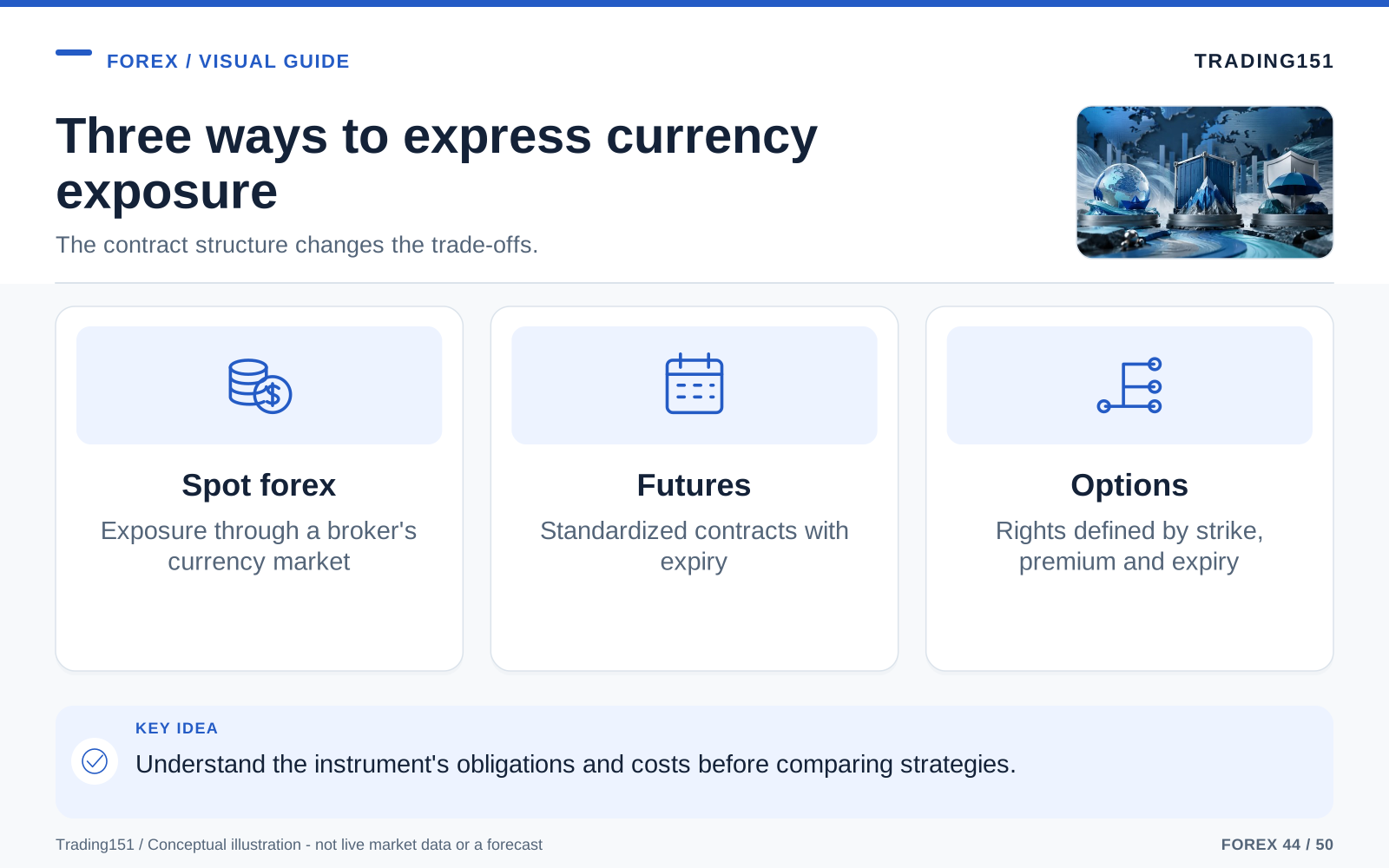
Read this diagram as text
- Spot forex
- Exposure through a broker's currency market
- Futures
- Standardized contracts with expiry
- Options
- Rights defined by strike, premium and expiry
2. Currency Futures: Structured, Transparent, and Less Forgiving of Sloppiness
Currency futures take the wild west of the currency market and force it into a highly regulated, standardized box. When you trade futures, you're buying or selling a specific contract that expires in a specific month. Because of interest rates and the time left until that expiration, the futures price might look a little different than the spot price. You also have to be careful when backtesting—when one contract expires and rolls over to the next, the chart can show an artificial price jump that never actually happened in real life.
But the biggest difference is that futures trade on a centralized public exchange. Everyone trades the same contract, with a set size, a fixed tick value, and a hard expiration date. Instead of messing around with custom lot sizes offered by a broker, you're playing in a structured arena.
This completely changes the vibe of your trading day.
Futures naturally attract traders who love structure. They want to see real, centralized trading volume. They want to know beyond a shadow of a doubt that the price on their screen is the same price every other trader in the world is seeing, not some tweaked version from a retail broker.
Why Futures Appeal to Serious Traders
- Centralized exchange: Everything goes through an official exchange, entirely cutting out the shady broker-network pricing.
- Real volume data: You can see exactly how many contracts are changing hands, which is mandatory if you trade based on order flow or volume profiles.
- Standardized rules: Tick values, contract sizes, and margin requirements are set in stone.
- Clear fees: Instead of paying for trades through invisible spreads, you usually pay flat, obvious commissions.
- Heavily regulated: Knowing the market is strictly monitored gives a lot of traders total peace of mind.
What Makes Futures Feel Different
Futures feel a lot more like a business. Before you even put a trade on, you have to think about margin requirements, tick values, rollover dates, and contract months. The market naturally forces you to slow down and act like a professional.
For a lot of people, this is a large psychological advantage. Something about trading a formal, structured instrument makes them naturally more disciplined. They manage their risk better, they keep tighter records, and they respect their setups more simply because the environment demands it.
The Downsides of Futures
The trade-off for all that structure is rigidity. You can’t fine-tune your position sizes like you can in Spot. Even with the introduction of micro contracts, you’re still bound by fixed multipliers, which can be tough to navigate on a smaller account.
Then there’s the expiration headache. Futures contracts eventually die. If you want to hold a long-term position, you have to manually close your trade in the expiring month and reopen it in the next one (called "rolling"). It’s just one more operational chore you have to stay on top of.
And don't forget: transparency doesn't magically equal profitability. Seeing real volume won't save you if your strategy is terrible or you trade on tilt. It just gives you clearer data while you lose money.
Futures in One Sentence
Futures offer a clean, professional, and transparent market, but they demand more capital, more planning, and strict respect for the rules.
3. Currency Options: Flexible Risk, Deeper Strategy, More Moving Parts
Now we're stepping away from simple directional bets and moving into pure strategy. With options, you aren't just guessing if the euro will go up or down. You’re betting on when it will move, how fast it will move, and how wild the price swings will be along the way. You can be 100% right about the market's direction and still lose money if it took too long to get there, or if you paid too much for the option upfront. Defined risk sounds amazing, but you really have to understand the math behind the premium before you jump in.
At its core, a currency option gives you the right (but not the obligation) to buy or sell a currency at a specific price before a certain date. That "no obligation" part is a guarantee—it completely rewires your risk profile.
When you buy an option, the absolute most you can lose is the money you paid for it (the premium). Period. You know your worst-case scenario before you even enter the trade.
That sounds like a cheat code, and in many ways it is. But options aren’t just a safer version of Spot trading wearing a nicer suit. They are an entirely different universe with their own set of physical laws.
What Makes Options So Powerful
- Hard-capped risk: If you're a buyer, your maximum loss is locked in from second one.
- Endless strategy: You can trade based on time, volatility, price direction, or a bizarre mix of all three.
- Great for hedging: You can use options like an insurance policy to protect your other open trades or investments.
- Creative freedom: You don’t have to just be "bullish" or "bearish." You can build a trade that profits if the market stays totally flat, or one that makes money if the market explodes in either direction.
Why Options Confuse So Many People
Because simply being right about the direction isn’t enough.
You can nail the trend perfectly, but if the market creeps there too slowly, or if volatility dries up, your option loses value and you walk away with a loss. New traders almost always underestimate this. Spot trading is checkers; options trading is 3D chess where you have to balance direction, time decay, and volatility all at once.
This is where "The Greeks" (Delta, Theta, Vega, Gamma) come in. They aren't just fancy financial jargon designed to make you feel stupid. They exist because options prices are being pulled in four different directions at once. Once it clicks, the Greeks act like a dashboard for your trade. Until then, it feels like trying to read a menu in a language you don't speak.
The Emotional Side of Options
Options are a weird psychological mixed bag. On one hand, they totally eliminate the fear of a catastrophic account blowout.
Because your risk is hard-capped, you can sleep soundly during major news events. A trader who knows they can only lose exactly $200 makes much better decisions than a trader sweating over an open-ended, highly leveraged Spot position.
On the other hand, they introduce a whole new kind of stress: the stress of overthinking. You constantly find yourself wondering why your option’s price is dropping. Is the market moving against me, or is time decay eating my premium? Did volatility crush my trade? The mental gymnastics can get exhausting.
Options in One Sentence
Options are incredible for capping your risk and getting creative with your strategies, but they will absolutely punish you if you don't take the time to learn the math.
Spot vs. Futures vs. Options: The Differences That Really Matter
Sure, they all give you currency exposure. But when the rubber meets the road, the differences drastically impact your daily trading routine.
1. Ease of Entry
Spot Forex takes the cake here. It’s beginner-friendly, the software is usually intuitive, and you can trade with pennies while you learn.
Futures are a step up in difficulty. You have to learn about contract specs, margins, and rollovers—not impossible, but it definitely adds friction.
Options have a severe learning curve. Clicking "buy" is easy, but managing the actual strategy behind the trade takes serious studying.
2. Transparency
Futures win hands down if you care about centralized pricing and seeing real, undeniable market volume.
Spot Forex has large liquidity, but because it's run through decentralized broker networks, you're always slightly in the dark on true global volume.
Options are transparent in their listed pricing, but you have to understand options pricing models to know if you're getting a good deal.
3. Flexibility
Spot Forex is the undisputed king of sizing flexibility. You can trade the exact fractional amount you want to.
Options offer the most strategic flexibility, letting you craft highly specific bets on how the market will behave.
Futures are rigid. You play by the exchange's rules and sizes, which is great for discipline but bad for fine-tuning a small account.
4. Risk Profile
Spot Forex is totally manageable, right up until you abuse your leverage and accidentally blow up your account on a random Tuesday.
Futures pack a heavy punch. The contract sizes are large, meaning a small move can swing your P&L substantially if you're undercapitalized.
Options are fantastic for defining your worst-case scenario upfront, as long as you can navigate the complexity of time decay.
5. Trading Personality Fit
- Spot: Perfect for action junkies, fast thinkers, and folks who love flexibility.
- Futures: Great for rule-followers who want structure, real data, and zero broker nonsense.
- Options: Best for the deep thinkers who prefer setting up clever scenarios rather than reacting to every chart tick.
The Costs Nobody Pays Enough Attention To
Everybody loves to obsess over the obvious stuff like spreads and commissions. Yes, you need to calculate your all-in costs: the spread, the exchange fees, the overnight financing, the slippage, and the option premium. And yes, you absolutely need to make sure the smallest trade size fits your account's risk management rules.
But there’s a large hidden cost that nobody talks about: the mental and financial drain of trading a market that triggers your worst habits.
If you lack impulse control, Spot Forex will bleed your wallet dry because it's too easy to click "buy" when you're bored. If you hate paperwork and logistics, Futures will drive you crazy with contract expirations. If you hate math and abstract thinking, buying Options is basically just setting money on fire.
The market is only half the battle. The other half is the version of you that shows up to trade it.
How to Choose the Right One for Your Style
Still on the fence? Here’s the easiest way to break it down.
Choose Spot Forex if...
- You’re starting out and just want to get a feel for price action and execution.
- Your account size is small and you need the freedom to trade in micro-lots.
- You want a straightforward, no-BS way to bet on currency direction.
- You’re a day trader or short-term swing trader who needs to move fast.
Choose Currency Futures if...
- You want completely centralized pricing and to see real trading volume.
- You thrive in a highly structured, professional environment.
- You don't mind keeping track of expiration cycles and strict margin requirements.
- You already have decent trading discipline and enough cash to handle the contract sizes.
Choose Currency Options if...
- Knowing your exact max loss before entering a trade helps you sleep at night.
- You want to hedge your portfolio or get creative with your market predictions.
- You enjoy digging into the math of how pricing and volatility work.
- You think in probabilities and "what-if" scenarios, rather than just "up or down."
Common Mistakes in Each Market
Spot Forex Mistakes
- Going crazy with leverage just because your broker lets you.
- Overtrading simply because the market is open 24 hours a day.
- Getting eaten alive by overnight rollover fees on trades you accidentally held for weeks.
- Picking a shady broker based on a flashy Instagram ad instead of checking their regulations.
Futures Mistakes
- Underestimating how much money a single contract controls and over-leveraging.
- Forgetting to roll over your contracts and getting caught in expiration weirdness.
- Thinking that just because the market is regulated, it’ll magically be easier to make money.
- Buying expensive order-flow software before you even know how to manage a basic trade.
Options Mistakes
- Buying options and watching them slowly bleed out to zero because you ignored time decay.
- Getting the direction right but still losing money because volatility dropped.
- Trying to trade crazy multi-leg strategies when you barely understand a basic put or call.
- Assuming that "capped risk" means you don't need any actual skill or timing.
The Case for a Hybrid Approach
Nobody says you have to pick one market and sign a blood oath to it forever.
A lot of veteran traders eventually mix and match. You might use Spot for your day trading because it’s fast and fluid, but buy Options to hedge a long-term economic view. Or you might do your heavy lifting in Futures for the clean data, but keep Spot charts open on your other monitor because that's what the rest of the retail world is reacting to.
Just don't mix them to sound smart at dinner parties. A hybrid approach only works if you have a very specific, logical reason for using each tool.
Use Spot for the sizing flexibility. Use Futures for the transparency. Use Options for the calculated, capped-risk plays.
Once you know exactly what each market is best at, blending them becomes a large advantage rather than a confusing mess.
So Which Path Is Yours?
Look, the honest truth is that the "best" market is simply the one that makes it easiest for you to stay disciplined.
It’s not the one with the fanciest jargon. It’s not the one the loudest guy on Twitter trades. And it's definitely not the one promising to turn your $500 account into a fortune by next Thursday.
The right market is the one that naturally aligns with how your brain works when the pressure is on.
If you’re adaptable, highly active, and just learning how charts work, Spot Forex is a fantastic starting line.
If you love rules, crave clean data, and hate the idea of trading against your own broker, Currency Futures will be a breath of fresh air.
If you’re a strategic thinker who loves defining risk and doesn't mind studying some math, Currency Options offer a playground the other two simply can't touch.
Compare the exact contract, not the market's general reputation
Ask what happens after the trade. Is currency delivered, is the position rolled, or is it a cash-settled contract? Does it expire on a fixed date? What funding or rollover charge applies? These questions determine whether the product matches a planned payment, a short-term trade, or a longer-term hedge.
Futures use standardized contract terms and exchange-based processes, but the position still requires margin and can generate additional cash demands as it is marked to market. Contract size and expiration can make a precise hedge difficult for a small or irregular exposure. Closing one contract and opening another also introduces a roll transaction rather than extending the original position for free.
An option buyer pays for a defined contractual right, while an option seller takes on the corresponding obligation under the contract. The premium and expiration matter even if the directional view proves correct. An option can lose value because the move is too small, too late, or accompanied by a change in implied volatility.
Compare examples using the same underlying exposure, holding period, and adverse scenario. Include commissions, spread, financing, premium, and the cash needed to maintain the position. A product with a small initial outlay can have a large economic exposure. The most suitable structure is the one whose mechanics fit the purpose and whose risks can be funded, not necessarily the one that looks cheapest to enter.
Match the product to the intended exposure
A currency purchase, a rolling spot contract, a forward, an option, and an exchange-traded future can all involve exchange rates while creating different rights and obligations. Compare settlement, expiry, financing, margin, and counterparty arrangements before choosing one.
The smallest quoted spread may not identify the lowest total cost. A position held for weeks can be affected by recurring financing charges, while a dated contract may require a roll. An option adds a premium and a defined set of exercise terms. Start with the exposure and holding period, then select a product whose mechanics you can explain without relying on the platform's marketing label. 1, 2, 3
Final Thoughts: Match the Instrument to the Trader
Traders love arguing over which market is universally superior. It’s a completely pointless argument.
An liquid, profitable market can still be terrible for you. Spot is amazing for a disciplined day trader, but an absolute nightmare for someone with a gambling streak. Futures are a dream for the methodical planner, but way too stiff for someone who needs to micro-manage their lot sizes. Options are a superpower for a strategist, but a quick way to go broke if you just want instant gratification.
Stop asking which market is "best." Start asking: Which market helps me make better decisions, more consistently, with less unnecessary stress?
You have to find the setup that matches your risk tolerance and personality.
Open a demo account and try all three. Don't just pay attention to whether you make or lose fake money—pay attention to how you feel. Do Futures make you feel structured? Does Spot make you anxious and impulsive? Does watching an Option's time decay drive you insane? That kind of self-awareness will save you more money than any trading book ever could.
Because successful trading isn't just about reading the tape. It's about reading yourself.
Find the arena that lets you think clearly, handle your losses and survive long enough to get good at this. Let the instrument serve your strategy, not the other way around. Spot is there when you need agility, Futures are there when you need order, and Options are there when you need calculated leverage. Learn the nuts and bolts of one market completely before you start dipping your toes into the others. And if you eventually combine them, do it because it makes sense for your bottom line.
Sources and further reading
- BIS: April 2025 FX turnover, September 2025 preliminary release
- CME Group: Futures Expiration and Settlement
- Options Industry Council: Options Basics
Editorial revision: 7 October 2026. Numerical scenarios are hypothetical unless identified as historical. References support the added explanations and selected corrections; rules and product terms should be checked again before acting.