
Forex arbitrage seeks to exploit inconsistencies between related prices, but a theoretical discrepancy is not the same as an executable profit. Spreads, timing, funding, and incomplete fills can remove the apparent gain. Statistical relative-value trades introduce another distinction: expecting prices to converge is a risky forecast, not a locked-in arbitrage merely because the strategy uses that name.
What Exactly Is Forex Arbitrage?
At its core, arbitrage is just buying and selling the same (or highly related) asset in different places to pocket the difference in price. The whole trick is that this price gap exists right this second, and you have to lock it in before the market catches on and corrects itself.
Think of it like walking through an airport. One currency exchange booth is selling euros for a bargain, while another booth right around the corner is buying them for slightly more. If the price difference is big enough to cover your transaction fees, you could just buy at the first booth, walk over to the second, and make an instant profit. That’s pure arbitrage.
Forex is ripe for this because it’s a totally decentralized market. There isn’t one big central exchange broadcasting a single, unchangeable price to everyone. Instead, prices are spit out by a large, tangled web of banks, brokers, hedge funds, and liquidity providers. Usually, they all stay perfectly in sync. But because they run on different systems all over the globe, tiny pricing gaps occasionally pop up.
These gaps don't hang around. In highly liquid markets, they disappear in milliseconds. Still, that tiny window is all a specialized automated system needs to jump in and grab the cash.
There’s a large catch, though. People love throwing around the term risk-free, but that really only applies in a vacuum. In the real world, you've got execution delays, slippage, rejected orders, wide spreads, and commissions. A trade that looks perfect on your screen can easily turn into a loss by the time the order fills. The pricing math might be risk-free, but the trade execution definitely isn't.
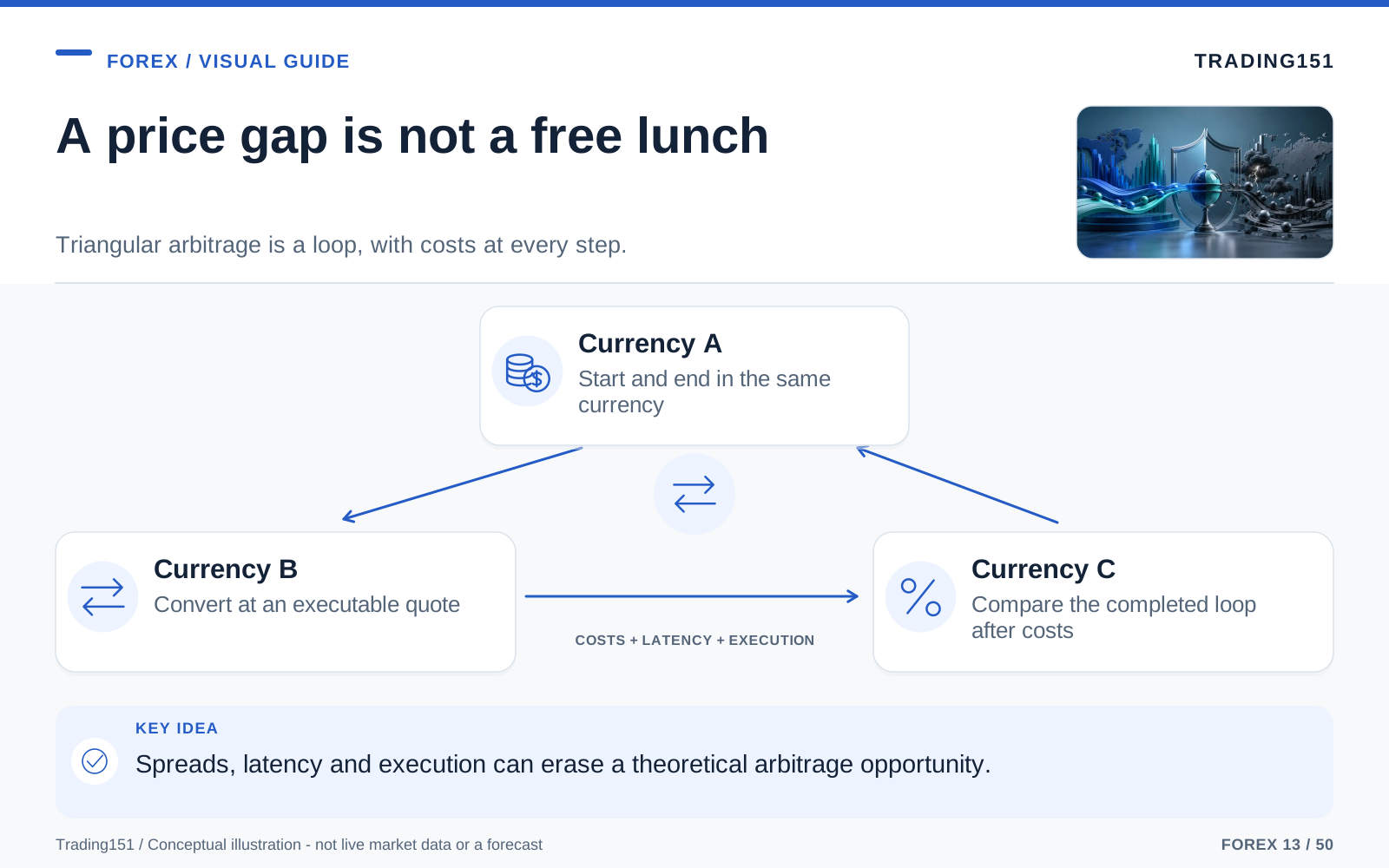
Read this diagram as text
- Currency A
- Start and end in the same currency
- Currency B
- Convert at an executable quote
- Currency C
- Compare the completed loop after costs
Why Arbitrage Exists in Forex at All
You’d think in a market moving trillions of dollars a day, obvious pricing mistakes wouldn't survive for a second. Shouldn’t severe competition wipe out these glitches instantly?
Most of the time, it does. But markets are driven by technology, and technology isn't perfect.
Prices get out of whack for all sorts of reasons. One data feed might update a millisecond slower than another. A large influx of orders might temporarily overwhelm one specific broker. Or, during a crazy news event, the normal math linking different currency pairs might just break for a split second. Whether the market is volatile or dead quiet, these little cracks appear simply because it's impossible to keep a global system perfectly synchronized 100% of the time.
Arbitrage traders aren't just greedy opportunists, either. They perform a vital function. When a quote is mispriced, they swarm it. All that buying and selling pressure forces the rogue price back in line with the rest of the market. In a weird way, arbitrage is exactly what keeps the market efficient.
1. Triangular Arbitrage: The Classic Currency Loop
Triangular arbitrage is probably the most famous type of Forex arbitrage, and it beautifully highlights how currencies are connected. Instead of just looking at one pair across two brokers, you’re looking at the mathematical relationship between three different pairs. The math might spot a flaw, but you have to trade all three legs before the prices blink. If one order goes through and the others fail, you aren't arbitraging anymore—you're just exposed to the market. Big institutions avoid this disaster by using ultra-fast tech and coordinated execution. So while doing the math on a spreadsheet is easy, executing three separate trades perfectly is a completely different beast.
How It Works
If you know the price of EUR/USD and GBP/USD, you can easily calculate exactly what EUR/GBP should be. That calculated number is called the cross rate. In a normal, efficient market, the actual price of EUR/GBP will match your math almost perfectly.
But every once in a while, for a fraction of a second, it doesn't.
Let’s say the actual EUR/GBP price is lagging behind what the other two pairs imply. You can run your money through a three-step loop, and end up with slightly more cash than you started with.
The Strategy in Action:
- Start with USD: You begin with $10,000.
- Trade 1: You sell that USD to buy EUR (via the EUR/USD pair).
- Trade 2: You trade those EUR for GBP (via EUR/GBP).
- Trade 3: You convert the GBP back into USD (via GBP/USD).
If the market was misaligned just enough, you might finish that loop with $10,012 or $10,018 instead of your original $10,000. It’s a tiny profit, sure. But if an algorithm can repeat that loop systematically all day long, those pennies add up fast.
Why It Makes Sense Mathematically
This works because currency pairs are glued together. EUR/USD, GBP/USD, and EUR/GBP can’t just go off and do their own things for long. When they do, the market is essentially making a math error. Traders spot it, trade the imbalance, and naturally force all three rates back where they belong.
Triangular arbitrage isn't about predicting market direction. It's about punishing the market for bad arithmetic.
The Reality Check
The romantic idea of pulling this off from your laptop fades quickly when you look at the required speed. Back in the day, a human clicking a mouse might have stood a chance. Those days are gone. Now, large trading firms deploy high-frequency algorithms that monitor these cross rates 24/7. When a gap opens, they attack it in microseconds.
For the average retail trader, understanding the strategy isn't the hurdle. The problem is being fast enough, well-connected enough, and having low enough fees to make a profit. Usually, by the time your charting software even renders the mispricing, a supercomputer has already eaten it.
2. Latency Arbitrage: Profiting From Delay
Latency arbitrage doesn’t care about currencies; it only cares about speed. It exploits a very basic reality: not all brokers and data feeds update at the same millisecond. But a stale quote isn't a guaranteed payday. Brokers hate this strategy and will actively reject orders, adjust prices, or ban your account entirely if their terms prohibit latency trading. Even if they don't, the time it takes your internet connection to send the order can easily eat up the delay you were trying to exploit. If you want to try this, you need to deeply understand both your network setup and your broker's rulebook.
How It Works
A trader watches a blazing-fast, institutional-grade price feed. On another monitor, they watch a retail broker whose prices are dragging behind by a fraction of a second.
When the fast feed suddenly spikes, the trader checks the slow broker. If the slow broker hasn't updated yet, the trader smashes the buy button at the old, stale price. There's no market analysis here—you're just looking into the future because your broker is stuck in the past.
A More Intuitive Way to Think About It
Imagine you and a friend are watching a live football match on different screens. You’re watching a live satellite feed, and they’re streaming it on an app with a 5-second delay. When you see a goal scored, you could easily bet your friend on the outcome of the play before they see it happen. You aren't a sports genius; you just have the information first.
That’s latency arbitrage in a nutshell. It feels a bit like cheating, which is exactly why brokers fight it tooth and nail.
Why Brokers Push Back
From a broker’s point of view, latency arbitrage is a losing game. If they keep filling orders at old prices, they take a direct financial hit—especially if they are market makers taking the other side of your trades.
Because of this, nearly all retail brokers outright ban latency trading in their fine print. If they suspect you're doing it, they might intentionally delay your executions, hit you with large slippage, requote your orders, or just shut down your account.
The Practical Problem
Even if you do spot a lagging price, turning it into actual cash is remarkably hard. You might get a requote. The price might jump the second you hit "buy." And if you somehow pull it off consistently, your broker's risk team will flag you almost immediately.
So, does latency arbitrage exist? Yes. Can you do it consistently on a standard retail account without getting booted? Probably not.
3. Broker-to-Broker Arbitrage: Exploiting Quote Differences Across Platforms
Broker-to-broker arbitrage is essentially the cousin of latency arbitrage, but slightly broader. Instead of comparing one fast feed to one slow broker, you're pitting two different brokers against each other, looking for moments when their prices disagree.
How It Works
Let’s say Broker A has EUR/USD priced at 1.08505, and Broker B has it at 1.08515. That’s a 1-pip difference. You could theoretically buy from Broker A and simultaneously sell on Broker B, locking in a profit when the two prices eventually meet in the middle.
It sounds dead simple. But in a live market, things get messy fast.
- You need cash everywhere: You can’t instantly wire money between brokers, so you need fully funded accounts on both sides.
- Execution has to be simultaneous: If your buy order fills but your sell order doesn't, you aren't arbitraging anymore. You're just taking a naked risk on the market.
- The spread is a killer: The price gap has to be big enough to pay for the bid/ask spreads at both brokers, plus any commissions.
- Prices can move before you fill: The gap you see on your screen might vanish in the split second it takes to process your clicks.
Why Retail Traders Often Underestimate the Friction
This strategy gets sold as an easy "buy low here, sell high there" trick. But retail platforms aren't built for seamless cross-exchange trading. They are entirely separate ecosystems with different liquidity, different latency, and different rules. A spread that looks unusually profitable on a chart can be absolutely worthless once you factor in the real-world costs of getting the trade done.
That’s why a lot of "perfect" arbitrage setups fall apart when you remember to factor in the boring stuff: commissions, swap rates, slippage, and execution delays during fast markets.
4. Covered Interest Arbitrage: The Institutional Version
Covered interest arbitrage is a heavy-duty, structural approach. It isn't about exploiting a glitchy server; it’s about the intricate math connecting global interest rates, spot exchange rates, and forward exchange rates. To do this, you have to look at actual borrowing costs, not just the base rate set by a central bank. Credit scores, balance sheet rules, collateral, and access to corporate forward markets all come into play. Sometimes a gap exists purely because one specific bank has funding limits that others don't. So, while you might see "free profit" on a spreadsheet, it might only be accessible to a large financial institution.
How It Works
Countries have different interest rates. If you can earn more interest holding US Dollars than holding Euros, you naturally want to hold Dollars. But here’s the problem: what if the Dollar drops in value against the Euro while you're holding it? That exchange rate risk could wipe out your interest advantage entirely.
Covered interest arbitrage solves that problem by combining two transactions:
- Buying the higher-yielding currency right now in the spot market.
- Locking in a guaranteed future exchange rate using a forward contract.
The magic word here is covered. You've completely removed the risk of the currency moving against you. The trade is purely designed to exploit a mismatch between global interest rates and forward contracts, without making a directional bet on the currency.
What the Trader Is Really Looking For
Usually, the forward rate adjusts perfectly to cancel out the interest rate difference. When it fails to do that, a temporary arbitrage window opens. Big banks will borrow money where it's cheap, lend it where it pays more, and use forward contracts to guarantee a risk-free round trip.
Institutional desks monitor this so closely that any mispricing is usually ironed out instantly. But the concept is crucial because it’s the invisible glue holding currency and money markets together.
Why Retail Traders Rarely Use It
You won't see retail traders doing this. It requires access to commercial forward contracts, large piles of capital, and interbank borrowing rates that regular people simply can't get. It’s hard to pull off in the pure, textbook sense without an institutional setup.
Still, understanding it is worthwhile—it proves that arbitrage isn't always a hyper-fast video game. Sometimes, it’s just the financial system forcing everything to stay balanced.
5. Statistical Arbitrage: When “Almost Arbitrage” Replaces Certainty
Statistical arbitrage, or "StatArb," is a bit of an outlier. It uses the word arbitrage, but it’s absolutely not risk-free. Instead of looking for a mathematical certainty, it bets that two things that normally move together will eventually snap back to their historical average.
How It Works
You look for two currency pairs that are tightly correlated. Take AUD/USD and NZD/USD, for example. Australia and New Zealand have deeply connected economies, so their currencies usually dance to the same beat.
But what if one pair suddenly spikes while the other tanks? A StatArb trader looks at that wide gap and decides it's totally unjustified. They will then:
- Sell the pair that shot up too high.
- Buy the pair that got left behind.
The goal is simple: wait for the historical relationship to re-establish itself and close the gap, bagging a profit as they converge.
Why Traders Like It
Unlike trying to beat a broker’s server by a microsecond, StatArb gives you time to breathe. These trades can play out over minutes, hours, or even days. That makes it appealing to quantitative traders who can crunch data but don't have multimillion-dollar fiber-optic setups.
The Catch
The downside is large: historical data is not a promise. Correlations snap. What goes up does not always come down. A central bank surprise, a trade war, or a geopolitical crisis can permanently sever the link between two currencies.
StatArb can be elegant and lucrative, but don't kid yourself into thinking it's true arbitrage. It's an educated, data-driven gamble.
The Hidden Costs That Destroy Arbitrage Trades
This is the part almost everyone skips, and ironically, it’s the only part that really matters. You have to calculate the cost of every leg of the trade, assuming the worst possible market conditions. Bid-ask spreads, commissions, conversion fees, overnight financing, and getting only half your order filled will destroy your margins. When your profit target is microscopic, you need to track exactly what price you got, not what price was flashing on the screen. If your master plan only works when you assume zero fees and perfect fills, you don't have a strategy—you have a pipe dream.
On a spreadsheet, arbitrage looks flawless. In a live account, the friction of trading is usually enough to bleed it dry.
1. Spreads and Commissions
We are usually talking about profits measured in fractions of a pip. If you expect to make 0.4 pips, but paying the spread costs you 0.8 pips, you’re dead in the water. Throw a broker commission on top of that, and the math becomes severe.
This is why big institutions dominate. They trade with tight spreads and microscopic commissions that retail traders simply can't access.
2. Slippage
Arbitrage demands surgical precision. You need the exact price gap you saw on your screen. If one of your trades slips by even half a pip, your profit is gone. And during fast, volatile markets—which is exactly when arbitrage opportunities appear—slippage is practically guaranteed.
3. Rejected Orders and Partial Fills
Nothing is scarier than executing a multi-leg arbitrage play, getting one order filled, and having the other rejected. Suddenly, your perfectly hedged, risk-free trade is just a naked, highly leveraged bet on market direction.
4. Swap, Financing, and Platform Rules
Some strategies look great over a few days until the broker hits you with overnight swap fees. Other times, you'll fall victim to platform rules. Many brokers use "last-look" execution policies, mandate minimum times you have to hold a trade, or bury clauses that let them void trades they consider abusive.
5. Infrastructure Costs
Doing this seriously requires heavy tech. You’re going to need a low-latency virtual private server (VPS), direct API integration, and custom software to sniff out gaps and fire off trades instantly. By the time you pay for all of that, the overhead costs might be larger than any profits you squeeze out.
Why the Market Closes Arbitrage Opportunities So Fast
Arbitrage opportunities vanish quickly because the act of trading them destroys them.
If EUR/GBP is priced too low compared to EUR/USD and GBP/USD, every algorithm on earth buys EUR/GBP. That large wave of buying instantly pushes the price back up to where it belongs. If a broker's feed is lagging, traders hammering the old price force the broker to update their tech or widen their spreads. If the forward market drifts out of line, big banks step in and force it back.
This self-correcting behavior is the backbone of financial markets. Arbitrage isn't a permanent crack in the foundation; it's the actual repair crew fixing the crack.
That’s why the competition is so fierce. When large capital, blazing speed, and supercomputers are hunting for the same inefficiency, it barely survives a millisecond.
Who Wins at Arbitrage Today?
The cleanest, easiest arbitrage trades are scooped up by large firms with serious hardware. We’re talking about:
- High-frequency trading (HFT) firms with servers parked directly next to the exchange.
- Major banks and institutional desks that have direct market access.
- Quant funds running complex automated cross-market models.
- Liquidity providers who essentially control the plumbing of the market.
These players get better prices, pay lower fees, and execute faster than we can even blink. They aren't just playing the game better; they are playing a completely different sport.
Does that mean an everyday trader has zero chance? No. But it means the opportunities you can find are going to be weird, niche, and a lot less glamorous than the fantasy of printing free money.
Is Arbitrage Still Possible for the Individual Trader?
The short answer is yes, but definitely not how you think.
The classic dream—downloading a bot, connecting it to your broker, and sleeping while it harvests risk-free profits—is basically dead in liquid mainstream FX markets.
However, there are still a few rough edges where a savvy individual trader can find an edge.
1. Less Efficient Markets
Heavyweights relentlessly police major pairs like EUR/USD. But if you look at exotic or highly illiquid pairs, you might spot larger pricing gaps simply because the big players aren't arbitraging them as aggressively. You’ll still have to fight terrible spreads and bad fills, but the gaps do exist.
2. Statistical and Relative-Value Approaches
A lot of independent traders who claim to be doing "arbitrage" are just doing relative-value trading. They look for weird dislocations in correlated assets and bet on them reverting to normal. It’s not risk-free, but it’s a lot more realistic than trying to outrun a Wall Street server on pure speed.
3. Cross-Market Opportunities Outside Traditional FX
Some traders look outside of spot Forex entirely. They hunt for inefficiencies between crypto exchanges, CFDs, or futures markets. These spaces can be heavily fragmented, which creates mispricing. Just be careful—you’re trading market risk for counterparty risk, withdrawal freezes, and sketchy exchange rules.
4. Arbitrage as a Lens, Not Just a Strategy
The biggest benefit of studying arbitrage is just understanding how markets breathe. It forces you to respect how prices connect, why trading costs are lethal, and how fast execution quality matters. Even if you never take an arbitrage trade, looking at the market through that lens makes you a much sharper, more disciplined trader.
The Ethical Debate: Is Arbitrage “Real Trading”?
You’d be surprised how often traders argue about this. Purists love arbitrage because it’s sharply logical—no emotions, no guessing, just pure math. Traditional traders often mock it, calling it a sterile, robotic game that requires zero market intuition.
But that criticism kind of misses the point.
Arbitrage might not look like classic directional trading, but the market desperately needs it. It forces prices to align across the globe. It stops a currency from having substantially different values depending on which broker you log into. Arbitrageurs aren't hacking the market; they are the mechanics keeping the engine running smoothly.
It also takes a completely different kind of mental toughness. A good arbitrageur isn't looking for the thrill of a big breakout. They are obsessing over ping times, server latency, slippage metrics, and risk management. It’s much closer to software engineering than day trading.
The Mindset Required to Pursue Arbitrage
Most people who try arbitrage eventually realize they got into it for the wrong reasons.
If you're chasing the phrase "risk-free profit," you are going to get crushed. Real arbitrage is a grind. It’s tedious, hyper-technical, and frankly, kind of boring. You need to be skeptical and patient. You have to assume every trade setup is a mirage until you've factored in every possible cost. You have to actively try to break your own trading system before a live market does it for you.
That means asking the hard, unromantic questions:
- What is my actual net profit after every fee?
- How often will both of my orders get filled?
- What is my escape plan if the broker freezes the trade?
- How fast will this blow up during a volatile news event?
- What hidden assumption is this strategy relying on that might change tomorrow?
Those aren't the questions of someone looking for a get-rich-quick scheme. They are the questions of someone building a machine sturdy enough to survive the severe reality of live markets.
Use executable prices for every leg
A triangular comparison must use the side of each quote available for the trade. Starting with dollars, buying euros normally requires paying the EUR/USD ask. Selling those euros for pounds uses the EUR/GBP bid. Selling the pounds back for dollars uses the GBP/USD bid. Comparing only midpoint exchange rates ignores the spread paid along the route.
For an illustrative loop, begin with $10,000 and a EUR/USD ask of 1.1002. That buys roughly EUR 9,089.26. At a EUR/GBP bid of 0.8600, it becomes about GBP 7,816.76. At a GBP/USD bid of 1.2790, the result is about $9,997.63, before commissions. Quotes that look consistent enough to promise a small gain can instead produce a loss once the tradable sides are used.
Execution adds another hurdle. The first leg may fill while a later quote disappears or the final trade is rejected. The trader is then left with an exposed currency position rather than a completed loop. Capital and margin may also be needed at more than one venue before the trades begin.
The right question is therefore not whether a spreadsheet shows a price inconsistency. It is whether all legs can be completed at the required sizes and prices, after every cost and under the applicable terms. Without that, the apparent arbitrage is a research observation, not an available return.
The opportunity has to survive execution
An apparent price discrepancy is not a realized arbitrage profit until the required trades can be completed at the assumed sizes and prices. Quotes can change, one leg can be rejected, and balances may sit in the wrong currency or venue. Include those constraints before treating a calculation as executable. The residual position after a failed leg can turn a small theoretical edge into an ordinary directional risk. 1
A Few Closing Thoughts
Forex arbitrage sits right at the fascinating crossroads of finance, high-level math, and technology. From a distance, it looks like trading in its most perfect form: no predicting the future, no chart reading, just cold, hard price relationships that either line up or don't. But when you zoom in on a real chart, you realize the whole game is dictated by who has the fastest internet, the lowest fees, and the best tech. That’s exactly why the idea is so tempting, and the execution is so difficult.
The old fantasy of effortlessly printing risk-free money was always a bit of a fairy tale. Real opportunities pop up, but they live in narrow windows and demand absolute perfection. Today, the easiest gaps are picked clean before your charting software even registers them. The few scraps that are left require custom software, flawless execution, and a deep understanding of where the hidden risks lie.
But the concept of arbitrage is still important. It’s the reason global markets stay balanced. It proves how intertwined everything is. And most importantly, it reminds us of a harsh truth in trading: if there is ever free money just sitting on the floor, someone faster is probably already bending down to pick it up.
That’s the real takeaway here. The market doesn't hand out free lunches. Inefficiencies are brief, and the winner is simply whoever spots the gap and pulls the trigger fastest. Learning to think like an arbitrageur trains you to analyze trading costs, question how prices relate, and spot market friction. For most of us, adopting that hyper-analytical mindset is a lot more valuable than hunting for a mythical risk-free trade. Just remember: whenever someone pitches you a "risk-free" strategy, look very closely at the execution risks, counterparty dangers, and legal red tape they casually forgot to mention.
Sources and further reading
Editorial revision: 7 October 2026. Numerical scenarios are hypothetical unless identified as historical. References support the added explanations and selected corrections; rules and product terms should be checked again before acting.