
Quantitative forex strategies turn an idea into rules that can be expressed, tested, and executed consistently. Their strength is not that mathematics makes the market predictable. It is that assumptions can be made explicit and results examined systematically. The main hazards include poor data, repeated searching for a flattering result, and an implementation whose costs differ from the model.
From Art to Science: Why the Quant Shift Happened
If you want to know why quant strategies took over modern Forex, you have to accept a slightly uncomfortable truth: humans are naturally terrible at trading. We don't handle winning and losing rationally. A loss hurts way more than an equal gain feels good. We get FOMO and chase price moves after they’re basically over. We hold onto losing trades because admitting we were wrong stings the ego. Then there’s fatigue. Boredom. Fear. None of these psychological traps magically vanish just because you bought a Bloomberg terminal.
Forex amplifies all those human flaws. The market never sleeps from Monday morning in Wellington to Friday evening in New York. A sudden headline out of Tokyo can trigger chaos in London, and a single remark from a politician in Washington can flip the script in seconds. The sheer volume of incoming information is dizzying. Even the most seasoned, cool-headed trader is going to miss things—or worse, overreact to noise that doesn't matter.
Quant trading was born out of this chaos. The premise is simple: take a theory about the market, turn it into strict rules, and see if those rules hold up under fire. If you think, “Currencies always trend hard after a surprise interest rate hike,” a quant will ask for the receipts. How often does that happen? Under what conditions? Over what time frame? And how much money would you lose along the way? The romance of "trusting your gut" gets replaced by cold, hard evidence.
There’s something really freeing about that. A well-built algorithm doesn’t care if its last trade was a winner or a loser. It doesn't revenge-trade or feel arrogant. If the rules say buy, it buys. If the rules say bail, it bails. That level of ruthless consistency is almost impossible for a human to maintain, especially after a severe week of losses.
That said, treating trading like a pure science is a bit of a stretch. Markets aren't predictable physics equations. They are messy, living ecosystems driven by human panic, greed, and incomplete data. The "science" of quant trading isn't about predicting the future with absolute accuracy. Good quants know they are playing a game of probabilities, not certainties. The goal is simply to build a system that works well enough, and often enough, to survive and grow your account over the long haul.
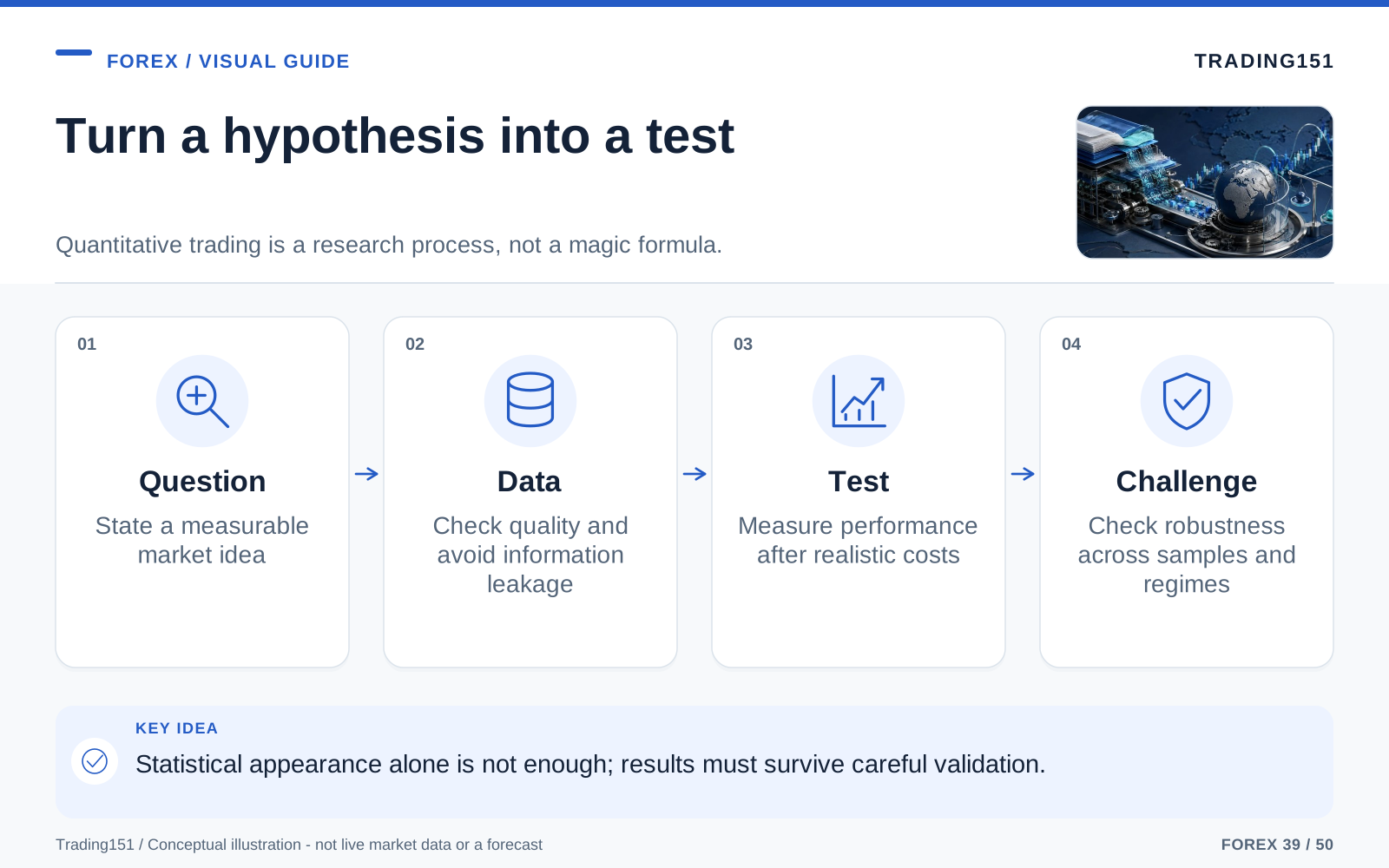
Read this diagram as text
- Question
- State a measurable market idea
- Data
- Check quality and avoid information leakage
- Test
- Measure performance after realistic costs
- Challenge
- Check robustness across samples and regimes
Why Forex Is So Well Suited to Quantitative Strategies
Not all financial markets play nice with algorithms, but Forex has a few unique quirks that make it a quant’s playground.
First off, the liquidity is insane. Major pairs like EUR/USD or USD/JPY trade in large volumes, meaning there is almost always a deep pool of buyers and sellers. This is a huge deal for quantitative models. High liquidity means you can accurately estimate your trading costs and get your orders filled without large price jumps. After all, a brilliant strategy is totally useless if you can't get in and out of the market at the price you want.
Second, the currency market is deeply tied to global macroeconomics. Things like interest rate gaps, inflation data, trade deficits, and central bank policies drive currency prices in complex—but not entirely random—ways. This gives quants plenty of juicy data to model. While some systems just look at short-term price blips, the really fascinating ones live right where raw market data meets global economics.
Third, currencies don't exist in a vacuum; they are endlessly intertwined. Mathematical models thrive on these correlations. A quant isn’t just staring at the Euro by itself. They’re analyzing how EUR/USD shifts when German bond yields change, or how the Aussie dollar reacts to a spike in gold prices. Forex isn't just a list of prices; it’s a large, interconnected web of signals.
Finally, because Forex is a continuous, global machine, it generates a staggering amount of data. And quants eat data for breakfast. The more historical observations you have, the easier it is to backtest ideas and figure out if a pattern is an actual edge—or just a random fluke masquerading as a brilliant insight.
The Basic Anatomy of a Quant Strategy
People tend to think quant strategies are incomprehensibly complex, but most of them rely on a surprisingly straightforward structure. Think of it like a three-part machine. And it all starts with a solid, testable hypothesis—not just blindly mining thousands of indicators until you find a chart that looks pretty. You have to clearly define what market behavior you're targeting, why it happens, and exactly how you'll execute it. Having a logical economic reason for why a trade should work makes it a lot easier to fix the model when things inevitably go off the rails.
- Data: The raw ingredients. This could be anything from historical price ticks and volume to central bank transcripts, options positioning, or even alternative data that measures market sentiment.
- Model: The brain of the operation. The model crunches the data and spits out a simple instruction: buy, sell, hold, trim risk, or sit on your hands.
- Execution and risk management: The brawn. This is where the theoretical signal becomes a real-life trade, managing position sizing, accounting for slippage, setting stop-losses, and making sure the portfolio isn't overly exposed.
That last step is the real secret sauce. Countless trading ideas look like money-printing machines on paper, only to get obliterated the second they hit a live market full of spreads, lag times, and sudden news spikes. A quant strategy is a chain, and a weak link anywhere—especially in execution—will blow up the whole operation.
The difference between a great quant and a bad one rarely comes down to who knows the fanciest math. It usually comes down to who asks the smartest questions. Is the data clean? Does the strategy make logical sense? Does it still make a profit after you pay broker fees? Can the strategy stomach a losing month without the trader panicking and pulling the plug? Those questions aren't as sexy as "machine learning," but they are what separate the pros from the blow-ups.
1. Trend Following: The Market Has Momentum for a Reason
Trend following is arguably the oldest and most intuitive quant strategy in the book. It’s based on a reality every trader eventually realizes: markets move in waves. Once a currency pair starts moving in one direction, it can keep going for way, way longer than anyone thinks makes sense.
On the surface, "buy what's going up and sell what's going down" sounds too simplistic to be a real strategy. But the secret isn't in the catchphrase. It’s in the hard rules: mathematically defining exactly what constitutes a trend, pinpointing the precise moment it starts, filtering out the fake-outs, and knowing exactly when the party is over.
A model might use a blend of moving averages, breakout channels, and momentum scores. For example, a system might trigger a buy on USD/JPY only if the price shatters a multi-week high and short-term momentum aligns perfectly with long-term momentum. A more advanced setup might combine price action with macro data—say, going long only if US rate expectations are rising while Japanese yields are falling.
The beauty of trend following is that you don’t have to be a psychic. You aren't trying to catch the absolute bottom or top of the market. You're just trying to carve out the meaty middle of a major move. It’s an practical trade-off.
The downside? Trend followers often look completely foolish before they look like geniuses. Flat, choppy markets will absolutely grind these systems down. The system buys a breakout, the market instantly reverses, and boom—you're stopped out. Over and over again. These small, frustrating paper cuts pile up while you're waiting for that one large, portfolio-making run. Trend following feels like printing money during a macro shift, but it's psychological torture during sideways markets.
This is why algorithms are so valuable here. A human trader who just took five annoying losses in a row is probably going to hesitate on the sixth signal. Naturally, that sixth signal ends up being the mega-trend that would have paid for all the losses and then some. A machine doesn't second-guess itself. It just takes the trade.
2. Mean Reversion: When Prices Stretch Too Far
If trend followers believe the trend is your friend, mean reversion traders believe that what goes up must eventually come down. Markets overreact. Panic, greed, and breaking news can stretch a currency's price way beyond what's logical. But once the emotional dust settles, the price usually drifts back to a normal baseline.
Think of it like a rubber band. Pull it too far, and eventually, it’s going to snap back.
In Forex, this works beautifully when a sudden price spike is totally disconnected from reality, or when a trade gets unusually overcrowded. A quant model might calculate exactly how far EUR/USD has strayed from its historical average, adjust for current volatility, and flag when the move is mathematically absurd. If the stars align, the model fades the move, betting against the crowd.
It sounds great in theory, but catching falling knives is a dangerous game. It's easy to look at a chart and say a currency is "too cheap." But what if it's cheap for a very good reason? Markets can stay deeply oversold for agonizingly long periods, and blindly betting on a bounce is a great way to blow up an account.
That’s why the best mean-reversion algorithms rely heavily on context. They might pause trading during huge economic announcements. They might wait for volatility to show actual signs of cooling off before stepping in. The strategy isn’t just buying because a chart looks crazy; it’s buying because the deviation is a statistical anomaly and the broader market context suggests it’s a temporary freak-out, not a permanent shift.
When you nail a mean reversion trade, you feel invincible. The market panics, prices tank, and while everyone else is hyperventilating, your system casually buys the bottom and rides the wave back up. But it takes serious guts. You’re stepping in front of a freight train while the news is screaming that the world is ending. It requires a level of conviction that is hard to maintain without a strictly coded model doing the heavy lifting.
3. Statistical Arbitrage: Hunting for Relationships That Drift Apart
Statistical arbitrage (or "stat arb") is a bit more advanced. Instead of trying to guess whether a single currency pair is going up or down, it looks for historically stable relationships between two different assets. When that relationship temporarily breaks, the system pounces.
Forex is fertile ground for this because currencies are heavily intertwined. The Aussie Dollar and the Kiwi (New Zealand Dollar) tend to move in tandem. Scandinavian currencies often share the same macro headwinds. You can even track relationships between currency pairs and bond yields or gold prices. The links aren't flawless, but they are absolutely measurable.
Imagine AUD and NZD have spent the last three years moving in a highly predictable, synchronized dance. Then, out of nowhere on a random Tuesday, the Aussie shoots up while the Kiwi does nothing. No major news, no rate changes—just a weird glitch in the matrix. A stat arb model spots this instantly. It shorts the Aussie and buys the Kiwi, fully expecting the two currencies to snap back into their usual alignment.
The beauty of stat arb is that it’s completely relative. It doesn’t really care if the U.S. Dollar is having a strong day or if global markets are crashing. It only cares about the narrowing of that specific spread between two related assets.
Of course, this only works if the relationship is going to fix itself. Sometimes a spread blows out because the underlying economics have shifted. Maybe one country's central bank suddenly got aggressive about inflation while the other didn't. What a purely mathematical model might view as a "glitch" could be the market waking up to a new reality.
This is why the best stat arb strategies aren't just blind math; they require a deep understanding of market mechanics. The algorithms can tell you when a relationship has broken. But human intuition is often needed to figure out if that relationship is dead for good.
4. High-Frequency Trading: Tiny Edges, Large Speed
High-frequency trading (HFT) is easily the most misunderstood beast in the quantitative world. When people hear "HFT," they picture a rogue AI recklessly gambling billions of dollars in milliseconds. In reality, HFT is mostly about exploiting tiny, boring pricing inefficiencies over and over again.
Because the Forex market is decentralized, different liquidity providers might briefly quote slightly different prices for the same currency. We are talking about fractions of a pip, lasting for fractions of a second. A human trader couldn't exploit this if they tried. But a lightning-fast HFT system? It can earn a large profit.
The real edge here isn't necessarily having a smarter trading strategy; it’s about having superior plumbing. We're talking custom microchips, hyper-optimized code, and paying large premiums just to put your servers physically closer to the exchange's servers. In the HFT world, a delay of a few microseconds is the difference between printing money and buying a ticket to a trade that already happened.
It sounds slightly insane, right? Why spend millions fighting over fractions of a penny? Because of scale. If you can make a microscopic profit a hundred thousand times a day, with very little risk, it adds up to staggering amounts of money.
But HFT is a severe game. A single coding bug can vaporize millions in seconds. The competition is cutthroat. The moment you find a profitable micro-edge, smart competing firms find it too, and suddenly the opportunity vanishes. It is a relentless, high-stakes arms race.
There’s also a never-ending debate about whether HFT is good for the market. Proponents say these firms provide crucial liquidity and keep trading costs low for everyone else. Critics say it's just a rigged game for tech billionaires. There’s truth on both sides. But HFT represents the absolute extreme of quant trading: when the profit margins are that microscopic, pure speed and flawless execution become your entire business model.
5. Sentiment Analysis: Turning Language into Trade Signals
For the longest time, quants only cared about hard numbers: price ticks, volume, yield spreads, and volatility data. But markets aren’t just calculators; they are driven by human narratives. A slight change in tone during a central bank press conference can send markets into a tailspin long before any actual data changes. Enter sentiment analysis: the art of turning words into math.
Using natural language processing (NLP), quants train algorithms to instantly read and grade the tone of news articles, political speeches, and even social media feeds. The AI isn't "understanding" the news the way you or I do. It’s simply hunting for quantifiable patterns in the text. Does a headline sound anxious? Is a central bank statement using more aggressive words about inflation than it did last month?
Think about how the market reacts to a Federal Reserve rate decision. Human traders are scrambling to read the statement, comparing it to last month's notes, and trying to gauge the vibe. An NLP model does this in milliseconds. If it detects that the Fed's vocabulary has shifted in a hawkish direction, the algorithm can buy the US Dollar before a human trader has even finished reading the first paragraph.
This field has exploded because modern markets are obsessed with forward guidance. Central banks don't just change rates anymore; they manage expectations through carefully crafted speeches. An algorithm that can digest and react to those subtle linguistic shifts has a large head start over the rest of the market.
That said, language is tricky. Context is everything, and algorithms still struggle with sarcasm, double meanings, and poorly translated remarks. Sentiment analysis is an powerful tool, but it works best when it’s treated as just one piece of a larger puzzle, rather than a flawless, mind-reading crystal ball.
The Quiet Hero of Quant Trading: Backtesting
If quant trading is a finely tuned sports car, backtesting is the garage where it was built. Before risking a single dime of real money, quants run their strategies through years of historical data to see how they would have survived in the past. But here’s the catch: if you test a strategy enough times, tweaking little rules here and there, you’ll eventually stumble upon a version that looks like a masterpiece purely by coincidence. This is a large trap. To avoid it, real pros track every failed experiment, keep chunks of historical data completely hidden for final validation, and strictly penalize overcomplicated models. A strategy shouldn't just be judged on its final, shiny result—it should be judged on the rigor of the testing process that got it there.
A proper backtest asks the severe questions. Did this strategy only make money because it got lucky during a crazy bull market? How devastating were the drawdowns? Did it completely fall apart when volatility spiked? What happens when you factor in realistic broker fees and slippage?
You aren't running a backtest to pat yourself on the back. You are running it to try and break your own strategy. You want to find its breaking point before the live market does.
This leads to the ultimate sin in quantitative trading: overfitting. If you give a smart researcher enough historical data and enough freedom to tweak the rules, they can design a system that looks flawless on paper. The problem? The model hasn't learned how to trade; it has just memorized the past.
Overfit strategies always look suspiciously perfect. The profit chart is a smooth, beautiful line going straight up. The win rate is unbelievable. And then, the exact second you turn it on with real money, it gets absolutely slaughtered.
The only cure for overfitting is humility. Good quants keep their models simple. They test them across different timeframes and asset classes. Most importantly, they assume their live results will be noticeably worse than their backtests. Backtesting is an invaluable tool for weeding out garbage ideas, but it is never a guarantee of future profits.
Risk Management: The Part That Keeps You Alive
When people first dive into quant trading, they obsess over the entry signals. What moving average did it use? What hidden pattern did it find? It’s completely natural, but it misses the one thing that determines if you survive in this game: risk management. And in the quant world, risk management goes way beyond just slapping a stop-loss on a trade. Strategies can suddenly correlate during a panic, liquidity can evaporate, and multiple models might accidentally double down on the same exposure. That’s why position caps, volatility scaling, and disaster scenario testing are the true heart of the system.
Here’s the reality: a mediocre trading strategy with elite risk management can steadily print money. A genius trading strategy with reckless risk management will eventually blow up your account.
Risk management in Forex is multi-layered. First, there's position sizing—exactly how much capital to risk on a single trade. Then there are hard stops and time limits for getting out of a stagnant position. There are portfolio constraints that stop you from accidentally betting your whole account on a single macro theme. There are volatility filters that automatically slash trade sizes when the market starts swinging substantially. And most importantly, there are emergency "kill switches" designed to shut the whole operation down when the market does something completely insane.
This is why the idea of a "fully autonomous money-making AI" is largely a myth. Professional quant funds are wrapped in layers of human oversight, fail-safes, and circuit breakers. You never want a model running completely wild just because a data feed glitched or a black swan event broke the algorithm's baseline assumptions. The model's job is to find the edge; the risk management system's job is to make sure one bad day doesn't end your career.
Financial history is littered with the graves of brilliant mathematical funds that collapsed the moment the market did something they thought was "statistically impossible." The lesson is harsh but true: survival isn't an afterthought. Survival is the strategy.
Where Quant Strategies Break Down
Despite all the advanced math, quant strategies fail for painfully human reasons. Developers get overconfident. They assume a temporary market trend is a permanent law of physics. They build on hidden assumptions that no one notices—until they suddenly snap. Then there’s the dreaded "implementation shortfall": the painful gap between a theoretical profit on a screen and the actual money in your account. Server lag, widened spreads, commissions, and bad fills all eat away at the margins. Tracking this gap isn't just admin work; it’s a critical dataset of its own.
The most famous strategy-killer is the classic Black Swan event. Because models are built on historical data, they assume the future will vaguely resemble the past. But every so often, the market rewrites the script overnight. A central bank unexpectedly intervenes, a geopolitical crisis erupts, or a large fund blows up. In those moments of sheer panic, historical correlations turn to dust, liquidity vanishes, and strategies that were supposed to be completely independent suddenly start losing money at the same time.
Then there’s "model decay." In the markets, there are no permanent secrets. Once a strategy proves to be profitable, it’s only a matter of time before competing firms spot the same inefficiency and jump in. As the trade gets crowded, the edge slowly vanishes. Quant trading is a never-ending treadmill; you are constantly racing to find new edges before the market arbitrages your old ones away.
Let's not forget operational risk—which sounds boring right up until a single typo wipes out a year's worth of profits in ten minutes. A bad line of code, a corrupted data feed, or a simple deployment error can turn a brilliant algorithm into a disaster. When you automate trading, you automate your mistakes, and computers are exceptionally good at making mistakes at lightning speed.
Finally, there's the illusion of safety. Complex math has a way of making bad ideas look respectable. A flawed strategy wrapped up in gorgeous charts and dense statistics can feel much safer than it is. That polished, hyper-intellectual veneer is what makes quant trading so powerful—and dangerous if you don't know what you're doing.
The Human Role: Why People Still Matter
It’s tempting to view quant trading as a sci-fi story where cold, calculating machines replace emotional humans. But that’s not how the best firms operate. The real magic happens when systematic processing is paired with human judgment.
Computers are objectively better at consistency, speed, and scale. They can instantly process oceans of data and execute complex rules without a second of hesitation. But humans? Humans are vastly superior at context. We are better at reading the room and realizing when the rules of the game have fundamentally changed.
This distinction is everything. An algorithm might spot a juicy statistical anomaly in a currency pair. But a human portfolio manager knows that this anomaly is only happening because of an unprecedented election tomorrow—an event the model’s historical data has never seen. A machine can be mathematically precise and still be completely blind to the bigger picture.
This is why you hear so much buzz around "quantamental" trading—a hybrid approach that blends hard quant tools with human macroeconomic intuition. The models provide the disciplined structure; the humans provide the real-world sanity check. If done poorly, you end up with a trader emotionally overriding the algorithm every five minutes. But when done right, it creates a deeply resilient system that respects data without blindly worshipping it.
The human touch is also required long before a trade is ever placed. Humans decide what data is reliable. Humans define what risk looks like. Humans decide when it’s time to take an aging strategy out behind the barn and retire it. The most critical decisions in quantitative trading aren't the buy and sell orders—they are the architectural choices humans make when designing the system in the first place.
The Next Frontier: AI, Machine Learning, and the Black Box Problem
Classic quant strategies are built on strict rules. A human finds a pattern, writes the logic, and tells the computer exactly what to do. Machine learning completely flips the script. Instead of feeding the computer rules, the researcher feeds it large amounts of data and simply says, "Find the hidden patterns."
The potential here is striking. Financial markets aren’t straightforward. Sometimes a price pattern only matters if volatility is completely dead, bond yields are rising, and the tone of a central bank speech just shifted. A traditional rule-based system struggles with that level of nuance. But a machine learning model can connect those dots effortlessly.
But there is a large catch: the "black box" problem. The smarter and more complex an AI model gets, the harder it is to understand why it's making a specific trade. If your deep-learning AI suddenly decides to short the Euro with large leverage, and your risk manager asks why, "Because the neural network felt like it" is not an acceptable answer.
In the world of high-stakes finance, you have to be able to explain your trades. It’s crucial for managing risk, passing audits, and maintaining the psychological grit needed to endure losing streaks. If you don't understand how your model thinks, you will inevitably panic and turn it off the second it hits a rough patch.
Because of this, the future probably isn't going to be entirely handed over to ultra-complex, opaque AI. Instead, the industry is leaning toward hybrid approaches: using AI to uncover specific insights, but wrapping it in transparent, human-designed risk controls. The frontier of machine learning is exciting, but it’s still very messy. And that’s how you know it’s where the real opportunity lies.
Count the experiments, not only the winning model
A strategy selected after testing hundreds of variations has a different evidential burden from one specified before examining the data. Some attractive results will arise by chance. Record the number of approaches tried, including abandoned ideas, and reserve data that have not influenced the selection. Otherwise, the final backtest understates how much searching produced it.
Treat data engineering as part of the strategy. Check time zones, missing observations, duplicated ticks, bid-ask conventions, and the timestamp at which each input became available. A tiny alignment error can allow the model to act on information from the future. A sophisticated statistical method cannot repair that problem after the fact.
Use a simple benchmark and stress the implementation. Add a delay, widen the spread, reduce the assumed fill quality, and test a range of plausible parameters. A result that survives only one exact setting deserves more skepticism than one that remains broadly similar across reasonable variations. Robustness is not proof, but fragility is important information.
Define when the live model will be reviewed or paused. A losing period may be within its expected behavior, or it may reflect a broken feed or a structural change in execution. Those cases require different responses. Clear monitoring rules make it easier to investigate the cause rather than repeatedly redesigning the model around the latest disappointment.
Count the choices made during research
A strategy may have only three parameters in its final form while reflecting dozens of earlier decisions: which market to use, which period to test, which variables to retain, which trades to exclude, and how to calculate the result. Each choice can make the historical fit more flattering.
Keep a research log that records those decisions, including the unsuccessful versions. Reserve genuinely unseen data for a later test, and avoid repeatedly returning to it until it becomes another training sample. Where possible, compare the proposed method with a simple baseline that uses the same data and cost assumptions. Complexity should earn its place by improving an implementable result, not by making the explanation harder to challenge.
A promising result also needs an economic or behavioral rationale that does not depend on the exact historical sequence. That rationale is not proof, but it can help distinguish a coherent hypothesis from an accidental pattern. The final assessment should combine the quality of the data, the number of research choices, robustness, execution realism, and the cost of failure. A single attractive performance statistic cannot carry all of that work. 1, 2, 3
Conclusion: A Market of Numbers, Judgment, and Nerve
Quantitative strategies completely rewired the Forex market. They forced a notoriously emotional, gut-driven industry to embrace cold, hard discipline. They allowed traders to mathematically prove their ideas before betting the farm on them. They sharpened execution and radically upgraded how the industry thinks about finding an edge.
But here is the greatest irony of quant trading: beneath all the heavy math and complex code, it is still a profoundly human endeavor. It’s still humans deciding what questions to ask. It’s humans deciding which data points are signal and which are noise. Humans build the safety nets, humans panic, humans adapt, and humans still fall into the trap of thinking they've finally conquered market uncertainty.
Let's be clear: no algorithm has ever completely removed uncertainty from the market.
Forex is a wild, living beast. It is constantly being shaped by political shockwaves, economic policy, human fear, and sheer unpredictability. Quant strategies don't magically tame that chaos—they just give you a much smarter way to navigate it. The code, the backtests, the algorithms—they are incredible tools. But they don’t change the core reality that markets are just large arenas where probability, cutthroat competition, and human behavior slam into each other.
So, that old-school image of the stressed-out, screaming trader? It’s only partially dead. The physical shouting on the trading floor might be gone, but the pressure hasn’t evaporated—it just moved into server rooms, code reviews, and tense risk committee meetings. The game is just as intense as it ever was. The players simply upgraded their weapons.
In this new era, the goal isn't absolute certainty. It's about edge. You find a tiny, mathematical advantage, prove it holds up under fire, ruthlessly manage your risk, and survive long enough for the law of large numbers to work its magic. Reproducibility is the ultimate, quiet superpower. You lock down the code, document your exact data snapshots, and test every tweak in isolation. Quant trading only becomes dangerous when the fancy math is used to cover up a sloppy, unstructured process. The best, most profitable systems aren't necessarily the most complex—they're the ones so well-built that anyone could audit them and see exactly why they win.
Sources and further reading
- TradingView Pine Script Documentation: Strategies
- SEC Investor Bulletin: Trading Basics and Order Types
- BIS: April 2025 FX turnover, September 2025 preliminary release
Editorial revision: 7 October 2026. Numerical scenarios are hypothetical unless identified as historical. References support the added explanations and selected corrections; rules and product terms should be checked again before acting.