
Stock prices respond to changing expectations about a company's future cash flows and the return investors require for bearing risk. Reported results, interest rates, industry conditions, and trading flows can all affect that assessment. The market reaction is not a simple grade on whether a headline sounds good or bad. It depends partly on what investors already expected and what the current price assumed.
The Starting Point: Supply and Demand
At its core, a stock moves for a reason so simple it almost feels silly to say out loud: there’s a mismatch between buyers and sellers. It's not like buying pressure is some magical fluid poured into the market. Every trade requires someone to buy and someone to sell. What shifts is urgency. If buyers are desperate to get in, they'll pay whatever sellers are asking. If sellers are desperate to get out, they'll take whatever buyers are offering. In a large company, this negotiation involves millions of shares. In a tiny, thinly traded stock, just one impatient trader can accidentally send the price flying.
There is no central committee on Wall Street deciding what a stock should be worth today. It’s just an endless, real-time negotiation. Buyers shout, "I'll give you this much!" and sellers yell back, "I won't take less than this!" When a crowd suddenly wants in, the price has to climb high enough to tempt current owners to hand over their shares. When everyone rushes for the exits, the price plunges until it finds a bargain hunter willing to step up.
We see this play out in everyday life all the time. Imagine a tiny neighborhood restaurant that suddenly goes viral on TikTok. With only ten tables available, getting a reservation instantly becomes a luxury. Or think of a heavily hyped concert selling out in seconds, sending scalper prices to the moon. Conversely, if a clothing store overstocks winter coats and the season turns out unseasonably warm, those coats are heading straight to the clearance rack. The product is exactly the same, but the balance of desire and availability has completely flipped.
Corporate shares are no different. They are literal slices of ownership, and they bounce around because people simply can't agree on their value. One trader thinks the company's best days are ahead, while another is convinced the hype is overblown. A trade sparks the moment those two opposing views meet.
- When everyone wants a piece of a company and nobody wants to let go, buyers have to cough up more cash. The stock goes up.
- When shareholders want out and buyers are standing on the sidelines, sellers have to slash their asking price. The stock goes down.
That’s the easy part. The real puzzle is figuring out why demand suddenly shifts. What makes a completely ignored stock the new flavor of the month? Why does last year's tech darling suddenly feel radioactive? That’s where things get interesting.
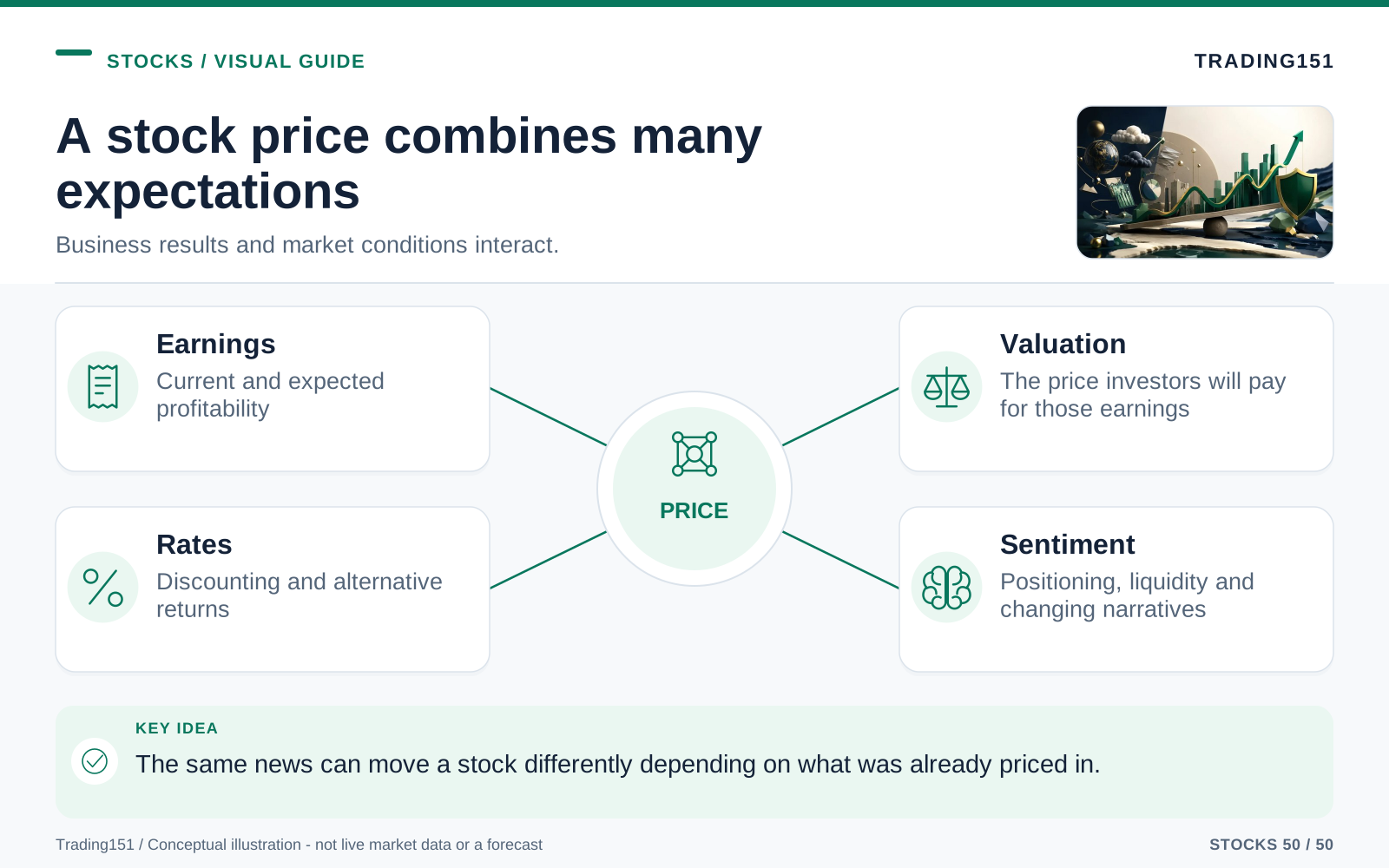
Read this diagram as text
- Earnings
- Current and expected profitability
- Valuation
- The price investors will pay for those earnings
- Rates
- Discounting and alternative returns
- Sentiment
- Positioning, liquidity and changing narratives
Company Fundamentals: The Business Behind the Ticker
It’s easy to look at a screen full of blinking red and green numbers and forget that every ticker symbol is a living, breathing business. Whether it’s a trillion-dollar tech empire, a local bank, or a scrappy biotech startup banking on a single experimental drug, the actual quality of the business is what matters most over the long haul.
When investors talk about a company’s fundamentals, they’re really just checking its pulse. Are revenues growing? Is it buried in debt? Can it fend off competitors? Simply put: is this business getting stronger, or is it slowly dying?
1. Earnings: The Market’s Favorite Report Card
Four times a year, public companies have to open their books and show the world how they did. These quarterly earnings reports reveal exactly how much money came in the door, how much was spent, and what was left in the vault. Think of it as Wall Street’s ultimate report card.
If a company consistently grows its sales and pads its bottom line, investors naturally feel great about holding onto it. It's proof the machine works, which attracts new buyers and keeps the stock resilient during market hiccups.
But when those numbers miss the mark—maybe sales hit a wall, costs spiral out of control, or customers jump ship—faith evaporates quickly. Even the most iconic, beloved brands will watch their stock plunge if the math stops making sense.
2. Expectations Matter as Much as Results
Here’s a harsh reality that usually blindsides new investors: a company can announce a large, record-breaking profit, pat itself on the back, and still watch its stock absolutely crater by 9:30 AM. How does that make sense? Because the market doesn’t care about results in a vacuum. It only cares about results compared to expectations. If a stock is already substantially expensive and crowded with hyped-up buyers, a "great" quarter might barely keep the price afloat. Meanwhile, a beaten-down, ignored company might surge on mediocre news, simply because everyone expected total disaster. The key question is never "was the quarter good?" but rather "was it good enough for the price we paid?"
If Wall Street expects a company to earn $1.50 per share, and it only earns $1.20, that "profit" is viewed as a large disappointment. But if the street only expected $0.80, that same exact $1.20 triggers a large rally.
That dynamic is why you hear the phrase "priced in" so often. If everybody already knows a company is going to crush its earnings, the stock price usually climbs weeks before the actual announcement. By the time the good news drops, the thrill is gone. You'll often see veteran investors sell on great news simply because they know the easy money has already been made.
The market is relentlessly forward-looking. It cares a little bit about today, but it’s hopelessly obsessed with tomorrow.
3. Guidance: What Management Says Comes Next
Earnings reports aren't just a history lesson; they're an opportunity for CEOs to look into their crystal ball. This forward-looking forecast—known as guidance—frequently causes wilder price swings than the actual quarterly numbers.
A company can post a phenomenal quarter, but if the CEO gets on the microphone and warns that demand is softening or supply chain costs are rising rapidly, investors will hit the sell button without a second thought. Alternatively, a company can report a severe quarter but see its stock rally because management sounds confident about a turnaround next year.
Investors heavily scrutinize the tone of these calls. Does leadership sound nervous or excited? Are they taking accountability for a bad quarter or pointing fingers at the weather? The hard numbers matter, but the story management spins around those numbers can matter just as much.
4. Valuation: A Great Company Is Not Always a Great Stock
Here is a truth that trips up a lot of smart people: a brilliant, world-class company can be a terrible investment if you pay too much for it. Conversely, a deeply flawed, struggling company can be a phenomenal investment if you buy it cheap enough.
This is the concept of valuation. You are weighing the price tag against the company’s actual cash flow, assets, and growth potential. When a stock is priced for absolute perfection, the tiniest stumble can trigger a severe sell-off. When it's priced for bankruptcy, merely surviving can spark a large rally.
Investing isn’t just a contest to find the best businesses. It’s a game of figuring out what those businesses are worth at their current price tag.
The Economic Weather Around Every Company
No business operates in a bubble. Even a brilliantly run enterprise will struggle in a broken economy, while a terribly managed company can look like a genius operation when the economic winds are blowing just right. The broader environment dictates everything from customer spending power and employee wages to borrowing costs and supply chain stability.
If you think of a company as a boat, the economy is the ocean it’s sailing on. A sturdy ship will definitely handle a storm better than a leaky dinghy, but it’s still going to feel the waves.
1. Interest Rates: The Market’s Gravity
Interest rates are easily one of the most dominant forces in all of finance. They dictate how expensive it is to borrow money and determine whether investors want to take a risk on stocks or park their cash in super-safe government bonds. Rates act like a giant lever on the market. They impact how much businesses pay on their debt, they give investors a risk-free alternative for their cash, and they aggressively rewrite the formulas used to calculate future profits.
When rates are sitting near zero, money is cheap. Companies can borrow endlessly to build factories, hire thousands of workers, or buy up their competitors. Low rates also force regular investors into the stock market because savings accounts and bonds are paying practically nothing. If safe bets are yielding 1%, a risky tech stock suddenly looks tempting.
But when interest rates start climbing, the math completely changes. Suddenly, borrowing money hurts. Consumers put off buying homes and cars. Heavily indebted companies start sweating. And perhaps most importantly, investors start looking at bonds paying a guaranteed 5% and asking themselves, "Why am I risking my money in the stock market when I can get a safe, decent return right here?"
This is why investors often refer to interest rates as financial gravity. When rates are low, stocks effortlessly float higher. When rates get cranked up, that gravity pulls everything back down to earth.
2. Inflation: The Quiet Pressure on Profits
Inflation eats into the market by quietly driving up the cost of simply keeping the lights on. If raw materials, rent, shipping, and payroll all get more expensive at the same time, companies face a tough choice: eat those costs and accept lower profits, or hike their prices and risk angering their customers.
Passing the bill to the consumer isn’t always possible. A high-end luxury brand might be able to raise prices without blinking, but a local grocery chain or a budget airline is going to fight for every penny, knowing their customers are tracking every price hike. If a business can't raise prices to offset their own rising costs, their profit margins shrink, and the stock takes a hit.
Worse, inflation forces everyday people to change their habits. They delay big purchases, switch to generic brands, and skip the extra dinner out. Companies relying on discretionary spending feel the pinch fast, while those selling absolute necessities tend to weather the storm.
3. Economic Growth and Consumer Confidence
When the economy is humming along, jobs are plentiful, and paychecks are steady, people naturally open their wallets. They book vacations, remodel their kitchens, and buy new phones. That confident spending turns directly into corporate revenue, which filters down into corporate profit.
But when the dreaded "R-word" (recession) starts dominating the headlines, the psychological shift is instant. Families start aggressively saving. Businesses freeze hiring. Banks pull back on lending. Before the economy even technically slows down, stock prices often tank because investors are projecting fear into the future.
Because markets are always living six months in the future, they rarely match the present mood. By the time a recession is officially declared on the evening news, the stock market has usually bottomed out and is already rallying for the recovery. This strange timing is exactly why the stock market often feels completely disconnected from everyday reality.
Industry Trends and Competition
Sometimes, broad economic weather doesn't matter at all—a stock moves purely because its specific industry is undergoing a seismic shift. A sudden new government regulation, a large technological leap, or a total shift in what consumers care about can rewrite the rules for an entire sector overnight.
Just think about what streaming did to cable TV, what smartphones did to digital cameras, or how the rise of electric vehicles forced legacy automakers to completely change their identities. In every one of those transitions, money violently sloshed from the losers to the winners.
And you can't ignore the guy across the street. Even if a company is highly profitable today, a younger, faster rival stealing their market share will terrify investors. Wall Street isn't going to sit around and wait for the damage to hit the quarterly earnings report; they’ll dump the stock the moment the threat looks credible.
This is why you’ll hear investors obsess over a company's "moat"—its built-in defenses. Does it have an loyal brand? A large cost advantage? A product that is notoriously painful to replace? Those moats are what keep a business alive when competitors try to storm the castle.
News, Narratives, and the Speed of Modern Markets
News has always dictated stock prices, but the sheer velocity of information today is entirely unprecedented. A market-moving headline can bounce around the globe in a fraction of a second. A rumor on social media can wipe out billions in market cap before a company's PR team even has time to draft a response. Meanwhile, trading algorithms are scanning and reacting to keywords before human eyes have even finished reading the first sentence.
Obviously, certain news directly impacts the bottom line: an FDA drug approval, a sudden CEO resignation, a large product recall, or a surprise buyout. But other news simply alters the vibe. The underlying math hasn't changed, but the mood has shifted entirely.
Humans are naturally wired for stories. We need a narrative to make sense of the chaos. Suddenly, a stock isn't just a software company; it's "the undisputed king of artificial intelligence." Another isn't just a retailer; it's "a dying relic of the mall era." Once a narrative sticks, it acts like a magnet, aggressively pulling money in or violently repelling it. The catch? Eventually, the hype fades, and the business has to justify the story with cold, hard cash.
The Human Element: Fear, Greed, and Herd Behavior
If the stock market was entirely run by rational supercomputers and perfectly balanced spreadsheets, prices would glide up and down in a calm, orderly fashion. But the market isn't a spreadsheet. It’s made of human beings. And humans are messy. We panic. We get arrogant. We desperately compare our portfolios to our neighbor’s. We hate losing money far more than we enjoy making it.
Ultimately, every chart you look at is just a real-time tracking of two overwhelming emotions: fear and greed. It sounds like a cliché, but those two primal feelings explain almost everything the market does.
1. Greed and the Fear of Missing Out
When a stock or a broader market goes up for months on end, being cautious suddenly starts feeling like a character flaw. People who sat on the sidelines feel like idiots. Group chats fill up with screenshots of large gains. Social media influencers start bragging about their genius stock picks, and countless articles are written explaining why "this time is different."
That’s when FOMO—the Fear Of Missing Out—kicks into overdrive. People stop buying a stock because they’ve done the research, and start buying simply because the line on the screen is going up and they don't want to be left behind.
This fever can inflate a stock's price to substantially irrational heights. The higher the price goes, the more attention it grabs, which brings in even more buyers. It feels like magic—until reality catches up, expectations get too high, and gravity finally kicks in.
2. Fear and Panic Selling
Fear is the same mechanism, just operating in reverse. When the market takes a sudden dive, investors immediately jump to the worst possible conclusions. A temporary speed bump is suddenly viewed as a catastrophic, permanent collapse. People who proudly labeled themselves "long-term, patient investors" just a week ago are suddenly logging into their brokerage accounts six times an hour, sweating.
Psychologically, taking a loss hurts deeply. Behavioral economists have proven that losing money feels significantly worse than the joy of making that exact same amount. That intense emotional pain drives people to sell at the worst possible moment—not because the facts on the ground have changed, but because they simply want the anxiety to stop.
Just as greed tricks people into paying way too much, panic tricks people into selling for way too little. And the concerning part? When you are caught in the middle of a panic, selling feels like the only rational thing to do.
3. The Herd Is Comforting, Even When It Is Wrong
Human beings are deeply tribal. It feels safe to be wrong alongside a giant crowd, and utterly concerning to be right, but completely alone. This instinct creates large herd behavior in the markets. Investors stampede into the hottest trades because "everyone else is doing it," and then they trample each other rushing for the exits when the mood shifts.
The cruel irony of the stock market is that the herd is usually the most confident right when they are the most wrong. At the absolute peak of a bubble, extreme optimism sounds brilliant because everyone is getting rich. At the absolute bottom of a crash, extreme pessimism sounds completely logical because everyone is losing money. The market loves to tempt you into believing that whatever happened yesterday is going to happen forever.
Big Money: Institutional Investors and Algorithms
Retail investors (regular people trading from their phones) definitely make waves, especially when they coordinate online. But the real, earth-shaking money belongs to the heavyweights: pension funds, mutual funds, sovereign wealth funds, and large hedge funds.
When you buy a dozen shares of a company, the market doesn't even blink. When a major pension fund decides to dump 5 million shares over a few weeks, the entire market feels the ripple. These institutions move large blocks of capital around the globe, and their asset allocation decisions can lift or crush entire sectors single-handedly.
We also can't ignore the machines. Modern Wall Street is heavily dominated by algorithmic trading. Giant server farms run programs that scan price volume, options chains, and news feeds, executing trades in milliseconds. Some are designed to hold for years, while others buy and sell in the blink of an eye. When thousands of algorithms catch the same signal at the same moment, the market can whip around violently.
That doesn't mean the machines have totally taken over, though. Every algorithm was coded by a human, reflecting a human's risk tolerance, biases, and goals. The tools have evolved into science fiction, but the actual game remains exactly the same.
Liquidity: The Hidden Factor People Notice Only When It Disappears
"Liquidity" is a fancy finance term for how easily you can buy or sell something without blowing up its price. Large tech stocks are highly liquid—you can sell ten thousand shares instantly, and the price won't budge. Smaller, obscure stocks are illiquid—one large sell order can absolutely wreck the chart because there simply aren't enough buyers waiting on the other side to catch the shares.
The thing about liquidity is that nobody thinks about it until it vanishes. When the market is calm, everyone assumes they can cash out instantly at the quoted price. But during a real panic, the buyers simply step away from the table. Prices start falling off a cliff, not necessarily because the company is doomed, but because there isn't anyone willing to buy the shares at yesterday's price.
This sudden vacuum is why market crashes feel violent. Selling triggers lower prices, those lower prices trigger widespread panic, and that panic triggers more selling. When liquidity dries up, you hit an air pocket, and the drop is concerning.
Unexpected Shocks: When the Outside World Breaks In
Wall Street can handle bad news, but it absolutely despises uncertainty. Nothing creates panic quite like an event that wasn't plugged into anyone's risk model. In finance, these are known as black swans—rare, totally unpredictable events with large consequences.
Pandemics, sudden wars, large cyberattacks, political shocks, or banking collapses all violently jolt the system. Investors don't mind a rough patch if they can calculate the damage. What they hate is not knowing where the bottom is or how long the bleeding will last.
When a major shock hits, big money immediately rushes toward safety. Investors dump risky stocks and pile into cash, gold, or government bonds, trying to build a bunker until the dust settles. Whether this reaction is rational or purely emotional, it forces prices to re-adjust instantly.
Of course, chaos always creates winners alongside the losers. A pandemic that grounds airlines might cause remote-work software to skyrocket. A large supply chain chokehold might destroy a company reliant on overseas shipping, but heavily reward a local manufacturer. Even in absolute panic, the market is ruthlessly sorting the survivors from the casualties.
Time Frame Changes Everything
If you’ve ever watched two smart people fiercely debate a stock on financial TV, it’s usually because they are playing totally different games. A day trader, a guy managing his 401(k), and a hedge fund manager can look at the same ticker symbol and care about completely different things.
Over minutes or hours, stock prices are just noise—bounced around by algorithms, random news alerts, technical levels, and raw human emotion. Over a few months, trends start to matter: inflation data, interest rates, and consumer spending. But zoom out over five or ten years, and none of the daily noise matters. Over the long haul, a stock's price will ultimately reflect the fundamental health of the business.
That is why a stock can be a catastrophic short-term trade but a phenomenal ten-year investment—or vice versa. Whenever you look at a stock, you shouldn't just be asking, "Is this a good company?" You have to ask, "For how long am I holding this, at what price, and what is everyone else expecting to happen?"
A good result can still fall short of the price's expectations
Suppose a company reports rising sales and profit, but its margins are weaker than expected and management lowers its outlook. The shares can fall without the market ignoring the growth. Investors may be revising the amount or reliability of future cash generation. A positive headline can coexist with information that reduces the value of the original thesis.
The reverse can happen too. A company may report a loss that is smaller than feared, secure financing, or show an improvement in a critical operating measure. The price can rise even though the latest accounts remain weak. The relevant comparison is with prior expectations, not an abstract rule that profitable companies rise and unprofitable ones fall.
Short-term trading can add another layer. Index changes, fund flows, option hedging, and limited available liquidity may affect the immediate path without changing the business in equal measure. Public information rarely permits every part of a day's move to be assigned to a single cause with confidence.
For an investor, separate the price response from the thesis review. Read the filing, compare the new information with the assumptions behind the purchase, and reassess the valuation. A falling price may create an opportunity, reveal a problem, or do both at once. The useful question is what changed in the expected ownership return, not whether the market's first reaction matched the tone of the announcement.
Expectations are part of the starting price
A company can report better results than last year and still disappoint investors who expected more. Conversely, weak results can be followed by a price rise when the market had anticipated something worse. This does not mean fundamentals are irrelevant. It means the comparison includes the expectations already reflected in the price. Separate the business's progress from the return available to someone buying at today's valuation. 1, 2
Price Is the Meeting Point of Facts and Expectations
So, after all that, what makes a stock move?
On a minute-by-minute basis, it's mostly chaos: shifting liquidity, aggressive algorithms, breaking headlines, and frantic emotions. It feels loud and unpredictable because it is.
Widen the lens to a few months, and the economic weather takes over. Interest rates, inflation, employment data, and general consumer confidence start dictating which way the wind is blowing.
But in the long run, the actual business always gets the final say. A company that creates great products, manages its debts wisely, adapts to the world, and generates large profits will almost always reward the people holding its shares.
The trick is realizing that all of these forces are colliding at the same time. An incredible earnings report can get completely wiped out if interest rates spike the same day. A terribly run company can double in price during a speculative mania. A historically great business can get cut in half during a global panic. A completely cheap stock can stay ignored for a decade if nobody believes the underlying story anymore.
The stock market is a weird, fascinating blend of a math test, a global auction, a mood ring, and a storytelling contest. You can't control the macroeconomic headlines, and you certainly can't perfectly time the algorithms. But you can learn to read the room.
No single force explains every chart. Fundamentals ultimately win the decade, but shiny narratives and large money flows can easily hijack the market for months on end. A smart investor learns to spot exactly what is driving the price without pretending every tick of the chart has some deep, profound meaning.
Always separate a dropping price from a broken business. If a company is performing exactly how you expected and the stock gets cheaper, that might just be a great opportunity. But if the actual business is losing customers, blowing cash, and getting crushed by competitors, chalking the price drop up to "market noise" is a great way to lose a lot of money.
The flashing ticker on your screen isn’t some all-knowing oracle handing down permanent truths. It is just a real-time record of what a very emotional crowd is willing to pay right now, based on whatever information they have today. Use that data, but always anchor yourself back to the actual business, the reality of the price tag, and the timeline you care about.
Sources and further reading
Editorial revision: 7 October 2026. Numerical scenarios are hypothetical unless identified as historical. References support the added explanations and selected corrections; rules and product terms should be checked again before acting.