
Governments encounter Bitcoin as a potential reserve asset, a regulated financial activity, seized property, and a payment technology. Those are different roles, and a headline about state interest does not always mean a government has bought bitcoin or adopted it for everyday use. The relevant details are the legal authority, funding source, custody, reporting, and obligations attached to the policy.
El Salvador: The Loudest Experiment in the Room
You can't have this conversation without starting in El Salvador. In 2021, President Nayib Bukele made it the first country on Earth to adopt Bitcoin as legal tender alongside the dollar. The announcement hit like a thunderclap. A small Central American nation, more often mentioned in headlines about violence and migration, suddenly found itself at the center of one of the biggest financial debates of the century.
On paper, the reasoning made sense. El Salvador is dollarized, meaning it has no control over its own currency — it can't print money, set its own interest rates, or run monetary policy the way bigger economies do. It also relies heavily on remittances from Salvadorans working abroad, mostly in the U.S. For a lot of families, that money isn't a bonus. It's what pays for food, medicine, school supplies, rent.
And traditional remittance channels aren't kind to those families. Somebody working a long week in Los Angeles sends money home, and by the time it lands, fees have already taken a bite out of it. Bitcoin — run through fast payment layers — promised something different: money moving across borders almost instantly, without a chain of middlemen taking their cut along the way.
There was real emotional weight behind that pitch. It said a family split apart by migration shouldn't have to pay a toll every time love crossed a border. It said a country too small to move the global banking system could still build something outside of it.
Reality turned out messier. Chivo, the government's official wallet, was plagued with technical problems. A lot of people downloaded it just to grab the signup bonus and then quietly went back to cash. Merchants weren't exactly thrilled to price groceries or bus fare in something that could swing 10% in a day. When you're living paycheck to paycheck, Bitcoin's volatility isn't a chart you glance at — it's the difference between a fine week and a scary one.
International lenders weren't shy about pushing back, either. The IMF kept warning about financial, fiscal, and legal risk. By 2025, as part of a broader financing deal, El Salvador quietly walked back the most aggressive parts of its policy. Accepting Bitcoin became optional for businesses, the government pulled back its own involvement, and Chivo's role shrank.
El Salvador's example should be read as a changing policy, not a completed experiment with a single verdict. Its 2021 adoption and the changes associated with the 2025 IMF-supported program are different stages. Public holdings, payment use, fiscal exposure, and legal acceptance each need their own evidence and date.
The lesson here isn't that every country should copy El Salvador's homework. It's that Bitcoin can be more than a payment rail. It can double as a national story, an investment magnet, a diplomatic headache, and a tourism pitch all at once. That's a powerful combination — and a hard one to manage. You can put Bitcoin on a billboard. You can't force your own citizens to trust it overnight.
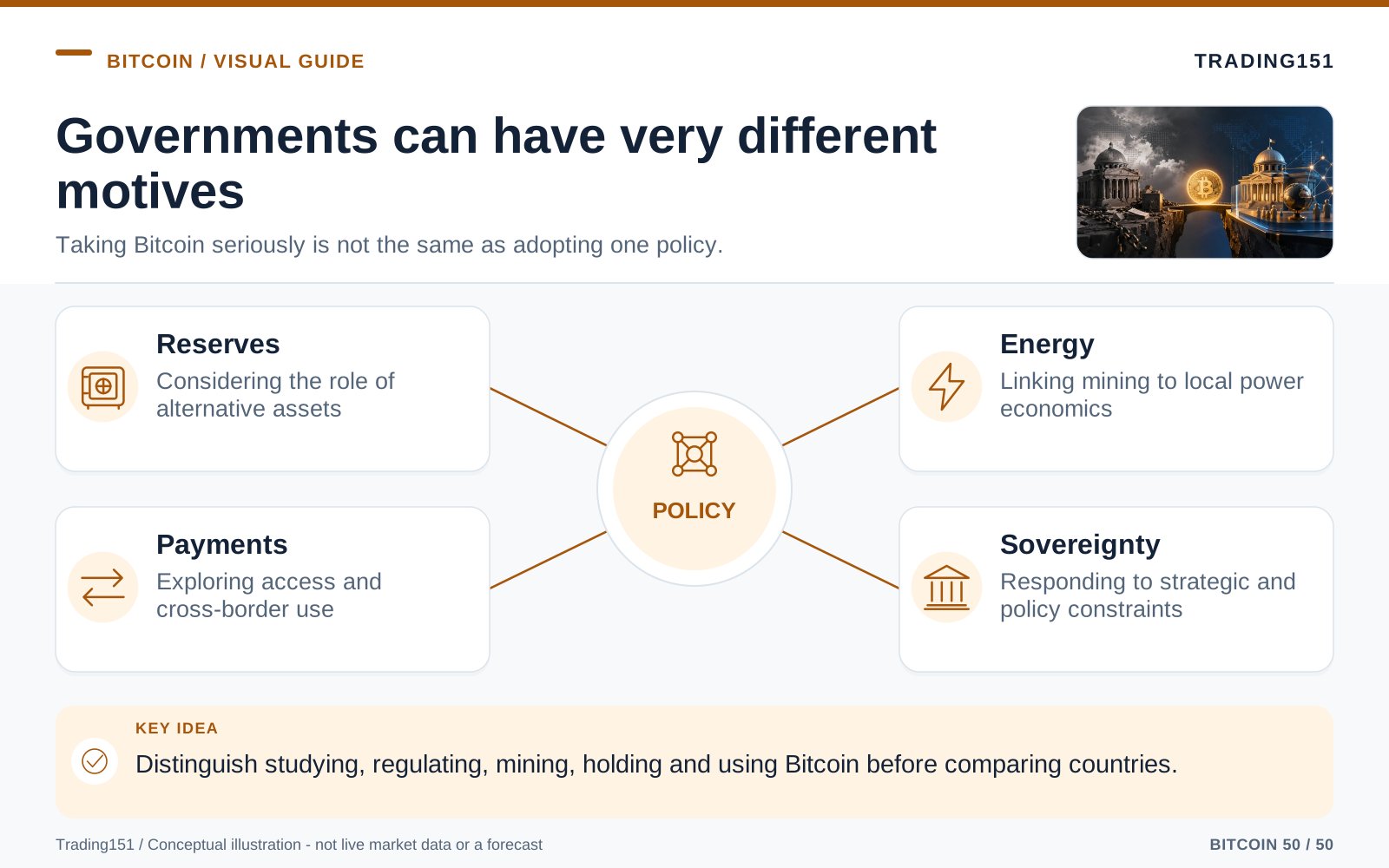
Read this diagram as text
- Reserves
- Considering the role of alternative assets
- Energy
- Linking mining to local power economics
- Payments
- Exploring access and cross-border use
- Sovereignty
- Responding to strategic and policy constraints
Bhutan: The Quiet Power of Stranded Energy
If El Salvador is the loud, theatrical version of sovereign Bitcoin adoption, Bhutan is the quiet one.
Nobody pictures Bhutan when they think about crypto mining. It's a tiny Himalayan kingdom tucked between India and China, known for its mountains, its Buddhist heritage, and its philosophy of Gross National Happiness. But behind that peaceful image, Bhutan's sovereign wealth fund has spent years quietly building up exposure to Bitcoin and mining operations.
Energy is the key to the whole story. Bhutan has hydropower in abundance, thanks to mountain rivers barreling down steep terrain. At times, the country generates far more electricity than it can use. Most of that surplus historically got exported, largely to India — but electricity isn't the easiest thing to store or shift around, and it doesn't always sell at a fair price. When power sits stranded or underpriced, it becomes a problem in search of a buyer.
Bitcoin mining might be the oddest energy buyer ever invented. It doesn't care about being near a financial hub. It doesn't need a port, a wealthy customer base, or a big city's worth of workers. You can drop mining rigs right next to the power source and turn raw electricity into a globally tradable asset. For a country sitting on clean surplus power, that's not a novelty act — it's leverage.
Bhutan's approach also complicates one of the standard knocks against Bitcoin. Critics love pointing out how much electricity mining eats up, and that's a fair concern when miners are pulling from fossil-fuel-heavy grids or competing with households for power. But it's not one story everywhere. Where there's surplus hydro, stranded gas, curtailed wind, or solar that would otherwise just go to waste, mining can act as a flexible buyer that shows up when nobody else will.
That doesn't make every mining operation a good citizen. It does make the conversation more interesting than the usual back-and-forth shouting. For Bhutan, this was never really about getting people to buy their morning coffee with satoshis. It was about geography — mountains, rivers, electricity — and Bitcoin gave the country a way to turn those raw advantages into something that could move well beyond its borders in an instant.
That's why Bhutan's story matters. It hints that some governments will treat Bitcoin less like a currency and more like an industrial play. The question for them isn't "will people buy groceries with this?" It's "can we turn energy we'd otherwise waste into something that strengthens our balance sheet?"
The Reserve Question: Why Governments Hold Anything at All
To understand Bitcoin's appeal here, it helps to back up and ask something basic: why do countries hold reserves in the first place? A reserve asset isn't judged just on upside. Officials worry about liquidity during a crisis, custody, legal standing, accounting headaches, volatility, sanctions exposure, and whether they can sell without falling the market. Bitcoin gives a country independence from another nation's currency and a supply nobody can inflate through backroom diplomacy. It also brings severe price swings and an operational learning curve most treasuries have never had to deal with. A government can find the idea compelling and still land on a tiny allocation — or none — because that's what fits its mandate.
Foreign reserves work like a national rainy-day fund. They let countries defend their currency, cover imports, keep creditors calm, and absorb external shocks. Traditionally that means dollars, government bonds, gold — assets that are durable, recognizable, and easy to offload when things get tense.
For decades the dollar has dominated that role, and it's still the backbone of the system today. But something changed when Russia's sovereign reserves got frozen after the invasion of Ukraine. Whatever your politics on the decision, the takeaway for other governments was unmistakable: park your reserves inside someone else's system, and someone else can freeze them with a single decision.
That realization didn't suddenly make Bitcoin safe or stable or universally trusted. But it did make the concept of neutral reserves a lot more appealing. Gold already fills that role, which is exactly why central banks still stockpile it. Gold has its own baggage, though — it's heavy, slow to move, expensive to secure, and awkward to settle across borders in a hurry. Great for sitting in a vault. Not so great when speed matters.
Self-custodied Bitcoin is not an account balance that a central ledger administrator can edit. That changes some control risks, but it does not make a government's holdings beyond legal or practical reach. Keys can be compromised or compelled, custodians can face orders, and counterparties and exchanges can restrict transactions. Reserve usability depends on more than the base protocol.
For a small country, that reshaping matters. For a sanctioned country, it matters a lot more. For a nation wedged between larger powers, it matters in quieter, subtler ways. Bitcoin isn't a full solution to the reserve problem. It's a new piece on an old chessboard.
Sanctions, Sovereignty, and the Search for Neutral Money
Bitcoin's political weight comes from one simple fact: it isn't anyone's liability. A dollar bill is a claim on a system the U.S. controls. A Treasury bond is a promise made by the U.S. government. A bank deposit only holds up as well as the bank behind it. Even gold, if it's parked overseas, depends on whoever's holding it and the politics around getting it back.
Bitcoin skips all of that. There's no issuer making a promise — it's a bearer asset, controlled by whoever holds the keys. Sounds technical, but the political implication is straightforward: control shifts closer to whoever's holding it.
That's exactly why governments can't just wave it off, even the ones who don't like it. A financial system built on permission is a great deal for whoever's handing out the permission — and concerning for whoever might lose it. Bitcoin runs on rails that don't ask the same questions and don't answer to the same gatekeepers.
Naturally, this cuts both ways. The same neutrality that appeals to dissidents, citizens stuck in collapsing economies, and small nations also spooks regulators and law enforcement. Bitcoin can fund lawful savings, cross-border payments, treasury diversification. It can just as easily move illicit funds or dodge sanctions. The technology has no opinion on which use is noble. People decide that part.
So the sovereign Bitcoin story will never be a tidy one. It lives right in the friction between freedom and control. A government might love Bitcoin for shielding its reserves from foreign pressure — and turn around and fear it the moment citizens start using it to dodge domestic capital controls. A central bank might trash-talk volatility in public while quietly studying custody solutions behind closed doors. A finance ministry might call it risky on television and worry, privately, that a rival country is stacking sats.
This isn't a side issue. It's basically the whole issue. Bitcoin forces governments to reckon with a form of money they can participate in but never fully control.
When Citizens Move First
Government adoption tends to grab headlines because it comes wrapped in speeches, laws, and executive orders. But in a lot of countries, ordinary citizens get there first. They don't wait around for a ministry to publish a framework. They react to what's happening in front of them.
Argentina is one of the clearest cases. Ordinary Argentines have spent years living with inflation, currency controls, and a peso nobody really trusts. When your savings lose value month after month, your habits change. People start improvising. They hunt for dollars. They lean on informal exchange markets. They figure out which apps let them hold stablecoins. Some buy Bitcoin. A lot of them don't care about ideology at all — they just want to hold onto whatever purchasing power they have left.
In places like this, Bitcoin usually isn't the first tool people reach for. Stablecoins tend to play the bigger everyday role, since they give dollar exposure without Bitcoin's wild swings. That distinction matters. The crypto economy in high-inflation countries isn't one neat "orange-pilled" story — it's a messy mix of Bitcoin, dollar tokens, exchanges, peer-to-peer trading, patchy regulation, and plain old survival instinct.
Even so, Bitcoin shifts the conversation. It gives people an asset that sits outside their local monetary system and outside the political promises that have already let them down. Even people who mostly stick with stablecoins tend to see Bitcoin as the deeper symbol — money nobody in power can simply print more of.
Once enough citizens start using alternative financial tools, governments face a choice. Fight it, regulate it, tax it, or build policy around it. Javier Milei's Argentina has drawn a lot of attention on this front. His rise to power reflected a public that was flat-out exhausted by inflation and central-bank dysfunction, and his government has opened the door to more crypto use in contracts and business. Still, Argentina's crypto story hasn't been a clean success — scandals and regulatory headaches have muddied what was supposed to be an optimistic narrative.
The broader pattern is really what matters here. In places where money fails people at the household level, nobody needs to read a white paper to understand the problem. They feel it standing in the supermarket line. They feel it when wages arrive late, already worth less than when the paycheck was issued. Bitcoin picks up cultural momentum in places like this because it speaks directly to a wound people are already carrying.
The United States: From Skepticism to Strategy
For years, the U.S. treated Bitcoin with a strange cocktail of fascination, suspicion, and regulatory confusion. Wall Street wanted products to sell. Silicon Valley wanted room to build. Lawmakers argued in circles. Regulators kept warning about fraud, manipulation, custody, investor protection. Through all of it, Bitcoin just... Kept surviving.
The first real institutional bridge showed up in January 2024, when the SEC approved spot Bitcoin exchange-traded products for listing and trading. That approval wasn't the SEC saying "Bitcoin is a great investment" — if anything, the agency went out of its way to say the opposite. But the practical impact was large. Ordinary investors could suddenly get spot Bitcoin exposure through a regular brokerage account, no private keys or crypto exchange logins required.
That single move dragged Bitcoin deeper into mainstream finance's machinery. Pension advisers, asset managers, registered investment advisers, everyday retail investors — they all suddenly had a regulated, familiar way to touch an asset that used to live almost entirely outside the traditional system. Bitcoin wasn't just something early adopters bought on sketchy niche platforms anymore. It had a spot on Wall Street's shelf.
The executive order of 6 March 2025 established a Strategic Bitcoin Reserve and a separate U.S. Digital Asset Stockpile. The Bitcoin reserve was to be capitalized with eligible bitcoin finally forfeited to the federal government, subject to legal exceptions and obligations. It also directed officials to develop budget-neutral acquisition strategies. The order itself is not evidence that additional open-market purchases occurred.
The distinction between seized and finally forfeited assets matters. Seizure can occur while ownership and victim claims remain unresolved; it does not automatically make an asset available for a reserve. A policy announcement, an eligible inventory, and a completed acquisition should therefore be reported separately.
This is where game theory starts to bite. A government doesn't need to be convinced Bitcoin will replace the dollar to justify holding some of it. It just needs to think there's a real chance Bitcoin becomes more important in global finance down the road. If that chance exists, holding zero becomes a decision in itself. For a superpower, being early might cost some political embarrassment. Being late might cost a genuine strategic edge.
That logic won't produce identical policy everywhere. Some countries will hold openly. Some will hold quietly. Some will end up with Bitcoin through seizures rather than purchases. Some will crack down on private ownership while building out state custody behind the scenes. Some will publicly trash Bitcoin while studying it closely in private. What matters is that the question has shifted from "can we ignore this?" to "where do we want to stand?"
Bitcoin as a Tool for Smaller States
Smaller countries find Bitcoin appealing for reasons that look pretty different from Washington's. A superpower thinks in terms of influence. A small country tends to think in terms of options — the kind of flexibility big reserve-currency nations never even have to consider. Mining can turn remote, otherwise-wasted energy into revenue. A Bitcoin reserve can diversify a thin, narrow asset base. Open payment rails can loosen a country's dependence on a small handful of correspondent banks. None of that happens automatically, of course. Bad contracts, opaque custody, political grandstanding, or borrowing money to speculate can just as easily turn a promising strategy into a public embarrassment. Good governance matters far more than a bold press release.
Small states are used to operating inside systems they never got a say in designing. Their trade often hinges on bigger neighbors. Their debt is frequently priced in someone else's currency. Their banking relationships usually run through institutions headquartered somewhere else entirely. Room to experiment with monetary policy is narrow to begin with. A new reserve asset — even a volatile one — can hand them a sliver of independence they didn't have before.
That said, no small country should treat its treasury like a roulette wheel. Bitcoin's swings can be severe, and a government responsible for salaries, hospitals, and debt payments can't manage public money the way a retail trader chases a bull run. But a small, carefully custodied, transparently reported allocation is a completely different animal from reckless speculation.
For some countries, Bitcoin might turn into a hedge against being ignored on the world stage. It draws in developers, investors, miners, entrepreneurs, tourists. El Salvador understood this better than most. The financial numbers matter, sure, but so does the attention. In a noisy, crowded world, attention itself can function like infrastructure.
For others, it's simpler and more practical. A country with surplus renewable energy gets a buyer in Bitcoin mining. A country with a big diaspora might see remittance costs drop through Bitcoin payment rails. A country locked out of global capital markets might find a bridge to a fresh pool of investors. None of these paths require Bitcoin to become everyday money for everybody.
That's probably the real shape of adoption ahead: not one grand replacement, but a scattering of specific use cases. A reserve here, a mining project there, a remittance corridor in one country, a legal framework for contracts in another. The sovereign Bitcoin map is likely to end up uneven, improvised, deeply local.
The Case Against It
It's easy to get caught up in the drama of sovereign adoption, but the objections deserve real weight. Public money carries a different burden than a private portfolio. Citizens don't get to opt out of their exposure, and losses can eat into services or erode trust fast. That's why treasury decisions need hard limits, independent custody controls, audited reporting, a clear reason for existing. Buying because the price is going up isn't a strategy — it's just momentum-chasing with taxpayer money. And treating every objection as anti-innovation bias isn't fair either. Bitcoin might deserve a seat at the table, but governments should be held to a much higher bar precisely because the asset is volatile and the money on the line isn't theirs personally.
Start with volatility. Bitcoin can rip upward violently — and crash just as hard. A national treasury isn't meant to behave like a venture fund. If a government buys near a peak and the price collapses, citizens don't experience that as an exciting long-term thesis. They experience it as public money gone. Political rivals won't say "just wait for the next halving cycle." They'll say "you gambled with hospital funding."
Then there's custody. Holding Bitcoin safely is nowhere near as simple as buying it. Private keys get lost, stolen, mismanaged, or compromised from the inside. A sovereign custody setup needs real procedures — audits, multi-signature controls, legal accountability, disaster recovery, protection against both hackers and political abuse. A country that can't run clean procurement probably isn't ready to manage digital bearer assets either.
Public understanding is another hurdle. Bitcoin isn't intuitive. Wallets, seed phrases, confirmations, fees, exchanges, taxes, scams — it's a steep climb. A government can announce a national Bitcoin policy in an afternoon press conference. Building actual public competence takes years.
Then there's institutional pushback. International lenders, central banks, legacy financial institutions all have reasons to worry about Bitcoin creeping into public finance. Some of that worry is genuine — volatility, consumer protection, money laundering, fiscal risk. Some of it is strategic: Bitcoin chips away at the monopoly these institutions hold over global settlement and reserves. Both kinds of resistance matter, because a lot of developing countries still depend heavily on these same institutions for loans, credit ratings, market confidence.
And finally, there's the risk of political theater. Bitcoin can be a serious policy tool — or it can be a shiny distraction. A leader can dress himself up in the language of innovation while quietly ignoring corruption, poverty, crumbling institutions. Bitcoin doesn't fix bad governance on its own. In the wrong hands, it can just hand bad governance a futuristic costume to wear.
Why the Idea Keeps Spreading Anyway
Despite all that, the idea keeps spreading — because the old system carries its own risks. Inflation is a risk. Sanctions are a risk. Frozen reserves are a risk. Currency dependency is a risk. Wasted energy is a risk. Being shut out of banking is a risk. A country doesn't need Bitcoin to be flawless before it starts questioning whether the current arrangement is as solid as it looks.
That's the part critics sometimes miss. Bitcoin isn't competing against some idealized financial system. It's competing against the one people and governments deal with day to day. In some places, that system runs fine. In others, it's expensive, politicized, unstable, or outright broken.
For wealthy countries with trusted currencies, Bitcoin might look like a speculative side bet. For a country with limited monetary sovereignty, it might look like insurance. For a country sitting on stranded energy, it might look like an export product. For citizens living under crushing inflation, it might look like a lifeboat. Same asset, completely different meaning depending on where you're standing.
That's why this shift isn't just about price. Price obviously matters — a long bear market cools political enthusiasm fast. But the deeper question is whether governments start seeing Bitcoin as one more tool on the national menu. Once it's on that menu, it's hard to take back off.
Distinguish a policy announcement from assets actually acquired
A reserve proposal, an enacted policy, and a completed purchase should be reported separately. So should assets confiscated through legal proceedings and assets acquired using public funds. A government can hold cryptocurrency temporarily while owing restitution or awaiting a court decision; that is not necessarily a discretionary investment position.
The U.S. executive order of March 6, 2025 established a Strategic Bitcoin Reserve framework centered on eligible bitcoin finally forfeited to the government. It also directed the development of budget-neutral acquisition strategies. That language should not be presented as proof that a particular open-market purchase occurred. Legal exceptions, victim claims, implementation, and verified reporting remain relevant to interpreting holdings.
El Salvador illustrates why policy dates matter. Its 2021 adoption of Bitcoin as legal tender was followed by changes in 2025, including voluntary private-sector acceptance and tax payments in U.S. dollars under the revised framework. Describing the country only through the original announcement leaves readers with an incomplete picture. Adoption should be assessed through actual rules and use, not only the visibility of the policy.
Public-sector interest can affect market expectations without establishing investment merit. A state may pursue strategic, political, administrative, or financial objectives that differ from those of a household. Examine the evidence for the specific action and its scale. Government involvement is a development to understand, not a substitute for evaluating custody risk, price uncertainty, or the suitability of an individual holding.
Public assets need public accounting
A government's Bitcoin policy should be evaluated through records of ownership, acquisition, custody, spending, and legal obligations. An attributed wallet balance can provide a clue without establishing the full public balance sheet. Transfers may be internal, holdings may be subject to claims, and a policy target may not represent a completed purchase.
The same standards apply to a state-linked mining venture. Revenue should be considered alongside equipment, electricity, financing, and other costs, including the alternative uses of public resources. A rising asset price can make a project look successful temporarily without showing whether the underlying arrangement serves its stated public purpose. The policy deserves the same scrutiny as other uses of public money. 1, 2, 3
Sovereigns Are Watching the Same Scarcity
The next chapter of government Bitcoin adoption will probably be a lot less dramatic than the first. Fewer countries will copy El Salvador's original legal-tender playbook exactly. More will quietly experiment with reserves, mining, custody, regulation, investment frameworks. The bold speeches will matter less than the boring details — who holds the keys, who audits the wallets, how gains and losses get reported, how citizens stay protected, how the policy holds up when the market crashes.
We might also see a split forming between Bitcoin and the broader crypto industry. Governments could grow more comfortable treating Bitcoin as a reserve asset while staying wary of the thousands of other tokens, shaky projects, and speculative manias floating around it. That divide is already visible. Bitcoin's simplicity is part of what makes it appealing — fixed supply, global settlement, no corporate issuer standing behind it. The rest of the crypto market is messier, more experimental, and riskier, all at once.
Gold isn't going anywhere. Neither is the dollar. Central banks aren't going to hand over their power just because a better monetary technology showed up — history rarely moves that cleanly. What's more likely is a layered system, with Bitcoin sitting alongside existing reserve assets and payment networks, used differently by different countries depending on what they need.
Some governments will buy too late. Some will buy too much. Some will fake understanding they don't really have. And some will use Bitcoin intelligently, patiently, in amounts small enough that volatility never turns into a national crisis. The winners probably won't be the loudest adopters — they'll be the countries that treat Bitcoin as neither magic nor nonsense, but as a strange new instrument that rewards discipline.
What's remarkable is that this conversation is happening at all. A piece of open-source software released into the world in 2009 has forced presidents, finance ministers, central bankers, sovereign wealth funds, and intelligence agencies to rethink what money even is. There used to be a debate about whether Bitcoin could survive governments at all. Now governments are showing up to the table themselves — not because they've suddenly turned into idealists, but because they recognize power when they see it.
This shift will be messy, loud, and full of contradictions. There will be failed apps, bad policy calls, embarrassing scandals, painful crashes. There will also be countries that use Bitcoin to strengthen their reserves, monetize spare energy, cut dependence on others, and carve out a little more breathing room in a world where monetary power has never really been neutral to begin with.
The old question was whether Bitcoin could survive governments. The new one is how governments are going to live alongside Bitcoin now that it's already outlasted their doubts.
Sources and further reading
- U.S. Executive Order: Strategic Bitcoin Reserve and Digital Asset Stockpile, March 2025
- Lightning Labs: The Lightning Network
- ESMA: End of the MiCA transitional period, June 2026
- IMF: El Salvador Extended Fund Facility, February 2025
Editorial revision: 7 October 2026. Numerical scenarios are hypothetical unless identified as historical. References support the added explanations and selected corrections; rules and product terms should be checked again before acting.