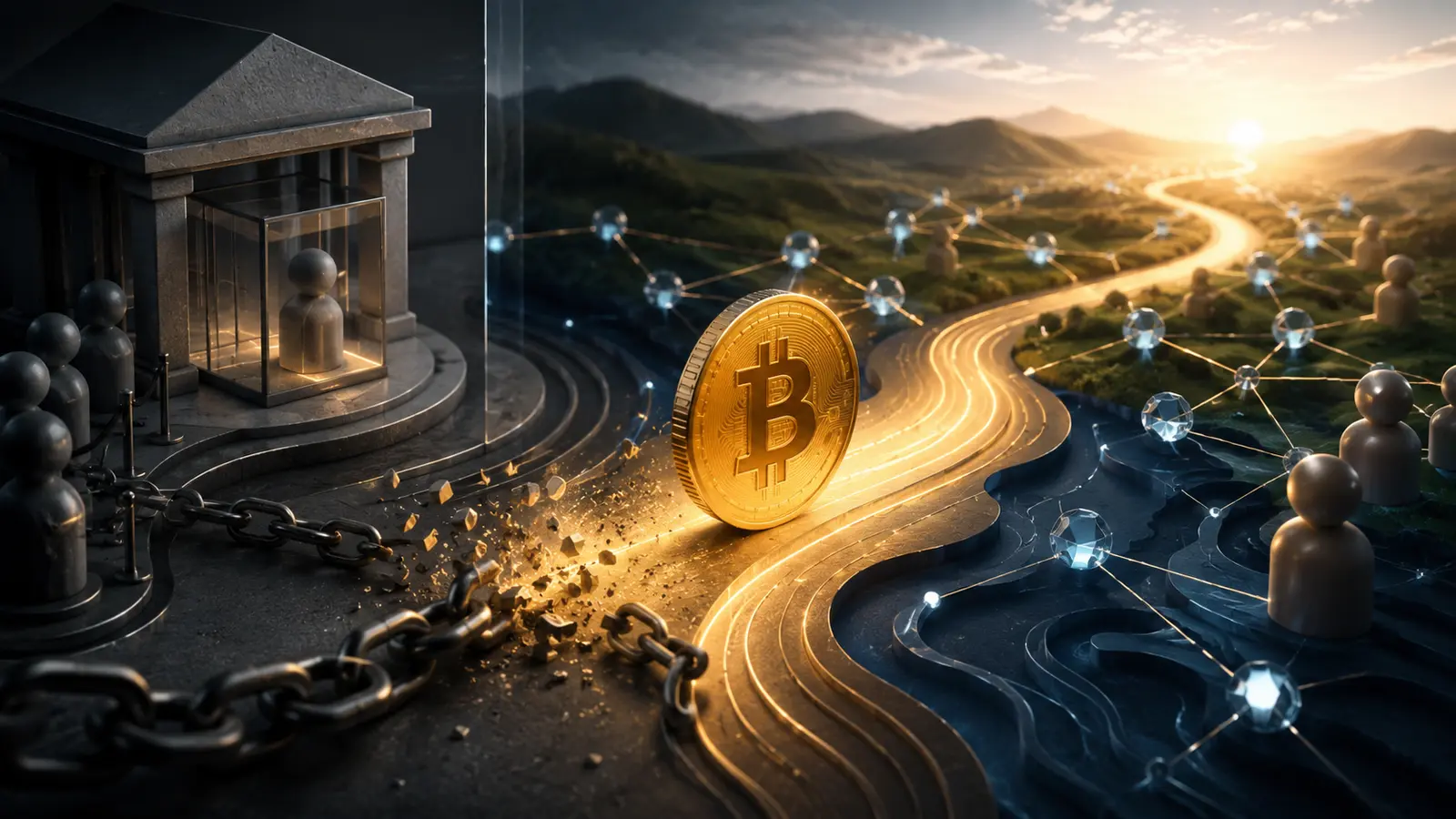
Financial freedom can mean having enough savings, being less dependent on an employer, or being able to make a payment without asking an intermediary. Bitcoin addresses some questions about control and transfer, but it does not automatically solve the others. A volatile asset can give its owner more authority over transactions while making near-term spending harder to plan.
The Old Problem: Money That Slowly Leaks Value
Before any of this makes sense, you have to understand the problem Bitcoin is responding to. Nearly all the money in circulation today — dollars, euros, pounds, yen, pesos, lira, bolivars, take your pick — is fiat currency. It works because governments declare it legal tender and everyone agrees to treat it that way. There's no fixed amount of gold or silver behind it. What backs it is confidence: confidence in law, in institutions, in the whole apparatus that issues and manages it.
That setup hands governments and central banks a lot of room to maneuver. When trouble hits, they can expand the money supply, cut interest rates, prop up failing institutions, and flood the system with liquidity. Defenders of this approach argue it keeps recessions from spiraling and keeps modern economies moving. And in the short run, sometimes it does exactly that.
But somebody pays for that flexibility, and it's usually not the people making the decisions.
When more money enters circulation than the economy produces in goods and services, each dollar buys a little less than it used to. That's inflation. We tend to talk about it as "prices going up," but that's only half the picture — the other half is that the cash sitting in your wallet is quietly losing power. The number on the bill never changes. Everything around it just gets more expensive.
This matters because savings aren't just digits in an account. They're stored time. Ten thousand dollars represents actual hours you worked, trips you skipped, things you talked yourself out of buying because you were thinking ahead. When inflation chips away at that pile, it's not just shrinking a number — it's quietly devaluing hours of your life you already spent.
That's the cruelty of it, and it's a quiet one. Inflation punishes the people who did the "responsible" thing and simply saved. It pushes ordinary families into a corner where saving alone isn't enough anymore — where they're expected to become investors, stock pickers, landlords, retirement strategists, part-time economists, just to keep from falling behind. Maybe you never wanted to speculate. Maybe you just wanted to hold on to what you earned. But in a system like this, standing still means losing ground.
That's not peace of mind. That's pressure. It forces people to keep running just to stay exactly where they are.
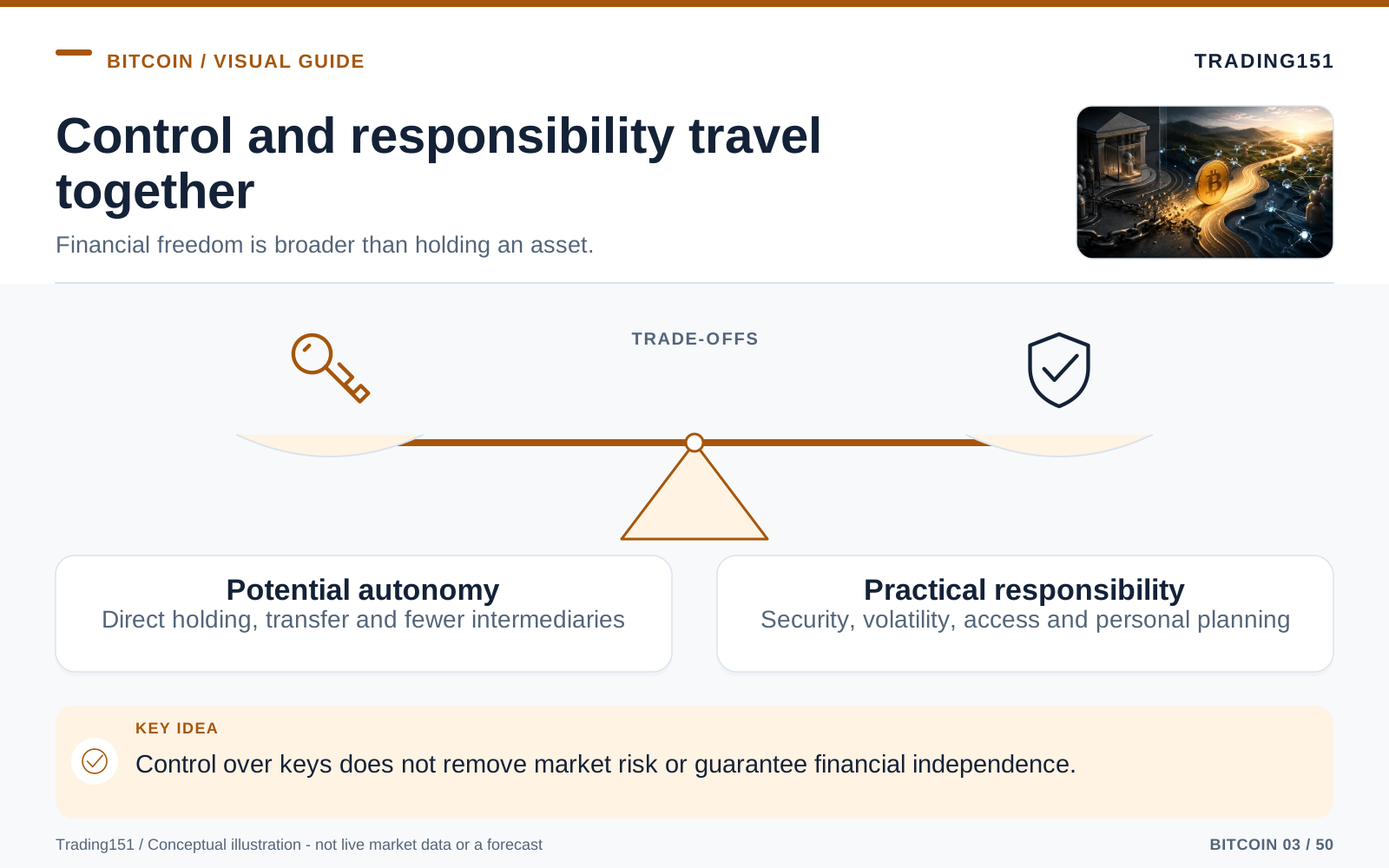
Read this diagram as text
- Potential autonomy
- Direct holding, transfer and fewer intermediaries
- Practical responsibility
- Security, volatility, access and personal planning
Why Scarcity Changes the Conversation
Bitcoin's boldest feature is also its simplest to explain: there will only ever be 21 million of them. That's not a slogan cooked up by a marketing team. It's baked into the network's code and enforced by thousands of independent participants scattered across the globe. No central bank gets to vote for more. No CEO can quietly issue extra supply. No emergency session can rewrite the rule because a government suddenly needs cash or a bank needs bailing out.
Scarcity itself isn't new, of course. Gold is scarce. Prime real estate is scarce. Fine art is scarce. What sets Bitcoin apart is how precisely its scarcity is enforced. Rising gold prices make mining more attractive, which eventually pulls more gold out of the ground. Land gets rezoned, subdivided, developed. Companies issue more shares whenever it suits them. Governments print more currency almost as a reflex. Bitcoin was built to resist all of that.
That's why so many people call it a savings technology rather than a currency. It hands you a way to hold a fixed slice of a monetary network — one that can't be diluted no matter what political pressure comes calling. Own a certain amount today, and you own that same fraction of the total supply tomorrow. Nobody can water it down by deciding to mint more.
If you've spent your whole life watching money lose value, that's a strange thing to wrap your head around. Bitcoin doesn't ask you to trust a committee with your purchasing power. It asks you to trust open rules, open-source code, math, and a network of people who all have skin in the game to keep it honest.
Of course, being scarce doesn't automatically make something valuable — a weirdly shaped rock in your backyard is technically one of a kind, and nobody cares. What makes Bitcoin matter is the whole package: scarcity paired with portability, divisibility, durability, verifiability, and the ability to move across the planet in minutes. You can send it across a border. Split it into tiny fractions. Store it without a vault. Verify it without trusting anyone's word for it. And anyone who knows how to protect a private key can hold it, full stop.
That combination is what turns Bitcoin from a quirky digital curiosity into something that challenges how we think about money.
Financial Freedom Begins With Control
Financial freedom isn't just about having more zeros in an account. It's also about controlling the money you already have. That control has value even if you never use it dramatically. Just knowing your savings can move without waiting on a bank's business hours, without being tied to one institution, without depending on someone else's approval — that opens up options. It doesn't guarantee that local laws, internet access, exchange markets, or your own personal safety will all cooperate. Bitcoin changes who gets to authorize a transaction. It doesn't erase every other dependency around it. Freedom grows at the edges — an extra path that stays open when the usual ones shut down.
In the traditional financial world, most people don't hold their own money. They hold a claim on money that lives inside banks, payment processors, custodians, and brokers. Most of the time that's fine — convenient, even. Your paycheck lands, your card works, the app opens without a fuss, and the whole system fades into the background. But it only stays invisible while it's working in your favor.
Accounts get frozen. Transfers get blocked. Withdrawals get capped. Payment platforms cut off access without much of an explanation. Banks end relationships and don't always say why. Governments slap on capital controls the moment a crisis hits. None of that feels real if you've lived somewhere stable your whole life. But for millions of people, it's not a hypothetical — it's Tuesday.
Bitcoin flips that relationship. When you hold it in a wallet you control, you're not waiting on a bank to say yes. You hold the keys — — that let you move it. It lives on a global network, and you can send it according to that network's rules, not according to whatever mood a middleman happens to be in.
This is what people mean by "be your own bank." It's an imperfect phrase, because being your own bank isn't always comfortable. Banks offer convenience, customer support, fraud protection, ways to undo a mistake. Bitcoin strips a lot of that safety net away. But it also strips away the gatekeepers. You get direct responsibility and direct ownership, bundled together, no separating the two.
That trade-off isn't right for everyone, in every situation. Still, just having the option is a big deal. You can hold value that's hard to seize, easy to carry, and reachable from almost anywhere on earth. With the right precautions, someone can cross a border carrying real wealth — not stuffed in a suitcase, not sitting in a bank account, but held in a recovery phrase they've memorized or safely stored. For people dealing with political upheaval, abusive financial control, or forced displacement, that's not a philosophical nicety. It can change everything.
Bitcoin as a Borderless Financial Network
One thing that's easy to underestimate about Bitcoin is just how open it is. Traditional finance is full of locked doors. Some need identification papers. Some need a minimum balance, a credit history, a fixed address, a relationship with a bank, or approval from a company that never has to explain itself. Billions of people either can't get reliable banking or live somewhere the banking system is shaky, overpriced, or tangled up in politics. Borderless settlement still has to touch down somewhere local on both ends — people earn, spend, and pay taxes in specific places, where prices, banking access, capital controls, and laws all differ. A Bitcoin transfer can cross the network with nothing resembling a passport check, but turning it into rent money or groceries usually still requires a market maker, a merchant, or another person willing to trade. The technology dissolves one kind of barrier while leaving others firmly in place. How useful it is depends on the tools and communities that connect the global ledger to real, everyday life.
Bitcoin doesn't ask where you were born. It doesn't care about your income, your social standing, your passport, your last name, or how well you get along with your bank manager. Anyone with internet access and enough know-how to use it safely can get in. That openness alone is one of Bitcoin's biggest contributions to financial freedom.
Picture a freelancer working from a country with a weak, unstable currency, taking on clients abroad. Traditional payment rails can be slow, costly, unreliable — money bouncing through several intermediaries, each one skimming a fee and tacking on delay. Someone sending money home to family might lose a painful cut to remittance fees. A small business might struggle just to get paid internationally because the banking system was never built with them in mind.
Bitcoin gives people like that another road. It's not magic — it doesn't fix everything overnight. You still need internet access, some education, liquidity, and tools simple enough to use without shooting yourself in the foot. But it opens up a global financial rail that's open by default, in a world where the existing system is usually closed by default.
For someone in a wealthy, stable country, Bitcoin might look mostly like an investment. For someone living through currency collapse, capital controls, or plain financial exclusion, it looks like something else entirely. It becomes a way to save outside a currency that's failing, receive money from family abroad, or carry wealth through genuine uncertainty. What seems abstract from a comfortable distance turns deeply practical the moment your local currency can no longer be trusted.
The Emotional Weight of Owning Hard Money
There's also a psychological side to Bitcoin that doesn't show up neatly in any financial model. Plenty of people find their way in chasing a price chart, but a lot of them stick around because it quietly changes how they think about time, spending, and responsibility.
When money loses value with every passing year, spending it fast starts to feel like the rational move. Why hold cash that'll buy less next year? Why put off a purchase when prices only climb from here? That mindset feeds consumption, debt, and short-term thinking — not because people are careless, but because the environment trains them to behave that way.
Bitcoin nudges people toward a different mindset. When you believe you're holding something scarce with long-term demand, you tend to think twice before spending it. A small purchase stops being just a small purchase. It becomes a real question: do I want this right now, or would I rather hold on to that value for later?
That question carries more weight than it seems like it should. It doesn't mean giving up on life's small pleasures or turning your morning coffee into a spreadsheet exercise. Financial freedom was never about becoming cold or joyless. But Bitcoin has a way of sharpening the line between what you need, what brings you joy, and what's just empty consumption. It can slow you down in a culture that's engineered to keep you spending.
Economists sometimes call this "lowering time preference" — choosing long-term stability over instant gratification. In plain English: thinking further down the road. Caring more about who you'll be in ten or twenty years. Building a life around patience instead of panic.
That's one of Bitcoin's quietest but most meaningful effects. Someone who learns to save, wait, and think for themselves has already taken a real step toward freedom — no matter what the market's doing this particular week.
Volatility Is Real, and So Is Responsibility
Any honest conversation about Bitcoin has to admit this much: the ride can be severe. Its price can swing in ways that would give anyone coming from a savings account, or even a typical stock portfolio, whiplash. It can shoot up fast, crash just as fast, and test the resolve of anyone who bought in for the wrong reasons or with money they couldn't afford to lock away.
That volatility isn't a footnote — it matters. If you need cash for rent, a medical bill, payroll, anything with a deadline, you can't treat Bitcoin like a stable bank balance. The price can turn on you at exactly the worst possible moment. Anyone ignoring that risk isn't pursuing financial freedom — they're gambling with stress they may not be able to afford.
But you also have to put that volatility in context. Bitcoin is still in the process of being monetized by the entire world, in real time, moving from obscurity toward broader recognition. Markets are still figuring out what a decentralized, fixed-supply, global digital asset is even worth. That process is messy by nature. It was never going to happen in a straight line.
People who take Bitcoin seriously tend to learn to think in years, not days. They don't build their whole life around short-term swings. They study security, steer clear of leverage, and understand that self-custody is powerful but unforgiving. Lose your private keys and there may be no getting them back. Send funds to the wrong address and there's no undo button. Fall for a scam and there's no institution standing by to make you whole again.
That's the hard edge of sovereignty. Bitcoin hands you control, but it doesn't erase the consequences that come with it. It rewards education, patience, and humility — and it punishes carelessness without mercy. Some people find that concerning. Others say that's precisely the point. They'd rather carry that responsibility themselves than live under a system where someone else can change the rules whenever it's convenient for them.
Bitcoin Is Not a Shortcut
One of the worst things to happen to Bitcoin's reputation is the constant promise of easy money. Every bull run drags in a wave of hype, influencers, wild predictions, and people treating it like a lottery ticket. That noise gets attention, but it buries the actual point of the technology. Financial freedom almost always starts with the boring stuff: manageable debt, a real emergency fund, useful skills, insurance where it makes sense, and spending habits that leave room to breathe. Bitcoin can support those foundations — it can't replace them. Go too heavy on it and you might create the opposite of freedom, where every price swing becomes an emergency. The real version of this idea isn't a sudden escape hatch through speculation. It's the slow, steady ability to hold some value under rules you can verify, while keeping the rest of your life stable.
Bitcoin isn't a way around discipline. It doesn't erase the need to work, budget, learn, save, or make sound decisions. It doesn't promise wealth. It won't save you from bad timing, emotional trading, scams, or plain overconfidence. Anyone treating it as a guaranteed path to luxury is misreading both Bitcoin and what freedom means.
Financial freedom is rarely dramatic. Usually it's built slowly, piece by piece — cutting dependence, building resilience, owning assets thoughtfully, steering clear of debt you don't need, and making choices your future self will thank you for. Bitcoin can be part of that story because it hands people access to money that can't be inflated on a whim. But it's a tool. Not a spell.
The people who tend to get the most out of Bitcoin usually aren't the loudest voices online. They're the quiet savers, the patient learners, the small business owners protecting their margins, the parents thinking about their kids' future, the workers stuck in unstable economies — people who just want an asset nobody can quietly water down for political convenience.
The Deeper Meaning of Separation
Bitcoin gets described a lot as "the separation of money and state." Sounds abstract, but the idea underneath it isn't complicated. For most of modern history, governments have run the money. They decide what counts as legal tender, steer its supply, regulate how it moves, and use the banking system as an extension of policy. Sometimes that power gets used responsibly. Sometimes it doesn't. Either way, the average person has almost no say in it.
Bitcoin exists outside that entirely. No government has to create it. No central bank manages it. No commercial bank moves it around on your behalf. It runs on rules anyone can see, changed only through broad consensus. At a moment when trust in institutions is running thin, that kind of transparency counts for something.
That doesn't mean Bitcoin is about to replace every currency or make governments obsolete — the world's more complicated than that. People will keep using national currencies for taxes, wages, everyday spending, and a hundred practical reasons. Bitcoin doesn't need to replace all of that to matter. Its existence alone gives people an alternative. It's a check against monetary systems that used to have zero real competition.
That alternative matters because freedom often starts with simply having the option to opt out. You might never use Bitcoin day to day. You might not want your wealth tied up in it at all. But the fact that a neutral, borderless, scarce monetary network now exists shifts the balance of power a little. It's a quiet reminder to institutions that people aren't locked into one system forever.
Keep control and purchasing power separate
Imagine someone who can securely authorize a bitcoin payment but needs to pay a fixed rent bill next week. Their control over the asset has not changed if its market value falls. Their ability to meet the bill has. This is why operational independence and financial resilience should be considered separately rather than treated as two names for the same benefit.
Start with the obligation. What amount is due, in which currency, and on what date? Then consider the route from the asset you hold to the payment you need to make. That route may involve an exchange, a bank, a merchant's payment service, or local trading liquidity. A transfer that is possible at the network level may still be inconvenient or costly in the circumstances that matter to you.
Self-custody also creates duties that a bank account usually delegates. Someone must protect the backup, recognize a fraudulent request, and leave usable instructions for an emergency. These are manageable tasks for some people and a substantial burden for others. Complexity is not evidence of independence; sometimes it creates a new form of dependence on a technically skilled relative or a service provider.
A more grounded idea of freedom includes room to make mistakes. Accessible emergency savings, limited debt, sensible asset exposure, and a recovery plan can matter more than an uncompromising position on any one technology. Bitcoin can be part of that discussion without being made responsible for every part of a person's financial life.
Independence has an operating cost
Financial freedom can mean different things: the ability to make a payment without an intermediary's permission, the ability to leave an unsuitable provider, or enough savings to stop working for a period. Bitcoin may relate to one of those goals without solving the others. A person can control their keys and still be unable to cover an unexpected bill after a price decline.
Separate the goals before deciding how much responsibility to take on. Money needed for routine expenses has a different job from a long-term speculative holding. A self-custody setup also needs time for backups, recovery planning, software maintenance, and safe transactions. Those tasks are manageable for some people and burdensome for others. Declining to manage them personally is not evidence of a lack of conviction.
The strongest form of independence often includes alternatives. Keep a way to meet essential obligations when an exchange is unavailable, a device fails, or a recipient does not accept Bitcoin. Avoid building a plan that requires every part of the system to work perfectly at the same moment. Control is valuable when it expands realistic choices; it is less useful when the pursuit of control removes the practical fallbacks that daily life requires. 1, 2
Freedom Comes with Operational Work
At the core of it, financial freedom was never really about money. Money's just the tool. What people want is agency — the ability to choose their work, protect the people they love, walk away from a bad situation, get through a crisis, build something that matters, and move through life without every decision being dictated by financial fear.
Bitcoin matters because it hands people a new route toward that agency. It's a form of property that's scarce, portable, divisible, verifiable, and hard to censor. It lets people hold value outside a system that can quietly water down their savings with a single policy decision. It gives people in collapsing economies a way to preserve wealth when their local currency can't be trusted. It offers the unbanked a door into a global financial network. It rewards savers for their patience. And at the very least, it hands everyone a choice they didn't used to have.
None of that makes Bitcoin perfect. It's volatile. It demands real responsibility. It can be confusing at first. It attracts hype, scammers, and shallow speculation like moths to a porch light. But none of that erases what it introduced to the world: money that no central authority can print, freeze, or quietly weaken whenever it's convenient for them.
For some people, Bitcoin will end up being an investment. For others, insurance. For plenty, it'll just stay something they watch from a distance and never touch. But for those who get why it exists, Bitcoin taps into something deeply human — a refusal to accept that a lifetime of work should be at the mercy of decisions made by distant institutions you'll never meet.
It's not a promise that life gets easier. It's not a guarantee of wealth. It's not a substitute for good judgment, patience, or responsibility. But it is a tool for people who want to hold something that can't be printed away, can't be carried only with someone else's permission, and can't be taken just because a middleman changed their mind.
In a world where so much feels unstable, that kind of ownership is more than just a clever piece of technology. It's a quiet form of dignity.
And for a lot of people, that's exactly where financial freedom begins.
Sources and further reading
- SEC Investor Bulletin: Crypto Asset Custody Basics for Retail Investors
- Bank of England: Money Creation in the Modern Economy
Editorial revision: 7 October 2026. Numerical scenarios are hypothetical unless identified as historical. References support the added explanations and selected corrections; rules and product terms should be checked again before acting.