
The Bitcoin whitepaper describes a way to make electronic payments without relying on a trusted intermediary to prevent double spending. Its central contribution is the combination of digital signatures, a peer-to-peer network, proof of work, and an incentive structure for maintaining a shared transaction history. It is a concise proposal, not a complete manual for every feature, wallet practice, or policy debate that developed afterward.
The Real Problem: Digital Money Is Too Easy to Copy
Satoshi kicked things off with a frustration we all know. Buying things online means relying on financial gatekeepers. Whether you’re grabbing coffee, Venmoing a buddy, or paying a contractor overseas, there's always a middleman sitting there, updating the ledger and deciding if your money is good.
To be fair, those middlemen do real work. They make sure you have the cash, stop scammers, and reverse charges if you get ripped off. They keep the master list of who owns what. But that also gives them total control. They can freeze your account, block a payment, hit you with ridiculous fees, and demand your personal data—and if they mess up, good luck fighting them.
But the root of the problem isn't that banks are cartoon villains. The real issue is that digital money, unlike cold hard cash, isn't naturally scarce.
Think about it: if I hand you a twenty-dollar bill, it’s gone from my wallet. It’s physical, and the transfer is final. But if I send you a digital file? I still have a copy on my hard drive. A photo, a PDF, an MP3—they can be duplicated a million times over. That’s the magic of the internet, but it’s an absolute nightmare if you're trying to invent digital money.
Imagine a digital dollar that worked like a JPEG. I could email it to you, email the same file to my landlord, buy a pizza with it, and still keep a copy for myself. Everyone thinks they got paid, but the currency would become worthless the second people realized it was just a copy-paste job.
That right there is the double-spending problem. It’s the final boss that the Bitcoin whitepaper set out to defeat.
Before Satoshi came along, the workaround was obvious: just hire a referee. A bank keeps the master spreadsheet. When you swipe your card, the bank checks the spreadsheet to see if you have the funds. If you’ve already spent them, the payment bounces.
It works, sure. But it puts all our trust right back into a central authority. Satoshi wanted something weirder and much more ambitious: a system where the network itself could agree on who owned what, without asking anyone for permission.
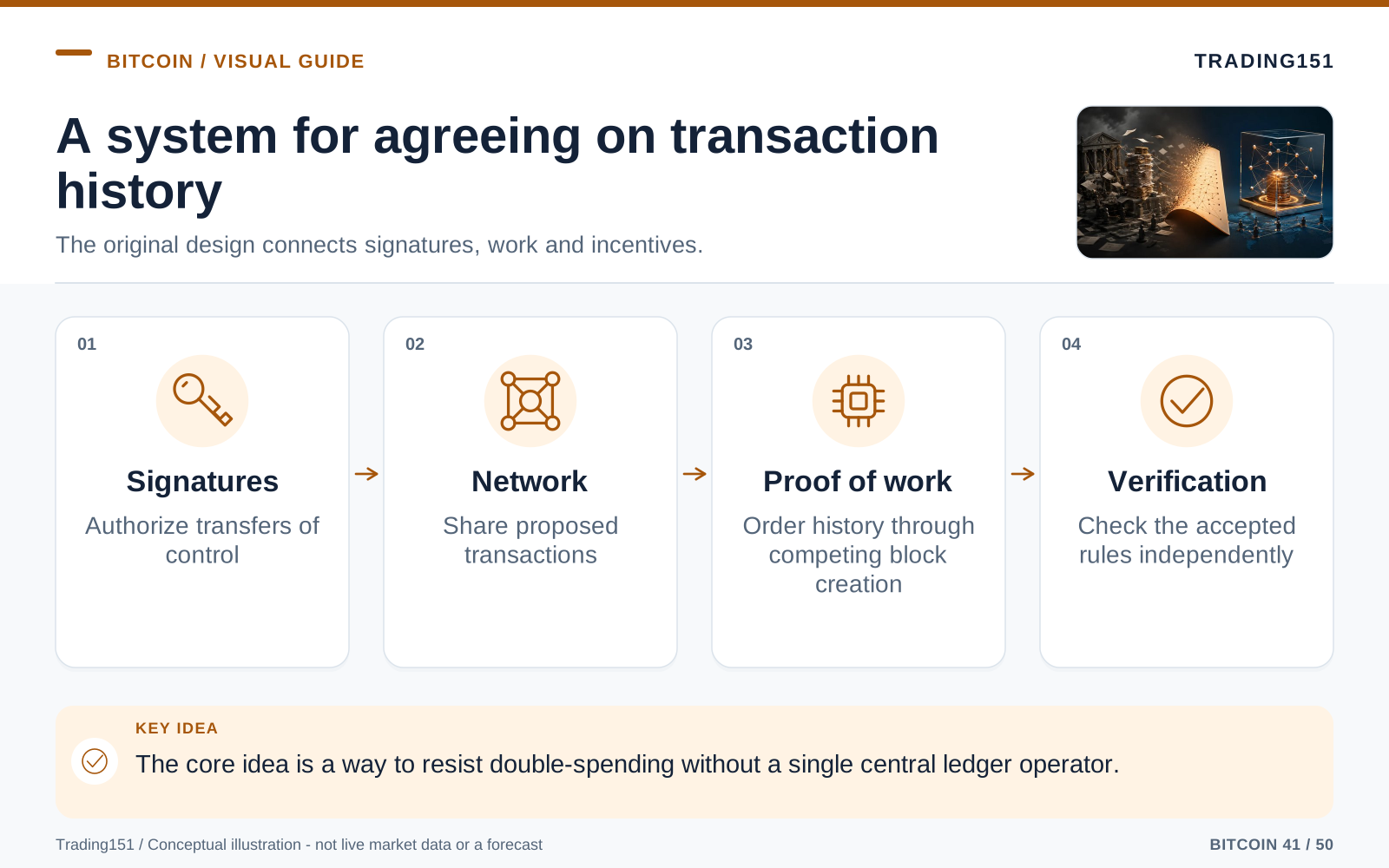
Read this diagram as text
- Signatures
- Authorize transfers of control
- Network
- Share proposed transactions
- Proof of work
- Order history through competing block creation
- Verification
- Check the accepted rules independently
Replacing the Bank Ledger with a Public One
The best way to wrap your head around Bitcoin is to picture a giant, public notebook that anyone in the world can read and copy. But you don't just take turns writing in it. Instead, everyone keeps their own identical copy, and they only write down new transactions if those updates follow strict rules. Specialized computers (miners) suggest the order of new entries, and everyone else checks their math. This separation of powers is huge: it stops the people doing the heavy lifting from just inventing free money for themselves. The whole network agrees on the truth through independent math-checking, rather than blindly trusting one master copy kept in a vault.
Imagine a small town that ditches physical cash. Instead, everyone carries the same notebook. When Alice wants to give Bob ten bucks, she stands in the town square and yells, "I'm paying Bob ten dollars!" Everyone hears her and jots it down.
Later on, if Alice tries to give that same ten dollars to Charlie, the town just checks their notebooks. It’s glaringly obvious she doesn't have the money anymore. The payment to Charlie is flat-out rejected.
Nobody "owns" this notebook. No single person can sneak in and rewrite history. It works precisely because everyone has a copy and can cross-check each other.
Bitcoin just takes that small-town dynamic and scales it to the internet. Instead of villagers, you have computers running software. Instead of people yelling in a square, digital transactions are broadcast across a large global network. Instead of a bank’s locked-down database, you have a ledger that belongs to everyone.
That’s the real magic behind the phrase peer-to-peer electronic cash. "Peer-to-peer" just means people talking directly to people. No Visa or Mastercard swiping an approval. No bank manager holding the vault keys. And absolutely no central server that a hacker or government can unplug to kill the system.
But sharing a public notebook creates a complication: what happens when rumors travel at different speeds? What if Alice sends that same digital coin to Bob and Charlie at the same millisecond? Half the world might hear about Bob first, while the other half thinks Charlie got paid. Who wins?
In our imaginary village, people could just argue it out until they agreed. But on the internet? There is no town square. Data moves at weird speeds, computers crash, and people absolutely lie. The network desperately needed a way to universally agree on which version of history happened first.
And that is exactly where Satoshi’s design goes from "interesting" to "genius."
Transactions Need Signatures
Before the network can even begin to figure out what happened first, it has to know if a transaction is real.
In the whitepaper, Satoshi describes coins as a "chain of digital signatures." That sounds super abstract, but the reality is pretty simple. If you own bitcoin, you hold a private key—essentially a hyper-secure password. That key lets you stamp a transaction with a digital signature, proving you have the right to spend those specific coins.
We aren't talking about a scanned copy of your handwritten signature. A digital signature is pure math. It proves beyond a shadow of a doubt that whoever holds the private key authorized the payment, without ever revealing what the key is.
Think of it like a medieval wax seal that only your specific ring can create. Anyone can look at the wax and know it was you, but they can't melt it down and use it to seal a different letter. In Bitcoin, that signature is mathematically glued to the transaction. If a hacker tries to change the amount or the destination address, the signature instantly breaks and becomes invalid.
Because of this, anyone on the network can verify a payment without knowing a single thing about who you are. They don't need your driver's license, your mother's maiden name, or your credit score. They just need the math to check out: the signature is valid, and the coins haven't been spent yet.
That elegantly solves the "permission" problem. But it still leaves us with the nightmare of getting everyone to agree on the timeline.
Turning Time into a Chain
Satoshi’s whitepaper introduces something called a timestamp server. But forget about a corporate data center stamping receipts. This one is entirely decentralized. It works by scooping up pending transactions, throwing them into a batch (a "block"), and permanently linking those blocks together in a strict chronological order.
Inside each block is a bundle of transactions. Once they're packed together, the whole block is run through something called a cryptographic hash function.
People usually compare a hash function to a digital fingerprint machine, which is pretty spot-on. You can feed it a single word, a 500-page novel, or a large block of financial data, and it will spit out a totally unique string of random-looking letters and numbers. If you feed it the same data, you get the same fingerprint.
But here is the kicker: if you change just one comma, one pixel, or a single digit in a transaction, the resulting fingerprint changes completely. It doesn't look even remotely similar.
Satoshi’s brilliant trick was making sure that every new block includes the fingerprint of the block that came just before it. Block 2 holds the hash of Block 1. Block 3 holds the hash of Block 2. And so on, forever.
This weaves an unbreakable chain of evidence. If some scammer goes back and tries to tweak a transaction from last week, the fingerprint of that old block instantly changes. But wait—the next block was already holding the old fingerprint. So now that block is broken too. The error ripples forward, shattering the entire chain like glass.
That’s what a "blockchain" is, even though the whitepaper barely uses the word. It isn't a trendy buzzword; it's just history, mathematically glued together so it can never be rewritten.
But we still have one loose end. If making these blocks was easy, a smart hacker could just whip up a fake, alternate-reality chain where their money was never spent. To stop that, the system had to make rewriting history agonizingly expensive.
Proof-of-Work: Making Cheating Expensive
Enter proof-of-work: the beating heart that keeps Bitcoin’s public ledger safe from tampering.
To officially add a new block to the chain, miners have to find a specific hash that fits a crazy set of rules. In plain English? The network forces computers to solve a sharply difficult guessing game. It’s hard to find the right answer, but once someone finds it, it takes everyone else half a second to verify it.
Picture a large, global lottery. Miners bundle up the latest transactions, then endlessly tweak a tiny piece of random data, running it through the fingerprint machine millions of times a second. They’re just hoping to spit out a hash that starts with enough zeros to pass the test. There’s no cheat code. You just have to brute-force it until you get lucky.
The second a miner hits the jackpot, they blast their block out to the rest of the network. The other computers don't have to do the heavy lifting—they just glance at the winning ticket, confirm the math is right, and make sure all the transactions are legit.
That imbalance is everything. Creating a block takes immense real-world effort. Checking it is basically free.
Proof-of-work is ultimately a way to vote on what's real, without needing user accounts. On the internet, it’s trivially easy to fake who you are. You could spin up a million fake bots right now. If Bitcoin let "accounts" vote on which transactions were real, a hacker with a botnet would take over in five minutes.
So instead, Bitcoin counts computational work. Your influence in the network is tied directly to your computing power, and computing power requires cold, hard cash. You need expensive hardware, mountains of electricity, and large cooling fans. You can’t fake a million computers.
This is what Satoshi meant by one CPU, one vote. Back in the day, a normal laptop could mine. Today, it’s giant warehouses of specialized machines. But the rule hasn't changed: the network always follows the chain that has the most verifiable, sweaty, energy-burning work poured into it.
That simple rule solves all the arguments. If the network accidentally splits and two valid chains emerge at the same time, everyone just looks at which one has more proof-of-work behind it. The shorter, weaker chain is abandoned, and the world moves on with a single version of the truth.
Why Rewriting Bitcoin Gets Harder with Time
One of the slickest concepts in the whitepaper is how it handles a done deal. With a credit card, a payment is final when the bank manager says it is. In Bitcoin, a payment simply gets harder and harder to undo the older it gets.
Let’s say a scammer buys a laptop with bitcoin, walks out of the store, and then tries to spin up a fake, alternate blockchain where he never sent the money. To pull that off, he has to redo the monumental proof-of-work for the block that held his payment, and then somehow outpace the entire honest network of miners who are already building the next blocks.
It’s not like fixing a typo in an Excel sheet. It’s like trying to lap an Olympic sprinter when they’ve already had a five-minute head start.
Every new block that gets stacked on top of your transaction buries it under a mountain of fresh computational work. That’s why crypto people obsess over "confirmations." If your payment is in the newest block, you have one confirmation. Wait ten minutes for the next block, and you have two. By the time you hit six blocks, reversing that payment would require an astronomical amount of energy and money.
Satoshi wasn't naive; he never claimed the system was foolproof. The whitepaper is super grounded in probability. It basically says, "Look, as long as honest people control more computing power than the bad guys, the good chain will grow faster. And the odds of a hacker catching up drop to near-zero as time goes on."
Put simply: Bitcoin isn't secure because people promise to be nice. It’s secure because cheating is financially ruinous.
The Incentive That Keeps the Machine Running
You can't build a global financial network on good vibes. People don’t drop millions of dollars on hardware and electricity just for the fun of processing a stranger's coffee purchase.
Satoshi knew this deeply. The whitepaper’s section on incentives is brief, but it’s the glue that holds the entire experiment together.
Miners get paid in two ways. First, whoever wins that block-guessing lottery gets to write a special transaction that creates brand-new bitcoin out of thin air, and they pay it directly to themselves. That’s the "block reward," and it’s how new bitcoin enters the world.
Second, they collect transaction fees. If you want your payment processed quickly, you attach a little tip. As the years go on and the block reward slowly dries up, those little tips are meant to become the main way miners get paid to keep the lights on.
This is why we call it "mining." Just like striking gold in a mountain requires heavy labor and diesel fuel, Bitcoin miners burn computing cycles and electricity to unearth new digital currency, securing the network in the process.
The absolute genius here isn't just that they get paid. It's that the paycheck directly aligns their greed with the health of the network.
A large mining farm has a choice. They can play by the rules, secure the network, and stack up highly valuable bitcoin. Or they can try to attack the system, risk burning millions of dollars in electricity, ruin everyone's trust in the network, and tank the value of the very coins they're trying to steal.
Satoshi’s design essentially weaponizes human greed to protect the system. It doesn’t ask anyone to be a saint. It just sets up a game where playing fair is the most profitable move on the board.
Why the Supply Schedule Matters
The whitepaper doesn't spend pages ranting about inflation or "hard money," but the way the mining reward is structured quietly dropped a bombshell: the creation of new money is dictated by code, not by a committee of financial professionals.
In the real world, central banks can just print more money or pull it out of circulation whenever they want. Maybe they're fighting a recession, maybe it's a political maneuver—whatever the reason, they have their hands on the dials.
Bitcoin doesn't have dials. Its supply schedule is hardcoded into the software. New coins are minted purely through mining, and the amount given out gets sliced in half every four years. There is no board of directors meeting in secret to decide if the world needs more bitcoin next quarter.
That relentless, predictable scarcity is a large part of why people care about it today. Diehards view it as the ultimate shield against inflation. Skeptics think a rigid money supply is an economic disaster waiting to happen. Satoshi, true to form, stayed out of the macroeconomic debate and kept the whitepaper strictly focused on the plumbing.
But the message was loud and clear: money doesn't have to rely on human judgment. It can be governed purely by math, consensus, and economic gravity.
Saving Space Without Losing the Plot
Once the core engine is built, Satoshi pivots to a very practical headache: if every transaction is recorded for eternity, won't this database eventually get too large for normal people to download?
The fix involves something called a "Merkle tree." It sounds like something out of Lord of the Rings, but it’s just a clever way to compress data.
Think of a Merkle tree as a way to boil down thousands of transactions into one tiny cryptographic fingerprint. Transactions are paired off and hashed together, then those hashes are paired and hashed again, shrinking down until you're left with a single string of text called the Merkle root. That little root is all that needs to go into the block's main header.
Why does this matter? Because it means you don't need to download the entire history of the world to prove your specific payment went through. You just need a tiny slice of the math that connects your transaction to that root. It's like proving a specific leaf belongs to an oak tree without having to uproot and carry the entire tree in your backpack.
Satoshi also pointed out that once a coin has been spent and buried under months of new blocks, nodes can safely delete the old, bulky transaction details to save hard drive space. The essential block headers stay forever, keeping the chain intact, but the digital clutter gets tossed out.
This wasn't an accident. Satoshi wanted regular people to use this thing. He knew that if Bitcoin required server-farm levels of storage, it would immediately become centralized. Merkle trees were his way of keeping the door open for the little guy.
Simplified Payment Verification
That brings us to Simplified Payment Verification, or SPV. This was Satoshi’s olive branch to people who just wanted to use Bitcoin on a laptop or phone without downloading the entire history of the universe. The whitepaper basically outlines a "lightweight" mode. It lets an app check that a payment is locked in by proof-of-work without needing to download and double-check every transaction in history. It saves battery and storage, but it fundamentally shifts who you're trusting. A lightweight app relies on the network meaning it might occasionally be tricked if a bad actor manages to fake enough proof. It’s a vital section because it proves Satoshi knew from day one that strict decentralization requires trade-offs.
A "full node" is the hardcore route. It downloads every block, checks every math problem, validates every signature, and trusts absolutely no one. It is the purest way to use Bitcoin, but it eats up bandwidth, storage, and patience.
An SPV wallet is the casual route. It only grabs the tiny block headers and basically asks the rest of the network, "Hey, did my transaction make it in?" It operates on the assumption that whatever chain has the most proof-of-work is probably telling the truth.
This is why mobile crypto wallets exist. Your phone doesn't need to hold the entire ledger; it just needs enough data to be reasonably sure you got paid.
But there’s a catch, and the whitepaper is very upfront about it. SPV is convenient, but you sacrifice a bit of that unbreakable independence. Once again, Satoshi wasn't writing utopian fan-fiction. He was an engineer offering practical tools: run the heavy software if you want absolute certainty, or run the light software if you want convenience.
Privacy, But Not the Kind People Expect
People love to say Bitcoin is completely anonymous. The whitepaper paints a much more nuanced picture. Bitcoin isn't a shadow economy; it’s radically transparent, but pseudonymous.
In your normal bank account, your spending is hidden from your neighbors, but fully visible to the bank. Your privacy completely hinges on whether the bank (and the government) decides to keep your secrets safe.
Bitcoin flips that upside down. The ledger is completely public. I can go online right now and watch millions of dollars move between accounts in real time. The catch? By default, there are no names attached to those accounts—just random strings of letters and numbers.
You can see that Wallet A sent money to Wallet B, but you don't inherently know who owns them. The privacy comes from keeping your real-world identity decoupled from your digital wallet.
But it's a pretty fragile shield. The moment you link your identity to an address—say, by shipping a physical package to your house, using a regulated exchange, or posting your wallet address on Twitter—the illusion breaks. Because the ledger is public forever, anyone can look at your transaction history, find patterns, and trace where the money went. It’s a transparency dream, but a privacy minefield.
Satoshi advised users to generate a brand-new wallet address for every transaction to keep people from connecting the dots. That advice holds up today. Bitcoin doesn’t give you an invisibility cloak; it just changes the rules of who gets to see what, and forces you to be smart about your own digital footprint.
What Bitcoin Did Not Try to Solve
To really get the whitepaper, you have to appreciate what it flat-out ignores. The document makes zero promises about making you rich, stabilizing the economy, replacing credit cards at the grocery store, or protecting you from real-world scams. It doesn't care how governments will react, and it doesn't offer a customer service hotline if you lose your password. Its scope is hyper-focused: stop double-spending in a purely peer-to-peer network without relying on a middleman. Today, people project their wildest political and economic fantasies onto these nine pages, but the actual text is just raw, brilliant engineering.
It doesn't guarantee your money will hold its value. It doesn't guarantee you won't accidentally delete your own keys. It doesn't promise free or instant transfers. It doesn't even boldly claim it will become the global reserve currency.
It is infinitely narrower—and because of that, infinitely stronger. It just explains a mechanism for sending value over the internet without a trusted middleman. It solves the double-spend problem, orders the timeline, pays its security guards, and makes hacking economically suicidal.
That restraint is what makes it so legendary. Satoshi didn’t write a screaming manifesto. While the philosophical ripple effects are large, the tone is pure computer science. Identify a bottleneck, build a machine to bypass it, and prove the math works.
Spend ten minutes on crypto Twitter and you'll hear a lot of wild theories that have absolutely nothing to do with this document. Some are fascinating, some are cultish. But the whitepaper itself doesn't need to scream to be heard. The idea was heavy enough to drop the mic on its own.
The Older Ideas Bitcoin Pulled Together
Contrary to the myth, Bitcoin wasn't pulled out of thin air. Satoshi stood on the shoulders of decades of work from cypherpunks, cryptographers, and digital privacy nerds.
People had been circling these ideas for a long time. A project called Hashcash used proof-of-work years earlier just to stop email spam. Another concept, b-money, sketched out a decentralized currency. Others played around with digital scarcity and cryptographic proofs.
Satoshi’s real stroke of genius wasn't inventing every piece from scratch. It was figuring out how they all fit together.
He took public-key cryptography, peer-to-peer networking, proof-of-work, and financial game theory, and snapped them together into an engine that fueled itself. The signatures handle ownership. The blocks handle time. The proof-of-work defends the timeline. The block rewards pay for the defense. And the "longest-chain" rule stops the arguments.
That’s why the paper is only nine pages long. There’s no fluff. Every paragraph introduces a load-bearing pillar. Knock one out, and the whole temple collapses.
Why the Whitepaper Still Matters
Over a decade and a half later, this weird little PDF still commands an insane amount of respect. It isn't flashy. It isn't padded with corporate jargon or designed to woo Silicon Valley billionaires. But it fundamentally solved a logic puzzle that the smartest people in the room had given up on.
Its blast radius extends way past Bitcoin. That nine-page document lit the fuse on the idea that total strangers, who actively distrust each other, can still share a single source of truth without a boss telling them what's real. It birthed the entire crypto industry—blockchains, tokens, decentralized finance, and a mountain of spectacular failures and wild successes.
But the original blueprint is still the sharpest. Bitcoin wasn't just a slow database. It was an answer to a deeply paranoid question: how do you build a working system when everyone involved might be a selfish, lying, anonymous jerk?
That’s not just a tech question. That is a large philosophical breakthrough. It’s about organizing humanity without bosses. It’s about proving that trust doesn’t have to live in a bank vault—it can live in open, verifiable math.
Read the proposal alongside what the network later became
Begin with the problem of double spending. A digital signature can show that a transaction was authorized by the relevant key, but it does not by itself establish which of two conflicting authorized spends came first. The proposed network uses proof of work and a shared chain of blocks to make one transaction history increasingly costly to replace.
The paper's discussion of the longest chain refers to accumulated proof of work in context, not a modern rule that any chain with more blocks automatically wins. Validity still matters: full nodes reject blocks that violate the rules they enforce, regardless of how much work was spent producing them. Work selects among valid competing histories; it does not authorize arbitrary creation of coins.
Treat the privacy section as a limited design discussion. Public keys need not directly display legal names, but transaction information is public and activity can become linked to identities through exchanges, payment relationships, or analysis. The proposal does not promise complete anonymity in every use.
Separate the original argument from later implementation details. Wallet backup standards, script upgrades, mining infrastructure, and second-layer systems require their own documentation. The whitepaper is most illuminating when read for the problem it solves and the assumptions it makes. It should not be stretched into a guarantee about investment returns or a complete answer to every operational and economic question about Bitcoin.
Read the paper as a design argument
The white paper explains a proposed solution to a particular payment problem. It is not a complete description of every later wallet standard, protocol improvement, mining arrangement, or commercial service built around Bitcoin. Some practical questions therefore require later documentation as well.
Separate the paper's assumptions and mechanism from claims made in its name. A design for resolving double spending does not prove a future price, eliminate every form of trust, or establish that all applications described as Bitcoin-based inherit the same security. Reading the original argument carefully is more useful than treating the document as a general endorsement of everything that followed it. 1, 2
Nine Pages, One Durable Design
The whitepaper doesn't end with a bang. There’s no visionary mic drop, no price prediction, no promise to burn Wall Street to the ground. Satoshi just wraps it up with a calm summary: it’s a peer-to-peer network using proof-of-work to lock in a public timeline, and it stays secure as long as honest computers outmuscle the bad guys.
That quiet confidence is exactly what makes it so compelling. It doesn't ask you to believe in it. It just shows you the math and walks away.
Today, Bitcoin is a Rorschach test. Some see it as digital gold. Others see an inflation hedge, an environmental disaster, a protest against the Federal Reserve, or just a giant casino.
But if you strip away the noise, you’re left with the quiet, stubborn problem Satoshi set out to solve: letting two people exchange value over the internet without begging a middleman for permission.
The answer wasn't a startup. It wasn't an app. It wasn't a new fintech bank. It was a self-sustaining ecosystem of cryptography and greed, perfectly balanced so that anyone, anywhere, could agree on the truth.
That is the enduring legacy of the Bitcoin whitepaper. It took the squishy, messy concept of human trust and turned it into cold, hard code. Love it, hate it, or ignore it, those nine pages permanently rewired how the world thinks about money.
And the best part? The author dropped this absolute bomb on the world and then vanished like a ghost. There's no CEO to subpoena, no founder to cancel. Satoshi left the chat, but the machine he built just kept humming, block after block, exactly like the paper said it would.
Sources and further reading
Editorial revision: 7 October 2026. Numerical scenarios are hypothetical unless identified as historical. References support the added explanations and selected corrections; rules and product terms should be checked again before acting.