
Bitcoin's issuance rules make its supply different from a currency whose amount can expand through monetary and banking activity. That does not automatically make its market price a reliable hedge against consumer-price inflation. A useful hedge needs to behave well against a specified risk over the period that matters to its owner. Bitcoin's scarcity is a design feature; its purchasing-power performance remains a market outcome.
Inflation: The Slow Leak in Your Wallet
Inflation, in the textbook sense, is just prices rising across the board over time. When that happens, the same pile of cash buys less than it used to. Your dollars or euros or pounds don't vanish from the account — they just quietly weigh less than they did before.
Which is exactly why it feels so personal. Inflation doesn't live in a chart or a central bank press release. It shows up when the rent notice arrives, when lunch suddenly costs what dinner used to, when the family trip gets pushed back a year, when savings that once felt solid start to feel a little thin.
There's no single cause. Sometimes it's a supply shock — a war, a drought, a shipping bottleneck, a factory that can't reopen. Sometimes it's demand running hot, with more money chasing fewer goods than the economy can supply at last year's prices. Sometimes companies simply raise prices because the market lets them get away with it. And sometimes it traces back to monetary policy — a system flooded with new money and cheap credit.
The underlying logic isn't complicated. When the money supply grows faster than the supply of actual goods and services, each unit of that money tends to be worth a little less. It doesn't hit evenly, and it doesn't hit right away, but over time it can be rough on anyone sitting on a pile of cash and nothing else.
Cash still has its place — bills, emergencies, the stuff you need next week. But it was never built to grow. In most modern economies, it's meant to be spent or invested, not hoarded, and it slowly loses ground if you just let it sit. That's the whole reason people go looking for something that holds its value better than paper does.
Read this diagram as text
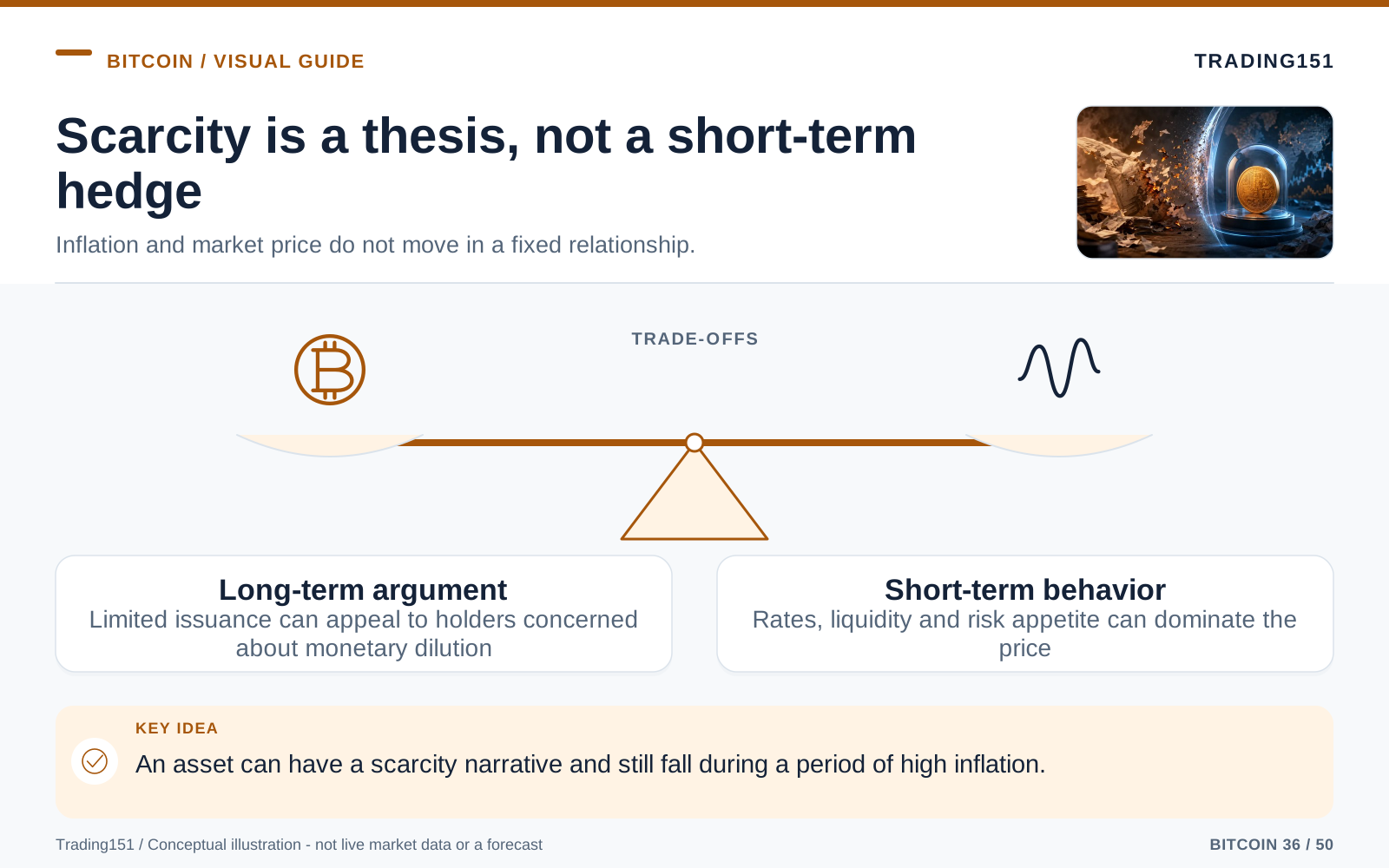
- Long-term argument
- Limited issuance can appeal to holders concerned about monetary dilution
- Short-term behavior
- Rates, liquidity and risk appetite can dominate the price
Why People Traditionally Run to Hard Assets
When people get nervous about their money being quietly diluted, they tend to reach for things that are hard to just make more of. Gold is the obvious one. It's been valued across every culture you can name for thousands of years, no government can print it, and pulling more of it out of the ground takes real labor, real machinery, real time.
Real estate has a similar pull. There's only so much land. A house is useful. In the right location, property does double duty as somewhere to live and somewhere to park wealth. When cash starts losing steam, something you can physically stand on tends to feel safer.
None of these are flawless, though. Gold is a pain to store safely, awkward to move around, and useless if you're just trying to buy groceries. Real estate needs serious upfront cash, comes loaded with taxes and upkeep, and you can't cash out overnight if you suddenly need to. Even stocks — which do a decent job protecting purchasing power over the long haul — leave you exposed to business cycles, bad management, and the occasional crash that wipes out years of gains.
Bitcoin showed up right when the world was primed to question all of this. We'd already moved communication, shopping, banking, entertainment, and most of our social lives online. So the idea of a store of value that was born digital, with no physical form at all, didn't sound as crazy as it might have a generation earlier. To some people, it started to sound almost inevitable.
The Birth of a New Kind of Scarcity
Bitcoin arrived in January 2009, right in the wreckage of the global financial crisis. Banks had collapsed, governments had rushed in to bail them out, and regular people watched institutions that had taken reckless risks get rescued anyway. Trust in the whole system was running on fumes.
Bitcoin's anonymous creator, known only as Satoshi Nakamoto, buried a message in the very first block of the blockchain: "The Times 03/Jan/2009 Chancellor on brink of second bailout for banks." Part timestamp, part statement of purpose. This wasn't just another digital payment gimmick. It was a direct answer to a financial system that a lot of people had come to see as too centralized, too fragile, and far too comfortable letting the public eat the losses while insiders kept the gains.
The core idea is radical when you sit with it: money that doesn't need a central issuer at all. No central bank pulling the levers. No company that can quietly change the rules of supply. No politician who can conjure up extra coins right before an election. The network runs on a global crowd of participants all following the same rulebook, enforced by code rather than by trust in an institution.
And the single most important rule is scarcity. There will only ever be 21 million bitcoin. More than 20 million are already in circulation, and the remaining fraction will trickle out over roughly the next century, with the very last coin expected sometime around 2140.
That hard cap is really the whole foundation of the inflation-hedge argument. Fiat currencies can be expanded whenever a government needs to fund a war, bail out a bank, or paper over a political mess. Bitcoin can't be. If demand goes up, the supply doesn't budge to meet it — the price has to absorb all the pressure instead.
The Case for Bitcoin as an Inflation Hedge
Nobody's arguing Bitcoin is calm — it clearly isn't. The argument is that it's scarce in a way ordinary money simply isn't built to be. For anyone who's lost faith in the long-term discipline of governments and central banks, that distinction matters a great deal. It helps to split the idea in two: there's an immediate inflation hedge, and there's a long-term debasement hedge, and they're not the same claim. A true short-term hedge should hold its value when a fresh inflation reading comes in hotter than expected. Bitcoin has never really done that with any consistency. The longer-term version of the argument is different — that a fixed-supply asset can appreciate over years if the pool of currency units keeps growing while demand for the scarce asset holds up. That's a defensible thesis on its own terms, even if it doesn't promise a clean, month-to-month correlation with inflation data. A lot of the confusion in this debate comes from people mixing up the two time horizons without realizing it.
1. Bitcoin Has a Hard Cap
Most national currencies have supplies that can flex. That's not automatically a bad thing — during a genuine crisis, a central bank stepping in with liquidity can be the difference between a rough patch and a depression. But that flexibility is also a temptation. Money that can be created tends to get created, sooner or later.
Bitcoin goes the other way entirely. Its monetary policy isn't flexible — it's deliberately locked down. The network doesn't care about election calendars, bank failures, budget shortfalls, or public pressure of any kind. Total supply climbs toward 21 million and then simply stops.
That rigidity is why people call it "hard money." Nobody can quietly water down every holder's stake by minting another 10 million coins out of nowhere. For anyone who worries about money printing, ballooning debt, and slow-motion currency debasement, that kind of certainty is appealing.
2. New Supply Keeps Shrinking
Bitcoin doesn't dump all its coins into circulation at once. New coins come out through mining, and the reward miners earn gets cut in half roughly every four years, in an event known as the halving. After the 2024 halving, the reward dropped to 3.125 bitcoin per block.
The halving matters because it means new supply keeps shrinking on a fixed schedule. Picture gold mining getting mechanically less productive every four years — not because anyone got lazy, but because the physics of the world itself changed to make it so. That's roughly what Bitcoin's code is doing on purpose. New coins get scarcer and scarcer until, eventually, they stop coming altogether.
That doesn't guarantee the price goes up — markets are never that obliging. But it does build a monetary structure that looks nothing like fiat money, where supply can expand any time policymakers decide it needs to.
3. It's Portable in a Way Gold and Real Estate Aren't
Scarcity isn't the only thing going for Bitcoin — it's also unusually easy to move. You can hold a meaningful chunk of wealth without a vault full of gold bars, without signing property deeds, without needing a functioning local bank. With the right setup, it can cross a border in minutes, or sit safely with just a hardware wallet and a recovery phrase, no institution required.
That matters most in places where inflation isn't a talking point but a daily reality. Where the local currency has effectively collapsed, or capital controls make it hard to get money out of the country, Bitcoin stops being a speculative bet and starts looking more like an escape hatch.
None of this makes it easy or risk-free. Self-custody demands real care. Mistakes can be permanent — there's no customer service line to call. Scams are everywhere. Still, being able to hold and move value without asking anyone's permission remains one of the more useful things about it.
4. Institutional Acceptance Has Changed the Conversation
In Bitcoin's early days, it was easy to write off as some fringe internet curiosity. Not anymore. Major banks, public companies, payment platforms, and asset managers have all built real products around it. Spot Bitcoin ETFs gave everyday investors an easy way in, and corporate treasuries started holding it — conversations that would have sounded absurd in a boardroom a decade ago.
None of that proves Bitcoin is safe, and it certainly doesn't make it crash-proof. But it does show the asset has drifted from the fringes into the financial mainstream. And the more infrastructure gets built around it, the harder it gets to write off as a fad that'll simply fade away.
The Case Against Bitcoin as an Inflation Hedge
The strongest knock against Bitcoin is also the most obvious: an inflation hedge is supposed to hold up when prices are climbing. Bitcoin can do that beautifully over a long enough stretch, but over shorter windows it can fall so hard that calling it a "hedge" starts to feel like a joke.
1. The Volatility Is Severe
Bitcoin can climb faster than almost anything else in finance — and it can also fall apart just as fast. It's had multiple drops of 50%, 60%, sometimes more than 70%. Long-term holders shrug this off as just part of the cycle. Someone trying to protect next year's house deposit sees it very differently.
A decent short-term hedge is supposed to be boring. Bitcoin is the opposite of boring. It can make you feel like a genius one month and a fool the next. If you bought it because grocery prices were climbing and then watched it lose half its value in a market panic, the theory of digital scarcity won't offer much comfort in the moment.
That's the real contradiction at the heart of all this. Bitcoin might be engineered as hard money, but it trades in a market packed with leverage, speculation, and raw emotion. The code stays calm. The people trading it, not so much.
2. It Often Trades Like a Risk Asset
For Bitcoin to behave like real digital gold, it would need to hold its ground during periods of market stress. Sometimes it does. But often — especially when interest rates rise or liquidity dries up globally — it falls right alongside tech stocks and everything else investors consider risky. In a genuine liquidity crunch, people sell what they can, not just what they've lost faith in. Bitcoin trades around the clock, settles fast, and often sits in the same portfolios as leveraged tech bets, so it gets sold off right along with them when cash gets tight. That doesn't undo its fixed supply, but it does chip away at the idea that it'll protect your purchasing power through every bout of market panic. A scarce asset can still get priced around by traders using borrowed money.
This is why skeptics push back on the "inflation hedge" label. If Bitcoin sells off the moment investors get nervous, is it really a safe haven at all? Or is it just a high-growth, high-volatility asset that thrives when money is cheap and risk appetite is high — and struggles the moment that changes?
The honest answer probably depends on the environment. Bitcoin can rally on fears of currency debasement, and it can also get crushed when central banks tighten and investors flee anything speculative. That makes it a lot more complicated than gold, and considerably more complicated than the "digital gold" slogan lets on.
3. Bitcoin Hasn't Been Tested for Centuries
Gold has outlasted empires, wars, defaults, depressions, and every monetary reset you could name. Bitcoin has survived hacks, bans, crashes, severe headlines, exchange collapses, and more premature obituaries than anyone can count — which is impressive. But it's still a teenager, comparatively speaking.
Fifteen or twenty years is a solid track record in tech. In monetary history, it's barely a footnote. Bitcoin hasn't lived through every kind of crisis yet. It hasn't been tested across generations the way gold has. It hasn't had to face down quantum computing, hostile regulation, or a slow collapse in the incentives that keep the network running.
None of that means Bitcoin is doomed to fail. But it does mean a bit of humility is in order. You can believe in its long-term case without pretending the experiment is already over.
4. Custody and Human Error Are Real Risks
Bitcoin hands people control over their own money — and that control comes with real responsibility attached. Lose your keys and the coins can be gone for good. Send funds to the wrong address and there's no bank manager to call and reverse it. Trust the wrong exchange and you might learn the hard way that "your balance" and "your property" aren't the same thing.
This is where Bitcoin's elegant design bumps into messy human reality. The network itself can be secure while the person using it is anything but. A brilliant inflation hedge isn't much use if it gets siphoned off by a phishing link, a fake wallet app, a hacked exchange, or a recovery phrase someone forgot to write down.
So, Does Bitcoin Work as an Inflation Hedge?
It really comes down to which kind of hedge you mean.
If you're picturing something stable that reliably guards your purchasing power over the next six months, Bitcoin misses the mark. Its price swings too substantially, and those swings often have nothing to do with what's happening to food, rent, or fuel prices. It isn't a smooth shield against next month's inflation report.
If you're thinking longer term — a hedge against years of monetary debasement — the case gets a lot more compelling. Bitcoin's fixed supply, predictable issuance schedule, deep global liquidity, and independence from any central bank all make it structurally appealing to people who expect fiat currencies to keep losing ground over time.
The distinction matters in practice. Bitcoin isn't a traditional inflation hedge the way an inflation-linked bond or a diversified basket of real assets might be. It's closer to a long-duration bet on digital scarcity — a bet that, over many years, more and more people will want exposure to an asset no government can print and no central bank can water down.
That bet has paid off handsomely for people who got in early and had the patience to hold on. It's also wrecked plenty of people who bought at the top, piled on leverage, ignored basic risk management, or invested money they needed back sooner than they thought.
How a Normal Person Should Think About Bitcoin
The worst way to approach Bitcoin is with religious certainty in either direction. It's not guaranteed salvation, and it's not obviously worthless either. It's a powerful, risky, still-maturing asset that deserves clear-eyed thinking rather than blind devotion or a lazy shrug. Start by naming the actual problem you're trying to solve. Rising grocery prices this year, a weakening local currency, decades of monetary expansion, worries about losing access to a bank account — these are different risks, and Bitcoin won't answer all of them equally well. A mix of cash, inflation-linked bonds, equities, property, gold, and a bit of bitcoin will usually hold up better than one all-in bet on any single asset. How much you put into it should reflect how volatile it is and the real possibility that the thesis takes years to prove out. A hedge that forces you to sell during a downturn has already failed, no matter what the chart looks like five years later.
For most people, rule one is simple: don't treat Bitcoin as a substitute for an emergency fund. Rent money, tax money, medical money, anything you might need on short notice — none of that belongs in something that can drop sharply without warning. Cash may lose value slowly, but it still does its job when you need it fast.
Rule two is to size the position honestly. A lot of thoughtful investors treat Bitcoin as a small but meaningful slice of the portfolio rather than an all-or-nothing swing. A modest allocation gets you exposure to the upside of digital scarcity without putting your entire financial life at the mercy of crypto volatility.
Rule three: stay away from leverage. Bitcoin is volatile enough on its own without borrowed money making things worse. Plenty of people who were completely right about where Bitcoin was headed still lost everything, simply because they leveraged up and couldn't survive the swings along the way.
Rule four is understanding custody before you buy more than a trivial amount. Keeping Bitcoin on an exchange is convenient, but it comes with counterparty risk — you're trusting someone else with your coins. Self-custody removes that risk but hands you full personal responsibility instead. Neither option is perfect, and both take some real learning to get comfortable with.
And finally, time horizon matters more than almost anything else on this list. Bitcoin makes the most sense for people thinking in years, not weeks. If a 50% drop would force you to sell, your position is too big. And if the only reason you can give for owning it is "the price might go up," you probably haven't thought it through yet.
Name the inflation risk before calling something a hedge
A household facing higher grocery bills next month needs something different from an investor worried about monetary instability over decades. The first needs accessible purchasing power on a near-term schedule. The second may be evaluating a broader, uncertain scenario. An asset can appeal to the second investor while being unsuitable for the first purpose.
Distinguish anticipated inflation from an inflation surprise. Prices across financial markets can adjust before an official inflation release, and a policy response can change interest rates or demand for risky assets. A simple comparison between Bitcoin's price and one inflation series may therefore miss the mechanism being claimed.
Choose the test before looking for a favorable period. Specify the currency, inflation measure, start date, horizon, and treatment of costs. Include periods in which Bitcoin fell while consumer prices rose. A hedge claim that works only after changing the starting point is not a dependable basis for a spending plan.
Scarcity still matters to the investment argument, but it is not the whole argument. Demand, liquidity, regulation, custody risks, and competing assets affect the price people will pay for that scarcity. Someone may choose a limited Bitcoin allocation because of a long-term monetary thesis. That is different from assuming it will preserve the value of money needed for a specific bill or a short-term inflation shock.
A hedge should have a review date
A position intended to offset a temporary exposure can become an unwanted speculation if left in place after the original need ends. Record the reason for the hedge, the amount it covers, and when it will be reviewed or closed. Judge the combined result rather than celebrating a hedge profit while ignoring a larger loss elsewhere. Paying a cost for reduced uncertainty can be a successful outcome even when the hedge itself loses money. 1, 2, 3, 4
A Hedge Depends on the Time Horizon
Bitcoin isn't the tidy, comfortable inflation hedge people sometimes want it to be. It won't shield you neatly from every rise in the cost of living. It won't move in a straight line. And it certainly won't spare you the fear, regret, or ugly stretches that come with holding something this volatile.
But it's also not just a casino chip with good branding. Its monetary design really is unlike anything that came before it. It introduced digital scarcity at a global scale, proved a decentralized monetary network could survive without any central issuer running the show, and gave millions of people a way to hold wealth outside the traditional financial system entirely.
Which makes Bitcoin less like a reliable umbrella in the rain and more like a hardy seed planted in uncertain soil. It might grow into one of the defining stores of value of the digital era. It might stay a volatile, controversial asset that never fully replaces gold or property as a safe haven. It might land somewhere in between.
The smartest stance isn't blind faith and it isn't automatic dismissal — it's cautious respect. Bitcoin has earned its seat at the inflation-hedge table, but it hasn't earned the right to be treated as risk-free. It's scarce, portable, global, and beyond any government's reach. It's also volatile, young, technically demanding, and, frankly, emotionally exhausting to hold through the rough patches.
In a world where fiat currencies are built to slowly lose ground, owning something mathematically scarce can absolutely be a rational move. Just don't mistake rational for easy. Bitcoin may well protect wealth over the long run — but it's going to test the patience, discipline, and nerve of anyone who decides to hold it.
Sources and further reading
- Bitcoin.org: Protect your privacy
- Bank of England: Money Creation in the Modern Economy
- Investor.gov: Asset Allocation
- BIS: April 2025 FX turnover, September 2025 preliminary release
Editorial revision: 7 October 2026. Numerical scenarios are hypothetical unless identified as historical. References support the added explanations and selected corrections; rules and product terms should be checked again before acting.