
Bitcoin-related DeFi offers ways to borrow, trade, and take on additional financial exposure. It does not make a bitcoin holding productive without changing its risk. The moment coins are lent, pledged, wrapped, or bridged, new dependencies appear. Understanding those dependencies is more useful than comparing advertised yields in isolation.
Why Bitcoin and DeFi Were Separate in the First Place
To understand why this convergence matters, it helps to go back to the design choices that made Bitcoin so different from everything that came after it.
Bitcoin was built to do a narrow set of things extremely well. Send and receive value without a bank, a payment processor, or a government sitting in the middle. Keep monetary policy simple and predictable. Prioritize security and decentralization over speed and flexibility, every time.
That caution wasn't an accident—it was baked into the architecture. Bitcoin's scripting language is intentionally limited. It can handle basic spending conditions, but it was never meant to run complex applications the way Ethereum does. Think of Bitcoin's base layer less like an app store and more like a bank vault with reinforced walls. It's phenomenal at protecting value. It just doesn't invite developers in to build sprawling financial machinery on top of it.
Ethereum went the other direction entirely. It gave developers a far more expressive smart-contract environment, one where applications could hold assets, enforce rules, distribute rewards, and talk to other contracts automatically. That flexibility is exactly what made Ethereum home base for DeFi—and it's also what opened the door to a much larger surface area for bugs, exploits, and expensive mistakes.
The split is philosophical as much as it is technical. Bitcoin's attitude is basically: do one thing, do it reliably, and change as little as possible. DeFi's attitude is: everything finance does can be rebuilt as open-source software, so let's get started already.
For a long stretch, that forced Bitcoin holders into a choice. Keep BTC on the Bitcoin network, where things stayed simple and secure, or venture into DeFi and accept a completely different risk profile. But the tension was obvious even then—there was too much value sitting in Bitcoin for DeFi to keep ignoring it, and too much happening in DeFi for Bitcoin holders to pretend it didn't exist.
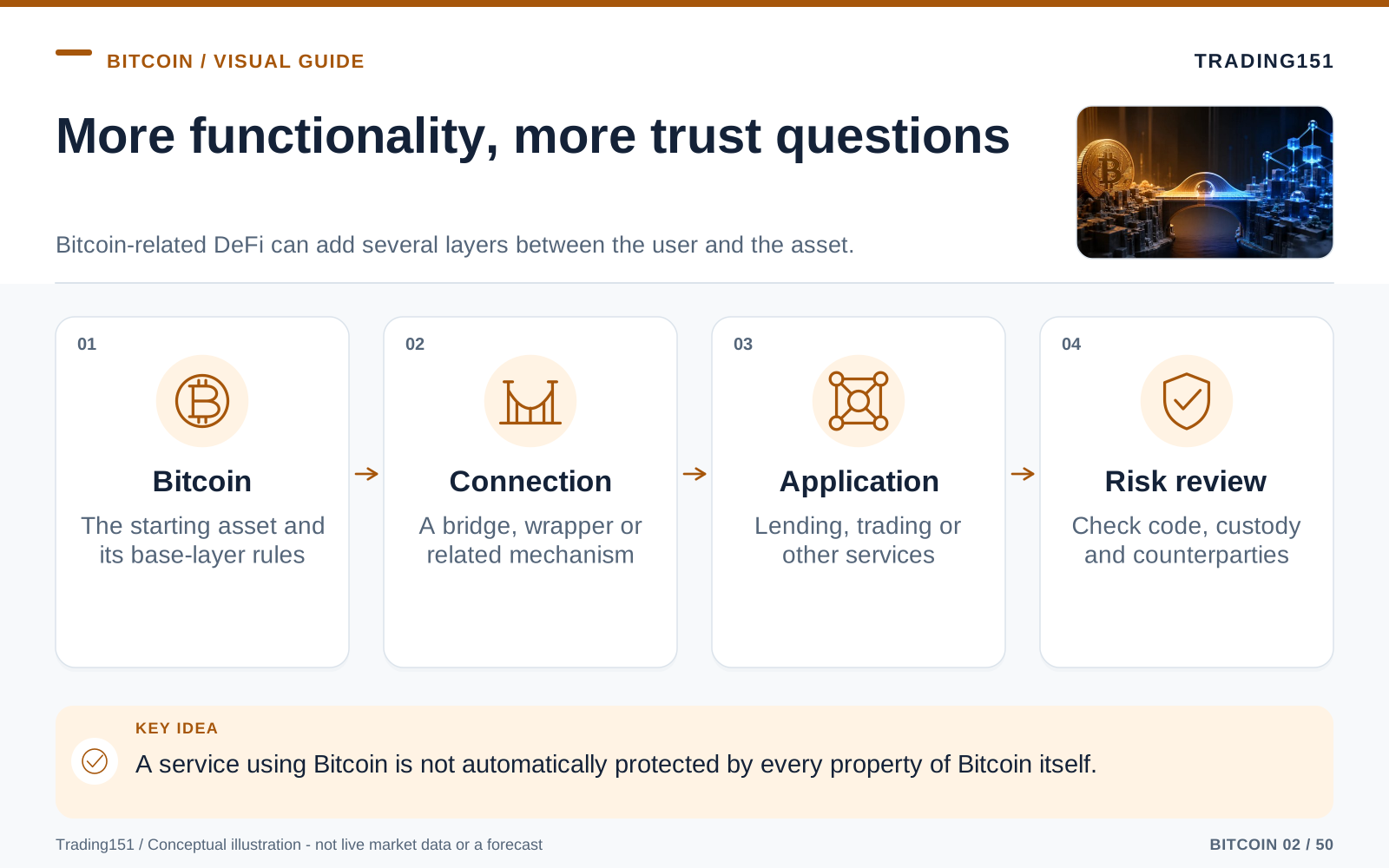
Read this diagram as text
- Bitcoin
- The starting asset and its base-layer rules
- Connection
- A bridge, wrapper or related mechanism
- Application
- Lending, trading or other services
- Risk review
- Check code, custody and counterparties
The First Bridge: Wrapped Bitcoin
The earliest widely used fix wasn't an attempt to turn Bitcoin into Ethereum. Instead, it brought Bitcoin's value into Ethereum's world through a tokenized stand-in known as Wrapped Bitcoin, or WBTC. It solves a straightforward compatibility problem: create a token on another chain that represents BTC being held somewhere else. That token can go anywhere smart contracts go, but the tradeoff is real—the user now depends not just on Bitcoin, but on the custodian, the bridge, the minting rules, and the destination chain too. The peg holds because of reserves and a redemption promise, not because the Bitcoin protocol itself enforces it. That's fine when everyone understands the arrangement. It becomes a problem when a wrapped asset gets marketed as if it carries no extra trust at all.
The mechanics aren't complicated once you picture it. Imagine walking into a theater in a heavy winter coat. You hand it to the coat check, they give you a ticket, and that ticket now proves the coat is yours. You can't wear the coat inside, but you can carry the ticket around as a claim on it. Walk out later, hand back the ticket, get the coat.
Wrapped Bitcoin works the same way. Real BTC gets locked up with a custodian, and an equal amount of WBTC gets minted on Ethereum as an ERC-20 token. From there, it moves through Ethereum's DeFi ecosystem like any other compatible asset—dropped into lending protocols, traded on DEXs, paired with stablecoins, or used as collateral for a loan.
This was a big deal. It made Bitcoin liquid inside DeFi without touching the Bitcoin protocol at all. All of a sudden, BTC holders had access to lending markets, trading pools, and yield opportunities that had mostly been built with Ethereum-native assets in mind.
But that breakthrough came bundled with a real compromise: trust.
Using custodial wrapped Bitcoin means trusting whoever holds the underlying BTC. Trusting that the reserves are there. Trusting that redemptions get honored. Trusting that the whole thing doesn't get frozen, mismanaged, hacked, or squeezed by regulators in some way that hurts users. Plenty of people are fine with that tradeoff. Others—especially the ones who got into Bitcoin specifically because of self-custody and censorship resistance—find it a little uncomfortable, like rebuilding the same old financial middlemen with a crypto skin over it.
That's the awkward truth sitting underneath a lot of wrapped assets. They connect blockchains together, sure, but they often bring trusted intermediaries right back in at the point where the stakes are highest.
The Search for More Trustless Bridges
Once wrapped Bitcoin proved there was real demand, developers started chasing less centralized ways to move BTC value between chains. The question driving all of it was simple: can Bitcoin join DeFi without forcing people to hand their coins over to one custodian?
One answer is decentralized custody. Instead of a single company holding the Bitcoin, a network of independent operators collectively manages deposits and redemptions using cryptography. TBTC is a good example—it spreads control across many participants, which cuts down the risk that one institution can lose, steal, or freeze everyone's coins.
This isn't magic, to be clear. It still carries assumptions, incentive structures, and technical risk. But it edges closer to what crypto is supposed to be about: fewer single points of failure, more transparency, and more reliance on code and economics than on somebody's word.
Another route is native cross-chain swapping. THORChain lets users trade native BTC for native ETH directly, without wrapping either one into a synthetic version on some other chain. Instead of carrying a paper claim into a foreign ecosystem, you're exchanging one real asset for another through a decentralized liquidity network.
This matters because bridges have quietly become one of DeFi's biggest weak points. Cross-chain bridges are some of the most frequently attacked targets in crypto, mostly because they sit on top of enormous pools of locked assets. When one fails, it fails big. A safer, more decentralized way of moving Bitcoin liquidity around isn't a nice-to-have—it's practically a requirement if Bitcoin and DeFi are going to keep merging.
Flipping the Question: Why Not Bring DeFi to Bitcoin?
For a while, the prevailing idea was to export Bitcoin outward—wrap it, bridge it, put it to work somewhere else. But the conversation has shifted. More builders are now flipping the question entirely: instead of bringing Bitcoin to DeFi, why not bring DeFi to Bitcoin?
That question carries weight because Bitcoin's reputation isn't just about price. It's about security, liquidity, and the sheer weight of a network that's been running, uninterrupted, for over a decade. Ethereum-based DeFi still leans on Bitcoin's base layer for that credibility, even when the actual value isn't sitting there directly.
That's where sidechains, Layer 2 networks, and adjacent systems come into the picture. They build additional environments where faster transactions, smart contracts, or entirely new asset types can operate while still keeping some connective tissue to Bitcoin.
Rootstock
Rootstock, usually just called RSK, is one of the older attempts to bring smart contracts into Bitcoin's orbit. It runs as a Bitcoin sidechain and is compatible with Ethereum-style smart contracts, which makes life easier for developers who already know their way around Ethereum tooling.
Its native token, RBTC, is pegged to BTC and covers transaction fees. The pitch is straightforward: build DeFi-style apps using familiar smart-contract infrastructure while keeping the whole thing tethered to Bitcoin's value and mining security.
Rootstock is basically one blueprint for Bitcoin DeFi—don't cram everything onto Bitcoin's base layer, but build a connected environment where programmable finance can run with Bitcoin sitting at the center.
Stacks
Stacks goes about it differently. It's built to bring smart contracts and full applications to Bitcoin while treating Bitcoin as the settlement layer underneath everything. Its programming language, Clarity, was designed with predictability and transparency as core goals, and its consensus mechanism ties Stacks activity back to Bitcoin through something called Proof of Transfer.
Skip the jargon and the point is this: Stacks wants to make Bitcoin more useful without asking Bitcoin to become something it was never designed to be. Decentralized exchanges, lending tools, NFT markets, and other applications can live in a Bitcoin-adjacent space while still drawing on Bitcoin's security and finality.
Whether Stacks ends up as the dominant Bitcoin DeFi layer is still an open question. But it's already proven there's genuine appetite for applications that treat Bitcoin as more than a reserve asset gathering dust.
The Lightning Network
Lightning is best known for cheap, fast Bitcoin payments. It lets people transact off-chain and settle back to the base layer later, which makes small, everyday payments practical instead of prohibitively expensive.
At first glance, that doesn't sound much like DeFi. It's not a lending market or an exchange. But it matters more than it seems, because payments are the foundation everything else gets built on. If assets and stablecoins can move efficiently over Lightning-style rails, Bitcoin's payment layer could become a active piece of global digital finance—not just a settlement backwater.
That has real implications for regular users. Picture a future where Bitcoin infrastructure handles instant payments, dollar-denominated assets, merchant settlement, remittances, and liquidity routing. That looks completely different from a world where BTC just sits untouched in cold storage forever.
Ordinals, Inscriptions, and Bitcoin's Cultural Shock
No conversation about modern Bitcoin activity is complete without mentioning Ordinals and inscriptions. By letting data attach to individual satoshis, Ordinals kicked off a wave of Bitcoin-native collectibles, experiments, and token standards. Some people loved it. Others called it spam, or a waste of scarce block space, or worse.
Whichever side of that argument you land on, the cultural impact is hard to deny. Ordinals reminded everyone that Bitcoin still had room for surprises. They pulled artists, speculators, developers, and infrastructure builders back into a conversation that had, for a while, felt frozen around a single idea: hold and never move.
Ordinals aren't full-scale DeFi by any stretch. On their own, they don't create serious lending markets or complex derivatives. But they changed the mood. They proved people are willing to experiment directly on Bitcoin, even when the experience is clunky, expensive, or controversial. And that shift has pushed more builders to ask what else might be possible.
What Bitcoin DeFi Lets People Do
All of this can sound pretty abstract until you tie it to an actual decision someone might make. Take a long-term Bitcoin holder—let's call her Sarah. She bought BTC years ago and believes in it deeply. She has no interest in selling, partly because she thinks it'll keep appreciating and partly because selling would trigger a tax headache. Still, she's not thrilled about a big chunk of her wealth sitting there doing absolutely nothing.
Bitcoin DeFi gives someone like Sarah more options. None of them are risk-free, and not all of them are worth taking. But they turn Bitcoin from a purely dormant asset into something that can participate in a broader financial strategy.
Earning Yield
The most obvious use case is yield. Sarah could deposit a Bitcoin-linked asset into a lending market, a liquidity pool, or a Bitcoin-focused DeFi protocol and earn a return generated by borrowers, traders, or general network activity. Yield always comes from somewhere—a borrower paying interest, traders paying fees, a protocol handing out freshly minted tokens, or a liquidity provider getting paid for taking on inventory risk. The percentage by itself doesn't tell you much about how durable it is. A yield paid mostly in some token whose price depends on ongoing incentives can evaporate twice over—once when the rate drops, and again when the reward token's price craters. Bitcoin doesn't generate cash flow just by existing, so every yield offer is worth tracing back to whatever activity, counterparty, and risk is funding it.
This can feel liberating because it cuts the bank out of the equation entirely. Instead of parking money in a savings account and accepting whatever rate the bank feels like offering, users can supply liquidity straight into open markets. The yield floats up and down depending on demand, risk, and how the protocol is designed.
The key word here is risk. A higher yield isn't free money—it's compensation for taking on smart-contract risk, liquidity risk, bridge risk, market risk, or usually some combination of all four. A sensible Bitcoin holder has to weigh whether the return is worth risking the one asset in their portfolio that was supposed to be the safe one.
Borrowing Without Selling
Borrowing against Bitcoin is another big use case. Maybe Sarah needs cash or stablecoins for a real expense but doesn't want to part with her BTC. By locking Bitcoin (or a Bitcoin-backed asset) as collateral, she can borrow against it while still keeping her upside exposure intact.
It's one of the more appealing ideas in crypto finance—turning a long-term holding into usable collateral, so you can access liquidity without giving up ownership.
But collateralized borrowing has sharp edges. If Bitcoin's price drops hard, the loan can quickly become undercollateralized, and the protocol may automatically liquidate some or all of the collateral to protect lenders. Put plainly: Sarah might avoid selling Bitcoin voluntarily, only to watch it get sold for her automatically in the middle of a crash. That risk needs to be understood before taking the loan, not after the liquidation notice hits.
Providing Liquidity
Bitcoin can also go into liquidity pools. Sarah might pair a Bitcoin-backed asset with a stablecoin or another crypto asset on a decentralized exchange. Traders swap through that pool, and Sarah collects a slice of the trading fees.
Sounds simple enough, but liquidity provision has its own quirks. If the prices of the paired assets move a lot relative to each other, Sarah could end up with impermanent loss—walking away with a different, and possibly worse, mix of assets than if she'd just held her Bitcoin outright. Fees might make up for that, or they might not, depending on how volatile things get and how the pool is structured.
The Risks Nobody Should Skip Past
None of this comes free. Anyone bringing Bitcoin into DeFi should walk in with eyes open about what can go wrong. And a protocol that's existed for three months isn't remotely the same as a network that's survived over a decade.
- Smart-contract risk: DeFi runs on code, and code breaks. Even audited contracts can hide bugs, and attackers are highly motivated when large sums are on the line.
- Bridge and custody risk: Any setup that locks BTC in one place and issues a stand-in somewhere else introduces a point of failure—technical, operational, legal, or just plain human.
- De-pegging risk: Wrapped or synthetic Bitcoin only works if the market believes it can be redeemed or swapped at the expected value. Lose that confidence, and the token can trade below real BTC.
- Liquidation risk: Borrowing against Bitcoin can go sideways fast during a sharp downturn. Automated liquidations don't care how strongly you believe in the long-term thesis.
- Liquidity risk: Some Bitcoin DeFi markets look perfectly healthy in calm conditions and turn thin and expensive to exit the moment things get stressful.
- Governance risk: Protocols can change rules, push upgrades, tweak parameters, or get hit by governance attacks. Know who can change things, and how fast.
- Regulatory risk: Custodians, front ends, stablecoin issuers, and other centralized access points can face legal pressure even when the underlying protocol itself is decentralized.
It's worth repeating: yield is never just yield. It's payment for risk. Sometimes that risk is reasonable and clearly laid out. Sometimes it's hiding behind a clean interface and a number that looks a little too good to question.
For Bitcoin holders specifically, the bar should be set high. The entire point of Bitcoin is that it can be self-custodied without leaning on financial intermediaries. Moving it into DeFi can absolutely be worthwhile, but it should be a deliberate choice, done in measured amounts, with a clear-eyed view of what could go sideways.
Why This Convergence Still Matters
Even with all those risks on the table, Bitcoin moving into DeFi matters because it expands what Bitcoin can mean in practice.
For plenty of people, Bitcoin will always be a savings technology first, and that's not a knock against it—the world needs assets that are hard to inflate, seize, censor, or manipulate. But savings don't exist in a vacuum. Eventually people want to borrow against them, spend from them, use them as collateral, or earn something on top of them. Traditional finance has built entire industries around exactly those needs.
If Bitcoin is going to become a serious global financial asset, it needs infrastructure around it. Some of that will be centralized—exchanges, custodians, ETFs, institutional lending desks. But some of it will be decentralized, open-source, and available to anyone with a wallet. That's the part where Bitcoin DeFi gets interesting.
The strongest version of this future doesn't ask users to abandon Bitcoin's principles in favor of DeFi's appetite for experimentation. It combines both, carefully: Bitcoin as the secure monetary foundation, with additional layers as optional territory for people who want more functionality and are willing to accept more risk for it.
The Likely Future: Layers, Not One Chain to Rule Them All
The future of Bitcoin DeFi probably won't crown a single winner. It's more likely to end up as a layered ecosystem, with different tools suited to different appetites for risk and convenience.
Some people will stick with custodial wrapped Bitcoin because it's liquid, familiar, and everywhere. Others will gravitate toward decentralized bridges or native swaps because trust minimization matters more to them. Some will use sidechains or Layer 2 networks for lending and trading. Others will stay put on the base layer and never touch DeFi at all.
That spread of options is a good thing. Bitcoin doesn't need every holder to turn into a yield farmer. It also doesn't need to stay frozen in one narrow use case forever. The more the ecosystem matures, the easier it should become for people to strike their own balance between security, usefulness, convenience, and risk.
The best outcome here isn't Bitcoin turning into Ethereum, and it isn't DeFi pretending Bitcoin's caution was pointless all along. It's each side learning something from the other. Bitcoin brings discipline, scarcity, and a hard-earned respect for security. DeFi brings creativity, openness, and a genuine belief that financial systems can be rebuilt out in the open.
Trace where the yield comes from
Suppose a service advertises a return on deposited bitcoin. Ask who is paying it. Interest from borrowers, trading fees, token incentives, and returns from a leveraged strategy are different sources of income. A reward paid in a newly issued token may look attractive in percentage terms while depending heavily on that token's market price and the continuation of subsidies.
Next, trace your claim through the arrangement. You might deposit bitcoin with a custodian, receive a representation on another network, and place that representation into a lending contract. Each step adds a question: can the custodian redeem, can the bridge operate, can the contract be upgraded, and can a borrower be liquidated without a shortfall? Calling the final product decentralized does not answer those questions.
A borrowing example makes the exposure clearer. Pledging $20,000 of collateral for a $5,000 loan starts at a 25% loan-to-value ratio. If the collateral falls to $10,000 while the loan remains $5,000, the ratio rises to 50%, before interest and fees. Whether that triggers liquidation depends on the contract. The fall in collateral value has not been avoided simply because no bitcoin was voluntarily sold.
Read the exit conditions before entering. Withdrawal delays, oracle failures, thin markets, and emergency controls matter most when many users want to leave together. The right comparison is not "bitcoin earning something versus bitcoin earning nothing." It is an unencumbered holding versus a new package of claims, costs, and failure modes.
Unwind the position on paper first
A DeFi position may involve several steps that looked simple when entered separately. Bitcoin is transferred to a custodian, a representation is issued elsewhere, the token is deposited as collateral, and another asset is borrowed. Each step can create a different claim and a different failure point. A single balance shown in an app can conceal that chain.
Before entering, work through the reverse journey. What must be repaid? Which fees are charged? Can collateral be withdrawn while a market is stressed? Does redemption depend on a bridge, an administrator, or a waiting period? Write the answers in the order the actions must happen. A position that cannot be unwound without fresh money has a funding risk that its advertised yield may not reveal.
A small successful test is useful for learning the mechanics, but it does not prove the whole arrangement will remain available at a larger size or during a crisis. Keep operational familiarity separate from confidence in the counterparties. 1
Bitcoin's Capital Is Becoming Programmable
Bitcoin started out as peer-to-peer electronic cash, grew into digital gold, and is now slowly turning into something bigger still: a monetary foundation that other financial systems can be built on top of.
That doesn't mean every Bitcoin DeFi project will make it. Plenty won't. Some will get hacked. Some will be substantially overhyped. Some will quietly fade away the moment the incentives dry up. The builders who are serious about this will have to prove they can deliver real utility without casually tossing aside the security guarantees that made Bitcoin valuable in the first place.
Still, the direction of travel is hard to argue with. Bitcoin's capital is too large to stay idle forever, and DeFi is too useful to remain cut off from the strongest asset in the entire space. The old wall between them is slowly turning into a network of bridges, side roads, tunnels, and fresh construction sites.
For everyday users, the opportunity here is real but not automatic. Bitcoin DeFi can unlock yield, liquidity, and new financial strategies—it can also introduce risks that simply holding Bitcoin never had to worry about. The smart move isn't blind enthusiasm, and it isn't stubborn rejection either. It's careful curiosity.
Bitcoin doesn't have to abandon what it is to take part in DeFi. And DeFi doesn't have to tame every rough edge of Bitcoin to benefit from its liquidity and credibility. Somewhere between the vault and the financial district, a new ecosystem is taking shape. It's still noisy, unfinished, and a little rough around the edges—but it might just become one of the most important frontiers in crypto's next chapter.
Sources and further reading
Editorial revision: 7 October 2026. Numerical scenarios are hypothetical unless identified as historical. References support the added explanations and selected corrections; rules and product terms should be checked again before acting.