
Bitcoin's decentralization is about distributing important powers rather than abolishing every form of trust. Users, nodes, miners, developers, exchanges, and wallet providers play different roles. A network can be dispersed in one respect and concentrated in another. Understanding who can do what is more informative than calling the whole system either completely decentralized or secretly centralized.
The Illusion of Control and the Middleman Problem
Most of modern life runs on trusting some middle party, and we barely notice because it's baked into everything we do. Tap a card at the grocery store, send cash through an app, back up your photos, get your paycheck deposited — we just assume it'll all keep working the same way tomorrow.
But look closer and there's almost always someone standing between you and the thing you think you own. Swipe your debit card and you're not actually handing anyone money — you're asking a bank and a payment processor to go update a ledger you'll never see. Your paycheck is a number that depends on banking rails you don't own and rules you never had a say in. Keep savings in your local currency, and you're trusting a central bank not to quietly erode its value.
None of this feels strange when institutions are stable and the technology just works. In wealthy countries especially, centralized finance is practically invisible — payments clear, accounts open, wires go through, and nobody thinks twice about the machinery underneath.
The convenience, though, hides something fragile: you're depending on people and institutions that can change their minds, fail, or get leaned on. Banks freeze accounts. Payment apps block transactions. Companies lock you out. Governments impose capital controls. Currencies get inflated away. Servers get hacked. Rules get rewritten with zero notice.
In that kind of system, "ownership" is a little softer than it sounds. You have access to your money, sure — but only because someone else recognizes your claim to it. What you're really holding is a promise. Most of the time that promise gets honored. But the power to deny it, delay it, reverse it, or quietly devalue it still sits above you, not with you.
Bitcoin was built to push back against that setup. It doesn't ask you to trust a bank, a company, or a government official. It asks you to trust a set of rules anyone can read, enforced by a network anyone can join and check for themselves.
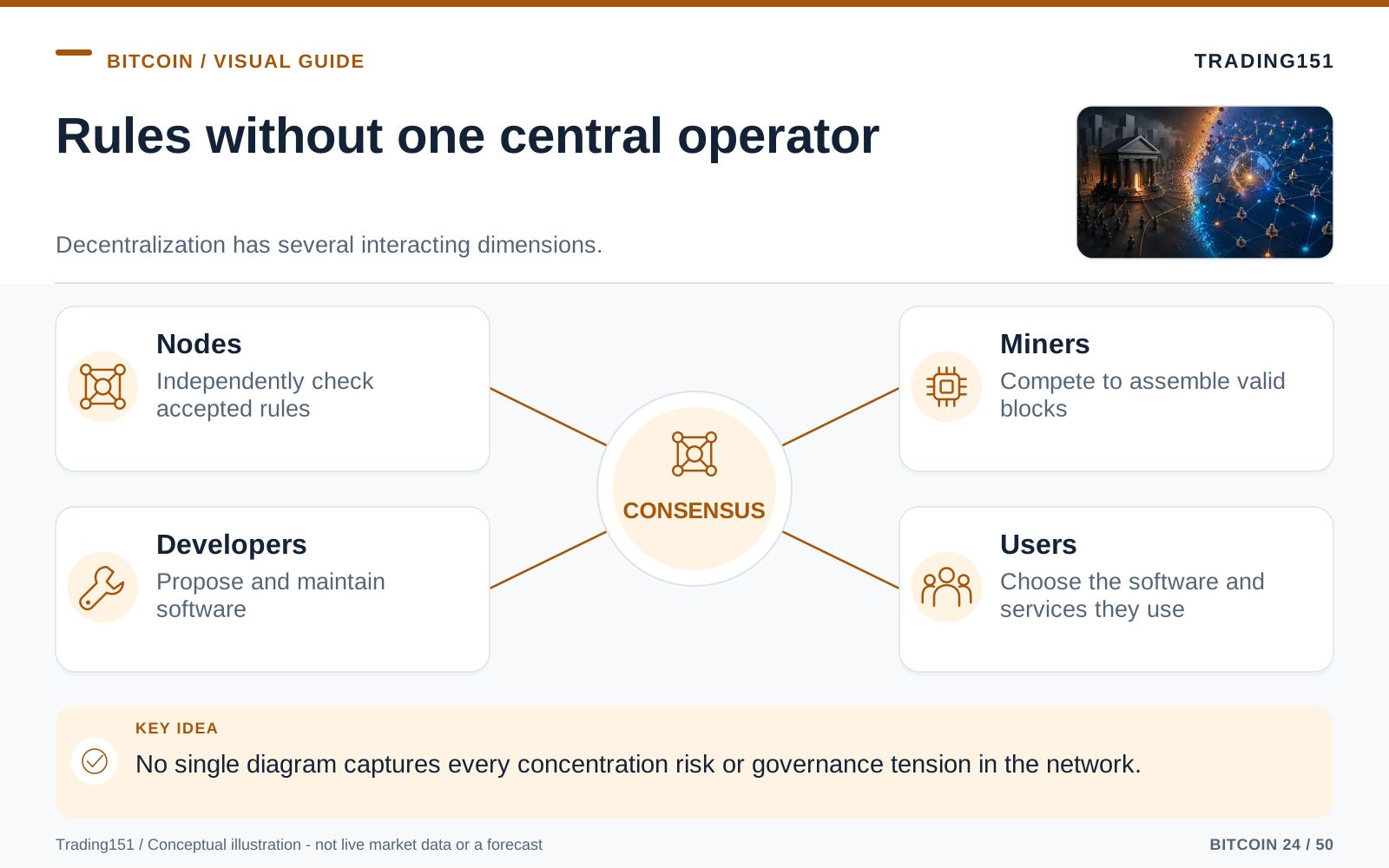
Read this diagram as text
- Nodes
- Independently check accepted rules
- Miners
- Compete to assemble valid blocks
- Developers
- Propose and maintain software
- Users
- Choose the software and services they use
The 2008 Catalyst: When Trust Broke
Bitcoin didn't show up out of nowhere, and it definitely didn't arrive at a calm moment in history. It was born right as trust in the financial system was falling apart.
By 2008, years of reckless lending, opaque financial products, and lax oversight had piled up into something the system couldn't absorb. When it all cracked, regular people paid for it — homes lost, jobs gone, savings wiped out. This wasn't some abstract economic story. It hit kitchens, neighborhoods, retirement accounts.
What made it sting even more was what happened next. The same institutions that helped cause the mess got rescued because they were "too big to fail." Banks were bailed out. Central banks expanded their balance sheets to keep things afloat. That phrase — too big to fail — became shorthand for a system where profits stayed private and losses got handed to everyone else.
For a lot of people, the message landed hard: the rules weren't the same for everyone. Make a bad financial call as an individual, and you live with the consequences. Make a catastrophic one as a major institution, and you get protected in the name of "stability." Something about that felt broken.
On October 31, 2008, right in the middle of that chaos, someone (or some group) using the name Satoshi Nakamoto quietly published a nine-page white paper called Bitcoin: A Peer-to-Peer Electronic Cash System. It laid out a way for people to send digital money to each other directly, no trusted third party required.
Then in January 2009, the first block of the Bitcoin blockchain went live. Buried inside it, Satoshi left a headline from The Times: "The Times 03/Jan/2009 Chancellor on brink of second bailout for banks."
That wasn't just a timestamp — it was a statement. It planted Bitcoin firmly in the middle of that financial and political moment, making clear this wasn't just some clever coding exercise. It was a response to a system that had failed and then protected itself anyway. Bitcoin started as code, but underneath it was an idea: if trust has been abused this badly, maybe it needs to be rebuilt from zero.
What Decentralization Really Means
"Decentralization" gets thrown around so much these days it's practically lost meaning. But in Bitcoin, it means something concrete: no single person, company, server, or government is in charge of the network. The ledger doesn't live in one office. No executive team enforces the rules. The whole thing holds together because thousands of independent participants each keep their own copy of the record and simply reject anything that breaks the agreed-upon rules.
It's worth saying, though, that decentralization isn't one clean dial — it has several dimensions, and they don't always move together. Node validation might be spread across thousands of computers while mining is concentrated in a handful of large pools. Ownership might be broad while custody sits with a few big firms. The software might be open source while only a small circle of developers really understands one critical piece of it. Asking "is Bitcoin decentralized, yes or no?" kind of misses the point. The better question is: where can power quietly build up, how visible is it when it does, and can users route around it if they need to?
Here's a way to picture it. Imagine a group of friends keeping track of who owes who money. One version: a single person holds the notebook, and everyone trusts them to write it down correctly. Simple, sure — but fragile. Lose the notebook and the whole record's gone. If that person lies or forgets an entry, everyone else is stuck with it.
Now picture the other version: everyone keeps their own notebook. Every time money changes hands, it gets announced to the group, and each person logs it independently. Later, everyone compares notebooks. If one doesn't match the rest, nobody rewrites history to fit it — that one notebook just gets ignored.
That's the basic idea behind Bitcoin. Instead of one authority keeping the books, the whole network shares the ledger. Instead of trusting an institution to tell you the truth, the system is built so you can check it yourself. Consensus takes the place of command.
That's also why Bitcoin has no headquarters, no CEO, and no customer service line that can override the rules. It runs on software, yes, but not the way a company runs software on its own private servers. Bitcoin exists because independent users, node operators, miners, developers, and holders all separately choose to follow the same rules. No single participant can just declare a new version of events and force it on everyone else.
Compared to a centralized database, that's inefficient — no argument there. But Bitcoin was never trying to be the fastest private database on earth. It's trying to be a public monetary system that doesn't depend on trusting whoever owns the database. That distinction is the whole point.
The Core Pillars of the Bitcoin Philosophy
Peel back the technical jargon and Bitcoin really rests on a handful of ideas — and they're not just about money. They're about responsibility, fairness, power, and the right to participate in something without having to ask anyone's permission first.
1. Verification Over Blind Trust
One of Bitcoin's most quoted lines is "don't trust, verify." Short phrase, but it captures a real shift in how people think about financial truth.
Traditional finance runs on trust in institutions — trust that the bank's records are accurate, that the payment company will process your transfer correctly, that the central bank will protect the currency's value, that regulators are watching. Sometimes that trust is earned. Sometimes it isn't.
Bitcoin takes a different path entirely. Its rules are public. Its supply schedule is fixed and known. Every transaction can be checked. The software itself can be inspected by anyone who wants to. If you run a Bitcoin node, you don't have to take anyone's word for it — your node independently verifies every transaction and block against the rules it's programmed to enforce.
None of that means every user needs to become a programmer. It just means the system is designed so verification is possible, not locked away behind corporate permission. Nothing's hidden inside a private balance sheet somewhere. It's all broadcast, checked, and preserved by the network itself.
That's a different way of thinking about money. Bitcoin shifts trust away from reputation and authority and toward transparency and proof. "Believe us" becomes "go check for yourself."
2. Scarcity in a World of Infinite Money
Bitcoin also brought something rare into the digital world: real scarcity. Digital files are usually the opposite of scarce — copy a file endlessly, send a photo to a thousand people and the original's still right there. That's exactly why digital cash was such a hard problem before Bitcoin. Somebody has to stop the same digital dollar from being spent twice, and doing that without a central authority seemed almost impossible.
Bitcoin cracked that problem using a public ledger, proof-of-work, and network-wide consensus. But the deeper philosophical move goes further than just solving double-spending. Bitcoin has a hard cap of 21 million coins. No committee votes to print more. No emergency decree doubles the supply overnight. No central banker wakes up and decides a little extra issuance is needed this year.
Why does that matter so much? Because money isn't just something you spend — it's stored time and effort. You work, you save, you put off spending today for something tomorrow, and you're trusting that what you saved will still be worth something later. When a currency gets expanded too aggressively, savings quietly lose their power. The number in your account stays the same, but what that number can buy shrinks underneath you.
Inflation gets talked about in dry economic terms, but for regular people it's deeply personal — it shows up in rent, groceries, gas, wages, and whether you can plan ahead. It punishes people who save and rewards people who borrow, and it pushes savers into riskier bets just to keep from falling behind.
Bitcoin's fixed supply is a direct rejection of that uncertainty. It's saying the rules of money shouldn't bend just because whoever's closest to power wants them to. Whether you agree with Bitcoin's monetary design or not, the philosophy underneath it is clear: money should protect the effort people put into earning it, not quietly siphon it off through expansion nobody voted on.
3. Self-Custody and Financial Sovereignty
Bitcoin also forces a rethink of what "ownership" even means. In traditional banking, most people don't hold money — they hold a claim on money that's managed by someone else. The bank controls the infrastructure. The payment network controls access. The state can override both if it wants to.
Sovereignty here isn't all-or-nothing, either. Someone might hold a small amount directly, keep another chunk with a custodian, run a node without ever mining, or split control across multiple keys with multisignature setups. Each step changes a specific dependency you're relying on. This matters because treating self-custody as a purity test can push newcomers into setups they don't fully understand yet — and that's how people lose coins. The end goal might be full independent control, but the safer road there is usually gradual: start small, test that you can recover your funds, and reduce your reliance on others only where it improves your situation.
With Bitcoin, you can hold wealth through a private key. That key isn't a password in the usual sense — it's the actual cryptographic authority to spend whatever coins are tied to a given address. Whoever holds that key holds the Bitcoin. Full stop.
That's the whole idea behind the phrase "not your keys, not your coins." It's a warning against confusing exposure to Bitcoin's price with owning it. Keeping coins on an exchange is convenient, but you're still trusting that exchange the same way you'd trust a bank. Self-custody cuts out that middleman entirely and puts control directly in your hands.
That control comes with real weight, too. Lose your private keys and there's no manager to call, no reset button hiding somewhere. Mistakes can be permanent. Critics see that as a serious flaw. Supporters see it as the price of real freedom — freedom without any responsibility attached usually isn't freedom at all.
Done right, self-custody gives people a kind of property that's portable, borderless, and hard to seize without their consent. You can carry the ability to access your wealth in a small hardware wallet, on a slip of paper, even memorized as a set of words. That's not just a clever technical trick. It's a different relationship between a person and their money.
4. Permissionless Access
Another core idea baked into Bitcoin is that nobody needs permission to use it. In traditional finance, access always comes with conditions — documents, approvals, location requirements, credit checks, sometimes even political acceptability. Sending money across a border can be slow, expensive, or flat-out impossible depending on where you happen to live.
Bitcoin doesn't ask who you are before letting you use the network. It doesn't check your nationality, your income, your religion, or your political views. A transaction is either valid under the protocol's rules or it isn't — the identity of whoever's sending it doesn't factor in.
If you live comfortably inside a stable banking system, that might sound less important than it is. But step outside that bubble and neutral, permissionless money can be life-changing. A dissident whose bank account just got frozen. A migrant worker sending wages home. A family trying to hold onto savings as their local currency collapses. A small business suddenly cut off from payment processors. These are the people who understand Bitcoin very differently than someone watching a price chart.
Permissionless money isn't a magic solution, and yes, it can be used by good people and bad people alike — the same is true of cash, the internet, and encryption. The real question is whether access to money should hinge on someone else's approval in the first place. Bitcoin's answer is no.
5. Censorship Resistance as a Human Rights Issue
Censorship resistance is probably the most misunderstood thing about Bitcoin. If you live somewhere comfortable and stable, financial censorship can feel like someone else's problem — the assumption being that if you haven't done anything wrong, your money will always be there for you.
History doesn't really back that up. Financial systems have been used as tools of control plenty of times. Governments freeze the accounts of political opponents. Banks get pressured into cutting off certain groups. Payment processors decide some causes are too controversial to touch. Capital controls trap citizens inside collapsing currencies. In moments like that, being able to move your own money isn't a luxury — it's a basic condition of freedom.
Bitcoin's decentralized structure makes it hard for any single authority to stop a valid transaction from going through. It's not invincible, and it doesn't erase every risk. But it does create a kind of money that's harder to silence than a bank account and harder to block than a corporate payment rail.
That's why the strongest Bitcoin advocates describe it as more than just an investment. To them, it's a tool for human dignity — a way to hold and move value when the institutions around you turn hostile, unstable, or exclusionary.
The Human Side of a Digital Network
From the outside, Bitcoin can look pretty cold. It's software. It's math. It's machines racing to add blocks to a chain, nodes checking rules with zero emotion involved. But the reason it exists in the first place is deeply human.
People run nodes because they want to verify the system for themselves, not take someone's word for it. Miners spend real energy and equipment because they get rewarded for keeping the network secure. Developers pore over code because the rules matter to them. Holders save in Bitcoin because they think it offers something their local currency or bank can't. Merchants accept it because some of their customers want a different kind of payment. Activists defend it because they see neutral money as part of a freer world.
Nobody's forcing all these people to cooperate — there's no central office issuing orders. The cooperation just emerges, because the incentives line up with the rules. That's part of Bitcoin's odd beauty. It takes self-interest, skepticism, and independence and somehow turns them into the foundation of something shared.
In that sense, Bitcoin isn't really a machine that replaces human trust. It's a machine that exists because human trust has limits. It doesn't assume everyone's a saint. It assumes people can be greedy, careless, or corrupt sometimes, and builds a system where no one person ever gets enough power to quietly wreck the ledger for everyone else.
That's exactly why Bitcoin keeps sparking such intense arguments. It's not just asking whether a digital asset can hold value. It's asking what money is, why it has value at all, who gets to create it, who gets to control it, and how much power people should really hand over just for the sake of convenience.
The Criticisms Are Part of the Conversation
None of this is meant to suggest Bitcoin is flawless — it isn't, and the real criticisms deserve real attention. It uses a lot of energy, and that raises fair questions about environmental impact, mining incentives, and where that energy comes from. Its base layer processes transactions slower than centralized payment networks, which keeps the scaling debate alive year after year. Self-custody is powerful, but it's also unforgiving — one mistake and your coins can be gone for good. And the broader crypto industry, has produced no shortage of scams, hype cycles, failed projects, and predatory speculation that muddy the water and distort how people understand Bitcoin itself.
A decentralized system deserves the closest scrutiny exactly where convenience tends to pull things back toward centralization. Mining economics, large custodians, developer influence, firmware supply chains, internet infrastructure, regulated on-ramps — all of it deserves a hard look. Criticism here isn't proof that the project failed. It's how people find out whether the escape routes are real or just theoretical. Bitcoin's philosophy only holds up if participants keep checking the institutions growing up around it, instead of assuming the word "decentralized" settles the argument on its own.
A mature take on Bitcoin doesn't need to pretend these problems don't exist. If anything, the philosophy gets stronger when it's argued honestly. A system built around verification should welcome scrutiny, not shy away from it. A movement that claims to care about truth can't just lean on slogans.
The more useful question isn't whether Bitcoin is perfect. It's whether the problem it's trying to solve is real. Centralized money can be abused. Savings can be quietly diluted. Access can be denied. Financial systems can shut out the very people who need them most. Institutions fail and still expect to be trusted afterward. Bitcoin exists because enough people looked at all that and decided an alternative was worth building.
Decentralization is not one number
Consider the difference between proposing software, validating a block, and controlling a customer's withdrawal. A developer can publish code without forcing everyone to run it. A miner can propose a block without making an invalid transaction valid to nodes that enforce the existing rules. An exchange can restrict its customers' withdrawals without gaining the power to rewrite Bitcoin's consensus rules.
Those limits matter, but so does practical influence. Widely used software, concentrated mining coordination, popular custodians, and dominant service providers can shape what users find convenient or difficult. Formal permission to choose an alternative is more useful when a workable alternative actually exists and switching costs are manageable.
Assess a service by the specific dependency it introduces. Can users verify its claims? Can they leave without cooperation? What information or keys must they retain? What happens if many users try to exit together? These questions apply to wallets and scaling systems as well as to exchanges.
Decentralization is therefore something to examine in the arrangement you use, not only in the base protocol. A person can hold a decentralized asset through a highly centralized account. That may be an acceptable convenience trade-off, but naming it accurately helps avoid disappointment. The philosophy becomes practical when users understand both the powers they retain and the powers they have delegated.
Ask who can change the rules that affect you
A system can distribute one function while concentrating another. Many people may validate records, while a small group controls an interface, a bridge, or a recovery service. Map the decisions separately: issuing units, changing software, freezing a customer account, and permitting withdrawals. That makes the word 'decentralized' more informative. It describes a set of arrangements to inspect, not a universal assurance that no intermediary can affect the user's experience. 1, 2
Decentralization Is an Ongoing Practice
Bitcoin is still young, historically speaking. It's already survived crashes, government bans, internal fights, exchange collapses, countless media obituaries, and wave after wave of speculation. And yet it just keeps producing blocks, roughly every ten minutes, without a CEO, without a central server, without ever asking permission to keep going.
Where it ends up is anyone's guess. It might become a widely held reserve asset. It might stay a more specialized form of savings and settlement. It might matter most in places where the existing financial system is weakest. It might keep getting misunderstood by people who only ever see the price and never the principle behind it.
But whatever happens to its market value, Bitcoin has already changed the conversation. It proved a decentralized monetary network can run at global scale. It showed that strangers who've never met can maintain a shared financial ledger without any central authority. It gave the world a working example of money governed by consensus instead of decree.
That's the deeper philosophy sitting underneath all of it. Decentralization isn't just a technical design choice — it's a statement about power. It says no single institution should have unchecked control over the economic lives of millions of people. It says the rules should be visible, the supply should be predictable, and participation should be open to anyone. It says trust, wherever possible, should be earned through verification rather than demanded through authority.
Bitcoin doesn't need everyone to love it, and it probably never will get there. What matters is that it exists at all — a peaceful, voluntary, borderless alternative to systems that used to seem untouchable.
Beyond the charts and the headlines, Bitcoin's real value is the idea it introduced to the world. People don't always need a middleman to agree on what's true. They don't always need permission to trade value with each other. They can build systems that protect individual freedom while still coordinating across entire continents. They can replace fragile promises with rules everyone can see.
And in a world where trust keeps getting broken, that idea matters a lot more than whatever number happens to be on the screen.
Sources and further reading
Editorial revision: 7 October 2026. Numerical scenarios are hypothetical unless identified as historical. References support the added explanations and selected corrections; rules and product terms should be checked again before acting.