
Gold and Bitcoin are often compared as scarce assets outside ordinary bank deposits. Their scarcity, storage, trading, and price behavior are not the same. A useful comparison starts with the form of ownership: physical metal, an investment product, bitcoin in a wallet, or a claim held through a provider. Those choices change costs and dependencies before the price outlook enters the discussion.
The Old King: Why Gold Still Matters
Gold's reputation is hard for any modern asset to touch. Long before stock exchanges or credit cards or central banks even existed, people were pulling gold out of the ground and turning it into coins, jewelry, and symbols of status. Pharaohs wanted it. Empires went to war over it. Families have passed it down for generations. There's something a plain gold coin carries — a sense of permanence — that a bank statement just can't fake.
Some of that appeal is instinctive the moment you see the stuff. It catches light differently than almost anything else. It sits dense and heavy in your palm. There's an almost primal pull to it that a lot of investors don't like to admit matters — but it does. Money was never purely math. It's always been tangled up with psychology, culture, and what a group of people collectively agree is worth something.
Then there's the physics of it. Gold doesn't rust. It doesn't rot. Dig up a piece that's been buried for five hundred years, give it a clean, and it looks basically the same as the day it was buried. It can't go bankrupt the way a company can. No government can print more of it into existence. And unlike a bond, it isn't a promise from someone who might not keep their word.
That independence is a big part of why gold has outlasted every financial system that's tried to replace it. Currencies get devalued. Governments fall. Banking rules get rewritten every decade or so. Gold just sits there, stubbornly unchanged. It won't pay you a dividend or send you a quarterly report, but it also doesn't need a working app or a management team to keep existing.
Gold tends to shine loudest — no pun intended — when everyone's nervous. Inflation ticks up, banks start looking wobbly, a war breaks out somewhere, markets take a hit — and people rediscover why they wanted something they could touch. It's not exciting the way a hot tech stock or a crypto rally is exciting. Its whole appeal is quieter than that. It's the asset that just says: whatever happens, I'll still be here.
There's real demand for it outside of investing too — jewelry, electronics, dental work, aerospace parts. That doesn't mean the price is driven by industrial use, but it does mean gold has a life that has nothing to do with portfolios. People want it because it's beautiful, because it signals status, because tradition says so.
Bottom line: gold earned the title of old king by surviving the hardest test finance has — time itself. It's outlasted greed, wars, technological leaps, and a thousand confident predictions of its own irrelevance. People have been calling gold outdated for decades. And yet, whenever things get shaky, it has this habit of quietly walking right back into the room.
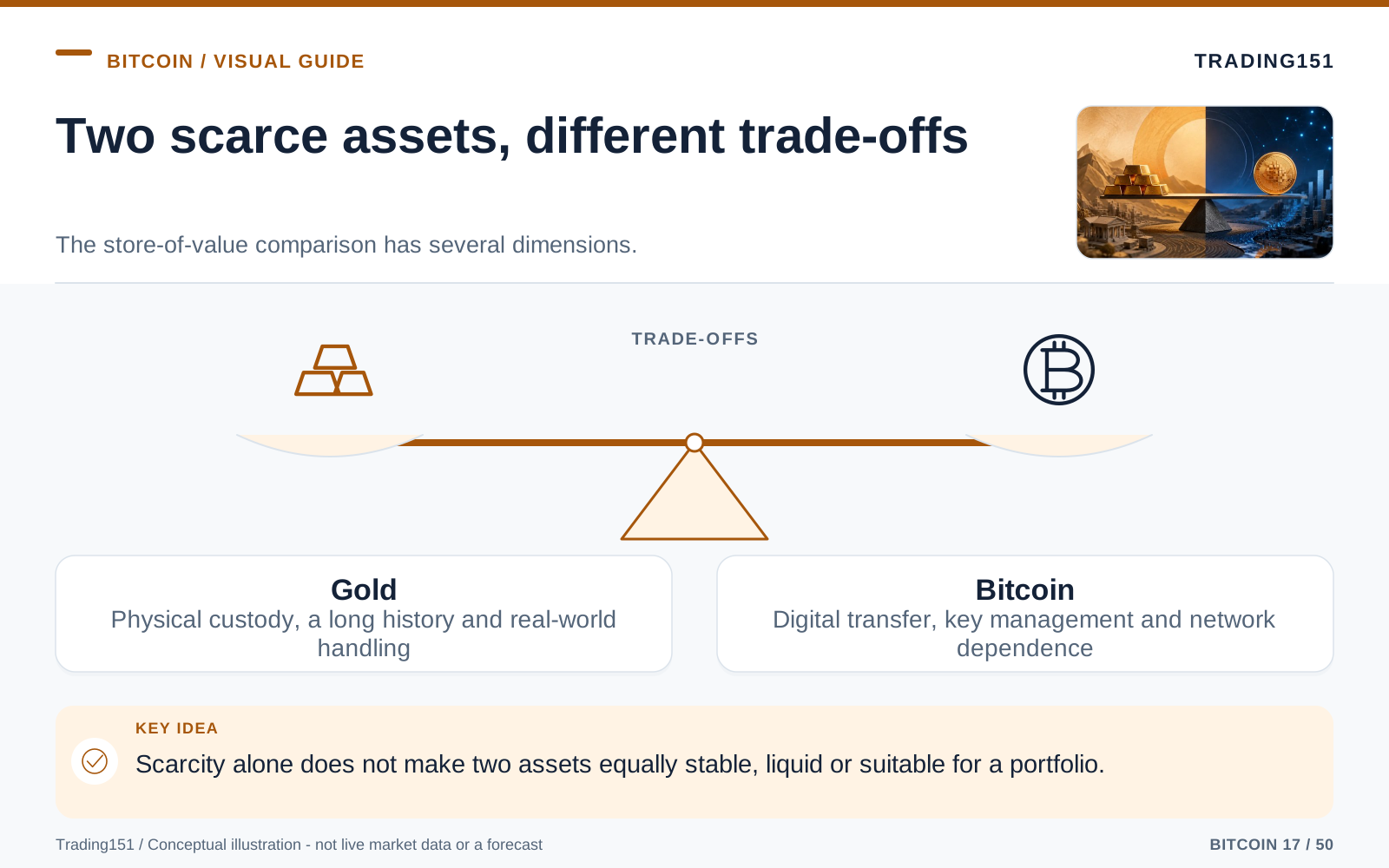
Read this diagram as text
- Gold
- Physical custody, a long history and real-world handling
- Bitcoin
- Digital transfer, key management and network dependence
The New Challenger: What Bitcoin Is Really Trying to Be
Bitcoin showed up from a completely different direction. Nobody found it in a riverbed or blasted it out of a mountain. It arrived in 2009 as open-source code, released into a world still reeling from a financial crisis that had wrecked public trust in banks and regulators alike.
Whoever Satoshi Nakamoto is, they built Bitcoin as peer-to-peer money that didn't need a central authority behind it. No government issues it. No single bank controls it. No company can just decide to print more. Every transaction gets recorded on a public ledger — the blockchain — kept alive by a global network of computers instead of one institution sitting at the top.
To a lot of people, that still sounds like a lot of hand-waving. You can't hold a Bitcoin. You can't melt it down into a ring. You can't lock it in a safe and admire it. If you grew up trusting things you could physically touch, Bitcoin can feel like wealth made out of thin air.
But if you grew up online, it doesn't feel that strange at all. Our photos already live in the cloud. Our friendships run through screens half the time. Paychecks show up as numbers on an app, not cash in an envelope. Most money is already digital in practice — Bitcoin just cuts out the banks and payment processors standing in the middle of it.
That's the reasoning behind calling it "digital gold." Believers argue it takes the same core idea — scarce money that no government controls — and rebuilds it for an internet-native world. Instead of scarcity enforced by geology, you get scarcity enforced by code, cryptography, and a network of people agreeing on the rules.
And that's exactly why this debate gets so heated. For a lot of its believers, Bitcoin isn't just an investment — it's a protest. Against inflation, against bailouts, against capital controls, against the idea that regular people have no choice but to trust institutions that haven't always deserved it. Gold people tend to trust history. Bitcoin people tend to trust math. Both, in their own way, are trying to get away from the fragility of paper promises.
Round 1: Scarcity and Supply
Scarcity is the foundation both of these assets are built on. Anything that can be produced endlessly and without effort tends to lose its ability to hold value over time — that's the whole story behind why seashells, beads, and plenty of paper currencies eventually failed as "hard" money once supply got too easy to expand. Gold's scarcity comes from geology and economics, not a hard mathematical ceiling. When the price climbs, previously unprofitable deposits suddenly become worth mining, recycling picks up, and more supply trickles into the market — though it still takes years to open a new mine. Bitcoin works differently. Its issuance follows a fixed schedule no matter what the price is doing, and its final supply is locked in by the protocol itself, not by geology or the willingness of a mining company to dig deeper.
Getting gold out of the ground is hard work — finding it, mining it, refining it, moving it, protecting it. A mining company can't just wave a wand and double the world's gold supply next year. They need land rights, permits, machinery, labor, financing, and honestly a bit of luck. Even a price spike doesn't fix that overnight.
Still, gold's scarcity isn't set in stone. Higher prices pull more exploration and mining online. New extraction technology can make previously worthless deposits suddenly viable. Someday, deep-sea mining or even asteroid mining could shake up the supply picture — a long way off, sure, but not impossible. Gold is scarce, yes, but there's no number baked into its DNA that says "this and no more."
Bitcoin doesn't work that way. There will only ever be 21 million bitcoins — full stop. That cap is written into the code itself. New coins trickle out through mining, but the reward for mining gets cut in half roughly every four years, in an event known simply as the halving.
That gives Bitcoin a kind of scarcity gold can't match: predictable scarcity. Anyone can check the rules for themselves. Anyone can see exactly how much Bitcoin exists right now, and project how much will exist decades from now. That transparency is one of the things people find so compelling about it.
Of course, being scarce doesn't automatically make something valuable. A napkin doodle can be one-of-a-kind and still be worth nothing to anyone but you. Scarcity only matters once people want the thing. Gold has millennia of demonstrated demand behind it. Bitcoin's history is a fraction of that — but in a short span, it's already built a global base of holders, miners, developers, and institutions willing to bet on it.
On raw supply discipline, Bitcoin has the tighter argument. Gold is scarce because it's a pain to produce. Bitcoin is scarce because the network enforces a hard limit, no exceptions. The real question isn't whether Bitcoin is scarce — it clearly is. It's whether enough people, for long enough, keep believing that digital scarcity deserves a real-world price tag.
Round 2: Portability and Movement
Gold is wonderfully solid — right up until you need to move it. Then its biggest strength turns into a genuine headache. Any meaningful amount of gold is heavy, hard to hide, and a pain to transport without drawing attention. It can be seized at a border, lost in transit, stolen out of storage, or simply trapped in a banking system that's decided to restrict access.
Imagine having to leave a country fast, most of your wealth in tow. A suitcase of gold bars is exactly the kind of thing that gets you stopped and questioned. Even assuming you got it out safely, selling or spending it somewhere new means testing, negotiating, proving it's real. Gold is fantastic at sitting still. Moving it fast and quietly was never really the design brief.
Bitcoin, on the other hand, was basically built to move. It crosses borders without armored trucks, without shipping paperwork, without waiting on a bank to open. Someone can carry access to their entire net worth on a hardware wallet, a phone app, or — in extreme cases — just twelve or twenty-four memorized words. That's not a luxury feature in a real crisis. That can be the difference that changes someone's life.
None of that makes Bitcoin effortless, to be clear. Network fees spike during busy stretches. One typo can cost you everything. A poorly secured wallet is an open invitation to a scammer. But the underlying fact still stands out: value can cross the planet without anyone physically carrying anything at all.
It's also far more divisible in daily use than gold ever will be. One bitcoin splits into 100 million smaller units, called satoshis, so you can send a fraction of a cent or a fortune with the same ease. Gold can technically be divided too, but shaving an exact sliver off a coin isn't how anyone's paying for groceries.
If your world is local and physical, gold still does its job as a store of wealth. If your world is global and digital, Bitcoin has the clear edge in portability and divisibility — easier to move, easier to split, easier to verify from a distance.
Round 3: Stability, Volatility, and the Sleep Test
This is where gold pulls ahead again, and by a wide margin. A good store of value shouldn't just hold up over decades — it should let you sleep at night in the meantime. Gold has earned a reputation as the calmer of the two. Its price can absolutely drop, and it can frustrate investors for years at a stretch, but it doesn't usually behave like a rollercoaster with the brakes cut.
Gold moves with the weight of an old, established market behind it. Central banks hold it. Funds hold it. Jewelers, private investors, institutions all over the world hold it. That broad, deep base of buyers gives it a steadiness newer assets simply haven't earned yet. Nobody buys gold hoping to get rich by Tuesday. They buy it for protection, for diversification, for a bit of ballast.
Bitcoin is an entirely different emotional ride. It's delivered eye-watering gains in certain stretches — and equally severe drawdowns in others. Anyone buying it needs to be ready for sharp swings, panicked headlines, regulatory scares, exchange collapses, social media meltdowns, and long stretches where their own conviction gets tested hard.
That volatility isn't just a line on a chart — it changes how people behave. Someone who felt like a genius during a bull run might discover their nerve is a lot thinner once the price craters and stays down for months. The asset is digital. The anxiety it causes is very real.
Believers argue that volatility should ease off as adoption grows and the market matures. Maybe it will, eventually. But right now, Bitcoin asks a lot more of your nerves than gold does. It's a trade: tolerate the uncertainty, and you get a shot at bigger long-term returns.
The sleep test cuts through most of the debate pretty cleanly. If a big drop in your holdings would send you into a panic, Bitcoin might cause you more stress than freedom. Gold won't erase all risk, but it behaves more like an anchor than a speedboat. Some people need the anchor. Some people are fine riding the speedboat. Knowing which one you are matters a lot more than winning the argument at dinner.
Round 4: Storage, Security, and Personal Responsibility
Both of these assets promise independence, and neither one lets you off the hook on security — they just move the problem somewhere else. Gold concentrates the risk physically: weight, transport, verifying it's real, keeping it under lock and key, the risk of theft or seizure. Bitcoin trades that for information risk — your keys can travel across a border in your head, but they can just as easily get swept up by malware, lost in a bad backup, or fumbled in a setup that got too complicated for its own good. Professional custody exists for both, and both times it brings back the very counterparty risk these assets were supposed to remove. Which one is "safer" really comes down to which failure mode you're equipped to manage.
With gold, security is a physical problem. Where do you keep it? A home safe is convenient but obviously invites theft. A bank deposit box feels sturdier but ties you to an institution — one that might not even be open when you need it most. Professional vaulting is the gold standard, so to speak, but it comes with fees and paperwork attached.
There's also the question of proving it's real. Gold can be faked or diluted. Serious buyers often lean on testing equipment, trusted dealers, or professional assays just to confirm what they're holding is genuine. A gold bar feels reassuringly simple in your hand, but the market around it still runs on a fair amount of trust.
Bitcoin sidesteps the physical storage problem entirely — and introduces a different kind of nightmare. Lose your private keys, and your funds can vanish in minutes with nobody to call. Send it to the wrong address, and there's no bank manager on the other end who can pull it back.
That's both the appeal and the danger of it in one package. It lets you become your own bank — but not everyone wants that job. Some people would rather have convenience and a safety net if something goes wrong. Others want total control, even knowing that control comes with zero forgiveness for mistakes.
Third-party custody makes Bitcoin far more approachable for everyday investors, through regulated exchanges and custodians and investment products. But the more you lean on a custodian, the more Bitcoin starts to look exactly like the system it was designed to route around. "Not your keys, not your coins" isn't just a slogan — it's a warning people learned the hard way.
Gold asks you to protect a physical object. Bitcoin asks you to protect a piece of information. One can be stolen from a safe. The other can be stolen through a phishing link, a compromised laptop, or one careless screenshot. Neither is automatically secure. The safer option really depends on what you know, what habits you've built, and how much responsibility you're willing to carry.
Round 5: Trust, Culture, and Generational Belief
Money has never just been a technical tool — it's a social agreement, at its core. A dollar bill has value because enough people accept it does. A gold coin has value because generations of humans have treated it as desirable. Bitcoin has value because a steadily growing network of people believes its scarcity, security, and independence are worth something real.
Gold's advantage is sheer cultural depth. It shows up in mythology, religion, jewelry, art, royal treasuries, and central bank vaults across every era you can name. It's woven so tightly into human history that even someone with zero investing knowledge instinctively knows gold is worth something. That kind of recognition doesn't get built overnight.
Bitcoin's advantage is momentum. It resonates with people who distrust inflation, who resent financial gatekeepers, who see the internet as the natural home for money in this century. Younger generations already live comfortably with digital assets, digital identities, and online communities. To them, value existing purely on a network isn't a stretch. It's just normal.
That generational divide sometimes gets overstated, but it's not made up. Plenty of older investors feel safer with something they can physically touch. Plenty of younger ones feel safer with something they can move and verify themselves, digitally, without asking anyone's permission. Gold says: trust what's already lasted. Bitcoin says: trust what can't easily be changed.
Central banks still hold gold because it's neutral, liquid, and historically accepted everywhere. Bitcoin, meanwhile, keeps pulling in attention from individuals, companies, funds, and investors hunting for an alternative to the traditional monetary system. Nothing about its future is guaranteed, but it's already outlasted — and outgrown — plenty of early predictions that it wouldn't survive at all.
Maybe the cultural question matters more than any other one here. If future generations keep treating Bitcoin as meaningful property, its role only grows. If the enthusiasm fades, or something better comes along, gold's ancient reputation could prove almost impossible to dislodge. Belief is powerful — but it has to be renewed, generation after generation, or it starts to fade.
What Gold Does Better
Gold's strongest case isn't that it's exciting — it's that it's proven. No software bugs. No protocol arguments. No dependence on an internet connection. No need for electricity to simply exist. A blackout doesn't make gold disappear. A forgotten password can't lock it away forever. A regulatory crackdown can't erase its physical presence from the world.
It's also just easier for most people to wrap their heads around. That simplicity is worth something on its own. You don't need to explain mining difficulty, seed phrases, nodes, or blockchain confirmations to make someone understand why a gold coin is worth locking up. It has an intuitive appeal Bitcoin still hasn't earned with most of the population.
And it tends to be kinder to investors who want lower volatility. Gold can still test your patience — especially through years of sideways movement — but it rarely demands the same emotional toughness Bitcoin does. For straightforward wealth preservation, gold is still hard to beat.
What Bitcoin Does Better
Bitcoin's strongest case is that it was built for a world where money needs to move digitally, and without asking anyone's permission. It's easier to send across borders, easier to break into small pieces, easier to verify without trusting a middleman. Its supply schedule is public and fixed, and there's a hard ceiling on how much will ever exist.
It offers something gold simply can't: real digital self-custody. You can hold wealth that isn't parked in a bank account, isn't tied to a local currency, and isn't visible to anyone standing nearby. For people living under unstable governments, capital controls, or a banking system that's stopped working properly, that's not a nice-to-have. That can matter enormously.
The risk side is just as clear, though. Bitcoin is still young, still volatile, still technically demanding, and still operating in regulatory territory that isn't fully settled. It can make you feel brilliant one year and foolish the next. It's not a calm asset, and pretending otherwise does newcomers no favors.
The Portfolio Question: Defense, Offense, or Both?
For most investors, the better question isn't "which one wins" — it's "what job do I need this asset to do?" Gold and Bitcoin can sit in completely different risk buckets. Gold's longer track record and lower volatility suit money whose main job is preservation. Bitcoin's smaller, more reflexive market offers bigger upside and much scarier drawdowns. Owning both isn't automatically "diversified" if you bought them for the same reason — but their behavior in the market, and who's holding them, tends to differ enough to matter. Start with the role you need filled — liquidity reserve, crisis hedge, long-term optionality, pure speculation — then size each asset by how reliably it's played that role.
Gold is usually the defensive pick. It's there to preserve purchasing power, add diversification, and provide some stability when trust in the financial system takes a hit. You don't buy gold expecting it to change the world. You buy it because the world has a habit of getting unstable when you least expect it.
Bitcoin plays offense. Higher risk, but also a shot at much bigger upside if adoption keeps expanding. It appeals to people who want exposure to a new kind of monetary network and are willing to eat the volatility as the entry fee.
That distinction matters more than it might seem. A retiree protecting decades of savings might see gold as sensible and Bitcoin as reckless. A young investor with decades ahead of them might see Bitcoin as essential and gold as too slow to bother with. Both of them could be right — for their own situation.
There's no single allocation that works for everyone. Risk tolerance, age, income, obligations, technical comfort, where you live, personal beliefs — all of it factors in. Someone dealing with an unstable local banking system might value Bitcoin's portability far more than someone sitting on a secure brokerage account and a paid-off house. Someone who can't stomach a big drawdown is probably better off owning very little Bitcoin, or none at all.
The mistake is treating either one like it's magic. Gold doesn't guarantee safety. Bitcoin doesn't guarantee freedom, or riches. Each can play a real role in a portfolio — but neither one removes the need for judgment, patience, and basic risk management on your part.
Compare the form you would actually own
Consider three people who say they own gold. One has coins at home, another has an allocated holding in a vault, and the third owns shares in a listed product. They face different arrangements for storage, insurance, sale, and access. The same distinction applies to bitcoin held directly versus exposure through a custodian or exchange-traded product. Comparing a gold bar with a bitcoin fund without noticing the ownership difference can produce a misleading answer.
Start with the situation the holding is meant to address. Is the concern long-term purchasing power, diversification, a disruption to a particular intermediary, or a need for portable assets? No form is equally convenient for all of them. An asset that can be moved without a bank may still need a buyer, a communication network, or a secure physical handover when it is time to spend the proceeds.
Costs can be episodic rather than annual. A physical purchase may involve a premium and a resale discount. A fund may charge ongoing fees. A digital transfer may involve network and withdrawal charges. Compare the expected round trip for the amount and frequency you actually have in mind.
Then stress-test the reason for owning it. A fall in price does not necessarily disprove a diversification role, but a holding too large to tolerate can defeat that purpose. Neither a long history nor a fixed supply relieves the owner of deciding how much uncertainty the rest of the financial plan can absorb.
Match the asset to the expense
Someone considering gold or Bitcoin as a hedge should begin with the liability being protected. Is the concern a bill due in six months, long-term currency weakness, a banking interruption, or portfolio concentration? Those are different problems.
For a near-term expense, the ability to sell at an adequate price on the required date matters more than a broad scarcity thesis. For a long-term holding, storage, custody, fees, and the willingness to tolerate large price changes become more important. Neither a physical form nor a limited supply removes the need to connect the investment with its actual job. 1, 2
Two Stores of Value, Two Kinds of Trust
The Bitcoin-versus-gold framing makes for a great headline because it sounds dramatic — ancient metal against digital code, tradition against innovation, vaults against private keys. But in practice, these two assets look less like enemies and more like different answers to the same underlying worry: that paper promises and digital systems can both fail, and physical assets aren't automatically safe either.
Gold answers that worry with history. It says: I've outlasted every empire, every crisis, every passing financial fashion. I don't need reinventing.
Bitcoin answers with technology. It says: in a digital world, scarcity can be enforced by code, and value can move without asking permission from anyone.
The smarter move might be to stop asking which one has to destroy the other. The world keeps getting more digital, sure, but it hasn't stopped being physical either. People still want tangible safety, and they also want digital freedom. Gold and Bitcoin might both keep surviving simply because they're solving different pieces of the same problem.
Uncle Bob and your cousin don't need to agree on everything. He can remind her that things which have stood the test of time usually earned it. She can remind him that the future rarely waits for permission from the past. Somewhere between the two of them sits a more balanced way of thinking about wealth — one that respects what's already lasted, and stays open to what's still being built.
Gold is a vote for endurance. Bitcoin is a vote for innovation. One carries the weight of human history behind it. The other carries the ambition of a brand-new monetary network. The real question was never which one wins the argument at dinner. It's which combination — if any — helps you face an uncertain future with a little more confidence, a little more flexibility, and a lot fewer illusions.
That's the actual clash of the wealth titans. Not a fight to the death — more a reminder that money has always come down to trust: where we put it, why we put it there, and how much of it we're willing to carry into whatever comes next.
Sources and further reading
- Investor.gov: Asset Allocation
- SEC Investor Bulletin: Exchange-Traded Products Providing Exposure to Bitcoin and Ether
Editorial revision: 7 October 2026. Numerical scenarios are hypothetical unless identified as historical. References support the added explanations and selected corrections; rules and product terms should be checked again before acting.