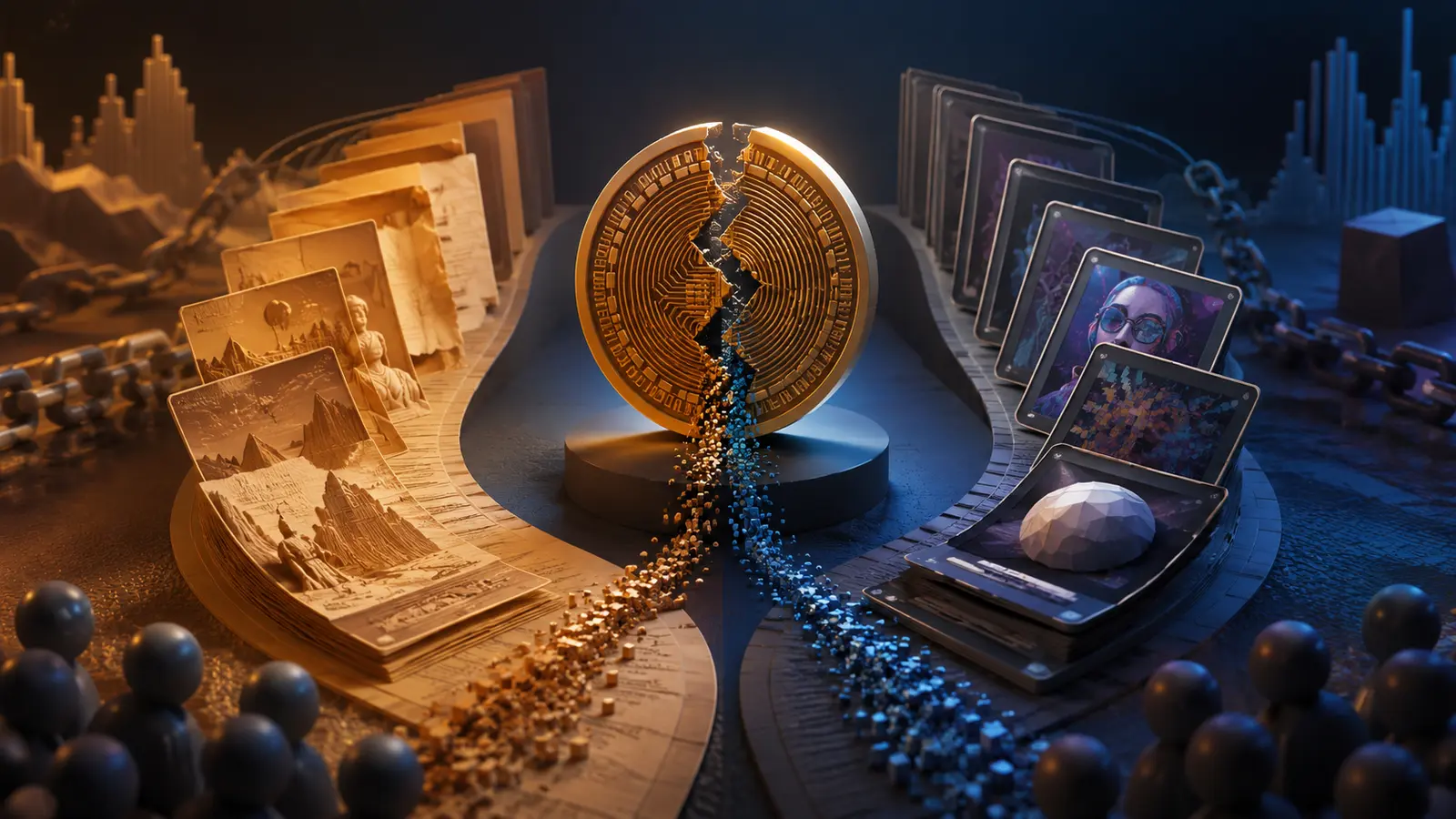
Ordinals give people a way to track individual satoshis, while inscriptions associate data with them under a particular indexing convention. They have opened up uses of Bitcoin that some users welcome and others regard as an expensive distraction. Understanding the dispute requires separating the on-chain data, the software that interprets it, and the rights a buyer actually receives.
The Anatomy of an Ordinal: What Exactly Are They?
The easiest way to get your head around Ordinals is to zoom all the way down to the smallest pieces of Bitcoin there are.
There will only ever be 21 million Bitcoin, but each one can be split into 100 million smaller units called satoshis, or sats. The name comes from Satoshi Nakamoto, Bitcoin's still-anonymous creator, and for most of the network's history every satoshi was treated exactly the same as every other one. One sat was one sat, interchangeable as grains of sand from the same beach.
That interchangeability has a name: fungibility. If you and I swap one ordinary satoshi for another, nothing has changed. Neither sat has a personality or a backstory or a special status. It's just a tiny sliver of Bitcoin.
Ordinal Theory breaks that symmetry by giving satoshis an order. It assigns each sat a number based on when it was mined, which means individual sats can suddenly be tracked as they move through the system. A satoshi stops being just a generic fraction of a coin. It can be identified. Followed. Turned into a carrier for something else entirely.
Step two is called inscription, and it's what attaches data to one of those newly numbered sats. That data could be a short message, a small image, a piece of software, a poem, even a sound clip — really anything that fits within Bitcoin's technical limits and whatever the fee market will bear.
The analogy people reach for is a numbered banknote. Picture a dollar bill with a unique serial number. Normally it's worth exactly one dollar. Now imagine an artist sketches something tiny and beautiful right on that specific bill. It's still a dollar — but that particular bill might become collectible because of what got added to it. Ordinals do roughly the same thing to satoshis, except the sketch is digital and the record lives permanently on Bitcoin.
That's what sets Ordinals apart from earlier Bitcoin experiments. They don't ask Bitcoin to become Ethereum. They don't bolt on a new token layer in the usual smart-contract sense. They just repurpose Bitcoin's existing transaction system in a way nobody planned for, and in doing so nudge a stubbornly conservative network into surprisingly expressive territory.
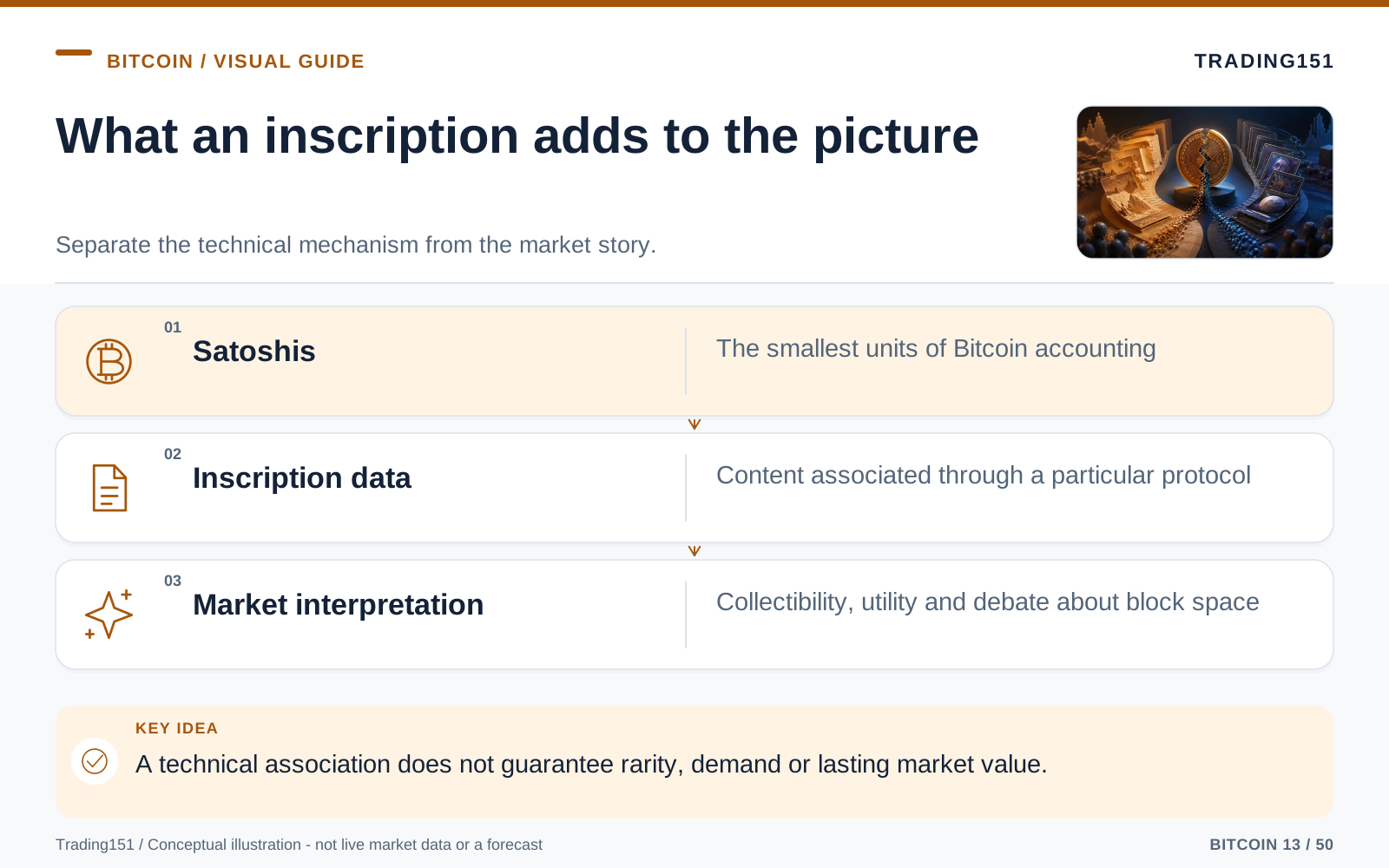
Read this diagram as text
- Satoshis
- The smallest units of Bitcoin accounting
- Inscription data
- Content associated through a particular protocol
- Market interpretation
- Collectibility, utility and debate about block space
How Ordinals Became Possible
Ordinals didn't come out of nowhere — they became possible thanks to earlier Bitcoin upgrades that were built for completely different reasons. They didn't touch Bitcoin's supply or introduce any new consensus rule. What they did was pair a numbering convention for satoshis with transaction features that made it practical to publish larger chunks of witness data. As far as the protocol is concerned, it just sees valid transaction data; it's the Ordinals software that interprets that data as an inscription tied to a particular sat. That distinction is really the whole story — it explains both why the design is clever and why it's controversial. Supporters see a smart repurposing of existing rules. Critics see an application quietly loading extra costs onto everyone competing for the same limited block space.
The first piece of the puzzle was SegWit, activated back in 2017. It restructured how transaction data is organized and made Bitcoin blocks more efficient overall. It also created a discount for certain types of transaction data — a detail that would matter a lot down the line for inscriptions.
The second piece was Taproot, which went live in 2021. Taproot was built to improve privacy and give more flexibility to complex spending conditions. Nobody designed it as an NFT machine, but it happened to make it much easier to cram larger, more flexible pieces of data into a Bitcoin transaction.
Ordinals took advantage of that combination in a way almost nobody saw coming, and that's a big part of why people are still arguing about it. To supporters, this is permissionless innovation working exactly as intended — people finding new uses for open infrastructure that nobody could have predicted in advance. To critics, it feels more like an unintended side effect being exploited to stuff the chain full of non-financial data.
Both sides have a point. Bitcoin runs on rules, and Ordinals follow those rules to the letter. But they also quietly rewrote the social meaning behind them. Before Ordinals, block space was basically thought of as room for moving money around. After Ordinals, it became something else too — a scarce digital surface where people could publish culture.
Ordinals vs. Traditional NFTs: The Big Difference
People throw around the phrase "Bitcoin NFTs" a lot, but that label only gets you halfway to understanding Ordinals. Sure, there's a family resemblance — both represent unique digital items, both pull in artists, collectors, and speculators. But under the hood, they're built very differently.
Casey Rodarmor and a lot of Ordinals supporters prefer the term digital artifacts. It might sound a little grandiose at first, but it points at something real. A good digital artifact, in this sense, should be complete, permissionless, uncensorable, and permanently on-chain — it shouldn't need a company, a hidden database, or a fragile web link just to keep existing.
1. The Pointer Problem vs. On-Chain Permanence
A lot of traditional NFTs don't put the artwork on the blockchain at all. Instead, the chain stores a token and some metadata that point somewhere else entirely. The actual image might sit on IPFS, or on a centralized server run by some company. That works fine in the best-case scenario. In the worst case, the token is basically just a receipt pointing at a file that can vanish, get swapped out, or simply become impossible to find.
It's the old "right-click save" joke, but with a darker undertone. The real problem was never that someone could copy an image. It's that plenty of NFTs quietly depend on outside infrastructure just to display the thing they're supposed to represent.
Bitcoin Ordinals sidestep that problem entirely. With an inscription, the actual data goes straight into the Bitcoin transaction itself. If it's an image, the image data is written directly into the chain. No separate website to trust. No single gallery server that needs to stay online forever. As long as nodes keep preserving Bitcoin's history, the inscription stays right there inside it.
A traditional NFT is a bit like buying a certificate that tells you where to find the artwork. An Ordinal is closer to carving the artwork straight into the vault wall. Less flexible, more expensive, sure — but it carries a kind of permanence that collectors find compelling.
2. Fewer Moving Parts
Ethereum NFTs typically run on smart contracts, which is one of Ethereum's biggest strengths — programmable ownership, royalties, marketplaces, games, lending, all of it. But that complexity comes at a cost. Contracts can have bugs. Admin keys can be misused. Metadata can be quietly changed if a project isn't built with care. A collection can look decentralized from the outside while still being controlled by a handful of people behind the scenes.
Ordinals skip most of that machinery. There's no smart contract pulling the strings — the inscription simply is what it is. Once it's confirmed on Bitcoin, it's about as close to unchangeable as digital assets get. For a lot of collectors, that simplicity reads as honesty.
Of course, simplicity cuts both ways — fewer features too. Ordinals don't naturally support all the elaborate mechanics NFT traders got used to on Ethereum. Fewer buttons, fewer programmable tricks, less room for elaborate tokenomics. Whether that feels refreshing or limiting probably depends on your taste.
3. A Different Kind of Scarcity
NFT scarcity usually comes down to whatever a project's smart contract decides. A creator launches a 10,000-piece collection, assigns rarity traits, sets aside a chunk for the team, and builds a marketing campaign around the whole thing. Sometimes that's done in the open. Sometimes it isn't.
Ordinals introduced a different flavor of scarcity altogether. Low inscription numbers got desirable simply for being early. Certain rare satoshis became collectible purely because of where they sit in Bitcoin's mining history. The block itself became part of the story behind the piece. Rarity stopped being only a design choice a founder made — it could also come straight from Bitcoin's own timeline.
That gives the whole thing an almost archaeological feel. Collectors aren't just buying a picture. A lot of the time, they're buying timing, placement, and provenance inside the oldest cryptocurrency network in existence.
The Great Bitcoin Argument: Spam or Free Market?
Ordinals didn't quietly slot into Bitcoin culture. They kicked the door open and picked a fight.
For a lot of Bitcoiners, the entire point of the network is being neutral money — decentralized, censorship-resistant, built for storing and moving value without asking anyone's permission. To them, block space is precious precisely because it's what lets people transact freely. Filling that space with images and meme-token noise feels irresponsible, maybe even offensive.
And when Ordinals took off, Bitcoin fees really did spike during the busiest stretches. Simple transactions got pricier. Blocks filled up fast. The mempool got jammed. Anyone just trying to send ordinary Bitcoin felt the difference — slower, more expensive, more annoying.
Critics saw it as a betrayal, plain and simple. Why should someone moving money pay more because somebody else wants to inscribe a cartoon wizard or a speculative token? To them, Ordinals turned a monetary network into a data dump and made everyday use worse for everybody.
Supporters had a blunt comeback: who exactly gets to decide what Bitcoin is for?
Bitcoin is permissionless. Nobody has to justify a transaction to a committee, a company, or some self-appointed cultural gatekeeper. If a transaction follows the consensus rules and pays the fee, miners can include it. Calling one use case legitimate and another spam might feel satisfying, but Bitcoin doesn't run on taste. It runs on rules and fees, full stop.
That's where the whole thing turns philosophical. The anti-Ordinals camp argues from purpose — Bitcoin should be money, period. The pro-Ordinals camp argues from neutrality — Bitcoin should process valid transactions without passing judgment on what they mean. Both sides believe they're protecting Bitcoin. They just disagree about which principle should win when push comes to shove.
The Fee Market and Bitcoin's Security Budget
There's also a more practical case for Ordinals: they generate demand for block space. Higher fees can help support miners as the block subsidy shrinks over time, but where those fees come from — and how stable they are — matters a lot. A wave of speculative inscriptions can fill blocks for weeks and then disappear the moment attention moves elsewhere. Regular payment users feel that demand the same way regardless of what's driving it — as a higher price to get their transaction settled. The fee market doesn't rank uses by social worth. It just decides which transactions pay enough. That's clean at the protocol level and messy for anyone who gets priced out during a surge.
Bitcoin miners secure the network by burning real energy and computing power. In exchange, they earn newly minted Bitcoin plus transaction fees. That newly minted portion is the block subsidy, and it gets cut in half roughly every four years during the well-known Bitcoin halving.
Over the long haul, that subsidy trends toward zero. Eventually Bitcoin's security has to rest much more heavily on transaction fees alone — what people call the security budget problem. If fees stay too low, will miners still have enough incentive to keep the network as secure as everyone expects?
Ordinals gave that whole debate a real stress test. During the busiest stretches of inscription and token activity, miners pulled in significantly more from fees. Supporters took that as proof that non-monetary demand for block space could help Bitcoin's long-term security. The people minting weird digital collectibles were, in effect, paying miners to keep the chain safe.
Critics aren't fully sold. They worry high fees just price out everyday users and drag Bitcoin away from its original peer-to-peer promise. And they'd argue a fee market built on speculative mania isn't exactly something you want to lean on.
Here's the uncomfortable truth: both concerns can be right at once. Bitcoin needs a healthy fee market, but high fees make small transactions painful. Ordinals didn't invent that tradeoff — they just made it impossible to ignore.
BRC-20: When Meme Coins Found Their Way Onto Bitcoin
Just as everyone was still processing image inscriptions, a pseudonymous developer known as Domo dropped another experiment on top: BRC-20.
The idea was almost excessively simple. If you can inscribe image data onto Bitcoin, you can inscribe text too. And if that text follows a consistent structured format, you can use it to fake the deployment, minting, and transferring of tokens. BRC-20 leaned on JSON inscriptions to mimic token behavior right on Bitcoin.
It wasn't elegant — not even close. Next to token standards on Ethereum or Solana, BRC-20 was clunky, limited, and inefficient. But crypto markets rarely reward elegance. They reward novelty, liquidity, and a good story. And suddenly Bitcoin had meme coins, with traders piling in almost immediately.
Tokens like ORDI and SATS became part of this strange new market. Some people found it absurd — the most conservative blockchain in crypto being used to trade the kind of speculative junk usually reserved for faster, looser chains. Others thought the absurdity was exactly the appeal. Bitcoin's cultural purity had been punctured, and the chaos pouring through that hole was impossible to look away from.
BRC-20 also said something bigger about human nature. No matter how serious a network's branding gets, people will always find a way to use open systems for play, status, gambling, art, and just plain messing around. You can engineer Bitcoin to be hard money. You can't engineer people out of being people.
Artists, Collectors, and the Lure of Digital Permanence
It's easy to mock Ordinals from a distance. Why would anyone spend real money on a tiny image attached to a satoshi? Why does a low inscription number matter to anyone? Why should a digital file be worth more just because it happens to live on Bitcoin?
But collecting has never really been rational. People collect stamps, sneakers, vinyl, trading cards, watches, paintings, first editions, movie props, old concert posters — you name it. What usually matters isn't the object itself but the story attached to it. Who made it? When? Who owned it before you? What moment does it capture?
Ordinals hand digital art a new kind of provenance. The artwork isn't sitting on some server somewhere — it's embedded directly in Bitcoin's historical record. The inscription number, the satoshi, the block, the date, all of it becomes part of the object's identity. For collectors, that can feel a lot closer to owning an artifact than owning a file.
There's status in the chain itself, too. Bitcoin is the oldest, most secure, most symbolically loaded cryptocurrency there is. For artists, putting work on it can feel like carving something into the bedrock of crypto history. For collectors, owning an early or culturally significant Ordinal can feel like holding a fragment of a new kind of digital archaeology.
That's not to say every Ordinal is worth anything. Most probably won't be remembered. Plenty will age badly, and a lot were minted just to chase a trend. But that's true of every art market that's ever existed. Cheap posters don't make fine art meaningless. Bad NFTs don't erase the chance that some digital artifacts end up mattering down the line.
The Real Risks Nobody Should Ignore
The hype around Ordinals can make them sound cleaner and safer than they are. Yes, they fix some of the problems traditional NFTs have — but they bring their own baggage too. An inscription can be permanently on-chain and still be a terrible collectible. Provenance can get disputed. Marketplaces mislabel rare sats. Wallets accidentally spend an inscribed output as if it were ordinary bitcoin. Thin markets make a "floor price" essentially meaningless. Copyright issues, offensive content, legal disputes — none of that vanishes just because the data lives on-chain. Buyers still need to understand transaction structure before moving anything. Permanence protects the bytes. It doesn't guarantee authenticity, cultural value, liquidity, or that anyone involved knows what they're doing.
First up, wallet risk. Managing Ordinals takes real care because the collectible is tied to one specific satoshi. Send Bitcoin from the wrong wallet, or mix funds carelessly, and you can accidentally spend away the exact sat carrying your inscription. Good Ordinals wallets try to prevent that — but mistakes still happen, plenty of them.
Then there's market risk. Ordinals are substantially speculative. Prices can shoot up the moment attention floods in and crash just as fast the moment the crowd wanders off. A piece can be permanently inscribed on Bitcoin and still be worth nothing to anyone else.
There's also indexing risk. The raw inscription data lives on Bitcoin, sure, but most people rely on wallets, marketplaces, and indexers just to see and trade their Ordinals in the first place. When those tools disagree or break, things get confusing fast. Bitcoin preserves the data — it doesn't hand you software to make sense of it.
And finally, cultural risk. Bitcoin's culture isn't uniformly welcoming to Ordinals, and probably never will be. Some people will always view them as spam, and that social friction can shape developer support, wallet design, and the ecosystem's reputation as a whole.
None of this kills the case for Ordinals. It just makes the whole thing less magical and more human. Permanent doesn't mean foolproof. On-chain doesn't mean valuable. New doesn't mean safe.
How to Get Started with Ordinals Without Losing Your Mind
If you want to dip a toe in, know going in that Ordinals are still less forgiving than crypto collectibles on more consumer-friendly chains. Tools have gotten better, but there's a real learning curve here.
- Use an Ordinals-compatible wallet: Don't try to make do with a basic Bitcoin wallet that has no idea what an inscription even is. Wallets like Xverse, Leather, Unisat, and Magic Eden's wallet are built specifically to help you handle Ordinals safely.
- Keep ordinary Bitcoin and Ordinals separate: Good wallets automatically keep collectible sats apart from your regular spendable Bitcoin. That matters a lot — you really don't want to accidentally send off an inscribed sat in a normal transaction.
- Start on a marketplace you understand: Platforms like Magic Eden, OKX, and Gamma make browsing and buying far easier than wrestling with raw Bitcoin transactions yourself.
- Watch fees closely before buying: Bitcoin fees can jump fast when demand spikes. A purchase that looks totally reasonable one minute can get a lot pricier once network fees get added in.
- Don't confuse permanence with profit: An Ordinal might sit on Bitcoin forever, but that says nothing about whether anyone will want to buy it off you later. Treat this space as experimental, not a sure thing.
The safest way in is curiosity before commitment. Poke around. Learn how inscriptions work. Study older collections and the inscription numbers that matter. Get comfortable with wallet mechanics first. Then, if you still want in, start small.
What Ordinals Mean for Bitcoin's Future
Ordinals forced a conversation Bitcoin had been dodging for years. A lot of people talked about Bitcoin's identity as if it were locked in forever — money, digital gold, a savings tool, a hedge against monetary abuse. All of that's probably still true. But Ordinals showed there's more to it: Bitcoin can also act as a settlement layer for culture, identity, software, and collectibles nobody planned for in advance.
That doesn't mean Bitcoin should try to be everything for everyone. Its strength has always come from restraint. The base layer is slow, expensive, and limited compared to newer chains — and that limitation is a big part of why it stays secure and dependable. Trying to turn Bitcoin into a cheap, high-speed app platform would completely miss the point.
But Ordinals make a different, subtler argument. They suggest Bitcoin's scarcity isn't purely monetary — its block space is scarce too. And if people are willing to compete for that space, whether to move money or preserve some piece of art, the network is just going to process whatever valid transaction pays enough to get in.
Uncomfortable, maybe, but it's deeply in character for Bitcoin. No central authority sits around deciding which transactions are beautiful, useful, dumb, noble, or embarrassing. The network doesn't have opinions about taste. It only understands validity and fees.
Owning the inscription is not owning every associated right
A buyer may be able to transfer an inscribed satoshi without acquiring copyright in the image associated with it. Copyright, licensing, and permission to reproduce a work depend on the relevant legal rights and sale terms. The fact that a transaction is recorded on-chain does not settle those questions. A marketplace description should not be treated as a substitute for an explicit license.
Preservation needs similar care. Data included in blockchain history can be retrieved from sources that retain it, but not every node keeps all historical block data indefinitely. Pruned nodes are a normal part of Bitcoin's design. Access through a particular website also depends on that website continuing to operate. Distinguish the persistence of the transaction record from the continued availability of a convenient display interface.
Wallet handling introduces a more immediate concern. Software that does not recognize an inscription may treat its associated output as ordinary spendable bitcoin. Using an inscription-aware wallet and understanding its coin-selection behavior can reduce that risk, but the user still needs to verify what an outgoing transaction spends.
For a purchase decision, write down what is scarce and why someone would want it. Is the appeal artistic, historical, social, or purely speculative? None of those answers is made stronger by confusing technical transferability with legal ownership or guaranteed resale demand. The technology can establish a record; it cannot establish what a future buyer will pay for it.
Separate the collectible from the file
Owning an inscription does not necessarily confer copyright, commercial-use rights, or an exclusive right to display the underlying image. Those rights depend on the creator's terms and the relevant law, not simply on the location of a record. A copy of the file may remain accessible to others.
Before paying a premium, identify what is scarce: a particular on-chain item, a claimed edition, a license, or merely the seller's story about provenance. These can have different meanings. A clear description of what transfers is more useful than treating the word 'ownership' as though it answers every question. 1, 2
Permissionless Systems Stay Messy
The most interesting thing about Ordinals was never really the pictures. It's that they dragged messiness back into a culture that likes to sound pure.
Bitcoin has always drawn grand theories — about money, sovereignty, energy, freedom, inflation, where the financial system is headed. Ordinals dragged in a totally different set of human impulses: collecting, showing off, joking around, gambling, archiving, remixing, arguing about art. Some Bitcoiners hated every bit of it. Others found it refreshing, even overdue.
Maybe that's exactly why Ordinals hit such a nerve. They made Bitcoin feel less like a finished monument and more like a living public square. Public squares are never spotless. People argue in them. Artists tag the walls. Traders crowd in. Purists complain loudly. Builders keep showing up anyway, because that mess is proof that something's alive.
Ordinals didn't break Bitcoin. They just exposed a side of it that was hiding in plain sight all along: give people open block space, and they'll use it in ways nobody could have fully predicted.
Whether that reads as a breakthrough or a nuisance really comes down to what you think Bitcoin should protect most fiercely — its monetary focus, or its permissionless neutrality. That argument isn't going away anytime soon. Neither are the inscriptions.
Bitcoin is still money. Still a settlement network. Still the most battle-tested chain in crypto. But now it's also, love it or hate it, a permanent gallery wall for the internet's strangest artifacts. The oldest player in cryptocurrency hasn't exactly gotten polite. It's just gotten interesting again.
Sources and further reading
- The Ordinal Theory Handbook: Inscriptions
- SEC Investor Bulletin: Crypto Asset Custody Basics for Retail Investors
Editorial revision: 7 October 2026. Numerical scenarios are hypothetical unless identified as historical. References support the added explanations and selected corrections; rules and product terms should be checked again before acting.