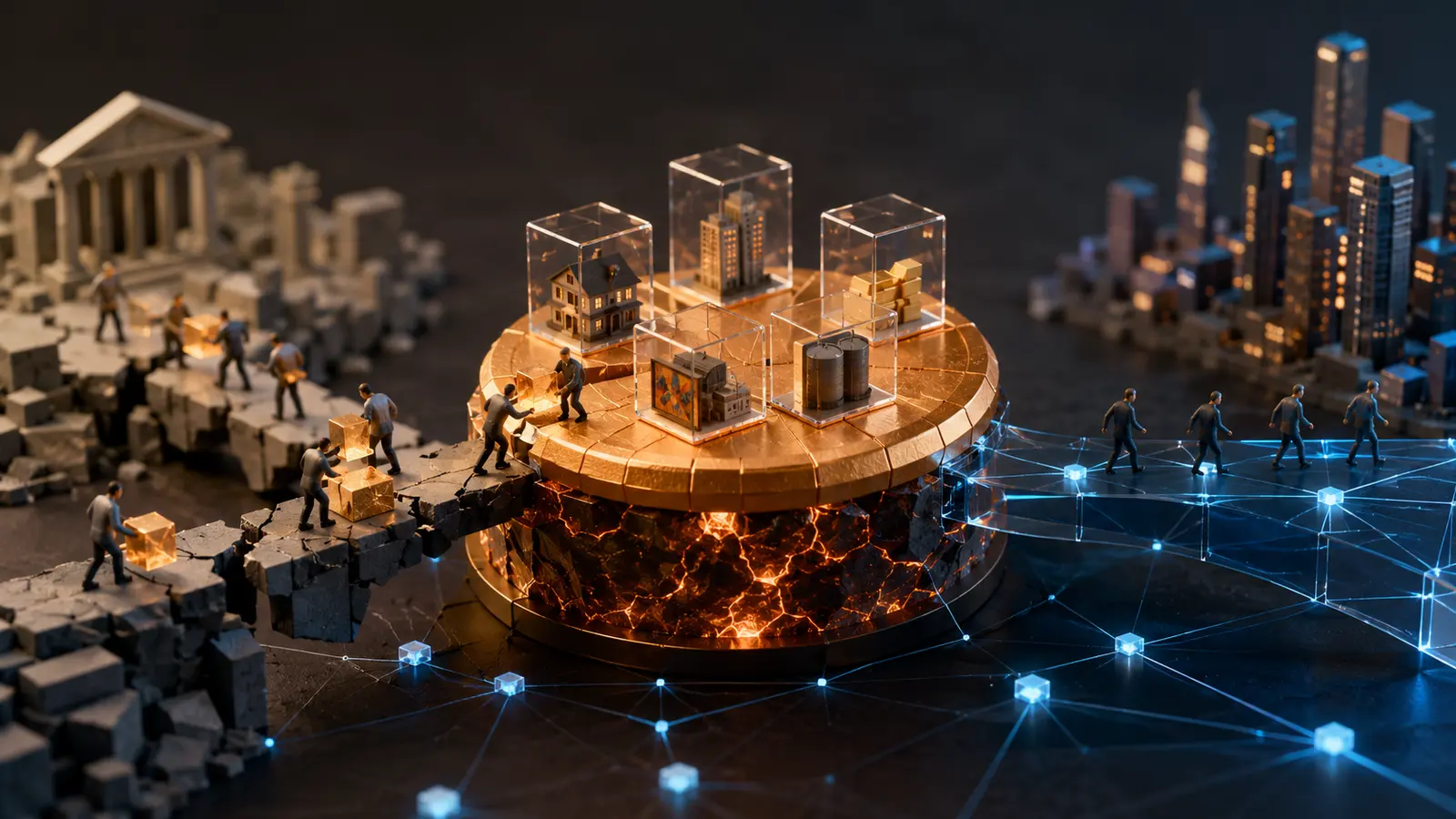
A token can make an asset easier to transfer without making the underlying ownership claim any stronger. That distinction matters in projects built around Bitcoin. The technical design explains how a token moves; the issuer's obligations, custody arrangements, and applicable law explain what its holder can actually claim. Both need scrutiny before the convenience means much.
What Asset Tokenization Means
At its core, tokenization is just taking something of value and creating a digital token for it on a blockchain. The asset could be physical, financial, or purely digital—think commercial real estate, government bonds, private loans, physical gold, fine art, or even music royalties. A token proves you control a digital entry, but on its own, it can't magically force a court or a company to honor your claim. Because of this, real-world tokenization relies on two ledgers: the blockchain that moves the token, and the legal framework that dictates what the token gets you. If those two don't perfectly align, the whole thing falls apart. Minting the token is the easy part. The real work is figuring out redemption, transfer rules, bankruptcy protection, and how to handle disputes.
A token doesn’t digitally teleport a physical object onto the blockchain. The skyscraper is still on the street, the gold is still in a vault, and a bond still relies on legal contracts. What the blockchain does is hold a tamper-proof record of who owns what. When done right, every token maps directly to a legally binding economic interest.
Think of it like a giant pizza. You don’t have to buy the whole pie; you can just grab a slice. Tokenization takes that exact logic and applies it to things that are traditionally hard to chop up. A high-rise can be split into a million digital pieces. A large private loan can be chopped into bite-sized exposures. A multi-million-dollar painting can be co-owned by thousands of everyday investors instead of sitting in one billionaire's living room.
But chopping things up is only half the magic. The bigger shift is making ownership records programmable, portable, and a breeze to verify. Instead of dealing with messy spreadsheets, agonizingly slow settlement processes, and endless middlemen, tokenized assets zip along a shared digital track.
On paper, this opens up some large perks:
- Way more liquidity: Things that usually take months to sell—like real estate or fine art—can be traded in smaller chunks with far less friction.
- Better access: Everyday investors finally get a shot at high-tier, institutional-grade assets that are normally reserved for the ultra-wealthy.
- Instant settlement: Transfers that usually take days of back-office paperwork can settle in minutes on a blockchain.
- Crystal-clear records: A public, auditable ledger makes it easy to verify ownership history and almost impossible to fake it.
- Built-in automation: Things like compliance rules, dividend payouts, and interest can be hardcoded right into the token itself.
All of this sounds amazing, but there’s a giant catch: tokenization isn’t just a tech problem. It’s a large legal and operational headache. A token is totally useless if the real world ignores it. If your token says you own part of a building, somebody still needs to manage the property, collect the rent, handle the taxes, and make sure your rights as a token holder hold up in court.
That’s exactly why the smartest teams in this space aren't just writing clever code. They’re doing the grueling work of bridging blockchains with real-world custody, strict regulations, identity verification, and legal enforcement.
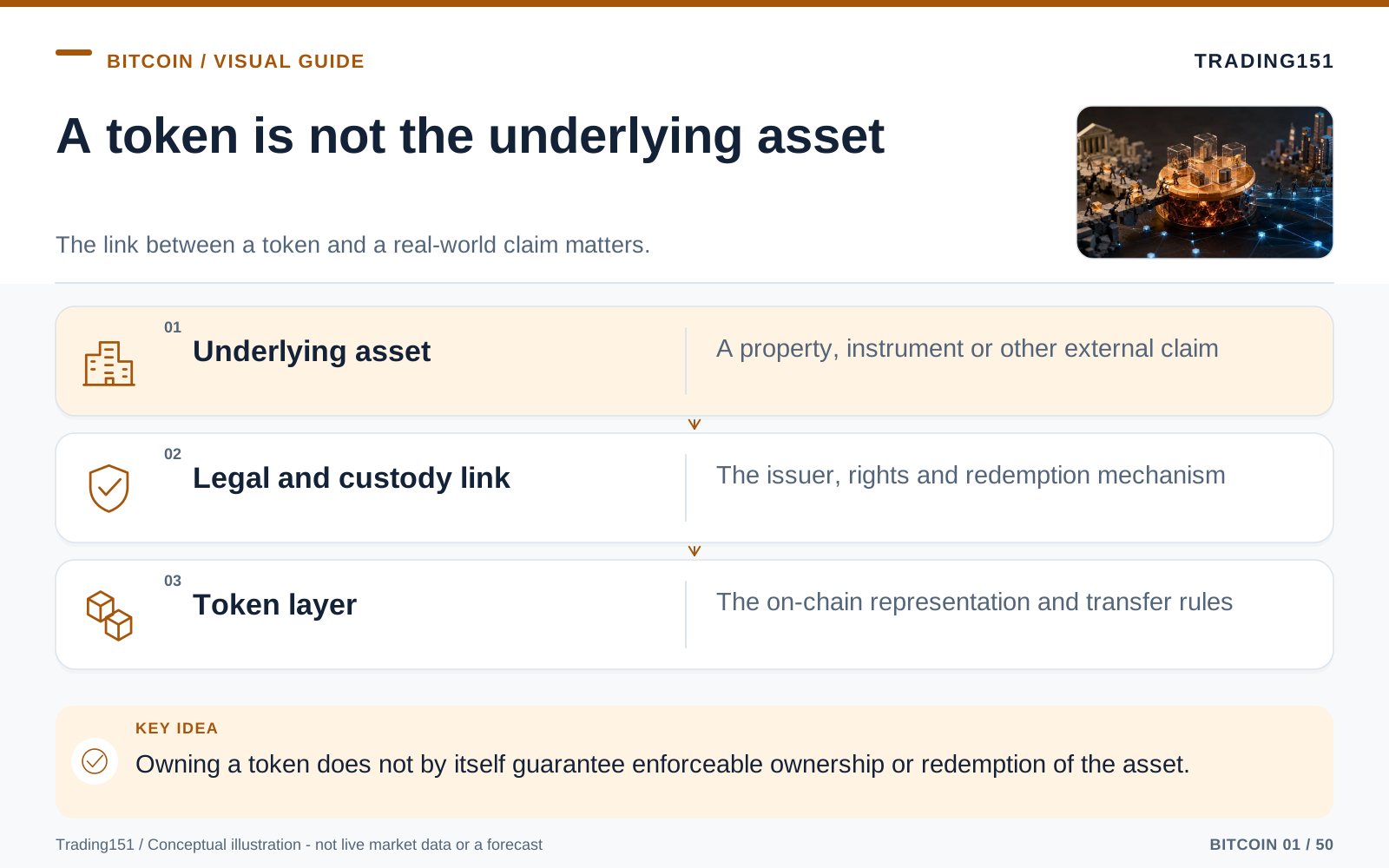
Read this diagram as text
- Underlying asset
- A property, instrument or other external claim
- Legal and custody link
- The issuer, rights and redemption mechanism
- Token layer
- The on-chain representation and transfer rules
Why Bring Tokenization to Bitcoin?
At first glance, Bitcoin seems like a terrible fit for this. Compared to newer chains, it’s rigid. The base layer was never meant to run complex apps, it doesn't tolerate rapid-fire experimentation, and it certainly isn't trying to process every random financial trade on-chain.
But here’s the kicker: that stubbornness is exactly why people want to use it.
Bitcoin’s value lies in its conservatism. The rules are beautifully simple, globally understood, and hard to mess with. It has chugged along for over fifteen years, securing large amounts of wealth via a decentralized army of miners and nodes. If you’re an institution looking to move millions of dollars of real-world value onto a blockchain, you don't want a network that constantly changes. You want a foundation that is battle-tested, neutral, and practically indestructible.
This is where Bitcoiners make their strongest case. Ethereum might be far more flexible, but Bitcoin has unrivaled brand recognition, a large pool of native liquidity, and a strong reputation for final settlement. You don’t have to be a crypto nerd to know what Bitcoin is. That sheer cultural gravity is almost impossible for other networks to replicate.
There’s also a very practical strategy at play here. Hundreds of billions of dollars are just sitting in Bitcoin. If developers can bring tokenized bonds, stablecoins, and commodities directly to the Bitcoin ecosystem, holders won't have to bridge their wealth somewhere else to use it. In this scenario, tokenization doesn’t replace Bitcoin—it just builds a vibrant financial district right around it.
The goal isn't to turn Bitcoin into an Ethereum clone. It probably shouldn’t be one. The better question is whether Bitcoin can stay true to its simple base layer while letting secondary layers handle all the complex asset stuff. That’s exactly the tightrope developers are trying to walk right now.
A Short History: From Colored Coins to Ordinals and Runes
The idea of slapping assets onto Bitcoin isn't new. Way before Ethereum even existed, developers were already brainstorming how to "mark" certain fractions of a bitcoin so they represented something else entirely.
One of the coolest early ideas was called Colored Coins. The concept was beautifully straightforward: you take a tiny fraction of a bitcoin and "color" it with a new identity. Maybe it represents a company share, a concert ticket, or a piece of digital art. The Bitcoin blockchain would simply track who owned it.
It was brilliant in theory, but the timing was terrible. Wallets were clunky, standards were practically non-existent, and the Bitcoin network just didn’t have the infrastructure to make it work smoothly. Colored Coins faded out, though they deeply inspired everything that came later.
Eventually, Ethereum stole the show because it was built from the ground up for this exact purpose. ERC-20 tokens, NFTs, lending platforms, and automated decentralized exchanges gave developers the ultimate sandbox. Bitcoin, meanwhile, stuck to its guns: sound money and secure settlement.
Then came the Taproot upgrade.
Flipped on in 2021, Taproot quietly upgraded Bitcoin’s scripting limits, privacy, and efficiency. It wasn’t designed to launch a token craze, but it inadvertently cracked the door open for developers to play with data in new ways. By early 2023, developer Casey Rodarmor pushed that door wide open with the Ordinals protocol, which let people inscribe digital artifacts directly onto individual satoshis (the smallest fractions of a bitcoin).
The backlash was instant. A lot of purists hated Ordinals, seeing them as digital spam bloating the network and jacking up fees. Others thought native Bitcoin artifacts were the coolest thing ever. But love it or hate it, Ordinals proved one thing: there was a large appetite for putting more than just payment data on Bitcoin.
BRC-20 tokens quickly followed, hacking the Ordinals system to create tradeable, fungible tokens. Then we got Runes, a sleeker protocol designed to clean up the network bloat left behind by those early experiments. All the while, projects outside the inscription hype—like Taproot Assets, RGB, Liquid, and Stacks—kept quietly building in the background.
No single one of these tools is the magic bullet for Bitcoin tokenization. But together, they prove that Bitcoin is capable of vastly more than people gave it credit for.
How Tokenization Can Work Without Overloading Bitcoin
Of course, there's a glaring problem: Bitcoin’s base layer is precious and heavily constrained by design. That scarcity is exactly what keeps it decentralized enough for anyone to run a node. It also means Bitcoin cannot realistically handle every real estate trade, bond payout, and secondary market flip directly on Layer 1. Most smart architectures keep the heavy data off-chain—using clients, sidechains, or specialized networks—while using Bitcoin merely for final settlement and security. This saves block space but introduces tricky questions about data storage and emergency recovery if a secondary network fails. Ultimately, these systems have to be judged by their worst-case recovery paths, not just by how loudly they yell 'Bitcoin' in their marketing.
If every token transaction settled directly on Bitcoin’s main chain, it would be a disaster. Fees would skyrocket, confirmation times would grind to a halt, and everyday users would be priced out. It wouldn't be a financial revolution; it would just be a large traffic jam.
The smarter approach is to treat Bitcoin as the ultimate bedrock of security, while pushing the actual day-to-day activity to higher layers or sidechains. Think of Bitcoin as the deep concrete foundation of a skyscraper. You don’t host your daily office meetings in the concrete foundation—you build floors on top of it.
1. Taproot Assets and the Lightning Network
The Lightning Network was originally built to make bitcoin payments fast and dirt-cheap. Instead of logging every tiny payment on the main chain, users open payment channels and only settle the final tab on Layer 1.
Taproot Assets piggybacks on this exact concept, but applies it to other assets. It effectively lets you issue and zip things like stablecoins or tokenized gold across Lightning infrastructure, meaning you get the speed and near-zero fees of a Lightning transaction, just with different assets.
Stablecoins are the obvious killer app here. Being able to send digital dollars instantly over Bitcoin's rails would be a game-changer for international commerce and remittances. And for real-world assets, this kind of speed makes trading small fractions of a token highly practical rather than prohibitively expensive.
2. RGB and Client-Side Validation
RGB handles things a bit differently. Rather than stuffing contract details onto the Bitcoin blockchain, RGB keeps almost everything off-chain. The people involved in a transaction verify the data themselves, while Bitcoin is just used as an anchor to prevent double-spending.
This is called "client-side validation." It’s fantastic for privacy because the entire world doesn’t get to peek at your contract details. It also takes a lot of pressure off Bitcoin’s limited block space. If you're dealing with private corporate bonds or real estate documents, that level of privacy is a must-have.
Client-side validation adds operational requirements. Users need compatible wallets, the relevant off-chain proof data, and dependable backups. Losing that information can impair the ability to demonstrate or transfer rights, even when an on-chain commitment remains visible. Recovery arrangements need to be understood before an asset is acquired; an immutable commitment is not a substitute for preserving the data required to use it.
3. Sidechains Such as Liquid
Sidechains are essentially parallel blockchains that run next to Bitcoin, connected by a peg. They aren’t Bitcoin Layer 1, but they offer faster speeds, extra privacy, and much easier token issuance.
Blockstream’s Liquid Network is probably the most famous example. It’s tailor-made for fast, confidential trading between institutions and exchanges. Liquid natively supports custom assets, making it a natural fit for stablecoins and tokenized securities.
Liquid’s biggest strength is that it just works today. It gives you features the base layer can’t, while staying deeply tethered to the Bitcoin ecosystem. The downside? Hardcore purists point out that it relies on a trusted federation of companies rather than Bitcoin’s pure proof-of-work mining. For a bank, that might be a perfectly fine tradeoff. For a cypherpunk, maybe not.
4. Stacks and Bitcoin-Connected Smart Contracts
Stacks takes a different route, aiming to bring full-blown smart contracts to the Bitcoin ecosystem while using the main chain as its ultimate source of truth. It lets developers build decentralized apps, lending protocols, and complex asset marketplaces with a programming language much more flexible than Bitcoin’s native script.
This makes Stacks highly appealing for projects that need complex logic—think automated dividend payouts, whitelists for accredited investors, or decentralized collateral markets. Instead of trying to force Bitcoin to do math it wasn't designed for, Stacks handles the heavy lifting and periodically anchors its records back to Layer 1.
The trust assumptions depend on the particular system. Establish what Bitcoin verifies, what the separate network or protocol verifies, and what depends on an issuer, custodian, or legal agreement. Describing a product as built on Bitcoin does not mean every part inherits Bitcoin's validation model or removes intermediary risk.
What Could Be Tokenized on Bitcoin?
The buzzword "real-world assets" can feel like empty marketing fluff. But when you look closely, the best use cases are usually assets where the traditional system is clunky, heavily fragmented, or completely shut off from everyday investors.
1. Bonds, Treasuries, and Private Credit
Fixed-income products—like government bonds, Treasury bills, and private credit—are absolute no-brainers for tokenization. They’re basically just digital cash flows to begin with. Turning a bond into a token is a lot cleaner than trying to tokenize something messy and physical, like an apartment building.
If you tokenize a bond, retail investors can buy tiny fractions of it, interest can stream directly to their wallets, and they can trade it without waiting for a broker to catch up. For institutions, it drastically cuts down on back-office paperwork and makes it easier to use debt as instant collateral.
2. Real Estate
Real estate is the one everyone grasps immediately. Property is highly valuable, widely understood, and painfully hard to sell. Doing a real estate deal means wrangling lawyers, banks, title companies, and inspectors, usually over months. You can buy fractional shares of real estate today, but they're usually locked inside rigid, opaque private funds.
Tokenization flips that on its head. A builder could fund a new project by selling digital shares directly to the public. Landlords could automatically beam rental income straight to token holders. You could buy exposure to a specific neighborhood or commercial high-rise just as easily as you buy a stock.
But real estate is also the perfect reality check for this tech. A blockchain token cannot fix a leaky roof, evict a bad tenant, or fight the city over zoning laws. The legal framework surrounding the token is ultimately what matters.
3. Commodities and Precious Metals
Commodities like gold, silver, and oil are fantastic candidates because they already trade in highly standardized units. If you hold a token backed by physical gold, you get the financial exposure without having to rent a vault, pay for transport, or hire armed guards.
Bringing this to Bitcoin is a fascinating concept. For years, Bitcoin has been pitched as "digital gold." If you put tokenized physical gold on a Bitcoin layer, investors can effortlessly glide between digital scarcity and physical scarcity without ever leaving the ecosystem. It's the perfect setup for hard-money advocates who want the tangibility of gold paired with the sheer speed of a blockchain.
4. Stablecoins and Fiat-Backed Tokens
Stablecoins are admittedly pretty boring, but they are arguably the most important piece of the puzzle. A fiat-backed stablecoin is essentially a tokenized claim on a dollar sitting in a bank. Right now, they are the main bridge connecting the wild volatility of crypto to the everyday pricing of the real world.
Integrating stablecoins deeply into Bitcoin’s infrastructure could be large. People living under broken banking systems don't necessarily want volatile assets; they want digital dollars. A stablecoin running on Bitcoin rails would make cross-border payments, freelance gigs, and daily savings frictionless and practical.
5. Funds, Indexes, and Alternative Assets
This tech works great for pooled investments, too. A fund could issue tokens representing a large basket of bonds, stocks, or real estate. It gives you the diversification of an index fund, but with the flexibility of a liquid token.
Then there’s the alternative stuff: music royalties, unpaid invoices, or intellectual property rights. These markets are traditionally opaque and heavily gatekept. If tokenization can make them transparent and easy to trade, it could open up entirely new asset classes to the general public.
The Difference Between a Token and Ownership
One of the most dangerous myths in this space is that the token itself is the asset. For native crypto stuff, sure. But for real-world assets? Not a chance.
A gold token is not a bar of gold. It is a digital receipt tethered to custody agreements, auditing firms, and redemption laws. A tokenized apartment isn’t the drywall and the plumbing; it’s a legal claim wrapped in local property law. The token only has value because a real-world legal system is standing behind it, ready to enforce the issuer’s promises.
This distinction is huge. It separates real financial innovation from cheap gimmicks. A slick mobile app means absolutely nothing if you can't verify the reserves, enforce your rights, or cash out when you need to. Paperwork still rules the world. The best tokenization projects don't pretend the law doesn't exist; they just use blockchains to make legal ownership run dramatically smoother.
The Roadblocks Bitcoin Still Has to Face
The potential here is enormous, but we shouldn't kid ourselves about the hurdles. Bringing real-world assets to Bitcoin means fighting technical, cultural, and regulatory battles that won't be easily solved by just throwing code at them.
A Cultural Fight Inside Bitcoin
Bitcoin has a fierce, deeply ingrained culture, and not everyone is thrilled about tokenization. A lot of old-school Bitcoiners firmly believe the network should be used exclusively for censorship-resistant money. To them, launching corporate bonds or meme tokens on-chain is just spam that clogs up block space and distracts from Satoshi's original vision.
And they aren't exactly wrong. Block space is scarce. If a flood of token trading spikes network fees, people trying to use Bitcoin to escape failing currencies might get priced out. The entire bet relies on layered systems successfully keeping the heavy traffic off the main chain.
Scalability and Fee Pressure
Bitcoin simply cannot be the direct settlement engine for global finance. It wasn't built for that volume, and that’s a feature, not a bug. Tokenization only survives if sidechains, Lightning, and client-side validation absorb the vast majority of the daily action.
Because of this, infrastructure is everything right now. Wallets need to feel seamless. Bridges between layers need to be bulletproof. Developers have to abstract away all the technical jargon so that normal people can trade assets without needing a computer science degree.
Regulation and Compliance
Real-world assets are heavily regulated. Period. Tokenized real estate, stocks, and bonds are going to be treated as securities. Stablecoins have to navigate a maze of banking and money-transmission laws.
This creates large friction. Bitcoin is fundamentally permissionless and borderless. Securities laws are the exact opposite. You can't just let a regulated corporate bond float freely across the internet if the issuer is legally required to restrict who buys it. That means serious real-world asset projects have to bake in whitelists, identity checks, and transfer limits.
Crypto purists might hate that. But if we’re talking about institutional assets, it’s completely unavoidable. The trick is building compliance into the system without completely killing the speed and transparency that makes blockchains valuable in the first place.
Custody, Oracles, and Real-World Trust
Finally, real-world assets inherently rely on real-world trust. Somebody physically has to make sure the gold hasn't been stolen, the property is owned by the right entity, and the borrower made their payment.
Custodians, auditors, and data providers may be needed to establish whether an off-chain asset exists and whether the token holder has an enforceable claim. Bitcoin can verify transactions under its rules, but it cannot inspect a warehouse, settle a title dispute, or guarantee an issuer's solvency. A credible tokenization design makes those dependencies explicit rather than presenting a blockchain record as complete proof of ownership.
What a Mature Bitcoin Tokenization Market Might Look Like
If this all works, the end user will probably never even realize they’re using Bitcoin. That’s how good tech is supposed to feel. When you swipe a credit card, you don't think about payment routing; you just want it to work. A mature tokenization market will be pleasantly boring. Issuers will clearly outline rights, auditors will quietly verify reserves, and apps will handle compliance checks seamlessly in the background. The real product isn't a shiny token—it's a legally binding claim that is ridiculously easy to trade and bulletproof when push comes to shove.
In a few years, a well-built app might let you hold raw bitcoin, digital dollars, tokenized Apple stock, and a slice of a Miami apartment all in the same wallet. A coffee shop could accept Lightning-fast stablecoin payments and automatically instantly swap part of its balance into bitcoin or short-term debt. Large global funds could swap tokenized Treasury bills as collateral without waiting for banks to open on Monday.
Behind the curtain, a stack of technologies would be working together. Bitcoin’s Layer 1 acts as the ultimate vault. Lightning handles the fast payments. Sidechains handle the heavy trading. Smart-contract layers handle automation. And real-world auditors and lawyers tether those digital tokens to physical reality.
We aren’t there yet. The tools are still being heavily tested, and some of them are going to fail. There will be regulatory crackdowns, overhyped scams, and endless arguments on crypto Twitter. But the trend is undeniable: Bitcoin is shedding its reputation as just a passive rock you hold in a vault. It’s evolving into a foundation for a completely new financial stack.
Start with the redemption question
Imagine a token advertised as representing one gram of gold. Before examining its trading interface, ask how someone turns that token into gold or cash. Is there a minimum redemption amount? Who verifies the metal? Can the issuer pause withdrawals? What happens if the vault operator or the token company becomes insolvent? A transferable token with no workable redemption route is not equivalent to holding the asset it names.
The same questions apply to tokenized property or debt. Ownership may sit in a legal entity while the token represents a contractual interest in that entity. Voting rights, distributions, transfer restrictions, and dispute resolution come from the documents, not from the fact that a blockchain records transfers. A technically valid transaction can still fail to transfer the legal rights a buyer expected.
Follow the information trail as carefully as the asset trail. The network may verify a signature or a commitment, while an auditor, administrator, or data provider verifies something outside the network. These are different assurances. A report about reserves also needs a date and an explanation of liabilities; knowing what an issuer holds is not enough without knowing what it owes.
A credible project should make these limits easy to find. The strongest case for tokenization is a specific improvement, such as easier administration or access, supported by enforceable rights. Claiming that Bitcoin removes every intermediary's risk obscures the very details a holder needs to understand.
Ask who can make the token whole
A tokenized claim needs a path from the digital record to the promised benefit. Consider a token said to represent a share of rental income. Who collects the rent, pays maintenance, calculates the distribution, and resolves a dispute? The blockchain can record a transfer without answering any of those questions. The legal documents and operating arrangements carry much of the substance.
Redemption terms are especially revealing. A holder may have a right to cash, a right to delivery, a right to a discretionary distribution, or no direct redemption right at all. Minimum sizes, identity checks, jurisdictional restrictions, and fees can make those rights quite different in practice. Read the exit provisions before treating two tokens with similar labels as equivalent investments. Transferability is useful, but it does not by itself make the underlying claim liquid or enforceable. 1, 2
The Token Is Easy; the Legal Claim Is Hard
Tokenizing assets on Bitcoin isn't about turning the network into a casino for meme coins, even though speculators will inevitably show up. It’s fundamentally about upgrading global settlement. Traditional finance runs on ancient, siloed infrastructure. Stock trades take days to clear. Moving money across borders is an agonizing process. Private markets are walled gardens.
Bitcoin offers something radical: a base layer that is globally accessible, entirely neutral, and impossible for one company or government to shut down. That doesn't mean it's the perfect fit for every asset. But it does make it an compelling foundation, especially as engineers figure out how to scale it without bloating the main chain.
The reality is that Bitcoin probably won’t kill off every other blockchain or bankrupt traditional banks. Instead, it will likely become the ultimate, unshakeable settlement anchor for a large digital economy. Some assets will thrive on Ethereum. Others will live on private banking chains. And a huge chunk of the market will anchor itself to Bitcoin through sidechains, Lightning, RGB, and Layer 2s.
The irony here is beautiful: Bitcoin was never meant to be flexible. Its greatest strength has always been its rigid, uncompromising nature. Yet, through years of stubborn experimentation, builders are figuring out how to turn that extreme rigidity into the ultimate foundation for global finance.
At its core, Bitcoin is still digital money. That will never change. But around that indestructible core, an entirely new financial architecture is being built. If asset tokenization takes over the world, Bitcoin might not be the flashiest or loudest platform in the room. But it just might be the quiet, impenetrable bedrock holding the entire thing together.
Sources and further reading
- SEC Investor Bulletin: Crypto Asset Custody Basics for Retail Investors
- Liquid Network: How Liquid Works
Editorial revision: 7 October 2026. Numerical scenarios are hypothetical unless identified as historical. References support the added explanations and selected corrections; rules and product terms should be checked again before acting.