
Bitcoin is often called digital gold because supporters emphasize limited supply, independence from a single government issuer, and its possible role as a store of value. The comparison is an analogy, not a claim that the two assets behave identically. Their histories, physical properties, custody arrangements, uses, and price dynamics differ. Understanding both the resemblance and its limits is more useful than treating the nickname as a valuation model.
Why Gold Won Humanity’s Trust
When you stop and really think about it, gold is a strange thing to build a civilization around. It isn’t all that useful for daily survival. You can’t eat it. You definitely can’t build a sturdy bridge with it. It’s far too soft to forge into reliable tools or weapons. If we had picked our money purely based on utility, we probably would have gone with iron, wheat, salt, or oil. Gold’s superpower wasn't just that it was rare. It was that you could recognize it anywhere, melt it down, recast it, save it for generations, and trade it without having to trust whoever minted the coin. Centuries of relying on it gave birth to our legal customs, vault systems, pricing hubs, and a deep-seated cultural instinct that this shiny metal would still matter tomorrow. That shared history acts as a large piece of psychological infrastructure. Bitcoin might be able to replicate some of those monetary traits through code, but it can’t fake thousands of years of human familiarity. It has to earn our trust the hard way—through lived experience.
But then again, money has never just been about usefulness. It’s fundamentally about trust. For anything to work as a reliable store of value, people have to truly believe it will still be desirable tomorrow, next year, and long after they're gone. Gold won that trust because it possesses a bizarre mix of physical traits that almost nothing else on earth can match.
First off, it survives. Gold doesn’t rust, it doesn't rot, and it never fades. You can pull a gold coin from a centuries-old shipwreck and its beauty is virtually untouched. That kind of permanence is crucial because money is, essentially, stored human energy. If you pour your sweat into a job today and save what you earn, you are trusting that money to carry your effort safely into the future. A currency that decays, spoils, or vanishes simply fails at that job.
Gold is also stubbornly scarce. No king, president, corporation, or committee can simply declare that more gold exists. Sure, you can mine more of it, but only through a grueling, substantially expensive process that demands land, heavy labor, large machinery, intense energy, and a lot of risk and time. That friction is a feature, not a bug. Gold actively resists human impatience. You can’t conjure it out of thin air just because a government blew its budget or a banking system needs a bailout.
It’s easy to spot, simple enough to divide up, and universally desired across totally different cultures. Over thousands of years, those practical traits transformed gold into something far larger than just a metal. It evolved into a heavy social contract. People wanted it because they knew other people wanted it, and that feedback loop only grew stronger with every new generation that used gold to protect their wealth.
That is what people are talking about when they call gold a "store of value." It’s a mechanism for capturing the fruits of your present labor and hurling them into the future, feeling reasonably confident they won’t be secretly hollowed out along the way. Gold never promises comfort or ease. What it promises is survival.
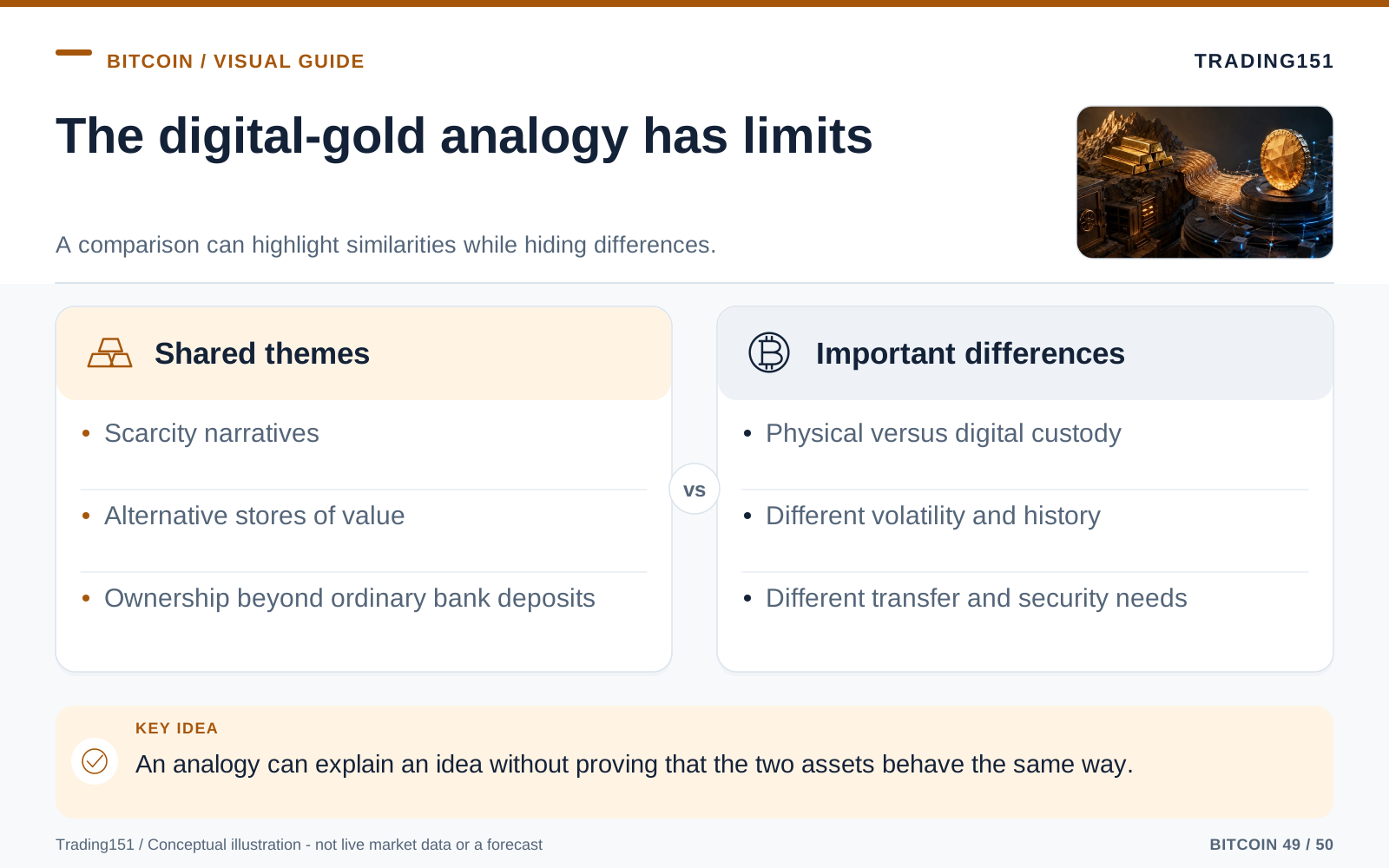
Read this diagram as text
- Shared themes
- Scarcity narratives; Alternative stores of value; Ownership beyond ordinary bank deposits
- Important differences
- Physical versus digital custody; Different volatility and history; Different transfer and security needs
The Problem Gold Could Not Solve
For all its incredible strengths, gold is firmly trapped in the physical world, and the physical world is heavy.
If you manage to accumulate a meaningful amount of gold, you instantly hit a deeply awkward problem: where exactly do you put it? Keeping a little jewelry in a bedside drawer is fine, but storing your life savings in solid bullion is a logistical nightmare. Suddenly, you need a serious safe, a reinforced vault, insurance policies, armed guards, secure transport, stacks of paperwork, and a baseline level of paranoia that makes owning it feel less like financial freedom and more like a high-stress security gig.
Gold is also notoriously a pain to move. Trying to send a large chunk of wealth across an international border means dealing with shipping companies, customs agents, middlemen, and putting your faith in people you will probably never meet. When things go sideways—think wars, banking freezes, sudden capital controls, or regime collapses—these physical limitations become terrifyingly obvious. The very asset meant to protect you from one type of disaster suddenly exposes you to a whole new set of risks.
Then there's the issue of verification. Most of us can’t just glance at a gold bar and know for a fact it’s pure. We have to rely on specialized dealers, paper certificates, refiners, and expensive testing gear. Ironically, this metal famous for not requiring trust still forces you to trust a chain of experts to confirm it is what it says it is.
None of this rendered gold useless. Not by a long shot. But the internet radically shifted our baseline expectations. We got used to information flashing across the globe instantly. We became entirely comfortable working, shopping, investing, and talking to people across borders through glowing screens. Our entire world went digital, but our money was lagging behind.
Bitcoin stepped right into that gap.
Bitcoin Enters the Story
Back in 2008, right as the global financial system felt like it was tearing at the seams, an anonymous creator named Satoshi Nakamoto quietly dropped the Bitcoin white paper. The timing couldn't have been more loaded. Historic banks were collapsing overnight. Governments were scrambling to intervene. Central banks were printing money at a dizzying pace. Everyday people were finding out the hard way that the financial architecture they relied on was terrifyingly fragile.
Bitcoin didn’t launch like a tech startup with a slick PR team and a polished logo. There was no CEO to interview, no glass-walled headquarters, no customer support hotline, and absolutely no marketing budget. It was just open-source software—a sprawling network that let people ping value directly to one another without begging a bank, payment processor, or government agency for permission.
That alone was a large conceptual leap, but Bitcoin’s real genius was its monetary policy. Satoshi engineered a system running on rules that no single person or group could just rewrite on a whim. The absolute core of that system is a hard cap: there will never, under any circumstances, be more than 21 million bitcoin. Not 22 million. Not 30 million because the economy "needs a boost." Not a fresh emergency batch because the people in charge messed up.
That absolute, unbending supply limit is the entire foundation of the digital-gold comparison. Gold is scarce because the earth is stingy with it. Bitcoin is scarce because the network locks in that scarcity through unyielding code, heavy cryptography, and global consensus. One type of scarcity relies on geology; the other relies on math.
People often get confused by Bitcoin’s "mining" process because the word itself conjures up images of digital coins being physically chipped out of some internet rock. In reality, miners are just throwing large amounts of computing power at the network to secure it, verify everyone's transactions, and race to add the next block of data to Bitcoin’s public record. They get rewarded with newly minted bitcoin for doing this work, but those rewards shrink on a rigid schedule. Roughly every four years, the amount of new bitcoin created is slashed in half—an event everyone calls the "halving."
This totally transparent, totally predictable supply schedule is a large departure from how government money works. Fiat currencies are built to be flexible. Central banks can flood the system with new money during recessions, pandemics, or political crises. Sometimes that flexibility keeps the ship from sinking. Other times, it acts as a silent tax, quietly eating away at the purchasing power of anyone trying to save money. Bitcoin does the exact opposite. It trades flexibility for absolute, stone-cold certainty.
Why People Call Bitcoin Digital Gold
The whole comparison boils down to a pretty straightforward idea: both are a large pain to create, neither is controlled by a single boss, and people value them specifically because they trust that they are rare. But Bitcoin takes the best parts of gold and completely redesigns them for a digital life.
1. Scarcity Without a Mine Shaft
Gold gets its rarity from the dirt. Bitcoin gets its rarity from a public, unbreakable rule enforced by tens of thousands of independent computers running the network. You can see the difference when you try to use them. With gold, nobody truly knows how much is still buried underground. A large new vein, a leap in drilling tech, or even sci-fi concepts like asteroid mining could totally upend the supply. Bitcoin’s limit is enforced socially just as much as technically. The code lays out the rule, but everyday people enforce it by running nodes, taking payments, and flat-out rejecting any changes that break the rules. Sure, someone could copy the code and make a version with 50 million coins, but they can’t force the rest of the world to care or give it value. The 21 million cap survives because the people holding it have zero incentive to dilute their own wealth. The code sets the boundary; human consensus gives it teeth.
Unlike gold, where supply is always an educated guess, Bitcoin’s exact supply is baked into the protocol and mathematically verified by the network every few minutes. Anyone with a decent laptop can run a Bitcoin node and check the math for themselves. You don’t have to take a bank’s word for it, trust a government spreadsheet, or believe a corporate brochure. The system practically begs you to double-check its work.
2. Portability in a Borderless World
Gold is wealth you can physically feel, but that tactile satisfaction comes with a complication. It’s dense, it’s obvious, and it’s hard to move around quietly. On a normal Tuesday, that’s just annoying. During a crisis, it can be fatal.
Bitcoin plays by completely different physical rules. The coins aren’t "inside" your phone or sitting on a hard drive like a PDF file. They just exist as entries on a global, decentralized ledger. What you own is the private key—a cryptographic password that proves those entries belong to you and lets you move them. You can keep that key on a piece of hardware, scribble it on paper as a seed phrase, or even just memorize the words.
That doesn’t mean it's foolproof. If you lose your keys, there is no friendly 1-800 number to call to reset your password. The money is gone. But in exchange for that responsibility, you get unparalleled portability. You can hop on a plane and cross the globe with a billion dollars in your head—wealth that no metal detector will ever ping and no border guard can seize.
3. Divisibility for Everyday Scale
You can divide gold, but it’s an ugly process. Shaving tiny flecks off a coin just isn’t how we buy coffee in the 21st century. While gold is fantastic for hoarding huge amounts of wealth, it’s practically useless for everyday, small-scale transactions.
Bitcoin, on the other hand, was engineered to be sliced up beautifully. A single bitcoin can be chopped into 100 million microscopic pieces called satoshis, or "sats." That means you don’t have to be rich to get off zero. You can buy ten bucks' worth, send a fraction to a friend, or slowly stash away tiny amounts over time. The same network seamlessly handles a three-dollar coffee and a three-billion-dollar corporate settlement.
This matters just as much psychologically as it does technically. Gold usually feels like a rich person's game—something reserved for old money, central banks, and James Bond villains. Bitcoin, despite being technical under the hood, is open to anyone with a cheap smartphone and the willingness to learn the ropes.
4. Verification Without Permission
Gold has a fake-problem that has never really gone away. Bars get hollowed out and filled with tungsten, coins get plated, and authentic-looking paperwork gets forged every day. The more gold you buy, the more you have to pay experts to prove you didn't get scammed.
Bitcoin completely flips the script. The ledger is entirely public, and the rules are open for anyone to see. If you run your own node, your computer instantly checks the entire history of the network and automatically rejects any counterfeit coins. You don’t need an auditor. You don't need a certificate of authenticity. You just need math. The system verifies itself.
That is a large, quiet revolution. In the physical world, authenticity requires a middleman. In Bitcoin, authenticity is just the default state of the network.
5. Ownership Without a Middleman
You can hold your own gold, but only if you have physical space for it. Hiding gold bars under the floorboards is a great way to invite a home invasion. Because of that, most people end up paying a bank or a vaulting service to hold it for them. You might own the paper saying the gold is yours, but someone else holds the keys to the room.
Bitcoin lets you truly own your money. You can hold your private keys yourself and send money anywhere on earth without ever asking a bank to approve the transfer. Is self-custody for everyone? Absolutely not. It requires real care, secure backups, and a healthy dose of humility. But just having the option changes everything. If you live somewhere with a collapsing currency, an authoritarian government, or banks that randomly freeze accounts, being able to hold your wealth completely outside the traditional system isn't just a cool tech trick. It’s a lifeline.
The Part Critics Are Right About
Let's be clear: none of this means Bitcoin is flawless, and pretending it has no downsides just makes proponents look delusional. Gold has a track record spanning thousands of years. Bitcoin is barely a teenager. It has morphed from a cypherpunk experiment into a large global asset, but it still violently swings through wild phases of hype, terror, wild speculation, and crushing doubt. Gold is much easier to wrap your head around when things get scary. It doesn't rely on software updates, you don't have to guard a seed phrase, and you certainly don't need an internet connection to hold it. Bitcoin might be vastly superior for moving and verifying value, but it comes with device failures, user errors, confusing interfaces, and a price history that can easily ruin your sleep. Calling it "digital gold" is a great mental shortcut, but it doesn't mean they are identical twins. The nickname highlights the ambition while kind of glossing over some very real growing pains.
The elephant in the room is volatility. Sure, gold’s price fluctuates, but Bitcoin’s price charts look like a heart attack. It has spiked so violently that early buyers look like geniuses, and it has crashed so aggressively that even the most die-hard believers have had their faith tested. An asset that can casually lose half its value in a couple of months doesn’t exactly scream "safe haven" to someone who needs to pay rent next week.
This is easily the sharpest critique of the whole digital-gold theory. A true store of value shouldn’t make you nauseous. Bitcoin advocates will tell you that this wild volatility is just the growing pains of a totally new asset figuring out its price in real-time. They argue that as more people buy in, liquidity gets thicker, the infrastructure matures, and the wild swings will eventually smooth out. They’re probably right, but it’s still a hope, not a promise. Bitcoin has to earn its stability over time.
There are also painfully real practical risks. People accidentally throw away hard drives with millions on them. Major exchanges implode. Phishing scams are everywhere. If you screw up your security, the freedom Bitcoin gives you can quickly turn into a nightmare. By cutting out the middlemen, Bitcoin also cuts out the safety nets we’ve all grown accustomed to. That’s the core trade-off: you get absolute control, but you also shoulder absolute responsibility.
And then, of course, there’s the energy debate. Mining Bitcoin takes a large amount of electricity, which understandably draws a lot of fire from environmentalists. Fans argue that this energy burn is exactly what secures a neutral, incorruptible money system, and that miners incentivize the build-out of renewable energy grids by buying up wasted, stranded power. Critics think burning that much energy for internet money is inherently reckless. Wherever you fall on the spectrum, it deserves a real conversation. Security, true scarcity, and decentralization don't come for free. They have a large physical cost, and we have to be honest about that.
The Intrinsic Value Argument
One of the oldest and most aggressively repeated knocks against Bitcoin goes like this: "It has no intrinsic value." Critics argue that at least you can melt gold down to make a necklace or put it inside an iPhone. Bitcoin, they say, is just imaginary internet money.
It sounds like a kill-shot argument until you stop and think about what gives any money its value. A hundred-dollar bill is just a few cents worth of linen and ink. The numbers in your checking account are just database entries sitting on a bank's server. Even back when people traded paper stock certificates, the value wasn't in the fancy paper—it was in the shared belief of what that paper represented.
Yes, gold has real-world uses in jewelry and electronics, but those uses don’t even come close to explaining why a single bar costs more than a car. People don't lock pallets of gold in Swiss vaults because they are planning a large jewelry-making project. They horde it because they trust that humanity will universally agree that it is valuable tomorrow.
Bitcoin derives its value from something entirely different: the network itself. Its worth comes from the unprecedented reality that anyone on earth can instantly agree on who owns what without a central boss, verify the total supply with their own eyes, and send value anywhere on the planet without fear of censorship or inflation. The ability to do that securely, 24/7, across borders, without relying on a bank—that is the utility.
The real question isn’t whether Bitcoin shares gold’s exact flavor of physical utility. The question is whether humanity finds an open, mathematically scarce, totally un-censorable financial network valuable. The market has loudly decided that it does.
A Generational Shift in What Feels Safe
Bitcoin is also the clearest reflection of a large generational divide in how we view trust. For a lot of older folks, safety has to be something you can knock on. A house feels real. A gold coin feels real. A stack of cash feels real. To them, a cryptographic private key feels inherently flimsy and concerning.
But if you grew up entirely online, your brain is wired differently. Your social life, your memories, your business, your entertainment, and your identity are already completely digital. Younger people are entirely comfortable trusting open-source code, end-to-end encryption, and borderless internet communities. To them, a mathematically scarce digital asset doesn’t feel like a scam; it feels completely natural. Frankly, it makes more intuitive sense to them than burying a shiny rock in a vault they’ll never see.
There is a heavy political layer to this, too. Millennials and Gen Z watched the 2008 financial crisis permanently fracture trust in traditional institutions. They’ve grown up in an economy defined by soaring living costs, impossibly expensive housing, crushing debt, and endless headlines about money printing and corporate bailouts. For many of them, buying Bitcoin isn’t just an investment strategy. It’s a quiet, opting-out protest against a financial game that feels rigged to benefit the people already at the top while punishing the people trying to save.
Obviously, not every young person is a crypto-evangelist, and not every critic is some out-of-touch boomer. It's not that black and white. But Bitcoin's cultural momentum comes from tapping into a very real, very widespread exhaustion: the feeling that the rules of money are dictated from on high, by people we didn't elect, in rooms we aren't allowed into. Bitcoin simply offers a new set of rules—rules that anyone can read, and absolutely no one can change.
Gold and Bitcoin Can Coexist
The idea that Bitcoin is going to entirely murder gold is great for internet engagement, but human nature rarely works that cleanly. Gold still does things Bitcoin can’t. It’s beautifully physical. You don't need a battery, a software update, or an internet connection to know you have it. It carries thousands of years of deep, cultural memory that you can't just replicate with a clever string of code.
But Bitcoin does things gold could only dream of. It travels at the speed of light. It can be shattered into millions of tiny, tradable pieces. It lets everyday people verify its authenticity for free. You can carry a fortune in your head, bypass borders, and settle large transactions on a Sunday at 3 AM. It’s rougher, vastly more volatile, and far riskier, but it is tailor-made for a society where wealth moves at the speed of information.
For a lot of people, gold will always be the ultimate disaster insurance—the physical thing you clutch when the digital world feels like it's falling apart. For others, Bitcoin makes far more sense—a scarce asset native to the internet rather than pulled from the dirt. In the end, smart people will likely view them not as mortal enemies, but as two distinct tools built to hedge against entirely different fears.
The gold comparison clarifies one idea and leaves several others open
Gold has physical uses and a long history of monetary and investment demand. Bitcoin offers a digitally transferable asset with an issuance schedule enforced under its network's rules. Those characteristics can appeal to investors for different reasons. They do not establish that either asset will preserve purchasing power over every period relevant to its owner.
Ownership form changes the comparison. Physical gold, an allocated custody account, a gold fund, native bitcoin, and a Bitcoin exchange-traded product introduce different costs and legal relationships. Comparing a self-custodied Bitcoin balance with a traded gold fund may say as much about custody structures as it does about the underlying assets.
The assets also have different operational burdens. Physical gold requires secure storage and a way to verify and sell it. Bitcoin requires secure key management or reliance on a custodian, along with access to compatible systems. Portability is an advantage only when the owner can use it safely under the circumstances that matter.
Treat a proposed portfolio role as a testable claim. Is the asset intended to diversify equities, preserve value over decades, or provide an alternative transfer method? Those are different objectives and call for different evidence. The phrase digital gold is a useful starting point for discussing scarcity. It is not proof of low volatility, crisis protection, or an appropriate allocation for a particular investor.
The analogy should clarify, not erase differences
Calling Bitcoin digital gold highlights scarcity and a possible store-of-value role. It can also obscure differences in market history, physical uses, custody, legal treatment, and price behavior. An analogy is useful when it explains a feature; it becomes misleading when it is treated as evidence that two assets must react alike.
For a portfolio decision, compare the actual instruments available. Physical bullion, allocated custody, a gold fund, directly held bitcoin, and a Bitcoin exchange-traded product each introduce different costs and claims. The choice is not merely between two abstract assets. It is between arrangements through which a person can buy, hold, transfer, and sell exposure.
A hedge should also be assessed against the risk it is meant to offset and over the relevant period. An asset that performs well during one kind of crisis may not help during another. The phrase 'digital gold' cannot establish that relationship in advance. Treat it as a starting point for a comparison, not the conclusion of the investment analysis. 1, 2
The Comparison Works—Up to a Point
Calling it "digital gold" is a phenomenal starting point, but if you stop there, you miss the bigger picture. Bitcoin isn’t just a techy version of a shiny metal. It is a live, global experiment testing whether money can be run by open math instead of closed-door meetings. It asks whether we can create scarcity in a digital world defined by infinite copy-and-paste. It’s testing whether millions of total strangers can share a financial system without needing a referee to blow the whistle.
This is why people get so unbelievably fired up about it. They aren’t just arguing about the price of an asset; they’re arguing about the nature of trust itself. They are debating who gets to control money, how the middle class can survive inflation, and whether the internet age deserves its own native currency.
Bitcoin might never fully replace gold. It might not follow the exact utopian path its loudest fans predict. It will definitely continue to be heavily misunderstood, substantially hyped, prematurely declared dead, and endlessly debated. But look at what it has already pulled off: it proved that scarcity can be programmed, that ownership can be truly borderless, and that trust in money doesn't require blind faith in bankers—just open verification.
Gold earned its crown by surviving our history. Bitcoin is trying to earn its place by surviving our future.
That is the real pulse of the digital-gold story. It’s not about code pretending to be a rock, or an ancient metal becoming useless. It’s the realization that humanity has stepped into an entirely new era of money. For the very first time, our endless search for a hard, reliable way to store our wealth isn’t happening in muddy riverbeds or deep mountain mines—it’s happening across a decentralized network that anyone, anywhere, can join.
The gold rush of the 1800s took pickaxes, covered wagons, and a reckless willingness to dive into the physical unknown. The digital gold rush demands something else entirely: a lot of curiosity, a healthy dose of caution, real patience, and an open mind about what value looks like now that the world has moved online.
Sources and further reading
Editorial revision: 7 October 2026. Numerical scenarios are hypothetical unless identified as historical. References support the added explanations and selected corrections; rules and product terms should be checked again before acting.