
Institutional involvement in Bitcoin takes several forms: managing products for clients, holding assets in custody, making markets, or buying for a firm's own balance sheet. Those activities do not express the same investment view. A large number associated with a financial institution needs context before it can be interpreted as a large bullish bet by that institution.
Chapter 1: The Pandemic Shock and the Problem with Cash
To really get why institutions flipped on Bitcoin, you have to rewind to the spring of 2020. Corporate treasurers didn't just wake up one morning and decide to become cypherpunks. They were staring down a very real, very boring math problem: cash was yielding next to nothing, government money-printing was going into overdrive, and holding all your company's reserves in a single currency suddenly felt risky. In those tense boardroom meetings, Bitcoin wasn't pitched as the future of money—it was just a small, controversial answer to the question of where to park surplus cash. You didn't have to believe Bitcoin would overthrow the US dollar. You just had to believe it offered enough upside to justify the weird looks and the extra paperwork.
When the pandemic slammed the brakes on the global economy, governments and central banks reacted with concerning speed. Interest rates were gutted. Large emergency lending programs popped up overnight. Trillions of dollars were quite printed, borrowed, and blasted into the system just to keep everything from collapsing.
You can argue all day about whether they had to do it. They probably did—the world economy hadn't just slowed down; someone had violently pulled the emergency brake. But the long-term hangover from all that printing was glaringly obvious. Suddenly, holding cash didn't feel safe anymore. It felt like watching an ice cube melt on a hot sidewalk.
That was exactly what Michael Saylor was agonizing over at MicroStrategy, the software company he’d been running for decades. His company was sitting on hundreds of millions of dollars in cash reserves. In normal times, that’s a sign of a bulletproof business. In 2020, Saylor realized it was a liability. If money was being printed by the trillion, sitting on a pile of dollars just meant slowly losing your purchasing power.
He needed a place to park that money where government policy couldn't touch it. Gold was the classic choice, but gold is a headache. You have to physically store it, move it, and verify it—plus, if the price goes up, gold miners just dig up more of it. Real estate isn't exactly something you can easily buy and sell on a whim. And stocks were already tangled up in the very same financial system he was trying to protect himself from.
Bitcoin was the wildcard. It had a hard cap on its supply, you could trade it anywhere in the world instantly, nobody controlled it, and the underlying code could be verified by anyone. There will only ever be 21 million Bitcoins. For a corporate treasurer terrified of inflation, that single, hard-coded rule was seductive.
In August 2020, MicroStrategy dropped a bombshell: they’d bought $250 million worth of Bitcoin to use as their primary treasury reserve. It was like setting off a flare in the middle of Wall Street. This wasn't some speculative side-bet by a bored CEO. A publicly traded company had swapped its cash for Bitcoin.
And Saylor didn't exactly keep it a secret. He practically became Bitcoin’s megaphone, preaching about it with this weird mix of cold engineering logic and almost religious fervor. Whether you thought he was an absolute genius or a total lunatic, the message was loud and clear: a Nasdaq-listed company had fully crossed the rubicon.
Before long, the dominoes started falling. Tesla jumped in. Square (now Block) put it on their balance sheet. A whole ecosystem of crypto-native firms, miners, and eventually dedicated "Bitcoin treasury" companies started treating Bitcoin as a strategic reserve, not just a day trade. Fast forward to 2026, and MicroStrategy (now rebranded as Strategy Inc.) is sitting on hundreds of thousands of coins.
Now, this doesn't mean every CFO on earth was suddenly eager to buy Bitcoin. Most of them still wanted nothing to do with it. The volatility was a nightmare, the accounting rules were a mess, and trying to explain a 30% drop to angry shareholders wasn’t on anyone’s bucket list. But Saylor permanently shifted the vibe. Before 2020, the question was, "Why on earth would a real company buy Bitcoin?" After MicroStrategy, it became, "Wait, under what conditions should we buy it too?"
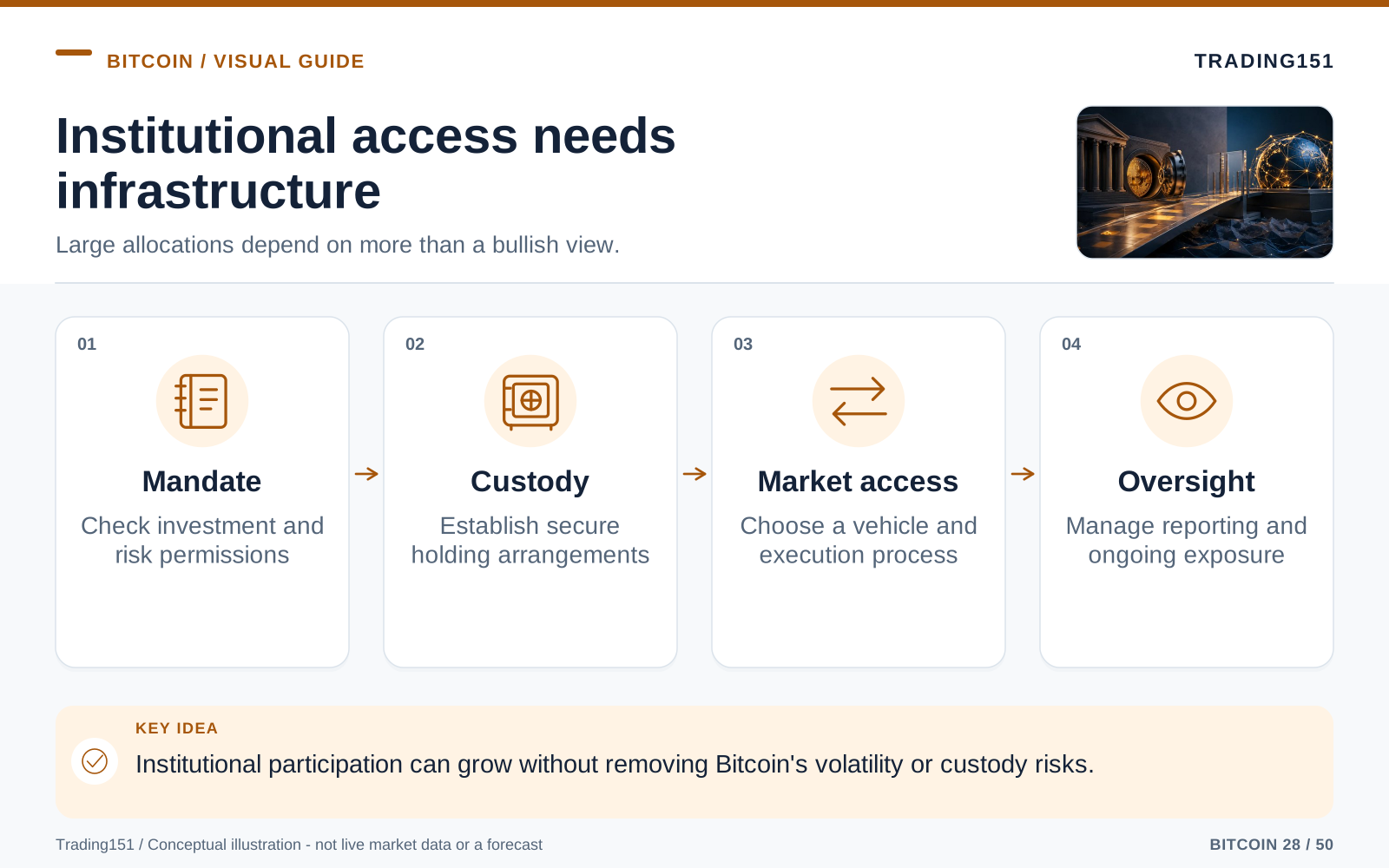
Read this diagram as text
- Mandate
- Check investment and risk permissions
- Custody
- Establish secure holding arrangements
- Market access
- Choose a vehicle and execution process
- Oversight
- Manage reporting and ongoing exposure
Chapter 2: Wall Street Finds the Door
Corporate treasuries were a nice win, but they weren’t the main event. The real money isn't sitting in the bank accounts of software companies. The deepest pockets belong to asset managers, brokerages, pension funds, private banks, registered investment advisers, and family offices. We're talking about the large financial infrastructure that handles money for everyone from billionaires to retired schoolteachers.
But for those heavyweights, Bitcoin had a huge practical hurdle: buying it directly just didn't fit into their systems.
If you're a regular person, you can just download an app, buy some Bitcoin, and send it to your own wallet. (Whether you do that safely is a whole different conversation, but the process itself is straightforward.) A pension fund or a wealth management firm absolutely cannot do that. They need layers of approved custodians, strict audits, insurance policies, liquidity providers, compliance checks, tax reporting frameworks, risk models, sign-offs from legal, board approvals, and a financial product that fits into the brokerage software they already use.
To put it bluntly: institutions didn’t just need Bitcoin. They needed Bitcoin in a tailored suit.
For years, the crypto industry tried to give them exactly that by launching a spot Bitcoin Exchange-Traded Fund (ETF) in the U.S. The pitch was simple. An ETF would let investors get in on Bitcoin through their regular brokerage accounts without having to mess around with private keys or wire funds to some random crypto exchange. It would sit neatly right next to their stocks, bond funds, and gold ETFs on the platforms financial advisers already lived on.
But for years, the U.S. Securities and Exchange Commission (SEC) slammed the door in their faces. The SEC repeatedly rejected spot Bitcoin proposals, usually citing fears about market manipulation and a lack of investor protection. We did get futures-based Bitcoin products first, but it just wasn't the same. A futures ETF tracks derivative contracts. A spot ETF holds the real thing—or at least, it’s built around a trust structure designed to track actual Bitcoin.
And then BlackRock entered the chat.
When BlackRock filed its application in June 2023, the entire mood of the market flipped overnight. BlackRock isn't some scrappy crypto startup begging for attention. They are the biggest asset manager on the planet, with deep, ingrained relationships with regulators, large institutions, and armies of financial advisers. When BlackRock makes a move, the market assumes they already know the outcome.
The symbolism was potent. Not that long ago, Larry Fink, BlackRock’s CEO, had brushed off Bitcoin with heavy skepticism. Fast forward a few years, and he was casually going on television calling it "digitized gold" and an international asset. That pivot essentially mirrored the entire institutional shift. Wall Street hadn't forgotten their early dismissals; they just let client demand, better infrastructure, and pure opportunity overwrite them.
Suddenly, it was a stampede. Other large issuers scrambled to file or update their own applications. Fidelity, Franklin Templeton, VanEck, Invesco, Ark, Bitwise, WisdomTree, Grayscale—everybody wanted a piece of the pie. The question wasn't if Wall Street was going to get a spot Bitcoin product anymore. The question was who was going to grab the biggest slice of the market when the floodgates finally opened.
On January 10, 2024, the SEC officially green-lit the trading of spot Bitcoin ETFs. It certainly wasn’t a love letter to crypto. The approval felt reluctant, narrow, and came loaded with warnings. But a win is a win, and the market knew exactly what it meant.
The very next day, the ETFs went live. Suddenly, for the average investor, getting exposure to Bitcoin was as aggressively boring and simple as typing a ticker symbol into an E-Trade account. For financial advisers, Bitcoin became something they could comfortably slide into a model portfolio, talk about in terms of asset allocation, and justify to clients using the safe, familiar language of risk and diversification.
That was the exact moment Bitcoin walked right through the front door of traditional finance.
Chapter 3: The ETF Boom and the New Shape of Demand
The arrival of U.S. spot Bitcoin ETFs didn’t just give people a new way to trade. It fundamentally changed the type of buyer showing up to the market.
Before the ETFs, the Bitcoin ecosystem was mostly a mix of retail traders, dedicated crypto funds, miners, hardcore early adopters, and a small handful of institutions willing to deal with the headache of direct custody. After the ETFs, a totally different flavor of capital unlocked: retirement money, adviser-managed portfolios, and cautious investors who loved their traditional brokerage accounts but hated the idea of using a crypto exchange.
And this difference isn't just semantic. Someone who buys Bitcoin directly might be doing it because they love the tech, believe in the political movement, or want the freedom of holding their own money. Someone who buys a Bitcoin ETF probably just wants the price to go up. They don’t care about running a network node, they haven't read up on the history of fiat currency, and they definitely don't care about the block size wars of 2017. They just want a line item that performs.
Bitcoin purists often view this as shallow. And frankly, it is. But financial markets are almost always filled with shallow adoption long before they reach deep understanding. Think about it: most people who invest in gold don't keep a bullion testing kit in their garage. Most people who buy oil stocks don't want a barrel of crude delivered to their driveway. Financial products exist to strip away the messy reality of ownership—and that exact abstraction is what allows trillion-dollar markets to form.
BlackRock’s iShares Bitcoin Trust quickly became the poster child for this new era. By mid-2026, it was sitting on tens of billions of dollars in assets, proving that the demand for nicely packaged Bitcoin wasn't just launch-week hype. Fidelity’s ETF pulled in large numbers too, while Grayscale’s trust—which converted to an ETF but kept its higher fees—saw a much messier, complicated outflow of legacy holders cashing out.
This large initial wave of ETF money fueled a powerful narrative: the institutions are finally here, and they're buying up Bitcoin faster than the miners can dig it up. It was an intoxicating story, and like all great market narratives, it was partly true and partly a little too neat. Inflows can easily turn into outflows. Advisers rebalance portfolios. Investors panic-sell. Bitcoin can still take a large nosedive, even with famous Wall Street logos attached to it.
And that’s a crucial point to remember. Institutional money doesn't magically erase volatility. It just changes the cast of characters participating in it.
Today, Bitcoin trades in an environment where retail hype, ETF inflows, macroeconomic data, interest rates, leverage, mining costs, corporate treasury moves, and regulatory drama all violently smash into one another. The old Bitcoin market felt like the Wild West. The new Bitcoin market still feels like the Wild West, just with Bloomberg terminals, authorized participants, and extremely stressed compliance officers.
Chapter 4: Why Institutions Buy Bitcoin
It's easy to just wave off Wall Street’s interest in Bitcoin as pure greed. And sure, greed is absolutely part of it—Wall Street isn't exactly running a charity. If clients are begging for a product and firms can skim a fee for providing it, that product is going to exist. But institutions rarely make a move for just one grand, sweeping reason. A fast-moving hedge fund might just be riding the price momentum. A quiet family office might want an asset that is provably scarce over the long haul. A financial adviser might just be tired of their clients asking about it. And a large corporation might just want a tiny slice of Bitcoin as a strategic "just in case" hedge. Because these large buys can be paired with complex hedges and futures contracts, a flashy headline number doesn't necessarily mean a firm is a true believer. Institutional adoption is less about Wall Street having a collective "aha!" moment, and more about hundreds of different players finding unique ways to use the same asset.
That said, the institutional case for Bitcoin goes much deeper than just chasing a green candle on a chart. When the suits sit down to make a serious argument for it, they usually lean on a few key ideas.
1. Scarcity in a World of Endless Printing
Bitcoin's fundamental promise is a hard-capped supply: there will only ever be 21 million coins. In a world where central banks have spent a decade frantically printing money and expanding balance sheets, that fixed supply is appealing. Even if you don't fully understand the tech, the simple math of a scarce asset versus an endlessly printable currency is a very powerful narrative.
2. The Search for Uncorrelated Assets
In portfolio management, the ideal is finding assets that don't all move in the same direction at the same time. If stocks crater, you want something else to go up, or at least hold steady. For a long time, Bitcoin felt like an alien asset—it marched to the beat of its own drum. It didn't seem to care what the S&P 500 or bond yields were doing.
Now, to be clear, Bitcoin isn't a perfect hedge. When the market panics and liquidity dries up, Bitcoin often crashes right alongside high-risk tech stocks. In a true crisis, everything gets sold. But even with that volatility, the sheer upside potential means that dedicating just a tiny fraction of a portfolio to Bitcoin can dramatically improve long-term returns. For most big institutions, Bitcoin isn't an all-in gamble. It's a calculated 1% or 2% allocation.
3. Client Demand Got Too Loud to Ignore
Asset managers absolutely hate being bullied into a trade by their clients, but they hate losing those clients even more. For years, financial advisers had to sit through awkward meetings with clients who demanded Bitcoin, only to have to tell them to go open a sketchy-sounding account on a crypto exchange.
The ETF completely solved that problem. Suddenly, advisers could keep the money in-house, offer a regulated product, collect their fees, and talk about Bitcoin using the same financial jargon they use for real estate or gold. For the client, it was perfectly frictionless: no seed phrases, no concerning exchange withdrawals, and no anxiety about sending money into a digital black hole. Just a familiar ticker symbol on their monthly brokerage statement.
4. A Hedge Against the System Itself
One of the wildest things about Bitcoin is its dual appeal: it attracts people who actively despise institutions, but it also attracts institutions that are deeply paranoid about other institutions.
Recent geopolitics have made this paranoia a lot easier to understand. Between heavy-handed sanctions, frozen sovereign reserves, capital controls, banking crises, and weaponized payment networks, big investors have realized that the modern financial system is powerful—but it is not neutral. If your money is sitting on someone else's rails, it can be delayed, censored, seized, or used as a political weapon.
Bitcoin doesn’t magically fix all of that. It’s highly volatile, completely transparent, and honestly pretty clunky to use for large, private transactions. But because it is a neutral network with no CEO and no central operator, it offers an escape hatch. Even if a large fund never actually plans to transact in Bitcoin, they completely understand why holding an asset that lives outside the traditional banking system is valuable.
5. The Career Risk Flipped
And then there's the quiet truth that nobody in finance likes to admit: career risk.
For a long time, pitching Bitcoin to your boss at a conservative financial firm was a great way to look like an idiot. The safest, smartest career move was to just laugh at it. But the second BlackRock, Fidelity, and the rest of the heavyweights jumped in, the math completely changed. Suddenly, ignoring Bitcoin didn't make you look prudent and careful; it made you look stubborn and out of touch.
Institutions move at a glacial pace because committees exist solely to protect careers. But once enough big, respected names rubber-stamp something, those committees relax. Nobody wants to be the first guy through the door. But everybody is perfectly happy to be the tenth guy through the door, especially if the first nine guys are wearing expensive suits.
Chapter 5: What Bitcoin Gains From the Suits
Love them or hate them, the institutions gave Bitcoin something it simply couldn't build on its own: large, mainstream distribution.
Today, a wealth manager in Ohio, a family office in Singapore, a pension consultant in Toronto, and a private banker in Switzerland can all sit down and talk about Bitcoin using the same language. They can debate allocation sizes, volatility models, custody solutions, tax implications, and risk disclosures. Yes, it sounds unbelievably boring. But boring is exactly what attracts trillions of dollars. Hype gets you attention; boring process gets you funding.
Institutions also brought much-needed liquidity. More buyers, more sellers, more market makers, and more regulated platforms mean the market is deeper. A deep market isn't immune to crashes, but it can absorb large trades and attract serious players who would never touch a thin, chaotic, easily manipulated market.
And then there’s legitimacy. Hardcore Bitcoiners hate that word. They’ll proudly tell you that Bitcoin never needed Wall Street’s permission, and they’re right—the network was churning out blocks long before Larry Fink cared. But in the real world, legitimacy matters. It’s a lot harder for politicians to ban or cripple an asset when large public companies, major banks, and millions of everyday voters hold it in their retirement accounts.
This institutional flood also forced the infrastructure to grow up. Custody solutions got better. Tax software improved. Research got sharper. Security standards skyrocketed because the stakes are suddenly astronomical. If a sketchy crypto exchange gets hacked, retail users lose money. If an institutional custodian gets hacked, it's a global financial crisis.
None of this makes Bitcoin perfectly safe. It’s still wild, it’s still highly experimental, and it still relies heavily on market confidence, network security, and regulators staying somewhat friendly. But nobody can pretend it’s just a weird hobby for internet nerds anymore.
Chapter 6: What Bitcoin Risks Losing
The irony here is so obvious it almost feels scripted. Bitcoin launched in the direct aftermath of the 2008 financial crash, carrying a hidden message about bank bailouts in its very first block of code. It was explicitly built to be peer-to-peer electronic cash—a way to move money without ever having to trust a bank. The culture was obsessed with self-custody because self-custody was the entire point. If you held your own keys, no bank could freeze your account, no broker could block your trades, and no custodian could go bankrupt and take your money with them.
But today, a large chunk of the new money pouring into Bitcoin is coming through products where the investor never touches a private key.
When someone buys a spot Bitcoin ETF, they are just buying price exposure. And for a lot of people, that’s perfectly fine. But they don’t own Bitcoin in the way it was designed to be owned. They own shares in a trust. They are entirely dependent on a large chain of sponsors, custodians, brokers, market makers, and legal frameworks. It’s convenient, sure, but the middlemen are right back exactly where they started: in the middle.
To the early cypherpunks, watching Wall Street package and sell Bitcoin feels a bit like watching a punk rock rebellion get turned into a corporate franchise.
And this isn't just a philosophical debate. If a large percentage of the world's Bitcoin ends up sitting in the vaults of just a few institutional custodians, those custodians become large targets. Governments could easily step in to regulate them, subpoena them, freeze withdrawals, or pressure them into voting a certain way on network upgrades. The base layer of the Bitcoin network might remain perfectly decentralized, but the actual ownership and influence could become dangerously centralized at the top.
There's also the very real risk that these new ETF investors have absolutely no idea what they’re buying. An ETF is great for making your portfolio go up, but it has exactly zero censorship resistance. If the banking system fails, or if your brokerage account gets frozen, that ETF won't help you. It turns a revolutionary tool for financial sovereignty into just another ticker symbol.
This is the great trade-off. Wall Street made Bitcoin easy to buy, talk about, and slip into a 401(k). But in doing so, they sanded down the radical, anti-establishment edge that made the whole thing matter in the first place.
Chapter 7: Can Wall Street Tame Bitcoin?
But that's what makes this story so substantially different from the usual tale of corporate sellouts. Yes, Wall Street can build large businesses around Bitcoin. They can sell ETF shares, hold coins in vaults, lend against them, trade derivatives, and shape how everyday investors perceive the asset. But they can’t control the code.
Bitcoin is, fundamentally, money for people who disagree. It can sit in the wallet of a political dissident, a middle-class saver in a country suffering from hyperinflation, a large hedge fund, a public tech company, a sovereign nation, a retiree checking their ETF, or a high schooler throwing twenty bucks into an app. The network doesn't care. It doesn't check if you understand Austrian economics, it doesn't care if you work at Goldman Sachs, and it doesn't care if you're just looking for a quick trade.
That cold, mechanical neutrality makes a lot of people uncomfortable, but it's the entire point. If Bitcoin only worked for the hardcore cypherpunks who built it, it wouldn't be a neutral system. The fact that the Wall Street firms can use it is the ultimate proof that the permissionless design works.
The real question here isn’t whether Wall Street will inevitably corrupt Bitcoin. The much more interesting question is whether Bitcoin will quietly reprogram Wall Street. Once an asset with a mathematically capped supply starts living inside traditional portfolios, it forces the old financial system to reckon with a totally new kind of competitor. It gives investors a clear benchmark that isn't a fiat currency, a government bond, a stock, or a traditional commodity. Even when it's dressed up in a boring ETF wrapper, Bitcoin carries a virus that traditional finance can't quite cure: the idea that money doesn't have to be printed by a government or controlled by a bank.
Chapter 8: The Next Phase Will Be a Lot Less Romantic
The early days of Bitcoin were inherently romantic because they were driven by complete outsiders. The lore is incredible: an anonymous creator, cypherpunk mailing lists, legendary forum arguments, catastrophic exchange hacks, guys searching landfills for lost hard drives, sudden billionaires, gut-wrenching crashes, and a bunch of outcasts who sounded completely insane right up until the price made them look like geniuses.
This new institutional era? It's not romantic at all. It’s filled with SEC filings, custody agreements, basis trades, risk committees, model portfolios, authorized participants, and cutthroat fee wars. As the money gets bigger, the language gets dramatically more boring.
But that doesn't mean the story is over. It just means the genre has changed.
Bitcoin’s biggest test used to be whether it could survive being totally ignored. It passed. Then the test was whether it could survive being openly mocked. It passed that, too. The test it faces today is whether it can be completely swallowed by the financial mainstream without losing the core properties that made it valuable in the first place.
There will undoubtedly be more wild market cycles. ETF money isn't just going to flow straight up forever. Companies that boldly copied the MicroStrategy playbook will look like visionaries during the bull runs and terribly fragile during the crashes. Politicians and regulators will keep fighting endlessly over custody rules, disclosures, taxes, and investor protection. Banks will dip their toes in, panic, pull out, and then quietly jump back in again.
But underneath all of that chaos, a new block of transactions will keep getting added to the chain roughly every ten minutes. It's easy to completely forget that quiet, relentless heartbeat when you're distracted by screaming pundits, price targets, and glossy Wall Street product launches. But that heartbeat is the only thing that matters. Bitcoin’s credibility doesn’t come from a charismatic CEO making big promises on a quarterly earnings call. It comes from a piece of software simply doing exactly what it said it would do, year after year, without ever asking for anyone's permission.
Custody, client assets, and proprietary holdings are different
Suppose an asset manager sponsors a bitcoin investment product holding $10 billion of assets. Those assets generally represent investors' exposure through the product, not $10 billion of the manager's own corporate money committed to bitcoin. The sponsor may earn fees for administering the arrangement. Confusing assets under management with a proprietary investment overstates what the figure tells you about conviction.
Similarly, a custody balance can belong to many clients, and a reported derivatives position can be part of a hedge. A long position may be offset elsewhere. Public disclosures often show only a defined portion of an institution's activity and may arrive after a delay. They are useful evidence, but not a complete real-time portfolio.
Read the source document's definitions. Does the figure describe units, market value, net inflows, trading volume, or client assets? A product's value can rise because bitcoin's price rose even if no new money arrived. Net subscriptions and assets under management answer different questions about demand.
For an individual investor, institutional participation can help explain changes in access and infrastructure without becoming a recommendation. Large institutions have different mandates, liabilities, financing, and risk controls. Their involvement does not make an unsuitable position suitable for someone else. Use the disclosures to understand the market, not to outsource a personal exposure decision to a headline.
Read the mandate behind the holding
An institution's exposure may serve a purpose quite different from an individual's long-term investment. It may be holding assets for clients, managing a fund that must follow stated rules, hedging a derivative, or maintaining inventory for customer activity. The institution's name does not tell us which explanation applies.
That matters when interpreting a filing or headline. Assets under custody are not necessarily assets owned for the firm's shareholders. A long position may coexist with an offsetting short or another hedge that is not visible in the same disclosure. A change in reported value may reflect the asset's price rather than a purchase. Separate quantity, valuation, ownership, and mandate before drawing a conclusion.
An individual also has different constraints. A large institution may have specialist custody, access to financing, and the ability to spread operational costs across a substantial portfolio. Those advantages do not transfer to someone who copies the position in a retail account. The useful lesson is to examine why the institution holds the exposure and whether that reasoning applies to the money you are managing. An impressive participant can be evidence of market access without being an investment instruction. 1, 2
From Curiosity to Balance-Sheet Asset
The arrival of institutional Bitcoin isn’t a clean, undisputed victory for anyone.
For Wall Street, it's a highly profitable admission of defeat. Their early dismissals were dead wrong. Bitcoin didn't go away. The clients never stopped asking for it. The market kept aggressively bouncing back. The infrastructure matured, the legal barriers fell, and eventually, the large institutions realized that ignoring Bitcoin was costing them way more money than selling it.
For the hardcore Bitcoiners, this moment is vindicating, but it's also a large warning sign. The asset that used to get them laughed out of polite society is now fully embedded in the most powerful financial platforms on earth. That is undeniably historic. But as more and more people buy Bitcoin through heavily regulated middlemen, it becomes more crucial than ever to remember why self-custody and direct ownership were the whole point to begin with.
The suits have officially arrived. They brought armies of lawyers, analysts, custodians, market makers, slick pitch decks, and oceans of capital. But they also brought a lot of contradictions. Bitcoin is more mainstream than ever, but that doesn't mean people understand it. It’s easier to buy, but it's far less sovereign. It’s been fully embraced by the financial system, even though it was built specifically to replace it.
Maybe that tension isn’t a bug. Maybe it’s the defining feature of this entire era.
Bitcoin never needed Wall Street to survive. It spent over a decade thriving without permission, without corporate sponsorships, and without a round of applause from the banks. But eventually, Wall Street decided they needed Bitcoin—or, at the very least, they needed a way to package it, custody it, and charge a management fee for it.
And that is the greatest plot twist in modern financial history. The rebel asset didn’t have to storm the castle gates. It just waited outside long enough for the castle to build it a front door.
Sources and further reading
- SEC Investor Bulletin: Exchange-Traded Products Providing Exposure to Bitcoin and Ether
- SEC: Frequently Asked Questions About Form 13F
Editorial revision: 7 October 2026. Numerical scenarios are hypothetical unless identified as historical. References support the added explanations and selected corrections; rules and product terms should be checked again before acting.