
Bitcoin regulation is a collection of rules governing different activities, not a single global decision to allow or ban an asset. Holding bitcoin, operating an exchange, offering a derivative, mining, and marketing an investment can fall under different regimes. A reliable overview needs dates and jurisdictional limits, especially when proposals and enacted rules are discussed together.
Why Governments Regulate Bitcoin
Here’s the thing about Bitcoin: it’s not a company. There’s no fancy headquarters, no CEO, no customer support hotline, and absolutely no boardroom where a regulator can waltz in, slap down a subpoena, and demand a change to the code. That makes regulating it totally different from regulating a traditional bank or the stock market. Because governments can't easily license a peer-to-peer protocol, they focus their energy on the places where Bitcoin bumps into the real world—the identifiable businesses like exchanges, brokers, banks, custodians, payment processors, mining outfits, and tax systems.
This creates a weird split reality. The underlying network might keep humming along freely, but getting access to it can become way easier, sharply hard, very expensive, or heavily monitored depending entirely on where you live. Regulation usually completely changes the user experience long before it even touches the protocol itself.
So, why do governments even bother? First and foremost, it’s about consumer protection. Crypto history is littered with severe reminders that technical freedom doesn’t mean financial safety. Remember Mt. Gox? It used to dominate Bitcoin trading until it imploded in 2014, taking a large chunk of customer funds down with it. Fast forward to the FTX disaster, which proved that slick marketing, celebrity hype, and deep political ties could easily mask old-fashioned corporate fraud. When regular people lose their life savings because a platform mixed up funds, lied about what they had in reserve, or failed basic security checks, regulators face large pressure to step in.
Then there’s financial crime. Despite the myth, Bitcoin isn’t completely anonymous—every transaction is permanently etched onto a public blockchain. But it is pseudonymous, which leaves the door cracked open for folks who want to move cash outside the traditional banking system. Ransomware gangs, people dodging sanctions, dark-web vendors, and money launderers have all taken a swing at exploiting crypto. That’s exactly why authorities care so deeply about "know-your-customer" (KYC) rules, suspicious activity reports, and the so-called Travel Rule, which forces platforms to attach identifying information to money transfers.
Don't forget about taxes. Bitcoin creates all sorts of tax headaches, from capital gains and business revenue to mining income and cross-border tracking. Tax agencies simply won't tolerate a parallel financial universe where profits vanish into thin air just because they happened "on-chain." In most places, Bitcoin is treated less like everyday cash and more like property or a commodity, meaning every time you sell or trade it, you might be triggering a taxable event.
Another huge factor is monetary sovereignty. For generations, central banks have enjoyed total control over issuing national currencies and managing payment systems. Bitcoin doesn’t exactly replace that large machinery, but it definitely challenges the long-held assumption that people have to rely solely on state-backed money or commercial banks. In a country with a strong economy, that challenge might just feel like an academic debate. But in places struggling with crippling inflation, strict capital controls, or deep mistrust in the banking system, Bitcoin’s alternative feels real and practical.
Finally, regulators are sweating over market stability. Bitcoin trades 24/7 all over the planet, and its price can swing substantially without warning. That kind of volatility doesn’t just stay contained in the crypto bubble. It spills over, impacting retail investors, publicly traded companies, hedge funds, lenders, miners, and even the traditional banks that service the crypto industry. Even the policymakers who absolutely despise Bitcoin have figured out that just pretending it doesn't exist isn't an actual strategy.
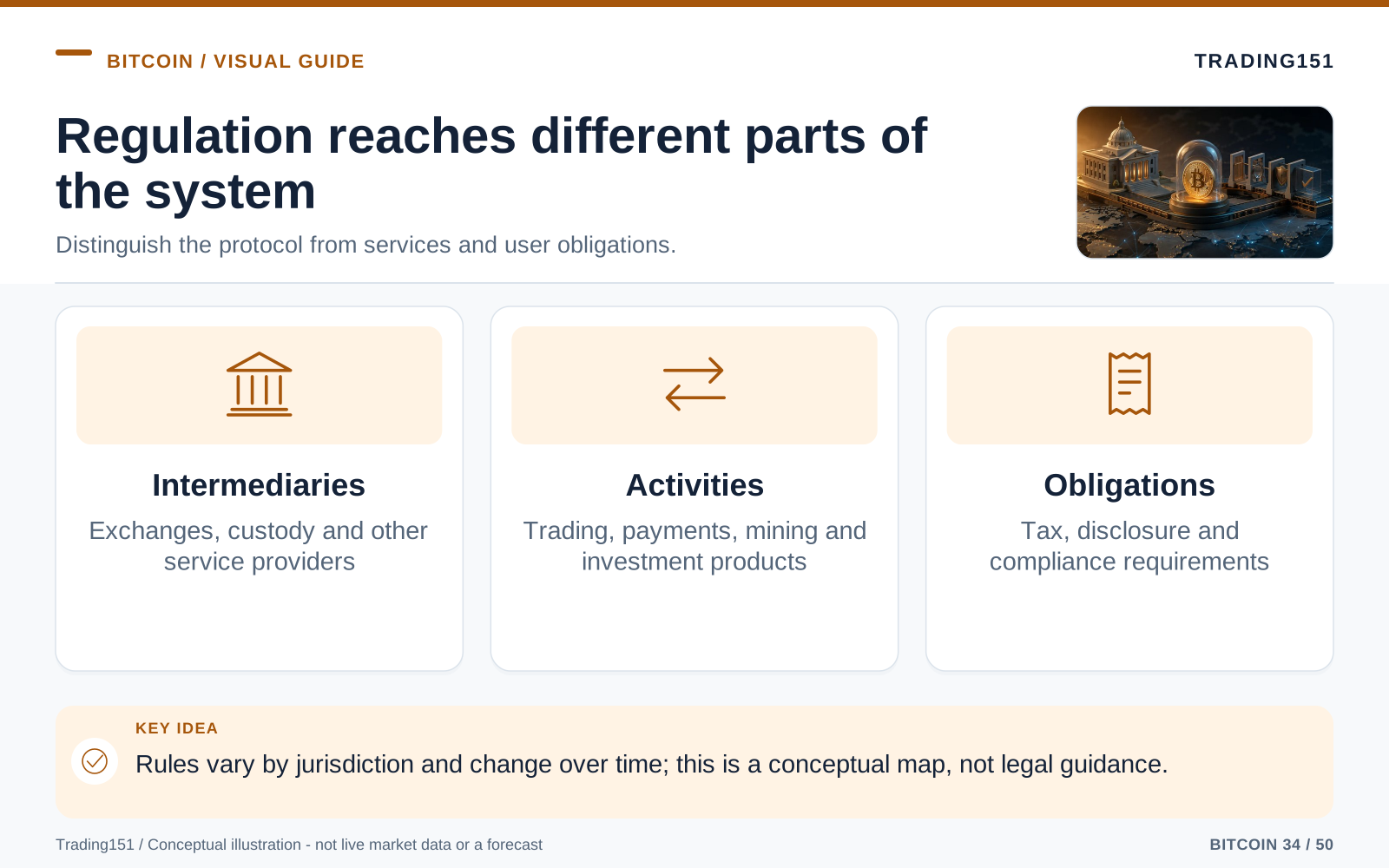
Read this diagram as text
- Intermediaries
- Exchanges, custody and other service providers
- Activities
- Trading, payments, mining and investment products
- Obligations
- Tax, disclosure and compliance requirements
North America: Legitimacy, Lawsuits, and Finding the Guardrails
The United States: Too Big for Half-Measures
U.S. oversight depends on the activity and product involved. Trading, custody, payments, taxation, securities offerings, and derivatives do not all raise the same legal questions. A useful review starts by identifying the customer's claim and the service being provided, then checks the relevant federal and state requirements.
Different authorities have different responsibilities. Securities-law questions, commodity derivatives, money transmission, anti-money-laundering compliance, and tax reporting can overlap without being interchangeable. A classification used for tax purposes does not decide every other regulatory question, and registration for one activity is not authorization for all services a company might offer.
Readers should distinguish enacted law, final rules, proposals, and litigation. A press release announcing an initiative does not establish that every business model is now permitted. The exact legal entity, service, customer location, and effective date remain essential, especially when a platform changes which affiliate serves an account.
U.S. spot Bitcoin exchange-traded products began trading in January 2024 after approval of the relevant exchange rule changes. They offer brokerage-account exposure without requiring the investor to manage the fund's private keys. That approval did not certify Bitcoin as safe or remove the product's custody, market, fee, or structural risks.
Canada: The Quiet Pioneer
While the US has been loudly battling it out in court, Canada took a much quieter—and arguably more effective—path. Canada was the very first country to approve a spot Bitcoin ETF, beating the US to the punch by years. Instead of fighting the industry, Canadian regulators rolled up their sleeves and built a comprehensive framework requiring crypto trading platforms to register as investment dealers.
They didn't stop there. The rules in Canada are remarkably specific: platforms have to separate client assets from their own, meet strict capital requirements, and stick to clear limits on how much leverage they can offer to everyday investors. The message up north has been remarkably consistent. They aren't trying to ban crypto, but if you want to offer it to the Canadian public, you have to play by the traditional financial rules. Period.
Europe: The Quest for the Perfect Rulebook
The European Union: Writing the Big Law
The European Union's Markets in Crypto-Assets Regulation, MiCA, establishes a framework for specified crypto-asset issuers and service providers. Its scope has boundaries: assets already classified as financial instruments and other excluded arrangements require separate analysis. It is not a single rule covering every activity that happens to use a blockchain.
MiCA includes requirements concerning authorization, disclosures, conduct, and protection of client assets for covered services. The type of token and activity matter. A self-custody software tool, a custodial exchange, and an issuer should not be treated as legally identical merely because each is described as a crypto business.
The EU's maximum transitional period ended on 1 July 2026. ESMA stated that providers without the required authorization must stop offering covered services in the EU and follow applicable wind-down requirements. Authorized providers can use the relevant cross-border framework, but a license is not blanket permission for every product. Verify the entity, authorized services, and any national requirements that still apply.
The United Kingdom: Taking It Slow and Steady
The United Kingdom has its own framework, separate from the EU's MiCA regime. Check the product category and the customer's status before applying a headline rule. Registration for anti-money-laundering purposes, permission to promote an investment, and authorization for a regulated activity are different questions.
From 8 October 2025, the FCA allowed retail access to qualifying crypto exchange-traded notes on recognized UK investment exchanges, subject to the applicable rules. The retail ban on cryptoasset derivatives remained in place. The FCA also said the crypto ETNs would not have Financial Services Compensation Scheme protection. Access to one category therefore should not be reported as the removal of all retail crypto restrictions.
Asia: From Open Sandboxes to Hard Bans
China: Control Comes First
There was a time when China practically ran the Bitcoin economy. Major exchanges catered heavily to Chinese users, and for years, a large chunk of global mining power was physically located there. Thanks to dirt-cheap electricity, incredible hardware supply chains, and raw entrepreneurial hustle, China was the undisputed engine of Bitcoin’s early industrial boom.
But then the government slammed on the brakes. Authorities banned financial institutions from touching crypto, launched a large crackdown on exchanges, and in 2021, kicked off a ruthless campaign against both trading and mining. The mining ban alone sent absolute shockwaves across the network, forcing miners to pack up their rigs and flee to North America, Central Asia, and pretty much anywhere else that would have them.
You don't have to look hard to understand why China took this stance. Bitcoin is a decentralized asset that ignores borders and completely bypasses Chinese banks. That makes it a complication for a government built around strict capital controls, intense financial supervision, and the rollout of its own strictly monitored central bank digital currency.
Yet, China's ban also highlights a funny truth about Bitcoin: outlawing the formal businesses doesn't magically erase the demand. People are still trading peer-to-peer, accessing offshore accounts, and holding crypto informally, even with the big platforms gone. A government can make Bitcoin annoying, risky, and legally dangerous to use—but making it disappear is a totally different story.
Japan: Hard Lessons and Stronger Rules
Japan requires registration for businesses conducting regulated crypto-asset exchange services. The FSA's published information helps users check the relevant provider and applicable warnings. Registration should not be confused with a guarantee of a token's value or an assurance that an account cannot suffer losses.
Because of that trauma, Japan moved much faster than the rest of the world. They built a strict regulatory framework requiring crypto exchanges to register, comply with heavy anti-money-laundering rules, protect customer funds, and pass tough security audits. They also set up self-regulatory groups, letting the industry help set the standards while the government kept a close watch.
The practical lesson is to verify the provider and the service, not to infer safety from a country's reputation for strict regulation. Check custody arrangements, withdrawal terms, disclosures, and any administrative action. A regulated business can still offer a volatile asset, and legal supervision cannot eliminate every operational failure.
India: A Booming Market Under a Heavy Tax Cloud
India illustrates why tax treatment must be separated from broader questions about permission and supervision. A transaction may create reporting or payment obligations even when a user is uncertain about the platform's regulatory position. Tax compliance does not itself certify a service as approved.
India's Income Tax Department describes income from transfers of virtual digital assets as subject to a 30% rate, plus applicable surcharge and cess, with restrictive deduction and loss rules. Its guidance also describes 1% tax deduction at source for specified payments to residents, subject to conditions and thresholds, generally Rs. 50,000 for specified payers and Rs. 10,000 for others. It is inaccurate to describe this as an unconditional tax on every transaction. Check the provisions applicable to the transaction date and taxpayer.
These rules make transaction records important. Track acquisition cost, consideration, withholding, and the nature of each transfer rather than assuming the amount withheld equals the final liability. A foreign platform or a peer-to-peer transaction does not automatically remove the user's tax obligations.
Singapore and Hong Kong: Competing for the Heavyweights
Singapore distinguishes support for digital-asset services from encouragement of retail speculation. MAS's consumer-protection measures address matters such as conflicts of interest, complaints, risk awareness, incentives, and restrictions on financing or leverage for retail customers. The service provider's license and the customer category should be checked directly rather than inferred from the company's marketing.
Meanwhile, Hong Kong has rolled out a fresh licensing regime specifically designed to attract compliant exchanges, big asset managers, and serious Web3 startups. This move has huge geopolitical weight. With mainland China keeping the door firmly shut on crypto, Hong Kong is deliberately carving out a safe, regulated space for digital assets within its own financial borders.
A jurisdiction can permit specified services while limiting who may use them and how they are marketed. For a customer, the relevant evidence is the authorization held by the contracting entity and its permitted activities. A regional office, an industry award, or an application awaiting approval is not an adequate substitute.
Latin America: Speculation, Survival, and Large Experiments
El Salvador: The Legal Tender Revolution Hits Reality
Nobody has tied their national identity to Bitcoin quite as aggressively as El Salvador. Back in 2021, President Nayib Bukele shocked the world by making Bitcoin official legal tender. The government rolled out the Chivo wallet, handed out free Bitcoin to citizens who signed up, and aggressively marketed the country as a paradise for crypto tourists, miners, and investors.
For the die-hard believers, El Salvador was living proof that a real nation-state could fully embrace Bitcoin instead of just tolerating it. For the skeptics, it looked like a reckless gamble with public funds and political optics. On the ground, the reality has been a bit of a mixed bag. Sure, some businesses started accepting Bitcoin, people downloaded the wallets, and the country got a large PR boost. But the dream of everyday citizens buying groceries and paying rent in Bitcoin never quite materialized the way the marketing slogans promised.
El Salvador's policy changed in 2025. The IMF-supported program described private-sector acceptance of Bitcoin as voluntary and sought to confine public-sector exposure. Readers should not continue describing the original 2021 arrangements as though they remained unchanged. A government's adoption announcement, later legal amendments, and actual public holdings are separate matters.
El Salvador is still a powerful symbol. But these days, it’s also a sobering reminder that any bold Bitcoin policy eventually has to survive contact with national budgets, global lenders, local shopkeepers, and the daily habits of ordinary people.
Argentina: Where Inflation Does the Selling For You
In Argentina, nobody needs to explain the appeal of Bitcoin or dollar-pegged stablecoins. When you’ve spent your life navigating endless currency crises, tight capital controls, and severe inflation, you don’t need a philosophical lecture on the history of money. You feel the debasement of the peso every time you buy groceries.
That doesn't mean every Argentine is suddenly a Bitcoin maximalist. Bitcoin can still drop 20% in a week, making it a concerning savings tool for someone who can barely afford rent. But the desperation for an alternative is very, very real. In Argentina, crypto isn't about Silicon Valley futurism; it’s about regular people desperately searching for a way to protect whatever purchasing power they have left, get paid, or move money around impossible government restrictions.
Javier Milei's election in 2023 attracted attention from supporters of monetary competition. Political views are not, by themselves, a legal permission for every crypto activity. Users and businesses still need to check the tax, foreign-exchange, registration, and financial-service rules applicable to their transactions.
The Middle East: Building Hubs and Writing Rulebooks
The United Arab Emirates: A Welcoming but Managed Oasis
Dubai's Virtual Assets Regulatory Authority, VARA, regulates covered virtual-asset activities in Dubai's mainland and free zones, excluding the Dubai International Financial Centre. Other UAE jurisdictions have different authorities and frameworks. Referring to a firm as 'UAE regulated' is not enough to establish which regulator supervises the service being offered.
The stage of approval also matters. VARA distinguishes permission to incorporate and prepare operations from the license needed to conduct virtual-asset activities. A company should not present preliminary approval as unrestricted operating authorization. Customers should check the public register and the specific activities permitted.
Clear licensing rules can help businesses plan, but their existence does not establish that every applicant will qualify or that every licensed service suits a retail customer. Examine the entity, permissions, custody terms, and dispute arrangements rather than relying on a jurisdiction's promotional reputation.
Saudi Arabia and the Gulf: Curious but Cautious
Across the rest of the Gulf, the vibe is definitely interested, but far more cautious. Governments are actively researching blockchain tech, tokenization, central bank digital currencies, and digital finance as they look for ways to diversify their economies away from oil. But Bitcoin itself can be a tricky subject politically and religiously, raising thorny questions about pure speculation, who controls the money, and fitting into traditional financial norms.
Policies across the Gulf need to be assessed country by country and activity by activity. Research into tokenization or central-bank digital currency does not amount to permission for retail Bitcoin trading. A regional trend is no substitute for the rules that apply to the actual service and customer.
Africa: Grassroots Demand Meets Regulatory Reality
Nigeria: The People Moved First
If you want to see what organic, grassroots crypto adoption looks like, look at Nigeria. Young, extremely online Nigerians have embraced Bitcoin and other crypto assets to send money home, get paid for freelance work, save their cash, build businesses, and shield themselves from a constantly weakening naira. Combine a large diaspora, a booming tech culture, and serious currency woes, and Bitcoin's appeal is a no-brainer.
For years, the government's response was basically panic. Authorities banned banks from servicing crypto businesses, trying to choke off access. But the peer-to-peer markets just kept exploding anyway. The gap between what the public was doing and what the banks allowed was simply impossible to maintain. Eventually, Nigerian authorities realized they had to shift gears from prohibition to supervision, with the SEC stepping in to create actual rules and registration paths for crypto companies.
Nigeria's experience raises a broader policy question: how do restrictions affect access, supervision, and consumer protection? The answer requires evidence, not an assumption that a ban either stops all activity or has no effect. Users should check the current registration and banking arrangements rather than relying on older summaries of a changing framework.
Kenya, South Africa, and the Wider Continent
African markets are not a single use case. Payments, remittances, investing, business receipts, and speculation can all be relevant, with different costs and risks. Claims about who uses Bitcoin and why should be tied to a country, a period, and credible evidence rather than a general narrative about an entire continent.
South Africa has taken some large steps lately to pull crypto companies into its formal financial system, especially when it comes to licensing and stopping money laundering. Kenya is seeing incredible adoption rates while sparking serious policy debates. Other nations are still sitting on the fence, warning citizens about extreme volatility and scams while quietly studying how to regulate the space.
For a household or business, practical access matters more than a broad adoption label. Can funds be received, converted at a reasonable total cost, withdrawn reliably, and recorded for tax purposes? Answering those questions requires local information. Global transaction figures cannot establish that a particular service is affordable or suitable.
Bitcoin Mining: Regulating the Electricity Meter
Regulating Bitcoin isn’t just about the guys trading it on screens; it’s also about the large physical infrastructure that keeps the network alive. Mining—the energy-hungry process that secures the ledger and mints new coins—essentially turns raw electricity into computational security. Naturally, that makes it a large political target anywhere the power grid is stressed, electricity bills are high, or climate goals are on the line.
When China banned mining, it effectively scattered the industry to the wind. Suddenly, large mining operations popped up in the US, Kazakhstan, Canada, Russia, and pockets of Latin America. The local reception has been completely mixed. Some towns welcomed miners with open arms, seeing them as great customers for wasted, stranded energy and helpful partners in balancing the power grid. Others just saw giant, noisy warehouses that sucked up absurd amounts of power while creating barely any local jobs.
The environmental debate around mining usually gets totally oversimplified. The truth is, Bitcoin mining can run on coal, natural gas, hydro, wind, solar, or even flared gas from oil fields that would otherwise just burn into the atmosphere. The actual climate impact depends entirely on where the mine is plugged in. That’s exactly why regulators are waking up. They don't just want to know if you're mining; they want to know exactly where you are, what kind of power you're drawing, and whether you're helping or hurting the local grid.
Mining can be subject to ordinary rules on grid connections, land use, noise, employment, and environmental impacts, as well as any mining-specific requirements. Future measures should be identified as proposals until adopted. An assessment needs the site's actual energy and operating arrangements, not just the fact that it mines Bitcoin.
The Global Direction: Less Wild West, More Border Patrol
People throw around the phrase "Wild West" so much when talking about crypto that it’s almost a cliché at this point. But honestly? It perfectly captures Bitcoin's early days. For a very long time, the tech simply outran the law. Exchanges popped up out of nowhere long before anyone asked for a license. Insane token promotions went viral before advertising standards existed. Regular people took on large security risks without even realizing it. And criminals poked at every vulnerability they could find. Meanwhile, regulators were usually late to the party, totally confused, or both.
Many regulatory frameworks focus on customer identification, custody, disclosures, market conduct, and reporting. Coverage and enforcement differ, however. Do not assume that every exchange segregates assets effectively, every stablecoin has equivalent backing, or every customer receives the same remedies simply because a framework exists.
Large international groups like the Financial Action Task Force (FATF) have been leaning heavily on countries to adopt shared anti-money-laundering standards for crypto companies. The IMF is constantly waving red flags about the economic risks of adopting crypto as national currency. And securities regulators all over the world are swapping notes on exchange blowups, fraud cases, and retail wipeouts.
But this doesn’t mean the world finally agrees on what Bitcoin is. To some folks, it’s digital gold. To others, it’s a completely useless speculative token. And to millions of others, it’s a vital hedge against a failing state, a censorship-resistant payment network, a protest, a savings account, or a regulatory nightmare that just won't die. The same string of code means something entirely different depending on whether you're sitting in Zurich, Lagos, Buenos Aires, Beijing, San Salvador, or New York.
That’s exactly why the rules will never be perfectly uniform. Governments aren't just regulating the code; they're regulating their own deeply held fears and priorities. A country terrified of capital flight will treat Bitcoin very differently than a country desperate to attract new fintech jobs. A nation battling 100% inflation will view crypto through a completely different lens than one with a strong currency.
What Good Bitcoin Regulation Looks Like
The best Bitcoin regulation doesn't try to do the impossible. It doesn't pretend you can license a decentralized global network the same way you license a local credit union. It doesn't lie to consumers and tell them a substantially volatile asset is suddenly perfectly safe just because a compliance form was filed. And it certainly doesn't try to ban open-source software just because politicians are uncomfortable with how it works.
Good rules know the difference between the software itself and the companies holding your money. They recognize the difference between getting scammed and just making a bad trade. They offer clear definitions to businesses, provide actual due process when accounts are frozen, and don't treat every person holding their own private keys like a suspected criminal by default. Proportionality is key, too—a tiny local merchant accepting Bitcoin shouldn't have to jump through the same regulatory hoops as a multi-billion-dollar global exchange.
Most importantly, smart regulation targets the actual source of the risk. Everyday consumers rarely get hurt because the underlying Bitcoin protocol failed. They get wiped out by hacked exchanges, Ponzi schemes, lying influencers, insane leverage, terrible security, and shady executives gambling with customer deposits. Those are human failures, and you fix them with human rules.
Good regulation also has to leave room for self-custody. The entire point of Bitcoin is the ability to hold your own money without relying on a middleman. Yes, that comes with large responsibility—if you lose your keys, there's no 1-800 number to call to get your money back. But if you strip away the right to self-custody entirely, you aren't regulating Bitcoin; you're just turning it into another generic asset trapped inside the same walled garden it was built to escape.
On the flip side, serious crypto businesses need to accept serious obligations. If your company holds people's money, processes trades, markets investments, or promises a yield, you have absolutely zero right to act surprised when regulators ask to see your audits, demand capital reserves, and insist on basic risk controls. The crypto industry simply can't demand mainstream adoption while acting like basic financial guardrails don't apply to them.
The best path forward isn't blind hatred or blind hype. It’s a practical compromise: keep the base network completely open, tightly regulate the middlemen, throw the frauds in jail, protect the consumers, collect the taxes, and let responsible innovation keep building.
Check the activity, the jurisdiction, and the effective date
Start with the activity you actually plan to undertake. Permission to operate a crypto-asset service does not automatically authorize every investment product, lending arrangement, or marketing claim. A provider may need different permissions for different services, and a foreign authorization may not cover customers in your country. Read the legal entity's status rather than relying on a general statement that the brand is regulated.
Then identify the stage of the rule. A consultation announces a possible policy; a passed law establishes a legal framework; implementing measures and transition periods determine when particular duties apply. Reporting a proposal as a current requirement, or an expired transition as still available, can mislead readers even when the underlying source was accurate when published.
The European Union's MiCA framework, U.S. treatment of investment products, and national rules for payments or taxes address overlapping but different questions. None should be summarized as a universal guarantee that a crypto investment is safe. Authorization can establish obligations without protecting an investor from price losses or every service failure.
Use official regulator and government material for a decision that depends on the law. Keep the publication date and the date checked with the record. This article provides context rather than a jurisdiction-by-jurisdiction compliance opinion; businesses, cross-border users, and people dealing with substantial tax or reporting exposure may need advice specific to their circumstances.
A practical check before using a cross-border platform
Consider a customer who lives in one country, opens an account with a brand headquartered in another, and is assigned to an affiliate in a third. The app may look identical to the one shown in an advertisement aimed at a different market. The protections can still be different. The starting point is the agreement naming the entity that actually owes the customer money or holds the assets.
Check that name against the appropriate official register and read the permitted activities. A registration for one service should not be treated as approval of a separate lending, staking, derivatives, or advisory product. Where a license is described as pending, provisional, or preliminary, identify what operations are allowed at that stage. A company announcement can be accurate about an application while misleading about what the application permits it to do.
Next, examine the custody chain. Does the platform hold assets itself, use a third party, or provide only an interface? Which terms govern a withdrawal? What happens if an affiliate fails? A complaint procedure is more useful when the customer knows which entity it covers and which authority or court can hear a dispute. These questions are not answered by the country flag displayed on the homepage.
Finally, keep dated copies of the relevant terms, statements, and notices. Platforms can change their service entity or product range, and rules can change during a holding period. A record of the original arrangement helps explain what the customer agreed to and what subsequently changed. The purpose is not to turn every user into a lawyer. It is to make the key facts visible before money is committed, and to recognize when qualified local advice is needed rather than relying on a broad country summary. 1, 2, 3, 4
Regulation Will Shape Access, Not Erase the Network
Ultimately, the story of Bitcoin regulation is just the story of the world scrambling to catch up to an invention it never asked for and has no idea how to undo. First came the curiosity. Then the wild speculation. Then came the endless parade of scandals, overnight billionaires, spectacular bankruptcies, political grandstanding, large mining operations, Wall Street ETFs, complex tax forms, and wild national experiments.
The current landscape is messy, but one thing is certain: Bitcoin is no longer on the fringes. It has completely migrated from obscure message boards to the halls of parliament. It’s moved from clunky hobbyist wallets into large institutional portfolios, from dark web markets to fully licensed exchanges, and from a neat theoretical paper into the daily financial reality of millions of people.
There is no dependable single-line summary of the world's Bitcoin rules. The useful comparison identifies the activity, jurisdiction, legal entity, customer type, and effective date. Recheck these details before transferring money or launching a service, because a correct historical description can still be the wrong basis for a current decision.
Bitcoin was born as a way to move money without asking for permission. Regulation is simply the rest of the world trying to figure out what to do when that permissionless system collides with real people, real economies, and real consequences.
People used to joke that Bitcoin was just "magic internet money." But it was never just that. It was always a direct challenge to the global financial system, delivered entirely in code. Seventeen years later, governments are still trying to figure out how to reply.
Sources and further reading
- ESMA: End of the MiCA transitional period, June 2026
- IMF: El Salvador Extended Fund Facility, February 2025
- U.S. Executive Order: Strategic Bitcoin Reserve and Digital Asset Stockpile, March 2025
- FCA: Retail access to crypto exchange-traded notes
- SEC Investor Bulletin: Exchange-Traded Products Providing Exposure to Bitcoin and Ether
- India Income Tax Department: Taxation of Virtual Digital Assets
- Japan Financial Services Agency: Crypto-asset business information
- MAS: Consumer protection measures for digital payment token services
- VARA: Licence Applications and Operating Permissions
Editorial revision: 7 October 2026. Numerical scenarios are hypothetical unless identified as historical. References support the added explanations and selected corrections; rules and product terms should be checked again before acting.