
Bitcoin taxes become easier to manage when each transaction has a clear record: what moved, when it moved, what it was worth, and why. This article focuses on individual U.S. federal tax concepts, not a universal set of rules. Other countries may treat the same activity differently, and even within the United States the answer can depend on how the asset was acquired and used.
The Rule That Explains Almost Everything: Bitcoin Is Property
If you only remember one thing, make it this: for U.S. tax purposes, Bitcoin is treated as property, not cash. I know, it feels completely counterintuitive. But because the IRS sees it as property, a single transaction can be two events baked into one. If you spend Bitcoin to buy a laptop, the IRS sees you "disposing" of a valuable asset to acquire a new one. They want to know the difference between what that Bitcoin was worth when you bought it versus what it was worth when you bought the laptop. That’s why casually spending crypto can suddenly bury you in paperwork. The rule itself is simple enough; keeping track of it all is the hard part.
Seriously, treating it as "property" changes everything.
Think about it: when you hand a bartender a twenty-dollar bill, you don't have to calculate if that specific piece of paper gained or lost value since you withdrew it. Cash is just cash. But the tax system treats Bitcoin more like a share of Apple stock, a rare collectible, or a piece of real estate. Whether you buy, hold, sell, trade, gift, donate, or spend it—almost every move has a potential tax consequence.
Imagine buying a painting for $2,000 and later trading it directly for a $7,000 motorcycle. The IRS wouldn't just wave it off because "no cash changed hands." You gave up an asset that went up in value, and they want their cut of the gain. Bitcoin works exactly the same way. Selling it for fiat is an obvious tax event, but trading it for Ethereum or buying a computer with it counts as a taxable disposal, too.
This is why crypto taxes feel so alien. On the blockchain, a transaction is just coins moving from Point A to Point B. But the tax authorities is asking two totally different questions: "Did you give up ownership?" and "Did you make or lose money when you did it?"
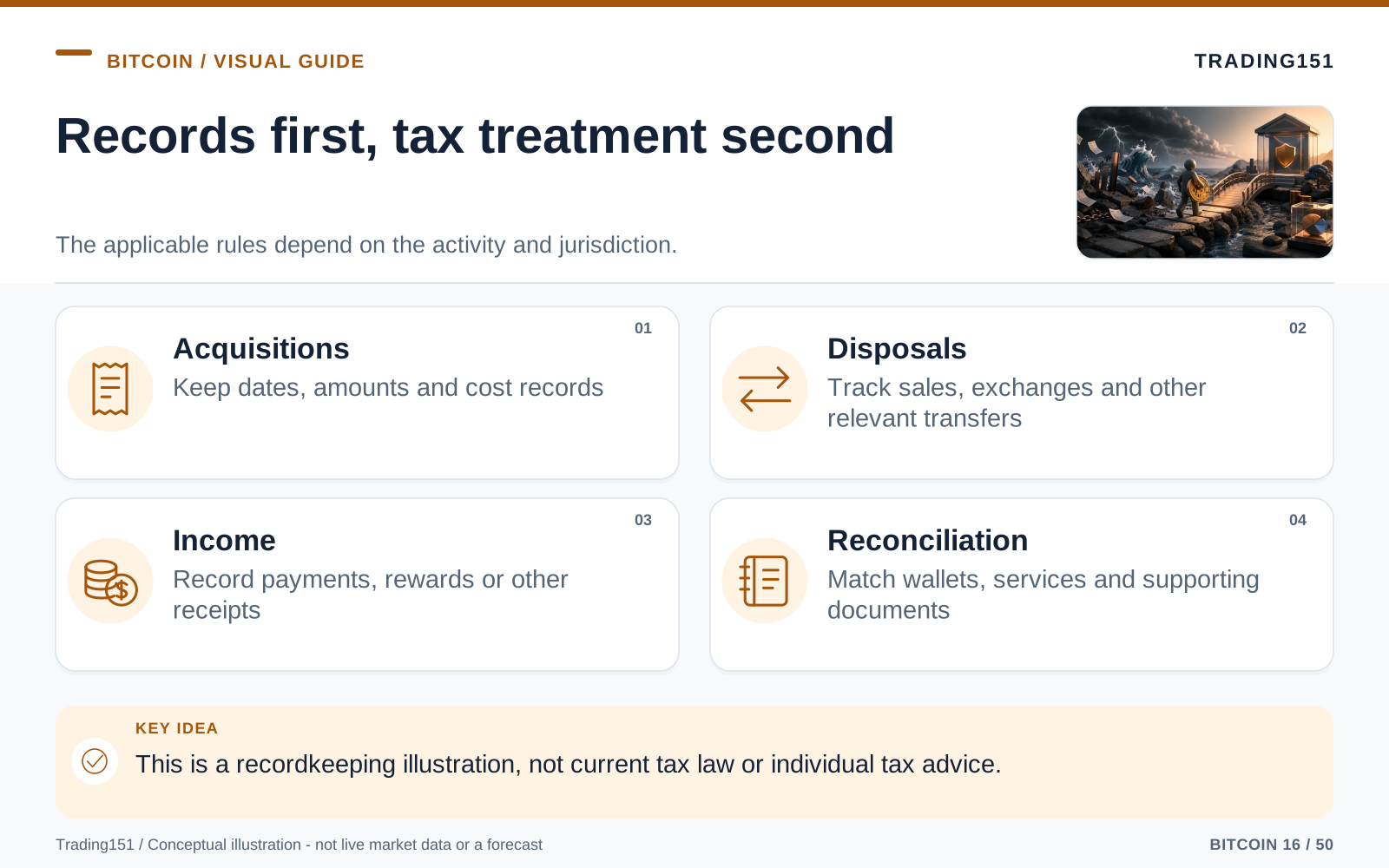
Read this diagram as text
- Acquisitions
- Keep dates, amounts and cost records
- Disposals
- Track sales, exchanges and other relevant transfers
- Income
- Record payments, rewards or other receipts
- Reconciliation
- Match wallets, services and supporting documents
What Does Not Usually Trigger a Tax Bill
Before we dive into the headaches, let's talk about the safe zones. Not every Bitcoin transaction is going to end with a tax bill. A lot of actions are just administrative—meaning you need to keep a record, but you don't owe the government anything.
Buying Bitcoin and Holding It
If you buy Bitcoin with cash and just let it sit in your wallet, you generally don't owe any taxes. The price can skyrocket, crash, and bounce back a dozen times, but until you sell, trade, or spend it, those gains or losses are just "unrealized" numbers on a screen.
This is a huge relief for long-term holders. You can sit on your Bitcoin for a decade and not owe a dime in taxes on it, purely because you never pulled the trigger to lock in those gains.
Moving Bitcoin Between Your Own Wallets
Moving your own Bitcoin from an exchange like Coinbase to a personal hardware wallet isn't a taxable event. As long as you own it before and after the transfer, you're in the clear. The same goes for shifting funds between two cold wallets you control.
But don't just ignore these transfers. You still need to track them. Tax software notoriously misreads wallet withdrawals as "sales" if it can't figure out where the coins went. Leaving a quick note like "transferred to Ledger" in your records can save you a world of pain later.
Giving Bitcoin as a Gift
A genuine gift of bitcoin generally is not a sale by the giver for U.S. federal income-tax purposes. Gift-tax reporting is a separate question. The annual exclusion for qualifying present-interest gifts is $19,000 per recipient for 2026, but filing can still be required in particular situations, including certain gift-splitting arrangements. Exceeding the exclusion does not necessarily mean gift tax is immediately payable; other exclusions and reporting rules may apply.
A recipient generally needs the donor's basis and acquisition records. For a later gain, carryover basis commonly applies; when value at the gift date is below the donor's basis, special dual-basis rules can affect a later loss. Holding-period rules also depend on the basis used. A gift should not be confused with an inheritance, which has different basis rules.
Donating Bitcoin to a Qualified Charity
Donating highly appreciated Bitcoin directly to a registered charity can be an incredible financial move if you do it right. It's often much smarter to donate the crypto directly rather than cashing it out first, because selling it would trigger a capital gains tax on your end.
Just make sure you dot your i's and cross your t's. The charity has to be eligible, you'll need proper receipts, and huge donations might require formal appraisals or extra tax forms. If you're sitting on big gains and want to give back, this is one of those times where paying for professional advice is 100% worth it.
What Usually Does Trigger Taxes
Now for the inevitable part. A taxable event usually kicks in the moment you "dispose" of your Bitcoin. It’s a stuffy legal term, but it basically just means you gave up ownership: you sold it, traded it, spent it, or used it to pay off a debt.
Selling Bitcoin for Dollars
This one is straightforward. You bought Bitcoin for $20,000 and sold it for $35,000. That $15,000 difference is your capital gain (minus trading fees). If the market tanked and you panic-sold for $15,000, you'd be looking at a capital loss instead.
The key here is that you aren't taxed on the total amount you received. You're only taxed on the profit—the difference between what it cost you and what you eventually sold it for.
Trading Bitcoin for Another Crypto Asset
This is the one that catches almost everyone off guard. If you trade Bitcoin for Ethereum, a Solana meme coin, a stablecoin, or an NFT, the IRS considers that a taxable disposal of your Bitcoin.
To the exchange, it looks like a seamless swap. To the IRS, it looks like you sold your Bitcoin for cash at its current market value, and then immediately turned around and used that cash to buy the new asset. Yes, you might owe taxes even if a single dollar never touched your bank account.
Let's pause to talk about stablecoins. A lot of folks think parking their profits in USDC or USDT is perfectly safe because the money never technically "left crypto." That assumption can cost you dearly. Trading your Bitcoin for a stablecoin is almost always treated as a taxable sale.
Spending Bitcoin on Goods or Services
Buying something with Bitcoin can also trigger a tax event, which is exactly why using crypto for everyday purchases is such a headache in countries that treat it as property.
Let's say you bought $300 worth of Bitcoin years ago, and today that same fraction of a coin is worth $1,200. If you use it to buy a new phone, you didn't just buy a phone—you also disposed of an asset that went up in value by $900. You'll likely have to report that gain.
Doing this once for a big purchase isn't terrible. But if you're using Bitcoin to buy coffee, pay for a VPN, and order takeout, the record-keeping becomes an absolute nightmare. Every transaction could be a taxable event.
Getting Paid in Bitcoin
If you're getting paid in Bitcoin for a job, a service, or running a business, things start off as ordinary income. The IRS looks at whatever the Bitcoin was worth in fiat the exact moment you received it.
So, if a freelancer gets paid $2,000 in Bitcoin, they report $2,000 of ordinary income. But what happens later? If they hold onto it and sell it when it's worth $2,600, that extra $600 is a capital gain. If it tanks to $1,500, they claim a $500 capital loss.
That original income value becomes your "cost basis." This is super important to track, otherwise, you could end up getting taxed twice on the same money.
Mining Rewards, Forks, and Airdrops
If you mine Bitcoin, the rewards are typically treated as ordinary income the moment you receive them. That value becomes the baseline for any future gains or losses. If you're running a serious mining operation, things like electricity costs, hardware depreciation, and pool fees start coming into play as business deductions—but seriously, go talk to an accountant for that.
Hard forks and airdrops can also count as taxable income the second you gain control of the new tokens. This gets messy when some random, untradable coin gets dumped into your wallet without you even asking for it. But as a rule of thumb: don't assume "free" means "tax-free."
Cost Basis: The Number You Can’t Afford to Guess
Your "cost basis" is essentially just what you originally paid for your Bitcoin before you sold, traded, or spent it. It's the purchase price plus the fees. Without this number, you cannot calculate your taxes accurately. And it's usually more complicated than just checking the sticker price. Trading fees, transfer costs, and the specific accounting method you use to decide which Bitcoin you sold all change the math. It gets even worse if you're mixing coins bought months apart into a single wallet. Even if your Ledger doesn't show the separate batches, a clean tax record should. Reconstructing this history three years later by squinting at old screenshots is a miserable experience—it's so much easier (and cheaper) to track it as you go.
Let's look at a clean example:
- You buy 0.5 BTC for $25,000.
- The exchange hits you with a $100 fee.
- Your true cost basis is now $25,100.
- A few months later, you sell that 0.5 BTC for $32,000.
- Your initial capital gain is $6,900.
Of course, real life is rarely that clean. Most of us dollar-cost average. We buy $50 here, $200 there, maybe grab a little extra during a market dip. Then, two years later, we sell a fraction of our stash. So, which exact coins did you just sell?
Lot identification is governed by tax rules, not simply by a setting chosen after the event in tax software. Under the applicable U.S. rules, adequate identification and timely records or instructions are required, with the relevant wallet or account taken into consideration. Where the requirements are not met, FIFO generally applies. Check the rules for the transaction year before assuming that an alternative method shown by an application is available.
This is where messy records will cost you real money. The better you document your purchase history, wallet transfers, and fees, the more control you have over your final tax bill.
Holding Period: Why One Extra Day Can Matter
In the US, capital gains are split into two buckets: short-term and long-term.
Short-term gains kick in if you held your Bitcoin for a year or less. These are taxed at your ordinary income rate—the same bracket as your day job or freelance hustle.
Long-term gains apply to assets held for more than a year. These get preferential treatment and are taxed at much lower rates: usually 0%, 15%, or 20%, depending on your overall income. (If you're a high earner, you might also get hit with a net investment income tax).
The takeaway here is simple: if you're sitting on a large gain and you're just a few days away from the one-year mark, check your calendar before hitting the sell button. Waiting a week could drastically shrink your tax bill. Obviously, don't let taxes completely dictate your financial strategy, but it's silly to ignore the calendar when thousands of dollars are on the line.
Capital Gains Versus Ordinary Income
You can save yourself a lot of confusion by simply keeping these two questions separate:
- Did I receive this Bitcoin as income?
- Did I later sell or dispose of it for a profit or loss?
If you were paid in Bitcoin, its value on payday is ordinary income. If you later sell it, any change in value from that specific payday is treated as a capital gain or loss.
For example, imagine a freelance designer who accepts Bitcoin for a logo. On the day they get paid, the Bitcoin is worth $1,000. They report $1,000 of ordinary income on their taxes. Six months later, they sell it for $1,400. That extra $400 is a short-term capital gain. If they had waited 18 months to sell, that $400 would be a long-term capital gain.
People miss this two-step dance all the time. They get fixated on the final sale price and totally forget that the original payment was a taxable event of its own.
The Forms You Are Likely to Hear About
Tax forms are always shifting, and what you need heavily depends on how you use your crypto. But if you're a US taxpayer, you'll probably run into these usual suspects.
The Digital Asset Question
Right at the top of the standard federal tax return, there's a specific question asking about digital assets. The wording changes slightly every year, but the IRS’s motive doesn't: they want to know if you're actively playing in the crypto sandbox. Keep in mind that simply buying Bitcoin with cash and holding it might be treated differently than trading, spending, or receiving it. Read the question closely—don't just blindly check a box.
Form 8949 and Schedule D
This is where capital gains and losses live. Form 8949 and Schedule D are where you (or your software) will list out the details of your disposals: the dates you acquired and sold the assets, your proceeds, your cost basis, and your final gain or loss.
Schedule C
If your Bitcoin activity is basically a business—like you're a full-time miner or an independent contractor getting paid in crypto—you'll likely be dealing with Schedule C. This also opens up a whole new world of business deductions and self-employment taxes.
1099 Forms, Including Form 1099-DA
Form 1099-DA is used for specified digital-asset broker reporting. The reporting phase beginning with 2025 transactions generally concerns gross proceeds; basis reporting begins for certain covered digital assets in the later phase applying to 2026 transactions. A form's arrival does not mean it contains every fact needed to calculate the tax, and transactions can remain reportable by the taxpayer even when no form is received.
A broker form is a reconciliation starting point, not a complete tax calculation. Gross proceeds are not the same as profit, and a broker may lack basis information for coins transferred from another account or wallet. Match reported sales with your acquisition and transfer records, investigate discrepancies, and retain the evidence used for the return.
Why Record-Keeping Is the Whole Game
Yes, the Bitcoin blockchain is entirely public and transparent. But no, that doesn't mean your taxes are automatically organized. The blockchain doesn't know if a wallet belongs to you, an exchange, your sister, or a charity. It doesn't know why you moved those coins, and it definitely doesn't know what you originally paid for them on some random exchange. You have to connect those dots. You need timestamps, transaction IDs, fiat values, and notes explaining why coins moved between your own accounts. Do not just rely on an exchange's dashboard—if that platform goes bankrupt or deletes your account, your data is gone. Export your CSV files. Reconciling your totals for ten minutes a month will save you a week of agonizing detective work next April, and it gives your CPA something far better to work with than a folder full of messy spreadsheets.
At a bare minimum, track these details:
- The exact dates and times you bought, sold, traded, or transferred coins.
- The fiat value of the asset at the exact moment of the taxable event.
- Any fees paid to exchanges, miners, or brokers.
- A list of all the wallet addresses you control.
- Your CSV exports and transaction histories from every platform.
- Receipts, invoices, or donation acknowledgments.
- Brief notes explaining weird movements (like consolidating old wallets or moving funds to a hardware device).
The absolute best time to log this info is right after you hit "confirm." The absolute worst time is three years later, when the exchange you used doesn't exist anymore, and you're furiously trying to figure out why you sent 0.082 BTC to a random address on a Tuesday night.
Crypto Tax Software Helps, but It Still Needs a Human
If you have more than a handful of transactions, crypto tax software is almost mandatory. Platforms like CoinTracker, Koinly, TokenTax, and TaxBit are lifesavers. They pull in your exchange data, read your public wallet addresses, connect the transfers, crunch the math, and spit out reports you can confidently hand to an accountant.
But remember: they are just tools, not magic wands. Tax software regularly mislabels transfers as sales, loses track of your cost basis when coins hop between exchanges, or completely freaks out over old or obscure platforms. If you only plug in half your wallets, the final report will look professional—and be completely wrong.
Take the time to review the software's output. Look for glaring errors, like large phantom gains, self-transfers being logged as taxable sales, or coins that magically appeared out of thin air. A strong tax return happens when you combine good software with a skeptical human eye.
Tax Loss Harvesting: Making a Bad Year Less Bad
Bitcoin is notoriously volatile. Nobody likes selling at a loss, but in the tax world, those losses have a silver lining.
If you sell Bitcoin for less than you paid for it, that's a capital loss. You can use these capital losses to directly offset your capital gains. And if you have more losses than gains, U.S. taxpayers can usually write off up to $3,000 of those net losses against their ordinary income (like their salary) for the year, rolling whatever is left into future tax years.
Here's how it plays out:
- Let's say you make $12,000 in profit selling Bitcoin.
- But you also take a $7,000 hit selling a different token at a loss.
- Your taxable net capital gain shrinks to just $5,000.
That's "tax loss harvesting" in a nutshell—intentionally realizing a loss to cushion the blow on your taxable gains. It's not a magic loophole, and you shouldn't do it blindly. Selling a great asset just for a tax break is a terrible idea if it wrecks your long-term strategy.
Do not assume that a rapid sale and repurchase produces an uncomplicated deduction. Section 1091's wash-sale provisions concern stock or securities, and the classification of the asset and other applicable tax rules matter. A direct holding of bitcoin is not the same as a Bitcoin fund share. Obtain advice on the actual transaction and current law before relying on a purported tax-loss loophole.
Common Mistakes That Create Expensive Problems
Most crypto tax nightmares don't start with intentional tax evasion. They start with people making bad assumptions.
“I Never Cashed Out to My Bank, So I Do Not Owe Anything”
Withdrawing fiat to your bank account isn't the only trigger. Trading one coin for another, swapping into a stablecoin, or buying a physical item all count as taxable events.
“The Exchange Will Handle It”
Your exchange might send you a nice tax form, but they don't know your whole life. If you sent Bitcoin over from a cold wallet, they have no idea what you originally paid for it. You are ultimately on the hook for making sure your tax return is accurate.
“Small Transactions Do Not Matter”
Small transactions absolutely add up. Buying a coffee once won't ruin your life, but thousands of micro-transactions will create an absolute nightmare for your accountant. If you want to live on a Bitcoin standard, be prepared for the record-keeping that comes with it.
“A Lost Wallet Means an Automatic Deduction”
Losing access to your crypto is devastating, but the tax rules around it are severe. Losing your seed phrase, getting hacked, having your exchange go bankrupt, or falling for a rug pull all have substantially different tax treatments. Don't just assume you can write it off because the money is gone.
“The Blockchain Is Anonymous”
Bitcoin is pseudonymous, not completely anonymous. KYC-regulated exchanges have your ID, brokers report to the IRS, and modern blockchain analytics can easily connect the dots between your wallets. Trying to hide your activity is a terrible strategy. The smart move is to report it accurately and keep the receipts to back it up.
When a Tax Professional Is Worth It
A lot of people can handle a basic crypto tax return on their own using good software and a bit of patience. If you just bought some Bitcoin on a mainstream app, held it, and sold a fraction of it, your taxes are probably a breeze.
But the moment things get messy, a pro is worth their weight in gold. You should seriously consider hiring a CPA, enrolled agent, or tax attorney who specializes in digital assets if you:
- Juggle multiple exchanges and cold wallets.
- Have business expenses related to mining.
- Get paid in crypto for freelance or contract work.
- Are dealing with large gains, catastrophic losses, or totally missing cost basis records.
- Are handling inherited Bitcoin, large gifts, or estate planning.
- Messed around with DeFi, wrapped tokens, liquidity pools, or bridges.
- Have old crypto activity that you never bothered to report.
- Just received a scary letter from the IRS.
A great tax pro does more than just plug numbers into a form. They can help you untangle years of messy records, find legitimate deductions, choose the smartest reporting methods, and stop a minor mistake from turning into an audit.
A Practical Tax Season Checklist
Crypto taxes are way less intimidating when you treat them like a routine chore. Here is a battle-tested checklist to run through before you file:
- List every platform you touched. Write down every exchange, mobile app, hardware wallet, mining pool, and obscure DeFi platform you used. Don't forget the ones you only used once.
- Download all your history. Export your CSVs, statements, and any 1099s. Never trust an exchange to hold onto your data indefinitely.
- Tag your own transfers. Go through your records and explicitly label any transfers between your own wallets so your software doesn't flag them as taxable sales.
- Hunt down missing basis. Make sure every sale or trade has a recorded original purchase price. If your basis is listed as $0, you're going to pay taxes on the entire amount.
- Keep income and capital gains separate. Remember that mining rewards, airdrops, and getting paid in crypto usually start as income. Any future sales are a separate calculation.
- Audit your software. Never just trust the first report your tax software generates. Hunt for duplicate entries, missing wallets, or bizarre profit spikes.
- Answer the digital asset question honestly. Read the crypto question on your tax return and answer it based on what you did this year.
- Save your receipts. Keep all your exports, notes, and PDF reports tucked away safely. If the IRS comes knocking in two years, organization is your best defense.
- Raise your hand early. If something looks terribly wrong, ask a professional for help before you hit submit. It is infinitely easier to fix a mess before filing than it is to amend a return after receiving a penalty notice.
Reconcile the records before calculating the tax
Start by separating transfers from disposals. A movement between wallets you own is not the same event as a sale to another person, even if both appear as outgoing transactions. Match withdrawals with deposits using the date, amount, network fee, and transaction identifier. Otherwise, imported records can make a single transfer look like a sale in one account and an unexplained acquisition in another.
Next, distinguish proceeds from profit. Suppose a report shows $4,000 of sale proceeds for bitcoin whose properly established basis is $3,200. Before other adjustments, the gain is $800, not $4,000. A tax form that lacks basis has not established that the basis is zero. It has left work for you and your records to resolve.
The reporting timetable makes that distinction particularly important. Form 1099-DA reporting began for covered broker transactions occurring in 2025, while required basis reporting generally begins for specified covered digital assets acquired from 2026. Assets acquired earlier or transferred between services can still require substantial reconstruction. Check the IRS guidance and the actual form rather than assuming every broker reports the same information.
Keep unresolved items in a separate list instead of forcing the software to invent an answer. Missing acquisition records, gifts, inherited assets, and fees paid with digital assets may need individual treatment. A clean reconciliation is the foundation of the calculation. A polished tax summary built on misclassified transactions is still wrong.
Keep transfers distinct from sales
Moving coins between wallets you own should not be recorded as though every outgoing transaction were a disposal. Match the sending and receiving records and retain evidence of common ownership. Fees, exchange transactions, and payments to other people may need different treatment. A clean transfer history makes later basis reconciliation much easier, especially when a tax application imports only one side of the movement. 1, 2, 3
Keep Records Before Tax Season Arrives
Dealing with Bitcoin taxes is nobody's idea of a good time, but it's completely manageable. The core principle is simple: the IRS treats it as property. Track what it cost you when you acquired it, and calculate the difference when you let it go. If you earned it as payment, treat it like ordinary income. And if your records are a disaster, take a deep breath and take the time to rebuild them before you file.
The folks who end up in real trouble rarely get there because of one innocent mistake. They get there because they buried their head in the sand for years, assumed the blockchain was a ghost town, or relied blindly on a single tax form that only told half the story.
You don't have to be afraid of the tax side of Bitcoin, but you do have to respect it. Keep your receipts. Use your software intelligently. And hire a pro when things get too complex. Do that, and you can buy, hold, spend, and plan for the future with total peace of mind.
Bitcoin might be laying the foundation for a whole new financial world, but for now, tax season is still chained to the old one. Staying organized is the only way to bridge the gap.
Sources and further reading
- IRS: Frequently Asked Questions on Digital Asset Transactions
- IRS: Digital Asset Broker Reporting Questions
- IRS: Frequently Asked Questions on Gift Taxes
- IRS Publication 550: Investment Income and Expenses
Editorial revision: 7 October 2026. Numerical scenarios are hypothetical unless identified as historical. References support the added explanations and selected corrections; rules and product terms should be checked again before acting.