
Long-term stock investing gives businesses time to earn, reinvest, and distribute profits, while reducing the need to predict short-term price moves. It does not guarantee a positive return from every company or over every period. The strongest case usually combines diversified ownership, manageable costs, and money that can genuinely remain invested. Time is useful because of what can happen within it, not because waiting repairs every mistake.
The Real Advantage: Time, Not Perfect Timing
When you first start investing, it’s easy to assume the ultimate secret is perfectly timing the market—buying at the absolute bottom and selling right at the peak. It makes sense, right? And yes, getting your money into the market as early as possible gives it the longest runway to grow. But waiting around on the sidelines for a “safe” moment to jump in can easily turn into a permanent excuse not to invest. The hard truth is that the market rarely feels safe when the best opportunities are staring you in the face.
The problem with market timing is that it only looks easy in the rearview mirror. Anyone can look at a historical chart and point to the exact day they should have bought or sold. But trying to do that in real-time, with your hard-earned cash on the line and no crystal ball? That’s a totally different story. The news is chaotic. Emotions run high. Even Wall Street pros with huge research teams and supercomputers get it wrong all the time.
Long-term investing flips the script. Instead of exhausting yourself trying to predict every market dip and rally, it asks a much better question: “What happens if I just buy solid assets, hold them for decades, and keep adding to my stack?”
In the short term—days, weeks, or even months—stock prices bounce around for ridiculous reasons. A scary headline, an unexpected interest rate rumor, or just a bunch of traders overreacting can send things spiraling. But stretch your timeline out to years and decades, and reality takes over. A business either grows, makes money, and rewards its shareholders, or it doesn't. The longer you hold, the more actual business results matter, and the less you have to care about the daily noise.
And that’s where the magic of compounding enters the chat.
People love to overcomplicate compounding with large spreadsheets and complex math, but the concept is beautifully simple. Your money makes a little bit of money. Then, that new money starts making its own money. If you give it enough time, the snowball effect in the later years does an incredible amount of heavy lifting. It might feel a little boring at first. But after years of consistently reinvesting your gains, the curve suddenly explodes upward.
The catch? Compounding demands two things from you: consistency and extreme patience. It absolutely cannot work if you keep interrupting it.
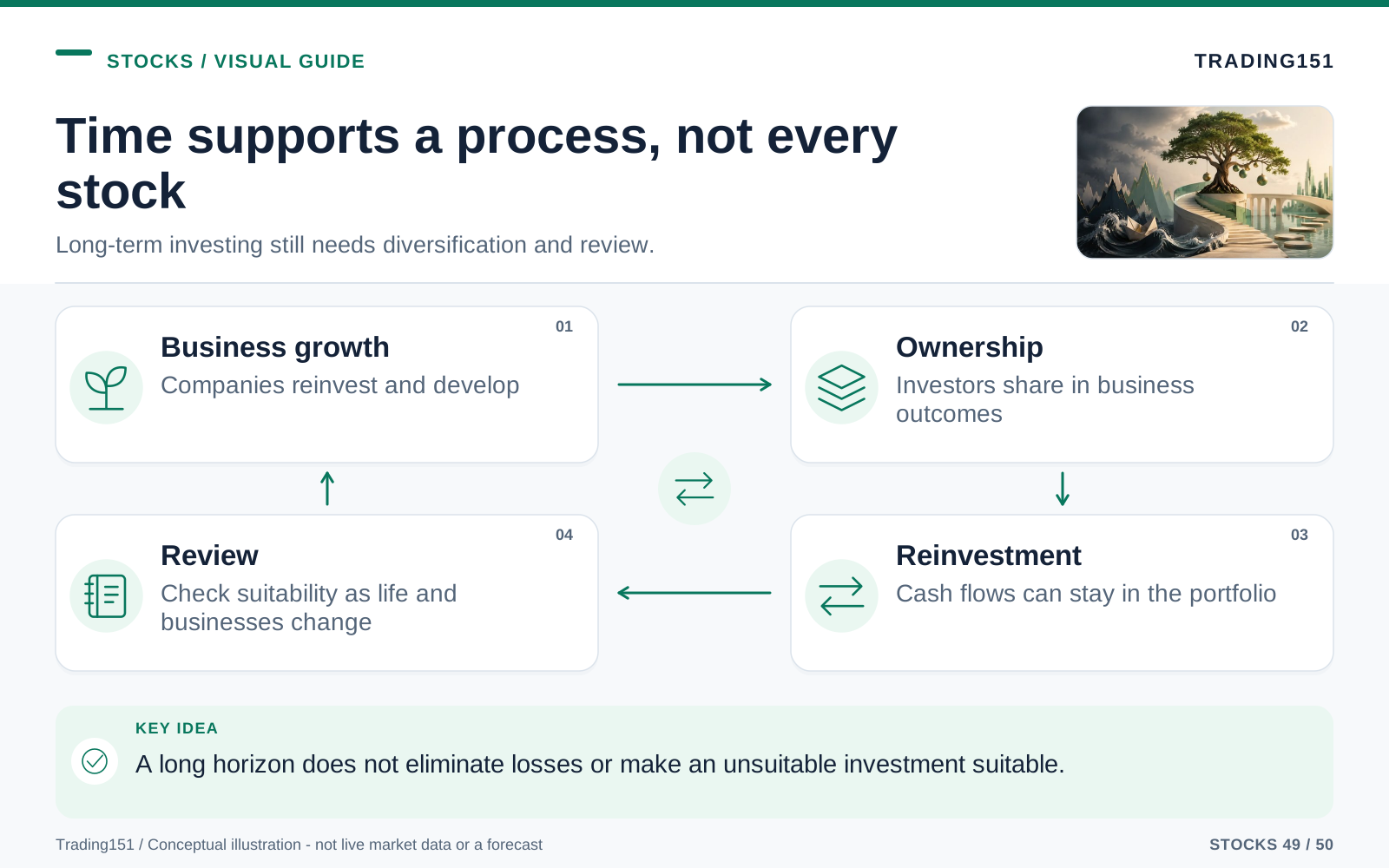
Read this diagram as text
- Business growth
- Companies reinvest and develop
- Ownership
- Investors share in business outcomes
- Reinvestment
- Cash flows can stay in the portfolio
- Review
- Check suitability as life and businesses change
Strategy 1: Buy and Hold Without Treating “Hold” Like a Suggestion
Buy-and-hold is exactly what it sounds like on the tin. You buy shares in great companies—or a broad index fund—and you hold onto them. You hold through the booming years, the severe recessions, the messy political elections, and all the random market tantrums. Now, this doesn't mean you just set it and forget it completely. A smart investor still keeps an eye on their holdings to make sure the core business is still fundamentally sound. You want to make sure the company is earning its spot in your portfolio, not just blindly clinging to a sinking ship.
There’s an old-school concept called the "Coffee Can Portfolio." Back in the day, people would hide their valuables in a coffee can and slip it under the mattress, untouched for years. The idea in investing is similar: buy fantastic assets, lock them away in a metaphorical coffee can, and fight the urge to tinker with them. It’s not about being lazy; it’s about having ironclad discipline.
If you're picking individual stocks, buy-and-hold only works if you're buying businesses that will be around in twenty years. A stock isn't a good buy just because the price tanked recently or because someone on the internet is reporting on it. To earn a long-term spot in your portfolio, a company needs real substance.
Before you buy, ask yourself a few direct questions:
- Is this company selling something people will still need or want a decade from now?
- Does it have a serious edge over its competitors, like an unbreakable brand, large scale, or unusually loyal customers?
- Is it making cold, hard cash, or is the stock price built purely on hype and empty promises?
- Would I panic if the stock market completely closed for five years and I couldn't sell a single share?
That last question is my favorite because it draws a thick line between investing and gambling. If your only reason for buying a stock is the hope that some other sucker will pay more for it next Tuesday, you aren't an investor. You're just speculating.
Trust me, the hardest part of the buy-and-hold strategy isn't the buying part. Buying is thrilling; it just takes a click of a button. Holding is where the actual grit is required. When a stock crashes 25%, your brain will scream at you to sell and stop the bleeding. When it doubles, your ego will convince you that you're a genius and you should buy more instantly. Long-term investing requires you to take a breath, look at the actual facts, and refuse to let temporary emotions dictate permanent decisions.
Strategy 2: Index Funds and ETFs, or Owning the Whole Field
Listen, not everyone wants to spend their weekends reading corporate balance sheets. And frankly, you don't have to. You can build incredible, life-changing wealth without ever attempting to pick the next great stock.
That’s the true beauty of index funds and exchange-traded funds (ETFs). Instead of betting everything on a single horse, you just buy the entire racetrack. A broad-market fund lets you own tiny slices of hundreds, sometimes thousands, of companies all in a single click.
It’s a brilliant shortcut. It instantly protects you from the disaster of a single company going bankrupt and wiping out your savings. It completely removes the stress of trying to pick winners. Plus, it saves you from the exhausting cycle of jumping from one "hot tip" to another.
The most famous example is an S&P 500 fund, which basically makes you a part-owner of the 500 largest companies in America. Want to go even broader? A total market fund sweeps up the large, medium, and small companies, too. You can even grab international funds so your financial future isn't entirely tethered to just one country's economy.
Jack Bogle, the legendary founder of Vanguard, used to say, "Don't look for the needle in the haystack. Just buy the haystack." It’s funny, but it’s also dead-on. Most of us don't need to outsmart Wall Street to get rich. We just need a reliable way to ride the overall growth of the global economy.
Indexing almost feels too simple, especially when the financial industry constantly tries to sell us on complex, flashy strategies. But simple doesn't mean weak. A basic, low-cost index fund held for a few decades is an absolute powerhouse—mostly because it removes almost every opportunity for you to mess it up.
Strategy 3: Dollar-Cost Averaging and the Gift of Not Having to Guess
New investors almost always share one very valid fear: “What if I pour my savings into the market right before a large crash?”
It's a fair question, and honestly? It will probably happen to you at some point. If you invest for decades, you are absolutely going to buy right before a dip at least once. Enter dollar-cost averaging—the strategy that makes this reality totally fine.
Dollar-cost averaging is just a fancy term for investing a set amount of money on a strict schedule, totally ignoring what the market is doing that day. You might invest $500 every payday, or maybe on the first of every month. The actual dollar amount isn't nearly as important as the habit itself.
Here's why it works: When the market is booming and prices are high, your regular contribution naturally buys fewer shares. But when the market is crashing and everyone else is panicking, stocks are basically on clearance—so that exact same contribution automatically buys you way more shares. You aren't trying to time the bottom; you're just sticking to the routine.
This takes an incredible amount of emotional pressure off your shoulders. You never have to wake up and agonize over whether today is the "perfect" day to buy. You aren’t paralyzed waiting for a market crash that might be years away. It takes your ego out of the equation entirely. The system just runs itself.
The absolute best way to do this is to automate it. Have the money automatically pulled from your checking account and invested in your chosen funds before you even have a chance to look at it. It sounds like a minor detail, but automation is the ultimate shield against your own worst enemy: yourself on a highly stressful Tuesday.
Strategy 4: Dividend Growth Investing and the Quiet Power of Cash Flow
There's something satisfying about watching cold, hard cash randomly deposit into your account. If that appeals to you, dividend investing might be right up your alley.
In simple terms, a dividend is just a company sharing its profits with you, the part-owner. Not every company does this. Young tech startups usually pour every penny back into growing the business. But older, deeply established companies often have more cash than they know what to do with, so they just hand it directly to their shareholders.
Dividend growth investing takes this a step further. You aren't just looking for companies that pay a dividend today; you want companies with a relentless track record of raising that payout year after year. Think about it: if a business can comfortably hike its dividend every twelve months through thick and thin, it’s usually a great sign of financial health and strong management.
But be careful here. A sky-high dividend yield isn’t always a blessing. Sometimes, a yield looks huge simply because the company's stock price just completely collapsed, and the market knows a dividend cut is coming. Chasing the biggest yield on the board without checking the health of the actual business is a fantastic way to lose your shirt.
Instead of just looking at the yield, ask yourself:
- Is the company making enough cash to easily afford this dividend?
- Did they keep paying it out during the last major recession?
- Are they still innovating, or are they starving the core business just to pay shareholders?
- Does this payout feel sustainable over the next decade?
You can put this strategy on steroids by turning on a DRIP (Dividend Reinvestment Plan). Most brokerages let you check a box to automatically use your cash dividends to buy more shares of the company that paid them.
In the beginning, it feels notably slow. Oh boy, an extra fraction of a share—who cares, right? But wait a few years. Those fractional shares start earning their own dividends, which then buy even more shares. It creates this beautiful, compounding snowball of cash flow that grows completely on its own.
If you're retired, these dividends can pay for your groceries without you ever having to sell a single share. If you're younger, reinvesting them builds your wealth at a substantially accelerated pace. But remember, the real magic comes from buying quality, stable companies—not just chasing the highest yields you can find.
Strategy 5: Growth Investing Without Losing Your Head
Growth investing is where all the sexy headlines live. It’s the thrill of finding that one tiny company that invents a new technology, completely disrupts an industry, and makes its early investors fabulously wealthy.
There is absolutely nothing wrong with holding growth stocks; in fact, they’re a great addition to a solid portfolio. The danger is that it is ridiculously easy to fall in love with a company's grand vision for the future while completely ignoring the absurd price you're paying for it today.
If you want to invest in growth without losing your mind, focus on the actual quality of the business, not just the hype. Is their revenue climbing? Are they anywhere near turning a profit? Do they have a unique advantage, or could a large competitor just copy their product next week and crush them?
Price always matters. Even a truly world-class company can be a terrible investment if you buy it at a totally detached, euphoric price. You don't have to be a pessimist, but you do need to make sure the company's financial realities somewhat match the optimistic story being told.
A great compromise? Use growth stocks as the "hot sauce" in your portfolio, not the main course. Build a strong foundation with broad index funds, and sprinkle a few growth stocks around the edges. If your bold picks take off, great! You win. But if they crash and burn, your financial future isn't entirely destroyed.
Building a Portfolio You Can Live With
Let me let you in on a secret: the "perfect" portfolio on a spreadsheet doesn't matter. The best investing strategy in the world is simply the one you won't abandon when the market inevitably terrifies you.
Your investments need to reflect your actual life—your goals, when you need the money, and how much stomach-dropping volatility you can personally handle. If you're thirty years away from retirement, you can afford to ride the stock market rollercoaster. But if you need that money for a house down payment in six months? Keep it far, far away from the stock market.
For most everyday investors, a stress-free portfolio looks something like this:
- The Core: Broad, dirt-cheap index funds or ETFs that make up the vast majority of your money.
- The Fun Stuff (Satellites): A smaller chunk of money for individual stocks, dividend plays, or high-growth companies that you just really want to own.
- Emergency savings: Cash set aside for unexpected expenses can reduce the chance of having to sell investments during a decline. The appropriate amount depends on income stability, essential spending, and other available support; no fixed balance covers every possible emergency.
- The Anchor: Bonds or other stable assets, which become much more important as you get closer to retirement.
This setup gives you the best of both worlds. The core does the heavy lifting, the satellites let you scratch that itch to pick stocks, and the cash cushion ensures that real-life emergencies don't derail your entire financial plan.
The Part Nobody Likes: Market Crashes Are Normal
It’s easy to brag about your risk tolerance when the market is up. But eventually, every investor has to face a crash that hurts worse than they expected. It is a deeply uncomfortable experience to open your investing app and see that years of your hard-earned savings have essentially vanished on paper. The absolute worst thing you can do is have money in the market that you need to pay next month's rent. If you separate your short-term cash needs from your long-term wealth, a market crash shifts from being a personal financial crisis to just an annoying, temporary dip in numbers.
You have to accept that market crashes aren't glitches in the system; they are a feature. The only reason stocks offer such high returns over time is that they demand a toll of uncertainty, fear, and wild price swings. You cannot get the long-term rewards without enduring the short-term pain.
The hardest part is remembering that the loss is temporary, even when it feels like the end of the world. A stock portfolio isn't a bank account. The value is supposed to bounce around. A red day doesn't mean you're a failure, just like a green day doesn't make you a financial genius.
When the market starts bleeding, take a deep breath and ask yourself two distinct questions:
- Has my actual, day-to-day personal life changed?
- Is the fundamental, long-term reason I bought these investments still true?
If you're holding a broad index fund and have decades until retirement, a market crash is just noise. It's ugly, sure, but it doesn't change your plan. On the other hand, if you own an individual stock and the company itself is fundamentally falling apart, that's a different story. You need to know the difference.
Here are a few tricks to help you survive the inevitable crashes:
- Stash a serious emergency fund. Cash feels boring when the stock market is soaring, but it feels like an absolute lifesaver when the economy tanks and your roof starts leaking.
- Stop staring at your screen. Checking your portfolio every hour just turns normal market fluctuations into a source of daily anxiety.
- Write a letter to yourself. Write down your investing plan while you're calm, so the panicked version of you has instructions to follow when the market crashes.
- Remember what you own. A share of stock isn't just a blinking red or green light on your phone; it represents real ownership in a living, breathing business.
Great investors aren't fearless. They feel the same panic as everyone else. They just refuse to let that fear grab the steering wheel.
Fees, Taxes, and Other Small Leaks That Become Big Ones
Everyone loves talking about explosive market returns, but almost nobody wants to talk about costs—and that's a large mistake. A 1% fee sounds totally harmless. But over thirty years, that tiny fee will relentlessly chew through a shocking percentage of your total wealth. Every dollar you pay in unnecessary fees is a dollar that can't compound and grow for your future. Minimizing these quiet little leaks is one of the easiest ways to boost your wealth without having to predict a single market trend.
Low costs leave more of an investment's return with the investor, all else equal. When comparing funds, check that their holdings and exposures really are similar, then consider fees alongside tracking difference, transaction costs, taxes, and account restrictions. The lowest advertised fee is only one part of the comparison.
Over-trading is another silent wealth killer. Constantly jumping in and out of stocks triggers taxes, trading spreads, and endless fees. Worse, it trains your brain to treat investing like a casino game, which is dangerous.
Taxes are tricky and change depending on where you live and what accounts you use, but you have to pay attention to them. Maximize your tax-advantaged retirement accounts, understand how your dividends are taxed, and know the penalty for selling a stock too early. You don't need to be a CPA, but ignoring taxes is a painfully expensive habit.
I know—fees, taxes, and account types are miserably boring compared to hunting for the next breakout tech stock. But these boring details are exactly where smart investors quietly secure their edge.
When Selling Makes Sense
"Diamond hands" and holding forever sound great in theory, but reality is different. Sometimes, you absolutely should sell. The trick is to sell based on logic, not panic.
First of all, sell when you reach your goal! If you've been investing for ten years to buy a house, and it's time to buy the house, sell the stocks. Using the money for its intended purpose isn't “losing your position”—it’s the whole reason you started investing in the first place.
You should also sell when the core reason you bought a stock is completely dead. If a company takes on large, unmanageable debt, betrays its customers, or gets left in the dust by competitors, get out. Stubbornly holding onto a dying company just because you hate admitting you were wrong is a great way to turn a small loss into a devastating one.
Rebalancing is another perfectly valid excuse to hit the sell button. If your tech stocks have been on an absolute tear and suddenly make up 80% of your portfolio, it might be smart to sell a little and buy some safer assets. It feels counterintuitive to sell your winners, but keeping your risk in check is crucial.
What you shouldn't do is sell out of sheer boredom, sudden panic, or jealousy that your neighbor is getting rich faster on crypto. Those are totally normal human feelings, but letting them dictate your financial moves will cost you dearly.
A Simple Long-Term Investing Routine
A solid investing routine doesn't need to look like a wall of complicated math. In fact, if it’s too complex, you’re just going to abandon it.
Here is a ridiculously simple, low-stress rhythm that works beautifully for most people:
- Figure out your "why". Know exactly what this money is for—whether it's an early retirement, buying a farm, or just sleeping better at night.
- Pad your savings first. Don't invest grocery money. If you might need the cash next month, keep it in a savings account.
- Pick a boring core. Broad, low-cost index funds are the perfect, steady foundation for almost anyone.
- Put it on autopilot. Set up automatic transfers so you pay your future self before you have a chance to spend the money.
- Turn on dividend reinvestment. Let that compounding snowball build momentum while you sleep.
- Check in, but don't obsess. Looking at your accounts once or twice a year is plenty. Seriously.
- Bump it up when you can. Whenever you get a raise, a tax refund, or pay off a debt, immediately throw a chunk of that new money into your investments.
Is this routine going to make you sound like a Wall Street genius at dinner parties? Definitely not. But your financial plan doesn't need to be flashy to make you wealthy.
A long horizon helps only when the investment and the funding fit
A holding period should follow the goal. Money needed for a near-term purchase cannot safely be assigned a long horizon merely because stocks offer the possibility of higher returns. A downturn just before the spending date can force a sale before any recovery. Accessible reserves and an appropriate asset mix help separate those spending needs from long-term growth capital.
Diversification changes what patience means. Holding a broad portfolio is different from waiting indefinitely for one damaged company to recover. Businesses can fail, dilute shareholders, or lose their competitive position. A long-term approach still needs a process for reviewing the underlying exposure and recognizing when the original reasoning no longer holds.
Costs and behavior compound alongside investment returns. Repeated fees, unnecessary turnover, and avoidable tax friction can reduce the result over many years. So can abandoning the plan after a decline and returning only after prices have risen. A simple arrangement that is understood and sustainable may be more useful than a complex one that repeatedly prompts changes.
Use projections as ranges, not promises. Include lower-return periods, inflation, and possible changes in contributions or withdrawals. The case for long-term investing is strongest when the plan remains useful under less favorable outcomes, not only under a smooth average-return illustration. Patience is a practical advantage when it is supported by suitable finances and a sound investment, rather than used as a substitute for them.
Time does not repair every investment
A longer horizon can make short-term fluctuations easier to tolerate, but it cannot guarantee that a particular company, fund, or market will recover. Businesses can lose their competitive position, shares can be diluted, and some investments can fail entirely. The benefit of patience depends on what is being held and why.
Review the underlying case at sensible intervals and distinguish temporary volatility from a change in the reasons for ownership. Long-term investing is not the absence of judgment. It is a process that avoids unnecessary reactions while still responding to meaningful changes in the investment or the investor's needs. 1, 2, 3
Give a Sound Plan Enough Time to Work
Eventually, long-term investing completely rewires how you look at money. You stop seeing your paycheck as just something to spend, and start seeing it as a tool to buy your future freedom. You stop caring about the manic talking heads on financial news, and start caring about consistent habits and time. You realize that true wealth is usually built quietly, during stretches of time that look boring from the outside.
You are going to have moments where this approach feels stupid. A buddy will brag about doubling his money on a lucky trade overnight. The news will convince you the economy is collapsing. A stock you almost bought will go to the moon, and one you bought will tank. Take a breath. None of that means your strategy is broken.
The goal isn't to “win” the stock market every month. The goal is to stay in the game long enough for decades of good, solid decisions to stack up in your favor.
Real wealth is built through a chain of fiercely ordinary actions: earning, saving, buying a diverse mix of assets, reinvesting the profits, and stubbornly refusing to hit the panic button. Not a single step of that process is glamorous, but breaking any link in that chain out of sudden fear can ruin the whole thing.
To be clear, having patience doesn't mean clinging blindly to a sinking ship. You sell when your original thesis proves wrong, when the money is needed for its intended goal, or when your portfolio gets recklessly lopsided. But true patience means rejecting the idea that temporary market discomfort equals a bad investment.
Your absolute biggest edge in the market is having a plan that can survive sheer boredom, the envy of seeing others get rich quick, and gut-wrenching fear. Build a strategy around your actual life, automate as much as possible, and step away. Let the businesses and the math work their magic in the background. Time might not fix every bad stock pick, but it gives a solid, disciplined plan all the room it needs to change your life.
Sources and further reading
Editorial revision: 7 October 2026. Numerical scenarios are hypothetical unless identified as historical. References support the added explanations and selected corrections; rules and product terms should be checked again before acting.