
Risk management in stock investing begins with the possibility that the money may be needed before an investment recovers, or that a particular investment may never recover at all. Position size, diversification, cash reserves, valuation, and account structure all matter. A stop-loss order is one possible tool, not a complete plan and not a requirement that fits every long-term investor.
What Risk Really Means
If you open a finance textbook, you'll see risk defined with words like "volatility," "beta," or "standard deviation." Sure, those are useful concepts, but they don't capture what risk feels like. For most of us, risk isn’t a Greek letter. Risk is opening your brokerage app on a Tuesday morning and seeing your favorite stock down 35%. Risk is the sudden, sinking realization that you put way too much money into a single company. Risk is needing to pay for a new roof the exact month the market crashes.
But there is a huge difference we need to clear up: volatility is not the same thing as permanent loss.
Volatility is just the market breathing. Prices go up and down because millions of people are reacting to headlines, interest rates, earnings reports, fear, greed, and a whole lot of meaningless noise. A fantastic company can see its stock price drop for reasons that have absolutely nothing to do with its actual long-term value. A broad market index can have a terrible month and still be perfectly fine over the course of a decade.
Permanent loss, though? That leaves a scar. That happens when the investment itself was fundamentally flawed, when a business starts falling apart, when debt suffocates a company, or when you simply paid way too much for a hype story that never materialized. It also happens when you're forced to sell a volatile asset at the worst possible moment just to pay your bills. Volatility is uncomfortable. Permanent loss is destructive.
A solid approach to risk won't stop your portfolio from ever seeing red. But it will make sure that when things inevitably do dip, you aren't backed into a corner and forced to make a terrible decision. It gives you room to breathe and think.
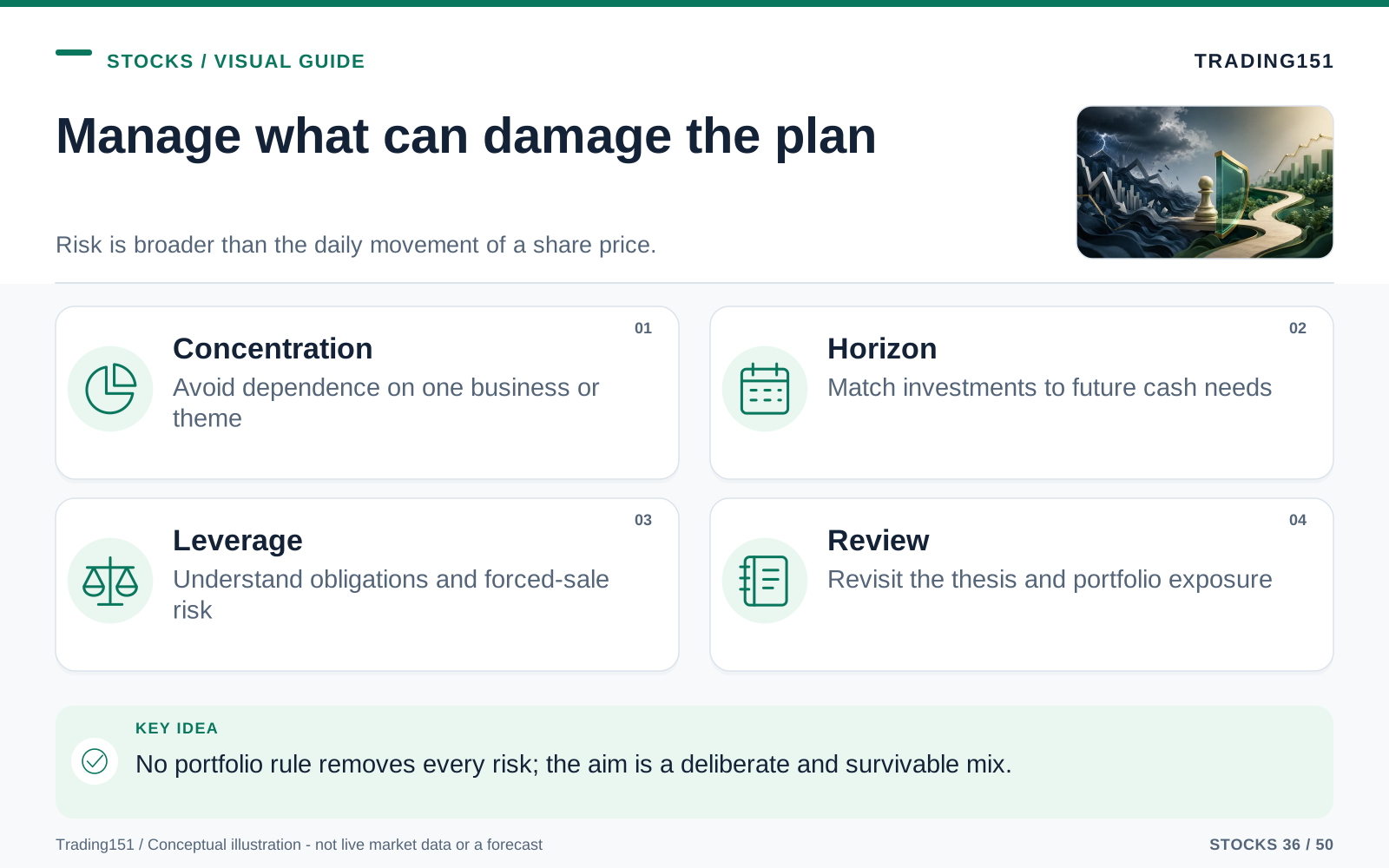
Read this diagram as text
- Concentration
- Avoid dependence on one business or theme
- Horizon
- Match investments to future cash needs
- Leverage
- Understand obligations and forced-sale risk
- Review
- Revisit the thesis and portfolio exposure
Risk Tolerance and Risk Capacity Are Not the Same Thing
One of the biggest traps in investing is overestimating how much risk you can stomach. This usually happens when the market is booming. When everything is going up, everybody feels like a genius. A portfolio stuffed with aggressive tech stocks feels "visionary." Putting all your money into three companies feels like "high conviction." Then the market corrects, and suddenly that same portfolio makes you want to throw up. Tolerance is in your head; capacity is in your wallet. You might have the nerves of steel to watch a stock drop 40%, but if you're retiring next year or you might get laid off, your actual capacity for that drop is zero. The opposite is true, too: a 25-year-old has decades to recover from a market crash, but might panic and sell at the first 5% dip. Your portfolio needs to reflect the more conservative of those two realities, rather than just inflating your ego.
Let's break down the difference between what you can stomach and what you can afford.
Risk Tolerance
Risk tolerance is purely psychological. It’s your ability to watch your net worth shrink without losing your mind. Some people can watch their portfolio drop 25% and sleep like a baby while they buy the dip. Others feel physically ill after a 7% slide. Neither reaction is "wrong," and one doesn't make you a better person than the other. We're just wired differently.
The danger comes when you lie to yourself. If you claim to be a fearless, long-term investor, but a standard market hiccup makes you want to liquidate your entire account, your plan isn't grounded in reality. A strategy that only works when you're relaxed isn't a strategy at all. Because the market will test your nerves, and it won't ask for permission first.
Risk Capacity
Risk capacity is strictly financial. It asks a much more practical question: how much financial pain can your actual, day-to-day life absorb?
A 25-year-old investing for retirement has time on their side. If the market takes a large hit, they have decades for it to bounce back, and they can keep buying shares at a discount. A 63-year-old planning to retire in eighteen months is playing a completely different game. A large drop right before they need to start pulling money out can permanently derail their retirement, even if the market eventually recovers five years later.
Your goal is to build a portfolio that respects both boundaries: what your stomach can handle, and what your bank account can survive. Ignore either one, and you're asking for trouble. Play it too safe, and inflation will eat your savings. Play it too aggressive for your timeline or your anxiety levels, and you’ll likely bail out at the exact wrong time.
Start With the Money You Can’t Afford to Risk
Before you even think about picking stocks, mutual funds, or trading strategies, you need to draw a hard line around the money that has no business being in the stock market in the first place.
Rent money doesn't belong in the market. Neither does next semester’s tuition, or the down payment for the house you want to buy next year. The stock market is an incredible engine for long-term wealth, but it is a horrific place to park cash you need in the short term.
That’s why financial peace of mind usually starts with a boring, old-fashioned emergency fund. For most folks, that means keeping three to six months' worth of living expenses in a basic, easily accessible savings account. The exact number is totally up to you—it depends on your health, job security, your debts, and who is relying on you. A freelance graphic designer might want a bigger cushion than a tenured professor with strong job security.
Let's be clear: this cash isn't going to make you rich. But making you rich isn't its job. Its job is to act as a shock absorber so that regular life stuff doesn't blow up your investment strategy. Cars break down. Roofs leak. People get laid off. Life’s emergencies don’t wait for the market to hit an all-time high. When you have cash on hand, you never have to sell your long-term investments at a loss just to fix a short-term crisis.
Diversification: The Boring Habit That Saves Portfolios
We've all heard "don’t put all your eggs in one basket." It’s so overused that most people completely tune it out. It sounds almost too basic. But basic doesn't mean ineffective. Diversification is one of the very few "free lunches" in investing that works in almost every market climate.
Picture a guy named Alex who falls head over heels for one particular company. He buys their products, listens to every podcast featuring the CEO, reads all the hyped-up online threads, and convinces himself the stock is a guaranteed home run. He dumps half his life savings into it. For a while, he feels like a genius as the stock climbs. Then the company misses an earnings report, downgrades their outlook, and the market turns on them. The stock gets cut in half. Alex wasn't just wrong about a stock—he bet so heavily on it that being wrong hurt his financial future.
Now look at Sarah. She likes picking individual stocks too, but she refuses to let one single idea dictate her future. Her money is spread across broad index funds, a handful of individual stocks in different industries, and some safe cash for near-term expenses. If one of her companies completely tanks, it’s annoying, but it doesn't wreck her life. The hits in one sector get padded by the wins in another.
That’s the magic of diversification. It won’t stop you from ever losing money, but it absolutely stops one single mistake from becoming the end of your financial story.
And to be clear, true diversification isn't just owning 30 different stocks. If you own 30 high-growth software companies, you aren't really diversified. You're just making one large bet on the tech sector, wearing 30 different t-shirts. If interest rates spike and tech takes a hit, your entire portfolio goes down together.
A truly resilient portfolio spreads the risk around. It crosses different industries, company sizes, and geographic regions. It might include broad index funds, reliable dividend payers, international stocks, bonds, or real estate. The exact recipe is up to you. But the golden rule remains: never let one single company, trend, or prediction dictate your financial survival.
Asset Allocation: The Decision That Does Most of the Heavy Lifting
It’s amazing how many people will spend weeks researching the perfect stock, but barely give five minutes of thought to the overall structure of their portfolio. It’s totally backwards. Your asset allocation—meaning how much of your money is in stocks, bonds, cash, and other assets—will dictate your returns and your risk far more than any individual stock you ever pick.
A 20-something with decades ahead of them might go heavily into stocks, accepting the wild rollercoaster ride in exchange for maximum long-term growth. Someone three years away from retirement is going to want a much more balanced mix, heavily focused on keeping what they've already built. The way you invest for a goal 30 years away should look entirely different from how you invest for a goal 5 years away.
The "right" allocation isn't the one that makes you the most money during a bull market. The right allocation is the one you can stick with when the market is crashing and the news is telling you the world is ending.
Want a quick way to test your setup? Imagine a real market crash. Not a theoretical percentage on a spreadsheet, but the visceral, sinking feeling of logging in and seeing your life savings down 20%, while every news channel screams about a recession. Would you realistically hold your ground? If your honest answer is "no, I'd probably panic sell," then your portfolio is too aggressive for you. It is far better to own a slightly more conservative mix that lets you sleep at night than an aggressive one you'll abandon at the absolute worst time.
Position Sizing: How Much Is Too Much?
Finding a great investment idea is only half the battle. The other half—and arguably the more important half—is deciding how much money to put into it. Position sizing is basically translating your opinion into a dollar amount of potential damage. If a stock could realistically drop 50%, it shouldn't make up such a large chunk of your portfolio that a drop like that would ruin you. And remember to look at how your investments relate to each other: owning three different semiconductor stocks isn't three small bets; it's one giant bet on the microchip industry.
Position sizing isn't exactly a thrilling topic to discuss at a dinner party, but it is the ultimate hallmark of a mature investor. It’s a way of saying, "I really like this idea, but I humbly accept that I might be completely wrong."
Nobody gets it right 100% of the time. Not the billionaire hedge fund managers, not the analysts with their fancy software terminals, and definitely not the anonymous guys posting screenshots online. Great companies stumble. Brilliant products flop. Cheap stocks get even cheaper. Beautiful charts completely collapse.
Because being wrong is just a part of the game, you have to control how much you put on the line. If a stock makes up 3% of your portfolio and it completely tanks, it’s a bummer, but you'll survive. But if that same stock is 40% of your portfolio? That decline can wipe out your confidence, decimate your finances, and push you into making desperate, emotional choices.
Some day traders follow strict rules, like never risking more than 1% or 2% of their total account on a single trade. For long-term investors, it’s usually more about setting a cap on position size—for example, deciding that no single stock will ever make up more than 5% or 10% of their total portfolio unless there is a massively compelling reason.
The exact percentage doesn't matter as much as the discipline behind it. You want every investment to be small enough that if you realize you made a mistake, you can just admit it and move on without feeling trapped. When a position gets too big, objective analysis usually turns into pure denial. You stop asking, "Is this still a good business?" and you start bargaining, "How can I convince myself this will bounce back?"
Know Why You Bought Before You Decide When to Sell
Buying a stock is fun and exciting. Selling is severe. Selling forces you to look in the mirror and admit that the story changed, or worse, that you were just wrong from the start. That’s why so many people never bother to create an exit strategy. They buy riding a wave of confidence, and then just wing it when things go south.
Do yourself a favor: before you click "buy," physically write down exactly why you're buying it. And I don't mean a vague thought like, "I think it’s gonna go up." Write down an actual thesis.
For example: "I’m buying this company because they have zero debt, incredible cash flow, pricing power, and room to expand into Europe." Or: "I’m buying this S&P 500 index fund because I want a piece of the whole US economy for the next 20 years." Those are two completely different reasons, and they will dictate completely different triggers for when it’s time to sell.
If the stock price drops, but the actual business is still crushing it and your timeline hasn't changed, you probably shouldn't sell. That’s just normal market turbulence. But if the company suddenly takes on large debt, loses its competitive edge, or management repeatedly fails to deliver? Your original thesis is dead. At that point, clinging to the stock just because you don't want to lock in a loss isn't being "disciplined." It’s just being stubborn.
Having your reasons written down gives you an anchor when your emotions start screaming at you. It changes the internal monologue from, "Am I terrified right now?" to, "Has the fundamental reason I bought this changed?" That is a infinitely better question to be asking.
Stop-Losses, Mental Stops, and the Limits of Automation
Stop-loss orders can be a great tool, especially if you're actively trading or taking a gamble on a highly speculative stock. A stop-loss is basically an automated rule telling your broker to sell if the price drops to a certain point. It’s designed to prevent a small paper cut from turning into a severed artery. They can enforce discipline when you might otherwise hesitate, but they aren't flawless. They don't guarantee you'll get exactly that price, especially if terrible news breaks overnight and the stock opens way lower the next morning. And for long-term buy-and-hold investors, a rigid, automated stop-loss might accidentally kick you out of a wonderful company just because the market had a volatile week. You have to match the tool to the job: automated price exits for short-term trades, thesis-based reviews for long-term holds, and position sizes that keep both approaches stress-free.
For example, if you buy a stock at $100 and decide you refuse to lose more than 15%, you set your stop-loss at $85. If it hits $85, it automatically sells. You made the decision objectively, before fear or ego even had a chance to enter the chat.
You can also use "trailing stops" to lock in your profits. If that $100 stock climbs to $150, a trailing stop moves up right behind it. It lets you ride the wave upward, while ensuring you have a parachute ready if the trend violently reverses.
But stop-losses aren't magic. In a substantially unpredictable market, a stock price can gap down past your stop, and you end up selling for less than you planned. Or, a stock might dip just low enough to trigger your sell order, only to instantly rebound and hit record highs without you. For long-term investors, automating your exits can sometimes cause you to trade way more often than you need to.
That’s why a lot of seasoned investors prefer "mental stops" or thesis-based exits. Instead of relying on a rigid price trigger, they decide ahead of time what real-world conditions would force them to sell. Maybe it’s a ruined balance sheet, declining sales, a scandal with the CEO, or simply the stock growing so much that it takes up too much of the portfolio.
The best method really just depends on your personal style. It doesn't matter if you use an automated trigger or a written promise to yourself. What matters is that you make the rule before your emotions take the wheel.
Dollar-Cost Averaging: A Quiet Cure for Bad Timing
Trying to time the market is tempting because it makes us feel smart. We all want to buy at the exact bottom, sell at the absolute peak, and wait on the sidelines for the perfect moment to jump back in. The problem? Those perfect entry points are only obvious when you look in the rearview mirror.
People lose way more money waiting around for the "perfect" time to invest than they ever would have lost just consistently putting money in. They sit on cash during huge rallies, eventually cave in and buy when prices are sky-high, and then panic-sell the moment the market dips. It’s an exhausting, never-ending cycle driven purely by stress.
Dollar-cost averaging offers a much more peaceful way forward. It’s simple: you invest a set amount of money on a strict schedule—maybe every Friday, maybe the 1st of every month, or every time you get paid—and you completely ignore the news. When the market is booming, your money buys fewer shares. When the market is crashing, your money automatically buys more shares at a discount. Over time, this naturally smooths out the ride and removes the risk of dumping all your cash in on the worst possible day.
But the biggest benefit is mostly psychological. Dollar-cost averaging turns investing into a boring, background habit instead of a stressful, high-stakes decision. You never have to wake up and wonder, "Is today the right day to buy?" The decision is already made. You just live your life.
This is hands-down the best approach for anyone trying to build long-term wealth from their paycheck. It pairs perfectly with broad market index funds, where the goal isn’t to outsmart Wall Street on a daily basis, but just to quietly hitch a ride on the overall growth of the economy.
Rebalancing: Selling a Little of What Worked
Risk is sneaky. It can quietly infect your portfolio without you even noticing. You might start out with a perfectly balanced plan, but then one part of your portfolio goes on a tear and doubles in value. Suddenly, it’s taking up way more space in your account than you ever intended. At first, this feels like an awesome problem to have. And it is—until you realize your portfolio is dangerously lopsided.
Let's say your original plan was to keep 80% of your money in stocks and 20% in bonds or cash. But after a large bull market, stocks have grown so much that they now make up 90% of your account. Without consciously making a single new decision, you are now carrying significantly more risk than you originally signed up for.
Rebalancing is simply pruning the garden. You bring the portfolio back to its original target. You sell off a little bit of the stuff that did well, and you use that cash to buy more of the stuff that lagged behind (or you just direct your new deposits to the underperforming areas). It feels weird. It forces you to sell your "winners" and buy the things that feel less exciting. But that deeply unnatural feeling is exactly why it works so beautifully to manage risk.
You don't need to do this obsessively. Most people just check in once or twice a year to see if things have drifted too far off course. You aren't looking for mathematical perfection; you just want to stop your portfolio from slowly mutating into a high-risk monster you never meant to create.
Beware of Leverage and “Easy Money”
Investing with borrowed money—leverage—is a fantastic way to multiply your gains, but it's also a fantastic way to completely destroy your finances. Leverage takes many forms: margin loans from your broker, aggressive options trading, leveraged ETFs, or any setup where a tiny wrong move can trigger a large loss. Leverage speeds up the clock. A regular investor can usually just sit on their hands and wait for a stock to recover. A leveraged investor doesn't have that luxury. They face interest charges, margin calls, and brokers forcing them to liquidate before their idea ever has time to work out. That loss of control is the ultimate danger. Even if you have a slight edge, leverage gives the financing terms the power to decide when you must sell.
And the danger isn't just the math. It completely alters your brain chemistry. When you're playing with borrowed money, every tiny market dip feels like a life-or-death emergency. You lose all your patience. A totally normal 5% market correction can force you to sell your best assets at rock bottom just to cover your loans. In the worst-case scenarios, leverage can vaporize your entire account, even if your underlying investment idea wasn't that bad.
For 99% of everyday investors, simply refusing to use leverage is one of the cleanest forms of risk management. You don’t need to squeeze every last theoretical penny out of the market. You just need a strategy that survives bad luck, bad timing, and the simple reality that you will occasionally be wrong.
Do Not Confuse a Great Company With a Great Price
Here's a risk most people don't see coming: overpaying for a fantastic company. An incredible, world-changing business can still be a garbage investment if you buy the stock at an outrageously high price. This is tough to swallow because we're constantly told to "buy great companies," as if the price tag doesn't matter.
It matters.
If the market's expectations for a company are sky-high, even phenomenal news might not be enough to keep the stock price up. A business can shatter sales records, crush their rivals, and rake in cash, and the stock can still plummet because investors had priced in absolute, flawless perfection. The stock market doesn't just judge a company on how good it is today. It judges a company against what everyone expects it to do tomorrow.
This is where the concept of a "margin of safety" comes into play. A margin of safety simply means leaving yourself some room to be wrong. You don’t assume everything is going to go off without a hitch. You ask yourself: what if their growth slows down? What if material costs spike? What if the economy cools off? The murkier the future is, the more careful you should be about the price you're willing to pay today.
You don’t need a Ph.D. in finance to calculate a stock's exact intrinsic value down to the penny. Investing is never that precise anyway. But you do need the humility to look at a chart and say, "I love this business, but the stock is just too expensive for the amount of risk I'd be taking." Sometimes, the best risk management decision you can make is just not buying at all.
Your Biggest Risk May Be Your Own Behavior
The stock market is tricky, but human psychology is what really ruins portfolios. The same survival instincts that keep us alive in the real world work completely against us when we're investing.
When prices are shooting to the moon, FOMO (fear of missing out) takes over. We see everyone else seemingly getting rich, and we want in. We lower our standards, chase hype, and tell ourselves "this time is different." Then, when the market inevitably tanks, we feel the exact opposite pressure. We want the pain to stop. Hitting the "sell" button provides instant emotional relief, even though it absolutely wrecks our long-term plan.
That’s exactly why so many investors predictably buy high and sell low. They aren't stupid. They’re just human.
Managing your own brain starts with removing unnecessary temptations. Checking your brokerage app three times a day isn't making you a better investor. It’s just giving your emotions more opportunities to hijack your logic. Financial news can be helpful in small doses, but remember that a lot of financial media exists to keep your eyes glued to the screen, not to make you wealthy. News headlines are designed to create panic and urgency. Good investing is designed entirely around patience.
If you want to protect your portfolio from yourself, try a few of these habits:
- Write your plan down. An idea in your head is far too easy to twist and rewrite when you're panicking. A physical piece of paper keeps you honest.
- Keep an investment journal. Jot down exactly why you bought an asset, what would trigger you to sell it, and the risks you're worried about on day one.
- Stop checking your balances. If you're holding an asset for the next 10 years, you absolutely do not need minute-by-minute updates.
- Curate your social media. Confidence on the internet is cheap. Screenshots can be cherry-picked, and the loudest guy in the comments is rarely the richest.
- Enforce a waiting period. If you suddenly feel a burning urge to buy or sell, force yourself to wait. Urgency is almost always just emotion wearing a mask.
The goal here isn't to become some cold, emotionless robot. That's unrealistic. The goal is to build a system that stops your very normal human emotions from touching the steering wheel when it matters most.
A Simple Personal Risk Checklist
Before you put your money into anything, do yourself a favor: take a deep breath and ask yourself a few basic questions. They don't need to be complex.
- Do I understand what I'm buying? If you can’t explain how this investment turns a profit, you probably shouldn't own much of it.
- How much money can I lose without it hurting my actual life? This is crucial if you're playing with individual stocks, crypto, or trendy themes.
- Why am I buying this today? Having a solid, logical thesis is infinitely better than buying out of boredom, hype, or FOMO.
- What is my exit strategy? Decide what specific events would force you to sell before the market tests your patience.
- Is this position too big? Even the greatest stock pick in the world becomes a large risk if it dominates your portfolio.
- Do I have cash on the sidelines? If you don't have an emergency fund, your stock portfolio will suddenly become your emergency fund at the absolute worst possible time.
- Does this match my timeline? Money you need to spend in the near future has no business riding the major short-term swings of the stock market.
Look, answering these won't act as a magic shield against losing money. Nothing will. But they will absolutely act as a speed bump for impulsive decisions and force every investment to earn its place in your account.
The Real Goal: Staying in the Game
Practicing good risk management can feel overly cautious, especially when the market is ripping higher and reckless people look like financial geniuses. There is always going to be someone out there making more money than you in a hot market. Someone will always have a bigger stock pick, a crazier gamble, or a blind bet that miraculously paid off.
Do not let their highlight reel pull you away from your own plan.
Your goal is not to "win" the market every month. It isn't to magically own every stock that goes up, or to impress strangers on the internet with your flawless timing. Your only real goal is to build wealth in a way that lets you sleep at night. That means protecting yourself from catastrophic ruin, keeping your own psychology in check, and giving compound interest enough time to work its quiet magic.
The truth is, good investing usually feels boring while you're doing it. You invest a portion of your paycheck every month. You diversify. You don't bet the farm. You keep cash in the bank for emergencies. You rebalance occasionally. You admit when a stock pick was wrong while the loss is still small. You let your winners run without making them your entire identity.
And then, years later, all those boring choices start to look powerful.
Choose the risk control that matches the investment
Start with the purpose of the money. A concentrated trading position and a diversified retirement portfolio do not necessarily call for the same exit rule. A tight price stop may be central to one strategy and disruptive to another. The relevant question is which losses or funding problems the plan must prevent, not which rule sounds most disciplined in isolation.
Distinguish temporary market fluctuation from a permanent impairment of the investment case. That distinction is difficult in real time, so it helps to record the original business assumptions and review triggers. A falling price alone does not prove that a business is broken, while a familiar company name does not prove that a decline is temporary.
Diversification should be assessed by exposure rather than by the number of holdings. Several stocks can depend on the same customer, commodity price, interest-rate environment, or industry cycle. Funds can overlap heavily as well. Consider how the portfolio might behave when those shared drivers deteriorate together.
Keep the controls proportionate and understandable. Limits on a single holding, a suitable amount of accessible cash, and avoidance of unaffordable borrowing can address risks that an elaborate trading rule misses. No arrangement eliminates uncertainty. The aim is to prevent an ordinary adverse outcome from becoming a financial problem that forces decisions at the worst possible time.
Match the control to the risk being controlled
A stop order addresses a particular exit instruction. It does not solve concentration, an unsuitable time horizon, or a business whose shares cannot be sold readily during stress. Diversification addresses some company-specific exposure, but it does not guarantee that the portfolio will hold its value in a broad decline. Cash reserves address near-term funding needs without making long-term purchasing power certain.
These tools work best when their jobs are explicit. Start with the event that would create a problem: a forced withdrawal, a single company failing, a large gap, or an inability to tolerate further loss. Then choose the control that actually reduces that vulnerability. Adding a tool because it is conventionally called 'risk management' can create confidence without addressing the real weakness.
For example, an investor planning to use a portfolio for a house purchase next year has a different problem from an investor managing a speculative trade for the next hour. The first may need a more suitable asset allocation; the second may need tightly controlled exposure and execution rules. Both need to consider loss, but there is no reason to expect the same stop setting or portfolio rule to serve them equally well. 1, 2, 3
Risk Control Buys You Staying Power
Ultimately, managing risk isn't about being terrified of the stock market. It’s about respecting it. The market has minted unbelievable wealth for patient, disciplined investors. It has also ruthlessly punished people who were overconfident, impatient, and unprepared. Both of those things are true at the same time.
A real-world risk plan tells you how much money you can safely invest, how much you can afford to lose on one bad idea, and what specific red flags mean it's time to sell. It also factors in the real world: your job security, your debts, your insurance, and your upcoming life expenses. Because your stock portfolio isn't some isolated video game—it’s tied directly to the safety of your household.
There are no cheat codes that completely eliminate uncertainty. Stop-losses can fail to execute perfectly, diversification can weaken during a global panic, and the most meticulously researched company can still go bankrupt. The true value of a risk management plan is simply that it replaces panicked, stressful improvisation with calm, calculated decisions you made when your head was clear.
The ultimate objective is durability. Keep enough cash on hand to weather the storms, avoid risks you don't fully understand, and keep your bets small enough that your curiosity outlives your disappointments. The investors who manage to stay solvent and keep their emotions in check are the ones who retain the power to learn, adjust, and strike when the real opportunities finally present themselves.
Sources and further reading
- Investor.gov: Asset Allocation
- SEC Investor Bulletin: Stop, Stop-Limit and Trailing Stop Orders
- Investor.gov: Stocks
Editorial revision: 7 October 2026. Numerical scenarios are hypothetical unless identified as historical. References support the added explanations and selected corrections; rules and product terms should be checked again before acting.