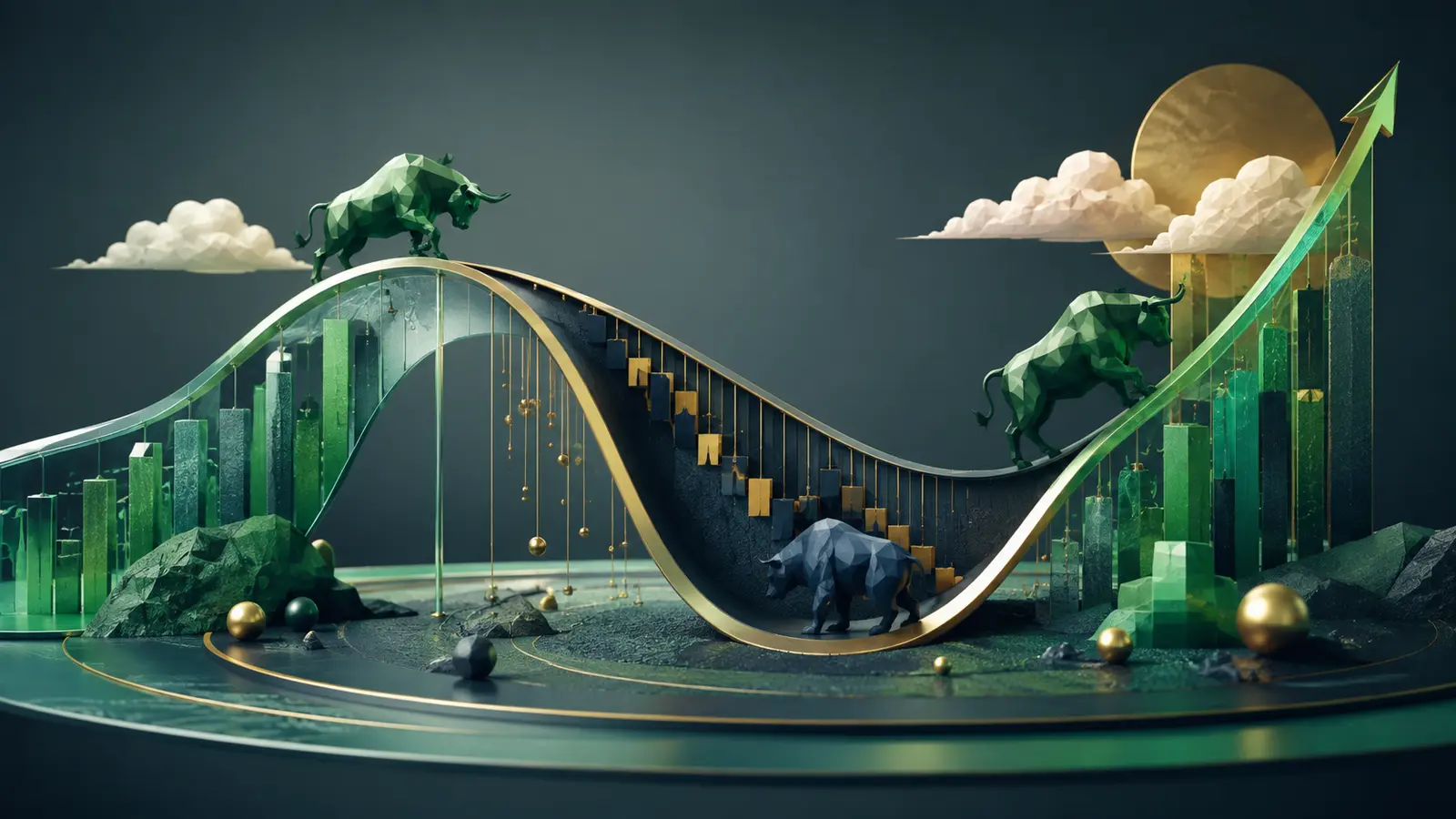
Stock-market cycles describe recurring periods of rising confidence, expanding valuations, stress, and recovery. They are patterns in economic and investor behavior, not a clock with dependable intervals. Different industries and countries can occupy different conditions at the same time. Understanding cycles can help frame risks, but it does not make the next turning point observable in advance with certainty.
Phase 1: Accumulation (The Quiet Spring)
You know the accumulation phase has started when absolutely nobody wants to talk about their portfolio. A bear market has already done its worst. Prices have been dragged down for months, maybe years. The high-flying stocks everyone loved in the last boom are basically punchlines now. Anyone who bought at the top is angry, embarrassed, or just deeply tired of losing money. The news is terrible, and the average person wouldn't touch a stock with a ten-foot pole. It’s a deeply uncomfortable time. The economy probably still looks shaky, bankruptcies are making headlines, and the companies best positioned to bounce back look like a mess. The few people buying now aren't necessarily predicting a miracle tomorrow; they're just stepping in because prices are so low that the worst-case scenario is already baked in. (Just remember: there’s a difference between finding a true bargain and blindly buying garbage, because not every beaten-down company is going to survive the winter.)
That’s exactly what makes this phase so fascinating.
Think about walking into a department store in July and seeing heavy winter parkas marked down by 80%. Most people walk right past them because they’re thinking about the beach. But a patient shopper looks at that rack and thinks, Winter is going to happen eventually. I might as well buy this now while nobody else cares.
That’s the exact mindset of the accumulation phase. Prices have dropped so far that the patient money starts sniffing around for deals. The businesses don't look perfect, the economy feels fragile, and earnings might still be dropping. But veteran investors know that markets almost always start climbing before the headlines get better. By the time the news finally tells you it's "safe" to invest, the best prices are long gone.
During this phase, the buying is whisper-quiet. Institutional investors, seasoned fund managers, and patient individuals slowly scoop up shares. They aren't going on TV to declare a new bull market. They’re just quietly taking advantage of fire-sale prices while everyone else is too depressed to notice.
If you're just watching from the sidelines, this phase is painfully boring. The market might inch up for a few weeks, then slump right back down. Good news is totally ignored. Bad news gets put under a microscope. Every little rally is treated like a trap. That intense skepticism is exactly why accumulation can drag on for so long.
How it feels: Boring, lonely, and deeply uneasy. Buying here never feels brave in the moment—it usually feels like you're way too early, completely wrong, or both.
What’s really happening: The market is quietly changing hands. Stocks are shifting from exhausted, panicked sellers into the accounts of patient, long-term buyers. The fear is still loud, but underneath the surface, the actual selling pressure is secretly running out of steam.
The mistake investors make: Waiting for an "all-clear" signal. The severe truth is that the stock market rarely offers comfortable headlines and bargain prices at the same time. By the time confidence comes back, the deals are usually gone.
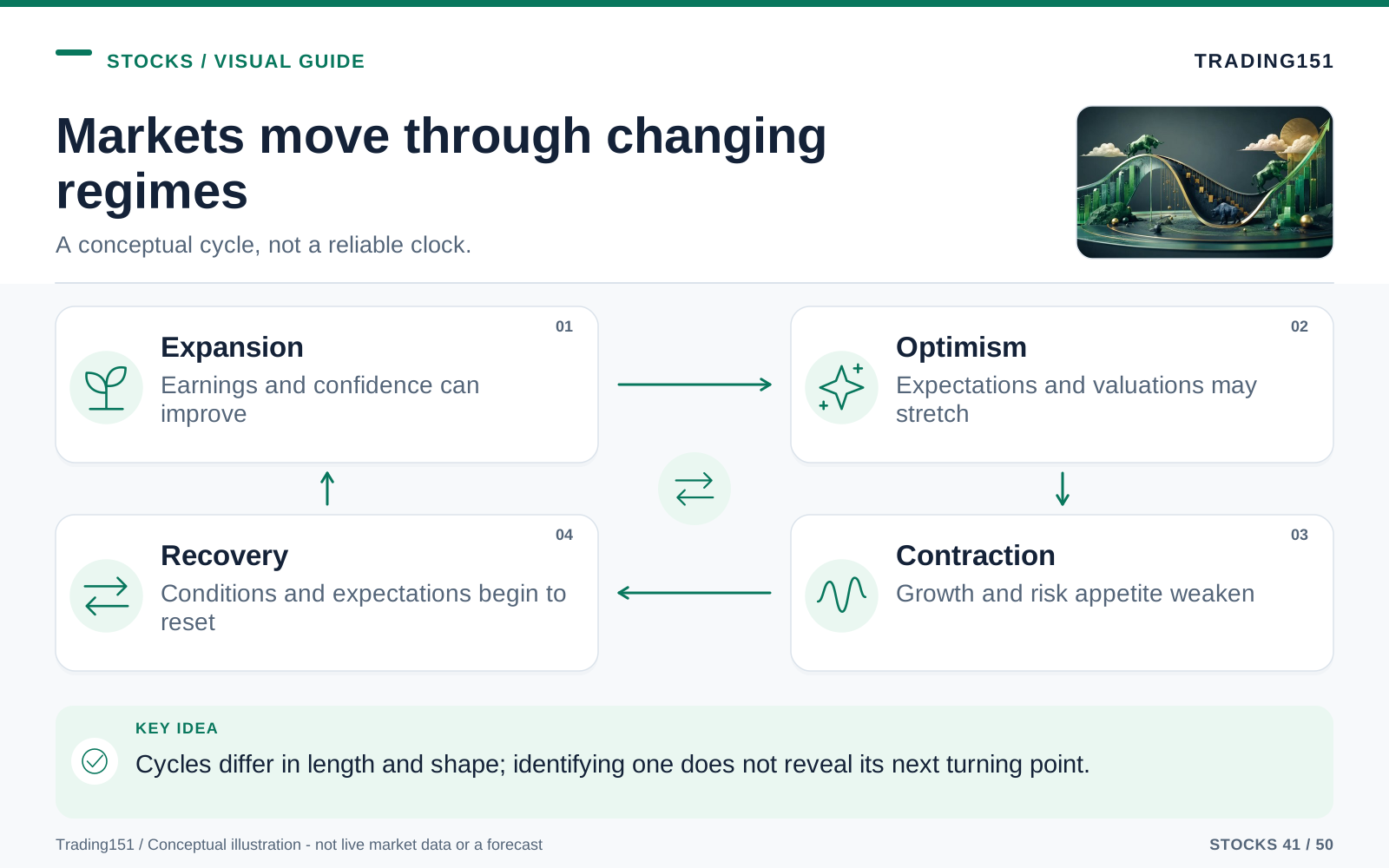
Read this diagram as text
- Expansion
- Earnings and confidence can improve
- Optimism
- Expectations and valuations may stretch
- Contraction
- Growth and risk appetite weaken
- Recovery
- Conditions and expectations begin to reset
Phase 2: Mark-Up (The Sizzling Summer)
Eventually, things just stop breaking. Rallies start lasting longer. The dips don't plunge quite as deep. Stocks that used to collapse at the slightest hint of bad news suddenly hold their ground. Corporate earnings get a little better, the economy stops feeling like it's on a cliff edge, and the overall mood brightens. Even the folks who swore off investing forever start peeking at their accounts again.
This is the mark-up phase. Most people just call it a bull market.
In the early days of this phase, a lot of investors are suspicious. The trauma of the last crash is still too fresh. Every green day feels like a trick. Financial talking heads warn that the bounce is a fluke. The people who panic-sold at the bottom are sitting on the sidelines, praying the market crashes again so they can get back in at a better price.
But the market doesn't care if you're ready or not. Prices keep climbing. The rally spreads to more and more companies. Business is improving. The disciplined investors who held on through the pain finally start seeing their patience pay off. Slowly but surely, all that heavy skepticism morphs into cautious optimism.
The middle part of the mark-up phase is usually the absolute best part of the cycle. Credit is flowing, earnings are growing, and people are making money without being completely insane about it. Sure, there are still worries, but the general trend is up, up, up. This is where long-term investors naturally pad their portfolios, even if it feels a bit bumpy along the way.
But as the phase drags on, the vibe shifts. Confidence mutates into excitement. Excitement swells into arrogance. Arrogance turns into flat-out euphoria.
This is when the market feels like a cheat code. People who haven't thought about a stock in a decade suddenly want to trade options. Risky, highly speculative assets become the hottest trend. Prices get substantially expensive, but everyone has a brilliant excuse for why it makes sense. People start arguing that a company doesn't need to make money as long as the CEO tells a good story. You don't need a reasonable valuation if everyone just assumes the stock will double by next month.
You can hear the top approaching in everyday conversations. Your uncle pitches you a stock over dinner. Your social media feed is choked with screenshots of large gains. People start thinking their dumb luck is financial genius. You start hearing the phrase this time is different thrown around, usually wrapped up in some story about artificial intelligence, a new financial paradigm, or a "new era" of investing.
How it feels: Incredible, thrilling, and bizarrely easy. It honestly feels like stocks can only go up, because every time you check your phone, they do.
What’s really happening: A flood of new money is chasing ever-higher prices. The actual businesses might be doing fine, but raw emotion and greed are taking the steering wheel.
The mistake investors make: Assuming the easy money they made yesterday guarantees easy money tomorrow. Late in a bull market, folks tend to take on the most extreme risks at the exact moment the potential rewards are the lowest.
Phase 3: Distribution (The Crisp Autumn)
Here’s the tricky thing about the distribution phase: nobody rings a bell at the top. The news is probably still fantastic. Wall Street analysts are still pumping out aggressive price targets. Regular investors are still aggressively "buying the dip." On the surface, the party is still raging. Distribution is sneaky because the headlines often stay positive while the "smart money" quietly heads for the exits. You’ll start to see a weird disconnect where stock prices completely ignore actual business fundamentals. Fewer and fewer stocks are driving the market higher, companies start rushing to issue new shares, and people invent creative new excuses for why "valuations don't matter anymore." None of this guarantees a crash is happening tomorrow, but it’s a giant flashing yellow light that the upside just isn't worth the risk anymore.
The very personality of the market begins to shift.
Instead of marching steadily upward, prices start thrashing sideways. Large rallies mysteriously fizzle out. You might see a handful of famous tech stocks hitting all-time highs while hundreds of smaller companies quietly bleed out in the background. The major indexes might look totally fine, but under the hood, the engine is sputtering. The leadership is narrowing down to just a few big names.
During distribution, those quiet, patient buyers who got in during the accumulation phase start pulling their chips off the table. They aren't panic-selling their entire portfolios, but they're trimming their positions. They’re locking in profits, moving cash to safer spots, and getting way more picky. Meanwhile, the latecomers are still throwing money at the market because they’re desperate to catch the gains they missed last year.
That is the ugly truth of distribution: stocks are slowly being handed from disciplined, wealthy sellers to eager, overly emotional buyers.
Now, a sideways market doesn't always mean the world is ending. Markets need to catch their breath. That's why distribution is so maddeningly hard to spot in real time. The real danger is when stocks have had a large multi-year run, everything is substantially expensive, everyone is unusually bullish, and yet the market just can't seem to push higher even when the news is perfect.
The mood gets weird, too. Investors get fiercely defensive. If you suggest maybe taking some risk off the table, you're mocked for being a doomer. Buying the dip has worked fifty times in a row, so it feels automatic. Anyone pointing out the danger looks completely out of touch.
How it feels: Choppy, confusing, and vaguely stressful. You might get a gut feeling that something is "off," but it's easy to ignore because everyone else is still cheering.
What’s really happening: The demand is quietly evaporating. The market requires heavier and heavier doses of hype just to keep prices afloat, and that hype is running out.
The mistake investors make: Thinking that just because a trend hasn't broken yet, it never will. Distribution is the phase that punishes complacency.
Phase 4: Mark-Down (The Harsh Winter)
Eventually, the rubber band snaps. Sometimes there’s an obvious spark—like a sudden spike in interest rates, a banking crisis, a geopolitical disaster, or some hyped company collapsing overnight. But sometimes? The market just runs out of people willing to buy, and it caves in under its own weight.
This is the mark-down phase. Welcome to the bear market.
At first, nobody really panics. The previous bull market practically trained everyone to buy every dip. A 5% drop is just a blip. A 10% drop? That's a discount. Everyone on social media reminds each other that the market always bounces back. And to be fair, they aren't totally crazy—not every little dip turns into a catastrophic crash.
But in a real mark-down phase, the bounces get pathetic. Suddenly, bad news hurts again. Stocks start falling even when companies report decent earnings. All those speculative, moonshot investments that felt like sure things start plunging in unison. The folks who bought in at the tail end of the party suddenly realize that owning a "popular" stock is very different from owning a good one.
As the red ink piles up, psychology shifts from confident to deeply in denial. People bargain with themselves, promising to sell the second their account gets back to break-even. They delete their brokerage apps so they don't have to look at the damage. They desperately hunt for articles that validate their choices. The market, sadly, doesn’t care what price you bought at.
Then, the denial turns to pure panic. The people who prided themselves on being long-term investors just want out, regardless of the price. The same assets they couldn't get enough of a year ago now feel completely toxic. It’s one of the cruelest tricks the market plays on our brains: falling prices make great assets look concerning, while rising prices make terrible assets look perfectly safe.
The final act of this winter is called capitulation. This is the breaking point. People stop hoping for a rebound and just want the bleeding to stop. Selling isn't about logic anymore; it's purely emotional. The headlines are apocalyptic, and regular folks swear they will never put another dime in the stock market again. If there was a chart for the phrase I just can't take it anymore, this is what it would look like.
Ironically, that mass surrender is exactly what clears the path for the next boom. It flushes out all the excess optimism, forces the weak hands to sell, and resets prices to a level where the patient money can step back in. You’ll never guess the exact bottom, but the vibe right before the turnaround is usually miserable.
How it feels: Concerning, exhausting, and completely unfair. It honestly feels like the bleeding will never stop.
What’s really happening: The market is hitting the reset button. Overpriced junk is being repriced, debt is being cleared out, and expectations are finally slamming back down to reality.
The mistake investors make: Selling simply because they can't stomach the pain anymore. Panic selling usually happens right after the worst of the damage has already been done.
Why Market Cycles Keep Fooling Smart People
In theory, this all sounds simple. Just load up during the accumulation phase, ride the wave up, sell before the distribution phase ends, and sit on a beach during the mark-down. Easy, right?
In real life, it’s a totally different story.
The problem isn't that people are stupid. The real issue is that the market cycle is designed to weaponize your own instincts against you. We are hardwired to be social creatures. If everyone around us is terrified and running for the exits, our lizard brains tell us we should run too. If everyone we know is getting rich and popping champagne, we assume they know something we don't.
In the real world, following the crowd keeps you alive. If a hundred people sprint out of a burning building, you don't stand there analyzing the smoke patterns. You run.
But in the stock market, following the crowd will quietly destroy your wealth.
When prices are cheap and future returns look amazing, the crowd is paralyzed with fear. When prices are completely bloated and future returns look terrible, the crowd feels unstoppable. That’s why investing feels so backwards. The absolute best opportunities show up when you feel sick to your stomach. The most dangerous traps are set when you feel invincible.
Warren Buffett’s old quote about being "fearful when others are greedy, and greedy when others are fearful" is legendary because it fits on a bumper sticker. Living by it is substantially difficult. It takes immense patience, humility, and the willingness to look like a complete idiot to your friends for a while.
That last part is key. Making the right investment choice rarely feels good in the moment. Buying stocks when the world is ending makes you look reckless until you're eventually proven right. Selling your high-flyers while everyone else is still dancing makes you look like a coward. The market loves to test your emotional discipline right before it rewards it.
How to Recognize the Market’s Mood
Look, nobody can perfectly pinpoint exactly where we are in a cycle. Markets are messy. You might have tech stocks crashing while healthcare stocks are booming. The S&P 500 might be moving sideways while speculative crypto is melting down. That’s why you have to think in terms of probabilities, not certainties. If you want a cheat code, look at the credit markets. When banks are lending to anyone with a pulse and companies are borrowing money for fun, it pours gas on a boom. When lending dries up and defaults start rolling in, it makes the downturns much worse. Also, keep in mind that the stock market usually moves ahead of the actual economy. If you sit on your hands waiting for the government to officially declare a recession or a recovery, you’re going to be late to the party.
But there are still clues if you know where to look.
In the accumulation phase, the vibe is overwhelmingly negative, but stocks just refuse to drop any lower. Bad news barely moves the needle anymore. Good companies hold their ground. Prices start making sense again, and the seasoned pros start poking around even though Twitter is fully convinced the world is ending.
When the mark-up is happening, the upward trend is undeniable. Everything is going up. Profits are solid. Dips are bought immediately. People are happy to take risks, but at least in the first half of this phase, there's still a healthy dose of skepticism keeping things grounded.
By the time distribution hits, things get wobbly. A few large stocks might be propping up the whole market while everything else quietly sinks. Things are overpriced, everyone is thrilled, and folks bend over backwards to justify taking wild risks. The market basically stops going up even though the news is universally fantastic.
And when the mark-down arrives, it’s purely defensive. Rebounds get crushed. People slash their risk. Tiny bits of bad news that people laughed at a year ago suddenly cause 10% drops. Eventually, the fear gets so thick that investors stop wondering how much money they can make and just start begging to know how much more they can lose.
These aren't perfect sirens that go off. They’re just reminders to watch how the crowd is acting, not just what the headlines are saying. The mood of the market almost always shifts before the official story does.
How to Survive the Cycle Without Losing Your Mind
Knowing all this stuff is great, but it’s completely useless unless it changes how you manage your money. You aren't trying to become a mythical day-trader who catches every top and bottom. That’s a fantasy that usually ends in tears. Your goal is simply to build habits that stop you from doing really dumb things at really bad times.
1. Stop Trying to Pick the Exact Top or Bottom
Even the guys managing billions of dollars rarely buy at the very bottom or sell at the very peak. Those perfect moments only exist in the rearview mirror. In real time, bottoms look like the end of the world, and tops look like permanent prosperity.
It’s much better to think in zones. If the market just took a 30% dive, the news is dreadful, and great companies are on sale, you don't need to snipe the exact bottom to start buying. If stocks have been rocketing upward for a decade, your Uber driver is giving you options tips, and garbage companies are valued at billions, you don't need to know the exact top to decide it's time to play some defense.
Striving for perfection just paralyzes you. Being "mostly right" and emotionally stable will make you way more money in the long run.
2. Use Dollar-Cost Averaging to Remove Some Emotion
Dollar-cost averaging just means you put a set amount of money into the market on a rigid schedule—like every paycheck, or the first of every month—no matter what the market is doing. When things are expensive, your money buys fewer shares. When everything crashes, your money scoops up a lot of them.
It’s not magic. It doesn't mean you'll never lose money. But what it does brilliantly is strip the emotional agonizing out of the process. Instead of waking up and stressing, Is today the absolute perfect day to invest? you just let your system run quietly in the background, straight through every phase of the cycle.
For most normal people, that mental relief is priceless. It’s vastly easier to trust an automated plan than to wrestle with fear and greed every morning.
3. Keep Cash for Real Life, Not for Market Panic
The number one reason people dump their stocks during a crash usually has nothing to do with their investment strategy. They sell because life happened, and they desperately need the cash. A layoff, a blown transmission, a medical emergency—these things force people to liquidate their portfolios at the absolute worst possible moment.
That is exactly why you don't put your grocery money in the stock market. Your emergency fund, the down payment for a house you want next year, or your kid's tuition money needs to sit in boring, safe cash accounts.
When you know your rent is covered no matter what the S&P 500 does, bear markets lose their teeth. You still won't enjoy looking at the red numbers, but you won't be forced into a devastating financial mistake just to keep the lights on.
4. Build a Portfolio You Can Hold
A portfolio is completely useless if you can't stomach holding it. A hyper-aggressive mix of tech stocks and crypto might look incredible on a spreadsheet when you're dreaming about returns. But if a standard 20% market drop is going to make you panic and sell everything, that portfolio was far too risky for you. Just know that nothing is completely bulletproof. "Safe" defensive stocks can get way too expensive, bonds can take a beating if inflation spikes, and cash slowly loses its buying power over time. The goal is to own a mix of things that react differently to the world, and to trim the winners to buy the losers—not to hunt for one magical asset that never goes down.
The right portfolio isn't the one that makes you sound like a genius to your friends. It’s the one you can hold onto when the news is concerning and your account balance makes you want to throw up. If that means holding more bonds or cash than the finance bros recommend, do it. If it means spreading your money across the globe instead of betting on three hot stocks, do it.
There is absolutely no shame in building a portfolio that lets you sleep at night. Surviving the winter is way more important than looking cool in the summer.
5. Write Down Your Rules Before Emotions Take Over
The absolute worst time to figure out your game plan is in the middle of a market crash. By then, the adrenaline is pumping. Every headline feels like a life-or-death emergency. You feel this intense, burning pressure to do something right now.
Write your rules down on a boring Tuesday when you are perfectly calm. Decide exactly how much you're going to invest each month. Decide how much cash you need to feel secure. Set the exact percentage of your money that should be in stocks, and figure out when you'll rebalance it. Define exactly what would make you sell something, and what wouldn't. A piece of paper isn't going to stop you from feeling scared, but it gives you an anchor to hold onto when the wind starts howling.
6. Be Careful With Stories That Sound Too Good
Every cycle has a killer story. Sometimes it's the dot-com boom. Sometimes it's real estate, crypto, artificial intelligence, or a handful of mega-corporations that are supposedly going to own the world. Usually, there's a grain of real truth to the hype! The danger isn't the story itself. The danger is thinking you can pay any price for it.
A spectacular company can still be a garbage investment if the stock price is already totally detached from reality. A world-changing technological trend can still lose you a fortune if you pile in at the same time as everyone else. At the top of the cycle, people always forget that the price you pay matters. The market always finds a severe way to remind them.
What Long-Term Investors Should Remember
Market cycles are physically and emotionally exhausting, but they aren't a glitch in the matrix. They are a necessary feature of the system. The booms are what fund wild innovation and get people to take leaps of faith. The busts are what clean out the scammers, clear away the bloated debt, and force companies to get disciplined. It never feels fair when you're stuck in the middle of it, but both sides of the coin have a job to do.
If you're playing the long game, the biggest takeaway is this: stop treating every dip like the apocalypse, and stop treating every rally like proof that you're a financial wizard. A raging bull market can cover up stupid decisions. A vicious bear market can hand you the opportunity of a lifetime. Your only job is to keep your head cool enough to tell the difference.
It also helps to just zoom out. If you stare at a daily stock chart, it looks like pure chaos. A one-year chart looks dramatic. But a thirty-year chart tells a totally different story. The market has clawed its way through world wars, crippling inflation, global pandemics, banking collapses, and large bubbles bursting. That doesn't mean every company survives, and it doesn't mean risk is fake. But it does prove that real, productive businesses—backed by patient money—have an incredible track record of outliving fear.
The hardest part is that the healing almost always starts before you feel ready for it. If you sit on the sidelines waiting for 100% emotional certainty, you are going to pay a steep price. The market isn't going to wait around for you to feel brave before it kicks off the next bull run.
The cycle is easiest to label after the turning point
Economic and market cycles are related but distinct. Share prices respond to expectations, so they can turn before reported activity reaches its strongest or weakest point. Economic data also arrive with delays and may be revised. A strategy that buys only after a recession is officially declared over may be acting on information the market considered much earlier.
Avoid defining the phase solely by the trade you would like to make. If rising prices are called a recovery when you are bullish and a speculative bubble when you are bearish, the framework cannot be tested. Use specified indicators and acknowledge cases in which they disagree.
Valuation can help describe vulnerability without supplying precise timing. An expensive market can become more expensive, and a cheap market can remain cheap or deteriorate. Position size and the ability to hold through uncertainty matter because a reasonable long-term view can be uncomfortable for an extended period.
Use cycle analysis to examine the plan rather than repeatedly replace it. Ask whether debt, concentration, or near-term spending makes the portfolio unusually sensitive to a downturn. Rebalance under established rules where appropriate, and change the underlying allocation when goals or constraints change. A useful framework should improve preparation for several outcomes, not require confidence that the current phase has been identified perfectly.
A turning point is easier to name afterward
Economic and market cycles are often described with clean stages, but the boundaries are uncertain in real time. Data may be revised, industries may be in different phases, and prices can move before the economic change becomes obvious.
Use a cycle framework to organize scenarios rather than to assign false precision to the current stage. What would support the expansion case? What would weaken it? Which holdings would be vulnerable if the classification were wrong? Those questions can improve preparation without pretending that a label provides an exact trading signal.
A portfolio should not become dependent on one cycle diagnosis merely because the story sounds coherent. Position size, diversification, and liquidity remain relevant when the economic narrative is persuasive. The cost of being early, late, or simply mistaken belongs in the decision. 1, 2, 3
Cycles Change; Human Reactions Repeat
The stock market isn’t a rigged casino, but it’s definitely not a magical ATM that dispenses cash just because you're feeling optimistic. It’s a substantially competitive, emotional arena. Prices are constantly cycling through fear, quiet recovery, loud excitement, ridiculous excess, crushing disappointment, and eventual renewal.
Once you wrap your head around those four phases—Accumulation, Mark-Up, Distribution, and Mark-Down—the whole game starts to feel a little less crazy. It doesn't necessarily get easy, but it stops being quite so confusing. You start realizing that the mass panic and the wild euphoria aren't random flukes. They're just part of the schedule.
Every cycle puts on a different mask. One decade it's real estate, the next it's software, then it's commodities or some complex new debt product. The names and the tech change, but the human drama is a rerun: disbelief, excitement, absolute certainty, panic, and then slowly putting the pieces back together.
Think of cycle awareness as a seatbelt, not a crystal ball. When stocks are very expensive and everyone is borrowing money to gamble, tighten the seatbelt. When everyone is terrified and running away, check to see if those beaten-down prices are a gift. And no matter what, keep enough cash on hand so that the market can never force you to sell.
No season lasts forever, and absolutely nobody times every transition perfectly. Things like holding a diversified portfolio, investing a little bit every month, and sticking to written rules for rebalancing your accounts are boring. They’ll never make you sound like a genius at a dinner party. But they are vastly more reliable—especially when the market decides to change direction earlier than you expected, later than you hoped, or in a way nobody saw coming.
Sources and further reading
- Bank of England: Money Creation in the Modern Economy
- Investor.gov: Asset Allocation
- TradingView Pine Script Documentation: Strategies
Editorial revision: 7 October 2026. Numerical scenarios are hypothetical unless identified as historical. References support the added explanations and selected corrections; rules and product terms should be checked again before acting.