
Diversification is not a contest to own the most ticker symbols. It is a way to avoid making the whole financial plan depend on one company, industry, or economic outcome. Funds can make that easier, but several funds may own many of the same shares. The useful check is what risks sit underneath the labels.
Why Diversification Matters More Than It Sounds
Picture this: You open a small shop in a town famous for unpredictable weather. You decide to sell only sunglasses. During a blazing summer, you look like an absolute genius. The line is out the door, cash is flowing, and you wonder why anyone bothers selling anything else.
Then November hits. The sky turns relentlessly grey. Suddenly, your shelves are fully stocked but your register is dead quiet. That brilliant business model you had in July looks fragile by Thanksgiving.
Now, imagine a shop next door. They sell sunglasses, sure, but they also stock umbrellas, raincoats, sunscreen, and thick wool socks. They probably won't have that one record-breaking day the sunglasses shop had during the heatwave. But when the weather flips, they don't panic. They just keep making money.
That’s the core of diversification. You aren’t trying to perfectly predict the weather. You’re just dressing for all of it.
Our economy moves in cycles. Some years, tech companies are the absolute darlings of Wall Street. Other years, energy companies or banks take the lead. And when times get tough, people might hold off on buying new cars or booking fancy vacations, but they still buy groceries, pay their power bills, and pick up their prescriptions.
If you only own whatever is hot right now, it’s going to feel amazing—until it doesn't. The winners of one season rarely stay on top forever. Diversification stops you from betting your entire retirement on the hope that today's favorite stock will be tomorrow's, too.
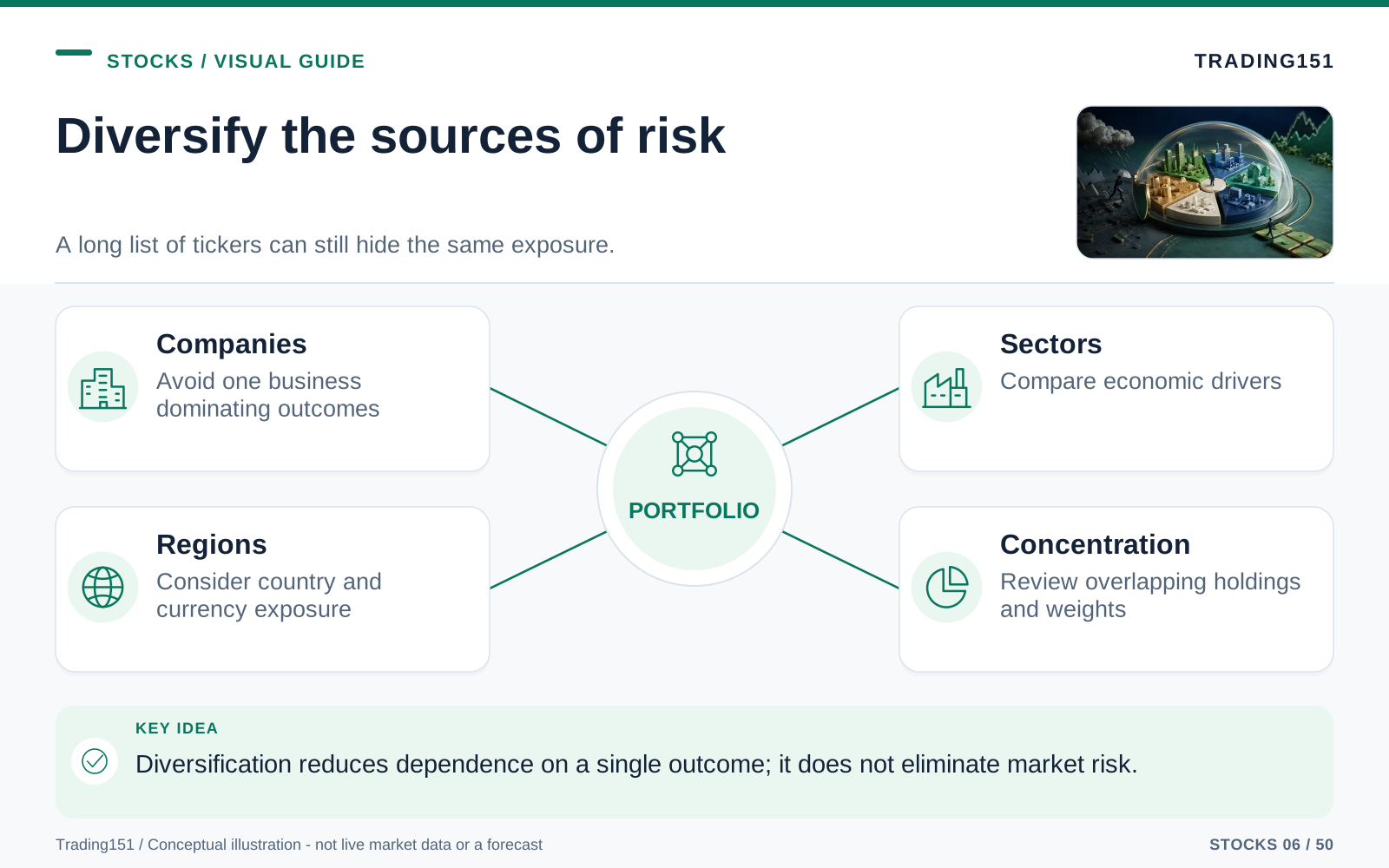
Read this diagram as text
- Companies
- Avoid one business dominating outcomes
- Sectors
- Compare economic drivers
- Regions
- Consider country and currency exposure
- Concentration
- Review overlapping holdings and weights
What Diversification Can and Can’t Do
Let’s get one thing straight right out of the gate: diversification isn't magic. It won't act as an invisible shield against every market drop. If the entire stock market crashes, a diversified portfolio will still take a hit. When sheer panic sets in, investors tend to sell everything they can get their hands on, dragging even the best companies down with the bad. Diversification mainly fixes unsystematic risk—a fancy term for the damage caused by one specific company, industry, or country going belly up. It can't magically erase broad market downturns, but over the long haul, it buys you survival. It removes single points of failure, meaning you don't have to be perfectly right about your predictions to still make money.
Will it make you the wealthiest person at a dinner party during a large bull market? Probably not. There's always going to be that one person bragging about betting their life savings on a random stock that went to the moon. They might even make your diversified portfolio look boring.
But boring is highly underrated in investing. Boring means you aren't relying on a miracle. Boring means you're still sleeping soundly when that hot stock inevitably crashes. Boring means your financial plan is built to withstand the real world.
The goal isn't to eliminate risk entirely. The goal is to avoid completely unnecessary, hyper-concentrated risk. You accept the normal ups and downs of the market, but you flat-out refuse to let one company’s unexpected lawsuit or one country’s recession ruin your life.
Step 1: Start With Your Real Life, Not the Market
When most people start investing, their first question is usually, "What should I buy?" It makes sense, but it’s the wrong starting point. The much better question is, "What is this money for?"
A portfolio isn't a trophy; it's a tool with a specific job. The right mix of investments for a 25-year-old building a retirement nest egg is completely different from a 35-year-old saving for a house down payment next year. What's smart for one person is reckless for the other.
Before you buy a single stock, be direct with yourself about these three things:
- When do I need this cash? This is your time horizon.
- How would I react if my account balance dropped by 30% tomorrow? This is your actual risk tolerance.
- Do I have an emergency fund? If you invest the money you need for rent, car repairs, or medical bills, you'll inevitably be forced to sell your stocks at the worst possible time just to stay afloat.
If you're investing for a goal that's decades away, market crashes are annoying but ultimately harmless. You have plenty of time for things to recover, and if you keep investing through the downturn, you're essentially buying stocks on a large discount.
But if you need that money in a year or two, a market drop is a disaster. Short-term cash doesn't belong in the stock market. Keep it in a high-yield savings account or a short-term CD where it might not grow as fast, but it’ll be there when you need to write the check.
Risk tolerance is the tricky part because we all think we're brave when the market is going up. The real test is whether you can resist hitting the "sell" button when the news is concerning and your account is bleeding red. A good portfolio is one you can comfortably stick with during the ugliest years.
Step 2: Build the Foundation With Asset Allocation
Before you even think about picking individual stocks, you need to decide on your asset allocation. That’s just industry jargon for figuring out how to divide your money between big categories like stocks, bonds, and cash. This breakdown is entirely dictated by when you need the money. Stocks offer the highest potential for growth, while bonds and cash act as your shock absorbers. You wouldn't build a three-year portfolio the same way you’d build a thirty-year portfolio, even if you really love the idea of high returns.
Think of these categories as having totally different jobs in your financial life:
- Stocks: The growth engine. When you buy a stock, you own a tiny slice of a real business. They are the best way to build wealth over the long haul, but they are notorious for wild price swings from year to year.
- Bonds: The stabilizers. A bond is essentially you lending money to a company or a government. They won't grow as fast as stocks, but they act like a parachute, softening the blow when the stock market dives.
- Cash and cash equivalents: Accessible reserves can help meet near-term expenses without selling stocks during a decline. Bank deposits and money market funds are different products: eligible deposits may have insurance within applicable limits, while investment funds do not automatically carry the same protection. Check access, fees, and the legal arrangement rather than assuming any cash-like holding guarantees a bill can be paid.
A classic, middle-of-the-road portfolio is often 60% stocks and 40% bonds. A young investor with decades to go might push that to 80% or 90% stocks. Someone nearing retirement—or someone who checks their portfolio every day and gets anxious—should lean far more conservative.
There is no universal "perfect" mix. The right allocation is the one that fits your timeline, your job stability, and your ability to keep cool when the market throws a tantrum.
Step 3: Diversify Inside the Stock Portion
Okay, so you've decided how much of your money is going into stocks. Now, how do you spread that around? Grabbing five random tech companies might feel like diversification, but if they all tank the moment interest rates rise, you haven't protected yourself at all. You have to look under the hood. For example, an S&P 500 fund and a total-market fund often share the same top holdings. If you add a tech-specific fund on top of that, you're just piling more money into the same handful of mega-companies you already own. A quick glance at the top ten holdings of any fund will usually tell you if you're doubling up.
True stock diversification happens across three main dimensions.
Sector: What the Company Does
The stock market is carved up into sectors—tech, healthcare, financials, energy, real estate, consumer goods, and so on.
Each one reacts differently to what's happening in the world. Tech stocks love cheap money and growth-hungry investors. Utilities offer safety when people get nervous. Consumer staples (the companies making toothpaste, toilet paper, and groceries) hold remarkably steady because people still need to brush their teeth during a recession.
If you go all-in on one sector, your portfolio is a glass cannon. A portfolio packed with software, social media, and AI companies might sound cutting-edge, but they are all vulnerable to the same economic headwinds.
Company Size: Large, Medium, and Small
You also want to mix up the size of the companies you own (often called market capitalization). This is just a fancy way of saying how much a company is worth.
- Large-cap companies: Think Apple, Microsoft, or Coca-Cola. They are large, global, and financially strong. They can still take a hit, but they rarely fold overnight.
- Mid-cap companies: The sweet spot in the middle. These are established companies that still have plenty of room to expand.
- Small-cap companies: These are the scrappy smaller businesses. They offer large growth potential, but they come with a much bumpier ride.
Large companies give you an anchor. Small companies give you a growth engine. You want a mix of both, rather than placing all your chips on today's giants or tomorrow's underdogs.
Geography: Where the Company Operates
It’s human nature to buy what we know, which is why most people heavily favor companies in their home country. (There's even a term for it: home-country bias.)
While there's nothing wrong with owning local giants, the world is a big place. Europe, Japan, India, Canada, and Australia are packed with massively profitable companies that have loyal customers and real growth.
International markets take turns leading the pack. One decade, U.S. stocks will dominate. The next, international markets will leave the U.S. in the dust. Currency shifts, political climates, and regional trends all play a part.
International holdings can reduce dependence on a single market, but the benefit depends on the companies and exposures selected. Currency, political, and regulatory risks remain, and businesses listed in different countries can still respond to the same global shock.
Step 4: Use Funds When Picking Stocks Becomes Too Much
If you're reading this and thinking, "This sounds like a full-time job," you aren't wrong. Trying to hand-pick enough individual stocks to cover every sector, size, and country is exhausting and completely unrealistic for most of us.
That’s where mutual funds and ETFs (Exchange-Traded Funds) come to the rescue.
Instead of buying one stock at a time, a fund lets you buy a large basket of them with a single click. One broad U.S. index fund might hold thousands of different companies. An international fund can give you instant exposure to dozens of countries at once. A total world stock fund basically lets you own a tiny slice of the global economy.
This is why index funds are the ideal for everyday investors. They are substantially simple, low-maintenance, and cheap. You aren't trying to guess which specific company will win; you're just betting that human progress will keep marching forward.
There's a really nice, quiet humility to this approach. You're admitting you can't predict the future, and realizing you don't need to. Why exhaust yourself looking for the needle when you can just buy the whole haystack?
Step 5: Keep Costs Low
Diversification is amazing, but high fees will quietly bleed your portfolio dry. A 1% or 2% management fee might sound like pocket change today. Over twenty or thirty years, however, that tiny fee will cannibalize a shocking amount of your total wealth.
This is another reason low-cost index funds and ETFs are so popular—they let you keep the money your money makes. Always check the "expense ratio" before buying a fund. Lower isn't the only thing to look at, but it’s a large factor.
And beware of the illusion of complexity. Some people collect mutual funds the way others collect kitchen gadgets. Having twelve different funds doesn't make you a better investor than someone with three. More often than not, it just leads to overlapping investments, higher fees, and a logistical headache.
Step 6: Add Money in a Way You Can Stick With
One of the biggest mental hurdles in investing is trying to time the market. People constantly ask, "Is today a good day to buy?" The direct answer? Nobody knows. The market can look substantially overpriced and keep soaring, or look like a bargain and keep dropping.
The best way around this is a trick called dollar-cost averaging. That’s just a technical way of saying: invest a set amount of money on a strict schedule, completely ignoring what the market is doing.
It’s not glamorous, but it works beautifully. When the market is booming, your fixed contribution buys fewer shares. When the market is in the gutter, your money automatically scoops up more shares on the cheap. Most importantly, it completely removes the anxiety of trying to guess the perfect moment to jump in.
It turns wealth-building into an automatic habit. And a "good enough" plan that you stick with for 20 years will absolutely destroy a "perfect" plan that you abandon the second things get scary.
Step 7: Rebalance Before the Portfolio Drifts Too Far
Even the perfect portfolio won't stay perfectly balanced on its own. Over time, parts of it will grow faster than others. A portfolio that started off as 70% stocks and 30% bonds might accidentally drift into 82% stocks after a really good year in the market. Without making a conscious decision, you suddenly took on a lot more risk than you planned.
Rebalancing is how you fix that. It just means tweaking your investments back to your original targets.
You can do this by selling off a little bit of the winners and buying more of the losers. Or, an even easier way (that avoids triggering capital gains taxes) is to just direct your new monthly contributions into whatever category is currently falling behind.
Psychologically, this feels totally backwards. Human instinct screams at us to buy more of the stuff that's going up and ditch the stuff that's dropping. But rebalancing forces you to do the smart thing: lock in your profits from the expensive assets and buy the cheaper ones while they are on sale.
You don't need to obsess over this. Checking in on your targets once or twice a year is plenty. You aren't aiming for absolute perfection; you're just making sure your portfolio still matches the rational plan you made when you were calm.
Common Diversification Mistakes
Diversification is simple in theory, but there are a few classic traps that catch a lot of smart people.
Mistake 1: Owning Many Investments That All Do the Same Thing
As we touched on earlier, holding ten different mutual funds doesn't automatically mean you're diversified. If they all mostly hold the same large U.S. tech giants, you’re just buying the same risk in ten different wrappers.
Before you add a new fund, ask yourself what job it’s doing. Does it cover a blind spot in your portfolio, or is it just a duplicate of what you already own?
Mistake 2: Letting One Stock Become the Whole Story
Sometimes you hit a home run. A single stock shoots up so much that it completely takes over your portfolio. This happens a lot with company stock options or a lucky early bet on a brand you love.
It’s totally fine to celebrate a win. But letting pride get in the way of risk management is dangerous. If a huge chunk of your net worth is tied up in a single ticker symbol, your entire future is at the mercy of one CEO's bad day, one product flop, or one unpredictable scandal.
Be especially careful with employer stock. If your paycheck and your life savings both rely on the same company, a bad quarter can cost you your job and your retirement at the same time.
Mistake 3: Confusing Familiar With Safe
We naturally gravitate toward brands we know. Buying stock in a company whose products you use every day feels inherently safer than dropping money into a faceless index fund.
But a familiar brand doesn't mean a safe stock. Iconic companies get disrupted, mismanaged, and overpriced all the time. A broad, boring fund might lack that personal connection, but it’s infinitely smarter than putting all your chips on a brand just because you happen to like their sneakers or their coffee.
Mistake 4: Selling During Panic
Diversification is a seatbelt, not a forcefield. There will absolutely be months—and sometimes years—where your account balance makes you feel sick to your stomach.
Selling in a panic turns a temporary, on-paper dip into a permanent, real-life loss. And if you cash out, you face an even harder decision: figuring out exactly when it’s "safe" to buy back in. Spoiler alert: by the time the news feels safe again, the stock market has usually already rebounded, and you missed the recovery.
A diversified portfolio should be planned with substantial adverse market periods in mind. Staying invested is useful only when the allocation and funding needs remain suitable; diversification is not a reason to ignore a genuine change in circumstances or an unaffordable risk.
A Simple Example of a Diversified Portfolio
There are endless ways to build a portfolio, but looking at a basic, real-world example helps demystify the whole thing. A sensible, long-term investor might set up something like this:
- U.S. stock market fund: This captures the growth of large, mid-sized, and small American businesses all at once.
- International stock market fund: This covers all the companies operating outside the investor's home country.
- Bond fund: This acts as the ballast, providing steady income and softening the blow when stocks inevitably stumble.
- Cash reserve: Money sitting safely aside for emergencies or short-term needs, completely untouched by market swings.
This isn't a strict recipe everyone must follow. The exact percentages depend heavily on your age, your risk tolerance, your income, and when you plan to retire. But it proves an incredible point: a world-class portfolio doesn't need to be complicated.
For the vast majority of people, three or four cheap, broad funds will substantially outperform a messy, stressful collection of hand-picked stocks and trendy investments they barely understand.
The Human Side of Diversification
We talk a lot about numbers, but investing is largely an emotional game. The most mathematically perfect portfolio on earth is completely useless if it makes you so anxious that you sell everything at the first sign of trouble.
Diversification is great for your net worth, but it’s even better for your mental health. When one part of your portfolio is falling, you can find comfort in the fact that another part is probably holding steady. It stops you from obsessing over a single bad earnings report or a concerning news headline.
It also frees you from the pressure of having to be a psychic. You don't need to predict which country will boom next year, or guess if small tech companies will beat large energy companies. You just buy a sensible mix of everything and let time do the heavy lifting.
Sure, it’s not thrilling. But building wealth shouldn't feel like an action movie. True wealth-building looks like patience, automatic deposits, low fees, occasional tweaks, and learning how to tune out the noise.
Look through the fund names to the underlying holdings
Suppose a portfolio holds a broad U.S. stock fund, a technology fund, and an individual technology company. If 50% of the portfolio is in the broad fund, which has a hypothetical 6% allocation to that company, the indirect exposure is 3%. Add a 20% position in a sector fund holding 10% in the same company, and another 2% appears. A direct 5% holding then brings the total to 10%, before any other overlap.
The numbers are illustrative, but the method is practical: multiply the portfolio weight of each fund by the company's weight inside it, then add the direct position. Apply the same reasoning to sectors and countries when useful. A portfolio can look varied on a brokerage screen while depending heavily on the same few businesses.
Include risks outside the investment account. Salary, bonuses, employer shares, a business you own, and local property can all be exposed to the same economic conditions. You may not be able to diversify every part of life, but recognizing the overlap can keep the investment portfolio from magnifying it unnecessarily.
Reviewing those exposures once or twice a year may be enough for a simple plan. The aim is not to remove every connection between holdings. It is to know which concentrations are intentional, which arrived unnoticed, and whether a setback in one area would force an unwanted sale in another.
Count the money outside the portfolio too
Investment risk does not stop at the brokerage account. A person's salary, employer shares, pension, property, and business interests may already depend on the same industry or region. Adding more of that exposure can increase concentration even when the securities account looks diversified on its own.
Consider the household as a whole when choosing an allocation. Someone employed by a technology company may need a different mix from someone whose income is unrelated to that sector. The aim is not to avoid every connection, but to recognize when one setback could affect both earnings and savings at the same time. 1, 2
A Portfolio Should Survive More Than One Story
Diversification isn't about being overly cautious; it's about being deeply realistic. No one knows exactly what the world will look like in ten years. We don't know which new technologies will dominate, which country will grow the fastest, when the next recession will hit, or which current trends will end up looking foolish in hindsight.
You should be able to look at your portfolio and instantly understand it. You should know what your main funds do, why you own them, and what specific risks you're taking on purpose. If your only explanation is "I bought all this stuff because the charts were going up," you don't have a plan yet—you just have a collection.
Expect certain parts of your portfolio to lag behind. When that happens, it doesn't mean your diversification is failing. In fact, it means it’s working exactly as intended. If everything you own is rising rapidly at the same time, it means they are all riding the same wave—and they will all crash together when that wave breaks.
Keep your investments broad, keep your fees low, and don't over-tinker. A diversified portfolio truly earns its keep on the days when your favorite prediction is dead wrong, the economy throws a curveball, and you realize you’re going to be just fine anyway.
Sources and further reading
Editorial revision: 7 October 2026. Numerical scenarios are hypothetical unless identified as historical. References support the added explanations and selected corrections; rules and product terms should be checked again before acting.