
A familiar brand can make a stock feel safer than it is. Blue-chip companies often have substantial operations, established customers, and long records, but size does not prevent overpayment, poor management, or a changing market. The label is a starting point for research, not a substitute for checking the business and its valuation.
Where the Term “Blue-Chip” Came From
You’d think the name has something to do with computer technology, but it comes straight from the poker table.
In old-school poker sets, the blue chips were worth the most. Back in the 1920s, Wall Street traders started borrowing the slang to describe high-priced, top-tier stocks. Oliver Gingold, a reporter for Dow Jones, usually gets the credit for making the term mainstream after he noticed certain stocks trading at substantial prices for the time.
The definition has evolved quite a bit since the roaring twenties. Today, just having a high stock price doesn't make a company a blue chip. It’s all about the quality of the underlying business: its sheer size, brand reputation, financial muscle, and proven ability to make money in both good times and bad.
Simply put, "blue-chip" is now just shorthand for a company that has nothing left to prove.
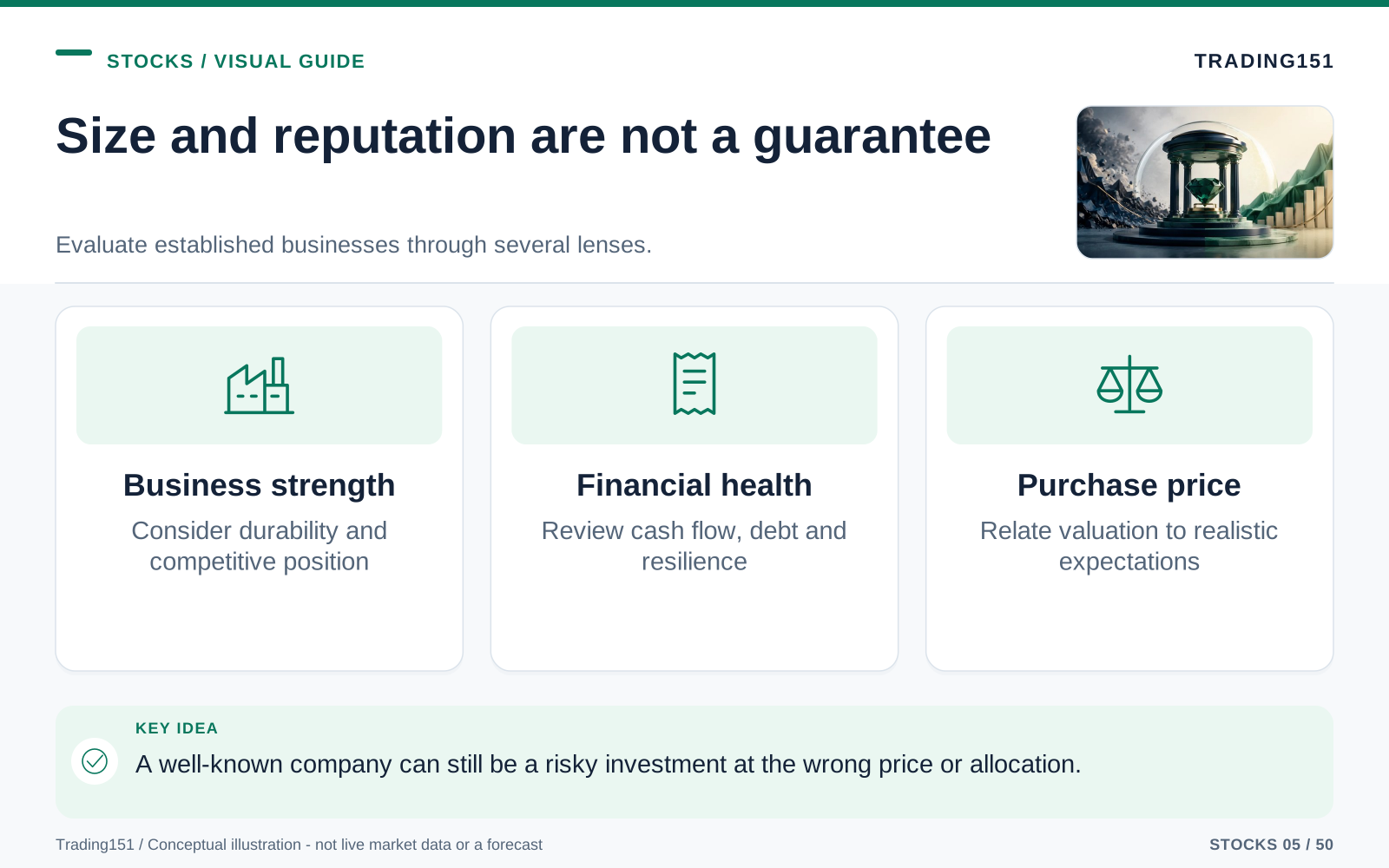
Read this diagram as text
- Business strength
- Consider durability and competitive position
- Financial health
- Review cash flow, debt and resilience
- Purchase price
- Relate valuation to realistic expectations
What Makes a Company a Blue-Chip?
There’s no official checklist or government agency that stamps a stock as a certified blue chip. It’s a title a company earns the hard way, usually over decades.
That said, the businesses that hold this title tend to have a lot in common. They’re large, widely known, financially resilient, and usually so ingrained in our daily lives that total chaos would erupt if they vanished overnight.
1. They Are Big Enough to Matter
We’re talking about companies with market caps in the hundreds of billions—sometimes trillions—of dollars. Being this big comes with serious perks that smaller rivals can only dream of. They have large global supply chains, serious bargaining power, fierce brand loyalty, and the financial cushion to survive a few bad quarters without facing bankruptcy.
Obviously, being big isn't everything. A giant company can still be horribly run. But when you combine large scale with smart leadership and a business model that’s been humming along for decades, you get a nearly unstoppable force.
2. Their Names Are Familiar for a Reason
Most blue chips are household names because you can't escape them. Think about your morning routine. You wake up and check your smartphone, buy a coffee with your credit card, use big-name software at work, and maybe order something online or stop by a large pharmacy chain on the way home. Without even trying, you’ve handed money to half a dozen blue-chip companies by noon.
That level of familiarity goes way beyond clever marketing. It’s a large competitive advantage. When a brand is that trusted, people keep buying its products even when the economy gets tough and money is tight.
3. They Have a Long Record of Earning Money
The best blue chips have been to hell and back. They’ve navigated recessions, housing crashes, supply chain nightmares, and shifting consumer trends. And they didn't just survive by getting lucky—they made it because their products were essential and their finances were rock solid. You really start to trust a company when you see its profits coming from dozens of different products and regions, rather than one lucky hit. If you want to know what a company is made of, look at how it handled its last crisis. Did it keep investing in itself? Did it manage its debt? Surviving is great, but how it survived tells you a whole lot more.
This track record is a big deal because investing isn't just about promises for the future. It's about what a company has already proven it can handle. A business that kept printing cash through a global financial crisis deserves a lot more respect than a startup that’s only ever known a booming economy.
4. Many Return Cash to Shareholders
If there's one thing investors love about blue chips, it's that they tend to share the wealth, usually through dividends or stock buybacks. Dividends are straight cash deposited into your account. Buybacks are when a company buys its own shares off the market, making your remaining shares represent a bigger piece of the pie. They do different things. Dividends are a highly visible promise that executives rarely want to break, while buybacks are quieter and really only work well when the stock is cheap. If a blue chip buys back its own stock when the price is sky-high, it's just burning cash.
A history of paying and increasing dividends can be evidence of durable cash generation and a commitment to shareholder distributions. It does not show that payments can continue under every future condition. Check the payout alongside free cash flow, debt obligations, reinvestment needs, and the company's ability to absorb a downturn.
That steady income is exactly why retirees and conservative investors flock to these stocks. They get to own a piece of a great business and collect a reliable paycheck that often grows over time.
Why Investors Are Drawn to Blue-Chip Stocks
People flock to these heavyweights for a bunch of reasons. Some want the dividend checks. Others want long-term growth without the gut-wrenching volatility of betting on startups. Some just want to buy a business they understand. But if you dig down, it all points to one thing: a craving for stability.
Let's face it, the stock market is deeply emotional. Prices swing substantially based on interest rates, political drama, inflation, or just raw fear and greed. When the market feels like a rollercoaster, holding companies that quietly keep making money makes the whole experience a lot less stressful.
The Comfort of Owning Real Businesses
There is something grounding about knowing you own a fraction of a business that makes physical things, serves actual people, and has been doing it for ages. When a hyped-up tech startup crashes, investors usually have nothing left to cling to but hope. When a blue chip drops, it stings, but you know the company is still out there shipping packages, filling prescriptions, or selling toothpaste.
That mental difference is huge. Being a good investor isn't just about reading spreadsheets; it’s about managing your own psychology so you don't panic-sell at the bottom. Blue chips help you sleep at night, making it far easier to hold on when the market gets ugly.
Dividends Can Make Returns Feel More Tangible
Watching a stock ticker bounce up and down on a screen can feel like playing a video game. Dividends make it real. It's actual cash hitting your brokerage account every few months. You can use that money to pay bills, or, even better, use it to buy more stock.
Reinvesting those dividends is where the real magic happens over time. Each new share you buy pays its own dividends, which buys even more shares. It’s a slow, unglamorous process that won't make you rich overnight, but over a couple of decades, that snowball effect becomes large.
They Can Reduce Portfolio Stress
Now, they are still stocks. They will absolutely drop in value during a market crash. They aren't savings accounts or government bonds. But compared to newer, smaller companies, blue chips are built like tanks.
When investors get spooked, they tend to pull their money out of risky assets and hide in quality companies. Businesses with giant cash piles and essential products suddenly look very attractive when the rest of the market is panicking. Owning them won’t prevent you from losing money on paper, but it definitely cushions the blow.
Blue-Chip Does Not Always Mean Boring
These stocks have a bit of a reputation for being a snooze-fest, and sometimes that’s fair. A conglomerate that sells detergent, soap, and toilet paper is never going to sound as thrilling as a startup building rockets or AI brain implants.
But in the investing world, "boring" is hardly an insult.
Boring usually means predictable. It means profitable. It means the company doesn't need interest rates to drop to zero just to stay afloat. It means everyday people are buying their stuff whether Wall Street is booming or crashing.
That being said, not every blue chip is a slow mover. Some of the biggest tech giants in the world are blue chips. They are massively profitable monopolies that still have plenty of room to invent new things and grow. The line between a "growth stock" and a "blue chip" is a lot blurrier than it used to be.
A business can be fully established and still hungry for more. The trick is figuring out if their future plans are built on a solid foundation, or just a really good sales pitch.
The Hidden Risk: Paying Too Much for Quality
One of the easiest traps to fall into is assuming that a fantastic company is a fantastic investment at any price. When a company is this widely loved, the stock can get crowded. People start treating it like a high-yield bond or an invincible winner, pushing the price so high that even if the business performs perfectly, the stock's returns are mediocre. You always have to look at the current price tag compared to its historical averages, and ask yourself if changing interest rates or slower growth justify paying a premium.
Ignoring the price tag just isn't grounded in reality.
A truly wonderful business can be a terrible investment if you overpay for it. If everyone is obsessed with a stock, its price might shoot way past what the company’s actual profits can justify. When that happens, the company might keep growing its earnings, but the stock price might trade sideways for a decade because all that future growth was already priced in.
This is why valuation is so critical. A blue chip might be a safer business, but it isn't immune to basic math. Buying a great company at a fair price is investing. Buying a great company at an astronomical price is just speculating.
Quality is important, but price is what determines your return.
The Risks Investors Should Not Ignore
Large, established businesses may offer more diversified operations or access to finance than smaller companies, but blue-chip status is not a reliable guarantee of lower investment risk. Valuation, leverage, concentration, and changes in the business still matter. A well-known company can suffer a permanent loss of value.
1. Big Companies Can Still Lose Their Edge
Corporate history is a graveyard of "invincible" companies that got comfortable and died. Some ignored the internet. Some misunderstood what their customers wanted. Others tried to do too many things at once and forgot what made them great in the first place.
Having a blue-chip reputation can lull investors into a false sense of security. It’s easy to assume that because a company has dominated for 50 years, it will dominate for 50 more. But capitalism is severe. If a younger, faster competitor builds a better mousetrap, customers will jump ship. If management gets lazy, the margins will shrink. Yesterday’s undisputed champion can easily become tomorrow's cautionary tale.
2. Dividends Can Be Cut
A long streak of paying dividends is great, but it’s not a legally binding contract. If a company hits a wall, takes on too much debt, or sees its profits vanish, the dividend is often the first thing on the chopping block. And for folks relying on that money for retirement, that cut hurts.
Before you buy a stock just for its dividend, you need to check if they can afford it. A sky-high dividend yield might look like a great deal, but often it’s a huge red flag. Usually, a yield gets that high because the stock price has tanked, and the market is placing bets that a dividend cut is right around the corner.
3. Slow Growth Can Feel Frustrating
There will be times when holding blue chips feels boring, especially when the rest of the market is booming. During a large bull run, you might watch highly speculative tech stocks double in a month while your solid, reliable business creeps up by 2%. It tests your patience.
This is where your temperament comes into play. If your true goal is building lasting wealth, you have to be okay with sitting on the sidelines while other people brag about their risky bets. Investing in blue chips isn’t about hitting the jackpot on Tuesday. It’s about staying in the game for decades and letting compound interest do the heavy lifting.
4. Economic Conditions Still Matter
No company operates in a vacuum. Interest rates, inflation, supply chains, government regulations, and currency exchange rates impact the giants just as much as the little guys. A fantastic business isn't immune to a bad economy; it’s just better equipped to survive it.
When interest rates rise, some investors may compare dividend yields with the contractual income available from government bonds. Bonds have their own credit, inflation, and market-price risks, especially if sold before maturity. Inflation also affects companies differently: some can raise selling prices, while others face weaker demand or costs that rise faster than revenue.
Different Types of Blue-Chip Stocks
It’s a mistake to group all blue chips into one basket. They behave very differently depending on what they do.
Defensive Blue-Chips
These are the companies selling things you can't live without. Think toothpaste, groceries, electricity, and prescription meds. They rarely grow at a breakneck pace, but their revenue barely flinches during a recession because people still have to wash their clothes and turn on the lights.
Cyclical Blue-Chips
These businesses are strong, but their fortunes are tied directly to the economy’s mood. We’re talking about large banks, automakers, airlines, and luxury fashion houses. When the economy is booming, they print money. When a recession hits, they take a beating.
Technology Blue-Chips
The biggest, most cash-rich companies on the planet today are in tech. They offer explosive growth, but they also have to deal with vicious competition, government anti-trust probes, and the constant pressure to invent the next big thing. Being a trillion-dollar company buys you a lot of power, but it doesn't make you untouchable.
Dividend Blue-Chips
Many investors specifically hunt for blue chips with decades-long streaks of raising their dividends. They’re fantastic for building compounding income, but you can't just blindly trust the streak. You always have to look under the hood to ensure the business is still generating enough real cash to keep those checks coming.
How to Invest in Blue-Chip Stocks
When it comes to getting these stocks into your portfolio, you generally have two choices: pick the individual companies yourself, or buy a fund that holds a bunch of them for you.
Buying Individual Stocks
Picking your own stocks puts you in the driver’s seat. You get to decide exactly which businesses you want to own and how much money goes into each one. If you enjoy diving into financial statements and researching corporate strategies, this can be rewarding.
The catch? It’s a lot of work. You have to keep tabs on earnings reports, debt levels, valuations, and management changes. You also have to build your own diversification. Just buying Apple and Coca-Cola doesn't make a well-rounded portfolio.
And if one of your hand-picked companies gets hit with a large scandal or disruption, your portfolio is going to feel the pain. Being a blue chip might lower the odds of a total collapse, but it doesn't eliminate the risk of a single stock burning you.
Buying Index Funds or ETFs
For the vast majority of people, funds are just the smarter, easier way to go. By buying a broad index fund or an Exchange-Traded Fund (ETF), you can own tiny slices of hundreds of top-tier companies with a single click. You don’t have to guess which specific stock is going to win out over the next ten years; you just buy all of them.
Funds completely remove the psychological burden of stock picking. You don't have to stress over a bad quarterly earnings call or wonder if a CEO’s resignation spells doom. Spreading your bets handles all that risk for you.
Since most big market indexes are weighted by size, buying a standard S&P 500 fund automatically gives you heavy exposure to the biggest blue chips. But if you want to get specific, there are plenty of ETFs out there dedicated solely to dividend aristocrats or established mega-cap value stocks.
What to Look For Before Buying
Whether you're picking a single stock or evaluating a specialized ETF, you need to know what a healthy company looks like. Just seeing the phrase "blue chip" should be the start of your homework, not the end.
Financial Strength
You want to see cash flow that goes up smoothly, and debt levels that aren't concerning. A pristine balance sheet gives a company the flexibility to survive a nasty recession, keep paying its dividend, and maybe even buy up weakened competitors while everyone else is panicking.
Competitive Advantage
Wall Street calls this a "moat." A great business has something that competitors find nearly impossible to replicate. It could be an iconic brand, a large distribution network, crucial patents, or sheer economies of scale. If a company doesn't have a moat, it’s only a matter of time before someone cheaper and faster eats their lunch.
Reasonable Valuation
Don’t let your love for a brand override your common sense. Compare the stock’s price tag to the actual money it makes. Look at its historical price-to-earnings ratios and compare it to its peers. You don’t need to time the market perfectly to catch the absolute bottom, but you definitely want to avoid buying a stock just because the logo feels safe.
Shareholder-Friendly Management
The people running the show matter. You want a leadership team that knows how to allocate capital. They shouldn't be piling on reckless debt or setting money on fire with terrible acquisitions. Good management invests in the future while clearly communicating their strategy to the people who own the stock—you.
Long-Term Relevance
Ask yourself one severe question: "Will people still care about this company in 20 years?" Nobody has a crystal ball, but asking it forces you to think past the current hype cycle. A true blue chip shouldn't just have a glorious past; it needs a highly believable future.
How Blue-Chips Fit Into a Portfolio
How much of your money should be in blue chips really depends on your age, your risk tolerance, and what you’re trying to achieve. And remember, just because you own five famous companies doesn't mean you're safely diversified. If you own five giant tech brands, they might all crash together when regulations change. Real diversification means spreading your money across entirely different industries.
If you're young, blue chips can serve as the reliable anchor of your portfolio, giving you a steady base while you take bigger swings with small-cap growth stocks or emerging markets. If you’re retired, you might lean almost entirely on dividend-paying blue chips and conservative funds to generate a safe monthly income. If you're somewhere in the middle, you’ll probably want a mix: enough stability to sleep well, and enough growth to outpace inflation.
It’s all about finding a balance you can live with. A portfolio made of 100% wild tech startups will age you prematurely. A portfolio made of only slow-moving utility companies might not grow fast enough to fund your retirement. Blue chips are there to keep you grounded when the rest of the market loses its mind.
Common Mistakes to Avoid
Assuming Famous Means Safe
Never confuse brand recognition with financial safety. Beloved brands go bankrupt. Consumer tastes shift. Debt spirals out of control. Always look at the actual math of the business, not just how nice their commercials are.
Chasing the Highest Dividend Yield
Seeing a 9% dividend yield might make your eyes light up, but it’s often a trap. Usually, a yield is that high because the stock price is in freefall and investors are betting the dividend is about to be slashed. You are almost always better off taking a smaller, safer dividend from a thriving company than a large payout from a dying one.
Ignoring Diversification
Buying Apple, Microsoft, Amazon, Google, and Meta does not mean you are diversified. Yes, they are all blue chips, but they are all exposed to the same sector risks. True safety comes from spreading your bets across completely different parts of the economy.
Buying Without a Plan
Blue chips are buy-and-hold investments. If you buy one without a clear idea of why you own it, or what specific event would make you sell, you’re going to panic when the price inevitably drops. Write down a simple plan before you buy. It’s the best defense against your own emotions.
Are Blue-Chip Stocks Right for Beginners?
For someone just dipping their toes into the market, blue chips are an amazing place to start. They are infinitely easier to wrap your head around than obscure cryptocurrency derivatives or deeply indebted micro-cap stocks. You can read their reports, walk into their stores, and physically see how they make their money.
That doesn’t mean a total beginner should just blindly throw cash at random famous tickers. Buying a broad S&P 500 index fund is still the smartest first move for almost everyone. But researching individual blue chips is a fantastic educational tool. It teaches you how to evaluate a moat, understand valuations, and think like a long-term business owner.
In a lot of ways, they aren’t just investments—they are the perfect case studies for how great businesses are built.
Stress-test the business behind the familiar name
Take a fictional established manufacturer with steady sales, a recognizable brand, and a long dividend history. Ask what happens if operating profit falls by 25% for two years. Can cash flow still cover essential investment and interest? Does a large debt refinancing fall in that period? Would maintaining the dividend require borrowing or selling assets?
That exercise can reveal more than a reassuring record of annual payouts. A dividend is a decision made with the resources available at the time. Past increases tell you something about history and policy; they do not bind a future board to keep paying through financial strain. The business's capacity to fund the payment matters more than the prestige of the streak.
Then examine the price separately. A durable company can still disappoint an investor who pays for growth that does not arrive. Compare the valuation with reasonable earnings and cash-flow scenarios, including an unexciting one. You do not need to predict a crisis to ask whether the current price leaves room for ordinary setbacks.
Finally, check your exposure beyond the direct holding. A company you buy separately may already be a large position in an index fund or an employer share plan. Familiarity can quietly become concentration. Owning a respected business is easier to defend when its weight in the portfolio does not require it to remain exceptional forever.
Familiarity is not diversification
A portfolio of well-known brands can still depend on a narrow set of conditions. Several companies may rely on the same consumers, financing markets, suppliers, or currency. The names look different while the economic exposure overlaps. Read the segment and geographic disclosures, then ask what would happen to the group under the same adverse event. Brand recognition helps explain what a business sells; it does not establish how well the holdings complement one another. 1, 2
Durability Deserves Respect, Not Blind Faith
Blue-chip stocks aren’t magic. They won't shield you from a major stock market crash, and they certainly aren't going to turn a thousand bucks into a million by next week. They can stall out, cut their dividends, or slowly fade away if leadership drops the ball.
But if you choose them carefully, they are the most reliable building blocks you can find in the financial world. They represent businesses with the scale, cash, and sheer stubbornness to do the one thing you need an investment to do: consistently make money.
Loading your portfolio with blue chips gives you a sturdy foundation. It’s perfect for anyone who wants reliable growth and income without having to research a brand-new, highly volatile industry every weekend. Just make sure that comfort comes from looking at their actual balance sheets and competitive strength, rather than just recognizing their logo.
You still have to view these giants with a healthy dose of skepticism. Keep an eye on their debt, see if they are reinvesting in themselves, and make sure they aren't grossly overvalued. A glorious 100-year history is a great selling point, but it doesn't make a stock immune to a bad year.
The truly great blue chips don't just rest on their laurels. They adapt, fiercely protect their customers, and spend their cash wisely. If you buy them at a fair price and hold them in a well-rounded portfolio, that kind of quiet, boring durability is worth far more than whatever trendy stock the market is obsessing over today.
Sources and further reading
Editorial revision: 7 October 2026. Numerical scenarios are hypothetical unless identified as historical. References support the added explanations and selected corrections; rules and product terms should be checked again before acting.