
Leaving Bitcoin on an exchange means relying on the service's custody, controls, and ability to honor withdrawals. The balance displayed in an account is not the same as independent control of the keys. Self-custody removes some intermediary risks but creates different responsibilities for backup and security. The choice deserves a practical assessment rather than a slogan about either convenience or personal control.
The "Crypto Bank" Illusion
People don't leave their coins on exchanges out of laziness. They do it because everything in their financial life has trained them to.
Most of us grew up outsourcing custody without a second thought. Your paycheck goes into a bank account. A brokerage holds your retirement savings. Your debit card works because some payment network is quietly vouching for it behind the scenes. Handing your money to an institution is just... Normal.
And in traditional finance, that trust comes with something backing it up. Deposits are often insured to a certain limit. There are consumer protections on the books in most places. If something goes sideways, there's usually a legal framework spelling out who's on the hook. The system is far from perfect — it can be slow, bureaucratic, occasionally maddening — but it has layers built in that people have learned, rightly or wrongly, to lean on.
Crypto exchanges have gotten very good at borrowing that same sense of safety. Slick branding. Former regulators on the payroll. Stadium sponsorships. Ads that talk about "security" in the same confident tone a bank would use. Every part of the experience is engineered to feel like you're dealing with a serious financial institution.
But it isn't one.
When you send Bitcoin to an exchange, you're handing a private company control of that asset. It notes down that it owes you a certain amount, and your dashboard reflects that IOU. Unless you personally hold the private keys, you can't move those coins on your own — you can only ask the exchange to do it for you, and hope it says yes.
That gap between "owning" and "being owed" barely registers when everything's running smoothly. It becomes the only thing that matters the moment something breaks.
If an exchange goes insolvent, freezes withdrawals, gets hacked, or files for bankruptcy, that balance in your app can turn into something close to meaningless overnight. Customers usually end up as creditors, standing in line behind secured lenders, lawyers, and restructuring firms, all fighting over whatever's left. Even in the best-case outcomes, getting anything back can take years — and what finally arrives is often a fraction of what people thought they had.
The convenience was real. So was the risk you were quietly taking on the whole time, whether you noticed it or not.
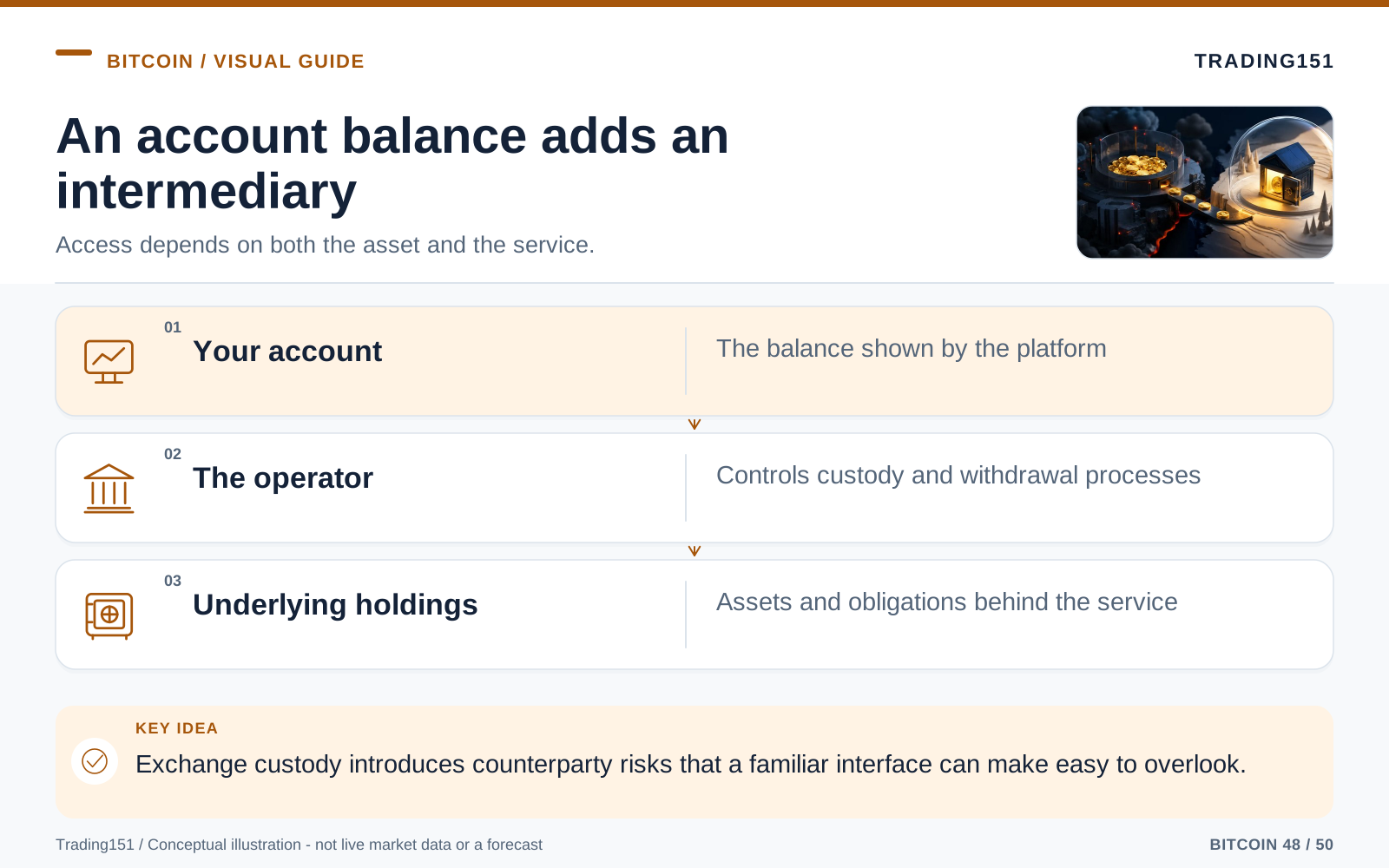
Read this diagram as text
- Your account
- The balance shown by the platform
- The operator
- Controls custody and withdrawal processes
- Underlying holdings
- Assets and obligations behind the service
A Number on a Screen Isn't the Same Thing as Bitcoin
What makes exchange custody so dangerous is precisely how invisible the danger is. You open the app, see a balance, watch it move with the market. Everything about it feels alive and real. Nothing in that interface hints that what you're looking at might just be a promise. Technically, an exchange balance is a liability owed to you — it isn't truly yours until a withdrawal lands in an address you control. The company behind it might be holding matching assets one-for-one. Or it might be lending some of them out. Or there might be a gap buried somewhere in the internal books that nobody outside the company can see. You, as a customer, generally have no way to tell the difference. A smooth-running app proves the website works — it doesn't prove every dollar owed could be paid out at once. That distinction disappears in calm markets and reappears, suddenly and violently, the moment a lot of people try to withdraw at the same time.
Ownership of Bitcoin was never meant to be decided by whose name is printed on an app screen. It's decided by who can produce the cryptographic signature needed to move coins on the blockchain — and that ability lives entirely in the private keys.
If the exchange holds those keys, the exchange is the one who can move the coins. Not you. You can click "withdraw," sure, but between that click and the Bitcoin network sit the company's systems, its policies, its available liquidity, its compliance team — an entire stack of things you don't control.
This isn't a fine print detail. It's the whole question custody boils down to: do you own the asset outright, or do you own a claim against a company that says it's holding the asset for you?
Nobody thinks about that difference when markets are calm. Everybody thinks about it during a crisis.
Exchanges Make an Irresistible Target
There's a common defense for leaving coins parked on an exchange: "a big exchange has way better security than I could ever build myself." And that's not wrong — large platforms run real security teams, use cold storage, monitor for anomalies, and build defenses no individual could match on their own.
But security isn't only about how strong the lock is. It's also about how much is sitting behind the door.
A person keeping Bitcoin at home might be worth robbing. A major exchange is a walk-in vault holding billions of dollars. For hackers, organized criminal groups, even state-backed actors, that's not just a tempting target — it's basically an open invitation.
And crypto's history is packed with reminders that "trusted" platforms fail too.
- Mt. Gox: once handled the majority of all Bitcoin trades on earth, then collapsed after losing a staggering chunk of customer funds — the first gut-punch lesson in custodial risk for an entire generation of early holders.
- Bitfinex: lost nearly 120,000 Bitcoin to hackers back in 2016, rattling confidence across the whole market at the time.
- Coincheck: had hundreds of millions of dollars in NEM tokens stolen in 2018, proving this problem was never limited to Bitcoin alone.
- QuadrigaCX: descended into chaos after its founder reportedly died while — allegedly — being the only person who could access the exchange's wallets. Users never really got a straight answer about what happened.
Every exchange insists it's learned from the ones that came before it, and to be fair, plenty have improved. But the underlying incentive hasn't changed one bit: pile enormous value into a single place, and someone will spend every day trying to find the crack.
Sometimes that crack is bad code. Sometimes it's a hot wallet left connected to the internet. Sometimes it's one employee who clicks the wrong phishing link. Sometimes it's a contractor, a leaked API key, a sloppy internal process, or just an ordinary human mistake that nobody catches in time.
Keep your Bitcoin on an exchange, and you're effectively betting that every layer of that company's security holds — not just today, but next month, next year, and every year after. No slip-ups, no shortcuts, no misconfigurations, no successful attacker, ever.
That's an enormous amount of faith to place in a company you probably only know through an app icon.
Sometimes the Threat Isn't a Hacker — It's the Company Itself
For a long time, most crypto users were mainly worried about outside attackers. Then a string of platform collapses revealed something scarier: sometimes the danger is already inside the building.
FTX is the case everyone points to now. This wasn't some sketchy site with broken English hiding in a corner of the internet — it was one of the biggest, most trusted names in the entire industry, backed by celebrities, politicians, and top-tier venture capital, run by a founder plenty of media outlets practically anointed as a financial genius. And yet money that customers believed was just sitting safely on the platform had been funneled into risky trades, leverage, and a tangle of internal obligations nobody outside the company understood. Once confidence cracked and everyone rushed for the exit at once, there simply wasn't enough liquid money left to hand back.
That's the true nightmare scenario in custodial crypto: you log in, the numbers are still sitting there exactly like before, but the money behind them is gone. The dashboard turns into a ghost — it shows what you're owed, not what you can get your hands on.
FTX wasn't an isolated case, either. Celsius, Voyager, BlockFi — all of them exposed customers to the same severe lesson in counterparty risk. Several marketed themselves as safe places to earn yield, borrowed the language of banking, and offered none of the protections people associate with a bank. A lot of users only learned what "deposit" really meant once it was too late.
The underlying lesson here is simple, even if it's uncomfortable: when a company controls your coins, you're not just trusting its cybersecurity. You're trusting its accounting, its leadership, its risk management, its lawyers, its internal controls — and, ultimately, its honesty. You're betting it isn't quietly doing something reckless with money you think of as yours.
Proof of Reserves Helps — It's Not a Magic Fix
After enough exchanges collapsed, the industry started talking a lot about transparency. Some platforms now publish proof-of-reserves reports to show they hold the assets they claim to. That's a genuine improvement over blind trust. It is not, however, the same thing as self-custody.
A reserve snapshot can confirm that certain addresses held certain assets at one specific moment, and, if the liability accounting behind it is done properly, that your balance was counted in that total. What it can't show you is whether the company also owes money elsewhere, has pledged those same assets as collateral somewhere else, or briefly borrowed funds just to look good for the audit. Reserves are only half of the solvency equation. Real assurance needs recurring checks, verified ownership of the wallets involved, honest liability accounting, and governance strong enough to stop insiders from quietly moving assets right after the report gets published.
In other words: a proof-of-reserves snapshot might tell you what was in certain wallets on a certain day. It won't tell you about undisclosed loans, encumbered assets, or whether your withdrawal will go through tomorrow.
These transparency tools reduce risk. They don't eliminate the core problem, which is that you're still depending on somebody else to hold the keys.
Self-custody sidesteps the whole question. You're not stuck wondering whether a company is solvent — you can verify your own wallet, see your coins sitting right there on the blockchain, and move them whenever you want without waiting on anyone's approval.
Frozen Accounts and the Choke Point Nobody Talks About
Even an exchange that's honest, solvent, and well-run is still, a centralized business. That means it has to answer to laws, sanctions rules, internal compliance policies, all of it. Some of that oversight is fair enough — an exchange plugged into the banking system can't just ignore the legal world around it.
But for users, that creates a separate risk entirely: your account can simply be frozen.
Sometimes it happens for legitimate reasons. Sometimes an automated system flags something incorrectly and locks you out for no real reason at all. Maybe a withdrawal address gets tagged as risky. Maybe logging in from a new country triggers a review. Maybe a large transfer looks "unusual," or your name partially matches an entry on some sanctions list somewhere. Suddenly you're being asked for more documents, more selfies, more proof of where your own money came from.
Anyone who's ever fought with an automated customer support bot knows exactly how helpless that feels. Now picture that same helplessness, except it's not a delayed package or a canceled subscription — it's your savings.
There's a bigger political dimension too. When a centralized company holds your funds, governments can lean on that company directly. They can order freezes, block entire regions, enforce sanctions, or impose restrictions that would be flatly impossible at the protocol level. The exchange becomes a gatekeeper standing between you and your own money.
Bitcoin's entire pitch was permissionless ownership — nobody should need a bank's blessing, or a payment processor's sign-off, just to hold or send value. But if your coins never actually leave the exchange, you're still living inside a permissioned system. You bought an asset built for freedom and then stored it somewhere that someone else can still say no.
Withdrawals Tend to Fail at the Worst Possible Moment
Here's a risk that sounds a lot less dramatic than fraud or hacking, but hits people just as hard in practice: exchanges tend to buckle under pressure exactly when you need them most.
Crypto markets move fast — a sudden crash, a big liquidation cascade, a surprise regulatory headline, an ETF announcement, a stablecoin scare, even a huge rally can send everyone rushing to trade or withdraw at the same time. That's the exact moment platforms get tested.
And, all too often, that's exactly when the error messages start showing up.
The app freezes. The login page won't load. Withdrawals slow to a crawl. Certain trading pairs get "temporarily suspended." Support goes silent. And somewhere in there, a cheery little banner pops up mentioning "elevated traffic" or "temporary technical difficulties."
Those words sound harmless right up until it's your money stuck behind them.
Maybe you wanted to sell into a rally and missed your price entirely. Maybe you were trying to get your coins out during a panic and instead spent an hour refreshing a page while rumors flew. Maybe you needed that money for something real, and the exchange's outage just became your emergency.
Self-custody won't shield you from network fees or volatility — nothing does. But it removes one very fragile dependency: you don't need a website, an app, a withdrawal desk, or anyone's risk team to grant you permission to use the Bitcoin network.
The Quiet Cost of Convenience
Convenience isn't neutral. It shapes how you behave, usually without you noticing.
When your coins live on an exchange, trading is one tap away, and that frictionlessness is a double-edged sword. It's handy for active traders, sure, but it also nudges long-term holders toward impulsive decisions they wouldn't otherwise make. One red candle and suddenly you're panic-selling. One random token pumps and you're rotating into it on a whim. The leverage button just sits there, glowing like a slot machine lever. The exchange makes more money when you trade more — not when you quietly hold.
Self-custody adds a small amount of friction back into the process, and that friction is a feature, not a bug. You have to open a wallet, double-check an address, confirm the transaction, and own the decision. For someone holding Bitcoin long-term, that little bit of resistance is healthy — it's what turns Bitcoin from a gambling chip into actual savings.
That psychological shift gets underrated constantly. Coins sitting on an exchange feel like part of the market's noise. Coins in your own wallet feel like they belong to you.
Self-Custody Is the Whole Point
The answer here isn't to panic. It's to use Bitcoin the way it was designed to be used.
Self-custody just means holding your own private keys. Instead of leaving coins under an exchange's control, you move them to a wallet where you — and only you — hold the signing authority. No company can lend them out, freeze them, lose them in a bankruptcy filing, or simply deny your withdrawal request, because there's no company standing between you and your coins anymore.
For any meaningful amount of Bitcoin, a hardware wallet is generally the best place to start. It's a small physical device built to keep your private keys offline — companies like Trezor, Ledger, and Coldcard make devices designed for exactly this. The logic is simple: even if your laptop gets compromised, the private key itself never has to leave the secure hardware.
Setting one up gives you a recovery phrase, usually 12 or 24 words. This isn't a password you can casually reset — it's the master backup for your entire wallet. Whoever holds those words can recover and spend the funds. Lose them, and you may lose access forever.
That's exactly why self-custody demands some care. Don't email the phrase to yourself. Don't photograph it. Don't paste it into a notes app, and definitely don't type it into some website claiming it needs to "verify" your wallet. Write it down by hand, protect it from fire, water, and theft, and make sure someone you trust has a sensible plan for it if anything happens to you.
It can feel intimidating at first, especially coming from a world of password resets and support tickets. Bitcoin doesn't work that way — there's no hotline to call if you make a mistake, no customer service rep who can reverse a bad transaction or magically restore a lost seed phrase. Self-custody hands you real power, but it also asks you to grow up a little, financially speaking.
That responsibility isn't a design flaw. It's the tradeoff that makes actual ownership possible in the first place.
How to Move Your Coins Off an Exchange
If you've never withdrawn Bitcoin before, it's normal to feel a little nervous about it. You don't need to move everything in one shot. Start with a wallet you've already recovered successfully from its backup, just to prove to yourself the backup works. Double-check the receive address right on the signing device itself, send a small test amount, wait for confirmation, and if you're feeling cautious, send a bit back the other way just to see the full round trip in action. Once you trust the process, move the rest over in a few sensible batches rather than rushing it all at once under pressure. Keep records of what you send and when — useful for taxes, and for whoever might need to sort things out after you're gone. This isn't meant to be some dramatic, one-time escape from the financial system. It's a controlled handoff of responsibility that you've already practiced.
Buy a hardware wallet directly from the manufacturer or an authorized retailer — never secondhand, never pre-configured by someone else. Set it up somewhere quiet, without distractions. Write the recovery phrase down by hand and confirm the backup works before you trust it with real money. Get comfortable with how receiving addresses function. Then send a small test withdrawal from the exchange first.
Once that test transaction arrives and you understand exactly what just happened, send the rest over in one or more additional transfers. Check every address carefully before confirming. Use address whitelisting on the exchange if it offers it. Keep good records. There's no prize for rushing.
None of this requires becoming a cybersecurity expert overnight. It just requires no longer treating an exchange account like a permanent vault.
For small amounts, keeping coins on an exchange for convenience can be a perfectly reasonable choice. Active traders may need exchange balances as part of doing business. But for real long-term savings — the kind of money that would hurt to lose — self-custody should be the default, not the afterthought.
Exchanges Are Tools, Not Homes
None of this makes every exchange some kind of scam. Plenty of them provide useful services — they make buying Bitcoin easy, they supply liquidity, they help people get in and out of the market. A healthy crypto ecosystem needs reliable on-ramps and off-ramps to function at all.
The mistake is treating those platforms as though they were built to be your personal vault.
An exchange is closer to an airport than a house. You pass through it on your way somewhere else. You might spend some time there, you might need its services — but you don't leave your most valuable belongings sitting in a plastic chair by the gate and assume they'll still be there in ten years.
Use exchanges for what they're good at: buying, selling, trading, moving. But once the goal shifts to holding for the long haul, the right question stops being "which exchange do I trust the most?" It becomes "why am I trusting an exchange at all?"
The relevant balance is the one you can legally and practically recover
Read the customer agreement for ownership, segregation, permitted use of assets, and the treatment of insolvency. A platform's claim to hold reserves does not by itself establish the full amount of its liabilities, the legal status of customer claims, or the absence of other obligations. Technical evidence of some assets is not equivalent to a complete financial and legal assessment.
Security protections have boundaries. Two-factor authentication can reduce account-takeover risk but cannot prevent an exchange-level failure or guarantee a withdrawal during a suspension. Insurance, where advertised, may cover defined events and beneficiaries rather than every customer loss. Check the policy scope instead of treating the word "insured" as comprehensive protection.
Keep only an amount consistent with the reason for using the service and the risk you can bear. For someone considering self-custody, learn the recovery procedure and test small transfers before moving a substantial holding. A rushed move to an unfamiliar wallet can replace counterparty risk with an avoidable key-management error.
Maintain records outside the exchange interface, including transaction history and the official support route. In a disruption, accurate records can help establish what happened even though they do not guarantee recovery. The decision is ultimately about which failures the arrangement can withstand. Convenience is valuable, but it should be evaluated alongside the legal and operational dependence that makes it possible.
Proof of assets does not settle the liability question
A platform may demonstrate control of certain wallets without providing a complete picture of what it owes. Assets can be subject to claims, pledges, or arrangements not visible in the same proof. The relevant assessment includes liabilities, customer entitlements, internal controls, and the scope of any independent review.
Ask what the evidence establishes on the stated date and what it leaves outside the scope. An assurance procedure is more useful when its limits are clear. It should not be promoted as a full financial-statement audit unless that is what was actually performed.
The customer also needs a practical exit plan. Withdrawal availability can depend on the asset, network, account status, and platform terms. Keeping funds accessible is a separate objective from obtaining an attractive trading interface or yield. A custody decision should remain sensible even when the platform's most appealing promotional feature is ignored. 1, 2, 3
An Exchange Balance Is Still Just an IOU
None of the risks described here are hypothetical. They've played out over and over — hacks, bankruptcies, frozen withdrawals, outright fraud, technical outages, regulatory crackdowns. Every market cycle produces a fresh batch of people who believed it couldn't happen to them.
Here's the uncomfortable truth: an exchange balance can vanish, freeze, shrink, or get tied up in a legal proceeding for years. A polished app can show you a number you're no longer able to touch. A company can look completely trustworthy right up until the exact day it stops processing withdrawals.
Bitcoin offers something rare — the ability to own money outright, with nobody's permission required. But that power doesn't switch on the moment you buy it on an exchange. It switches on the moment you take custody.
Withdraw your coins. Learn how your wallet works. Protect your recovery phrase like it matters, because it does. Run a small test transaction first. Build up confidence one careful step at a time.
Buying Bitcoin is step one. Owning it is the part that counts.
Because that old line still says it best: not your keys, not your coins.
Sources and further reading
- SEC Investor Bulletin: Crypto Asset Custody Basics for Retail Investors
- CFTC: Forex Fraud
- Bitcoin.org: Securing your wallet
Editorial revision: 7 October 2026. Numerical scenarios are hypothetical unless identified as historical. References support the added explanations and selected corrections; rules and product terms should be checked again before acting.