
Discussions of bitcoin liquidity often combine three different things: the ease of trading, the availability of leverage, and broader financial conditions. They influence one another, but they do not move in lockstep. A useful analysis names the measure being discussed before treating a rise or fall in "liquidity" as an explanation for price.
What Exactly Is a Liquidity Cycle?
Liquidity gets thrown around so much in financial conversations that it can start to feel meaningless. Simply put: it's the available money in the system. The cash, the credit, the purchasing power that's circulating and accessible. When liquidity is generous, borrowing is easy, risk-taking feels natural, and capital flows more freely. When it dries up, caution sets in fast. Cash becomes king. Debt feels heavier. People and institutions start cutting exposure rather than adding it.
It's worth being precise here: liquidity isn't just about what a central bank prints. It's the ease with which balance sheets can grow, assets can be purchased, and capital can move. It expands through lower funding costs, rising collateral values, credit creation, government spending, and investor confidence. It contracts when those channels close or reverse. No single chart — not even broad money supply — captures the whole thing. Bitcoin specifically responds to the marginal dollars that can reach risk markets, including leverage and stablecoin flows, not just the headline figures on a monetary policy statement.
An easier way to think about it: imagine the global economy as one enormous party. The central banks are tending bar. Credit and money are the drinks.
When the economy starts slowing down, the bartenders try to keep things lively. They drop interest rates, making borrowing cheaper. They might start buying assets through quantitative easing, pushing more money into the financial system. Banks loosen up and lend. Companies refinance debt at better rates. Investors look around for returns. Households feel wealthier as markets climb.
And when money is cheap, cash starts to feel like a losing bet. If inflation is quietly eating your purchasing power while rates sit near zero, staying on the sidelines isn't safety — it's slow erosion. So capital moves outward. First into safer assets. Then into stocks. Then growth stocks, technology bets, private deals, startups. Eventually money finds its way to the highest-risk, highest-potential assets in the room. Bitcoin tends to be near the front of that line.
This is the expansion phase. Money is loose. Risk feels rewarding. Confidence feeds on itself. The party gets louder.
But easy money isn't free. When too much purchasing power chases too few goods and services, inflation climbs. Asset valuations can disconnect from anything resembling reality. Borrowing feels so painless that people and companies pile on leverage they wouldn't have touched in saner conditions. Eventually the central banks decide the room has gotten too hot. The music's still playing — but someone starts reaching for the lights.
Rates go up. Borrowing gets expensive. Quantitative easing reverses into quantitative tightening. Liquidity gets pulled rather than pushed. Investors who were comfortable swinging for the fences now quietly ask what they can unload. Exposure shrinks. Companies protect their cash. Leveraged positions get unwound. Whatever ran fastest in the good times usually gets hit hardest when the tide turns.
This is the contraction phase. The party doesn't end all at once, but the mood shifts. The same market that generously rewarded boldness starts punishing recklessness.
A liquidity cycle is just this back-and-forth between abundance and scarcity. It doesn't run on a clean schedule with neat quarterly edges. But the pattern keeps repeating: money gets easier, then money gets tighter; risk appetite opens up, then it slams shut.
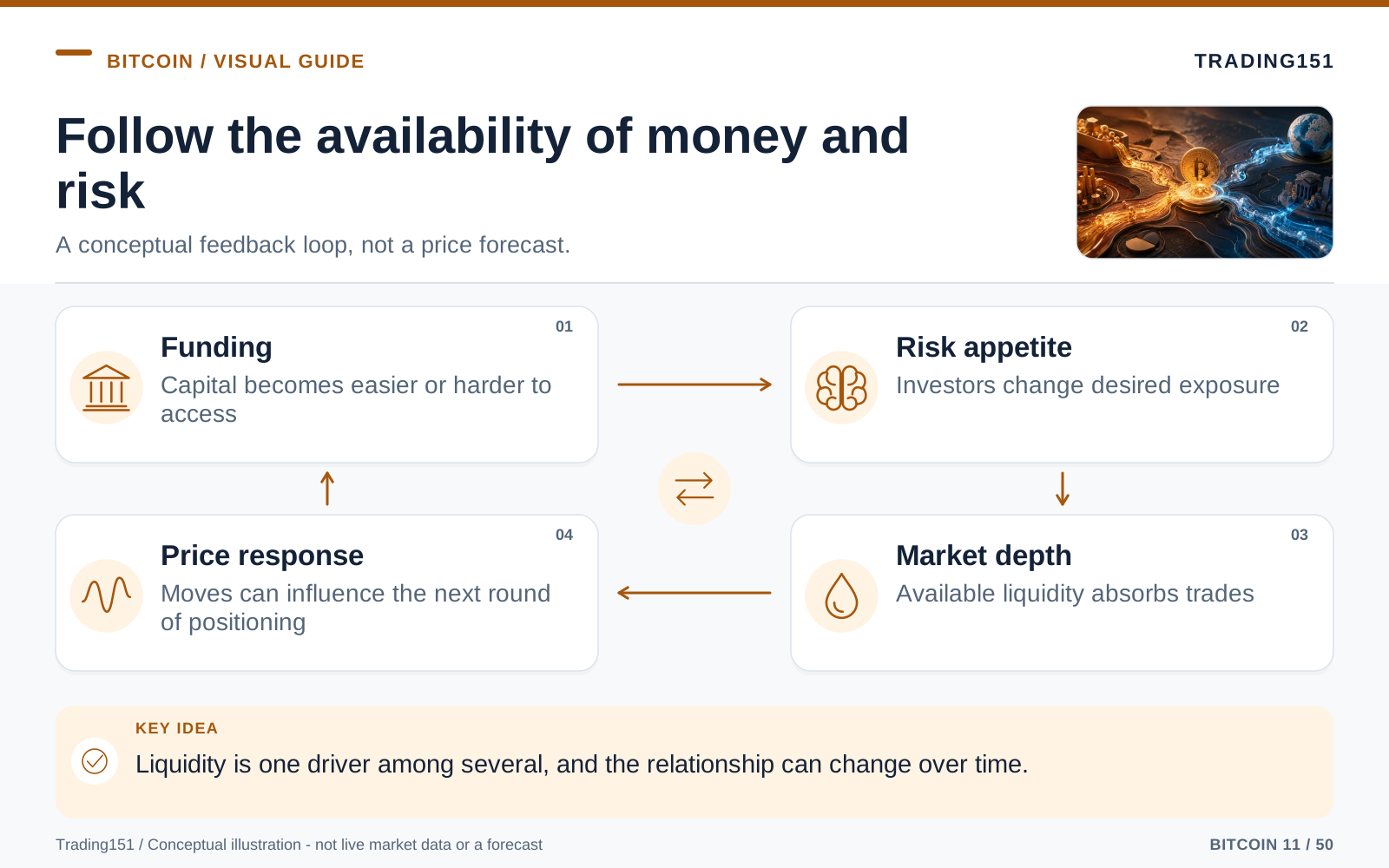
Read this diagram as text
- Funding
- Capital becomes easier or harder to access
- Risk appetite
- Investors change desired exposure
- Market depth
- Available liquidity absorbs trades
- Price response
- Moves can influence the next round of positioning
Why Bitcoin Reacts So Strongly
Bitcoin's origins matter here. It was built in the aftermath of 2008, when trust in banks, governments, and the whole architecture of monetary policy had taken a serious beating. Its design was almost a direct response to that moment — a monetary system where no committee controls the supply schedule, no central authority holds the keys, and no one can issue more coins to solve a political problem. Hard cap of 21 million. Full stop.
That fixed supply isn't just a technical detail — it's the core of Bitcoin's appeal. Central banks can't vote to inflate it away. Companies can't dilute holders to fund acquisitions. Politicians can't print more to cover their spending. Bitcoin's monetary rules are built into the protocol itself, not debated at meetings. That stubbornness is exactly what makes people value it.
Now put that fixed-supply asset inside a world where the fiat money supply is constantly shifting.
When liquidity expands, more dollars and euros and yen start looking for a home. A slice of that capital flows toward assets seen as scarce, independent, or capable of holding value over time. Bitcoin benefits from exactly that search. It trades continuously, globally, with fewer gatekeepers than traditional assets. Easy to buy, easy to sell, and emotionally compelling because it carries a story: digital gold, hard money, an exit ramp from monetary debasement.
That's why some describe Bitcoin as a liquidity sponge. When money floods the system, Bitcoin absorbs it quickly. Because its supply can't respond to demand the way a normal asset can — it can't issue more shares or expand production — even a modest shift in buying pressure has an outsized effect on price. New money entering doesn't create new Bitcoin. It just competes for the existing supply.
The same logic runs in reverse, and it's severe. When liquidity tightens, Bitcoin can fall hard. It pays no dividend. It has no earnings to anchor a valuation model. Many institutions still treat it as a risk asset — often the riskiest one on the table — especially during periods of market stress. When investors need cash in a hurry, they sell what they can sell, not necessarily what they want to sell. Bitcoin's deep, always-open market makes it a convenient source of liquidity in a crunch, which is exactly when you'd rather not be selling.
That's why Bitcoin can feel exaggerated compared to traditional assets. With the wind at its back, it can run harder than almost anything else in the market. When the wind turns, it can fall just as dramatically. That volatility isn't a flaw in the system — it's what happens when a fixed-supply asset floats in a constantly shifting ocean of global money.
Bitcoin Is Not Moving in a Vacuum
One of the most common mistakes newer investors make is treating Bitcoin as if it exists in its own separate universe — tracking on-chain data, mining flows, social media sentiment, technical chart patterns — while paying little real attention to the macro backdrop. Those signals can be useful. But none of them lift Bitcoin out of the gravitational pull of global money conditions.
When rates are low and liquidity is expanding, investors are more willing to imagine the future. They'll pay a premium for growth, scarcity, and possibility. Bitcoin's story becomes easier to believe in that kind of environment. People buying it aren't just buying what it is today — they're buying what they think it could become.
When rates rise and liquidity tightens, the market gets less dreamy. Investors start caring more about income, cash flow, and near-term survival. Future potential gets discounted more aggressively. Bitcoin doesn't stop being what it is, but the price the market is willing to pay for that future shifts — often sharply and without much warning.
That doesn't mean liquidity is Bitcoin's only driver. Adoption matters. Regulation matters. Custody infrastructure, ETF flows, corporate treasury decisions, mining economics, geopolitical uncertainty — all of it feeds in. But liquidity tends to set the season. The other factors decide whether you need a jacket or sunglasses. Liquidity decides whether it's summer or winter.
The Halving and the Money creation
Any serious discussion of Bitcoin cycles has to deal with the halving. Roughly every four years — every 210,000 blocks — the amount of new Bitcoin paid to miners gets cut in half. New supply entering the market shrinks. Historically, that's preceded some of Bitcoin's biggest bull markets, which is why halvings carry almost mythical weight in crypto culture.
The supply-side logic is clean: if new supply drops and demand holds steady, price faces upward pressure. If demand is growing at the same time, the effect amplifies. Easy to understand, easy to build confident predictions around.
But the halving alone doesn't close the argument. A supply shock still needs demand to do anything meaningful. If capital is fleeing risk assets, credit is tightening, and investors are scared, a reduced mining reward doesn't automatically trigger a rally. The halving can create dry tinder. Liquidity conditions often determine whether there's a spark — and when.
The timing is where it gets interesting. Bitcoin's halving cycle has repeatedly overlapped with broader shifts in global liquidity. The 2020 cycle is the clearest example. Yes, Bitcoin halved that year. But the macro backdrop was extraordinary — governments and central banks responded to the pandemic with staggering stimulus, flooding the financial system with fresh money at a scale that hadn't been seen before.
So was the bull market that followed driven by the halving or by monetary expansion? Probably both, working together. Reduced new supply landed at nearly the same moment that global liquidity was expanding dramatically. Scarcity met demand. That combination tends to be powerful.
Keeping the halving and liquidity together — rather than treating either as sufficient on its own — prevents a common trap: mistaking a calendar event for a guaranteed price machine. The halving shifts the supply side. Liquidity cycles help explain when the demand side is likely to show up with real conviction.
The Four Seasons of a Bitcoin Liquidity Cycle
Because liquidity cycles can feel abstract, it helps to think of them as seasons. They don't flip on an exact date, and the weather within each one can be strange and unpredictable. A warm stretch can arrive in the middle of winter. A cold snap can hit in spring. But the broader pattern still orients you. Bitcoin cycles have a similar feel.
1. Crypto Winter: The Contraction
Crypto winter is the season people remember most vividly, because it leaves a mark. Liquidity is tight. Central banks are hiking rates or holding them elevated. The forgiving mood of the bull market is gone. Leverage falls sharply. Projects that seemed visionary during the rally are suddenly exposed — weak business models, reckless risk management, sometimes outright fraud that got papered over by rising prices.
Bitcoin and the broader crypto market can fall 70%, 80%, more. The coverage turns dark. People who spent the bull market asking how to buy are now asking whether you managed to sell. Companies lay people off. The forums go quiet. The whole space contracts into something smaller and more serious.
The feeling: despair, boredom, embarrassment, and a bone-deep exhaustion.
The reality: winter hurts, but it also does necessary work. Speculators leave. Leverage gets flushed out. Unrealistic projects fail. The people who stay are mostly those who were never there just for the easy money. For a disciplined investor, winter is the time to study, to accumulate slowly when prices are beaten down, and to separate what's durable from what was always hype wearing a technical vocabulary.
2. Spring: The Pivot and Repair
Spring tends to arrive before most people believe it. The market has stopped making obvious new lows, but confidence is still fragile. Central banks may not be actively cutting yet, but the tone changes. Rate hikes slow or stop. Inflation cools. Economic weakness becomes more visible, and investors start wondering if the worst of the tightening might be behind them.
Bitcoin often starts moving before the crowd feels safe doing so. It grinds higher unevenly, with sharp pullbacks that shake people out at every step. Every rally gets labeled a bull trap. Every dip revives the old fear. People who survived winter are too burned to trust the recovery. People who left the market aren't paying attention yet.
The feeling: cautious optimism tangled up with disbelief.
The reality: spring is the repair phase — liquidity stops deteriorating before it clearly gets better, and risk appetite creeps back slowly and unevenly. The best opportunities rarely feel obvious, because the emotional memory of winter is still fresh enough to make caution feel smart. This is often when patient investors start seeing the first returns on buying when nobody else wanted to talk about Bitcoin.
3. Summer: The Expansion
Summer is when the cycle becomes visible to everyone, not just the people who were watching closely through the quiet months. Liquidity improves. Financial conditions loosen. Investors start taking on risk again. Bitcoin breaks through important levels, and eventually it challenges or exceeds previous highs. Media coverage floods back. Fresh narratives emerge. People who ignored the market for years suddenly feel a pang of urgency they can't quite explain.
This is also when the halving narrative gains real traction. Reduced new supply combined with growing demand and expanding liquidity can produce impressive price action. Good projects rise. Bad projects rise too. For a while, it can feel like everything works.
The feeling: excitement, relief, growing confidence — and eventually something that starts to look a lot like euphoria.
The reality: summer is rewarding, but it's where discipline quietly erodes. Rising prices make people feel smarter than they are. Risk management starts to seem overcautious. People begin confusing a favorable liquidity environment with their own personal genius. The market is generous in summer, but that generosity isn't permanent.
4. Autumn: The Peak and Distribution
Autumn is the season that feels the best right before it turns. Prices are high. The stories are everywhere. New investors arrive late but arrive with maximum confidence. Phrases like "supercycle" and "this time is different" start circulating in earnest. The market becomes less about careful analysis and more about not wanting to get left behind.
Under the surface, though, the cycle is often already aging. Liquidity can become stretched. Inflation concerns creep back. Central banks start sounding less accommodating. Valuations get harder to justify with a straight face. The people who accumulated carefully through winter and spring may be quietly selling into strength, passing risk to the late arrivals who only found the market once it got exciting.
The feeling: greed, urgency, and a sense of near-invincibility.
The reality: autumn is when discipline matters most and is hardest to maintain. The market will hand you reasons to keep holding, to add more, to stay fully exposed. It will reward reckless behavior just long enough to make caution seem absurd. But this is usually the season to be trimming, reducing leverage, and honestly asking yourself how much of your position you'd be comfortable holding through a 70% drawdown.
How to Read the Tide Without Pretending to Predict Everything
Understanding liquidity cycles doesn't mean you can call the exact top or bottom. Nobody does that consistently — and anyone who claims they can is almost certainly selling something. The goal isn't to predict every wave. It's to have a reasonable sense of whether the tide is generally coming in or going out.
Rather than hunting for one perfect indicator, look for clusters: easing financial conditions, broadening market breadth, growing spot demand, healthier credit markets, rising stablecoin or fund inflows, and fewer signs of forced selling. Then watch for disconnects between the story and the price. If conditions look supportive but Bitcoin isn't responding, supply or underlying confidence may be weaker than it appears. Liquidity is a framework for updating your probabilities — not a system that issues commands. Every boat feels the tide, but hull damage, crew decisions, and local weather still determine what happens to any particular vessel.
A few signals are worth keeping an eye on regularly.
Interest rates matter. When major central banks are hiking aggressively, Bitcoin is typically fighting a headwind. Higher rates make cash and bonds more attractive, raise the cost of leverage, and dampen appetite for speculative assets. When central banks pause, cut, or shift toward a more accommodating tone, the wind can start to change.
Global money supply matters. Many Bitcoin analysts track global M2 — a broad measure of money supply across major economies. Bitcoin has historically responded strongly when global liquidity expands. The day-to-day correlation isn't perfect, but as a directional macro signal, it's hard to dismiss entirely.
The dollar matters. A strengthening U.S. dollar tends to tighten global liquidity, since so much of global trade and credit is dollar-denominated. When dollar funding conditions are strained, risk assets often struggle. When that pressure eases, there tends to be more room for capital to move into riskier positions.
Credit conditions matter. Liquidity isn't just about what central banks say at press conferences. It's also about whether banks are lending, whether companies can refinance at reasonable rates, whether credit spreads are widening or tightening. Bitcoin responds to the overall availability of capital, not just the headline policy rate.
Price behavior tells you something too. When Bitcoin stops falling on bad news, that can signal sellers are running out of steam. When it can't rise on obviously good news late in a bull market, buyers may be getting thin. Liquidity sets the backdrop, but price action shows how the market is absorbing it in real time.
Common Mistakes Investors Make
The first and most common mistake is treating every crash as evidence that Bitcoin has finally failed for good. It hasn't — not so far. Bitcoin has gone through repeated severe drawdowns precisely because it's volatile and because liquidity cycles are unforgiving. A falling price usually reflects fear, forced selling, and macro pressure — not a permanent verdict on the underlying idea.
The second mistake is treating every bull market as proof that Bitcoin can only go up from here. That's just as dangerous, and it tends to do more damage because it grows quietly during good times when everyone feels smart. Easy liquidity can make poor decisions look like genius for a while. When the cycle turns, the leverage and overconfidence get exposed fast and without mercy.
The third mistake is getting so absorbed in crypto-native narratives that you lose the thread on what's happening in the broader world. A new protocol launch, ETF inflows, a mining event, a regulatory development — any of these can move the needle. But none of them operate in a vacuum. If global liquidity is contracting, good news struggles to gain traction. If liquidity is expanding, mediocre news gets treated like rocket fuel.
The fourth mistake is using the cycle framework to generate false certainty. Liquidity cycles help you think in probabilities and avoid the worst timing mistakes. They don't eliminate risk. They don't guarantee outcomes. The market can stay irrational much longer than you have the money to wait it out. Policy can reverse overnight. External shocks don't care about your cycle chart.
Practical Takeaways for Staying Sane
1. Respect the macro environment. "Don't fight the Fed" became a cliché because it kept proving itself true. Bitcoin is decentralized, but the capital flowing into and out of it is deeply shaped by central bank policy. When money is actively being pulled from the system, be skeptical about calling a major rally imminent. When liquidity starts expanding again, start paying closer attention.
2. Zoom out before reacting. Bitcoin's daily chart can make calm people emotional very quickly. A 10% move can happen in hours. A 20% correction within a bull market isn't unusual — it's almost expected. Before reacting to whatever just printed, ask a more useful question: where are we in the liquidity cycle? Is the tide coming in, going out, or somewhere in the middle of turning?
3. Avoid leverage unless you truly understand the risk. Liquidity cycles already generate enormous swings. Adding heavy leverage turns that normal volatility into a personal crisis. A lot of people are right about Bitcoin's long-term direction and still end up losing money because a short-term move forced them out of their position before they could be proven right.
4. Use dollar-cost averaging if timing stresses you out. Buying a fixed amount on a regular schedule isn't glamorous. But it addresses a real problem — most people are bad at buying when they're frightened and selling when they're giddy. Removing some of that emotional pressure by spreading purchases across different market conditions isn't a lazy strategy. It's a practical one.
5. Have a plan for both fear and greed. It's easy to say you'll buy the next crash — until the crash arrives and everything feels like it might go to zero. It's easy to say you'll take profits — until the chart goes parabolic and selling feels like betting against yourself. Writing a plan in advance helps. Know how you'll accumulate, when you'd rebalance, how much risk you can handle (not just in theory), and what would change your view on the asset.
Three kinds of liquidity can point in different directions
Suppose global financial conditions appear easier, yet a particular exchange has a thin order book. A trader trying to sell quickly on that venue can still face substantial slippage. Now suppose the order book looks deep, but lenders tighten collateral requirements. Leveraged holders may need to reduce positions even though ordinary trades remain easy to execute. These are different channels, not contradictory observations.
Match the evidence to the claim. Order-book depth and spreads describe trading conditions at specific venues and times. Funding terms and collateral haircuts describe access to borrowed exposure. Broad money measures and policy indicators describe a much wider economic setting. None is a complete substitute for the others, and publicly displayed orders can be cancelled before a trade reaches them.
A chart comparing bitcoin with a money-supply series needs particular care. The choice of currency conversion, date range, and time lag can make a relationship appear stronger. If the lag was selected after looking at the result, it is part of the model fitting, not an independent discovery. Test whether the relationship holds in a period that was not used to choose it.
Keep the conclusion proportionate. Easier financing may support risk-taking, but it does not specify which asset receives the money or when. For a real decision, the question is whether the claimed relationship remains useful after costs, changing conditions, and the possibility that the market has already anticipated it.
Look past the headline volume
A venue can report substantial trading activity without offering the depth needed for your order. The relevant question is what quantity can be bought or sold near the quoted price now, and whether that liquidity remains available as the order executes.
For a larger transaction, inspect the spread and depth on the intended venue, consider how the order will be worked, and include withdrawal or settlement constraints. Volume across the entire crypto market does not guarantee access in one account. The same asset can be easy to trade in one currency pair and awkward to exit in another. 1
Liquidity Is the Weather, Not the Climate
Bitcoin carries a lot of identities at once. A decentralized network. A scarce digital asset. A monetary experiment. A technology platform. For a lot of people, a long-term savings vehicle and a political statement rolled into one. But in the short and medium term, its price tends to behave like a sensitive barometer for global liquidity conditions.
When the world is swimming in cheap money, Bitcoin absorbs attention and capital with remarkable force. When that money becomes scarce, Bitcoin tends to give it back just as dramatically. The halving matters because it constrains supply — but liquidity matters because it determines whether there's enough demand to meet that constrained supply with real conviction behind it.
None of this makes Bitcoin simple or safe. It doesn't mean every cycle will repeat on the same schedule. Markets evolve. Institutions go deeper into the space. Regulation matures. The asset itself grows up. But the core lesson stays useful: Bitcoin doesn't move in isolation. It rises and falls inside the larger breathing rhythm of the global financial system.
Next time Bitcoin appears to be doing something completely insane, take a breath before joining the panic or the celebration. Step away from the one-minute chart. Look at rates, liquidity, risk appetite, the broader flow of capital. Ask whether the tide is coming in or going out.
Because once you learn to read the tide, Bitcoin's waves become a lot less mysterious. They're still big enough to knock you over if you're not careful. But with patience, a bit of discipline, and some sense of where you are in the cycle, they can also be waves worth learning how to ride.
Sources and further reading
Editorial revision: 7 October 2026. Numerical scenarios are hypothetical unless identified as historical. References support the added explanations and selected corrections; rules and product terms should be checked again before acting.