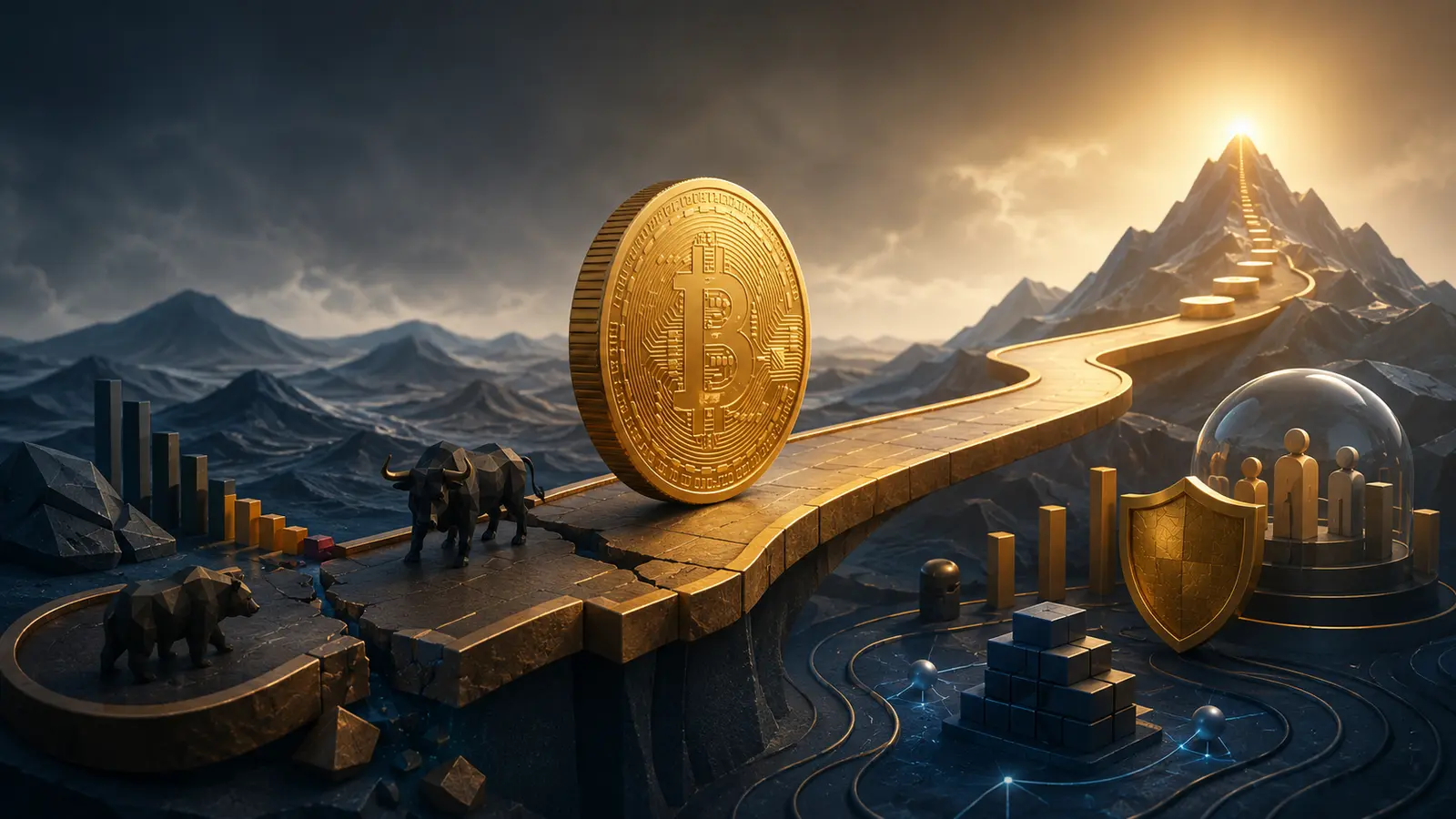
Bitcoin could trade at one million dollars, but possibility is not a forecast and a forecast is not a reason to invest. The useful work lies in examining the assumptions: the date, the purchasing power of the dollar, the demand required, and the risks along the way. A large round number is the beginning of that analysis, not its conclusion.
The Math Behind the Number
Before the hype and the predictions, let's start with arithmetic. Bitcoin has a hard cap of 21 million coins — not a promise from a company, not a policy that some committee can reverse. It's baked into the protocol itself. If Bitcoin hit $1,000,000 per coin, the total market cap using the full supply would be roughly $21 trillion.
That sounds staggering. In the context of global finance, though, it's not categorically impossible. A $21 trillion Bitcoin would eclipse any single public company's market cap. It would put Bitcoin in direct conversation with the world's biggest stores of value. It would still be a fraction of global real estate, bond markets, or total household wealth — but a very large fraction.
Here's where the argument gets interesting. Bitcoin doesn't need to swallow the entire world economy to get to seven figures. It just needs to capture a meaningful slice of the capital that's already searching for protection, portability, and something that will hold purchasing power over decades.
Right now, that capital is scattered across gold, prime real estate, government bonds, offshore accounts, cash reserves, art, and equities that investors buy partly because they don't trust cash to survive the next thirty years. If even a modest portion of that money rotates into Bitcoin, the price response can be dramatic — because the supply is fixed and a lot of it is held by people who don't want to sell.
One thing worth clarifying: market cap isn't cash deposited into an asset. Bitcoin doesn't need $21 trillion of new money to hit a $21 trillion valuation, for the same reason a company doesn't need its entire market cap wired into its bank account. Prices are set at the margin — by whoever's willing to buy and sell right now. In a market with a fixed supply and stubborn holders, it doesn't take all that much demand to push the price up significantly. Sustaining that valuation is a different matter; it takes deep liquidity, durable demand, and enough confidence that holders aren't scrambling to exit every time the number gets high.
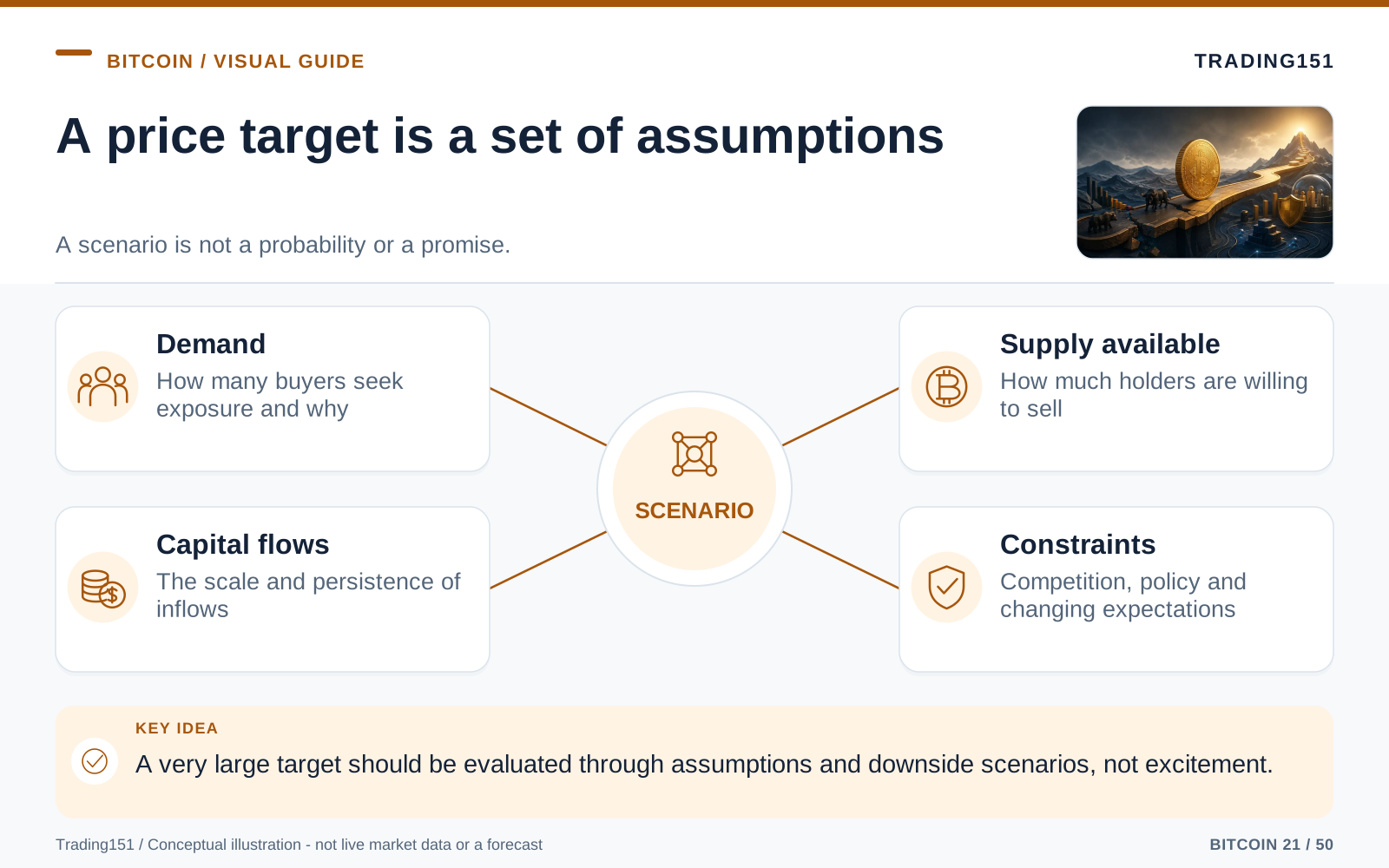
Read this diagram as text
- Demand
- How many buyers seek exposure and why
- Supply available
- How much holders are willing to sell
- Capital flows
- The scale and persistence of inflows
- Constraints
- Competition, policy and changing expectations
Why the Bull Case Exists
The case for a million-dollar Bitcoin draws on a few powerful ideas — some technical, some economic, some psychological. Together they explain why people who dismissed Bitcoin a decade ago are now writing memos about it.
1. Bitcoin Is the First Truly Scarce Digital Asset
Scarcity sounds simple, but it's difficult to achieve. Gold is scarce — but not perfectly. When prices climb high enough, miners are motivated to dig deeper, process lower-grade ore, and look harder for new deposits. Real estate is scarce in prime locations, but cities expand, zoning changes, towers get built. Even fine art can be replicated, tokenized, or substituted with something else collectors decide they want instead.
Bitcoin is built differently. Its supply doesn't respond to demand. If the price doubles, miners still can't produce more Bitcoin than the protocol allows. If a government decides it wants exposure, it has to buy from someone who already holds it. If a billionaire wants a meaningful position, that demand runs into a market where the final supply number is already set in stone.
That's the core of the appeal. In a world where almost every asset can be printed, diluted, issued, or expanded by committee, Bitcoin holds a single stubborn line: 21 million coins, that's it.
New Bitcoin does enter circulation through mining, but at a rate that shrinks roughly every four years in what's called the halving. Each halving cuts the reward miners receive per block, meaning new supply slows down over time until the final coin is eventually mined far in the future.
That structure creates a monetary narrative you don't have to trust a boardroom to maintain. You trust the code, the incentives built into the network, and the community's track record of refusing to budge on the supply cap. That's an unusual thing to be able to say about any financial asset.
2. Institutional Access Has Changed the Market
For most of Bitcoin's life, buying it was a pain. Unfamiliar exchanges, private key management, constant hack anxiety, tax confusion — it worked fine for early adopters who were into that stuff, but it put a real wall between Bitcoin and the large pools of capital managed by pension funds, family offices, endowments, and registered advisers.
That wall has been coming down. The arrival and growth of spot Bitcoin ETFs gave traditional investors a familiar entry point — exposure without wallets, seed phrases, or any of the infrastructure that used to make Bitcoin feel more like a technical project than an investment. Suddenly it could sit in a standard brokerage account next to stocks and bond funds.
Why does that matter? Because institutional adoption doesn't have to be sweeping to move price. A 1% allocation from a handful of major portfolios can represent enormous demand relative to how much Bitcoin is available and willing to trade. If Bitcoin becomes a standard alternative asset — even a modest one — the market may be forced to reprice it whether or not broader retail adoption follows.
There's also a psychological dimension here that's easy to underestimate. Many investors don't want to be pioneers. They want someone they trust to have already decided this is okay — custody, compliance, reporting, a product their adviser can explain without sounding like they fell for a forum post. Once that infrastructure exists, Bitcoin stops being intimidating and starts being normal. Normal things are a lot easier to accumulate.
3. Fiat Currency Debasement Keeps Strengthening the Story
Bitcoin's most devoted supporters describe it as an escape from fiat money. That framing can sound overwrought, but the underlying emotion isn't hard to follow. People earn, save, and invest — and year after year, the money buys a little less. Prices drift up. Wages lag. Savings accounts don't keep pace. Governments borrow heavily. Central banks expand their balance sheets during every serious crisis. And the average person is left wondering why the same effort produces less than it used to.
Inflation tends to get discussed in calm, technical language. For actual households, it's personal — it's the gap between what you thought you were saving and what it turned out to be worth.
Bitcoin was designed, from the start, as a response to exactly this dynamic. Satoshi Nakamoto embedded a reference to a bank bailout in Bitcoin's first block — not by accident. The whole architecture was built around the idea that you shouldn't have to trust a government to manage your money responsibly on your behalf.
No central bank can touch Bitcoin's supply. No election resets the cap. No emergency summit dilutes existing holders overnight. For anyone who has doubts about the long-term discipline of fiat systems, that's compelling — even if the asset is volatile in the short run.
There are two very different versions of a million-dollar Bitcoin. In the good one, it rises because more people choose to store value there over time. In the ugly one, it rises because fiat currencies are losing ground fast. The price might look identical on a chart. The world around that price would feel completely different.
4. The Network Effect Is Hard to Replicate
Bitcoin isn't the fastest blockchain. It's not particularly flexible. It can't do what newer smart-contract platforms do. But it has something that may be more durable than technical elegance: more than a decade of trust, earned in public, under constant pressure.
Bitcoin has processed transactions through bull runs and wipeouts, exchange collapses, regulatory crackdowns, mining bans, and relentless media skepticism. That survival record isn't trivial. It's part of what you're buying.
Money isn't just technology. It's belief, habit, liquidity, infrastructure, and shared recognition that this thing has value. Gold isn't valuable because it's the most practically useful metal. It's valuable because human civilizations across cultures and centuries agreed it could store wealth. Bitcoin is attempting to build a digital version of that recognition.
That's why displacing Bitcoin isn't just an engineering problem. A competitor needs more than better specs — it needs deeper trust, broader ownership, better security, more liquidity, stronger brand recognition, and a credible commitment to scarcity that people believe in. That's a much harder problem to solve than writing faster software.
What Would Have to Happen for Bitcoin to Reach $1 Million?
Getting to seven figures would almost certainly require several things working together, not one single catalyst. The most realistic path isn't an explosion — it's a long, uneven repricing driven by adoption, scarcity, and macroeconomic pressure playing out over years. That path needs broader savings demand, durable institutional infrastructure, credible custody, regulatory breathing room in major markets, continued network security, and a growing public belief that Bitcoin belongs alongside gold as a reserve asset. It also needs time for ownership to redistribute at higher price levels. One major purchase or crisis headline can spark a move; it cannot, by itself, build a stable multi-trillion-dollar market.
First, Bitcoin would need to keep earning legitimacy as a long-term asset. Not universal love — gold has critics, stocks have critics, real estate has critics. What matters is whether enough large pools of capital conclude that owning nothing is riskier than owning a little.
Second, custody and regulation need to mature without neutering the market. Big institutions need rules, audits, insurance, tax clarity, and infrastructure they can explain to compliance departments. At the same time, Bitcoin's value proposition depends partly on its permissionless, self-custody nature. If regulation makes Bitcoin safer without stripping its core properties, adoption gets easier. If it turns Bitcoin into a heavily restricted financial product, the upside story changes considerably.
Third, public confidence in traditional stores of value has to keep eroding — at least at the margins. This doesn't require a financial apocalypse. It could simply mean more people deciding that cash is a bad long-term savings vehicle, that bonds don't protect adequately against inflation, and that property is too expensive or illiquid for a generation that came of age during a housing crisis. Bitcoin is volatile, but it's also portable, divisible, borderless, and verifiable by anyone with an internet connection.
And finally, Bitcoin would need to stay secure and politically resilient — no catastrophic technical failure, no fatal governance collapse. It has to keep proving it can handle pressure from governments, miners, exchanges, institutions, and its own internal ideological debates.
The Real Risks That Could Stop It
The bull case is coherent. It's also not inevitable. Bitcoin has real vulnerabilities, and a serious investor should be able to name them clearly without getting defensive about it. A million-dollar price target is possible only if Bitcoin survives several major threats.
1. Government Pressure Could Limit Adoption
Bitcoin threatens something governments tend to protect: the relationship between citizens, banks, and the state. It lets people hold and move value outside the normal banking system — which is exactly what supporters love about it, and exactly what some governments may decide they can't tolerate.
Some countries will probably accommodate Bitcoin as a regulated investment while quietly discouraging its use as actual money. Others may restrict exchanges, tax gains heavily, require detailed transaction reporting, or make self-custody legally complicated. An outright global ban would be nearly impossible to enforce — the network is too decentralized for that. But coordinated pressure from major economies could slow adoption, spook institutions, and reduce liquidity without banning anything outright.
The key risk isn't that Bitcoin gets killed. It's that owning or using it becomes inconvenient, expensive, or legally uncertain enough to deter ordinary people. That alone could delay or quietly deflate the million-dollar thesis.
2. Volatility Can Break Conviction
Bitcoin's long-term chart looks remarkable. Living through it is something else. The asset can lose half its value quickly, sit in a depressed range for years, and grind down even people who believe in it. People tend to love Bitcoin in a bull market and very seriously reconsider during a prolonged crash.
Volatility matters for adoption because trust is fragile. Retirees, corporations, and conservative institutions aren't built to absorb 70% drawdowns. For Bitcoin to become a serious store of value over time, volatility will probably need to compress as liquidity grows and ownership broadens. That could happen naturally — it's just not guaranteed.
There's also a psychological trap embedded in price targets themselves. When people buy primarily because they expect a fast move to $1,000,000, they're set up to panic when the market turns against them. Great assets can still be lousy investments — at the wrong price, with the wrong time horizon, and with leverage they can't sustain.
3. A Better Technology Could Challenge the Narrative
Bitcoin's simplicity is a feature and a limitation at the same time. Newer crypto networks are faster, more programmable, and more flexible — supporting decentralized finance, tokenized real-world assets, stablecoins, and applications Bitcoin doesn't natively handle.
The question is whether any of that matters for what Bitcoin is trying to be. If Bitcoin is digital gold, it probably doesn't need to run apps. Gold doesn't run apps either. But if the market eventually rewards utility over monetary credibility, Bitcoin could face real pressure from a system that combines scarcity, security, speed, and programmability more effectively.
This is sometimes called the MySpace risk — the worry that Bitcoin is just the first recognizable version of an idea, not the lasting winner. The counterargument is that money isn't social media. People switch platforms for entertainment. They switch stores of value only when they trust the alternative more deeply. That makes switching costs much higher, and Bitcoin's head start much harder to overcome.
Two Very Different Ways to Get There
There's an important distinction worth making about how a million-dollar Bitcoin could happen, because the two main paths tell very different stories.
The first is a crisis scenario — a major currency collapse, a sovereign debt shock, a bank failure cascade that destroys confidence in traditional financial systems fast, driving a panicked rush into Bitcoin as one of the few assets that can't be printed. That kind of move could be fast and dramatic. It would also arrive alongside serious economic damage. A Bitcoin that reaches $1,000,000 because the world is falling apart is not the outcome most investors are hoping for.
The second path is slower, less cinematic, and far healthier. Bitcoin gradually earns its place as a savings asset. Institutional adoption builds steadily. Central bank credibility erodes at the margins. Each halving tightens supply a little further. More savings flow in from more parts of the world. The price climbs unevenly — with crashes, flat stretches, and long periods where the whole thing feels stuck — but the long-run direction holds. That path doesn't require disaster. It just requires Bitcoin to keep doing what it's been doing: surviving, and slowly convincing more people that it deserves a seat at the table.
What About the Timeline?
Anyone offering a confident timeline for this is mostly guessing. Bitcoin sits at the intersection of technology, regulation, macroeconomics, investor psychology, and global politics — and any of those can move in unexpected directions for reasons that have nothing to do with Bitcoin itself. Some analysts expect $1,000,000 within a cycle or two. Others push it out to mid-century. Some think it never happens. Worth noting: a nominal million dollars decades from now may buy considerably less than a nominal million buys today, so a price target can be reached partly because the measuring stick weakened. The more meaningful questions are about real purchasing power, Bitcoin's share of global savings assets, and whether demand at that valuation is stable or still speculative.
A fast move to $1,000,000 would almost certainly require extreme conditions — a major currency crisis, a sudden wave of institutional buying, a race between sovereigns to accumulate, or a severe supply squeeze. Possible, but it would likely come with chaos attached.
A slower move is more plausible and easier to imagine. If Bitcoin keeps surviving, if the supply stays fixed, if more investors treat it as digital gold, and if fiat currencies keep quietly losing ground over time, a seven-figure price becomes less shocking with each cycle. Not comfortable or guaranteed. Just less shocking.
And the path won't be smooth — Bitcoin's history makes that clear. Even in the most optimistic long-term scenario, there will be concerning crashes, long boring stretches, regulatory fights, exchange failures, and stretches where the whole thesis seems broken. Anyone imagining a clean, linear ride to a million hasn't been paying attention.
Should Ordinary Investors Bet on It?
The possibility of a million-dollar Bitcoin doesn't mean everyone should pile in. Bitcoin can be a powerful long-term asset and still wreck people who overextend themselves, use leverage, or buy at peaks they can't psychologically handle when things reverse.
A more useful frame isn't "guaranteed lottery ticket." It's an asymmetric bet with real downside on both sides. The downside includes regulation, competition, technology risk, market crashes, and the genuine possibility that the world doesn't adopt Bitcoin as deeply as its believers expect. The upside is a scarce digital asset becoming a major global store of value in an era of expanding debt and weakening trust in governments' ability to manage money over the long run.
For some investors, that risk-reward profile justifies a small allocation held for many years. For others, the volatility and uncertainty simply aren't worth it. Both positions can be perfectly rational. The mistake is treating Bitcoin as either obviously worthless or obviously destined to make everyone rich.
Position size matters. Time horizon matters. Emotional discipline matters. So does understanding custody — buying Bitcoin without knowing how it's stored, how exchanges work, or what can go wrong isn't really investing. It's gambling with extra steps and the false comfort of a price chart.
Separate the price target from the required return
Using a hypothetical starting price of $100,000, a move to $1 million would be a tenfold increase. Over ten years, that requires a compound annual price increase of about 25.9%. Over twenty years, it requires about 12.2%. Neither figure describes a smooth path, and the starting price is an assumption for the calculation, not a current quote.
The purchasing-power question changes the meaning again. One million future dollars may buy substantially less than one million dollars today. A nominal target reached partly through inflation is different from the same target reached while general prices remain stable. State both the horizon and whether the discussion is about nominal or inflation-adjusted value.
Market capitalization also needs careful wording. Multiplying a hypothetical price by a supply figure produces a valuation, not an amount of cash that must flow into the asset dollar for dollar. Market prices are set by trades at the margin. The resulting capitalization does not mean every holder could sell at that price at once.
For a decision, consider more than the successful scenario. What happens to your finances if the target takes twice as long, never arrives, or follows a very large drawdown? A position should be manageable under those outcomes too. Confidence in an exciting endpoint is not a substitute for the ability to live with the path or the possibility that the underlying thesis is wrong.
Do not let the target dictate the risk
A million-dollar goal is a number, not an investment method. Working backward from it can reveal an uncomfortable gap between the available savings and the required return. That gap should prompt a review of contributions, time, and spending plans rather than an automatic increase in leverage.
A useful plan has more than one acceptable outcome. Ask what progress would look like if returns were modest, if a severe decline arrived early, or if contributions had to pause. A strategy that only works under the most favorable path is not made stronger by the emotional importance of its target. Protecting the ability to keep saving can matter more than chasing a mathematically possible but fragile result. 1, 2
A Million Dollars Is a Scenario, Not a Promise
So — can Bitcoin reach one million dollars?
Yes, it can. The math allows it. The scarcity story supports it. The growth of institutional infrastructure makes it more plausible than it was five years ago. The steady erosion of confidence in fiat currencies gives it a real macroeconomic tailwind. A million-dollar Bitcoin is no longer just something people shout about in forums — it's a serious, if deeply uncertain, financial scenario that deserves a clear-eyed look.
But possible isn't the same as inevitable. Bitcoin still has to survive hostile regulation, severe drawdowns, technological competition, security risks, and its persistent tendency to attract maximum hype at precisely the wrong moments. It remains an experiment — just one that has grown into one of the most valuable experiments in the history of money.
The most grounded view sits somewhere between the evangelists and the skeptics. Bitcoin isn't magic. It doesn't remove risk from investing. It doesn't guarantee wealth. But it has done something new: it introduced a decentralized, scarce, digital monetary asset that anyone can verify and no central authority can quietly inflate away.
Whether it reaches $1,000,000 in ten years, thirty years, or never, Bitcoin has already forced a serious rethinking of what money can be. That may be its most enduring achievement, independent of where the price ultimately lands. The million-dollar question is simply whether the market will eventually value that idea as highly as its strongest believers think it should.
Sources and further reading
- SEC Investor Bulletin: Exchange-Traded Products Providing Exposure to Bitcoin and Ether
- TradingView Pine Script Documentation: Strategies
Editorial revision: 7 October 2026. Numerical scenarios are hypothetical unless identified as historical. References support the added explanations and selected corrections; rules and product terms should be checked again before acting.