
An exchange can make trading convenient while leaving important details out of view: who holds the keys, where the trade is settled, and what asset is delivered. Those questions apply to centralized and decentralized services alike. The label does not tell you whether you are buying native bitcoin, a tokenized claim on it, or exposure that cannot be withdrawn as bitcoin at all.
What Is a Cryptocurrency Exchange?
At its core, a cryptocurrency exchange is just a marketplace where people buy and sell digital assets. You want Bitcoin, someone else wants to sell it, and the exchange is what brings the two of you together.
Framed that way, it's not a complicated concept. It works a lot like a stock exchange, a brokerage app, or even a currency exchange booth at the airport. You show up with one asset — say, dollars, euros, pounds, Ethereum, or a stablecoin — and trade it for something else.
What sets crypto exchanges apart is how ownership works. Bitcoin isn't a number sitting in a bank's database. It exists on a public blockchain, and whoever holds the private keys controls the coins — full stop. That single fact is behind most of the real differences between centralized and decentralized exchanges.
A centralized exchange typically holds your funds on your behalf. A decentralized exchange typically lets you trade straight from a wallet only you control. That might sound like a minor technical detail, but it completely reshapes the relationship between you, the platform, and your money.
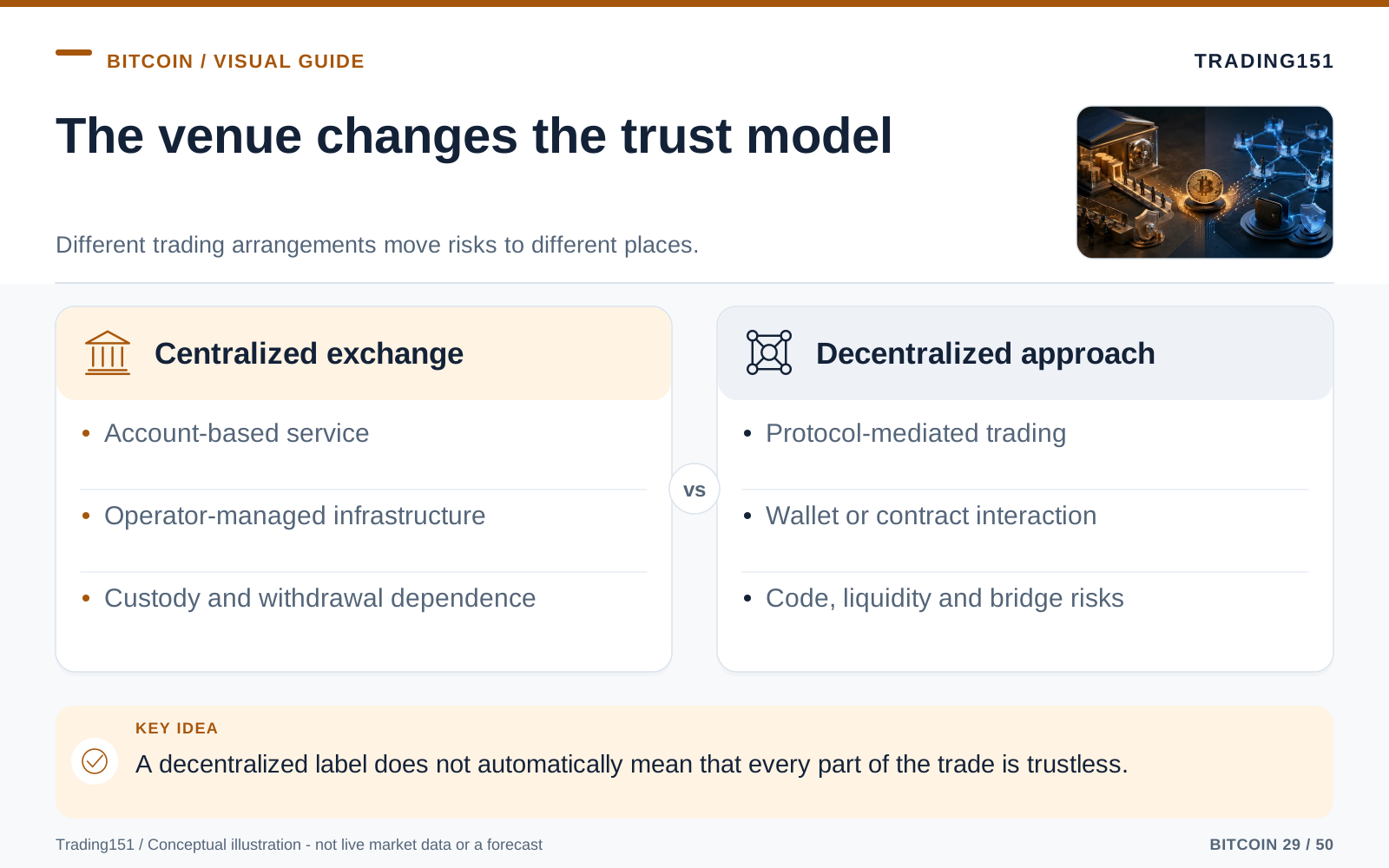
Read this diagram as text
- Centralized exchange
- Account-based service; Operator-managed infrastructure; Custody and withdrawal dependence
- Decentralized approach
- Protocol-mediated trading; Wallet or contract interaction; Code, liquidity and bridge risks
The Centralized Exchange: The Familiar Route Into Crypto
For most people, their very first Bitcoin purchase happens on a centralized exchange — a CEX, for short. These are the big, slick platforms that feel a lot like any modern finance app. Login screens, mobile apps, support teams, compliance departments, security settings, dashboards, ad campaigns — the whole package.
When someone brings up Coinbase, Binance, Kraken, Gemini, Bitstamp, or Crypto.com, they're talking about centralized exchanges. These are run by actual companies. The company builds the website, runs the order-matching engine, manages customer accounts, holds a large stash of crypto on its own books, and answers to the regulations of whatever countries it operates in.
How a CEX Works
A centralized exchange feels familiar because it borrows so heavily from online banking and brokerage apps you've probably already used. You open an account, prove your identity, deposit money, and place an order. Most of the actual trading happens inside the company's own database — the platform matches orders and updates internal balances, while coins only move on-chain for deposits, withdrawals, or the company's own treasury needs. That's what makes trading fast and cheap, but it also means the blockchain itself can't verify every customer's balance in real time. You're trusting the exchange's accounting, security, and solvency in between the moments you withdraw. The order book might be public, but the full balance sheet almost never is.
Here's roughly how a Bitcoin purchase plays out on a CEX:
- You create an account. Sign up with an email, pick a password, turn on two-factor authentication.
- You go through identity verification. Since centralized exchanges are usually regulated financial businesses, they'll ask for KYC — Know Your Customer. Expect to upload a government ID, confirm your address, and maybe snap a live selfie.
- You deposit funds. Depending on where you live and which exchange you're using, that could mean a bank transfer, debit card, credit card, wire, payment app, or a stablecoin deposit.
- You place an order. There's usually a simple "buy" button, plus market and limit order options for anyone who wants more control. Beginner screens keep it minimal; advanced trading screens throw charts, order books, and price depth at you.
- The exchange matches your trade. Most centralized exchanges run on an order book — basically a live, running list of buyers and sellers. When your bid matches someone's ask, the trade goes through.
- Your balance updates. The Bitcoin shows up in your exchange account, with the platform keeping its own internal ledger of who owns what.
The important part here is custody. Unless you withdraw your Bitcoin to a wallet you control, the exchange is the one holding it. Your account balance says you own Bitcoin, sure, but the private keys to those coins belong to the exchange.
That's where the old crypto saying comes from: "not your keys, not your coins." It's not saying your balance is fake — it's a reminder that you're relying on the exchange to stay solvent, secure, honest, and up and running. When everything's fine, that trade-off is convenient. When it isn't, things can get ugly fast.
Why People Use Centralized Exchanges
Centralized exchanges took off because they solve the single hardest problem in crypto for everyday people: getting in and out of the market. They turn Bitcoin from something requiring technical fluency into something you can buy with your regular bank account.
- They're easy to use. A decent CEX feels like a banking or stock-trading app — familiar territory, especially if you're new to all this.
- They support fiat money. CEXs are generally the simplest way to turn dollars, euros, pounds, or whatever your local currency is into Bitcoin, and back again.
- They offer strong liquidity. The bigger exchanges process large trading volumes, which means you can buy or sell fast without moving the price much.
- They offer account recovery. Forget your password? You can usually get back in after proving your identity — a safety net that matters a lot if you're not ready for full self-custody yet.
- They pile on extra services. Recurring buys, tax reports, staking, savings products, debit cards, OTC desks, educational content, advanced trading tools — plenty of CEXs offer all of it.
The Real Risks of a CEX
The convenience of a centralized exchange comes down to trusting someone else with your money. That's also its biggest weak spot.
- You don't hold the private keys. Leave your Bitcoin on the exchange, and you're counting on that company to keep it safe and honor your withdrawals whenever you ask.
- Exchanges can collapse. A poorly run or outright fraudulent platform can go under, freeze withdrawals, or file for bankruptcy. Customers sometimes wait years to get anything back — and often only get a fraction of it.
- They're a magnet for hackers. Sitting on huge pools of user assets makes centralized exchanges an obvious target.
- Your personal data is on the line. KYC means handing over sensitive documents. If the exchange gets breached, that data becomes its own separate headache, apart from any crypto losses.
- Accounts can get frozen or restricted. A CEX might lock an account, block withdrawals, pull services from certain regions, or comply with a legal order. Sometimes that's justified; sometimes it's maddening.
None of that automatically makes centralized exchanges unsafe. Plenty are run professionally, monitored closely, and take security seriously. But a CEX is asking you to make a specific trade: convenience for trust.
The Decentralized Exchange: Trading Without a Traditional Middleman
A decentralized exchange — DEX — takes a completely different approach. Instead of signing up with a company and letting it hold your assets, you connect your own crypto wallet and trade directly through blockchain-based software.
Uniswap, Curve, PancakeSwap, Sushi, dYdX, and 1inch are some of the well-known names. Bitcoin specifically is a bit more complicated here, since its base layer was never built for the same kind of smart-contract activity that powers Ethereum and similar chains. Bitcoin-focused peer-to-peer platforms like Bisq and Hodl Hodl often get lumped in with DEXs because they let people trade without going through a traditional custodial exchange.
How a DEX Works
A DEX usually runs on smart contracts — code sitting on a blockchain that executes automatically once certain conditions are met. Think of it like a vending machine: feed it the right input, and it spits out the right output. Nobody's sitting behind the counter deciding whether to approve you.
Instead of logging into a company account, you connect a wallet — MetaMask, Rabby, Trust Wallet, Phantom, a hardware wallet, whatever you're using. The DEX doesn't need to hold your funds the way a centralized exchange does. You approve the transaction from your own wallet, the smart contract runs it, and it settles on-chain.
A lot of DEXs skip the traditional order book altogether and use what's called an Automated Market Maker, or AMM, which relies on liquidity pools — basically stashes of tokens supplied by users known as liquidity providers.
Picture a pool holding Ethereum and Wrapped Bitcoin. When you trade Ethereum for Wrapped Bitcoin, you're not buying from any one specific seller. You're dropping Ethereum into the pool and pulling Wrapped Bitcoin back out, with the smart contract setting the price based on the pool's current balance and the protocol's rules.
Other decentralized platforms use order books, hybrids, or off-chain matching paired with on-chain settlement. The mechanics differ, but the underlying idea stays consistent: you're trading through code and wallets, not through a company account holding your balance.
Bitcoin on a DEX: Why It Gets Tricky
When someone says they're trading Bitcoin on a DEX, they might mean a few different things. Real Bitcoin lives on the Bitcoin blockchain. Most popular DEXs, though, run on Ethereum, BNB Chain, Solana, Arbitrum, Base, or other smart-contract networks — none of which can move native BTC directly without extra infrastructure. Bitcoin simply doesn't speak the smart-contract language most DEXs are built around, so trading it elsewhere usually requires a wrapped version, a bridge, a sidechain, or an atomic-swap setup, each with its own liquidity and quirks. And every one of these routes adds new assumptions. A DEX might remove one central operator, but it can quietly introduce bridge signers, contract administrators, front-end providers, or stablecoin issuers instead. "Non-custodial" tells you something useful, but it's not the whole picture of who could still fail you or get in the way.
That's why Bitcoin on a DEX usually shows up in one of these forms:
- Wrapped Bitcoin. A token like WBTC is designed to track BTC's price on another blockchain, but it comes with extra trust assumptions tied to whatever system is backing it.
- Cross-chain swaps. Some protocols let you trade across blockchains directly. Powerful, but more complex — often involving bridges, relayers, and additional security risk.
- Peer-to-peer Bitcoin trading. Tools like Bisq connect buyers and sellers more directly, using escrow-like mechanisms and security deposits to keep fraud in check.
Worth remembering as a beginner: buying BTC on a centralized exchange and pulling it into a Bitcoin wallet is not the same thing as buying a tokenized version of BTC on another chain. Both have their place, but they're not interchangeable.
Why People Use Decentralized Exchanges
DEXs draw in people who want more control and fewer middlemen standing in the way. They're also usually where the experimental, cutting-edge stuff in crypto shows up first.
- You keep custody of your funds. Trading happens straight from your own wallet — nothing sits in a company-controlled account.
- There's often no sign-up at all. Most DEXs skip the email, password, and ID document entirely. Connect a wallet, and you're in.
- New assets show up fast. Tokens frequently land on DEXs long before they ever reach the big centralized platforms — early access, sure, but also a lot more room for scams and half-baked projects.
- They're open to anyone. If you've got a compatible wallet and an internet connection, you can generally use the protocol from anywhere.
- They spread out the risk. There's no single central exchange wallet holding everyone's funds in one place, waiting to be a target.
The Real Risks of a DEX
Decentralization doesn't erase risk — it just relocates it. A DEX might not hold your funds, but now you're the one responsible for reading what you're signing, protecting your wallet, and steering clear of dangerous contracts.
- There's no support team to bail you out. Send funds to the wrong address, approve a shady contract, or lose your recovery phrase, and there's no help desk that can undo it.
- Smart contracts can have bugs. A flaw in the code can let attackers drain liquidity or exploit users directly.
- Fake tokens are everywhere. Anyone can slap a familiar name or logo on a new token. Grab the wrong contract address, and you're left holding nothing of value.
- Fees can spike unexpectedly. On some networks, transaction costs shoot up whenever the chain gets busy.
- Prices can shift mid-trade. Slippage happens when your final price ends up different from what you expected — common in thinner liquidity pools.
- Privacy isn't the same as anonymity. A DEX might not ask your name, but blockchain transactions are public by nature. Once a wallet gets tied to your identity, your whole activity history can potentially be traced.
A DEX hands you more independence, but also a lot more responsibility. That's exciting if you know what you're doing, and pretty daunting if you don't.
CEX vs DEX: The Main Differences
The simplest way to compare the two is by looking at what each one is optimizing for. A CEX prioritizes convenience, speed, fiat access, and an experience that feels familiar. A DEX prioritizes self-custody, open access, and trading through pure blockchain infrastructure.
1. Ease of Use: CEX Has the Advantage
For most beginners, a centralized exchange is simply easier. Deposit local currency, hit a basic buy button, rely on account tools you already sort of know. If you've ever used online banking, none of it feels totally foreign.
A DEX asks more of you upfront — a wallet, funds set aside for network fees, some understanding of what a token contract is, and enough confidence to approve transactions without a support team backing you up. That extra control is valuable, but the learning curve is real.
2. Custody and Control: DEX Has the Advantage
On a centralized exchange, the platform holds your assets until you withdraw them. On a decentralized exchange, you're generally keeping assets in your own wallet and signing every trade yourself. If self-custody matters to you, this is the difference that settles the debate.
That said, self-custody isn't foolproof. Lose your seed phrase, store it somewhere careless, or sign a malicious transaction, and your funds can vanish for good. Control is powerful — it's also completely unforgiving.
3. Privacy: DEX Usually Offers More, But Not Perfect Privacy
Centralized exchanges typically collect identity information and keep transaction records — part of how they comply with financial regulation. A DEX skips most of that account-registration process, which does buy you more privacy at the platform level.
But public blockchains are transparent by design. Wallet addresses, balances, and transactions can be visible to anyone who cares to look. A DEX cuts down on how much personal information you're handing over to a company — it doesn't make your activity invisible.
4. Liquidity: CEX Often Wins for Major Assets
For Bitcoin and other big cryptocurrencies, the major centralized exchanges usually offer deeper liquidity, tighter spreads, and faster execution — especially valuable if you're placing large orders.
DEX liquidity has gotten dramatically better, particularly on the bigger networks and popular trading pairs. But it's uneven. Some pools are deep and efficient; others are thin enough that a single trade can move the price significantly.
5. Fees: It Depends on the Platform and Network
A CEX might charge trading fees, deposit fees, withdrawal fees, spreads, or card-processing fees. That convenient "buy" button isn't always the cheapest way in.
A DEX typically charges a swap fee on top of blockchain network fees. Cheap on low-cost networks, surprisingly expensive on congested ones. The best route really depends on the asset, the network, the size of the trade, and how quickly you need it done.
6. Asset Selection: DEXs Move Faster, CEXs Filter More
Centralized exchanges generally vet assets before listing them. That's no guarantee of quality, but it does create some baseline screening. DEXs are wide open by comparison — a token can go live within minutes of launch.
That openness cuts both ways. It's where the earliest opportunities show up, but also where scams, copycat tokens, and abandoned projects run rampant.
When a Centralized Exchange Makes Sense
A centralized exchange is usually the right starting point if you're new to Bitcoin, and it's just as useful anytime you need to move between traditional money and crypto.
A CEX may be the better choice if:
- You're buying Bitcoin for the first time.
- You want to use a bank account, debit card, or local currency.
- You'd rather have a simple interface and someone to call if things go wrong.
- You're making recurring purchases over time.
- You need deep liquidity for a major asset like Bitcoin or Ethereum.
- You want a clean transaction history for accounting or taxes.
Plenty of experienced crypto users still rely on centralized exchanges — they just don't treat them as long-term storage. A common pattern: buy on a CEX, then withdraw straight to a personal wallet once the purchase clears.
When a Decentralized Exchange Makes Sense
A decentralized exchange starts to make more sense once you're comfortable managing your own wallet and paying close attention to transaction details. It's also the obvious choice if you want access to DeFi protocols or tokens that never made it onto the big centralized platforms.
A DEX may be the better choice if:
- You already understand self-custody and wallet security.
- You'd rather not leave funds sitting on a centralized platform.
- You're using DeFi applications on smart-contract networks.
- You want access to tokens the major CEXs don't carry.
- You're comfortable double-checking contract addresses and managing slippage.
- You prefer open, wallet-based access over yet another account to manage.
If none of that feels comfortable yet, take it slow. Start with small amounts, practice sending a few transactions, and never put money into a DEX that you can't afford to lose.
The Hybrid Approach: How Many People Use Both
The CEX-versus-DEX debate gets framed like you have to pick a side and stick with it forever. In practice, plenty of people just use both.
Someone might buy Bitcoin on a regulated centralized exchange because it's the easiest way to spend from a bank account, then withdraw it to a hardware wallet once the purchase clears for safekeeping. Later on, if they want to poke around in DeFi, they might spin up a separate wallet with a small amount of funds and try a DEX.
This hybrid style keeps growing more common. Centralized exchanges are rolling out self-custody wallets and Web3 features of their own. Decentralized platforms are cleaning up their interfaces and making swaps far less intimidating. The line between the two worlds isn't gone, but it's a lot less scary to cross than it used to be.
Basic Safety Tips Before Using Any Exchange
Whether you go with a CEX, a DEX, or both, a handful of habits can save you from expensive mistakes. Stick to a saved address or an official app, turn on phishing-resistant authentication wherever it's offered, use a unique email and password, and test a small deposit and withdrawal before you commit any real money. Double-check the exact network and asset instead of trusting a familiar-looking ticker symbol. Keep your trading balance proportional to what you need on the platform, and log your transactions while the history's still easy to pull. An exchange is at its safest when you've already figured out how you're going to leave it.
- Lock down your security. On centralized exchanges, turn on two-factor authentication through an authenticator app or hardware key — skip SMS codes when you can.
- Withdraw anything long-term. Planning to hold Bitcoin for years? Learn how to use a self-custody or hardware wallet.
- Test with small amounts first. Before any big withdrawal or swap, send a tiny test transaction to make sure everything lines up.
- Check addresses carefully. Crypto transactions can't be undone. A mistyped address, the wrong network, or a fake token contract can cost you everything.
- Watch out for urgency. Scammers love pressure tactics. Guaranteed profits, secret listings, fixed matches, private signals, risk-free returns — any of that, and it's time to walk away.
- Keep your recovery phrase offline. Never type your seed phrase into a website, chat, form, or support ticket. Legitimate wallet support will never ask for it.
- Know the full fee picture. Trading fees, spreads, withdrawal fees, network fees, slippage — check all of it before you confirm anything.
Identify the asset that will arrive in your wallet
Before a purchase, check the withdrawal asset and network. A token whose price tracks bitcoin on another blockchain is not the same technical asset as native bitcoin on the Bitcoin network. Sending it to an incompatible destination can create serious recovery problems. Similar names and logos do not establish compatibility.
For a decentralized trading route, trace the entire arrangement. The trade may rely on smart contracts, a bridge, a wrapped asset issuer, price feeds, or an interface operated by a company. Some designs reduce custody risk while introducing different technical or liquidity risks. Non-custodial does not mean that no other party or system matters.
For a centralized service, distinguish a trade shown in the account from a completed on-chain withdrawal. Internal account transfers can be fast because the provider updates its own records. That convenience does not remove withdrawal rules, limits, identity checks, or counterparty risk. Read the agreement governing the balance you actually hold.
A small test transfer can verify the immediate route, but it should accompany rather than replace these checks. Keep the asset, network, address, fee, and expected confirmation process together in the transaction record. Most preventable transfer mistakes begin with an assumption that two things with a similar name must be interchangeable.
A test transfer answers a limited question
A small transfer can confirm that an address, network, and withdrawal workflow work as expected. It does not prove that a platform is solvent or that a much larger withdrawal will face the same conditions. Use the test for its practical purpose, then keep reviewing the broader custody and counterparty risks. Operational success and financial safety are separate judgments. 1
Use Exchanges as Tools, Not Identities
Centralized and decentralized exchanges both played a huge role in making Bitcoin and crypto accessible, but they come from two different philosophies.
A centralized exchange is the well-lit front door — easier to walk through, easier to understand, well connected to traditional banking. In exchange, you're trusting a company with your assets, your data, and your access.
A decentralized exchange is more like an open marketplace built entirely out of code. It gives you more control and fewer gatekeepers, but it also expects you to take full responsibility for your own security. There's no password reset for a lost wallet, and no support agent who can undo a bad transaction.
For beginners, a reputable CEX is usually the most practical way in. For those who value self-custody and understand wallet security, a DEX can be a powerful tool. The smart move isn't declaring one good and the other bad — it's understanding what each was built for, knowing the risks, and picking the right tool for whatever you're trying to do.
Bitcoin was built to let people hold and move value without leaning entirely on traditional financial institutions. Exchanges made that world a lot easier to step into. Your job now is making sure convenience never blinds you to custody, risk, and responsibility. Start small, stay curious, and never trade anything you don't fully understand.
Sources and further reading
Editorial revision: 7 October 2026. Numerical scenarios are hypothetical unless identified as historical. References support the added explanations and selected corrections; rules and product terms should be checked again before acting.