
Bitcoin's volatility reflects the interaction of changing demand, available liquidity, leverage, and a market that trades continuously. Greater participation can improve some trading conditions without eliminating large moves. The price is set by transactions at the margin, not by dividing the asset's total value evenly among all holders. When willing buyers or sellers pull back, a relatively small imbalance can still produce a substantial repricing.
1. Bitcoin Is Still Young by Financial Standards
Bitcoin showed up in 2009. That feels ancient in internet time, but in the world of money it's basically a toddler. Gold has been a store of value for thousands of years. Stock exchanges have been running for centuries. National currencies are propped up by governments, central banks, courts, tax systems, whole economies built around them.
Bitcoin doesn't have any of that history. People are still arguing about what it even is. Digital gold? A speculative tech bet? A hedge against currency debasement? Worthless internet money? Depends who you ask — and that disagreement isn't trivial, because markets are really just crowds of people trying to agree on what something is worth.
When an asset hasn't settled into an agreed-upon value yet, every headline lands harder. A new regulation, a company adding Bitcoin to its balance sheet, an exchange collapsing, an ETF getting approved, a hack somewhere in the ecosystem — any of it can flip the mood overnight. Underneath all of it is the same unresolved question: is this a passing fad, a real long-term asset, or something we don't have a category for yet?
And since that question is still wide open for a lot of people, the price reacts hard whenever the answer seems to shift even a little.
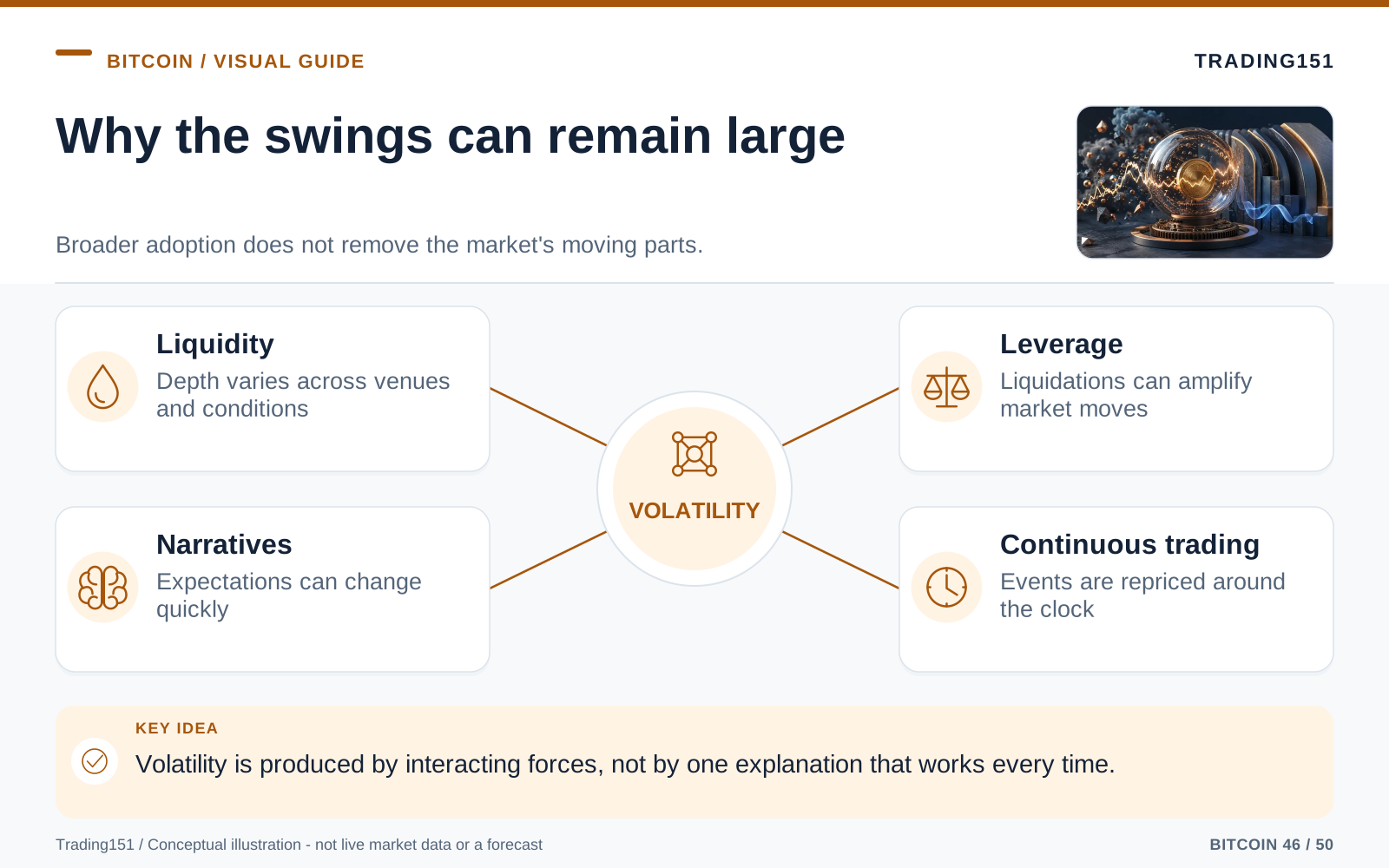
Read this diagram as text
- Liquidity
- Depth varies across venues and conditions
- Leverage
- Liquidations can amplify market moves
- Narratives
- Expectations can change quickly
- Continuous trading
- Events are repriced around the clock
2. A Smaller Market Means Bigger Waves
Bitcoin's grown enormously since it launched, sure — but stack it against global stocks, bonds, real estate, currencies, gold, and it's still a small player. And small markets move more. Market cap tends to exaggerate how much money is sitting there ready to trade at any given price. Only a slice of coins are ever actively offered for sale, and the order books can thin out fast once you move past the best bid and ask. A big buyer has to work through progressively pricier offers to fill an order; a big seller has to eat through layer after layer of demand. In theory, deeper liquidity should mean the same order moves the price less — but that depth can evaporate fast during a panic.
Picture throwing a rock into the ocean versus a swimming pool. Nobody notices the ocean splash. Everybody notices the pool. Bitcoin isn't a puddle anymore, but it's not an ocean either. A large order can still send visible ripples through it, especially when trading volume is thin.
That's part of why Bitcoin can lurch during weekends or in the dead hours of the trading day. Fewer people trading means thinner liquidity — fewer buyers and sellers sitting at different price points ready to absorb a trade. When that cushion is thick, a big order barely dents the price. When it's thin, one large trade can shove the price much further than it "should."
Which explains something that confuses a lot of newcomers: Bitcoin can suddenly drop with no obvious news attached. Sometimes there's no story at all. It's just a big seller showing up in a market that wasn't deep enough to soak up the order gracefully.
3. The Whale Effect: When Big Holders Make Everyone Nervous
A "whale," in crypto speak, is someone sitting on a large pile of Bitcoin — an early adopter, a fund, a mining operation, a company that quietly built up a position over years.
Whales move markets before they even do anything, purely by being watched. Blockchain activity is public, so when a large holder shifts thousands of coins toward an exchange, plenty of bots and analysts and paranoid Twitter accounts catch it within minutes. The assumption jumps straight to: they're about to sell.
Often that assumption is dead wrong. Coins get moved for custody reasons, internal reshuffling, collateral, all sorts of boring operational stuff. But markets rarely wait around for the boring explanation. The rumor of selling is often enough to trigger actual selling.
This is where psychology takes the wheel. Retail traders see the alert, figure somebody must know something, and rush to get out first. Bots respond to the price action. Leveraged positions start wobbling. Before long, a transfer that might have meant nothing has kicked off a wave of nervous selling — the whale never dumped a single coin, and the market's already acting like the worst has happened.
Bitcoin's transparency is one of its strengths. It's also just endless raw material for people to overthink. In a jumpy market, even a neutral transaction gets read as a warning sign.
4. Fixed Supply Meets Unpredictable Demand
At Bitcoin's core sits one hard rule: there will only ever be 21 million coins. New supply trickles in on a set schedule, and it gets cut roughly in half every four years in an event everyone calls the halving.
That fixed cap is a big part of the appeal. Nobody can vote to print another ten million coins because demand is heating up. There's no committee to lobby, no political override. The code just doesn't care what anyone wants.
But that same rigidity is exactly why the price can swing so violently. In most markets, rising demand eventually pulls more supply into existence. Oil gets pricier, producers drill more. Wheat gets pricier, farmers plant more. A stock gets expensive, the company issues more shares. Supply's slow to respond, but it does respond.
Not with Bitcoin. If demand spikes overnight, the network can't just crank out extra coins to meet it. The only lever left is price. Buyers pile in, sellers get scarcer, and the price has to keep climbing until enough holders decide it's worth letting go of their coins. When demand cools off, nothing steps in to shrink supply and prop things up — the price just falls until buyers reappear.
That's the trade-off baked into the design: scarcity gives Bitcoin its appeal, and scarcity is also what makes every shift in demand hit that much harder.
5. Bitcoin Trades All Day, Every Day
Traditional markets have opening bells and closing bells, weekends, holidays, sometimes even circuit breakers that pause trading outright. Those pauses give people a chance to breathe, process news, and come back with a clearer head. They also give the market some structure — everyone knows roughly when liquidity is strongest and when the big players are active.
Bitcoin skips all of that. It trades around the clock, every day, everywhere. No closing bell. No moment where everyone steps away at once. A rumor can spread at 3am. A liquidation cascade can hit on a Sunday. A regulator on the other side of the planet can drop an announcement while half the market is asleep.
That nonstop rhythm is part of what makes Bitcoin feel alive — and part of what makes it draining. You can go to bed at one price and wake up at a very different one. A move that a stock market might spread out over days can happen to Bitcoin in an hour, simply because there's never a moment when trading stops.
It also feeds overreaction. Tired, anxious people staring at charts too long tend to make bad calls, and Bitcoin never gives them a weekend off to cool down. The market's always open, so the emotion always has an outlet.
6. Leverage Turns Small Moves Into Cascades
If there's one single thing that turns ordinary Bitcoin volatility into full-blown chaos, it's leverage. It lets traders control a position way bigger than their actual capital — with 10x leverage, $1,000 controls a $10,000 position, and it only escalates from there. The problem is the feedback loop that comes with it. Prices dip, leveraged longs get liquidated, those forced sales push the price down further, and the next batch of leveraged positions crosses its own breaking point. Market makers, sensing the chaos, widen their spreads or pull back entirely, which drains exactly the liquidity that could've absorbed the selling. The same thing happens in reverse during a squeeze on shorts. Watching it unfold, it can look like Bitcoin's "fundamental value" just changed in five minutes — when really what's happening is a crowded, over-leveraged trade getting unwound by algorithms.
The appeal is obvious: get the direction right and your gains get multiplied. A small move turns into a real profit. The downside is just as obvious and considerably meaner — get it wrong, and your losses get multiplied too. Push far enough, and the exchange steps in and force-closes the position before the borrowed money disappears entirely. That's a liquidation.
Liquidations tend to chain-react. Say Bitcoin drops a few percent on bad news. That drop forces over-leveraged longs to close out. Those forced sales drag the price lower still, which trips more liquidations, which creates more selling. A dip that should've been manageable turns into a crash — not because the news was that bad, but because the market started eating itself.
It works the same way going up. When too many traders are betting against Bitcoin and the price starts climbing anyway, shorts get liquidated and forced to buy back in, which shoves the price even higher and can spark a sharp rally out of nowhere.
That's the real reason Bitcoin often moves in sudden bursts rather than smooth trends. It's not always the market carefully weighing new information — sometimes it's just clearing out a pile of crowded leveraged bets, and the price gets violent until that's done.
7. News, Rumors, FOMO, and FUD Move the Crowd
Bitcoin has no earnings calls, no CEO, no balance sheet, no product roadmap in the way a public company does. What it has instead is belief — adoption, liquidity, scarcity, security, regulation, and whether enough people are willing to keep holding it. Which means the story around it matters enormously.
When the story turns positive, things can get euphoric fast. A big institution announces Bitcoin exposure. A well-known investor calls it a hedge. An ETF starts pulling in real money. A country floats friendlier crypto rules. Suddenly everyone who was sitting on the sidelines starts worrying they're about to miss out — that's FOMO, plain and simple.
FOMO is dangerous because it converts patience into regret in real time. People start telling themselves "if I don't buy right now I'll never get another shot," and that thinking pushes them to buy fast, with no real plan, usually well after the price has already run.
Then there's FUD — fear, uncertainty, doubt. A rumor starts that some government's about to crack down hard. An exchange runs into trouble. A prominent investor trashes Bitcoin publicly. Some unrelated corner of crypto has a security breach, and suddenly it gets lumped in anyway. The mood flips dark, and people sell first, ask questions later.
Because crypto conversations move at internet speed, the narrative can flip within hours. One screenshot gets reposted, misread, exaggerated, and traded on before anyone's bothered checking whether it's even true. Bitcoin is global, digital, and emotional all at once — which means the market never stops being fed new stories.
8. Regulation Is Still Being Written
Regulatory uncertainty is another huge driver of volatility. Bitcoin exists inside a world built around national laws, banking rules, tax codes, anti-money-laundering standards, investor protections — and governments are still figuring out where it fits.
Some regulatory news is welcomed because it opens doors for institutions and everyday investors alike. Other news is treated as a threat because it might squeeze exchanges, wallets, mining, or custody services. And even when a rule has nothing to do with Bitcoin specifically, the broader crypto market often reacts as one big emotional blob anyway.
The real problem isn't whether a given rule is good or bad — markets can handle strict rules just fine as long as they're clear. What markets can't stand is not knowing what's coming. When investors can't tell if a government is about to embrace, restrict, tax, or outright ban something, they price in fear well before anything's decided.
As Bitcoin gets more woven into traditional finance, the rules will probably get clearer, and that could take some of the edge off the volatility over time. But while things are still being written, every legal headline has the potential to rattle the whole market.
9. Bitcoin Is Still Searching for Its Main Identity
Part of what makes Bitcoin so volatile is that nobody's fully agreed on what it's for.
Money? A savings tool? An inflation hedge? A speculative gamble? Digital gold? A political statement? A payments network? A long-term reserve asset? The answer changes depending on who you ask, and that disagreement quietly shapes how people trade it.
Treat Bitcoin like a high-growth tech stock, and you'll probably sell it when rates rise or risk appetite drops. Treat it like digital gold, and you'll probably buy more when things get shaky economically. Treat it as a pure trading vehicle, and you only care about charts and momentum. Treat it as a long-term store of value, and daily swings might not even register.
All of those people are trading in the same market at the same time, which means Bitcoin ends up acting like several different assets depending on the day. One week it trades like a risk asset. The next it trades like a macro hedge. During a mania it trades like a meme coin. During a crisis it can get sold off simply because it's one of the easiest things to sell for cash.
That identity crisis is a big part of the instability. Until the market broadly settles on what Bitcoin is, the price is going to keep getting yanked between competing interpretations of it.
10. Volatility Is Painful, but It Is Also Part of the Appeal
Most people frame volatility purely as a downside, and if you need stability, it is one. A currency that can move sharply in a single day is a nightmare to price everyday goods with. A savings asset that can crater in a bear market takes real nerve to hold through. A trader who underestimates how far Bitcoin can swing gets wiped out quickly.
But volatility is also exactly why Bitcoin gets so much attention in the first place. Assets that barely move rarely produce life-changing returns. Bitcoin's biggest gains have always come bundled with severe drawdowns — the same market that can outrun almost anything else can also punish overconfidence without much warning.
That's why longtime Bitcoin holders always bring up time horizon. Look at it minute by minute and it seems insane. Zoom out to years and the picture reads completely differently. That doesn't mean the price always goes up eventually, and it definitely doesn't mean the risk disappears — it just means the shorter your window, the louder every wobble sounds.
For traders, that volatility is opportunity. For long-term holders, it's the emotional toll of sticking around. For skeptics, it's proof Bitcoin isn't ready to be treated like real money yet. None of those views really cancels the others out — they can all be true at once.
How to Survive the Bitcoin Rollercoaster
Understanding why Bitcoin swings doesn't stop it from swinging — but it does make the swings feel less like a personal attack. Nobody can reliably predict every move, so that's not really the goal here. The goal is not making your worst decisions at your worst possible moment. Practically, that means cutting down on the number of decisions the market can force on you: skip leverage, keep your rent money and bills far away from your position, size it so a deep drawdown doesn't wreck you, and figure out your rebalancing rules ahead of time, not mid-panic. Price alerts and staring at charts all day turn ordinary volatility into a manufactured emergency — if checking the app isn't improving your decisions, close the app. None of this eliminates risk. The point is just to make sure the market never gets to decide your timing for you because your position was too big or you needed the cash somewhere else.
- Zoom out before you panic: One-hour charts are basically built to make you emotional. A single daily candle can look concerning — until you drop it into a multi-year chart and it barely registers. The shorter the timeframe, the more random Bitcoin looks.
- Trade off a plan, not a mood: Figure out ahead of time why you're buying, how much risk you can stomach, and what would make you reconsider. Decisions made calmly beat decisions made mid-crash almost every time.
- Consider dollar-cost averaging: Buying a fixed amount on a regular schedule takes the pressure off trying to time the exact bottom or top. It won't remove the risk, but it makes the volatility a lot easier to live with day to day.
- Don't trust every headline: News matters sometimes, but not every story deserves a reaction. Plenty are exaggerated, plenty are misread, and plenty exist purely to get clicks.
- Steer clear of leverage unless you really understand it: Borrowed money can turn an ordinary price move into a personal disaster. In a market this volatile, leverage acts less like a tool and more like a trap waiting to spring.
- Don't invest money you'll need soon: Bitcoin can stay volatile far longer than your patience — or your rent deadline — can hold out. Money earmarked for bills, debt, or near-term plans has no business anywhere near this kind of swing.
- Keep Bitcoin separate from the rest of crypto in your head: A scandal involving some random token, exchange, or influencer usually has nothing to do with Bitcoin's fundamentals. The market may still treat it like everything's connected, at least for a few days.
A larger market can still move sharply at the margin
Market capitalization is not the amount of cash required to move the price by a given percentage. A new marginal price changes the quoted value of all units used in the calculation, even though only a portion traded at that price. This is why a large change in market value should not be described as an equal amount of money entering or leaving the asset.
Liquidity is also uneven across venues and times. A continuously open market can have quieter periods when the available depth is thinner. Derivative liquidations can add orders as prices move, while a venue-specific problem can restrict where participants can transfer or trade. These mechanisms can reinforce a move without requiring a single new fundamental fact.
Measure volatility over a stated period and with a stated method. Daily return volatility, intraday ranges, and the size of a maximum drawdown describe different experiences. A quieter recent month does not establish that the risk of a large future move has disappeared.
Plan the exposure around an adverse scenario rather than a reassuring label such as "maturing asset." Someone who cannot tolerate a substantial temporary or permanent loss needs a different allocation from someone with money set aside for a speculative thesis. The market's age or popularity does not change the household's need to pay a bill on time.
A large move does not measure cash inflow
Market capitalization is price multiplied by the relevant number of units. A rise in that calculated value does not mean an equal amount of new cash entered the market. Prices are formed through marginal transactions and available liquidity. Keep that distinction in mind when reading claims that a specified amount of buying must create a predictable increase in Bitcoin's total value. 1, 2, 3
Volatility Fades Only When Uncertainty Does
Bitcoin's volatility was never caused by one thing. It's a young asset with a hard supply cap, trading nonstop in a global market crowded with whales, leverage, speculation, half-written regulation, and a lot of very strong opinions.
Put all of that together and you get huge swings. Sometimes they're driven by real news. Sometimes it's just rumors, liquidations, thin order books, or fear feeding on itself. Either way, this isn't some weird glitch sitting outside the Bitcoin story — it's stitched directly into how the market functions right now.
Over time, Bitcoin will probably calm down some as liquidity deepens, adoption spreads, regulation firms up, and more long-term holders show up and stop trading every day. A bigger ocean absorbs waves better than a small pool does. But that takes years, not months, and it's never going to make Bitcoin perfectly calm.
For now, anyone getting involved has to accept what it is: a groundbreaking financial experiment, a scarce digital asset, a 24/7 global trading market, and a deeply emotional battleground where people are still fighting over what money is even supposed to be.
The rollercoaster might slow down eventually. It might even smooth out as the market matures. But right now, the seatbelt still comes with the ticket.
Sources and further reading
- BIS: April 2025 FX turnover, September 2025 preliminary release
- SEC Investor Bulletin: Crypto Asset Custody Basics for Retail Investors
- Investor.gov: Asset Allocation
Editorial revision: 7 October 2026. Numerical scenarios are hypothetical unless identified as historical. References support the added explanations and selected corrections; rules and product terms should be checked again before acting.