Bitcoin's long-term future will depend on more than whether its price rises. Security, usable custody, demand, regulation, and the ability to make payments all matter. Some developments could strengthen the network while increasing reliance on intermediaries. A useful outlook considers those trade-offs and identifies what evidence would support, weaken, or overturn the case.
Phase 1: Bitcoin Gets Boring — And That's Kind of the Point
Right now people still like to call it "digital gold." It's a handy phrase, but a little too tidy if you think about it. Gold has thousands of years of history behind it. Bitcoin barely clears fifteen. Gold is physical, ancient, something you can hold up to the light. Bitcoin is invisible, made of code, and still baffling to most of the planet. But here's the thing about infrastructure — it earns trust by disappearing. Nobody studies how card networks settle a transaction before buying a sandwich. Nobody checks how internet routing works before firing off a text. Bitcoin will look grown-up once custody, taxes, inheritance, payments, and compliance all become routine enough that people stop thinking about the plumbing and just use the thing. Getting boring wouldn't mean the experiment failed — it would mean the hard parts finally settled into standards nobody has to think twice about, the same way the internet's most critical protocols vanished under the apps we use every day.
Still, the gold comparison sticks around for a reason — because the core idea behind it is powerful. Scarcity matters.
Gold isn't valuable just because it's shiny. It's valuable because it's hard to dig up, hard to fake, and accepted just about everywhere on Earth. Bitcoin takes that same old human instinct — wanting money that can't be conjured out of thin air — and rewrites it in code. There will only ever be 21 million coins. The release schedule was set in stone from day one. No committee anywhere can vote to print more of it because a government needs cash or a bank needs bailing out.
That predictability is really the whole pitch behind "digital gold." In a world where people increasingly feel their savings are quietly getting eaten by inflation, debt, and constant monetary tinkering, Bitcoin offers something almost stubborn in comparison: the rules are out in the open, and nobody gets to change them on a whim.
Think about a young couple trying to save up for a house. Rent keeps climbing. Groceries cost more every month. Their paychecks go up a little, but never quite enough. Everyone tells them to just keep the money in a savings account, yet somehow it buys a little less each year. For people living that reality, Bitcoin isn't some speculative side bet. It's an attempt to lock away hours of work and effort in a form nobody else can quietly devalue.
Over the coming decades, the digital gold story will probably lose its drama and become almost mundane. Pension funds might hold a sliver of it. Companies might park some in their treasury for the long haul. Families might hand down hardware wallets the way their grandparents handed down land or gold coins. Financial advisers who once rolled their eyes at the idea may end up discussing it in the same flat, unremarkable tone they use for bonds or index funds.
None of that would make Bitcoin less important — if anything, it's the opposite. The day it stops being exciting might be the day it made it.
The real question for the long run is whether Bitcoin becomes one of the world's major stores of value. It doesn't have to replace every currency on the planet to matter. If it just becomes a widely-held reserve asset, a form of clean collateral, and a savings tool for people who don't fully trust the system they live under, its footprint on the global economy could still be large.
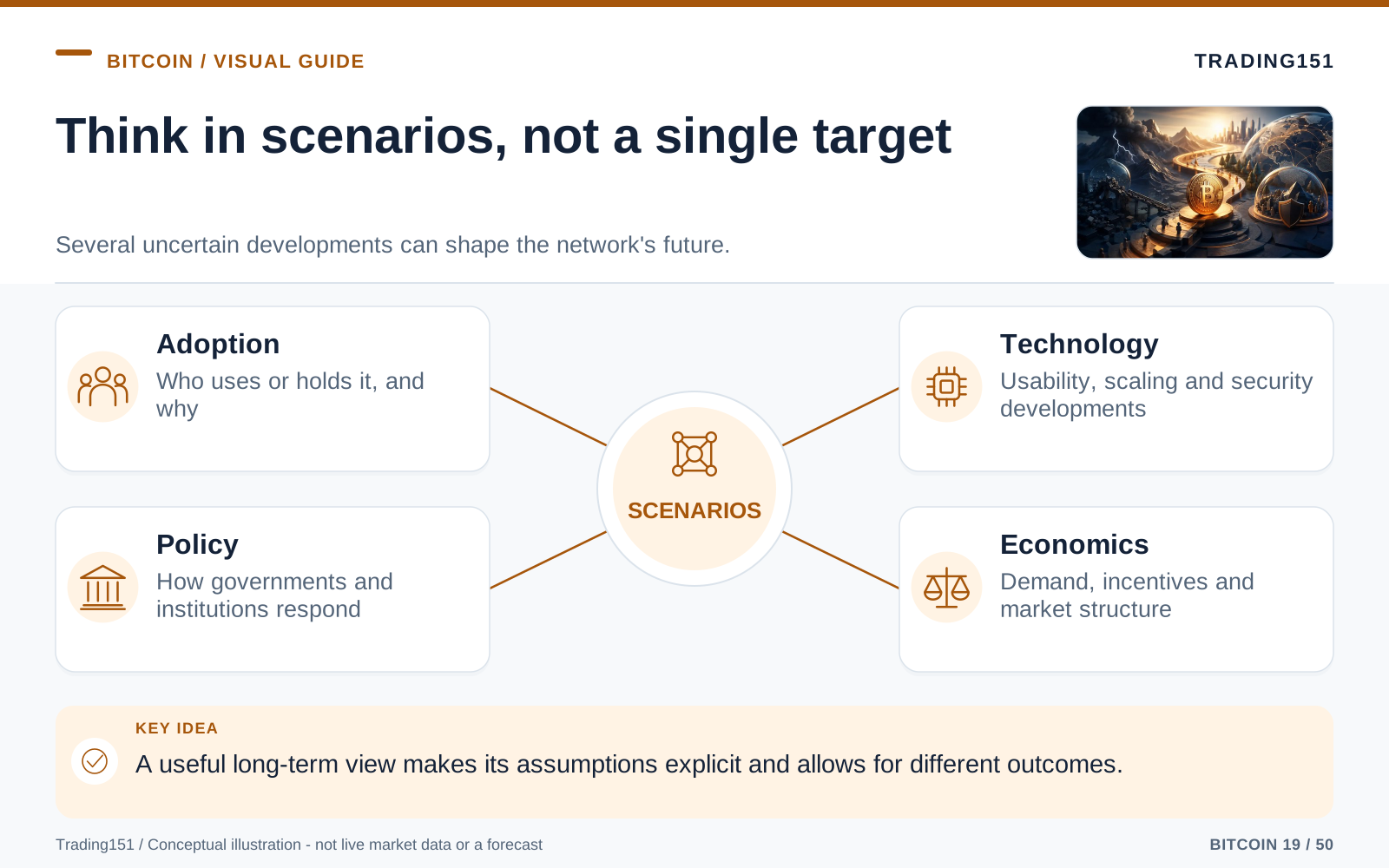
Read this diagram as text
- Adoption
- Who uses or holds it, and why
- Technology
- Usability, scaling and security developments
- Policy
- How governments and institutions respond
- Economics
- Demand, incentives and market structure
Phase 2: Spending Bitcoin Without Even Thinking About Bitcoin
One of the oldest jabs at Bitcoin is also the easiest to understand: if it's really money, why is it such a hassle to buy a coffee with it?
Right now, paying for your latte directly on Bitcoin's main chain just isn't practical for most people. The base layer is slow on purpose — it's built for security and finality, not speed. Great for moving large sums or storing wealth for decades. Clunky for a five-dollar purchase.
But judging Bitcoin by its base layer alone is a bit like judging the internet by what dial-up felt like in 1998. The modern internet works because it's stacked in layers. Nobody thinks about TCP/IP or packet routing when they hit send on a message — they just expect it to work.
Bitcoin payments are probably headed down a similar road.
Layer 2 networks — Lightning being the big one — exist specifically to make small, instant, cheap payments possible. The easiest way to picture Lightning is like opening a bar tab: instead of settling every sip on the main blockchain, you rack up a bunch of tiny transactions off-chain and square things up later. The engineering underneath is complex, but none of that complexity has to leak into what the user experiences.
And that's really what matters long-term. Most people aren't going to care whether their payment routed through Lightning, some other scaling layer, or a custodial app quietly settling in Bitcoin behind the curtain. They'll care whether it's fast, cheap, and it just works.
Picture stepping into a bakery in Paris, a street market in Buenos Aires, or a tiny restaurant in Manila. You scan a code, tap your phone, done. You might be spending sats. The merchant might receive pesos or euros. Somewhere in between, Bitcoin is quietly doing the settlement — moving value across a border without asking a card network or a correspondent bank for permission first.
For someone comfortable in a stable economy, that's just a nice convenience. For someone dealing with a weak currency, capital controls, a broken banking system, or severe remittance fees, it can change their life.
Nobody sending money home to their family should have to hand over a painful chunk of their wages just because the old system is slow and expensive. A freelancer shouldn't wait a week to get paid by a client three time zones away. A small shop shouldn't need five middlemen just to get paid by a customer standing right in front of them.
If Bitcoin wins as a payment rail, it probably won't look like every menu quoting prices in BTC. It'll be quieter than that — Bitcoin becomes the invisible plumbing running underneath apps, wallets, exchanges, and local payment systems. Nobody will announce "I'm using Bitcoin." They'll just notice that their money moves faster than it used to.
Phase 3: The Geopolitical Game Nobody Wants to Lose
Bitcoin isn't just a personal savings tool. It's also a geopolitical piece on the board, and that particular story is still being written.
El Salvador made headlines adopting Bitcoin as legal tender, but whether other countries copy that exact move isn't really the question — most won't. What matters more is whether governments start treating Bitcoin as a strategic asset worth holding, full stop.
For most of the modern era, global trade and reserves have revolved around the U.S. dollar. That arrangement gives Washington enormous leverage, and it gives every other country a reason to want an alternative. Gold has traditionally filled that role. So have a handful of other major currencies. Bitcoin brings something new to the table — a neutral digital asset that no single country issues, controls, or can inflate away for its own political convenience.
That neutrality is exactly what makes this long game interesting.
Picture a resource-rich country sitting on stranded hydro, geothermal, solar, or natural gas power — energy that's hard to move or sell. Instead of letting it go to waste while waiting years for transmission lines to get built, the country starts mining Bitcoin with it. Over time it builds up a reserve that's globally liquid, portable, and answers to nobody's central bank. At first this looks eccentric. Then neighboring countries take notice. Then rival governments start quietly asking their own advisors why they've got nothing in this asset at all.
Bitcoin's fixed supply creates a weirdly intense kind of pressure once you think it through. There will never be more than 21 million coins, full stop. If enough institutions, companies, and governments decide holding some is simply prudent, the scramble for a meaningful slice gets fierce. No finance minister wants to be the one explaining decades from now why their country sat out a neutral reserve asset while everyone else quietly stacked it.
That said, don't expect central banks to come rushing in tomorrow, and don't expect governments to give up defending their own currencies either. States rarely surrender monetary power willingly. But Bitcoin doesn't need a stamp of approval from every government to keep existing — its staying power comes from being distributed, borderless, and run by a global network that doesn't answer to any one capital.
Long-term, Bitcoin might end up sitting next to gold and foreign currency reserves as this slightly awkward but useful asset. Countries may never love it. They'll tax it, regulate it, occasionally trash-talk it, maybe try to clip its edges. But they might find it's grown too significant to just wave away.
Phase 4: Bitcoin and the Machine Economy
Bitcoin's future gets even stranger once you stop thinking about human users and start thinking about machines. Machines can already swap data faster than any traditional billing system can settle a tiny payment, which makes programmable micro-payments appealing. A sensor might buy a weather reading. A software agent might pay for a burst of computing power. A device might stream payments for electricity by the minute instead of getting a monthly bill. The real challenge isn't just speed — it's identity, spending limits, dispute handling, secure key storage, and keeping some human accountable for what the machine is doing. Autonomous money only works when it's tightly boxed in, not when every gadget on Earth gets a blank-check wallet.
AI systems, autonomous devices, and automated software agents are only going to become a bigger slice of the global economy from here. And these systems will need to pay for things — data, compute, electricity, bandwidth, storage, API access. Sometimes thousands or millions of tiny payments a day.
Traditional banking simply wasn't built for that. Banks run on legal identities, compliance departments, business hours, and settlement delays, tied to accounts owned by actual people or corporations. An AI agent can't walk into a branch and show ID. A sensor bolted to a shipping container can't fill out account paperwork. A self-driving car can't call up a credit card company every time it needs to top off its battery.
Bitcoin, especially through the fast payment layers built on top of it, offers something different — open, programmable, always online, global by default. It can move tiny slivers of value without the gatekeeping baked into legacy finance.
Picture a self-driving truck paying a charging station by the minute. An AI research agent paying a few cents for access to a specialized dataset. A network of connected devices quietly paying each other for bandwidth or storage. These are transactions too small and too frequent for the old rails to bother with, but they fit naturally into a monetary system built for the internet age.
None of this means Bitcoin becomes the only money machines use. Stablecoins, central bank digital currencies, and other cryptocurrencies will all be fighting for a piece of this. But Bitcoin has one edge nothing else quite matches — it's the most recognized scarce digital asset out there, and its monetary policy isn't run by a company or a state that can change its mind.
If the internet eventually grows an economy where machines trade value as easily as they trade information today, Bitcoin could end up being one of the base languages that economy speaks.
The Hard Problems Bitcoin Still Has to Face
Any honest look at Bitcoin's future has to admit the road ahead isn't clear. It's survived crashes, exchange collapses, political attacks, internal feuds, and more premature obituaries than anyone can count. But surviving isn't the same thing as guaranteed success. There are real, unglamorous questions still sitting on the table: can fee revenue support network security as the mining subsidy shrinks away? Will mining and custody stay open and contestable rather than concentrated? Can privacy hold up? Will self-custody get safer for regular people? Will the scaling layers avoid creating quiet points of failure? Regulation and political legitimacy will matter here just as much as the code does. Bitcoin has survived in part because it changes slowly — but that same caution can make it slower to adapt when adaptation is needed. Where this all lands will depend heavily on how well the ecosystem builds around a base layer that flatly refuses to move fast.
1. Regulation and the Fight Over Self-Custody Governments probably can't kill Bitcoin outright, but they can absolutely make it more painful to use. They can squeeze exchanges, choke off privacy tools, pile on taxes, monitor every transaction, and go after self-custody in the name of consumer protection or anti-money-laundering rules.
The real fight here won't be a simple "Bitcoin versus the government" showdown. It'll be more subtle than that — open Bitcoin versus permissioned Bitcoin. In one version of the future, people hold their own keys, transact privately within the law, and touch the network directly. In another, Bitcoin gets boxed into heavily surveilled financial products where you get the price exposure but lose the actual freedom that made the whole thing worth building in the first place.
That fight might end up shaping the next era more than any price chart ever will.
2. The Quantum Computing Question Quantum computing gets thrown around as some kind of doomsday clock for Bitcoin. The worry is that a sufficiently powerful quantum machine could eventually crack the cryptography protecting today's wallets.
Worth taking seriously, sure — but it's not a reason to assume a sudden meltdown. Nearly every cryptographic system on the internet would be facing the same threat, including banking systems, government communications, and cloud infrastructure. By the time quantum computers are strong enough to threaten Bitcoin, the whole world will already be mid-migration toward post-quantum cryptography anyway.
Bitcoin can adapt to this, but adapting takes coordination, not just clever engineering. The network would need broad agreement on how to upgrade without chaos, how to protect old coins, and how to move people over safely. Bitcoin's cautious, slow-moving nature is usually a strength — but in a genuine cryptographic emergency, that same caution would get tested hard.
3. Energy, Mining, and Public Perception Bitcoin mining eats a lot of electricity, and that's not going away as a talking point anytime soon. Some of the criticism is fair. Energy use matters. Where that energy comes from matters even more. Sloppy, careless mining operations really can strain a local grid, add emissions, or stir up backlash from nearby communities.
That said, "Bitcoin wastes energy" is a slogan, not the full story. Miners are unusually flexible buyers of power — they can set up shop in the middle of nowhere, shut down instantly when demand spikes elsewhere, and soak up energy that would otherwise go to waste. In some cases mining helps monetize excess renewable power, stabilizes grids, or captures gas that would've just been flared off and burned for nothing.
Where mining ends up long-term probably depends on whether the industry can prove it's useful to energy systems, rather than just hungry for cheap electricity wherever it can find it. If miners lean into grid balancing, renewable buildouts, and capturing wasted energy, the environmental argument looks completely different in a decade. If they just chase the cheapest power with zero regard for the neighbors, expect the political pushback to keep growing.
4. Usability and Human Error Bitcoin hands people real ownership over their money, which sounds great until you realize how unforgiving that is. Lose your keys and that money might be gone forever. Send it to the wrong address and there's no customer service line to call for a refund.
For Bitcoin to go truly mainstream, wallets need to get dramatically safer and easier to use without quietly killing off the option to self-custody. Better recovery tools, multisig setups, inheritance planning, hardware security, interfaces that don't require a computer science degree — all of that needs to keep improving. This can't stay a maze built for hobbyists if it's ever going to serve regular people.
A Generational Shift in Trust
The biggest piece of Bitcoin's future might not be technical at all. It might be psychological.
For most of modern life, people have simply trusted institutions to look after their money. Banks to hold the deposits. Central banks to protect what that money is worth. Payment companies to move it around. Governments to not abuse their grip on the financial system.
Sometimes that trust is well-earned — modern finance does a lot right, providing credit, liquidity, and consumer protections at a large scale. But that trust has also been broken, over and over. People have watched currencies collapse, savings quietly eaten by inflation, accounts frozen without warning, banks bailed out with public money, fees stacked on top of fees, and financial access denied for reasons that felt arbitrary or plainly political.
Bitcoin was born straight out of that disappointment. Its answer is simple: stop asking people to trust a committee when the rules can just be enforced by code, open verification, and a network nobody controls alone.
That idea lands especially hard with people who grew up online. Younger generations are already at home with digital ownership, digital communities, software running their lives. To them, the idea that money should move the way the internet does isn't strange at all. What feels strange is a financial system that closes on weekends, charges a fortune for international transfers, and takes days to settle something that's already sitting in a database somewhere.
Bitcoin turns money into something closer to an open protocol. Anyone can use it. Anyone can check the math. Nobody gets to quietly change the supply. That doesn't make it perfect, but it makes it different in a way that's hard to un-see once you get it.
What Success Might Look Like
People love to picture Bitcoin's win as one dramatic moment — fiat currencies collapsing overnight, the whole world suddenly pricing things in BTC, central banks throwing in the towel. The real version is probably a lot quieter than that.
Success might look like millions of ordinary people holding a small amount as long-term savings. Companies quietly using it as collateral. Payment apps routing international transfers through Bitcoin rails while customers never even notice what's happening under the hood. Miners soaking up excess renewable power at the edge of the grid. Families in unstable economies using it not because it's trendy, but simply because it works when everything local has stopped working.
It'll probably look uneven, too. Some countries will embrace it, others will crack down hard. Some people will insist on self-custody, others will happily hand it off to a regulated custodian. Some businesses will touch Bitcoin directly, others only through some wrapped financial product three steps removed. There won't be one clean, tidy story here. It'll be messy, political, technical, and very human.
And that messiness doesn't weaken the case for Bitcoin at all. It just makes it a lot more believable.
Watch for evidence that could change the thesis
A long-term thesis becomes more useful when it has observable tests. Rather than writing that adoption will keep growing, specify what kind of adoption matters: direct payments, investment holdings, settlement between businesses, or access through financial products. Growth in one category does not automatically establish growth in the others.
Do the same for security and usability. A service that makes wallets easier to use may be valuable, but check which responsibilities it takes over and what happens if it fails. A scaling system may reduce day-to-day fees while adding liquidity or exit constraints. The relevant question is whether the improvement survives the conditions in which users most need it.
Separate milestones from price targets. A network can make technical progress during a falling market, and a price can rise while important operational problems remain unresolved. Keeping a short record of both favorable and unfavorable developments helps prevent the chart from becoming the only evidence you notice.
Set a review interval and write down what would warrant a change in exposure or conviction. That might be a deterioration in an assumption you considered essential, rather than an ordinary period of volatility. The point is not to invent a perfect forecast. It is to avoid a thesis that absorbs every possible outcome and therefore can never be questioned. An investment argument should remain open to revision even when the technology behind it was designed to change slowly.
Make a long-term thesis reviewable
A long holding period should not mean an argument that can never be questioned. Identify the developments that matter to the thesis: reliable access, continued demand, workable custody, or a particular use case. Separate them from a price target.
Reviewing those assumptions does not require reacting to every headline. A scheduled check can ask whether the original reasons still hold and whether the position has become too large for the wider finances. Conviction is more useful when it includes a willingness to notice contrary evidence. Otherwise, 'long term' can become a way of postponing every difficult decision. 1, 2
The Future May Look Boring — And That Would Be the Real Win
Bitcoin started as a quiet experiment among people who believed money could exist without a central authority pulling the strings. It survived because the idea was simple enough to grasp and sturdy enough to defend: a scarce digital asset, secured by a global network, open to anyone willing to show up.
Its next hundred years won't be defined by price alone, even though price will keep grabbing headlines because markets are just how the world expresses greed, fear, and everything in between. The deeper story is whether Bitcoin quietly becomes infrastructure.
If it does, it might preserve wealth for families who've stopped trusting cash to hold its value. It might act as neutral collateral in global finance. It might move money across borders faster than the old system ever could. It might give people in broken economies a real way out. It might give machines a way to pay each other without a human middleman. And it might force governments, banks, and everyday people to rethink what money is supposed to do.
The clearest sign that Bitcoin succeeded might be that nobody notices it anymore — not because people stopped caring, but because it's woven so deeply into everyday financial life that it stops feeling exotic. Nobody marvels at electricity every time they flip a light switch, or at the internet every time a message crosses the planet in a second. Technology that matures enough just fades into the background of daily life.
Bitcoin started as a whisper in some obscure corner of the internet. It grew into a roar across global markets. Its long-term future might end up being something quieter and, in its own way, more powerful — a neutral foundation for value in a world that's still figuring out how to trust anything digital.
The genesis block wasn't the end of an experiment. It was just the first page of a much longer story.
Sources and further reading
Editorial revision: 7 October 2026. Numerical scenarios are hypothetical unless identified as historical. References support the added explanations and selected corrections; rules and product terms should be checked again before acting.