
Bitcoin's price changes when the balance between available buying and selling interest shifts. News, financing conditions, leveraged positions, and market-specific developments can all contribute, often at the same time. The challenge is not finding a story after a move; there is usually one available. It is deciding which evidence supports that story and how much of the move remains unexplained.
1. Supply and Demand: The Foundation of Bitcoin’s Price
At its core, the biggest force driving Bitcoin’s price is exactly what you learned in high school economics: supply and demand. But the supply part is a little tricky. It’s not just the total number of coins that have been mined so far. A lot of Bitcoin is lost forever, sitting in dead wallets. Other coins belong to stubborn holders who refuse to sell, while a different batch is bouncing around exchanges, ready to be traded in seconds. The price you see is really just reacting to that active, liquid chunk of the supply. If even a modest wave of buyers steps in when nobody wants to sell, the price shoots up. But that exact same buying pressure might do absolutely nothing if terrified holders are rushing for the exits. Scarcity sets the stage, but the willingness to trade is what makes the price move.
Bitcoin was famously built with a hard cap. There will never be more than 21 million coins. No central bank can vote to print more of it. No government can inflate it away to pay off debts, and no board of directors can issue new shares. That limit is hard-coded into the network.
That scarcity matters because it makes Bitcoin behave very differently from traditional money. When demand spikes, buyers are forced to fight over a strictly limited pool of coins. If the current owners aren’t willing to sell on the cheap, buyers have no choice but to bid the price up. Conversely, when demand dries up or a bunch of people decide to cash out at once, the price can tank just as fast.
This is why Bitcoin reacts so violently to shifts in public confidence or adoption. The supply side is a known mathematical constant. The demand side is where all the drama lives.
The 21 million cap is only half of the supply equation. The other half is how new coins are brought into the world. They’re created through mining—specialized computers doing the heavy lifting to secure the network and process transactions. In exchange, miners get rewarded with newly minted Bitcoin.
Here’s the catch: that reward gets slashed over time. Roughly every four years, Bitcoin goes through a halving, which cuts the amount of new Bitcoin paid to miners in half. Basically, the spigot of fresh supply gets tightened.
Think of it like mining a rare metal. Now imagine that overnight, all the mines in the world start producing half as much as they used to, but buyers still want just as much of the metal—maybe more. Suddenly, the existing supply becomes a lot more precious.
Now, a halving doesn't mean the price is guaranteed to instantly explode the next day. Markets are pretty smart, and traders try to price these things in months in advance. But halvings still matter deeply because they are a hard reminder of Bitcoin’s scarcity. They prove that the supply schedule isn’t something you can bend, politicize, or negotiate.
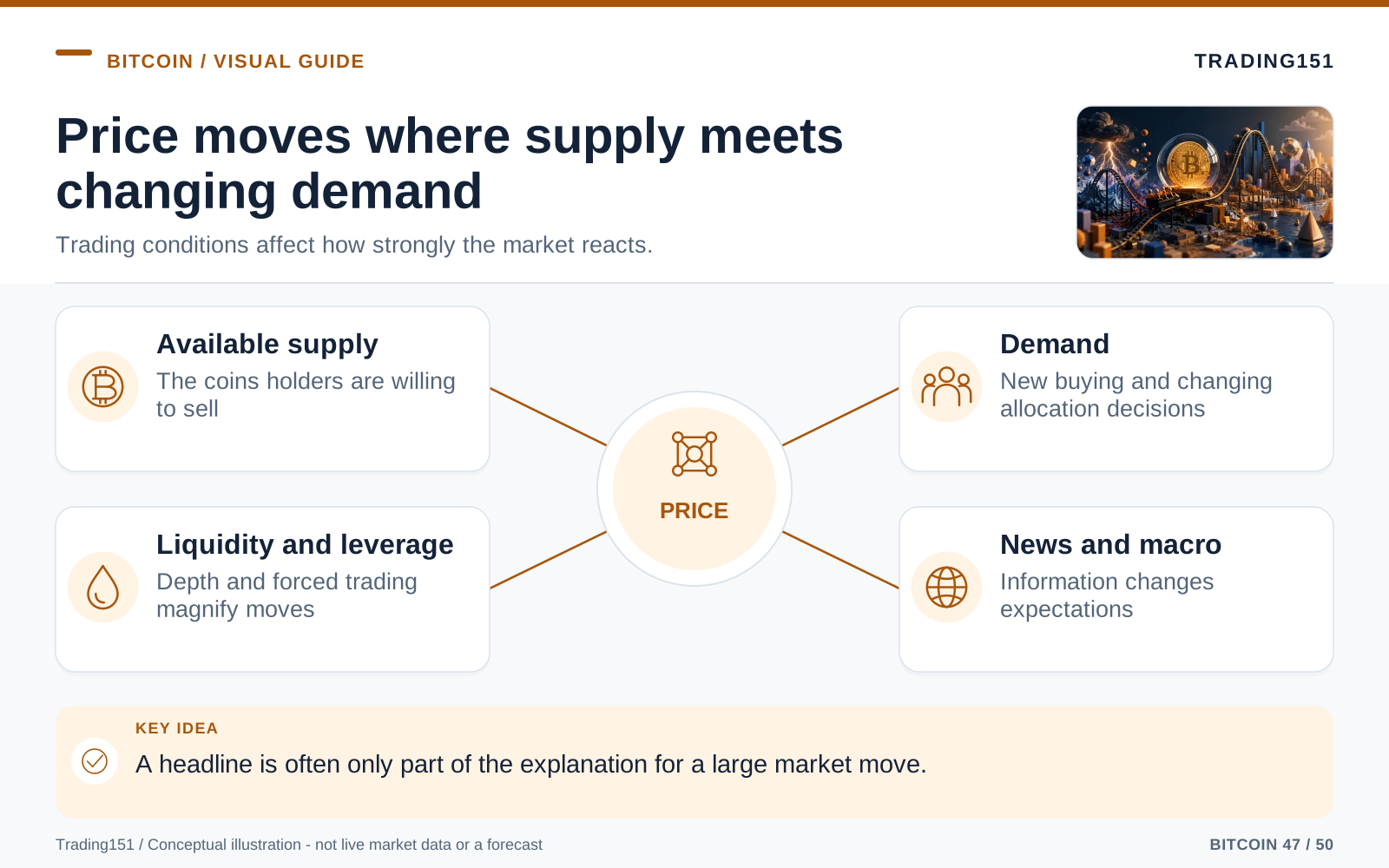
Read this diagram as text
- Available supply
- The coins holders are willing to sell
- Demand
- New buying and changing allocation decisions
- Liquidity and leverage
- Depth and forced trading magnify moves
- News and macro
- Information changes expectations
2. Market Sentiment: Fear, Greed, and the Stories People Tell
If supply and demand are the bedrock of Bitcoin’s price, sentiment is the weather. It changes fast, and when a storm rolls in, everybody gets wet.
Bitcoin is notoriously emotional. When people are feeling optimistic, every minor dip looks like a golden buying opportunity. But when they get spooked, even a harmless rumor can trigger a stampede for the exits. This happens in all markets, sure, but it’s dialed up to eleven in crypto because the casino never closes and traders are hyper-reactive.
FOMO—the fear of missing out—is arguably the single strongest emotion in Bitcoin. It usually kicks in right after a steep rally. The price breaks a key psychological barrier, the media goes crazy, your feed fills up with people bragging about their gains, and folks who ignored Bitcoin for years suddenly start sweating, wondering if they’ve missed the boat. New money floods in, often not because these people did their research, but because they can’t stand watching their neighbors get rich.
That surge of demand pumps the price even higher, grabbing more headlines, and dragging in even more buyers. For a little while, it’s a self-fulfilling prophecy.
On the flip side, you have FUD: fear, uncertainty, and doubt. Bad news spreads through the crypto world like wildfire. Maybe a big exchange is in trouble. Maybe a politician hints at a ban. A famous investor talks trash about it, or a rumor goes around that a large whale is about to dump their bags. Sometimes the threats are real; sometimes they’re completely made up. Either way, a scared market doesn’t stick around to fact-check.
When panic hits, people hit the sell button first and ask questions later. And because Bitcoin trades 24/7, these severe sell-offs can happen on a Sunday morning while the stock market is closed and regular banks are completely offline.
Sentiment also dictates the dominant stories around Bitcoin at any given time. During one bull run, everyone might agree it’s digital gold. In another phase, it trades like a risky tech startup. If banks are failing, people focus on the fact that it operates outside the traditional system. The actual code of Bitcoin hasn’t changed a bit, but the narrative driving it shifts all the time.
3. Regulation: The Market Watches Governments Closely
Bitcoin was invented to bypass governments and banks. But that doesn’t mean governments can’t mess with its price.
Regulation directly impacts how easily regular people and large funds can buy, hold, or use Bitcoin. When a major economy announces strict new rules, threatens a ban, or goes on an enforcement spree, the market usually takes a hit. Investors hate uncertainty, and governments are great at creating it.
Crackdowns and bans can hit hard. Back in 2021, when China cracked down on crypto mining and trading, it sent shockwaves through the market. A huge chunk of the world's mining power was located there. Miners had to pack up their rigs and flee, investors panicked about what it meant globally, and the price tumbled.
It’s not just outright bans, though. Tax laws, reporting mandates, and rules for exchanges can also steer the market. Even if a law doesn't ban Bitcoin, simply making it annoying or legally risky to own is enough to scare off big institutional money.
But regulation can also be a large catalyst for growth. When a country clarifies its rules in a way that legitimizes Bitcoin, it gives the green light to cautious investors. A perfect example is the approval of Bitcoin ETFs in the U.S.—it proved that regulatory clarity can unlock billions of dollars from traditional finance that were previously sitting on the sidelines.
4. Macroeconomics: Interest Rates and Inflation
Bitcoin might live on the internet, but it doesn't exist in a vacuum. It’s heavily swayed by the broader economy—especially interest rates and inflation.
When central banks drop interest rates to near zero, borrowing money becomes inexpensive. Savings accounts pay nothing, bonds are boring, and investors start hunting for assets that offer real returns. In this easy money environment, speculative and high-growth assets like Bitcoin tend to absolutely rip.
But when inflation gets out of hand and central banks hike interest rates to fight it, the script flips. Suddenly, you can get a decent, risk-free yield just by holding cash or government bonds. Borrowing money gets expensive. In response, investors start pulling their cash out of volatile assets.
People often debate whether Bitcoin is an inflation hedge. The argument makes sense on paper: its supply is strictly capped at 21 million, unlike fiat currencies which governments print endlessly. When people feel their dollars are losing purchasing power, a truly scarce asset starts looking really attractive.
That said, Bitcoin doesn’t always go up the minute inflation spikes. In the short term, markets do weird things. If inflation forces central banks to aggressively hike rates, Bitcoin can take a beating right alongside tech stocks, even if the long-term case for it being digital gold holds up. It’s confusing, but it just shows how conflicting macroeconomic forces can yank the price in opposite directions.
Then there's global liquidity. When money is sloshing around the global financial system, investors are brave. When liquidity dries up, they get conservative. Bitcoin thrives when people are eager to take on risk and have capital looking for a home.
5. Institutional Adoption: When Bigger Players Enter the Market
In the early days, Bitcoin was just a playground for tech geeks, libertarians, and retail traders. Today, the adults in the suits have arrived.
Publicly traded companies, hedge funds, asset managers, and family offices are now heavily involved, and they move the market simply because of their size. A single Wall Street firm can scoop up more Bitcoin in a day than thousands of everyday investors combined.
When these heavyweights step in, a few things happen. First, demand obviously shoots up. When a multi-billion dollar fund allocates even a tiny fraction of its portfolio to Bitcoin, the dollar amount is staggering. Second, it often shrinks the available supply. When institutions buy, they usually lock those coins up in deep cold storage for the long haul, pulling them off the active market.
Third, it completely shifts public perception. When large, respected financial institutions embrace Bitcoin, it forces the skeptics to pay attention. It doesn't eliminate the risk, but it definitely changes the vibe.
There’s a catch, though. Big money can sell just as easily as it buys. If an institution decides to rebalance its portfolio, or if a major ETF sees heavy outflows, the market will definitely feel it. Bitcoin’s price isn't just about who is buying—it's about how strong their hands are when things get choppy.
6. Liquidity and Leverage: Why Moves Can Become So Violent
If you’ve ever wondered why Bitcoin sometimes drops 20% in an hour, the answer usually comes down to leverage and market structure. Leverage basically turns normal price swings into a forced chain reaction.
When traders borrow money to place bigger bets, they are playing with fire. If they are betting the price will go up and it suddenly drops, their exchange will demand more collateral. If they don't have it, the exchange automatically liquidates their position—selling their Bitcoin at market price to cover the debt.
Liquidity plays a huge role here, too. Liquidity is just a fancy word for how easy it is to buy or sell without moving the price. If liquidity is deep, you can drop a large trade and the market barely blinks. If it’s thin—say, on a Sunday night when trading desks are closed—a moderately large order can send the price flying.
Leverage just pours gasoline on that fire. That forced selling from liquidations pushes the price down even further. Which triggers the next guy's liquidation. Which pushes the price down more. Suddenly, a totally normal dip turns into a violent, cascading crash. The same thing happens in reverse during a large rally, forcing short sellers to buy back in and sending the price into the stratosphere.
The chart looks like pure human panic, but it's really just automated trading engines unwinding bad bets.
So, if you’re a long-term investor, it helps to keep this in perspective. Not every violent crash means the dream is dead. Sometimes, the market is just taking out the trash and clearing out the over-leveraged gamblers.
7. Mining Economics: The Real-World Cost Behind Digital Money
Bitcoin is digital, but creating it requires serious physical infrastructure. Mining involves warehouses full of specialized computers, large cooling systems, and a staggering amount of electricity.
Miners are in a relentless competition to process transactions and add new blocks to the chain. Their business model relies on a delicate balance: the price of Bitcoin, their local electricity rates, how hard the network makes it to mine a block, and the size of the block reward.
When the price of Bitcoin is high, mining is lucrative. This attracts more miners, which increases the network's difficulty, meaning it takes more computing power to earn the same reward. But when the price tanks, miners with expensive electricity or older machines start losing money.
This matters to the price because miners are constant, natural sellers. They have to pay their power bills in dollars, not Bitcoin. If they are financially squeezed, they might be forced to dump large amounts of Bitcoin onto the market just to keep the lights on. If they are highly profitable, they can afford to hold onto their newly mined coins, which chokes off sell pressure.
The cost to mine a Bitcoin doesn't act as a magical price floor—Bitcoin can absolutely trade below what it costs to produce it. But mining economics still heavily influence the supply side. Especially after a halving event, when rewards are slashed, miners become a critical piece of the market puzzle.
8. Technology, Security, and Trust in the Network
Bitcoin runs on trust. Not trust in a CEO or a government, but trust that the code works, the network won't crash, and the rules of the game won't suddenly change.
Bitcoin has earned its reputation by being famously stubborn, conservative, and difficult to upgrade. Tech fans often complain that it moves too slow or lacks flashy features, but that’s a feature, not a bug. When you are dealing with a global monetary network, being boring and unbreakable is way more important than moving fast and breaking things.
That said, technical developments still matter. Upgrades that improve privacy, scale the network, or make it cheaper to use bolster the long-term argument for holding it.
But Bitcoin’s price is also guilty by association. When the broader crypto industry messes up, Bitcoin usually takes a hit. If a shady crypto exchange collapses, or a prominent lending platform goes bankrupt, the public loses trust. The average person on the street doesn’t differentiate between a decentralized Bitcoin protocol and a centralized, fraudulent crypto bank. They just hear crypto scam and hit sell.
It’s frustrating, because Bitcoin the network and the sketchy businesses built adjacent to it are entirely different things. But markets aren't always rational, and nuance is the first thing to die in a panic.
9. Media Coverage, Influencers, and Public Attention
Bitcoin is hyper-sensitive to the spotlight. When no one is talking about it, the market can drift sideways for months. But the moment it hits the front page of mainstream news sites, the volume explodes.
When traditional media starts hyping a bull run, it acts like a giant billboard for regular people who don't usually care about crypto. Positive headlines make it feel urgent and exciting. Negative headlines make it sound like a toxic asset destined for zero.
Influential public figures can also wield annoying amounts of short-term power. A single tweet from a famous tech founder or a stark warning from a prominent politician can send the market spiraling or soaring. Sometimes the market reaction makes sense; often, it’s just noise.
Things like Google search trends, app store rankings, and online chatter are all real-time gauges of retail interest. A large spike in attention usually means a flood of new money is arriving. But it’s also a classic warning sign that the market is getting overheated and euphoric. The trick is figuring out whether the hype is the start of a trend or the bitter end of one.
10. Geopolitics and Currency Trust
Because Bitcoin is borderless, local chaos can trigger global price moves.
For people living in countries plagued by hyperinflation, capital controls, or bank freezes, Bitcoin isn't a speculative toy—it's a financial lifeboat. It becomes a vital way to protect their life savings or move money outside the reach of a failing government.
Geopolitical friction drives demand, too. When trust in traditional institutions and fiat currencies fractures, people naturally look for an exit. Historically, that was gold. Today, a lot of people prefer a digital, scarce asset they can carry across a border on a flash drive or memorize in their head.
But don't mistake Bitcoin for a perfect safe haven. When global panic strikes—like the onset of a sudden crisis—investors tend to liquidate everything they can to get their hands on cash. Bitcoin often tanks right alongside the stock market in those initial moments of sheer terror. It’s only after the dust settles that the narrative tends to swing back toward Bitcoin as an independent, scarce asset.
11. Competition and the Broader Crypto Market
Bitcoin may be the king, but it's not the only game in town. There are thousands of other cryptocurrencies fighting for capital, developer talent, and media attention.
When the overall crypto market is running hot, Bitcoin usually benefits as a rising tide lifts all boats. New investors typically buy Bitcoin first because it’s the safest brand name, and then slowly wade out into riskier bets. During bear markets, that money often rotates back into Bitcoin as a flight to safety.
Competition can also challenge the narrative. Fans of other blockchains love to point out that Bitcoin is relatively slow and doesn't support complex applications natively. They argue that newer tech makes Bitcoin obsolete.
Bitcoin's defense is its absolute simplicity and unmatched security. It’s not trying to do everything; it just wants to be decentralized money. For its strongest believers, that narrow, stubborn focus is its biggest selling point.
Still, investor capital isn't unlimited. If a large new trend takes over the crypto space and sucks up all the oxygen, Bitcoin can lag behind. And if faith in the broader crypto ecosystem implodes, Bitcoin is going down with the ship, even if it’s the sturdiest vessel in the water.
12. Long-Term Holders and Exchange Supply
If you really want to understand Bitcoin’s price, you have to look at where the coins are sitting.
When large amounts of Bitcoin are scooped up by long-term believers and transferred off exchanges into cold storage, the circulating supply shrinks. This makes the market extremely tight. If a burst of new buyers shows up, there just aren't enough sellers to meet the demand, and the price is forced violently upward to convince someone to part with their stash.
On the flip side, when you see a large influx of Bitcoin moving back onto exchanges, it’s usually a warning sign. It doesn't guarantee a dump, but it shows that holders are dusting off their wallets and getting ready to sell if the price is right.
These long-term holders act like a shock absorber for the market. If they refuse to sell during a severe crash, they eventually put a floor under the price. If they decide it’s finally time to take profits after a large run-up, their selling pressure caps the rally.
This is where Bitcoin’s weird, tribal culture directly impacts its economics. Some people are holding for a decade, rain or shine. Others are day-trading every tiny blip on the chart. The constant tug-of-war between those two groups dictates the daily price action.
Separate a plausible explanation from evidence of a cause
Start with timing. Did the proposed cause become public before the move, or was it discovered afterward? Was it genuinely unexpected? A headline that repeats known information may be relevant background without being the trigger for the latest price change. Distinguish the event's date from the publication date of an article discussing it.
Check the scale and type of the evidence. A transfer to an exchange is not necessarily a sale, a fund's reported holdings can change in value without new purchases, and a liquidation estimate may cover only selected venues. Each can inform an explanation, but none should be stretched beyond what the measurement establishes.
Consider several mechanisms together. A policy announcement may prompt an initial move, thin liquidity may amplify it, and leveraged positions may then be closed automatically. Explaining the outcome solely as investor sentiment or solely as liquidations can omit part of the sequence. Market behavior often has a trigger and an amplification mechanism rather than one complete cause.
For a trading or investment decision, ask what follows from the explanation. Does it change the long-term thesis, the immediate execution risk, or neither? Not every interesting account of a price move supports an actionable forecast. Sometimes the most accurate conclusion is that several factors are plausible and their individual contributions cannot be measured reliably from the available public data.
Leave room for more than one cause
A price move can reflect several influences at once: a release, a change in leverage, a large order, reduced liquidity, or a shift in broader risk appetite. A news story published afterward may identify a plausible contributor without proving it was the sole cause. State the evidence and uncertainty rather than converting a convenient explanation into a mechanical rule for the next event. 1, 2, 3
Why the Volatility Makes Sense
So, what really moves the price of Bitcoin?
Honestly? Everything, all at once.
Its hard-capped supply creates scarcity. The halvings constantly tighten the spigot of new coins. Human emotion turns normal price swings into euphoric rallies or panicked crashes. Government regulations can either open the floodgates for billions of dollars or scare it all away. Inflation and interest rates dictate whether people even want to take a risk in the first place. Big institutions bring large volume, while leverage ensures that the resulting moves are as dramatic as possible.
When you zoom out, Bitcoin’s volatility isn’t a glitch or a flaw. It’s exactly what happens when a globally traded, perfectly scarce asset is accessible 24/7 to anyone on earth—from a billionaire hedging his portfolio to a teenager gambling with borrowed money.
Yeah, the ride is uncomfortable. But that wild, unconstrained price discovery is exactly why Bitcoin captured the world's attention to begin with.
If you’re trying to wrap your head around Bitcoin, do yourself a favor and stop staring at the daily charts. Look at the gears turning underneath. Is demand growing? Are miners struggling? Are long-term holders getting spooked, or are they stacking more? Pay attention to the broader economic environment and the shifting narratives.
No single metric will ever explain every chaotic jump or sudden crash. Bitcoin is a tug-of-war between technology, politics, economics, and pure human psychology.
The rollercoaster is very real. But once you realize what’s moving the tracks, the ride starts to make a lot more sense.
Sources and further reading
- BIS: April 2025 FX turnover, September 2025 preliminary release
- Bitcoin.org: Protect your privacy
- SEC Investor Bulletin: Crypto Asset Custody Basics for Retail Investors
Editorial revision: 7 October 2026. Numerical scenarios are hypothetical unless identified as historical. References support the added explanations and selected corrections; rules and product terms should be checked again before acting.