
The four-year Bitcoin cycle is a way of organizing a short market history around a recurring supply event. It can help describe past episodes, but it is not a calendar issued by the network. The halving is programmed. The timing of rallies, peaks, drawdowns, and recoveries is not. A useful cycle theory must leave room to be wrong.
The Engine Behind the Cycle: The Bitcoin Halving
It all starts with Bitcoin's supply schedule. Unlike fiat currencies like the dollar or the euro, Bitcoin doesn't have a central bank ready to fire up the money creation when things get tough. New Bitcoin is created through mining, and the rules for how that happens are hardcoded into the software. Crucially, the halving affects the flow of new coins, not the total supply already out there. Sure, millions of coins trade hands every day, making the drop in new supply seem tiny by comparison. But the real impact comes from the grind: that lower issuance just keeps happening, block after block. Miners suddenly have fewer new coins to sell to cover their electricity bills. Whether that squeeze pushes the price up depends on buyer demand and how tightly long-term holders are gripping their coins. But —the halving is a relentless, long-term supply constraint, not just a one-day event.
To understand this, you need to know what miners do. They're the folks (and large companies) running the specialized computers that secure the network. In exchange for doing that heavy lifting, they earn a "block reward"—a mix of newly minted Bitcoin and transaction fees. This reward is how new BTC enters the world.
But here’s the kicker: there will only ever be 21 million Bitcoin. To release those coins slowly over time, the network is programmed to cut the block reward in half every 210,000 blocks. That math works out to about once every four years. We call it the halving.
- When Bitcoin started in 2009, miners pulled in 50 BTC per block.
- In 2012, that dropped to 25 BTC.
- In 2016, it went down to 12.5 BTC.
- In 2020, it hit 6.25 BTC.
- And in April 2024, it was slashed to 3.125 BTC.
It sounds like technical trivia, but supply mechanics are a huge deal in any market. Imagine if the production of gold or oil was sliced in half overnight, but people still wanted to buy just as much of it—if not more. Miners suddenly have half as much fresh supply to dump on the market, meaning buyers have to fight over a shrinking pool of new coins. It doesn’t mean the price magically rises sharply the very next day, but it fundamentally alters the underlying supply-and-demand pressure.
That's why you'll hear people call the halving a "supply shock." It doesn't delete existing Bitcoin, and it certainly doesn't guarantee that people will keep buying. It just turns off the tap a little more. And if demand stays robust, that shrinking flow really starts to matter.
Of course, the market never handles this gracefully. Everyone knows exactly when the halving is coming, so traders constantly try to front-run it. Miners upgrade their gear to stay profitable. Diamond-handed holders refuse to sell, while short-term gamblers buy the rumor and dump the news. Plus, big institutions are doing their own thing based on macroeconomics. Despite all that noise, the halving has consistently acted like a metronome for Bitcoin, creating a rhythm of four distinct "seasons" that play out over each cycle.
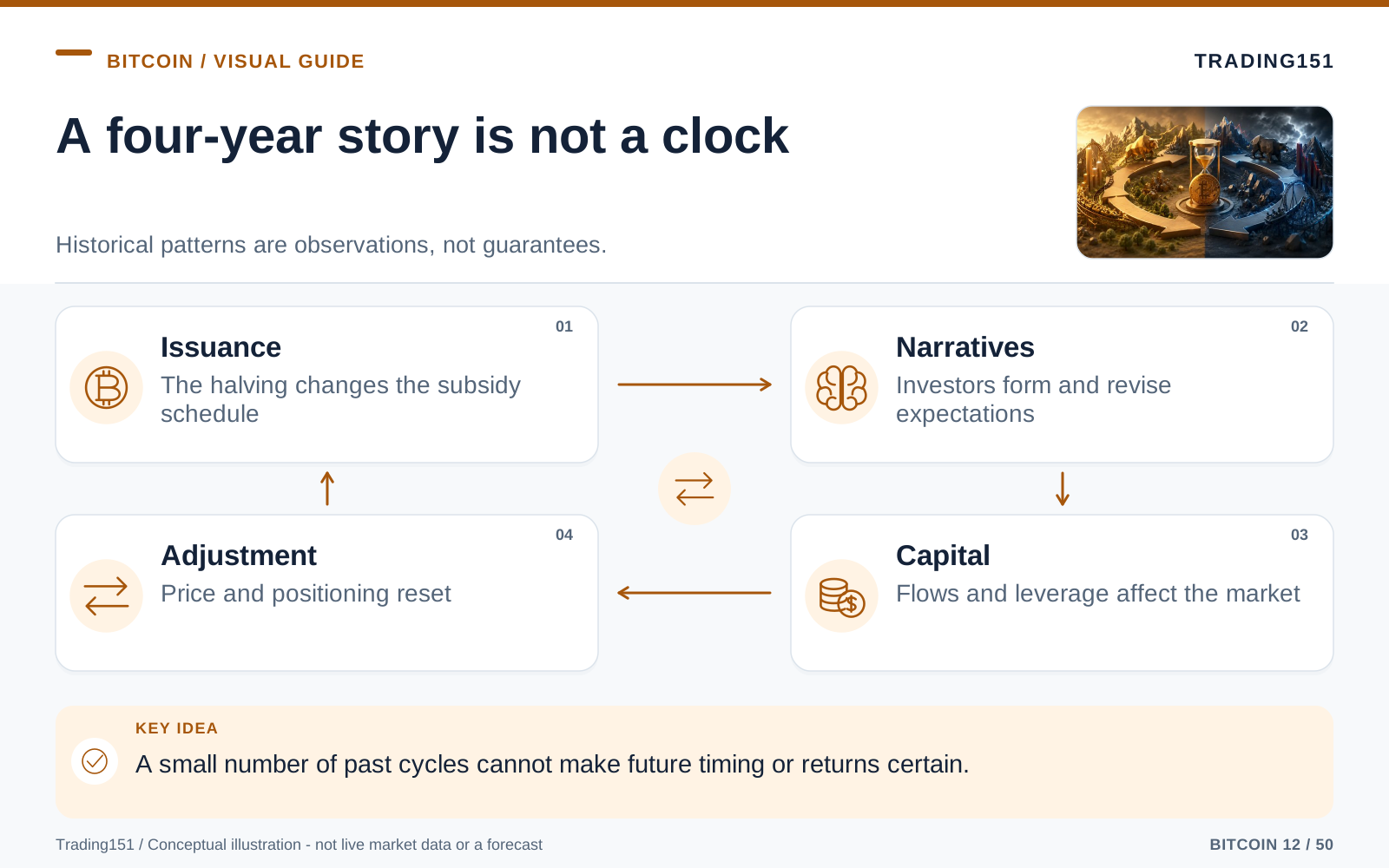
Read this diagram as text
- Issuance
- The halving changes the subsidy schedule
- Narratives
- Investors form and revise expectations
- Capital
- Flows and leverage affect the market
- Adjustment
- Price and positioning reset
Season 1: Accumulation, or the Quiet Winter
You know you're in the accumulation phase when absolutely no one wants to talk to you about crypto at parties.
This period always follows a savage bear market. Prices are usually down 70% or more from the top. All those insane price predictions? Gone. The crypto influencers who were flooding your feed a year ago have either pivoted to AI, disappeared entirely, or started tweeting vague motivational quotes. The mainstream media is running obituaries for Bitcoin. Regulators are out for blood. And all the bad leverage, failed projects, and outright scams from the last bull run are finally getting flushed out.
It's boring to watch. The price just slowly grinds sideways for months on end. Any mini-rally gets immediately crushed. The folks who bought the top are deeply embarrassed, while the skeptics take victory laps. Even the die-hard believers start to sweat a little, wondering if maybe, just maybe, this time it really is over.
The psychology: Fear turns into total apathy. That's a huge difference. When the market is actively crashing, people are panicking—they're screaming on Twitter, blaming exchanges, blaming the Fed, blaming each other. But by the time deep accumulation sets in, everyone is just exhausted. People don't even hate Bitcoin anymore; they just don't care. Boredom takes over, and frankly, boredom is the ultimate filter.
The action: While the tourists have packed up and gone home, the smart money quietly steps in. This is when the veterans, well-funded miners, and institutional desks start scooping up cheap coins. They aren't buying because they're caught up in the hype—there is no hype. They're buying because the leverage is gone, the weak hands have sold, and the risk-to-reward ratio looks incredible.
Fair warning: this phase drags on way longer than you want it to. Buying here sucks because you don't get that instant dopamine hit of your portfolio shooting up the next day. Instead, you get months of sideways chop. But historically? This is where the real money is made. Not when Bitcoin is front-page news, but when it's utterly forgotten.
Season 2: Recovery and Pre-Halving, or the First Warm Days of Spring
Eventually, the bleeding just... Stops. Nobody rings a bell at the exact bottom, but the panic selling dries up. The terrible news headlines stop crashing the price, and Bitcoin starts creeping up so quietly that it almost feels like a trap.
Welcome to the recovery phase. The dust has settled, and guess what? The network hasn't died. Blocks are still being processed. Devs are still writing code. The survivors of the bear market start crawling out of their bunkers, bruised but alive. Slowly, the market remembers that Bitcoin has been declared dead hundreds of times before, and it's always come back.
The psychology: Hope creeps back in, but everyone is heavily traumatized. No one wants to get hurt again, so every green day is treated with extreme suspicion. People call every pump a "bull trap," and the second the price dips 5%, Twitter declares that the bear market is back. It takes a long time for the PTSD of the crash to wear off.
The action: As the next halving gets closer, the price usually starts front-running the event. Traders want to get in before the supply gets cut. But it’s never a straight line up. Bitcoin will surge, violently shake out the latecomers, and then grind higher again. It’s frustrating, but it shakes the weak hands out of the market before the real run begins.
Funnily enough, the halving day itself is usually a large letdown. People log in expecting explosive fireworks, but it’s just a line of code executing. One block pays out the old reward, the next pays the new one. There’s no parade, and there’s definitely no guaranteed giant green candle on the chart. The actual impact takes months to hit, as the reduced daily supply slowly starves the market of new coins.
That lag is exactly why trading this cycle is so tricky. The market doesn't skyrocket just because the code says so. It rockets when the shrinking supply finally collides with a wave of fresh capital and new hype.
Season 3: The Bull Market, or the Summer Everyone Claims They Saw Coming
Then comes the tipping point. The price action stops feeling fragile, and Bitcoin starts effortlessly tearing through resistance levels. Suddenly, the previous all-time highs are back in play. The mainstream media pivots back to covering crypto favorably. And right on cue, the friends who ghosted you during the bear market text you to ask if it's "too late to get in."
This is when the bull market completely detaches from reality.
The first leg of the bull run is usually driven by the veterans who bought during the quiet winter. But the final, explosive leg? That's driven by the masses. Early buyers had a thesis and a plan. Late buyers are purely driven by FOMO—that gut-wrenching feeling that everyone else is getting rich without them.
The psychology: Disbelief morphs into cockiness, and cockiness morphs into pure, unadulterated euphoria. At first, people are just happy to be back in the green. Then they get greedy. Suddenly, everything you learned during the severe bear market is thrown out the window. Who needs risk management when everything goes up 10% a day? People who were too scared to buy Bitcoin at $20k are suddenly emptying their savings accounts to buy it at $80k because the momentum makes them feel invincible.
The action: It's a gold rush. Money floods the system. Bitcoin is on the morning news. Coinbase crashes under the weight of new signups. And then the circus really begins: altcoins go parabolic, and totally useless meme coins start printing overnight millionaires. Latecomers see a dog token jump 400% in a week and decide that playing it safe is for losers.
This phase is intoxicating, but it's dangerous. Nothing makes you feel like a financial genius quite like a raging bull market. When your portfolio doubles in a month, taking out a loan to buy more feels like a brilliant idea. When your neighbor buys a new car off a random crypto trade, sticking to a conservative investment plan feels stupid. The market actively rewards terrible, reckless behavior—just long enough for people to confuse sheer luck with actual skill.
And without fail, you’ll start hearing the four most dangerous words in investing: "This time is different." And sure, the details are always a bit different. Maybe institutions are buying this time, or ETFs are live. But underneath it all, human nature hasn't changed. When people say "this time is different," what they really mean is that they think gravity has been permanently turned off.
Spoiler alert: it hasn't.
Season 4: The Blow-Off Top and Bear Market, or the Autumn Nobody Wants to Admit Has Arrived
Bull markets don't politely taper off when everyone decides prices are fair. They explode. They end because the market gets dangerously top-heavy with leverage, late money, and blind greed. At the absolute peak, Bitcoin feels unstoppable. Anyone predicting a pullback gets bullied off the timeline. People stop looking at actual charts and start updating spreadsheets to see how rich they'll be when Bitcoin hits a million dollars.
Then, the music stops, and the first severe red candle drops.
At first, no one believes it's over. Everyone calls it a "healthy correction." Influencers scream to "buy the dip!" Traders pull up historical charts to prove that a 30% drop is totally normal in a bull run. And to be fair, they're often right—bull markets usually survive a few nasty shakeouts before finally rolling over.
But eventually, a dip comes that just doesn't bounce. The dip buyers run out of cash. Leveraged long positions start getting liquidated. And suddenly, the momentum flips. All those people who bought just because the price was going up start panic-selling because the price is going down. The flywheel reverses.
The psychology: It’s a rapid descent from euphoria to deep denial, then anxiety, then rage, and finally, despair. The guy who swore he was holding his bags for ten years is suddenly sweating profusely, checking his portfolio app at 3 AM. The market, which just weeks ago felt like a magical ATM, suddenly feels cruel and personal, punishing everyone who got too greedy.
The action: The cascade begins. Margin calls trigger a large domino effect. Zombie crypto projects fold. Crypto lenders that promised 15% yields suddenly halt withdrawals. Scams that thrived in the easy-money days get exposed the second liquidity dries up. The retail tourists cut their losses and run. Then the aggressive day traders blow up. And finally, the long-term holders who tried to brave the storm capitulate because they just can't stomach the red numbers anymore.
It's an ugly process. But it's necessary. A forest fire burns out the deadwood. The leverage gets nuked, the frauds go to jail, and the surviving builders put their heads down and get back to work without the distraction of hype. The chaos fades.
The market goes quiet. And just like that, the cycle resets.
Why the Cycle Isn't a Guarantee
As helpful as the four-year framework is, you'll get burned if you treat it like a rigid calendar. Bitcoin isn't under any obligation to peak exactly 500 days after a halving just because some guy on YouTube drew lines on a chart. And once everyone figures out a trading pattern, it stops working perfectly. People start trying to front-run the front-runners. Miners hedge their bets, futures traders shift the timeline, and large Wall Street funds rebalance their portfolios on schedules that have absolutely nothing to do with Bitcoin's halving. Sure, the overall rhythm is still there, but every cycle brings new players who change the rules of the game.
Here’s what’s actively warping the cycle today:
Wall Street Crashed the Party
In the early days, Bitcoin was just a bunch of retail traders, cypherpunks, and miners bouncing the price around. That crowd is still here, but they aren't steering the ship alone anymore. The launch of the US Spot Bitcoin ETFs in early 2024 changed everything. Now, boomers can buy Bitcoin right from their retirement accounts.
That doesn’t mean Bitcoin is suddenly as stable as a bond, but it does mean it's deeply wired into traditional finance. Wall Street hedge funds, algorithmic trading desks, and registered investment advisors are pushing large volume now. They might dampen the crazy volatility, or they might make it weirder—but either way, they are definitely altering the timeline.
The Gravity of Diminishing Returns
The days of Bitcoin doing a 100x return in a year are over. It was easy to post insane multiples when Bitcoin’s total market cap was the size of a mid-tier tech company. It takes a hell of a lot more capital to move a trillion-dollar asset.
That doesn't mean Bitcoin can't make huge moves. It just means the percentage gains from the bottom of the bear market to the top of the bull market are getting smaller each time around. It's just simple math: moving a boulder takes more energy than moving a pebble.
The Real World Matters (A Lot)
Bitcoin doesn’t exist in a vacuum. Interest rates, inflation, wars, banking collapses, and the Federal Reserve’s mood swings all dictate what happens to the price. When money is cheap and easily available, speculative assets like Bitcoin rip higher. When the Fed raises rates and chokes off liquidity, even the most bullish halving narrative can’t save the market from a bleed-out.
This is where die-hard cycle theorists get wrecked. They stare so hard at the Bitcoin halving countdown that they ignore the actual global economy. The halving controls supply, but global macroeconomic conditions control demand. You can't ignore half the equation.
2024 Already Broke the Rules
If you followed the old playbook, Bitcoin wasn't supposed to break its all-time high until after the halving. But 2024 threw that script out the window. Thanks to the large tidal wave of Wall Street ETF money, Bitcoin smashed through its all-time high months before the April 2024 halving even happened.
After that, the market became a messy tug-of-war between institutional cash, macroeconomics, and classic crypto degeneracy. We saw major peaks in 2025 before nasty cool-offs. It didn't invalidate the four-year theory, but it proved you have to stay on your toes. History rhymes, but it rarely repeats itself exactly.
The Halving Isn't Magic, It's Just Math
Please don't fall for the trap of treating the halving like a magical "go up" button. The logic of "supply gets cut, therefore price automatically rises sharply" is dangerously flawed. The real world is much messier.
Yes, the halving cuts new supply, but it doesn’t magically generate new buyers. If the miners have fewer coins to sell, but nobody is buying anyway, the price will still drop. If everyone aggressively buys the rumor months in advance, the actual halving event might just be a "sell the news" dump. If old-school whales decide it's time to cash out, their selling will completely overpower the drop in miner supply.
Instead of magic, think of the halving as a slow, structural shift in pressure. It gradually tightens the valve on new coins entering the market. Over a long enough timeline, if demand holds up, that squeeze really starts to bite. But markets are made of messy, emotional humans acting on different timelines and incentives. The halving just changes the baseline math—it's human psychology that builds the cycle.
What the Cycle Teaches Us About Human Nature
The biggest takeaway from studying Bitcoin's history isn't about supply mechanics; it's about how ridiculously predictable people are when money is on the line.
When prices are in the gutter and the market is dead, people are terrified to buy. They want a guarantee that the bottom is in before they make a move. By the time that "guarantee" arrives, the price has already doubled. Conversely, when prices are rocketing to the moon, buying feels safe because all your friends are doing it. In reality, that's exactly when you're in the most danger.
That's the severe irony of investing. The absolute best financial opportunities feel terrible in the moment. The worst financial mistakes usually feel like a sure thing because everyone is cheering you on.
Understanding the four-year cycle gives you a huge advantage because it lets you step back from the emotional chaos. Instead of staring at a 15-minute chart, you can ask yourself the real questions: Are people currently bored, or are they overly hyped? Is the system swimming in risky leverage, or did it just get flushed out? Are people buying because they believe in the tech, or just because they want to get rich by next Tuesday?
You won't always get the answers right, but asking those questions is infinitely better than waking up, checking the price, and letting your emotions drive your trades.
How to Navigate the Cycle Without Losing Your Mind
Knowing about the cycle is great, but only if it improves your decision-making. If you let it fuel your arrogance, it will destroy your portfolio. But if you use it as a tool for patience, it's invaluable. The trick is to build your strategy before the market goes insane. Sit down during a quiet week and map out exactly how much you're willing to risk, how much pain you can stomach, and what your exit price is. Making those decisions when the market is boring makes you immune to the FOMO of a large pump or the sheer terror of a crash. Stop trying to snipe the exact top or bottom. The only real goal is to make sure you aren't making life-altering financial decisions when the rest of the market has lost its collective mind.
Zoom Out Before You Do Something Stupid
Staring at Bitcoin's daily chart is a great way to drive yourself insane. A 10% swing is just a random Tuesday in crypto. A single bad headline can tank the mood for an entire weekend. Crypto Twitter will make every minor dip feel like the apocalypse and every green candle feel like the dawn of a new financial empire.
Whenever you feel the urge to panic-sell or FOMO-buy, just zoom out. Look at the macro picture. Are we in the dead of winter, early spring, or late summer euphoria? A scary 15% drop means something completely different in a raging bull market than it does at the bottom of a bear cycle.
Just Dollar-Cost Average and Relax
Trying to perfectly time the bottom or snipe the absolute top is a large waste of time. Even the pros get it wrong constantly. For 99% of people, dollar-cost averaging (DCA)—just buying a set amount of Bitcoin every week or month regardless of the price—is the smartest play.
DCA isn't a magic shield against losses, and it won't stop your portfolio from bleeding in a bear market. But what it does do is remove the exhausting emotional burden of trying to time the market. It turns investing from a high-stress gamble into a boring, background habit. And in a market as volatile as Bitcoin, being bored is a superpower.
Make a Plan Before the Chaos Starts
The absolute worst time to figure out your exit strategy is when your heart is pounding because the market is up 20% in a day. If you plan during euphoria, greed is making your decisions. If you plan during a crash, fear is driving the bus.
Figure out exactly what you want out of Bitcoin right now. Are you holding for the next ten years? Are you swinging trades for extra cash? Or did you just throw a few bucks in for fun? Be honest with yourself. If you're a long-term holder, you shouldn't be sweating a weekend dip. If you're a short-term trader, don't suddenly rebrand yourself as a "long-term investor" just because your trade went deeply into the red.
Take Profits, Ignore the Haters
Crypto culture has this weird, toxic trait where selling your bags is viewed as an act of treason. That is absolute garbage. Taking profit is not a moral failing; it's called being an adult. Bull markets print life-changing screenshots, but only the money you cash out will change your life.
Taking profits doesn't mean you have to sell your entire stack. It might just mean shaving a little off the top as the price rips, pulling out your initial investment so you're playing with house money, or moving some cash into safer assets. The specifics are up to you. Just make sure you hit the "sell" button before the bear market does it for you.
Never Confuse a Pattern With a Promise
The four-year cycle is a map, not the actual terrain. Maps are great because they give you a general sense of direction, but if you look at a map and forget there might be a sudden roadblock ahead, you're going to crash.
Going forward, Bitcoin might chill out and become a stable, boring asset. Or it might keep swinging substantially for another twenty years. We could get hit with severe regulations, large macro shocks, or unexpected technological leaps that break the old models entirely. Don't be a blind zealot, but don't be a cynical hater either. Stay sharp, stay curious, and be ready to adapt.
How People Keep Messing Up the 4-Year Theory
The most common trap is expecting a perfect replay of the last cycle. It never happens. Every bull run has a different macro environment, different players, and a different narrative driving the hype. The block halving is mathematically precise; human behavior is definitely not.
The second mistake is ignoring common sense just because it's "supposed" to be a bull market year. A great narrative can pump a token for a while, but it doesn't delete risk. FOMOing into an asset just because the chart is green is a recipe for disaster.
Third, stop waiting for someone to give you the "all-clear" signal. Markets don't offer certainty at a discount. By the time your local news anchor admits the bear market is over, the easy money has already been made. By the time everyone on earth agrees that Bitcoin is going to $500k, you're probably standing at the edge of a cliff.
Fourth, don't use the cycle to justify going aggressively all-in. Even if your thesis is dead-on, if you over-leverage or bet money you can't afford to lose, the normal crypto volatility will eventually shake you out and force you to sell at a loss.
Finally, never forget that Bitcoin is still a large experiment. Yes, it has survived incredible stress tests and secured trillions in capital. But it's also highly volatile, politically targeted, and complex. Acknowledge both realities.
So, Does the 4-Year Cycle Even Matter Anymore?
Yes, it absolutely matters. But probably not in the rigid, fortune-telling way that Twitter influencers want you to believe.
It matters because the halving is a real, mathematical shift in supply. It matters because human psychology is doomed to repeat its boom-and-bust cycles forever. And it matters because, time and time again, Bitcoin has followed this exact rhythm: winter accumulation, cautious spring recovery, manic summer highs, and a severe autumn reset.
But you should treat the cycle as an emotional compass, not a countdown clock. It's a tool to gauge when the market is irrationally terrified or unsustainably greedy. It reminds you that boring sideways price action is secretly productive, while explosive up-only charts are deeply dangerous. It brings a little bit of sanity to a market that otherwise feels like a casino.
The investors who survive don't worship the four-year cycle as an infallible religion. They use it as a guide, but they stay flexible. They know that in the world of crypto, a healthy dose of humility is the only thing that keeps you from blowing up your account before the next bull run.
Decide what would count as a failed cycle forecast
A forecast that moves its dates whenever prices disagree is difficult to test. Before using a cycle model, write down the event it predicts, the time window, and the evidence that would contradict it. "A major rally sometime after the halving" leaves so much room that almost any later rise can be claimed as confirmation.
Compare the model with a simpler alternative. Would a regular purchase schedule, a fixed allocation, or no trade at all have produced a better result after costs and taxes? Include the periods when the model kept you out of a rising market, not just the occasions when it helped you avoid a decline. A story about calling the peak is incomplete without the missed opportunities and false alarms.
Definitions matter too. A cycle peak measured in dollars may not be a peak in inflation-adjusted terms or in another currency. A price index and the return earned by someone making contributions along the way are different series. Be clear about which outcome the model is supposed to explain.
The practical lesson can survive even if the timing theory does not. Pre-agreed exposure limits and a plan for handling a large gain or loss reduce improvisation. They do not require believing that the next market phase will arrive on schedule. Use history to prepare for a range of outcomes, rather than to assign precise dates to events the protocol does not control.
Decide what would disprove the cycle story
A cycle theory becomes difficult to evaluate when every result can be made to fit it. An early rally is called anticipation; a late rally is called delay; a fall is called a final shakeout. That may produce a persuasive narrative, but it does not leave a clear prediction to test.
Write down a time window, a measurable event, and a condition under which the theory would be considered unhelpful. Keep those definitions unchanged while observing the outcome. Compare the theory with simpler alternatives, such as holding a constant allocation or making regular contributions, rather than only with an imagined investor who bought every top.
This does not require abandoning historical analysis. It gives history a disciplined role. Past episodes can suggest questions about leverage, liquidity, or investor behavior without dictating a future price path. The useful lesson may concern vulnerability during a crowded trade rather than the date of the next peak. 1, 2
A Cycle Is a Map, Not a Clock
The Bitcoin cycle is a cocktail of hard math, powerful narratives, and basic human nature. The math is simple: the halving cuts supply. The narrative is whatever story the market latches onto—institutional adoption, digital gold, escaping inflation. And the human nature is the same cocktail of greed, fear, regret, and FOMO that has driven financial markets for hundreds of years.
That chaotic mix is exactly why Bitcoin feels completely unhinged in the moment, but weirdly poetic when you look back at the chart years later. In the dead of winter, Bitcoin is a pariah. In the spring, people tentatively wonder if it's safe to come out. By summer, everyone acts like they're a financial genius who never doubted it for a second. And in the fall, the market ruthlessly reminds everyone that gravity still exists.
No theory in the world can strip the volatility out of crypto. No magical chart pattern can promise you safety, and no block halving can guarantee you a profit. But understanding how these cycles work gives you the ultimate edge: perspective.
Having perspective stops you from substantially aping into every green candle on your feed. It lets you realize when you're getting swept up in a panicked mob, and it reminds you that Bitcoin has never, ever moved in a straight line.
The ride is still going to be absolutely wild. The timeline will get messy, and there are zero guarantees about the future. But if you can learn to feel out the rhythm instead of white-knuckling every dip, the crypto market becomes a lot less scary.
So zoom out. Keep your ego in check. Only risk what you can stomach losing. And never forget: in Bitcoin, the winter never feels like the opportunity of a lifetime while you're freezing in it. It only looks obvious once the spring finally comes.
Sources and further reading
Editorial revision: 7 October 2026. Numerical scenarios are hypothetical unless identified as historical. References support the added explanations and selected corrections; rules and product terms should be checked again before acting.