Bitcoin has no contractual claim on a company's earnings and does not promise a stream of interest payments. Its market value depends on what people are willing to pay for the properties and uses they expect it to retain. Limited issuance, transferability, and independence from a single issuer are part of that argument. None produces a guaranteed price without continuing demand.
Value Is Not as Solid as It Feels
We have a weird habit of talking about value like it’s a physical ingredient hidden away inside objects. We say gold is inherently valuable. We look at dollar bills or real estate or vintage art and assume their worth just sits right there in the atoms. But value isn't some invisible substance you can extract if you crack an item open. Truly, value exists entirely in the relationships between everyday objects and the human beings who actively want, rely on, trust, or expect others to embrace those objects down the road. It’s also substantially easy to trip up and confuse price with value. A price tag simply reflects whatever random buyers and sellers happen to agree upon at any passing second. Real value, on the other hand, boils down to underlying usefulness, raw rarity, deeply earned trust, social status, and long-term problem-solving power. Markets routinely misjudge things—overpricing a popular trend today only to aggressively discount it tomorrow, or vice versa. Watching Bitcoin’s daily charts won't settle any deeper debates, since a chart merely snapshots the temporary sentiments of active traders. The real bull case relies heavily on whether this decentralized system keeps accomplishing something meaningful that everyday folks truly care about.
Take a sharp look at a normal hundred-dollar bill. From a purely physical standpoint, it's completely unspectacular—a rectangular slip of blended cotton and linen bearing fancy green ink. You certainly can’t boil it for dinner, assemble a cabin with it, sew a wardrobe out of it, or plug your phone charger into it. Imagine if everyone simply collectively woke up tomorrow morning and decided they wouldn't take dollars anymore; that crisp banknote instantly becomes an over-engineered bookmark. It functions as currency strictly because we operate on a large shared leap of faith: we believe our neighbors will continue treating it as valid spending power. A corner baker gladly accepts your money because the utility company wants those exact same funds from him. The electric firm demands it to cover payroll, and employees need it because local grocery stores and banks happily balance their ledgers using that very denomination.
None of this implies fiat currencies are total illusions or pointless fakes; it simply reminds us that money completely relies upon an underlying social contract. Even classic wealth like gold operates under these exact same principles. Sure, gold possesses handy industrial features, handles erosion beautifully, looks gorgeous, and takes large effort to dig up and refine. Yet an immense chunk of its large financial worth exists simply because humanity spent thousands of years collectively agreeing to treat bright yellow metal as precious treasure. Notice how a freshly cast gold ingot never speaks up to declare its own market worth—people do.
Bitcoin unapologetically pushes us to face this deeply uncomfortable reality by completely shaving off the comforting physical decorations of old money, leaving us staring right at the bare social consensus beneath. Without shiny jewelry or official emblems to soothe our nerves, it forces a radical question onto the table: can a strictly digital network successfully build unshakeable scarcity, indisputable individual ownership, and rapid global transferability without relying on a centralized corporate clearinghouse?
Die-hard believers naturally shout yes, while dedicated skeptics aggressively say no. Regardless of which camp you sit in, the intense argument keeps going because Bitcoin represents way more than just another digital payments app or trendy speculative fad. It functions as a ambitious shot at crafting money where every regulation gets rigidly protected by transparent mathematics and community participation rather than powerful centralized boards.
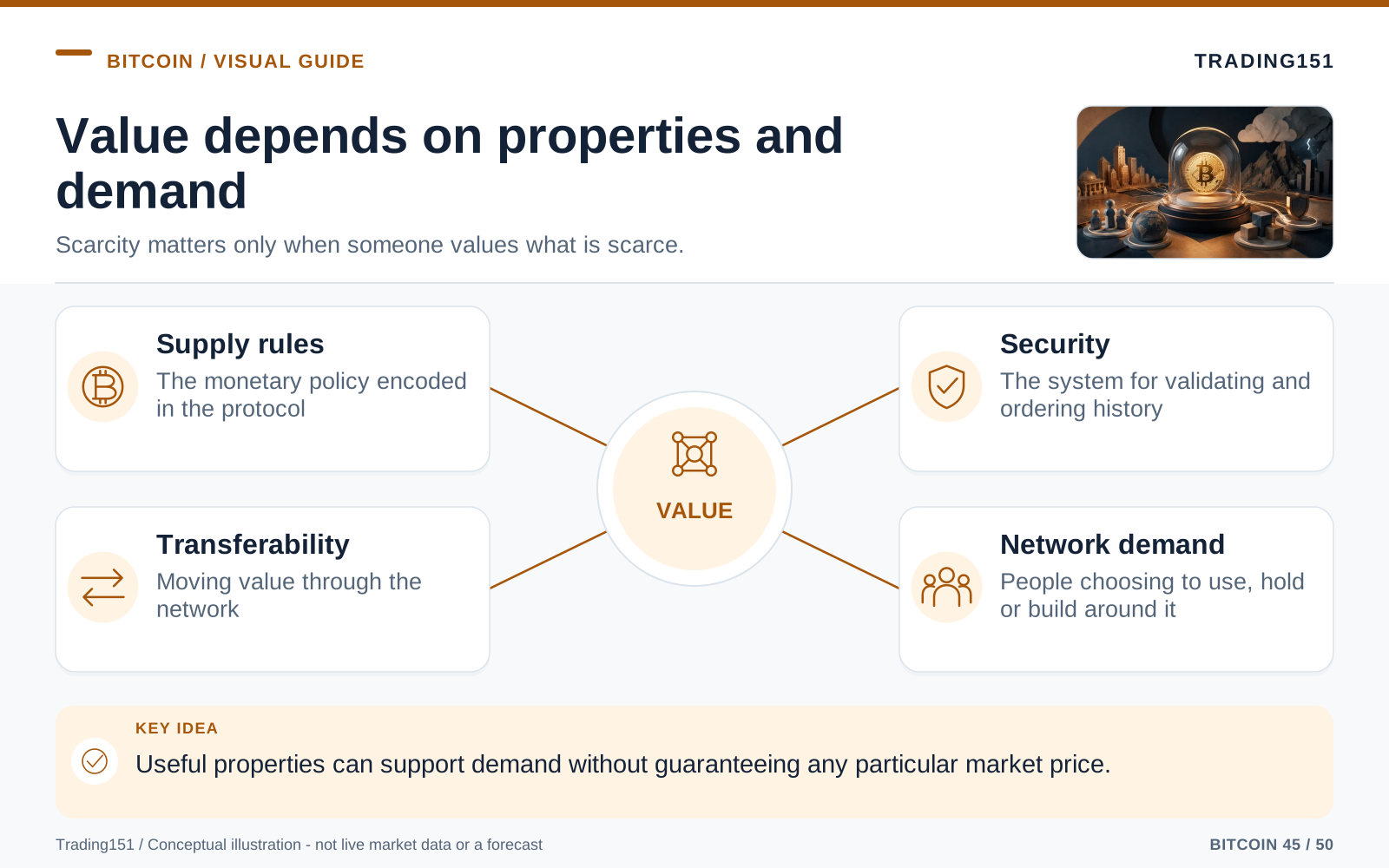
Read this diagram as text
- Supply rules
- The monetary policy encoded in the protocol
- Security
- The system for validating and ordering history
- Transferability
- Moving value through the network
- Network demand
- People choosing to use, hold or build around it
Bitcoin Is Valuable Because It Is Scarce
The single most defining feature inside Bitcoin happens to be the easiest one to grasp right away: there will never exist more than 21 million individual coins.
That famous ceiling wasn’t dreamed up by some slick ad agency; it represents a foundational rule enforced round-the-clock by decentralized nodes scattered worldwide. Fresh coins enter the economy via an unwavering, hardcoded clockwork schedule, flowing directly to the dedicated miners working to safeguard the network. Then, roughly every four years, the fresh supply minted out of every newly processed block simply cuts right down the middle. Most folks know this recurring milestone as the "halving." As years roll by, the rate of inflation gets steadily squashed smaller and smaller until every last drop of that hard supply cap has finally entered circulation.
Just contrast that setup with regular national currencies. Traditional central banks possess unrestricted power to dilute their domestic money supply whenever policy makers feel the economy requires an emergency jolt. Sometimes, they pump fresh cash to pad out credit markets, prevent spiralling recessions, or bail out collapsing financial giants. While these monetary interventions aim to patch short-term crises, endlessly increasing currency volumes definitely brings ugly long-term side effects. As the amount of circulating money swells far faster than actual physical goods, property, and professional services produced across real economies, each remaining dollar sees its real-world purchasing power evaporate. Regular everyday citizens simply feel this dynamic as painful everyday inflation: normal groceries creep up out of reach, monthly rents jump higher, hard-earned family nest eggs quietly wither away, and wages struggle to keep food on the table.
Bitcoin arrived as a blunt, mathematically engineered response to that perpetual degradation. No smooth-talking politician anywhere on earth holds a magical pen to casually mandate another ten million bitcoin into existence overnight. No banking committee can conveniently tweak its emission targets after a messy economic quarter. No corporate executive board exists to pass large share dilutive financings. Every rule is wide open for inspection, and ordinary individuals independently verifying transactions on simple home computers will automatically dump and block any unauthorized coin that violates the shared playbook.
Of course, rarity all on its own doesn't automatically equal worth. A randomly scrambled text file resting quietly on your home hard drive is arguably ultra-scarce if you never make a duplicate copy, yet nobody is preparing to pay you a dime for it. What truly gives Bitcoin's limited supply real weight is how effortlessly it pairs up with strong demand, relentless security, and a large global tribe actively recognizing and respecting its unalterable parameters. It isn’t merely scarce; it maintains verifiable scarcity anyone can easily check completely on their own terms without asking anyone for permission.
Bitcoin Is Valuable Because No One Controls It
Within conventional financial ecosystems, holding funds generally comes chained to a laundry list of subtle strings and conditions. Whenever you log into your smartphone banking app and check your checking balance, it naturally feels like direct personal wealth; yet legally speaking, it simply represents a precarious promise made by that financial institution to honor your claim. Your chosen bank holds the ledger, processes every incoming or outgoing transmission, and ultimately controls the levers. Whenever they wish, they maintain complete operational power to halt transactions, freeze your accounts entirely, reverse completed payments, or demand mountains of tedious paperwork before they permit you to access your hard-earned cash.
To be completely fair, this familiar machinery mostly runs quite smoothly for everyday life. Banking institutions handle plenty of complex administrative heavy lifting, offering convenient protection and friendly everyday services that satisfy most average consumers. However, this entire system inherently operates under an umbrella of permission and continuous surveillance. Enjoying peaceful access completely depends upon your permanent geographic residency, what specific paperwork you possess, whether prominent corporate establishments feel interested in hosting your profile, and critically—whether your domestic banking system and local governance manage to stay reasonably honest and financially solvent over time.
Bitcoin radically shatters this classic hierarchy by systematically eliminating the central gatekeeper completely. The entire digital engine hums along atop an organic, fiercely decentralized array of computer nodes and intensive cryptographic processing hardware distributed right across the globe. No lonely corporate server room hosts the master ledger file. No VIP executives hold the authority to roll back valid, finalized transfers or selectively freeze out individual users they dislike or disagree with. Once you carefully lock away your private cryptographic security keys in self-custody, your stored wealth fully escapes the jurisdiction, reach, and discretion of any traditional bank, state regulator, or financial intermediary anywhere on earth.
This unprecedented degree of sovereignty means virtually everything to people dealing with broken realities around our globe. For prosperous individuals relaxing safely inside thriving Western economies, an unstoppable, permission-free network might occasionally appear unnecessary or merely theoretical. But flip your perspective toward ordinary citizens struggling underneath severe hyperinflationary regimes, authoritarian states, freezing currency capital controls, or chaotic banking failures, and Bitcoin’s true genius suddenly shines through like a lighthouse in a storm. Underneath those harrowing realities, access to an incorruptible monetary alternative transforms from a geeky philosophical experiment into an absolutely essential, life-saving financial shield.
Skeptics occasionally assert that lacking an official central overseer represents a fatal vulnerability, loudly pointing to the total absence of friendly fraud recovery assistance or automated phone support when user passwords vanish. While personal custody undeniably demands a serious commitment to personal responsibility, removing centralized administration deliberately acts as the foundational core of the asset. By stripping away central authority figures completely, Bitcoin gracefully escapes the historic pitfalls that steadily ruined traditional money: short-sighted human greed, political corruption, catastrophic economic blunders, and unchecked monetary dilution.
Bitcoin Is Valuable Because It Turns Energy Into Security
If there's one thing everyone complains about, it's how much electricity Bitcoin burns through. You constantly read headlines comparing the network's power usage to entire medium-sized countries. To critics, this sounds like an environmental disaster just waiting to happen. But if you look under the hood, all that energy isn't just waste—it's the exact mechanism that keeps the whole system bulletproof.
Bitcoin's security model, known as Proof of Work, essentially forces miners to burn real-world electricity and heavy computing power to earn the right to process transactions. If a bad actor wanted to rewrite Bitcoin's history or fake a bunch of transactions, they couldn't just hack a central server. They would have to outspend the combined electrical and computing power of the rest of the global network. The sheer cost makes a hostile takeover economically suicidal. Even if a government or an evil billionaire managed to gather enough hardware and power to attack the network, the sheer disruption would crater the price of the very asset they were spending billions to steal.
Basically, Bitcoin’s unhackable nature isn't based on trusting a fancy cyber-security firm or hoping the government protects it. It relies on making fraud physically and financially devastating. The energy flowing into the system permanently anchors this purely digital currency right down into the physical world. It gives undeniable weight to the ledger.
Now, it's totally fair to debate whether Bitcoin's carbon footprint is worth the trade-off. We shouldn't just ignore those concerns. But from a pure design perspective, that electricity consumption isn't a bug—it’s the core feature. Bitcoin uses energy specifically because it’s trying to forge a strong monetary network that doesn't need a president, a CEO, or an army to defend it.
Bitcoin Is Valuable Because It Is Easy to Move
People love comparing Bitcoin to gold because both are super scarce and tough to create out of thin air. However, physical gold has a large, glaring flaw: it’s heavy, slow, and annoying to transport.
Try moving a million dollars' worth of gold across an ocean. You're suddenly dealing with armored trucks, high-security vaults, armed guards, large insurance premiums, customs agents, and a mountain of paperwork. Even a small stash can become a complication if you need to hop a border or settle an urgent debt fast. Gold is fantastic at sitting quietly in a dark room. It absolutely sucks at moving at the speed of the modern digital economy.
Bitcoin flips that script completely. You can blast value across the planet at 2:00 AM on a Sunday. The network doesn't care if it's a bank holiday, whether you're sending it to someone next door or halfway around the world, or whether you have the "right" kind of bank account. The transaction simply broadcasts out to the global network and permanently locks into the public ledger.
That frictionless mobility is a huge reason Bitcoin continues to draw large attention as a reliable store of value. If you can't easily move your wealth right when you desperately need to, you don't fully own it. Bitcoin lets anyone slide large amounts of value around without lugging physical briefcases of cash, heavy bullion, or dealing with sluggish traditional wire transfers.
Sure, Bitcoin isn't always the cheapest or fastest option if you're just buying a cup of coffee. When the network gets clogged, base-layer fees absolutely spike, which is why everyday users often lean on secondary layers like the Lightning Network or custodian apps for smaller purchases. But underneath it all, at the base layer, Bitcoin delivers something substantially unique: the freedom to settle major value globally, anytime, without asking the traditional banking system for permission.
Bitcoin Is Valuable Because It Is Divisible
A surprising number of people still think you have to buy a whole entire Bitcoin to get involved. That myth alone makes the network feel way more exclusive and out-of-reach than it is. In reality, a single bitcoin can be sliced up into 100 million tiny fractions known as satoshis—or just "sats" for short.
This effortless divisibility is a large deal. It means Bitcoin can comfortably scale to fit anyone's budget. A large corporate treasury can scoop up thousands of coins, while an everyday college student can automatically invest ten bucks from every paycheck. Someone in an emerging market can receive a microscopic fraction of a coin without worrying about rounding errors. If the price of one full bitcoin rises sharply to the moon, the system doesn't suddenly break—people just shift over to pricing things in smaller satoshi increments.
Any decent form of money absolutely needs to be divisible, because real life doesn't happen in perfectly round numbers. Groceries, rent, split restaurant tabs, and business invoices rarely match up to whole units of a scarce asset. Good luck trying to shave the exact right dust off a gold coin to pay for a taxi ride. Bitcoin’s pure digital nature makes slicing it up perfectly simple.
Bitcoin Is Valuable Because It Can Be Verified
Here’s one of Bitcoin’s most underrated superpowers: it’s ridiculously easy to verify and basically impossible to counterfeit. Think about a physical gold coin—you might need to weigh it, run chemical tests on it, or trust a professional appraiser to ensure it isn't filled with cheap tungsten. A traditional bank balance requires you to blindly trust whatever number the bank prints on your screen. Stock shares rely heavily on complex legal registries. Bitcoin, on the other hand, gets constantly verified by a public network following completely transparent rules.
Anyone can download the software, run their own Bitcoin node, and instantly check the entire history of the ledger. Your personal node doesn't need to trust the big mining pools, fancy crypto exchanges, slick wallet companies, or loud billionaires on Twitter. It independently verifies that every transaction plays by the rules and ensures nobody is secretly printing free coins out of thin air. This sheer power to independently audit the whole system is exactly why hardcore Bitcoiners constantly repeat the mantra: "Don't trust, verify."
That phrase might sound a little paranoid, but the philosophy behind it is liberating. In the traditional financial world, regular people are essentially forced to blindly trust large institutions they aren't allowed to inspect. Bitcoin drags the core rules out into the broad daylight. Sure, you might still prefer using an easy mobile exchange or a regulated custodian out of pure convenience, but the bedrock network itself remains permanently open for anyone with a standard laptop to inspect.
Why Not Just Copy Bitcoin?
Because Bitcoin's underlying code is completely open-source, anyone can copy it. And believe me, thousands of people already have. Since Bitcoin first launched, a large flood of alternative cryptocurrencies has hit the market. Some boast blazing-fast transaction speeds. Some pack in crazy complex smart-contract features. While a few represent genuine technical experiments, the vast majority are just hollow marketing ploys attached to a shiny token. Copying the raw software takes a decent programmer maybe an afternoon. The impossible part? Copying the large history and community surrounding it: the years of accumulated computing power, the wide distribution of everyday holders, the deep oceans of liquidity, the large hardware mining industry, the global exchange infrastructure, and most importantly, the organic social agreement that gives the network its soul. A fresh clone starts with an empty ledger and zero credibility. It might tweak a few technical settings or run a bit faster, but all that really accomplishes is creating a totally separate network—not a better version of Bitcoin's unique scarcity. Open-source code is cheap to clone; a battle-tested global monetary network is basically priceless.
So why exactly has Bitcoin remained the undisputed king of the hill?
It ultimately comes down to network trust. Money doesn't gain value just because the software is cleverly written. It gains value because real people actively recognize it, willingly accept it, heavily secure it, build large businesses around it, and fundamentally trust that others will keep doing the same thing tomorrow. Bitcoin boasts the longest unbroken track record, the most globally recognized brand name, the deepest pools of trading liquidity, the most large computing security shield, and an unbreakable cultural identity anchored entirely around decentralization and a hard supply cap.
Think about human language. Some brilliant linguist could theoretically invent a flawlessly logical language tomorrow morning. It could have zero confusing grammar rules and perfect spelling. But that doesn't mean billions of people are going to suddenly drop English or Spanish and start speaking it. The true value of any language stems entirely from the large network of people already communicating with it. Money relies on that exact same network effect. People naturally gravitate toward the form of money they confidently believe the rest of the world will accept.
Bitcoin’s large first-mover advantage isn't just about being early to the party. It’s about arriving early, surviving absolute hell, and becoming so deeply entrenched that it's practically impossible to uproot. Every year the network hums along without a CEO, every severe bear market it claws its way out of, every failed government ban it ignores, and every new user who figures out how to self-custody adds another thick layer of undeniable credibility.
The Lindy Effect: Trust Built Over Time
Bitcoin has been loudly declared dead more times than anyone can count. High-profile critics have dismissed it as a large bubble, an elaborate scam, a shady playground for criminals, a disgraceful waste of electricity, a clunky payment system, and a brief millennial fad. Some of this criticism has been thoughtful and constructive. A lot of it has just been lazy. Regardless, Bitcoin just keeps steadily churning out blocks.
The reason this relentless survival matters is straightforward: time is the ultimate acid test for any financial asset. Any new project can sound revolutionary in a slick white paper or during a roaring bull market. The true test is whether it can take a serious punch. Bitcoin has weathered devastating price crashes, bitter internal civil wars over technical upgrades, the spectacular bankruptcies of major exchanges, heavy-handed regulatory crackdowns, endless mainstream media mockery, and fierce competition from thousands of rival coins. Every time the dust settles, the network is still there, ticking away.
In the tech world, there’s a concept known as the Lindy effect. It basically suggests that for certain non-physical things like technologies, ideas, or social structures, their future life expectancy is proportional to their current age. The longer something survives, the more likely it is to stick around permanently. Every day that Bitcoin doesn't collapse, get hacked, or fade into irrelevance, the market's collective confidence in its long-term future grows stronger. It stops looking like a fragile, risky experiment and starts looking like permanent financial infrastructure.
But What About Volatility?
It’s impossible to talk about Bitcoin's value without addressing the large elephant in the room: the wild price swings. If Bitcoin is supposed to be such great money, why does its dollar value routinely skyrocket and then violently crash?
The honest answer is that Bitcoin is still a relatively young asset actively going through the messy, chaotic process of finding its place in the world. It isn't anchored by a large central bank furiously buying and selling to artificially smooth out the ride. Its price is purely determined by the raw open market, 24/7, without circuit breakers or trading halts. When hype takes over, the price rises sharply upward. When panic sets in, or traditional macroeconomic conditions sour, the price violently corrects.
For someone trying to use Bitcoin to pay next month's rent, this volatility is frustrating. It makes short-term financial planning difficult. But for someone treating Bitcoin as a long-term savings vehicle, the volatility is just the necessary turbulence on the flight toward global adoption. An asset doesn't realistically grow from a niche internet experiment worth absolute zero into a globally recognized reserve asset worth trillions of dollars without some serious bumps along the way. As the overall market cap grows larger, the large amounts of capital required to move the price significantly will theoretically cause the volatility to smooth out over time. But right now, the volatility is simply the entry fee you pay to participate in a completely free, unmanipulated market.
So What Is Bitcoin Backed By?
Let's circle all the way back to that original question: what is Bitcoin backed by?
If you're strictly looking for a central bank guarantee, a physical vault overflowing with gold bars, or a corporate balance sheet, the answer is nothing. But if you recognize that all money ultimately derives its value from shared human belief and utility, the answer becomes clear.
Bitcoin is backed by the unbreakable laws of mathematics. It is backed by large amounts of physical energy and specialized computing hardware. It is backed by an elegant, open-source protocol that anyone can inspect. It is backed by a decentralized global network of thousands of independent nodes fiercely enforcing the rules. And most importantly, it is backed by the collective, voluntary consensus of millions of people around the world who have decided that a scarce, decentralized, censorship-resistant digital bearer asset is profoundly valuable.
Scarcity explains the limit, not the price someone will pay
Scarcity is necessary to some monetary arguments but insufficient on its own. Many scarce objects have little market value because few people want them. The investment question is why demand for Bitcoin's particular properties might persist or grow, and what could weaken that demand relative to available supply.
Utility and speculation can coexist. A holder may value the ability to transfer an asset without relying on a particular bank, while another buyer may focus on expected resale value. Those motives can support the same price temporarily without providing the same basis for long-term demand. It is useful to identify which motive the investment thesis actually depends on.
There is no single accepted valuation model that turns those considerations into an objectively correct price. Comparisons with gold, payment networks, or other monetary assets rely on assumptions about adoption, liquidity, and competition. Such models can organize scenarios, but their outputs should be presented as conditional estimates rather than discoveries of an intrinsic number.
Test the thesis against alternatives. What happens if users prefer a different settlement method, custody becomes more restrictive, or investors demand less exposure to volatile assets? What evidence would count against the original view? A credible valuation discussion acknowledges those possibilities. The absence of a cash-flow model does not mean no one can value Bitcoin; it means the valuation rests heavily on uncertain judgments about future demand.
Separate scarcity from willingness to pay
A fixed or limited supply constrains one side of a market. It does not establish how many people will want the asset, what they will use it for, or what price they will pay. An object can be rare and unwanted. Bitcoin's valuation therefore requires a demand argument as well as an issuance argument.
That demand argument can include different motives: settlement, self-custody, speculation, portfolio exposure, or confidence in the monetary design. Those motives need not move together. A change that improves one use case may have little effect on another, and a rising price can itself attract demand that later disappears.
For an investor, the useful question is not only whether Bitcoin has distinctive properties. It is whether the current price offers an acceptable risk for the expected uses and uncertainties. Keep the technological assessment separate from the valuation. Recognizing a useful invention does not tell us what every unit should be worth, and disagreement about price does not necessarily imply disagreement about the underlying design. 1, 2, 3
Where Bitcoin’s Value Ultimately Comes From
It’s honestly entirely understandable why Bitcoin confuses so many people. It directly challenges basically everything we’ve been taught about how money is supposed to function. It feels too abstract, too heavily reliant on computer code, too radically unforgiving for self-custody, and still largely misunderstood by the general public. But casually brushing it off as “fake internet money” completely misses the bigger picture. All money—every type—relies heavily on shared belief. Bitcoin’s monumental achievement is that it takes that fragile shared belief and locks it into a hard set of undeniable rules, a rigidly fixed supply, and a resilient network that operates perfectly without any central master.
So what gives Bitcoin its value? Not a fragile promise from a politician. Not a dusty vault full of heavy metal. Not a tech company’s quarterly earnings report. Bitcoin holds large value simply because millions of ordinary people have closely examined its unique design and collectively decided that digitally scarce, unstoppable money is fiercely worth owning.
Bitcoin is backed by math, large energy, open-source transparency, and global human consensus. Sure, that might sound a little strange at first glance. But every form of money sounds a bit strange once you really put it under the microscope. The only real difference is that Bitcoin puts all of its rules out in the open and politely asks you to stop blindly trusting bankers, politicians, or hollow promises. It just asks you to trust a system you can easily verify completely on your own.
Sources and further reading
- Bitcoin Developer Guide: Block Chain
- Bank of England: Money Creation in the Modern Economy
- Investor.gov: Asset Allocation
Editorial revision: 7 October 2026. Numerical scenarios are hypothetical unless identified as historical. References support the added explanations and selected corrections; rules and product terms should be checked again before acting.