
Bitcoin's halving cuts the new-coin subsidy paid in each block after every 210,000 blocks. It does not halve anyone's wallet balance, shrink the existing supply, or mechanically double the work needed to find a block. The rule is predictable; its effects on miners, demand, and price are not. Keeping those distinctions clear makes the event easier to understand.
First, How Are New Bitcoins Created?
To really get the halving, you first need to know how new bitcoins are born.
Modern money is created through more than one process. Central banks issue banknotes and reserves, while commercial-bank lending creates much of the deposit money used by households and businesses. Monetary policy influences financing conditions and credit creation, but the relationship between policy, money growth, and inflation is not a simple exercise in printing notes. Bitcoin's issuance schedule is a different arrangement: new coins are limited by the network's consensus rules.
Bitcoin plays by an entirely different set of rules. There is no central office. No CEO is sitting around deciding to issue more coins because the market looks a little shaky.
Instead, Bitcoin relies on a large, decentralized web of computers running all over the globe. These machines track transactions, enforce the network's rules, and keep a shared public ledger updated—what we call the blockchain.
When you send bitcoin to a friend, your transaction doesn't just vanish into a bank's private servers. It gets broadcast to this global network, verified, bundled up with a bunch of other transactions, and locked into a "block" on the chain.
Miners assemble candidate blocks and repeatedly hash block headers, changing inputs in search of a result below the required target. This is a computational competition, not the solving of economically useful mathematical problems. Other nodes independently check that the resulting block follows the rules before accepting it.
The protocol targets an average interval of about ten minutes between blocks, but individual intervals can be much shorter or longer. A miner whose valid block becomes part of the accepted chain can claim the permitted subsidy and the transaction fees included in that block.
That payout is split into two pieces:
- The block subsidy: Brand new bitcoins minted out of thin air.
- Transaction fees: Amounts paid by transactions included in the block. Fees vary with transaction size, demand for block space, and the fee rate offered; they are not necessarily small.
For the halving, the block subsidy is the star of the show. It’s the sole mechanism for getting new bitcoins into circulation. Rather than dumping all the coins into the market on day one, the network drips them out slowly, following a schedule everyone can see from a mile away.
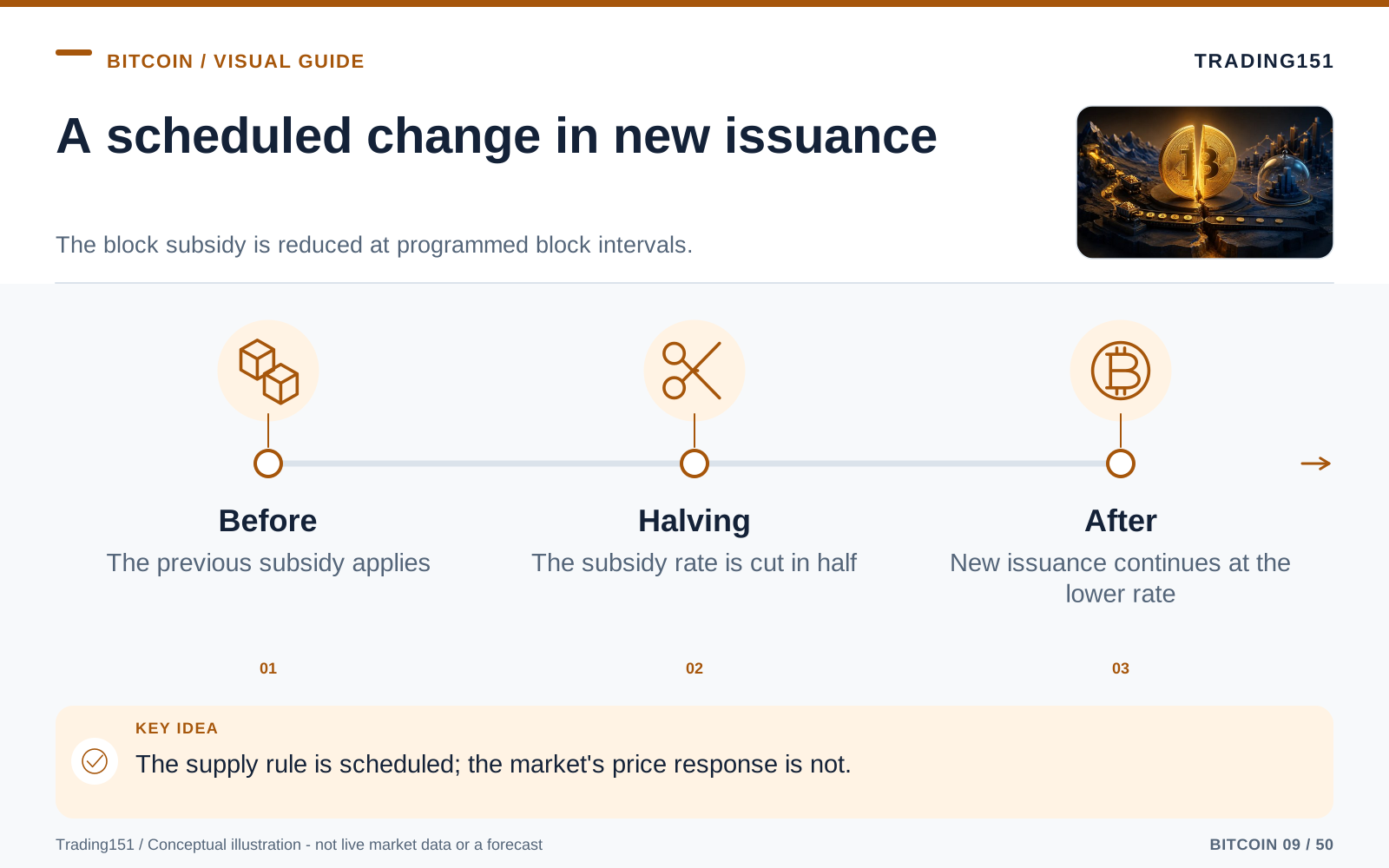
Read this diagram as text
- Before
- The previous subsidy applies
- Halving
- The subsidy rate is cut in half
- After
- New issuance continues at the lower rate
What Is the Bitcoin Halving?
Simply put, the halving is a hardcoded event that chops that block subsidy exactly in half.
The permitted block subsidy falls by 50%. Total miner revenue does not necessarily fall by the same percentage, because transaction fees are separate and the fiat value of bitcoin can change. Mining difficulty is also governed by a different adjustment process rather than being doubled by the halving.
This happens like clockwork every 210,000 blocks. Since a new block drops roughly every 10 minutes, that math works out to about four years. Because blocks aren't minted on a perfect-to-the-second schedule, we never know the exact day and time years in advance, but it's consistent enough that everyone treats it as a four-year cycle.
Here’s how the payouts have shrunk over the years:
- 2009: The network kicked off handing out a large 50 BTC per block.
- 2012: The first halving knocked it down to 25 BTC.
- 2016: The second halving brought it to 12.5 BTC.
- 2020: The third halving dropped it to 6.25 BTC.
- 2024: The fourth halving took it down to just 3.125 BTC per block.
The subsidy continues to decline at scheduled block heights, with integer rounding eventually reducing it to zero around 2140 if average block timing remains near the target. Under the existing rules, fees would then be miners' protocol-level compensation for adding blocks. Whether future fee demand will support an adequate security budget is an open economic question, not a guaranteed outcome.
This slow, transparent wind-down is what makes Bitcoin so unique. The halving never catches anyone off guard. It’s not an emergency brake pulled during a financial crisis. It’s just the machine doing exactly what it was built to do.
Why Did Bitcoin Need a Halving in the First Place?
The schedule limits new issuance while distributing coins over an extended period.
Bitcoin launched in January 2009, following the 2008 financial crisis. Its design offered a monetary network with a publicly verifiable issuance schedule rather than an issuer able to change the supply at its discretion. That context helps explain the interest in Bitcoin, but it does not establish that every monetary-policy response to the crisis had the same purpose or effect.
The arrangement shifts the source of trust. Users can inspect open-source rules and verify transactions themselves, while still depending on software, network participation, and their own custody arrangements. It does not remove every form of trust or every practical risk associated with holding and transferring value.
The declining subsidy schedule, together with the other consensus rules, produces an issuance limit commonly described as 21 million bitcoin. Rounding and coins that are never validly claimed mean the exact issued total is slightly lower than that headline figure.
Distributing the subsidy gradually provides an early source of compensation while transaction demand develops. Issuing all coins at launch would have required a different distribution and security-incentive arrangement; it would not prove that no fee-based incentive could exist. Keeping a fixed positive subsidy indefinitely, by contrast, would continue increasing the supply. The halving schedule is the design Bitcoin adopted to move toward fee-funded mining over time.
The schedule is disinflationary in the sense that the growth rate of the coin supply declines. It does not mean the existing supply shrinks or that consumer prices measured in bitcoin must fall. Supply issuance and purchasing power are separate questions.
Gold's limited availability, durability, physical uses, and monetary history all contribute to the demand for it. Mining costs and the time needed to expand production constrain supply, but production difficulty alone does not create value. An expensive-to-produce object can still be unwanted. The same distinction matters when discussing Bitcoin's scarcity.
Bitcoin's scarcity is enforced through software rules rather than geological availability. Full nodes reject blocks that claim more subsidy than the applicable rules permit. Users can verify those limits, although the asset's market value still depends on continuing demand and confidence in the wider system.
What Changes on Halving Day?
If you’re just a regular person holding some Bitcoin, halving day is unexpectedly uneventful. There’s no dramatic countdown clock in the sky, and nobody flips a giant switch. The network hits a specific block number, and the rules quietly shift. The block right before the halving pays out the old rate; the very next one pays half. The network already knows it’s coming and will immediately reject any miner trying to claim the old reward. Wallets work the same, trading never stops, and the coins in your account don't magically shrink.
The drama is entirely reserved for the markets and the mining companies. At the software level, it's striking because of how boring it is.
So what happens? The spigot gets tightened.
The 2024 halving reduced the subsidy from 6.25 BTC to 3.125 BTC per block. At the target average of about 144 blocks per day, that corresponds to a decline in new issuance from about 900 to 450 BTC daily. Actual daily output varies with block intervals, and newly issued coins are not necessarily sold immediately.
This is a reduction in the flow of new coins, not a reduction in the stock already issued. Because the schedule is known in advance, the extent to which the event changes market expectations is a separate question from the mechanical change in issuance.
Miners may sell some production to fund electricity, equipment, financing, and other costs. A lower subsidy can change that funding position, but miner selling does not mechanically halve: fees, bitcoin's price, reserves, borrowing, and operating decisions also matter. Some miners may sell existing holdings rather than only newly issued coins.
Lower new issuance can matter to the balance of supply and demand, but it does not determine the price. Existing holders can sell, prospective buyers can withdraw, and wider financial conditions can outweigh the change in production. The halving is one input to the market rather than a complete price model.
Why Does the Halving Get So Much Attention?
The halving is this perfect storm of tech, economics, and human psychology.
The economic appeal is a visible decline in supply growth. Whether that supports the price depends on demand and on how much of the scheduled change was already reflected in expectations. Scarcity is relevant, but it cannot establish the direction of the next market move by itself.
Technically, a halving demonstrates that participating nodes continue to enforce the pre-existing subsidy schedule at the relevant height. It is not a new vote on monetary policy and does not require an administrator to activate it on the day.
The event also attracts attention because it provides a clear date-related narrative in a market full of uncertain developments. Describing it as 'supply being cut in half' is misleading, however: the change concerns newly issued coins per block. A compelling narrative can influence behavior without proving a predictable return.
Because everyone is talking about it, it often becomes a self-fulfilling prophecy. The hype draws attention, attention draws curiosity, and curiosity brings in new buyers. It doesn’t always play out exactly as expected, but the narrative alone makes it the biggest event on the crypto calendar.
Does the Halving Make Bitcoin’s Price Go Up?
This is the million-dollar question. The hard truth is that markets don't politely wait for calendar events to make their move. Big traders and institutional funds position themselves months, sometimes years, in advance. The halving guarantees that supply will drop; it does not guarantee that anyone will want to buy it. Confusing a hardcoded software update with a guaranteed financial return is a dangerous game.
That being said, historically, halvings have acted as launching pads for large bull runs. After the 2012 halving, Bitcoin morphed from a weird internet experiment into an asset that cracked $1,000. Following 2016, it exploded to nearly $20,000. And after 2020, it eventually smashed through to nearly $69,000.
That track record is exactly why the halving has such mythic status. It’s always felt like the starting gun for the next crazy wave of crypto adoption.
But don't get it twisted—the halving isn’t a magic button that instantly makes you rich.
If you stare at the charts on halving day itself, you’ll probably be disappointed. The price usually barely twitches. The real fireworks, if they happen at all, usually take months to build up.
Why the delay? Because the supply crunch is a slow burn. Miners have to adjust, the market has to digest the lower inflation, and large outside factors—like global interest rates, stock market trends, and regulatory crackdowns—can totally overshadow the halving itself.
Then there’s the age-old Wall Street debate: "Is it already priced in?"
One camp argues that since everyone with an internet connection knows the halving is coming, the smart money has already bought in. The other camp argues that knowing a supply shock is coming on paper is vastly different from feeling the lack of new coins in the market day after day.
Both views identify plausible mechanisms, but they cannot both be declared correct for every cycle without evidence. Prices may anticipate a known event, while realized trading and funding conditions can still change afterward. The net effect is an empirical question, not something settled by the schedule alone.
A reasonable interpretation is that the halving changes issuance in a known direction while leaving demand uncertain. That distinction allows an investor to understand the event without treating it as an automatic reason to buy or a timetable for a rally.
The Miner’s Side of the Story
For miners, the event changes the economics of production. The subsidy component falls at a known block height, while most operating costs do not automatically fall with it. The impact on revenue and profit depends on transaction fees, the bitcoin price, hardware efficiency, financing, and the share of total hash rate controlled.
Consider two miners with similar equipment but different electricity contracts. A lower-cost operator may remain profitable under conditions that make the other uneconomic. This is not the same as saying every miner's total income instantly halves: the subsidy is only one revenue component, and both market prices and fees can change.
That intense pressure is what miners face every four years.
Efficiency and electricity prices are important, but they do not alone determine survival. Debt service, access to capital, maintenance, uptime, contractual obligations, and the ability to curtail production also affect an operator's resilience. The newest machine is not automatically the best investment at any purchase price.
Less efficient equipment can become uneconomic, prompting operators to curtail or relocate production. If total hash rate falls, blocks can arrive more slowly until the difficulty adjustment responds. The network does not evaluate a miner's finances or guarantee that remaining operators will be profitable.
Bitcoin adjusts mining difficulty every 2,016 blocks, using the time taken for the preceding adjustment interval and limits on the size of the change. The response is not immediate. A sudden loss of hash rate can therefore lengthen the time required to reach the next adjustment, while an increase can shorten it.
The halving is a predictable pressure on mining economics rather than a mechanism that guarantees an optimal industry structure. It can encourage efficiency, but it can also alter concentration, financing needs, and the geographical distribution of operations. Those outcomes depend on decisions made outside the protocol.
What Happens When All 21 Million Bitcoins Are Mined?
It’s the most common question people ask when they start going down the rabbit hole: what happens when the very last coin is squeezed out?
If miners are currently running their large server farms in exchange for newly minted Bitcoin, why on earth would they keep protecting the network once the reward hits zero?
The answer is transaction fees.
Miners already receive transaction fees as well as the subsidy. As the subsidy declines, fees would need to provide a greater share of protocol-level mining revenue for a given level of security spending. The design permits that transition, but it does not guarantee sufficient fee revenue or specify what future users will be willing to pay.
The subsidy is expected to end around 2140 under the existing schedule. That is far beyond a reliable forecast of technology, market demand, energy costs, or the institutional setting in which Bitcoin might operate. The uncertainty is a reason to examine the assumptions rather than to dismiss the question.
One view is that sustained demand for settlement will produce enough fees to support mining. Another is that a fee-only security budget could prove less dependable than the combination of subsidy and fees. Neither future outcome is established. The issue deserves continued research as the subsidy becomes a smaller component of compensation.
What matters is that this transition isn't an afterthought—it was baked into the design from day one. The halving is just the slow-motion bridge from an inflation-funded network to a fee-funded one.
Common Misunderstandings About the Halving
Because it gets so much hype, the halving is surrounded by terrible takes. Some are just funny; others will lose you money.
Myth 1: Your bitcoin gets cut in half.
You’d be surprised how often this comes up. No, your stash is safe. The halving doesn’t touch the coins sitting in your wallet. If you hold 0.5 BTC on Monday, you’ll still hold 0.5 BTC on Tuesday. It only affects the new coins being handed out to the miners.
Myth 2: The price is guaranteed to skyrocket the next day.
Lower issuance does not guarantee a price rise on the next day or over any particular period. A decline in demand or sales by existing holders can outweigh it. The halving describes the creation of new coins, not the total amount offered for sale at a given price.
Myth 3: This cycle will be a perfect copy of the last one.
The market surrounding each halving differs in liquidity, leverage, access, regulation, and investor participation. The small number of previous events makes a repeating-cycle claim difficult to establish. Market capitalization also is not a direct measure of the amount of cash required to move the price; available trading depth matters.
Myth 4: The miners secretly control the halving.
A miner cannot make a block valid merely by claiming the old subsidy. Nodes enforcing the existing rules reject an excessive claim, even if the block contains proof of work. Participants could propose different software rules or create a fork, but that would not automatically change what existing users accept as Bitcoin. Miners do not unilaterally set the accepted subsidy schedule.
Myth 5: Bitcoin dies the moment the block rewards stop.
The newly minted coins will eventually fade away, but the transaction fees will remain. Whether those fees are enough to sustain the network 120 years from now is a valid debate, but the system doesn't just hit a brick wall and shut off.
Why the Halving Matters Even If You Do Not Own Bitcoin
You don’t have to own a fraction of a Bitcoin to appreciate what the halving represents.
The contrast with conventional money is about policy flexibility and rule enforcement. Central banks can change policy instruments, while fiscal authorities can make spending and tax decisions under their legal frameworks. Commercial-bank credit creation is another part of the monetary system. These powers can help address shocks, but their use and effects require scrutiny.
Inflation can reduce purchasing power when the return on cash after tax does not keep pace with rising prices. The outcome depends on the currency, period, account return, and spending needs. It is not accurate to describe every bank balance as certain to lose purchasing power each year or every expansion of central-bank money as arbitrary.
Bitcoin instead follows a predetermined issuance schedule under its existing consensus rules. The supply continues to grow at a declining rate; it does not shrink because of the halving. This makes issuance predictable while leaving the exchange price, user demand, and wider economic consequences uncertain.
Supporters value the inability of a single issuer to expand the supply at will. Critics question the economic trade-offs of an inflexible supply schedule and the asset's price volatility. Those are arguments about different monetary arrangements, not proof that either system eliminates human judgment or risk.
Regardless of where you stand, the halving forces us to ask large questions: What is money? Who gets to print it? Is an inflexible algorithm safer than a room full of economists?
Those questions matter far more than the daily price chart, and the halving drags them into the spotlight every four years.
The Halving as a Test of Patience
In a financial world addicted to instant gratification, the halving is deeply weird.
Modern markets operate in milliseconds. Algorithms trade on news headlines before humans even read them. Crypto Twitter treats a 5% dip like the end of the world. Everyone is screaming for immediate answers: Is the bull market back? Should I sell? What’s the next coin?
The halving simply does not care. It is slow, methodical, and totally immune to the chaos. It doesn’t arrive early just because everyone is hyped, and it doesn't delay itself if the market is crashing. It hits when the block counter says it’s time.
The schedule gives users a verifiable feature amid uncertain market conditions. It does not make custody, trading venues, future software, or market prices equally predictable. Confidence in one rule should not be extended automatically to every aspect of the asset.
At each halving, the permitted new issuance per valid block falls by half. That is different from making the mining calculation twice as difficult; difficulty follows its separate adjustment process.
The market response can vary before and after the event. The protocol change remains the same in character, but its financial effect depends on the surrounding conditions. Understanding that separation is more useful than fitting every cycle to an identical price narrative.
Work through a miner's revenue, not just the headline
The difference between subsidy and total revenue is worth putting into numbers. Before a hypothetical halving, suppose a block pays 6.25 BTC in subsidy and 0.5 BTC in transaction fees, for 6.75 BTC altogether. If fees remain unchanged after the subsidy falls to 3.125 BTC, total revenue becomes 3.625 BTC. That is a decline of about 46.3%, not exactly 50%. The fees in this example are assumed, not a description of a particular block.
A miner's revenue in dollars also depends on the bitcoin price and its share of the network's mining activity. Costs depend on more than electricity: equipment financing, cooling, maintenance, hosting, and downtime can all matter. Two firms with similar machines can therefore experience the same subsidy cut very differently.
The difficulty adjustment is a separate mechanism. On Bitcoin's main network it recalibrates every 2,016 blocks, subject to the protocol's limits; it does not immediately compensate each miner for lost revenue. If substantial mining capacity leaves, blocks may arrive more slowly until an adjustment, and the remaining miners still face their own business costs.
For an investor, the useful consequence is restraint in interpreting the event. Lower issuance reduces one source of potential selling, but existing holders can still sell and demand can still weaken. A scheduled change in new supply is a fact. The price that buyers and sellers will agree on afterward is a market outcome, not part of the halving rule.
Date the event by block height
The expected calendar date of a future halving is an estimate because blocks do not arrive at fixed intervals. The protocol trigger is the specified block height. An article, forecast, or mining budget should distinguish that rule from the projected date on a countdown website. Small timing changes are not evidence that someone altered the issuance policy; they can simply reflect normal variation in block production. 1, 2
What the Halving Really Tells Us
It’s easy to get lost in the weeds with hash rates and block subsidies, but the core truth of the halving is straightforward.
Miners receive a subsidy and fees for accepted blocks. Every 210,000 blocks, the permitted subsidy halves, reducing the growth of the coin supply. The change does not reduce a holder's bitcoin balance, guarantee a price rise, or halve every miner's total revenue.
Strong price advances have followed some earlier halvings, but the sample is small and other developments occurred at the same time. That history does not establish that the halving caused the gains or that another cycle will repeat them. Bitcoin remains exposed to changes in demand, financing conditions, and market access.
But the real magic of the halving isn’t the price action. It’s the fact that it happens at all—without asking anyone’s permission. No chairman signs off on it. No politician campaigns on it.
The block arrives, and the rules change.
The halving makes one feature of Bitcoin unusually transparent: how the permitted creation of new coins changes at known block heights. Its significance lies in that verifiability. The investment decision still requires a separate judgment about price, risk, custody, and whether the exposure fits the money's purpose.
The new coins dry up. The rules hold firm. The clock keeps ticking.
And every four years, the world gets to decide all over again what that scarcity is really worth.
Sources and further reading
- Bitcoin Developer Guide: Block Chain
- Bitcoin Developer Guide: Mining
- Bank of England: Money Creation in the Modern Economy
Editorial revision: 7 October 2026. Numerical scenarios are hypothetical unless identified as historical. References support the added explanations and selected corrections; rules and product terms should be checked again before acting.