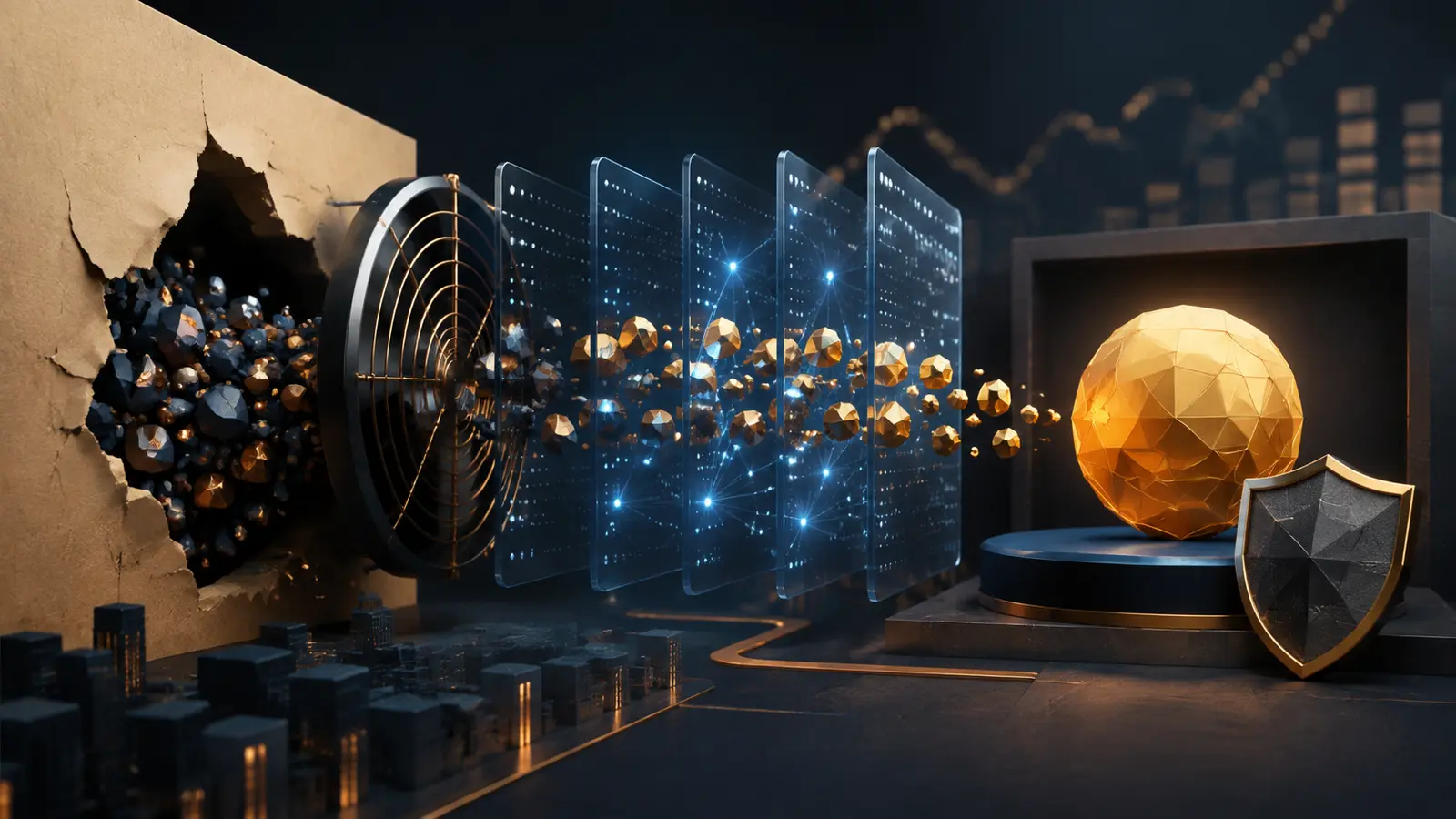
Bitcoin miners assemble candidate blocks and repeatedly calculate hashes in a competition governed by the network's difficulty target. Nodes then check whether a proposed block follows the rules. Mining is not the same as solving useful scientific equations, and more computing power does not let a miner create valid coins outside the issuance rules. Its role is to make rewriting accepted history costly.
The Problem Bitcoin Had to Solve
Before Bitcoin came along, digital money had a really stubborn problem: anything digital is easy to copy.
Think about taking a photo on your phone and sending it to a friend. They have the photo now, but you still have it too. You didn’t hand over the original; you just made a perfect copy and beamed it across the internet. For photos, memes, PDFs, or songs, that’s exactly how we want things to work. Copying makes sharing effortless.
But money? Money absolutely cannot work that way.
If I have a digital dollar and I send it to you, I can’t still have that dollar in my pocket to spend somewhere else. If I could, I’d pay rent, grab groceries, and tip my driver all with the same dollar. That would completely destroy the concept of money. In tech circles, this is known as the double-spending problem: how do you stop someone from spending the same digital coin twice?
Traditional finance solves this by leaning on trusted middlemen. Your bank holds a private ledger. When you pay for coffee, the bank updates the numbers—subtracting from your account and adding to the coffee shop’s. Credit card networks, payment apps like Venmo, and global settlement systems all rely on this same basic idea: a central authority keeps the master record, and everyone else just trusts it.
Bitcoin asked a substantially different question: what if we didn’t need a central authority at all?
Imagine no bank. No payment app. No single server storing everyone's balances. No admin who can secretly edit the books, and no customer service line to call when things break. Just a large network of random people who don’t even know or trust each other, yet somehow they all perfectly agree on who has what.
Solving that problem is exactly why Bitcoin mining exists.
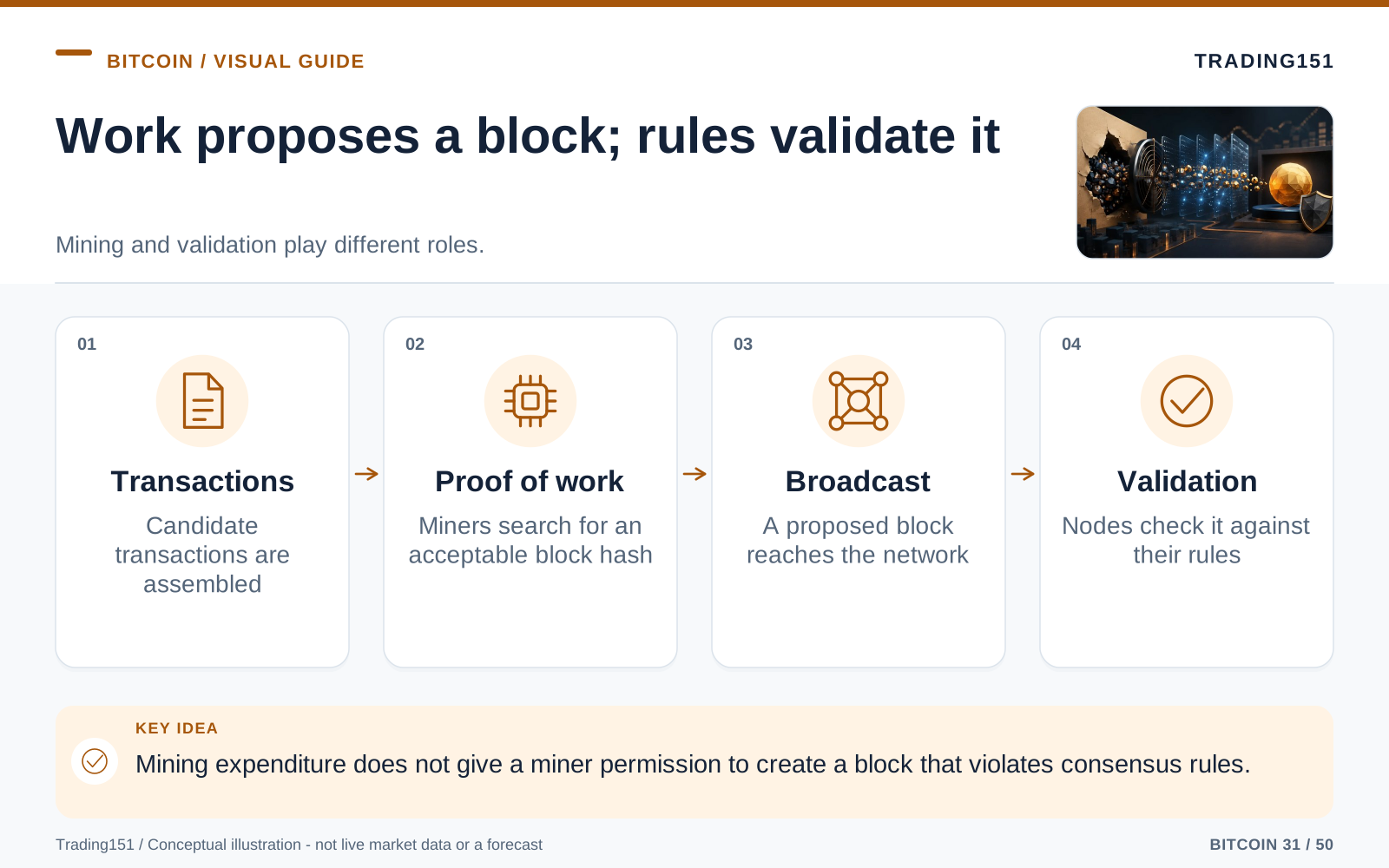
Read this diagram as text
- Transactions
- Candidate transactions are assembled
- Proof of work
- Miners search for an acceptable block hash
- Broadcast
- A proposed block reaches the network
- Validation
- Nodes check it against their rules
The Blockchain: A Ledger Anyone Can Check
Bitcoin runs on a large public ledger called the blockchain. Think of it like a giant, shared accounting book that’s copied and constantly updated across thousands of computers all over the world. Every Bitcoin transaction is permanently recorded in this book, and anyone—including you—can look at it to verify the history.
The word "blockchain" might sound super technical, but it’s a very literal description of how it works. Transactions are bundled together into groups, which are called blocks. Each new block is securely linked—or pointed back—to the block that came right before it. That one points to the one before it, all the way back to the very first block created in 2009. The end result? A literal chain of blocks. Hence, blockchain.
This chain is important because it gives Bitcoin its memory. If someone tries to spend money they don’t have, the network instantly checks the history and rejects the transaction. If someone tries to hack the system and rewrite an old payment, they wouldn’t just have to rewrite that one single record—they’d have to magically rewrite all the newer blocks stacked on top of it. Once the network has moved forward, rewriting history becomes impossibly difficult.
Now, while this ledger is totally public, it doesn’t look like a traditional bank statement with names and home addresses. Bitcoin transactions use cryptographic addresses instead of personal identities. You can easily see that funds moved from Address A to Address B, but the ledger won't tell you who owns those addresses.
The main takeaway here is this: Bitcoin’s master record isn’t locked away in some corporate vault. It’s public, shared, constantly checked, and updated by the entire network. Miners are just the people competing for the right to add the next page to the book.
What Miners Are Doing
So, what exactly is a Bitcoin miner? It’s simply a person, a company, or a group running highly specialized computers. These machines scoop up pending transactions, verify that they are totally legit, pack them into a new block, and then race against everyone else to officially add that block to the blockchain.
Mining software constructs a candidate block, chooses transactions, and includes a coinbase transaction specifying the miner's permitted compensation. The hardware repeatedly hashes variations of the block header to seek a result below the target. A hash is not a digital signature: signatures authorize spending, while proof-of-work hashing serves a different purpose.
It’s highly repetitive work. And the block they are trying to build isn’t static; they constantly update it as new transactions roll in or when another miner beats them to the punch. Most of the work they do leaves no trace at all. But when a miner finally succeeds, they give the whole network an undeniable, costly proof that they did the work. That proof is what lets the network safely agree on the next batch of transactions.
It sounds straightforward enough, but there’s a catch. In a system with no boss, you can’t just let anyone add blocks whenever they feel like it. If it were easy, a bad actor could just flood the network with fake transactions, rewrite the history, or completely confuse the ledger.
Bitcoin prevents this by making the act of creating a block expensive. Not expensive in the sense that you pay a fee to a boss, but expensive because it burns serious electricity and requires heavy-duty computing power. This concept is called Proof of Work.
Proof of work makes it costly to produce an alternative transaction history under the network's security assumptions. It does not guarantee that mining is profitable or that attacks are impossible. Full nodes separately enforce validity rules, while the cost and feasibility of reorganizations depend on accumulated work and the attacker's resources.
Step 1: Your Transaction Hangs Out in the Waiting Room
Let’s say you want to send some Bitcoin to a friend. You open your app, punch in the amount, pick a transaction fee, and hit send.
That transaction doesn’t magically appear on the blockchain right away. First, it gets broadcasted out to the Bitcoin network. Different computers running Bitcoin software—called nodes—hear about your transaction, check to make sure you have the money, and pass the message along. These valid, pending transactions then sit in a sort of digital waiting room called the mempool (short for memory pool).
The mempool isn’t one single server. It’s basically a collection of waiting lists maintained by all the different nodes. Every node might have a slightly different list of what’s pending, but conceptually, you can just think of the mempool as the staging area where transactions chill before a miner decides to grab them.
Miners are constantly peeking into this waiting room, looking for transactions to include in their next block.
Step 2: Packing Transactions Into a Block
Because every block has a strict size limit, miners can’t just scoop up everything in the mempool at once. They have to choose. And how do they choose? Usually, by looking at the fees.
When you send a transaction, you include a tiny fee to incentivize a miner to pick it up. If the network is super busy and the waiting room is packed, people will attach higher fees to skip the line. Miners, wanting to make as much money as possible, will naturally grab the transactions that pay the best.
The candidate block includes transactions the miner has checked and a coinbase transaction claiming no more than the permitted subsidy plus the included fees. The subsidy creates new coins under the issuance rules; the fees transfer existing coins. Other nodes independently validate the completed block.
But having a candidate block isn't enough. They can't just publish it. To make it official, they have to prove they did the work. That’s where the race begins.
Step 3: The Mining Race Begins
To lock their block into the blockchain, a miner’s computer has to run the block’s data through a cryptographic math function called SHA-256. This function acts like a digital meat grinder: you feed data into it, and it spits out a long string of letters and numbers called a hash.
There are two things you need to know about hashes. First, if you change even a single comma in the original data, the resulting hash changes completely. Second, it is mathematically impossible to predict what a hash will look like before you run the data through the grinder. You just have to run it and see.
Bitcoin’s network sets a rule: to be accepted, the hash of a new block must start with a certain number of zeroes. This is called the target.
Because you can’t predict a hash, the miner has no idea how to get one that starts with all those zeroes. The only way to find it is through brute force guessing. The miner takes their candidate block, adds a random number to it (called a nonce), and runs it through the grinder. Did it start with enough zeroes? No? Change the nonce and try again.
The miner’s computer does this billions or even trillions of times per second. It just endlessly swaps that one random number, grinding the data over and over. Most attempts fail instantly. But somewhere in the world, one machine will eventually stumble upon a hash that fits the target.
This is why mining is so often compared to a lottery. There are millions of machines worldwide churning out guesses at mind-bending speeds. It’s not about a computer being "clever" or solving complex algebra equations. It’s simply a large, brute-force sprint to be the first one to pull the winning ticket.
Step 4: The Winner Announces the Block
The second a miner hits that lucky hash, they immediately blast their winning block out to the rest of the network. The other nodes receive it and immediately double-check the homework.
They look at it and ask: Is the math right? Does this block perfectly point back to the previous one? Is every transaction inside it legit? Did the miner claim the correct reward amount?
Here’s the brilliant part: finding that winning hash takes an absurd amount of time and energy, but verifying it takes a fraction of a second. It’s exactly like a combination lock. Guessing the code might take you days, but once you tell someone the code, they can check if it works instantly.
If the block checks out, the nodes accept it and update their copies of the blockchain. The race instantly resets, and all the miners around the world start working on the next block, stacking it right on top of the fresh one.
Every time a new block gets added, the older blocks get buried deeper, making them exponentially harder to mess with. If your transaction is in the newest block, it has "one confirmation." Once the next block is stacked on top, it has two. After a few confirmations, reversing that transaction would require a hacker to redo an unimaginable amount of computational work just to catch up.
Why Blocks Arrive About Every Ten Minutes
Bitcoin is specifically programmed to spit out a new block roughly every ten minutes. It’s not an exact clock—sometimes blocks happen a minute apart, and sometimes there’s a long drought. But over time, it naturally averages out to ten minutes.
This rhythm is Bitcoin’s way of adapting to changes. If a bunch of new, super-fast mining computers suddenly plugged into the network, blocks would start arriving way too fast. To prevent this, Bitcoin automatically adjusts the difficulty of the puzzle.
Roughly every two weeks (or exactly every 2,016 blocks), the network looks back and checks the pace. Were blocks found too quickly? The system makes the puzzle harder. Were blocks found too slowly because miners turned their machines off? The system makes the puzzle easier. No human votes on this; it’s just hardcoded into the software.
Difficulty adjustments aim to keep the average block interval near ten minutes. Issuance is not perfectly steady in clock time: a hash-rate increase can accelerate blocks before the next adjustment, and a decline can slow them. The subsidy schedule is defined by block height, not by a fixed calendar timetable.
The Reward: Why Miners Spend So Much on Electricity
Mining is a severe business. The specialized machines are expensive. Renting warehouses, installing cooling systems, and paying for internet all add up. But the biggest recurring bill is always electricity. So why on earth do people do it?
Because the miner who finds the winning block gets paid.
That payout comes in two pieces:
- Transaction fees: The miner pockets all the tiny fees attached to the transactions they included in the block.
- The block subsidy: The miner gets a chunk of brand-new, freshly minted Bitcoin.
That second part—the newly minted Bitcoin—is exactly why we call it "mining." This is the only way new Bitcoin enters the world. There’s no CEO authorizing it, and no central bank printing it. The code just rewards whoever puts in the work.
The Halving: Bitcoin’s Built-In Supply Schedule
Bitcoin has a hard, unchangeable cap of 21 million coins. That’s not marketing hype; it’s written into the code.
The initial subsidy was 50 BTC per block. It halves every 210,000 blocks, approximately every four years at the target average block interval. Transaction fees are separate, so the change does not necessarily halve the miner's total compensation.
The subsidy fell to 25 BTC in 2012, 12.5 BTC in 2016, 6.25 BTC in 2020, and 3.125 BTC in April 2024. A miner of an accepted block can also collect its transaction fees. The 3.125 BTC figure is the subsidy, not a fixed total payment.
This process will keep happening until roughly the year 2140, when the very last fraction of a Bitcoin is finally mined. Once the block subsidy reaches zero, miners will survive entirely on transaction fees.
Why Mining Makes Bitcoin So Hard to Attack
The whole point of Proof of Work isn’t just to burn electricity for the fun of it. The real goal is to make hacking Bitcoin financially ruinous.
If an attacker wanted to reverse a transaction, they’d have to create a fake, alternative timeline of the blockchain where the payment never happened. But while they are working on their fake version, the honest network is continually adding new blocks to the real version. To catch up and trick the network into accepting the fake timeline, the attacker would have to secretly command more computing power than the rest of the entire global network combined.
Majority hash power can enable censorship and reorganizations, including double spending of the attacker's own transactions. Those attacks can be seriously disruptive. Hash power does not provide other users' private keys or make invalid blocks acceptable to nodes enforcing the rules. The distinction limits the attack's powers; it does not make it harmless.
Even so, an attack like that would cause chaos. Bitcoin’s defense is simply that pulling it off would require a god-like amount of specialized hardware, electricity, and coordination. The more honest miners are out there, the more expensive and absurdly difficult it becomes to attack.
Nodes and Miners Are Not the Same Thing
People often lump all Bitcoin computers into one bucket, but there is a large difference between a miner and a node.
Miners are the ones doing the heavy lifting. They spend the electricity, run the loud machines, and try to win the block rewards.
Nodes are the referees. A node simply keeps a complete copy of the blockchain and independently checks every transaction and block to make sure the rules are being followed. If a miner tries to cheat and creates a block that breaks the rules, the nodes will immediately reject it. It doesn’t matter how much electricity the miner wasted—the block gets tossed in the trash.
This is a crucial distinction. Miners don’t rule Bitcoin. They provide the brute force and security, but the nodes decide what counts as valid Bitcoin. It’s a beautiful system of checks and balances.
From Laptops to Industrial Warehouses
In the very beginning, you could mine Bitcoin on a regular laptop. The puzzle was easy because barely anyone was playing. But as Bitcoin became more valuable, the competition exploded.
Miners realized that graphics cards (GPUs)—the things that make video games look good—were much better at guessing hashes than regular computer processors. Soon after, people started programming specialized chips specifically for mining. Eventually, this led to the creation of ASICs (Application-Specific Integrated Circuits).
An ASIC miner does exactly one thing: it calculates SHA-256 hashes as fast as physically possible. It can’t browse the web, play games, or do your taxes. It is just a relentless hashing machine.
Once ASICs hit the scene, the days of laptop mining were officially over. The difficulty skyrocketed. Today, mining is dominated by large industrial operations. Companies build entire data centers, fill them with thousands of these noisy, heat-cranking machines, and run them 24/7 in a constant race for the next block.
Mining Pools: Teaming Up for Predictable Paydays
As the network got more competitive, it became almost impossible for a single, independent miner to find a block on their own. It was like buying one lottery ticket when a billionaire is buying millions of them.
A mining pool combines participants' work and distributes payments according to its stated method. Payouts may be based on submitted shares, with different arrangements for fees, timing, and who bears the risk of a long interval without finding a block. Joining a pool reduces some payout variance but adds dependence on the operator.
This transforms mining from a wild gamble into a steady business. Instead of praying for a large payday once every few years, miners get a tiny, predictable drip of income.
Today, almost all mining is done through pools. This does raise some eyebrows about centralization—if a few large pools control most of the hashing power, could they team up to do something sketchy? Fortunately, individual miners can just point their machines at a different pool if the pool operator starts acting badly. It keeps the system surprisingly fluid and balanced.
Can You Mine Bitcoin at Home?
Technically? Yes. Practically? Probably not, unless you know exactly what you’re doing.
Running a modern ASIC miner at home is nothing like leaving your laptop on overnight. These machines are violently loud—imagine a screaming vacuum cleaner that never turns off. They also blast out an incredible amount of heat. (Though some clever hobbyists use them to heat their homes or garages in the winter!)
On top of the noise and heat, you have to factor in your electricity bill. If you live somewhere with expensive power, your machine will cost more to run than it earns in Bitcoin.
For 99% of people, just buying Bitcoin is infinitely easier and cheaper than trying to mine it. The people who make real money mining treat it like an industrial business. But there is still a small, passionate subculture of hobbyists who mine at home just to support the network, learn about the tech, or experiment with capturing the waste heat. For them, it's not just about the profit.
The Elephant in the Room: Energy Consumption
We can’t talk about mining without talking about the energy debate.
Proof of Work uses a staggering amount of electricity. That’s a feature, not a bug—the large energy cost is exactly what keeps the network secure. But the obvious trade-off is that it requires a lot of power.
Critics look at this and see an environmental disaster. They argue that burning electricity for digital money is wasteful, especially when it relies on fossil fuels or puts strain on local power grids.
Supporters see it completely differently. They argue that an unhackable, globally accessible financial network is absolutely worth the energy. Furthermore, because miners are desperate for the cheapest power available, they often set up shop near "stranded" energy—power generated by remote wind farms, solar fields, or dams that would otherwise just be wasted because no one else is nearby to buy it. Some even run off the waste methane gas from oil fields that would normally just be burned into the atmosphere.
The truth is complex. Bitcoin mining can be dirty, or it can be green. It can stabilize grids, or it can strain them. It all depends on where the miners are operating and what kind of power they are plugging into. But one thing is undeniable: energy is the anchor that ties this digital system to the physical world.
Why Miners Chase Cheap Power Like Their Lives Depend on It
Mining is just turning electricity into hashes, and hoping those hashes turn into Bitcoin. That makes electricity the single most important metric in the entire business.
If you have cheap power, you can stay profitable even when the price of Bitcoin crashes. If your power is expensive, you’ll be forced to turn your machines off the second the market dips. This relentless financial pressure forces miners to become global energy scavengers.
They migrate to places with cheap, abundant energy, cold climates (which saves money on cooling fans), and friendly regulations. It’s an intensely physical, geographic game for a purely digital asset.
What Exactly is Happening Inside the Machine?
If you look at an ASIC miner, it’s basically just a metal shoebox with industrial fans strapped to the ends. Inside, it’s packed with specialized computer chips that do absolutely nothing but run SHA-256 math problems.
The machine pulls in a candidate block from its mining pool, rips through millions of hashes, and sends back "proofs" to the pool to show it’s working. It’s not "thinking." It’s just crunching numbers as fast as physically possible.
All of that intense processing creates an insane amount of heat. Every watt of electricity that goes into the machine comes out as heat. That’s why a commercial mining facility doesn't look like a quiet, futuristic server room. It looks—and sounds—like a roaring engine room on a cargo ship.
The Biggest Myths About Bitcoin Mining
Because the term "mining" is so evocative, it leads to some pretty funny misunderstandings.
Myth 1: Miners are searching the internet for hidden coins. Nope. They are just confirming transactions. The new coins are automatically generated by the code as a reward for doing the work.
Myth 2: Miners process transactions one by one. Actually, they scoop them up by the thousands, pack them into a block, and lock them all in at once.
Myth 3: Difficulty rises because fewer coins remain to be issued. Difficulty is adjusted using observed block timing under the protocol's rules, not the remaining coin supply. Changes in hash rate affect that timing, but the adjustment does not continuously measure how many machines are connected.
Myth 4: Miners control Bitcoin. Miners are powerful, but they don't make the rules. The nodes make the rules. If miners try to change the code or cheat the system, the nodes will just ignore them.
Mining is Bitcoin’s Internal Clock
Because there is no central server, Bitcoin doesn’t have a central clock to keep track of time. It uses the blocks themselves to order events.
Every time a block is added, the network essentially stamps it and says, "Okay, these transactions officially happened before whatever comes next." This shared timeline is critical; without it, someone could easily double-spend their coins by confusing the network about what happened first.
So miners aren’t just earning coins—they are acting as the metronome for a global financial system. Every new block is a permanent tick of the clock, burying past transactions under an ever-growing mountain of cryptographic work.
The Human Element in a World of Math
It’s easy to talk about mining as if it’s just a bunch of cold, calculating robots. But behind the scenes, it’s an intensely human, high-stakes business.
Real people are constantly making aggressive, risky decisions. When do we buy new machines? Do we build a facility in Texas or Iceland? Should we unplug the old models? How do we negotiate a better rate with the power company?
Mining combines equipment, electricity, financing, maintenance, and market-price risks. The scheduled halving reduces the subsidy, while total revenue also depends on fees and bitcoin's price. A viable operation needs room for adverse changes in several of those inputs at once; a profitable period is not evidence that the next hardware investment will pay for itself.
Why Bitcoin Mining Matters
It’s easy to look at the large server farms and the deafening noise and ask, "Is all this really necessary?"
If you trust the current financial system completely, then probably not. If you trust your bank, your government, and the payment apps on your phone, then Bitcoin’s energy use seems totally insane. A traditional database is efficient.
But Bitcoin isn’t trying to be an efficient database. It’s trying to be a financial network that no single person, company, or government can control. It is designed to be censorship-resistant, publicly verifiable, and totally decentralized.
To achieve that, you can’t rely on a trusted boss. You have to rely on something un-fakeable. For Bitcoin, that thing is raw physics. Proof of Work uses real-world energy to secure digital money. It physically anchors the virtual ledger to the real world.
A mining pool smooths payments, not the underlying economics
A small miner working alone might go a very long time without finding a block. Joining a pool combines work with other miners and uses a payout scheme to distribute revenue more regularly. That can reduce payment variability for the participant, but it does not guarantee profitability. Pool fees, payout rules, downtime, equipment efficiency, and electricity costs still matter.
Read the payout method before comparing advertised returns. Some arrangements pay for accepted shares of work under specified conditions; others distribute proceeds based on blocks the pool actually finds and their rules for participation. These methods allocate variance and counterparty exposure differently. A regular payment schedule is not evidence that the business is insulated from a falling bitcoin price or rising network difficulty.
Build a cost estimate that includes more than the machine's headline power draw. Cooling, electrical installation, hosting, maintenance, internet reliability, financing, and the equipment's eventual resale value can change the calculation. A machine that looks profitable at a cheap assumed electricity rate may not be viable at the rate actually available to you.
Use several scenarios for price, difficulty, fees, and downtime. Do not treat a calculator's daily revenue as an income promise. It is an estimate based on inputs that can change. The technical process explains how a miner earns a chance at revenue; the business calculation explains whether that chance is worth the cost.
Equipment cost is only the beginning
A mining budget should include power delivery, cooling, maintenance, hosting, financing, downtime, and the possibility that hardware becomes uncompetitive before its expected life ends. A machine's advertised efficiency is not the same as the facility's total operating cost.
Test several combinations of price, difficulty, and uptime rather than using a single favorable month. The same revenue forecast can produce a very different outcome under a shorter equipment life or a less flexible electricity contract. A purchase should make sense as an operating business, not only as a disguised forecast that bitcoin's price will rise. 1, 2, 3
The Ten-Minute Rhythm Keeps Beating
Right now, all over the world, millions of machines are screaming. They are pulling in transactions, scrambling data, and running trillions of guesses per second, desperately searching for a tiny string of zeroes.
Most of that work will be completely wasted. But roughly every ten minutes, somewhere on earth, a machine will finally hit the jackpot. A new block will be blasted out to the network. Transactions will be finalized. The ledger will tick forward. And instantly, the race starts all over again.
That relentless rhythm is the heartbeat of Bitcoin. It’s noisy, expensive, highly competitive, and far from perfect. But it is the very reason this decentralized network can exist without a boss. Mining turns raw electricity into unhackable security, pure competition into global consensus, and a scattered network of total strangers into a single, unbreakable timeline of truth.
Sources and further reading
- Bitcoin Developer Guide: Mining
- Bitcoin Developer Guide: Block Chain
- Cambridge: Sustainable energy use in Bitcoin mining, 2025 survey
Editorial revision: 7 October 2026. Numerical scenarios are hypothetical unless identified as historical. References support the added explanations and selected corrections; rules and product terms should be checked again before acting.