
Bitcoin's blockchain records transactions in blocks linked by cryptographic hashes, with proof of work used to order competing valid histories. That description explains the structure, but not yet the trust model. The important point is that nodes can check proposed blocks against rules rather than accept them merely because a miner, company, or majority of named users approves.
The Real Problem Bitcoin Set Out to Fix
Think about how modern finance works. Almost all of it relies on trusted middlemen. Whenever you send money—whether you're using a bank transfer, tapping a payment app, swiping a credit card, or buying something on Amazon—you aren't really handing over physical cash. What you're doing is asking a trusted institution to update their internal spreadsheets.
Let's say you want to send your friend Sarah 100 bucks. Your bank peeks at your account to make sure you have the cash, subtracts $100 from your balance, and shoots a message over to Sarah's bank telling them to add $100 to hers. To you, it feels like the money just magically teleported from your phone to hers, but behind the curtain, it's really just a bunch of digital bookkeeping.
We're all used to this setup, and a lot of the time it works just fine. Banks and payment companies make daily life a lot smoother. They can cancel fraudulent charges, help you out when you forget your password, process your paycheck, hand out debit cards, and give you someone to yell at on the phone when things inevitably go wrong.
But that convenience comes with some serious trade-offs. These middlemen get to charge fees, they can delay your transfers if they feel like it, block certain transactions, or even freeze your entire account. They have system outages, they make dumb mistakes, and they are large, juicy targets for hackers. Sending money across borders can be agonizingly slow and expensive. And if you happen to live somewhere without a stable banking system, you might just be locked out of the whole game entirely. Plus, because all these records live exclusively inside the institutions' private servers, you basically just have to take their word for it when it comes to what's real and what isn't.
The deeper issue here isn't necessarily that banks are inherently evil or that middlemen are entirely useless. The real issue is that our traditional digital money fundamentally requires a central referee. Somebody has to hold the master ledger. Somebody gets to make the final call on which transactions are valid. Somebody has to make absolutely sure you aren't spending the same digital dollar twice.
That last point—the double-spending problem—is huge. A digital file, like an MP3 or a photo, can be copy-pasted a million times. So if money is just a digital file, what's stopping some guy from just copying his digital coin and sending it to two different people at the same time? In normal finance, banks solve this by keeping their ledgers completely private and tightly controlled. Bitcoin, on the other hand, tries to solve it out in the open.
Back in 2008, a mysterious person (or maybe a group of people) going by the name Satoshi Nakamoto dropped a proposal for a "peer-to-peer electronic cash system." The groundbreaking part of this wasn't just the idea of digital money—we already had that sitting in our bank apps and PayPal accounts. The truly wild idea was that complete strangers could agree on the exact state of a financial ledger without having to trust a central operator to run things.
The Bitcoin blockchain is the specific engine that makes that crazy idea work.
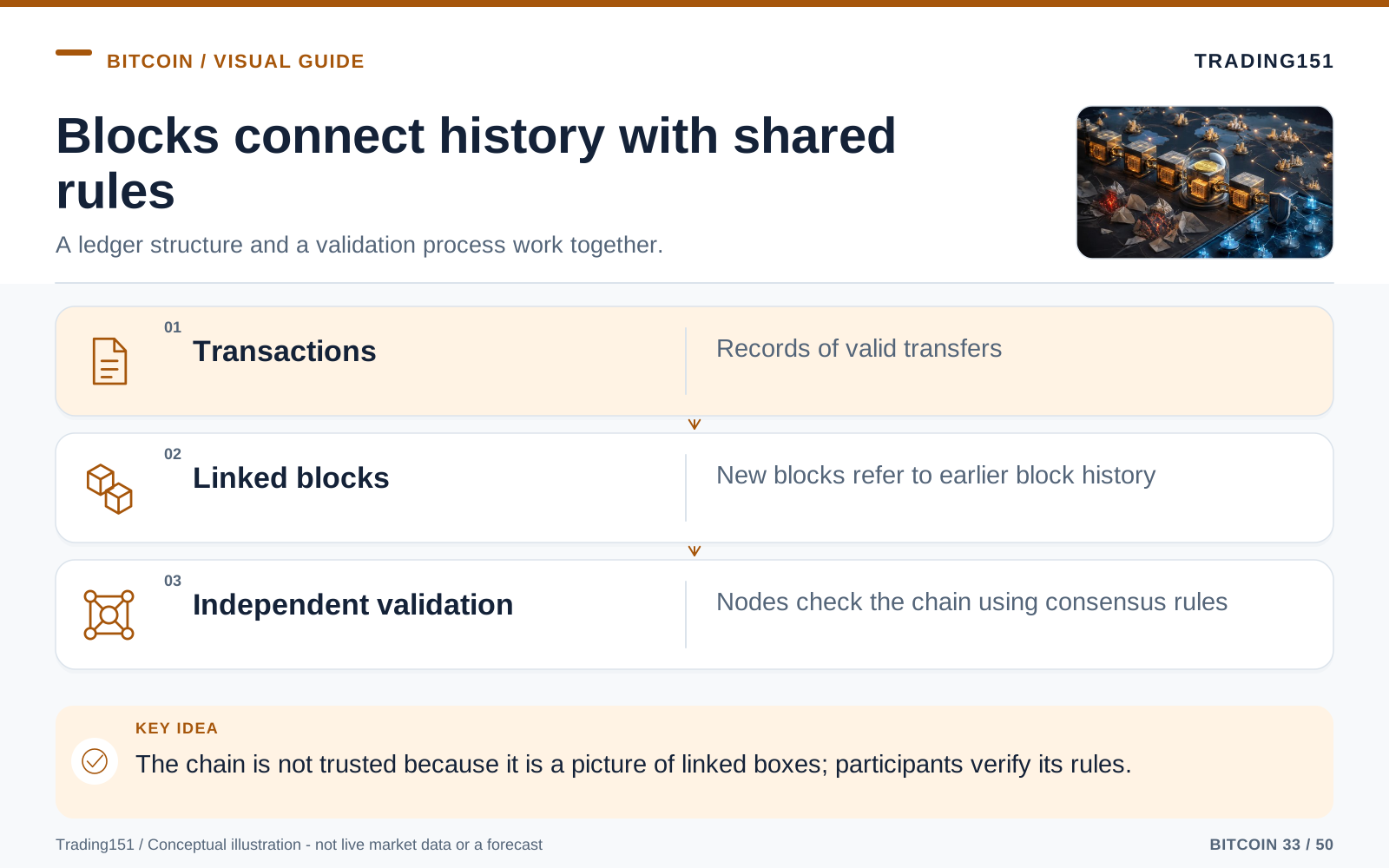
Read this diagram as text
- Transactions
- Records of valid transfers
- Linked blocks
- New blocks refer to earlier block history
- Independent validation
- Nodes check the chain using consensus rules
Imagine a Shared Notebook That Nobody Owns
If you want a good mental image of how the blockchain works, picture a shared notebook sitting in the lobby of a large apartment building. Now, the notebook analogy gets a little closer to reality if you throw in one slightly awkward detail: all the copies of the notebook don't update at the same millisecond. Because messages take a bit of time to zip across the internet, you can occasionally have two perfectly valid-looking versions of the notebook competing for a brief moment. Bitcoin handles this normal network lag by having the computers in the network essentially agree to follow whichever chain has the most "proof of work" piled up behind it. Once one version takes the lead, the network drops the other one, and any valid transactions from the losing chain get tossed back into the waiting room. Reaching a consensus isn't about one giant global supercomputer thinking in perfect unison; it's more like thousands of separate computers constantly chatting and eventually agreeing on the same version of history.
Okay, back to the building. Everyone living there chips in for shared expenses—stuff like groceries, maintenance, the electric bill, and rent. At first, the neighbors think about just picking one guy to act as the building's accountant. It sounds easy enough, but it immediately creates a glaring problem: that accountant could easily make a stupid math error, skip town with the cash, play favorites, or just quietly tweak the numbers to benefit himself.
So, the residents decide to try something totally different. They give every person their own identical copy of the notebook. Whenever somebody pays someone else, they have to shout the transaction out so the whole building can hear. Everyone checks their own notebooks to see if the payment makes sense, and if it checks out, everyone writes it down.
If John yells, "Hey, I just paid Mary $50 for my share of the electricity bill!" all the neighbors look at their notebooks to make sure John had $50 to his name in the first place. Once they all agree the money is there, every notebook gets updated at the same time.
Now, let's say John is feeling sneaky and tries to cheat the system later on. He sneaks into his own notebook and changes the entry to make it look like he only paid $10. It doesn't do him any good. Everyone else in the building still has the original $50 entry. His fake version doesn't match the group's shared reality, so the whole building just ignores him.
That is the fundamental vibe of the Bitcoin blockchain. It is simply a shared ledger that is continuously copied and updated across thousands of totally independent computers, which are called nodes. Every node has the power to check the rules for itself. It never has to call up "Bitcoin Headquarters" to ask for permission, because Bitcoin Headquarters doesn't exist.
This is honestly one of the things people get wrong about Bitcoin the most. The blockchain is not just a database. Lots of boring companies have databases. What makes Bitcoin special is that its database is spread out everywhere, totally public, strictly rule-based, and kept alive by a large network of people who don't know each other and definitely don't have to trust each other.
Every full node can look back through the entire history of transactions. It double-checks that the coins someone is trying to spend exist, that the digital signatures match up, that new blocks follow all the rules, and that nobody is trying to spend the same coin twice. If any transaction tries to break the rules, the honest nodes will instantly reject it, and they don't care who sent it.
Why Do We Even Call It a "Blockchain"?
The name "blockchain" just describes how this large ledger is organized. The transactions aren't just scribbled into the record one at a time in a messy, endless stream. Instead, they are bundled together into neat little batches, and these batches are called blocks.
Think about that apartment building notebook again. Instead of residents furiously scribbling down every expense on random pages whenever they happen, they agree to gather up all the recent transactions, double-check them as a group, and then permanently glue them all together onto one new, official page. Once the group signs off on that page, it becomes a permanent part of the notebook.
Bitcoin does basically the same thing. All the new transactions that are sitting around waiting to be confirmed get scooped up into a candidate block. That block holds a list of the transactions, a timestamp, some behind-the-scenes technical data, and—crucially—a very specific reference pointing back to the block that came right before it.
That little backward-pointing reference is exactly what creates the chain. Every new block points directly back to the previous one. And that previous block points to the one before that. If you follow those links all the way back, you will eventually hit Bitcoin's very first block, which people usually call the genesis block.
The design of the chain acts as a large security feature. Because each block is mathematically tangled up with the one right before it, you can't just sneak in and change an old transaction. If you wanted to rewrite history, you wouldn't just have to forge one block; you'd have to recalculate that block and every block that came after it, all while the rest of the network is racing ahead adding new ones.
Cryptography: The Glue That Holds It Together
Bitcoin relies heavily on a field called cryptography, which is essentially the science of secret codes and secure communication. You don't need a math degree to understand the basics, though. It really just comes down to two main concepts: hashing and digital signatures.
Hashing: The Digital Fingerprint
A hash function is a clever piece of math that takes an input—it could be a single word, a picture of a cat, or an entire encyclopedia—and scrambles it into a fixed-length string of random-looking characters. If you run the same input through the function, you will always get the same output. But if you change even a single comma in the encyclopedia, the resulting hash changes completely.
Bitcoin uses hashes constantly. Remember how each block points back to the previous one? It does this by including the hash of the previous block. This creates a sort of digital tamper-evident seal.
Imagine sealing every page of that apartment notebook with a unique wax stamp that somehow perfectly represents the exact words written on that page. If some guy tries to sneak in and change a single number, the wax stamp no longer matches the contents. In Bitcoin, that stamp is mathematical instead of physical, but it serves the same purpose: it makes secretly editing the ledger practically impossible.
Public and Private Keys: How You Own Stuff Without a Password
The second big cryptographic concept is the idea of a key pair: a public key and a private key.
Think of your public key (or, more commonly, the Bitcoin address that comes from it) like a slot in a mailbox. Anyone can walk up and drop Bitcoin into it. You can hand it out to strangers without worrying they're going to steal your funds.
Your private key is a totally different story. That is the ultimate secret password that gives you the power to spend the money. When you want to send some Bitcoin, your wallet software uses your private key to generate a unique digital signature for that specific transaction. The genius part is that the rest of the network can look at that signature and verify that it's legitimate, but they can do it without ever needing to see your actual private key.
It's an cool trick. It allows a totally public network to confirm that the rightful owner authorized a payment, without forcing the owner to expose the secret that proves they own it.
But with that power comes a lot of real-world responsibility. In normal banking, if you forget your password, you just hit "forgot password" and reset it. If you lose your credit card, you call an 800 number and cancel it. If you send a wire transfer to the wrong person, sometimes the bank can pull it back. Bitcoin offers zero forgiveness. If a hacker gets their hands on your private key, they can spend your coins, and they are gone forever. If you lose your key entirely, there is no customer service hotline to call. You're just locked out.
That is exactly why you'll hear Bitcoiners endlessly repeat the phrase, "Not your keys, not your coins." It sounds a bit preachy, but it hits at the very core of the system. True control comes from holding cryptographic ownership, not from having an account name sitting in a database owned by a company.
What Is Happening When You Hit 'Send'
From your perspective, sending Bitcoin feels pretty easy. You open up an app, paste in an address, type in the amount, and hit send. But what's going on under the hood is a lot more fascinating.
First, your wallet drafts a transaction. It basically broadcasts a message saying: here are the specific coins I want to spend, here is where they are going, and here is the small fee I'm willing to pay the network to process this. Your wallet then stamps this message with the digital signature created by your private key.
Next, your wallet shouts that transaction out to the nodes nearest to it on the network. Those nodes immediately check it against Bitcoin's rulebook. Does the math on the signature check out? Are these coins real? Has this guy already tried to spend them somewhere else? Is the transaction formatted correctly? If everything looks good, those nodes pass it along to their neighbors, and the transaction ripples out across the entire globe.
At this stage, your transaction is just hanging out in a sort of digital waiting room called the mempool. The network knows it exists, but it hasn't been officially cemented into a block yet. This is where the miners come in. Miners look at the mempool, grab a bunch of transactions—usually prioritizing the ones that offered the highest fees—and try to pack them into the next block.
The moment a miner successfully tacks a new block containing your transaction onto the chain, your payment has its first "confirmation." Every time another block gets added on top of that one, your transaction gets another confirmation, burying it deeper in the chain and making it exponentially harder to reverse. If you're just buying a cup of coffee, one confirmation is probably fine. If you're moving a million dollars, you're going to want to wait for a few confirmations, because the finality of the transaction gets stronger with every block.
This is a totally different paradigm than a credit card swipe. A credit card transaction might say "approved" the second you swipe it, but the merchant might face a chargeback weeks later. Bitcoin takes a little longer to settle up front, but once it is buried in the blockchain, reversing it becomes basically impossible.
Miners: The Network's Accountants, Security Guards, and Lottery Players
Mining is probably the most misunderstood part of Bitcoin, mostly because the word "mining" is a terrible metaphor. These people aren't sitting in digital caves swinging pickaxes to chip coins out of the internet. What they are doing is competing against each other to add the next official block to the ledger.
Here is the simple version of how it works: Miners scoop up those waiting transactions, double-check that nobody is breaking the rules, and organize them into a proposed block. Then, they enter a large, global math competition.
This race involves trying to find a specific hash that is lower than a target number set by the Bitcoin network. The miners take their proposed block, tweak a tiny piece of meaningless data inside it, and run it through the hashing math. Over and over and over. They are hoping to randomly spit out a hash that meets the network's strict criteria. It isn't about being smart; it's entirely about raw computing power and sheer persistence. The faster your computers can guess, the better your odds of winning.
This entire process is called Proof of Work. The name is totally literal. If a miner wants the right to write the next page of the ledger, they have to mathematically prove to everyone else that they burned a lot of electricity and computing power to do it.
That large cost isn't some unfortunate side effect—it is the entire security model. If creating blocks was free and easy, scammers could just spam the network with fake versions of history. By forcing miners to spend real-world money on electricity, Bitcoin ensures that trying to cheat the system is expensive.
When a miner finally hits the jackpot and finds a valid block, they immediately broadcast it to everyone else. The other nodes look it over. If the miner followed all the rules, the nodes accept the block and glue it to their own copies of the chain. The miner who won the race gets a reward—a chunk of brand-new Bitcoin that just popped into existence, plus all the transaction fees from the payments inside that block.
That block reward serves two purposes: it's how new Bitcoins are born and introduced to the world, and it's how the network pays for its own large security guard force. Miners are heavily financially incentivized to play by the rules, because if they try to sneak in a fake transaction, the rest of the network will reject their block, and they'll have burned all that electricity for absolutely nothing.
The Genius of the Difficulty Adjustment
Bitcoin is hardcoded to try and produce a new block roughly every ten minutes. But the real world is messy. Miners are constantly turning machines on, turning them off, upgrading to faster hardware, or moving their operations to places with cheaper power. If the system was static, blocks would start flying out way too fast when a bunch of new miners joined, and the whole network would grind to a halt if a bunch of them quit.
To fix this, Bitcoin has an automatic thermostat built in. Every two weeks or so, it looks at how fast blocks are being found and adjusts the difficulty of the math puzzle. If blocks are coming in too fast, the puzzle gets harder. If they are coming in too slow, it gets easier.
This silent, automatic adjustment is arguably one of the most brilliant pieces of engineering in the entire Bitcoin protocol. It allows a chaotic, global network of totally independent actors to keep perfect time without anyone acting as a manager. There's no CEO turning a dial in an office somewhere. The code just handles it.
Solving the Infamous Double-Spend Problem
Perhaps Bitcoin's greatest claim to fame is that it finally figured out how to solve the double-spend problem without relying on a boss.
In the real world, you can't really double-spend a $20 bill. Once you hand it to the cashier, it's not in your pocket anymore. But digital money is just information, and information can be copy-pasted. If you don't have a trusted bank watching everyone's accounts, what's stopping a scammer from trying to send the same digital coin to two different people?
Bitcoin fixes this by making the history of every transaction completely public, and by forcing all the nodes to only respect the version of the chain that has the most Proof of Work burned into it. If some guy tries to broadcast two conflicting transactions at the same time, the network will eventually hash it out and settle on just one version of events. Whichever transaction makes it into the dominant chain is permanent; the other one is essentially deleted from reality.
This is why we care about confirmations. A payment that just got broadcast to the network isn't nearly as secure as one that is buried under six blocks. Every new block piled on top makes it exponentially more expensive and difficult for an attacker to try and rewind time and replace that history.
What Decentralization Means Here
People throw the word decentralization around so much in tech circles that it often just sounds like marketing fluff. But in the context of Bitcoin, it means something very specific and practical: absolutely no single person or group has the power to control the ledger, change the rules, or shut the network down.
Miners might suggest new blocks, but it's the regular nodes that decide if those blocks are valid. Programmers can write updates to the software, but it's up to the individual users to download and run that code. Big crypto exchanges can list the coin for trading, but they don't own the underlying protocol. Governments can pass laws regulating the businesses that interact with Bitcoin, but they can't just log into a master server and rewrite the blockchain.
That separation of powers is large. If you want to change a bank's ledger, you just need the right login credentials. Bitcoin's ledger doesn't work like that. It's not theoretically impossible to attack it, but in the real world, the sheer amount of money and computing power required to do it makes it virtually impossible.
Transparency, But With a Catch
The Bitcoin blockchain is completely open to the public. Anybody with an internet connection can look at it. You can track every transaction, check wallet balances, see how much people are paying in fees, and watch blocks get confirmed in real time. This radical transparency is the whole reason the system works without needing a central auditor.
But that doesn't mean it's as simple as looking at a giant spreadsheet with everyone's names on it. Bitcoin addresses aren't inherently tied to your real-world identity. You don't sign up with your driver's license. A single person can spin up thousands of different addresses, and most good wallet software automatically gives you a fresh address every time you receive money to help protect your privacy. But, if a specific address ever gets linked back to your real name—maybe because you posted it online, or because you transferred funds to an exchange that has your ID—suddenly, anyone can trace that entire financial history.
Because of this, it's much more accurate to call Bitcoin pseudonymous, rather than fully anonymous. The ledger is an open book, but the real human identities remain hidden just off the page—unless they get connected through sloppy habits, public leaks, or forensic blockchain analysis.
This weird middle ground is part of what makes the tech so interesting. It's perfectly transparent so anyone can audit the total supply of coins, but it doesn't force you to stamp your legal name next to every cup of coffee you buy.
The Elephant in the Room: Energy Consumption
You can't really talk honestly about how the Bitcoin blockchain works without bringing up how much energy it uses. Proof of Work requires a large amount of electricity, entirely by design, because all those miners are locked in a relentless global competition to secure the next block. Critics look at this and argue that it's a colossal waste of power, and that the environmental impact is simply too high to justify.
Supporters push back hard. They argue that this energy is buying the network's security. They point out that miners are constantly hunting for the absolute cheapest, most remote, or stranded energy sources that nobody else wants to use. And on a philosophical level, they argue that having a neutral, globally accessible financial network is a fundamentally good thing that is well worth the electricity bill.
This argument isn't going to be settled anytime soon, and you can't just brush it off with quick talking points. Proof of Work is simultaneously the engine that makes Bitcoin so secure and the single most controversial thing about it. The same math that makes it so substantially expensive for a hacker to attack the network is what causes it to burn so much power.
Whether you think that trade-off is worth it really just depends on how much value you see in having a financial system that nobody can censor or control. If you think Bitcoin is just a giant casino for bros to gamble in, then yeah, the energy use looks insane. But if you view it as crucial infrastructure for global finance, the math looks very different.
But strictly from a technological standpoint, the key takeaway is this: the energy consumption isn't some weird bug. It is a deliberate feature. It is the direct mechanism Bitcoin uses to convert real-world physical cost into digital security.
What Blockchains Are Good At (And What They Aren't)
Once "blockchain" became the hottest buzzword in tech, every company on earth tried to figure out how to slap it onto their products. It got ridiculous. To be clear: a blockchain is not just a magical, better version of a normal database. In fact, in a lot of situations, a blockchain is significantly slower, way more complicated, and substantially inefficient compared to normal tech.
Blockchains really only make sense when you have a bunch of different parties who all need to look at the same data, but none of them trust each other enough to let one person hold the master copy. It's the right tool for the job only when you care more about censorship resistance, open verification, and security than you do about speed and convenience.
If a normal company just wants to track how many office chairs they have in the warehouse, using a regular, boring SQL database is the right move. Trying to build a blockchain to share notes for a small group project would be a unexpectedly bad idea. But if you have a large network of total strangers spread across the globe who need to definitively agree on who owns what, without paying a middleman to manage it? That is exactly when a blockchain shines.
Bitcoin is the most perfect example of this because the problem it was trying to solve was very narrow: how do we create a digital asset that is scarce, and let people trade it without using a bank? The blockchain wasn't just a cool feature they decided to add to Bitcoin. It is the fundamental architecture that makes Bitcoin possible in the first place.
Why the Idea Outgrew Bitcoin
While Bitcoin was the first real-world application of a blockchain, it got a lot of people thinking: if this technology can successfully track digital money, what else could we put on a distributed ledger?
People started throwing blockchains at everything. They built them to track global shipping logistics, handle digital identity, record real estate deeds, prove ownership of digital art, run complex financial contracts, and even attempt to build secure voting platforms. Some of these projects are brilliant. A lot of them are just shiny marketing campaigns trying to attract venture capital. The hard part is figuring out which projects need this technology, and which ones are just using the word "blockchain" to sound smart.
The projects that have legs tend to share a few common traits. They usually involve a lot of different people, low levels of trust, and a strict requirement that the data can be publicly verified. A shipping company might use a blockchain to let different factories and distributors prove exactly where a product originated, as long as the data being typed into the system is accurate. A city government might use one for land registries to prevent corrupt officials from secretly changing property lines.
But that last point is the kicker. A blockchain is good at protecting digital data from being tampered with. What it absolutely cannot do is magically guarantee that the data was true before it was typed in. If a guy lies about where a shipment of coffee came from and logs it into a blockchain, the blockchain is just going to keep that lie perfectly secure forever. It is an amazing tool for keeping records safe, but it's not a magical lie detector for the real world.
Why Bitcoin is Still the Benchmark
Despite all the endless drama—the years of intense arguments, the wild price swings, the government crackdowns, the celebrity endorsements, the absolute explosion of scams, and the very real technical development—Bitcoin is still the gold standard when people talk about blockchain. And it's not because it has the newest code or the flashiest features. It's simply because it was the first one to prove that this wild idea works on a large, global scale.
It proved that a decentralized network of volunteers can keep a ledger perfectly accurate. It proved that strangers can do business without trusting each other. It proved that you can create digital scarcity without a tech monopoly running the servers. And it proved that you can use financial incentives to convince self-interested people to protect the network rather than attack it.
None of this means Bitcoin is flawless. It can be slow compared to a Visa swipe. The fees get annoying when the network gets crowded. If you want to hold your own keys, you have to be very careful not to lose them. Privacy isn't guaranteed. The environmental debate is real. The price chart looks like a rollercoaster. And yes, the whole industry is still swarming with hype-men and fraudsters.
But if you look past all of that, the blockchain technology running underneath Bitcoin is a profound invention. It fundamentally shifted how we think about trust on the internet. Before Bitcoin launched, if something had digital value, it almost always required a central recordkeeper. Bitcoin showed us that it's entirely possible to build a system where the network itself is the only recordkeeper we need.
Verification does not mean trusting every participant
Imagine a miner publishes a block that pays itself more new bitcoin than the rules permit. The block may contain substantial proof of work, but nodes enforcing those rules reject it as invalid. Work determines how valid competing histories are compared; it does not excuse a rule violation. This distinction is central to understanding why mining power and control over the rules are not the same thing.
Among valid alternatives, Bitcoin follows the chain with the greatest cumulative proof of work, not simply whichever chain has the largest count of blocks in every conceivable comparison. The familiar phrase "longest chain" is shorthand that can obscure this. Temporary competing blocks can occur, and nodes may update the history they follow as more work accumulates.
There are also different ways to use the network. A full node independently validates the rules, while a lightweight wallet may rely on additional assumptions or services for information. A custodial account adds another layer: the provider maintains the customer's balance and controls withdrawals. All may display a bitcoin balance, but they offer different forms of verification and control.
The practical lesson is to identify which checks your own arrangement performs. Running software, owning keys, and trusting a provider are not interchangeable activities. Understanding the distinctions makes the blockchain less mystical and gives users a more accurate picture of what the system verifies for them and what remains their responsibility.
A valid record does not establish a true claim about the world
Bitcoin's rules can establish whether a transaction is valid within the system. They do not establish that a seller owns the physical item being advertised, that a charitable claim is genuine, or that an invoice is legitimate. Those questions require evidence outside the chain.
This distinction is useful whenever a product claims to be trustworthy because it uses a blockchain. Ask exactly what the ledger verifies and what someone entered into it. A record can be resistant to alteration while recording a claim that was false from the start. Strong transaction validation should not be stretched into a general guarantee about people, goods, or promises beyond the protocol. 1, 2
What the Ledger Changed
The technology powering Bitcoin is so much more than just a fancy database or a trendy buzzword for tech bros. It is an entirely new framework for establishing trust.
For practically all of human history, we have leaned on big institutions to handle our money and prove who owns what. Kings minted the coins. Banks held the ledgers. Governments kept the deeds to our houses. Financial companies decided whose payments got approved and whose got blocked. That entire system is baked into how the world works, and it isn't going to vanish overnight.
But Bitcoin introduced an entirely new option. It proved that a messy, leaderless network of strangers—bound together only by open-source code and heavy cryptography—could successfully maintain a global financial ledger without putting a single bank or government in charge.
That is why the blockchain is so much more important than whatever the price of a Bitcoin happens to be today. Prices crash, prices pump. The media narratives flip back and forth. The critics and the fanboys take turns acting like they know exactly what the future holds. But while all that noise is happening, block by block, the network just quietly keeps doing its job: allowing anyone on earth to verify the truth for themselves.
It might not make for as flashy a headline as a market crash or a billionaire's tweet, but that is the real revolution. Bitcoin's blockchain is a totally public, resilient, mathematically fortified record of truth. It swapped out a central promise for a shared mathematical proof. And regardless of whether Bitcoin ultimately becomes the money we use every day, a digital version of gold, or something we haven't even figured out yet, the core idea it unleashed has fundamentally and permanently changed how we think about trust in a digital world.
Sources and further reading
Editorial revision: 7 October 2026. Numerical scenarios are hypothetical unless identified as historical. References support the added explanations and selected corrections; rules and product terms should be checked again before acting.