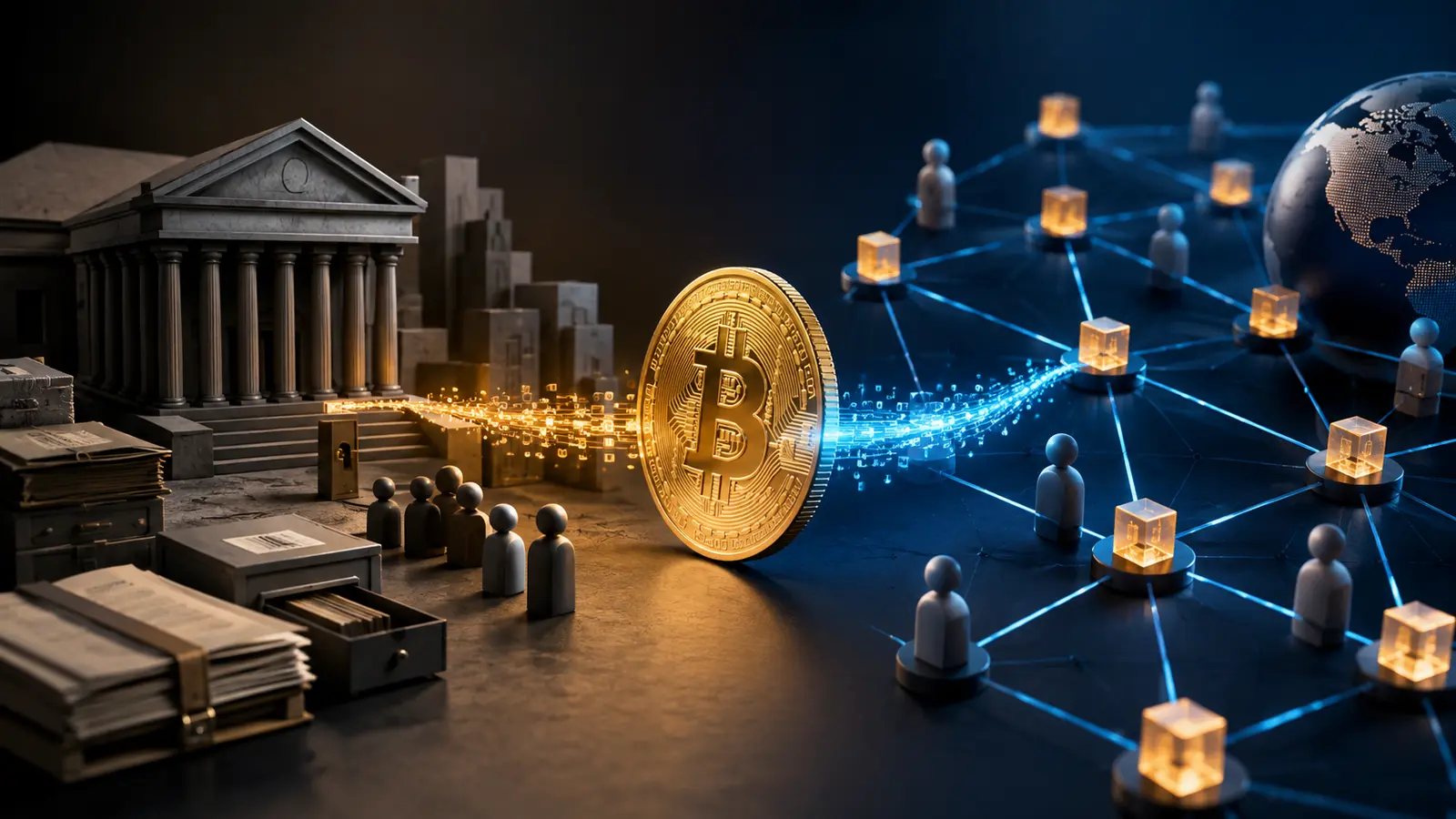
Bitcoin is both a peer-to-peer monetary network and the name commonly used for the asset transferred through it. The network maintains a shared transaction history under rules enforced by participating software. A wallet manages the keys and information needed to use the asset; it does not hold digital coins in the same way a purse holds cash. Keeping those ideas separate makes the system easier to understand.
The Quick Version: Bitcoin in Thirty Seconds
If you only have a minute: Bitcoin is digital money you can send straight to anyone, anywhere, over the internet. You don't need a bank, a credit card company, or a government to approve the transfer. Instead, it runs on a large public network of independent computers that all follow the same rules and share a single, public record of who owns what. New coins are slowly released through a process called mining, and the total supply is strictly capped forever at 21 million. That unique mix of independence, transparency, and hard scarcity is what sets Bitcoin apart from the dollars or euros sitting in your digital bank account.
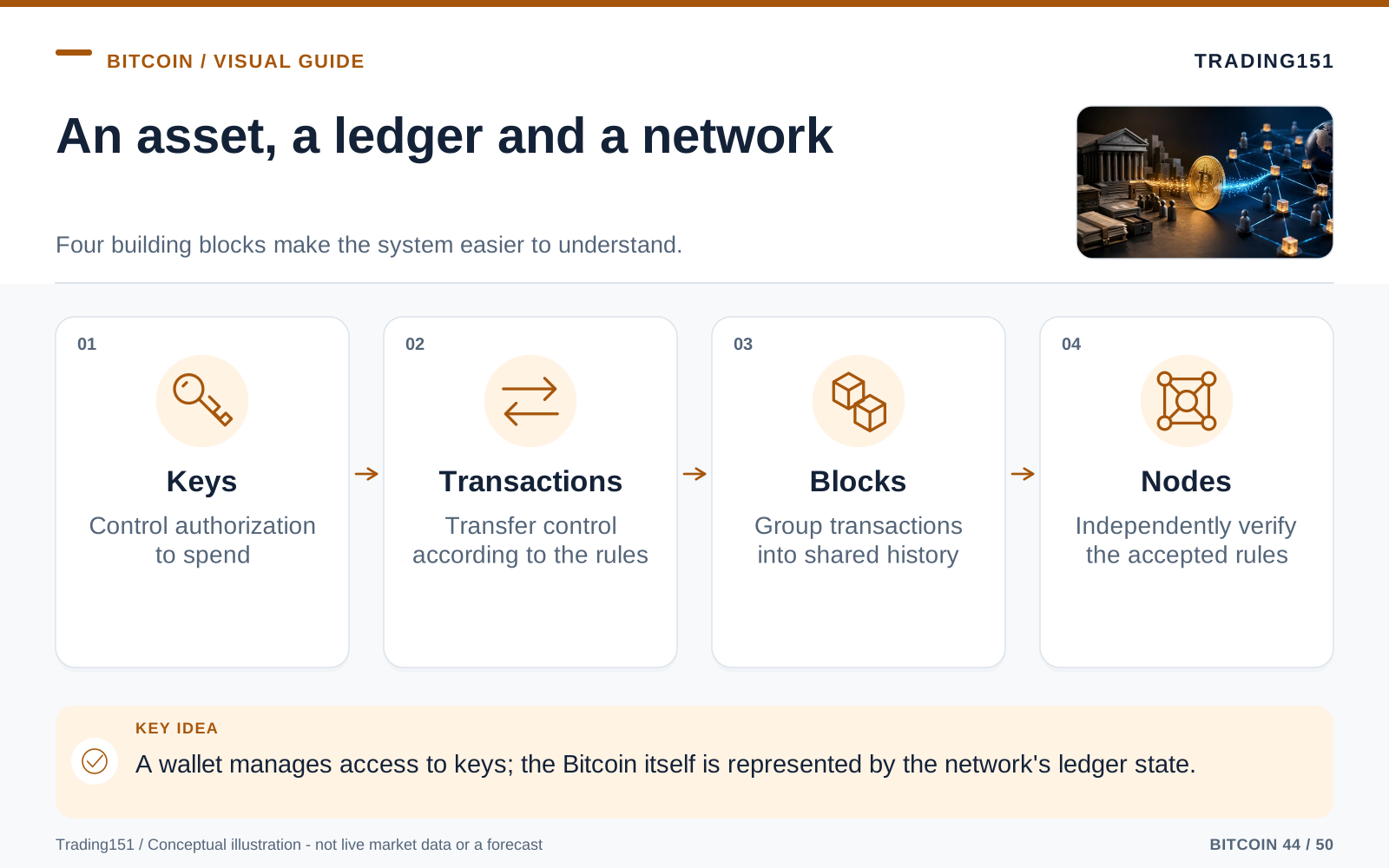
Read this diagram as text
- Keys
- Control authorization to spend
- Transactions
- Transfer control according to the rules
- Blocks
- Group transactions into shared history
- Nodes
- Independently verify the accepted rules
Why Bitcoin Was Created
To really get Bitcoin, you have to look at the world it was born into.
Rewind to 2008. The global financial system was melting down. Large banks were collapsing or getting bailed out, credit froze, and everyday people were losing their homes, jobs, and savings. The whole mess exposed a glaring, uncomfortable truth: our money relies entirely on giant, opaque institutions that we have to blindly trust, even when they make terrible decisions.
Right in the middle of this chaos, an anonymous person (or group) using the name Satoshi Nakamoto dropped a short whitepaper online. It was called Bitcoin: A Peer-to-Peer Electronic Cash System. Satoshi's true identity remains a mystery to this day, but the identity didn't matter. The idea did. They proposed a completely new kind of money that lived on the internet and let people trade directly with each other, totally bypassing the banks.
The timing wasn't a coincidence. When the very first Bitcoin block (known as the genesis block) was mined in January 2009, Satoshi embedded a hidden message inside it: a newspaper headline about a second round of bank bailouts. This wasn’t just a tech experiment. It was a direct critique of the modern banking system.
Satoshi didn’t want to build a better PayPal. The goal was much bigger: to build a currency with hard, transparent rules that couldn't be manipulated by politicians, central banks, or Wall Street CEOs.
So, What Exactly Is Bitcoin?
When you strip away the tech talk, Bitcoin is purely digital money. There are no physical coins you can hold in your hand, and there's no vault somewhere stuffed with gold to back it up. When someone says they "own Bitcoin," they don't mean they have a little coin graphic saved on their iPhone. What they have is the cryptographic authority to move a specific amount of value around on the Bitcoin network.
Your balance isn't sitting in a private account owned by a company; it's calculated from a large public history of transactions. That's why you could drop your phone in a lake, taking your Bitcoin wallet app with it, and your Bitcoin would still be completely safe on the network, waiting for you to recover your access with a backup phrase. The app is just a viewer—the money lives on the network itself.
This might sound weird, but think about it: most of our money is already digital. When you open your banking app and see $1,000, you’re just looking at numbers in a private database. When you buy groceries with a debit card, nobody is physically driving paper bills to the supermarket. Banks just update their internal spreadsheets.
What makes Bitcoin revolutionary is that there’s no central spreadsheet, and no single bank in charge of updating it. No manager can freeze your account. No payment processor can decide their servers are closed for a holiday. No government can suddenly print more of it. Instead, the rules are enforced by thousands of independent computers worldwide running the same software.
By the way, people usually use Bitcoin (capital B) to talk about the network as a whole, and bitcoin (lowercase b) to refer to the actual money. It’s a subtle distinction, but a helpful one to keep in mind.
The Big Idea: Money Without a Middleman
Right now, if you want to send money to a friend, you aren't sending it directly. A company sits between the two of you. They check your balance, authorize the transfer, take their cut in fees, and update the official record.
Middlemen are often helpful. They let you reset a forgotten password, reverse fraudulent charges, and call customer service if something breaks. But middlemen also hold all the power. They can freeze your funds, delay a transfer for days, demand your personal info, or hike up their fees whenever they feel like it.
Bitcoin completely cuts them out. When you pay someone in bitcoin, you broadcast your transaction straight to the network. The network checks the math to make sure everything is legit, and if it is, the payment goes through.
This is what people mean when they call Bitcoin decentralized. It doesn’t mean nobody is in charge and it's total chaos; it just means the power and responsibility are shared across a global network instead of locked in a corporate headquarters.
The Problem Bitcoin Had to Solve
But digital money has a large built-in problem that a $20 bill doesn't.
If I hand you a physical twenty-dollar bill, I don't have it anymore. It leaves my hand and enters yours. But digital files are different. Think about a photo or a PDF—you can copy and paste them a million times. So, how do you stop someone from just copying their digital money and spending the same coin twice?
In computer science, this is called the double-spending problem. Before Bitcoin came along, digital payment systems solved this by relying on a central authority. A bank or payment company kept a master ledger and acted as the referee, deciding if a transaction was valid.
Bitcoin solved the problem without the referee. It created a shared, public master list that everyone can see and verify, but no single person controls. We call that list the blockchain.
The Blockchain: A Public Record Book Everyone Can Verify
Picture a small town where everyone carries around an identical copy of the same notebook. Whenever Alice wants to pay Bob, she doesn't do it in secret. She stands in the town square and announces it. Everyone checks their notebook to make sure Alice has the funds. If she does, they all write the transaction down at the same time.
If Alice tries to cheat and spend money she doesn't have, the town immediately spots the lie. She can't just cross out a number in her own notebook, because thousands of other notebooks will contradict hers.
The Bitcoin blockchain is basically this town, but scaled up to a global network of computers. The "notebook" is a large digital record of every Bitcoin transaction ever made since 2009.
Transactions are bundled together into batches called blocks. Every ten minutes or so, a new block is securely locked onto the previous block, creating a literal, unbreakable chain. If someone tries to go back and alter an old transaction, it breaks the mathematical link to every block that came after it, immediately triggering alarms across the whole network. To rewrite the history, a hacker would need more computing power than the rest of the honest network combined. Bitcoin doesn't rely on humans being good people; it relies on math making it expensive and practically impossible to cheat.
Nodes: The Quiet Computers That Keep the Rules Honest
People hear a lot about miners in the Bitcoin world, but they aren't the only ones running the show. There’s another important player you should know about: the node.
A node is simply a computer running the Bitcoin software. Its job is to store a copy of the blockchain, listen for new transactions, and strictly enforce the rules. If a miner tries to sneak in a fake transaction, or award themselves extra coins, the honest nodes will simply reject the block and ignore them.
Nodes are the unsung heroes because they keep the miners in check. They ensure nobody can hijack the system. And the best part? Anyone with a decent laptop and some extra hard drive space can run one. You don't have to ask for permission or sign up for an account, because there is no Bitcoin headquarters.
Wallets: Where Your Bitcoin Really Lives
It’s super common to think a Bitcoin wallet stores your coins the way a leather wallet holds your cash. It doesn't. Your wallet is much closer to a keychain.
Remember, your bitcoin lives exclusively on the public blockchain. Your wallet app just holds the cryptographic keys needed to unlock and move your specific coins around.
When you set up a wallet, it generates a deeply hidden secret called a private key. From that private key, the software creates public information used to receive funds, usually a Bitcoin address.
- Your Bitcoin address is essentially your bank account number or Venmo handle. You can freely give it to anyone who wants to pay you.
- Your private key is the ultra-sensitive PIN or master password. It’s the mathematical proof that you own the right to spend the funds tied to that address.
The private key is absolutely everything. If someone gets their hands on it, your bitcoin is gone. If you lose it and haven't backed it up, it’s gone forever—there's no 1-800 number to call for a password reset. That’s the ultimate trade-off of Bitcoin: you get absolute control over your money, but you also bear 100% of the responsibility for keeping it safe.
Is Bitcoin Anonymous?
Not really. A better word for it is pseudonymous.
Your real name isn't stamped anywhere on the blockchain. Anyone looking at the public record just sees a string of random numbers and letters sending money to another string of random numbers and letters. That gives a baseline level of privacy you definitely don’t get from a traditional bank statement.
But—and this is a big but—the entire history is completely public. Anyone can audit it. If you ever link your real identity to your Bitcoin address (like by buying it on a regulated exchange using your ID), it’s quite easy for investigators to track your financial footprint. Bitcoin isn't a shady, invisible tunnel for secret transactions. It’s more like a completely transparent, glass bank where everyone uses account numbers instead of names.
Mining: How Bitcoin Secures the Network
Let's clear something up right away: the word mining is a little misleading. Miners aren't digging for digital gold with virtual pickaxes. They are just running highly specialized, powerful computers that compete to process the next batch of transactions.
Here’s how it works: miners scoop up a bunch of pending transactions, verify them, and try to seal them into a new block. To seal the block, their computers have to solve a substantially complex cryptographic puzzle. It’s essentially a large, global guessing game played at lightning speed.
The first miner to guess the correct winning number gets to add the newest block to the chain. The rest of the network verifies their math, accepts the block, and the race starts all over again.
This process is called proof of work. Miners have to prove they burned real-world energy (electricity and computing power) to participate. That large energy cost is exactly what keeps the network secure. Attacking Bitcoin would cost so much money in electricity and hardware that it simply wouldn't be worth the effort.
Where Do New Bitcoins Come From?
So what does the winning miner get for all that effort? They are rewarded with brand-new, freshly minted bitcoin, plus the transaction fees paid by users.
This is how new coins enter circulation without a central bank printing them. There is no board of directors deciding to print more money to stimulate the economy. The release schedule was hard-coded into the software from day one.
Back in 2009, a miner got 50 bitcoin for every block they solved. But the rules dictate that this reward gets cut in half roughly every four years (an event known as the halving). After the most recent halving in 2024, the reward dropped to 3.125 bitcoin per block. Over the next century, that reward will continually shrink until it hits zero. Once all the bitcoin is mined, miners will make their money entirely from transaction fees.
The 21 Million Limit
This brings us to one of Bitcoin’s most famous features: there will only ever be 21 million bitcoin. Ever.
This hard cap is why people often compare it to gold. Gold has value partly because it’s physically scarce and hard to dig up. Bitcoin is scarce by design—its mathematical rules prevent anyone from making more of it.
This is a stark contrast to normal money like dollars, euros, or yen. Governments and central banks can—and do—print more currency whenever they feel it’s necessary to fund spending, pay off debt, or manage economic crises. Over time, printing more money usually leads to inflation, meaning the cash in your wallet slowly loses its purchasing power.
Bitcoin flips that model upside down. Its monetary policy is locked in and completely predictable. Nobody can secretly decide to mint another 10 million coins to fund a war or bail out a failing corporation. To a lot of people, that predictability is Bitcoin's greatest selling point, even if traditional economists argue that a totally fixed money supply is too rigid for a modern economy.
Why Does Bitcoin Have Value?
It’s totally fair to wonder: Why should a bunch of digital code on the internet be worth anything at all?
But you could ask the same thing about the paper in your wallet. A hundred-dollar bill is just a piece of linen and cotton. A bank balance is just numbers on a server. Money only has value because we all collectively agree it does, and because we trust we can exchange it for goods and services tomorrow.
Bitcoin derives its value from a unique combination of traits:
- Scarcity: The supply is strictly capped at 21 million.
- Durability: It can't rust, rip, or physically degrade over time.
- Portability: You can carry a billion dollars across a border on a tiny USB drive, or just by memorizing a seed phrase.
- Divisibility: You can chop one bitcoin up into 100 million tiny pieces (called satoshis), making everyday purchases possible.
- Verifiability: Anyone can audit the entire system and transaction history at any time.
- Censorship resistance: Nobody can block you from sending your money or demand to know what you're buying.
- Network effect: The more people, companies, and investors adopt it, the more useful and secure the whole ecosystem becomes.
Now, does that mean the price will only ever go up? Absolutely not. The market decides the price, and markets are driven by human emotion—fear, greed, and hype. But those underlying traits explain why so many people view Bitcoin as a long-term financial revolution rather than a passing fad.
Bitcoin as Money, Investment, and Technology
Ask ten different people why they use Bitcoin, and you'll get ten different answers.
Some view it purely as a payment network—a way to send money to family overseas without getting gouged by wire fees. Others see it as "digital gold," a long-term savings account immune to inflation. Day traders love it because it’s volatile. Human rights activists use it to bypass oppressive regimes that routinely freeze the bank accounts of political dissidents.
This is why debates about crypto get so messy. People judge Bitcoin based on totally different scorecards. If you're wondering, "Is this good for buying coffee?" you'll have a very different opinion than the person asking, "Will this protect my life savings from a collapsing local currency?" Bitcoin doesn’t have to be just one thing. Like the internet itself, it adapts to what the user needs.
What Happens When You Send Bitcoin?
So, what happens under the hood when you pay someone?
- Your friend gives you their public Bitcoin address.
- Your wallet app drafts a transaction saying, in effect, "I want to move this much bitcoin to this address."
- Your wallet securely signs that request using your private key. This proves you own the funds without revealing the secret key itself.
- The transaction gets broadcast out to the global Bitcoin network.
- Nodes check the math to ensure everything is legit and you aren't trying to spend money you don't have.
- A miner bundles your transaction into the newest block.
- Once that block is permanently added to the blockchain, your payment gets its first "confirmation."
Every subsequent block added on top of yours acts like an extra layer of cement, making the transaction harder and harder to undo. For a five-dollar payment, one confirmation is plenty. If you're selling a house, you’d probably wait for a few more. That settlement process takes time, which is why a Bitcoin transfer feels different than a Visa swipe. A credit card feels instant, but the bank takes days to settle the funds on the back end. Bitcoin might take ten minutes, but once it’s settled, it’s practically permanent.
Why Are There Transaction Fees?
Space inside a Bitcoin block is highly limited. When lots of people are trying to move money at the same time, it creates a traffic jam. To get to the front of the line, users can attach a higher transaction fee to incentivize miners to pick up their payment first.
When the network is quiet, fees drop. When it’s heavily congested, they can spike.
This fee market is exactly why you wouldn't use the main Bitcoin network to buy a two-dollar cup of coffee—the fee might cost more than the coffee itself. The base layer is designed to be secure and decentralized, not to process every tiny daily purchase on earth.
What About the Lightning Network?
Because the main network can only handle so much traffic, developers have built secondary layers on top of it. The most famous is the Lightning Network.
Think of Lightning like keeping a bar tab. Instead of swiping your card for every beer and bogging down the bartender, you open a tab, order drinks all night, and settle up with one single transaction at the end. The Lightning Network lets people send thousands of tiny, instantaneous, near-free payments back and forth off the main chain, only recording the final balances to the Bitcoin blockchain later.
It’s still a work in progress, and it has its own quirks. But it proves an important point: while Bitcoin's core rules rarely change, the ecosystem around it is constantly evolving to make it more practical.
Where It Helps: Why People Care So Much
It Puts You in Direct Control
When you hold your own keys, nobody can tell you what to do with your money. If you live in a stable country with a solid banking system, that might sound like overkill. But if you live under a government that routinely freezes bank accounts or enforces strict capital controls, it’s completely life-changing.
It Completely Erases Borders
Bitcoin doesn't care about your nationality, your credit score, or business hours. A transaction glides across the globe exactly the same way an email does, bypassing the traditional financial system entirely.
The Rules Are Totally Transparent
Bitcoin's monetary policy isn't hidden behind closed doors at a central bank. Anyone can verify the total supply and audit the ledger at any time. You never have to guess what the network is doing.
It’s Hard to Confiscate
Physical cash can be stolen. Gold is heavy and hard to hide. Bank accounts can be seized. But Bitcoin? As long as you keep your keys secure, your wealth is protected by pure mathematics, making it uniquely resistant to confiscation.
Where It Falls Short: What Bitcoin Does Not Fix
Bitcoin is a brilliant invention, but it isn't magic, and acting like it’s flawless is a great way to get burned. It removes the need for a bank, but it doesn't remove human error. People still lose their passwords, fall for phishing scams, and make bad investments.
The Price Swings Are Severe
Bitcoin's price can swing substantially in both directions. While it’s been a great long-term hold for many, the extreme short-term volatility makes it tough to use as everyday money. A bakery doesn't want to price its bread in bitcoin if the value might drop 10% by tomorrow morning.
Being Your Own Bank is Unforgiving
Having total control is deeply empowering, right up until you make a mistake. Send funds to a typoed address? Forget your seed phrase? Your money is gone, and there is absolutely no customer support team to bail you out.
Fees and Speeds Fluctuate
The base layer prioritizes extreme security over speed. Blocks take ten minutes, and fees can be unpredictable when the network gets busy. You have to go in with realistic expectations.
The Energy Debate is Very Real
There's no getting around it: securing the network requires a large amount of electricity. Supporters argue that it's worth it to secure a neutral, global financial system, and point out that miners increasingly run on renewable or otherwise wasted energy. Critics argue the environmental cost is simply unjustifiable. It’s a messy, highly debated topic.
The Industry is a Magnet for Scams
While the Bitcoin protocol itself is rock solid, the broader "crypto" industry surrounding it is absolutely infested with grifters, fake investments, and hype artists. Bitcoin doesn't ask for blind trust, but the people trying to sell you things certainly do. Skepticism is your best friend here.
Things People Often Get Wrong About Bitcoin
"It’s just for criminals"
Sure, bad actors use Bitcoin—just like they use gift cards, shell companies, and hundred-dollar bills. But because the blockchain is entirely public, using Bitcoin for crime is a terrible idea. Law enforcement has gotten good at tracking it.
"It isn't backed by anything"
It’s not backed by gold or a government military. It’s backed by the most secure computing network in human history, its strict scarcity, and the collective trust of millions of people who value it. Whether that's "enough" backing depends entirely on who you ask.
"Governments will just shut it down"
Governments can certainly ban crypto exchanges or make it a headache to pay taxes. But physically shutting down the network? There is no central server to unplug or CEO to arrest. Trying to ban the Bitcoin network is like trying to ban the internet.
"I can't afford a whole Bitcoin"
You don't have to buy a whole one! Just like a dollar can be broken down into pennies, you can buy tiny fractions of a bitcoin. You can easily just buy $20 worth if you want to.
"Bitcoin and Crypto are the same thing"
Bitcoin was the pioneer, but it is fundamentally different from the thousands of other cryptocurrencies out there. Many crypto tokens are basically unregulated tech startups, risky experiments, or outright scams. Bitcoin has its own distinct history, security model, and ethos.
What Makes Bitcoin So Hard to Change?
One of Bitcoin’s biggest strengths is how stubborn it is.
With a normal app, a company pushes an update and your phone downloads it. Bitcoin doesn't work like that. If developers want to upgrade the code, the entire network—miners, node operators, and users—has to reach a large consensus to adopt it. If a proposed update threatens the core rules people care about, the community will aggressively reject it.
This makes Bitcoin slow to evolve compared to newer crypto projects. That can be frustrating, but when we're talking about a global financial network, boring and steady is exactly what you want.
Should You Buy Bitcoin?
The goal here isn't to convince you to put your life savings into crypto. Bitcoin is historically fascinating, but that doesn't mean it belongs in everyone's portfolio.
If you do decide to jump in, take the time to learn the ropes first. Understand how self-custody works, learn the tax implications where you live, and figure out your own risk tolerance. The absolute worst time to learn how a private key works is right after you've made a costly mistake. Don't buy something just because a guy on Twitter sounds really confident.
Why Bitcoin Still Matters
Bitcoin matters because it achieved something brilliant: it proved that strangers scattered across the globe could maintain a shared financial system without needing a central authority to keep them honest.
It might not replace the dollar, and traditional banks probably aren't going anywhere. But it fundamentally changed how we think about trust, ownership, and financial freedom in the digital age.
Whether you see it as an inflation hedge, a tool for human rights, or just a fascinating tech experiment, Bitcoin forced the world to ask a deeply uncomfortable question: What if our money didn't need a middleman?
It’s a bold, chaotic, imperfect, and remarkably human attempt to upgrade money for the internet era. And once you understand the mechanics behind it, it stops looking like magic, and starts making a whole lot of sense.
Keep the network, the asset, and the wallet separate
A transaction spends earlier outputs and creates new ones under specified conditions. The ability to satisfy those conditions, commonly through digital signatures, is what allows a holder to authorize a spend. The blockchain records the transaction history, while the wallet helps find relevant outputs, construct transactions, and manage the signing process.
Full nodes check transactions and blocks against the rules they enforce. Miners compete to add valid blocks using proof of work, receiving a block subsidy and transaction fees when their blocks become part of the accepted chain. These roles are related but not identical. Owning more computers or producing an invalid block does not entitle a participant to ignore other nodes' validation rules.
The issuance schedule limits new coins under the existing consensus rules, but the market determines the exchange price. Scarcity does not guarantee demand or a stable purchasing power. Bitcoin can be technically available to transfer while being an unsuitable place for money needed for a near-term expense.
Ownership arrangements also matter. Holding bitcoin through an exchange or another custodian creates a claim within that service's terms, whereas self-custody requires secure control and backup of the relevant keys. Neither arrangement should be judged solely by how convenient the balance looks on a screen. Understanding what is held, who can authorize movement, and what recovery is possible is part of understanding Bitcoin itself.
Know what the app balance represents
A balance labeled BTC may represent directly withdrawable bitcoin, a claim against a custodian, a fund share's economic exposure, or a derivative position. The interface can make those arrangements look similar. Check whether withdrawals are supported, who controls the keys, and which agreement defines your rights. Understanding the asset begins with understanding what was actually purchased, not just recognizing the symbol beside the number. 1, 2, 3
The Idea in a Nutshell
Ultimately, Bitcoin isn't magic internet money, nor is it a guaranteed get-rich-quick scheme. It's a public, totally decentralized network for securely storing and sending value.
It uses cryptography to prove you own your funds, a blockchain to keep a transparent history, mining to secure the network, and a fixed mathematical schedule to ensure the currency remains strictly scarce.
The real takeaway is that Bitcoin shifts the trust model. Instead of trusting a bank to keep the ledger accurate, you can verify it yourself. Instead of hoping a central bank won't inflate the currency, you can check the hard-coded supply limit. Instead of asking for permission to spend your own money, you just interact with an open network.
Whether it eventually becomes the world's reserve asset, or just settles into a niche we haven't quite predicted yet, Bitcoin has already made history. It proved that digital scarcity is possible, and that true financial ownership can exist entirely on the internet.
Sources and further reading
- Bitcoin Developer Guide: Block Chain
- Bitcoin Developer Guide: Transactions
- Bitcoin.org: Securing your wallet
Editorial revision: 7 October 2026. Numerical scenarios are hypothetical unless identified as historical. References support the added explanations and selected corrections; rules and product terms should be checked again before acting.