
Warren Buffett's investing approach is often summarized through a few memorable ideas: understand the business, consider durable earning power, pay attention to price, and think like an owner. Those ideas are useful, but copying a famous investor's reported holdings is not the same as applying the reasoning. Capital structure, deal access, tax considerations, and the ability to wait can differ substantially from an individual investor's circumstances.
1. Stay Inside Your Circle of Competence
One of the most liberating ideas Buffett offers is this: you don’t need to know everything. In fact, pretending you understand every booming industry or market trend is a surefire way to lose money. He calls this knowing your “circle of competence.” It doesn't matter how big your circle is, just that you know exactly where the edges are. Be honest about what you grasp—demand, competition, basic economics—and admit what you don't. Sure, you can expand that circle over time by reading and studying, but buying a stock first and trying to figure out how it works later completely defeats the point. It’s totally fine to keep a watchlist of companies outside your wheelhouse. Watch them for a few quarters. You’ll quickly realize which ones start making sense and which ones require specialized industry knowledge you just don't have.
Think of it like drawing a fence around the businesses you can judge. Inside the fence are the companies whose money-making engines make perfect sense to you. You know why their customers stick around, what could threaten their success, and what their future reasonably looks like. Outside the fence are businesses that might be trendy or highly profitable for someone else, but they’re just a bit too murky for you.
This distinction is huge. A nurse might have a fantastic read on medical-device companies but zero instinct for semiconductor chips. A restaurant owner gets food costs and margins in a way a software engineer never will, while the engineer knows exactly which tech tools businesses can't live without. Teachers, builders, parents, small-business owners—everyday people often spot powerful consumer trends way before Wall Street analysts put them into fancy slide decks.
Buffett never looks at ignorance as a flaw. To him, unrecognized ignorance is what kills your portfolio. For years, he completely ignored the tech sector because he couldn't confidently guess who the winners would be a decade down the line. People called him a dinosaur during the dot-com boom. But when he eventually backed up the truck for Apple, he wasn't suddenly chasing tech. He just saw a company with fiercely loyal customers, large pricing power, and an ecosystem people couldn't live without. In other words, he finally understood it well enough to bring it inside his circle.
You don't have to avoid tech, or banking, or energy. Just be direct with yourself about what you can accurately judge. A company can be front-page news and still be too hard for you to value. Missing out on a high-flyer isn't a tragedy, but putting your money into something you don't understand can absolutely wreck your finances.
What this means in practice: before buying a stock, force yourself to explain how the business works in one simple sentence. Why do people pay them? What could bankrupt them? Why will they be worth more ten years from now? If you find yourself leaning on corporate buzzwords or just parroting some talking head on TV, step away. The stock probably belongs outside your circle for now.
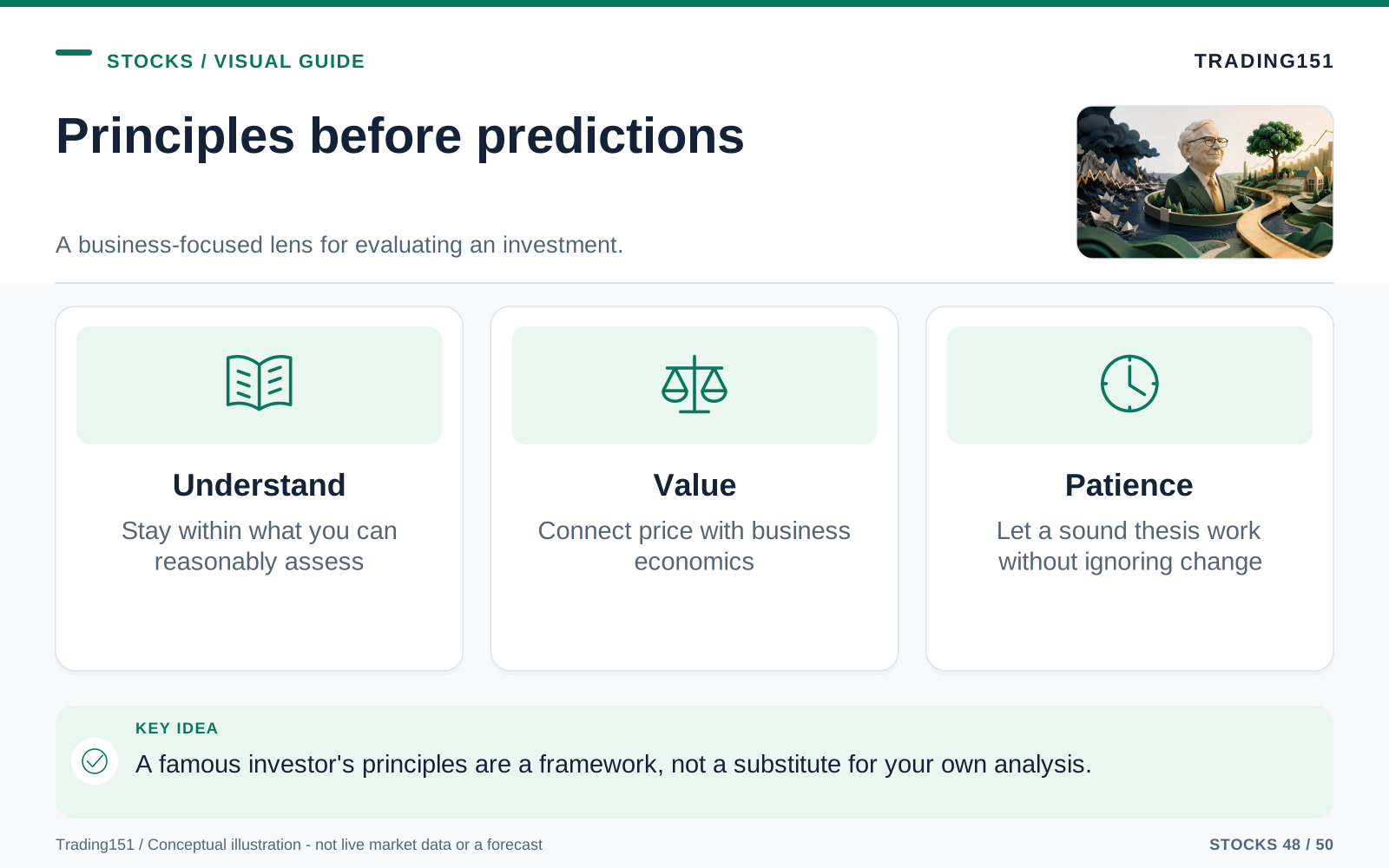
Read this diagram as text
- Understand
- Stay within what you can reasonably assess
- Value
- Connect price with business economics
- Patience
- Let a sound thesis work without ignoring change
2. Buy Businesses, Not Ticker Symbols
Open any investing app today, and the market feels like a giant casino. Numbers flash green and red, charts bounce around by the second, and it’s easy to reduce a real company to a glowing ticker symbol. If the price goes up, you feel like a genius. If it drops, you panic. It’s an addictive way to think, but Buffett argues it’s completely backward.
When he buys a stock, he acts like he’s buying the whole joint. A share isn’t a lottery ticket. It’s a literal piece of a living, breathing business—its assets, its cash flow, and the late-night decisions of its management team. The stock market might slap a different price tag on that business every day, but the company itself doesn’t fundamentally change just because the quote fluctuated.
Adopting this owner’s mindset completely changes the questions you ask. Instead of wondering, “Will this bounce by Friday?” you start asking, “Would I want to own this entire company if I had a few billion dollars lying around?” You stop caring about the shape of a stock chart and start caring about durable advantages, honest leadership, and the company's ability to keep generating cash.
Buffett famously joked that he’d be perfectly fine if the stock market closed for five years. That sounds crazy to most of us because we’ve been trained to obsess over daily prices. But think about it: if you owned a profitable local bakery or a car wash, you wouldn’t call a broker every morning at 9:30 a.m. to ask what it was worth. You’d look at whether the line was out the door, if your costs were in check, and if the cash register was ringing.
Stocks deserve that exact same mindset. Daily price swings are only useful if they give you a chance to buy a great business at a discount, or sell it at an absurd premium. Otherwise, the price is just noise. The business is the signal.
What this means in practice: do your homework on the company, not just the stock graph. Look at how they make their money, how consistent the profits are, and whether they treat their shareholders like actual partners. Remember, a stock quote just tells you what a stranger is willing to pay today. It says very little about what the business is worth.
3. Look for Wonderful Companies, Not Merely Cheap Ones
Early on, Buffett was heavily influenced by his mentor, Benjamin Graham, who practically invented value investing. Graham taught him to hunt for bargains—companies trading for less than their literal parts were worth. Buffett called these “cigar butts.” You find a discarded business on the sidewalk, and while it might be ugly, it still has one free puff of profit left in it. It worked, but it wasn't a strategy you could build an empire on. A truly wonderful company doesn't just sit there; it earns high returns on its capital and aggressively reinvests its cash to make even more money. Quality isn't just about survival. It's about a company having a wide-open runway to keep compounding its wealth over time, rather than just clinging to past glories or taking on debt just to fake its growth.
Charlie Munger, Buffett’s longtime partner, eventually convinced him to upgrade his mindset. Munger’s philosophy was simple but profound: it’s much better to buy a truly great business at a fair price than a terrible business at a bargain price.
The difference is night and day. A mediocre company that you buy on the cheap is going to require constant hand-holding. You’re continually fighting weak demand, terrible margins, and managers trying to plug holes in a sinking ship. A wonderful business, on the other hand, does the heavy lifting for you. It keeps customers coming back, reinvests its profits smartly, and lets time do the compounding.
Buffett calls a company’s special advantage its “moat.” Imagine a beautiful castle surrounded by a deep trench of water. The castle is the business, and the gold inside is the profit. Competitors are always trying to swim across and steal that gold. If the moat is shallow, they’ll overrun the castle in no time. If it’s wide and filled with crocodiles, the business is safe.
Moats come in all shapes and sizes. A brand that people deeply trust lets a company charge a few pennies more than a generic rival. A network effect means a product gets better the more people use it. Sometimes the moat is just sheer scale—a company so large it can build and ship things cheaper than anyone else.
But not every shiny company has a real moat, and moats can absolutely dry up. Tech changes. Management gets lazy. Consumer tastes pivot. Buffett’s greatest wins have always been with companies whose competitive edges aren't just strong today, but are built to withstand immense pressure tomorrow.
What this means in practice: don’t buy a stock just because it took a large nosedive and looks cheap. Ask yourself why this company deserves to exist in ten years. Who would care if they went out of business? What is stopping a smarter, faster rival from copying them? A bargain is great, but a strong business is what allows you to sleep at night.
4. Pay a Sensible Price and Leave Room for Error
Of course, even the most incredible business in the world can be a terrible investment if you substantially overpay for it. This is where the classic concept of a “margin of safety” comes in. It’s not just about the price tag; it's about being conservative with your expectations. Don't assume the company will grow perfectly every year, and definitely avoid businesses that need a flawless economy just to survive. Paying less is great, but a clean balance sheet and keeping your position size reasonable gives you a much-needed buffer for when things inevitably don't go to plan. You have to separate normal business risks from catastrophic risks that could wipe the company out entirely.
Think of a margin of safety as the gap between what a company is realistically worth and what you’re paying for it today. The bigger the gap, the more room you have to be dead wrong. And trust me, you will be wrong about something. Sales will slip. Supply chain costs will spike. A competitor will launch a better product. The future almost never perfectly matches the pristine spreadsheet you built.
It’s a basic concept, but it saves portfolios. Imagine you’re driving a 9,800-pound truck over a bridge with a 10,000-pound weight limit. Technically, you’re fine. But you are leaving zero room for a gust of wind, a pothole, or an engineering mistake. A smart driver looks for a bridge built to hold 30,000 pounds. That extra breathing room is your margin of safety.
People love to quote Buffett’s two golden rules: “Rule No. 1: Never lose money. Rule No. 2: Never forget Rule No. 1.” He doesn't mean you won't ever have a stock go down—he’s taken plenty of hits. He means you have to avoid permanent destruction of your capital. Sitting through a temporary dip in a great company is fine. Overpaying for a mediocre one on pure hype is how you permanently torch your wealth.
Valuing a company is closer to art than science. No one knows exactly what a business is worth down to the penny. The goal isn't to be a math genius; it’s to be roughly right. If a business isn't obviously attractive at the current price, Buffett just waits. He’d rather sit on his hands than force a trade based on wishful thinking.
What this means in practice: be skeptical of stocks priced for perfection. If a company has to grow at a blistering pace for the next ten years just to justify what it costs today, one bad quarter will crush it. Give yourself a cushion. A solid margin of safety protects you from bad luck, bad timing, and your own blind spots.
5. Let Mr. Market Serve You
One of the best stories Buffett borrowed from his old teacher Benjamin Graham is the parable of Mr. Market. Imagine you own a business, and your partner—Mr. Market—knocks on your door every day. He’s a highly emotional guy. Some days he's thrilled with the world and offers to buy you out for an unusually high price. Other days he's depressed and offers to sell you his half for pennies on the dollar. The actual business hasn’t changed. Only his mood has.
The stock market operates exactly like this. It is not a perfectly rational calculator. It’s a large, chaotic crowd of humans and computer algorithms reacting to fear, greed, news cycles, and uncertainty. Sometimes the crowd throws a euphoric party and prices stocks as if the economy will never stumble again. Other times, it panics and dumps perfectly good companies like the world is ending tomorrow.
Most people let Mr. Market dictate their emotions. When prices surge, they feel brave and buy at the absolute top. When prices tank, they get terrified and sell at the bottom just to stop the pain. It’s human nature, but it’s completely destructive. Buffett flips the script. To him, Mr. Market is an employee, not a boss. He’s just there to offer prices.
If the market is throwing a tantrum and offering you a wonderful business at a bargain-basement price, you take it. If it’s overly ecstatic and offering you an absurd amount of money for something you own, you happily sell. And if it's not offering anything interesting? You just ignore him. The power to do absolutely nothing is your biggest advantage.
We’ve all heard his famous advice: “Be fearful when others are greedy and greedy when others are fearful.” That doesn't mean you blindly buy a crashing stock. It just means keeping your head straight when everyone else loses theirs. A market panic is only an opportunity if you’ve already done the homework and know exactly what a company is worth.
What this means in practice: stop treating market volatility like a report card on your intelligence. A stock going down isn’t always bad news, and a stock rocketing up isn't proof it's a great company. The market just spits out numbers. It’s your job to decide if those numbers make any sense.
6. Patience Is Not Laziness
Wall Street is obsessed with action. There’s always a breaking news alert, a hot new strategy, or an urgent reason to tweak your portfolio. Moving your money around feels productive. It feels like real work. But in reality, constant tinkering is usually just impatience dressed up in a nice suit.
Buffett’s entire strategy hinges on his ability to wait. He loves comparing investing to baseball, but with a large cheat code: there are no called strikes. You can stand at home plate and watch thousands of pitches sail by. No umpire is going to penalize you for not swinging at a company you don't understand or a price that feels too high. You just stand there until the perfect pitch crosses right into your sweet spot.
This extreme patience is required both before and after you buy. Before you buy, it means being totally fine holding onto cash until a fat pitch arrives. That is mentally agonizing, especially when your neighbor is bragging about doubling his money in a bull market. But after you buy, patience means giving your thesis time to play out. The best investments rarely look like slam dunks in year one. The real, life-changing money is made quietly, over years of steady earnings growth, reinvestment, and the magic of compounding.
Compounding feels painfully slow at first. A company quietly growing its value won’t buy you a sports car in six months. But give it a decade or two, and the math becomes explosive. Buffett isn't one of the richest men on earth just because he gets high returns; he’s wealthy because he sustained good returns for an absurdly long time. Longevity is his secret weapon.
Patience also cuts down on the friction that kills returns. Trading all the time racks up taxes, piles on stress, and forces you to constantly try to outsmart the market. Buffett prefers a much more boring, but profitable, approach: make very few decisions, make them carefully, and then give them room to breathe.
What this means in practice: you do not need to trade every week to be a serious investor. A few brilliant decisions, held tightly through the market's inevitable rough patches, will do far more for your net worth than a hundred clever day-trades. Sometimes, the absolute smartest thing you can do is go for a walk and do nothing at all.
7. Study Management Like a Partner
Buffett cares intimately about the people running the show. The math matters, sure, but those numbers are the direct result of human decisions. A company with the best economics in the world can still ruin you if the CEO wastes cash on ego-driven vanity projects, hides problems, takes on stupid amounts of debt, or treats everyday shareholders like walking ATMs. You have to evaluate a management team by how they spend money, how honest they are, and how they pay themselves. Do their past promises line up with their results? When things go wrong, do they own up to it in plain English, or bury the bad news in confusing adjusted accounting metrics? Insider ownership is great, but an unaccountable founder can be just as dangerous. Look at how their decisions impact things on a per-share basis, not just how big they are making their corporate empire.
Great managers communicate like normal people. They openly admit when they screw up. They don't try to gaslight you into thinking a terrible year was a strategic transition. They know the difference between growing a business because it adds real value, and growing it just to stroke their own ego.
Buffett loves executives who act like they own the place. Yes, that means holding a large chunk of stock themselves, but it’s more about having a steward's mindset. They fiercely protect the brand. They avoid making things overly complicated. When they have too much cash and nothing smart to do with it, they give it back to the shareholders. They don't pull dramatic stunts just to get a pop in the stock price.
From the outside, it’s tough to spot a bad CEO right away. They are media-trained, their presentations are gorgeous, and they know how to make the future sound incredible. That’s why Buffett looks at their track record over time. Did they do what they promised three years ago? Are they addicted to issuing new stock and diluting your ownership? Do they speak to you like a partner, or do they hide behind corporate word salad?
What this means in practice: before putting your hard-earned money into a company, read their last few annual letters and earnings transcripts. Look for accountability and discipline. A fantastic business can drag a bad CEO along for a while, but eventually, reckless spending and arrogance will leave a large dent in your returns.
8. Keep Debt and Speculation on a Short Leash
You will never catch Warren Buffett betting the farm with borrowed money. He knows firsthand that while leverage can make you look like a genius in a roaring bull market, it can easily turn a temporary speed bump into a permanent bankruptcy. If you want to get rich, you have to survive first. You can’t reap the rewards of long-term compounding if you get wiped out and forced to sell during a recession.
That’s exactly why he avoids companies carrying bloated balance sheets. When the economy hits a wall, a heavily indebted business loses all its flexibility. They have to slash investments, sell off their best assets at fire-sale prices, or dilute shareholders just to keep the lights on. It doesn't matter how great a company's product is—if the bank is dictating their future, it's a terrible investment.
The same rule applies to us at home. Buying stocks on margin might feel exhilarating when everything is going up, but it completely changes your psychology. A normal market correction goes from being a mild annoyance to a total emergency when you owe someone money. Borrowing forces your hand, usually making you sell at the absolute worst possible moment.
Speculation is just as dangerous. It’s totally fine to take a flyer on a crazy stock, as long as you honestly admit it's a gamble. The danger comes when you start confusing a speculative bet with a real investment. Buffett's wealth is built on cold, hard business economics—not the blind hope that a greater fool will buy your shares for a higher price tomorrow. During market manias, people forget this. The narrative takes over, and rising rapidly prices become the only reason people buy.
What this means in practice: always prioritize financial survival. Stay away from companies that need a booming economy just to make their interest payments. And be careful about borrowing money to invest. Your primary job isn't to look like a visionary; it’s to stay in the game long enough for compounding to do its magic.
9. Remember That Temperament Beats IQ
Buffett frequently points out that you don’t need to be a certified genius to crush it in the stock market. What you need is the right temperament. This is so easy to overlook. Brilliant people make horrific investors if they are highly anxious, overly arrogant, or addicted to complex spreadsheets. Meanwhile, perfectly average folks can build immense wealth just by staying honest, disciplined, and refusing to follow the herd.
The market is essentially a giant psychological test. It tests your jealousy when your neighbor makes a quick buck on a meme stock. It tests your nerve when your portfolio drops sharply in a month. It tests your humility when you pass on a company and watch it soar without you. And it tests your ego every time you turn out to be wrong.
Buffett’s superpower isn't just his ability to read a balance sheet; it’s his emotional armor. He has actively built a life that keeps him rational. He lives in Omaha, far away from Wall Street's noise. He spends most of his day quietly reading. He doesn't feel the need to prove he’s the smartest guy in the room. That absolute lack of FOMO (fear of missing out) is his greatest advantage.
For the rest of us, mastering our emotions is arguably more important than mastering financial metrics. You can perfectly calculate discounted cash flows and analyze competitive advantages, but if you panic-sell the moment the news tells you a recession is coming, all that math is useless. Your biggest enemy isn't the market. It’s your own gut instinct to do something irrational when you feel stressed.
What this means in practice: set up guardrails to protect yourself from your own emotions. Write down exactly why you’re buying a stock, and decide beforehand what would make you sell it. Stop checking your portfolio every afternoon so that totally normal price swings don't start feeling like panic alarms. A calm, steady routine is your best defense against stupid mistakes.
10. Know When Simplicity Is the Best Strategy
One of the most authentic things about Warren Buffett is his deep respect for simplicity. Here is a man who has dedicated his entire life to picking individual stocks, yet he constantly tells everyday people they’d be much better off just buying a low-cost, broad-market index fund. That’s not a contradiction; it’s just total honesty.
Picking stocks is exhausting. It requires time, passion, emotional resilience, and a willingness to look like an idiot while you wait for the market to agree with you. Not everyone wants to spend their Saturday morning digging through SEC filings. And honestly? Not everyone should. For millions of people, the smartest, most profitable move is to buy a diversified index fund, consistently add money to it, never panic-sell, and just let American business do the heavy lifting over the decades.
This fits perfectly into how Buffett sees the world. Keep your fees low. Avoid complicated junk you don’t understand. Don’t pretend you have an edge when you really don't. Just let compounding work quietly in the background. A simple index strategy isn't a consolation prize for people who can't pick stocks—it is one of the most bulletproof wealth-building strategies on the planet.
It’s also incredible for your peace of mind. Owning the whole market completely removes the anxiety of trying to find the next big winner. It shifts your job from trying to predict the future to just being disciplined with your savings. It might not give you exciting stories for dinner parties, but the goal of investing isn't entertainment. The goal is financial freedom.
What this means in practice: if you don’t find joy in dissecting corporate balance sheets, don't force it. A boring, low-cost index fund, paired with a long-term mindset, will almost always outperform a messy, overly complicated portfolio that you constantly meddle with.
Borrow the discipline, not a portfolio you cannot reproduce
Begin with the parts that can be practiced without special access. Describe how a company makes money, why customers choose it, and what could weaken that advantage. Read the financial statements and assess whether the price leaves room for uncertainty. Passing on a business you cannot evaluate is a decision, not a research failure.
Avoid turning a quotation into an absolute rule. A long holding period is valuable only when the investment continues to make sense; it is not a commitment to keep every original purchase indefinitely. Likewise, patience does not remove the need to monitor debt, competition, management decisions, or a change in the investor's own circumstances.
Berkshire Hathaway's structure matters when interpreting its transactions. A large, diversified operating company and investment vehicle has resources and obligations unlike a typical household account. Negotiated investments may include terms unavailable to public-market buyers. Public filings may also arrive after the reported position date and do not explain every reason for a trade.
Use the example to improve the quality of your own questions. What must the business earn to justify this price? What could permanently impair the capital? Is the position size compatible with being wrong? Those questions travel better than a list of tickers. The aim is independent judgment informed by a useful body of writing, not confidence borrowed from someone else's reputation.
Borrow the discipline, not the historical entry price
An investment that worked for Berkshire Hathaway at one price and under one set of terms may not offer the same opportunity to a later buyer. Negotiated transactions, financing, scale, and the ability to hold through difficult periods can all differ.
The transferable lesson is the process: understand the business, evaluate management and capital allocation, consider the balance sheet, and remain price-conscious. Copying a disclosed holding without those steps replaces analysis with authority. An admired investor's decision can be a useful research lead without becoming a substitute for a current valuation and a suitable position size. 1, 2, 3
Copy the Discipline, Not the Portfolio
It is tempting to just boil Warren Buffett’s legendary career down to a few bumper-sticker quotes. Stay in your circle. Buy wonderful businesses. Be greedy when others are fearful. Hold forever. Those are all true, but they make the whole process sound deceptively easy.
The real takeaway is much deeper. Buffett’s method is ultimately a test of character. It demands humility, because you have to constantly admit what you don’t understand. It demands patience, because great deals don't magically appear just because you have cash to spend. It requires independence, because the crowd is almost always wrong at the exact worst time. And it demands emotional grit, because the market is essentially designed to shake you out of your positions.
His principles have survived for decades because they focus on the quality of your decisions, not just predicting the future. They force you to stick to businesses you truly get, demand a real margin of safety, and keep you away from the debt and impatience that turn a bad quarter into a permanent loss.
Whatever you do, don't just blindly copy Berkshire Hathaway's current portfolio. Berkshire operates on a totally different planet when it comes to taxes, liquidity, and size. Some of their moves are made for strategic reasons that have nothing to do with a regular retirement account. Borrow his thought process, not his ticker symbols.
The quiet, underlying truth is that your consistency compounds right alongside your money. Knowing your limits, demanding honest management, avoiding debt, and just sitting still for long periods of time naturally leads to making fewer, but significantly better, decisions. Keep it simple, do the hard work, and let time take care of the rest.
Sources and further reading
- Berkshire Hathaway: Shareholder Letters
- SEC: Beginners Guide to Financial Statements
- Investor.gov: Asset Allocation
Editorial revision: 7 October 2026. Numerical scenarios are hypothetical unless identified as historical. References support the added explanations and selected corrections; rules and product terms should be checked again before acting.