
Sector rotation shifts equity exposure among industries as their prospects, valuations, or price trends change. Economic-cycle explanations can make those shifts sound predictable, but the market often anticipates developments before the data confirm them. A usable strategy needs observable rules and a benchmark, not only a diagram showing which sector supposedly belongs in each phase of the cycle.
The Market Is Not One Thing
You always hear people talk about “the stock market” as if it rises and falls in one giant block. In reality, it’s a sprawling mix of completely different businesses. Some are built to run fast during boom times. Some are built to survive the tough times. Some need cheap money to grow, while others do better when inflation spikes. And some just sell things we all have to buy, regardless of how confident we feel about the economy.
This is why two people can both be fully invested in stocks and have substantially different years. One person might be loaded up on tech and luxury brands, riding a wave of market optimism. The other might be playing it safe in utilities and household goods, feeling totally left behind while the riskier stuff takes off. Give it a few months, though, and those roles can completely flip.
Sector rotation feeds on this unevenness. It’s not about deciding if stocks overall are "good" or "bad" right now. It's about figuring out which stocks make the most sense for the road ahead.
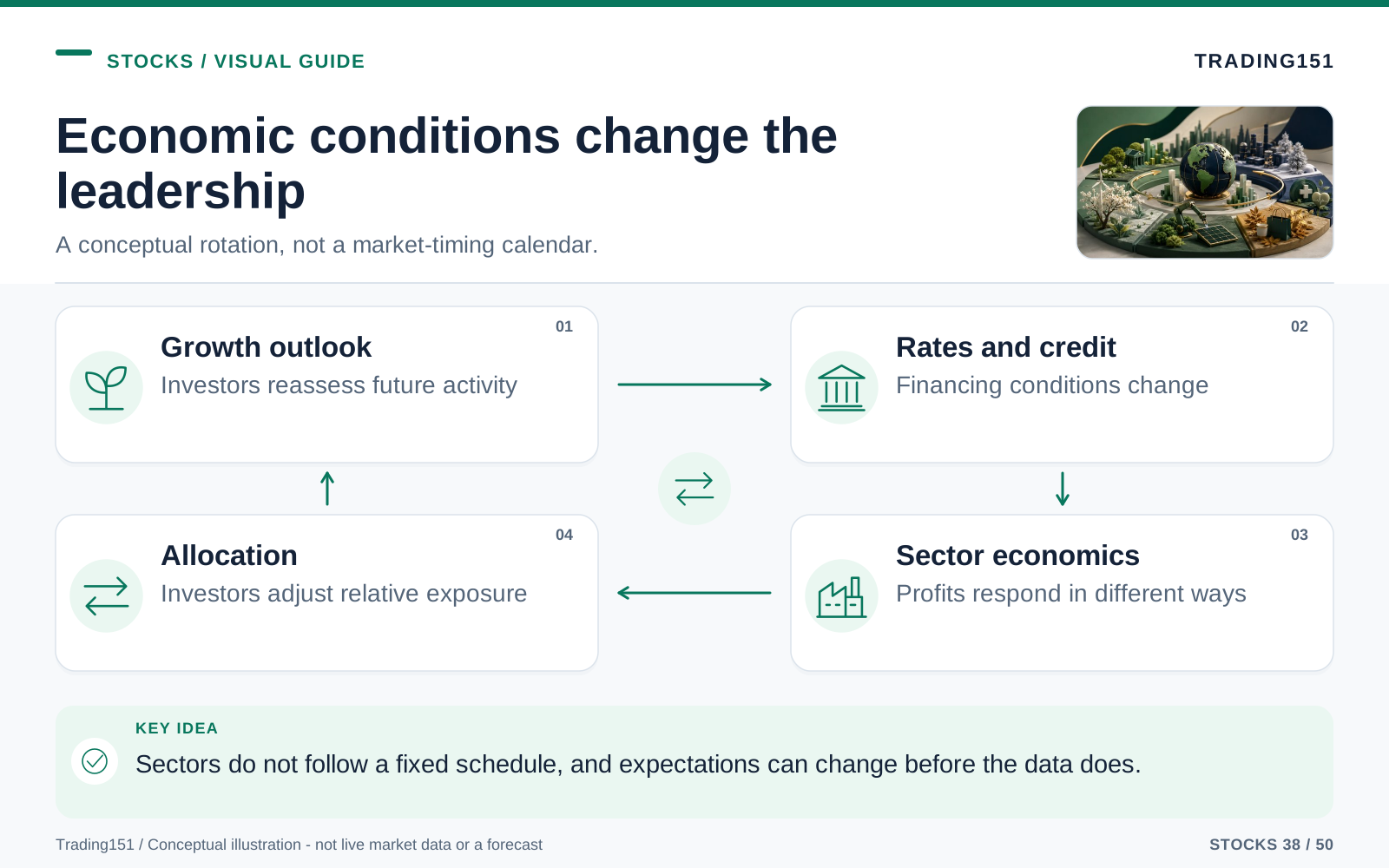
Read this diagram as text
- Growth outlook
- Investors reassess future activity
- Rates and credit
- Financing conditions change
- Sector economics
- Profits respond in different ways
- Allocation
- Investors adjust relative exposure
Meet the 11 Market Sectors
Before we can get into rotating, we need to know what we’re rotating between. The U.S. stock market is chopped up into 11 broad sectors under the Global Industry Classification Standard (often called GICS). Think of them as different neighborhoods in the same sprawling city. They share the same weather, but the vibe and pace are totally different. Now, keep in mind these labels aren't perfect. A large tech company might be slapped with a certain label based on its current revenue, even if its real growth engine is shifting somewhere else entirely. Big conglomerates can carry hidden exposures that a simple label misses. So, if a huge chunk of your money is in one company, look under the hood at how it makes its cash rather than just trusting the sector tag.
- Information Technology: Software, semiconductors, hardware, cloud computing, and cybersecurity. This is the digital infrastructure of the world. These companies usually crush it when businesses are spending aggressively and investors are willing to pay a premium for growth.
- Healthcare: Pharma, medical devices, hospitals, health insurers, and biotech. People don’t stop needing medicine or surgeries just because the economy hits a speed bump, giving this space a notoriously defensive feel.
- Financials: Banks, insurance companies, payment networks, asset managers, and stock exchanges. Their success is tied heavily to interest rates, how much people are borrowing, and overall confidence in the system.
- Consumer Discretionary: Retailers, car companies, hotels, restaurants, and luxury goods. These are the "nice-to-haves." They thrive when people feel financially secure enough to spend beyond the basics.
- Consumer Staples: Food, drinks, household products, and basic groceries. You might cancel a vacation if money gets tight, but you’re still going to buy toothpaste, dish soap, and dinner.
- Energy: Oil, gas, drilling, refineries, and pipelines. Their profits swing substantially based on global commodity prices, supply crunches, and geopolitical drama.
- Industrials: Manufacturing, aerospace, defense, railroads, airlines, and heavy machinery. If you want a read on the physical, nuts-and-bolts economy, look here.
- Materials: Chemicals, metals, mining, and packaging. These are the folks pulling the raw ingredients out of the earth or creating the materials needed to build everything else. They follow construction and manufacturing trends closely.
- Utilities: Your electric, gas, and water companies. They are heavily regulated, require a lot of cash to run, and pay out steady dividends. They’re pretty boring—but in a rocky market, boring is exactly what people want.
- Real Estate: REITs and companies that own apartments, offices, warehouses, and data centers. Because buying property requires borrowing huge sums of money, this sector is highly sensitive to interest rate changes.
- Communication Services: Telecom networks, streaming giants, social media, and search engines. It’s a bit of a mashup, honestly—combining slow-and-steady internet providers with aggressive digital growth platforms.
These sectors aren't permanent winners or losers. They’re tools in a toolbox. The trick is knowing which one to reach for.
Cyclical, Defensive, and Sensitive Sectors
A really helpful way to wrap your head around these 11 sectors is to group them by their personality.
Cyclical sectors ride the waves of the broader economy. When times are good and confidence is high, they boom. When growth hits a wall, they take a beating. Consumer discretionary, financials, industrials, materials, tech, and parts of communication services mostly fall into this bucket.
Defensive sectors sell the stuff we can’t live without, no matter what the stock market is doing. Consumer staples, healthcare, and utilities are the classic examples. You probably won't see them leading the charge during a large bull run, but they act as a shock absorber when everyone else is panicking.
Rate-sensitive sectors are heavily dictated by borrowing costs. Real estate and utilities are the obvious ones here, since they carry a lot of debt and attract investors who want dividend income (making them direct competitors to bonds). Financials are rate-sensitive too, but in a more complicated way: banks love it when interest rates go up because they can charge more for loans, but if rates go too high and people stop borrowing or start defaulting, it gets ugly fast.
Look, these buckets aren’t flawless. A mega-cap tech stock sitting on a mountain of cash might act safer than a small regional bank. A startup biotech firm with no profits is going to behave way more like a speculative crypto bet than a safe-haven asset. But generally speaking, these categories help you see the big picture.
The Economic Cycle: Four Market Seasons
The economy is never static. It speeds up, runs too hot, slows down, takes a hit, licks its wounds, and starts over. The path is never perfectly clean, but it rhymes often enough that we have to pay attention to it.
Sector rotation relies on the fact that different parts of the market take turns leading the pack through these phases. The catch? The stock market usually sniffs out the next phase long before the official economic data proves it. That’s what makes this strategy so powerful, and frustrating when you get it wrong.
1. Early Recovery: The First Warm Days After Winter
The vibe: The economy just went through the wringer. If you turn on the news, things probably still look bleak. Unemployment might be high, and people are keeping their wallets shut. But under the hood, conditions are starting to improve. Central banks have likely slashed interest rates. Money is getting cheaper to borrow. The companies that survived the downturn are starting to see their orders stabilize. The stock market often starts piling into cyclical stocks while the economic numbers still look terrible because investors are betting on the easy money and better days ahead. Sometimes this head fake fails if banks still won't lend or the recession deepens, so you have to look at credit conditions and corporate earnings rather than just blindly trusting a single good month in the market.
This is that weird twilight zone where stocks start going up even though the real world still feels broken. If you wait until everything feels 100% safe, you’re going to miss the biggest initial gains.
Where the money usually goes:
- Financials bounce back as the panic fades and lending starts to unfreeze.
- Consumer Discretionary picks up as people finally feel comfortable enough to book a flight, buy a car, or remodel their kitchen.
- Real Estate gets a boost from cheaper mortgages and attractive property prices.
- Industrials start humming again as businesses restock empty warehouses and gear up for new orders.
It feels uncomfortable to buy during this phase, but remember: stocks look forward, not backward.
2. Mid-Cycle Expansion: The Economy Finds Its Stride
The vibe: Things are just generally good. Companies are hiring, people are spending, and corporate profits look solid. You can get a loan if you need one, but things aren’t so crazy that inflation is spiraling out of control. It’s the "Goldilocks" zone.
This phase tends to last the longest and feel the calmest. It’s an environment where high-quality growth companies absolutely shine because investors are confident enough to look years down the road.
Where the money usually goes:
- Information Technology rocks as businesses pour money into software, automation, and tech upgrades to scale up.
- Communication Services rake it in from surging ad spends and entertainment budgets.
- Industrials keep climbing as construction, shipping, and manufacturing hit their stride.
- Consumer Discretionary keeps rolling as long as people are getting raises and feeling secure in their jobs.
The main danger here is getting lazy. When everything is going up, it’s remarkably easy to stop paying attention to how expensive stocks are getting in the background.
3. Late Cycle: Good News Starts to Feel Expensive
The vibe: The economy is still expanding, but the easy money has been made. Inflation starts creeping up. Wages and raw materials cost more, biting into corporate profits. The central bank starts hiking rates to cool things off. Companies are still reporting huge revenues, but investors start biting their nails, wondering how long the party can last.
Late-cycle markets are confusing. The data you see today looks amazing—low unemployment, high profits, busy stores. But the market doesn't care about today; it cares about tomorrow. When growth stops speeding up, the market leaders start shifting.
Where the money usually goes:
- Energy tends to surge as demand pushes up oil and gas prices, aided by inflation.
- Materials do well as the cost of raw goods spikes.
- Healthcare starts catching investors' eyes because people need medicine whether the economy is slowing down or not.
- Consumer Staples suddenly look very attractive to folks wanting to play it safe.
Discipline is everything here. It’s tempting to just buy whatever went up the most last month, but late-cycle shifts are sharp and severe. A stock that looks like a genius buy in April can become a complication by July if consumer demand suddenly snaps.
4. Contraction or Recession: Protecting Capital Comes First
The vibe: The music stops. Growth shrinks, earnings drop, and companies start slashing budgets. People stop spending. Banks pull back on lending. At this point, investors stop asking, "How much money can I make?" and start panicking about, "How much money am I going to lose?"
This is not the time to be a hero. The priority shifts from chasing large gains to protecting your cash, staying liquid, and avoiding businesses that need a perfect economy to stay afloat.
What holds up best:
- Consumer Staples do their job. People still need to buy food, soap, and toilet paper.
- Utilities keep the lights on, and financially, offering a steady stream of dividends.
- Healthcare stays resilient since doctor visits aren't something people usually cut from the budget.
Let’s be clear—defensive sectors don’t always go up during a recession. Sometimes they just fall a lot less than everything else. That might not sound exciting, but avoiding a 40% cratering in your portfolio is huge. The less you lose now, the less you have to make up when the skies clear.
Why Sector Rotation Works in Theory
It makes intuitive sense when you step back and look at it. Lower interest rates make borrowing cheaper, which sparks a housing boom, encourages people to spend, and boosts bank lending. When the economy is running hot, shipping and manufacturing boom. When inflation runs wild, the companies pulling commodities out of the ground earn a large profit. And when a recession hits, money naturally flees to the safety of companies with boring, predictable profits.
But it’s also driven heavily by human psychology. When everyone is feeling optimistic, they’ll happily overpay for a tech company's distant future growth. When fear takes over, they don't care about the future—they want cold, hard cash flows and reliable dividends right now. The same company can be treated like royalty or garbage purely based on the mood of the market.
That emotional pendulum is what creates these large shifts. A tech stock doesn’t even need bad earnings to drop; it just needs investors to decide they aren’t in the mood for high-risk bets anymore. A utility company doesn't need to reinvent the wheel to see its stock rise; it just needs a terrified market looking for a place to hide.
How Regular Investors Can Use Sector Rotation
Decades ago, this was way too tedious for the average person. Getting exposure to the "industrials" sector meant buying a dozen individual stocks, tracking their specific company drama, and bleeding out on trading commissions. Now, Exchange-Traded Funds (ETFs) make it simple.
Using Sector ETFs
A sector ETF is just a basket of stocks tied to one specific industry. Instead of trying to guess which individual bank or which specific retailer is going to win, you just buy the whole basket. It strips out the risk of picking a single bad apple and makes shuffling your portfolio way easier.
Want in on tech? There’s an ETF for that. Want to hide out in consumer staples? There’s an ETF for that, too. There are funds for all 11 sectors, ready to buy with a single click.
Now, this doesn’t magically erase your risk. If you buy a tech ETF and the whole tech sector tanks, you're still taking a hit. But it gives you a clean, manageable way to place a bet on an industry without having to become a full-time stock analyst to pull it off.
Thinking Top-Down
Sector rotation is a classic top-down strategy. You start by looking at the large macroeconomic picture, and then you zoom in to figure out which sectors fit that picture. You're basically asking yourself:
- Is the economy speeding up or hitting the brakes?
- Are interest rates going up, dropping, or stuck where they are?
- Is inflation a raging fire or cooling off?
- Are people spending freely or hoarding cash?
- Are corporate profits getting better or worse?
- Are investors feeling brave, or are they paying a premium for safety?
Once you form an opinion on those questions, you can adjust your portfolio to lean into the right sectors.
This is the total opposite of a bottom-up approach, where you just look for incredible individual companies. A bottom-up investor buys an amazing business and holds onto it regardless of whether we're in a recession, believing that great management and strong products matter way more than whatever the Federal Reserve is doing.
Honestly? Neither way is perfectly right or wrong. The best investors often blend both. They hold onto fantastic companies for the long haul, but they still keep an eye on the weather to see if the macroeconomic wind is at their back or blowing directly in their face.
The Core and Satellite Approach
If there’s one giant mistake people make with sector rotation, it’s treating it like an all-in poker hand. Selling all your tech stocks to buy utilities, and then dumping utilities to buy energy, sounds proactive. In reality, it’s mentally draining, creates a large tax bill, and is practically impossible to get right every time.
A much smarter, lower-stress way to do this is the core and satellite approach.
- The core: Think of this as the foundation of your house. It’s mostly broad, highly diversified index funds that cover the whole market. You aren't trying to outsmart anyone here. You just want to capture the overall growth of the market and protect yourself from bad timing.
- The satellite: This is a smaller chunk of your money that you use to make strategic bets. You might tilt this satellite portion into healthcare if you think a recession is looming, or juice it up with tech if you think the economy is about to rip higher.
This setup lets you play your hunches without risking your entire retirement on a single bad guess. If your sector call is right, you juice your returns. If you're wrong, your boring, diversified core keeps the ship from sinking.
Signals Investors Watch
There is no magic indicator that rings a bell telling you exactly where we are in the economic cycle. Sector rotation is a lot less about looking at one crystal-clear sign and a lot more like scanning a dashboard. You want to look at a handful of messy signals rather than betting the farm on just one. Yield curves, credit spreads, unemployment data, commodity prices, and corporate earnings all tell slightly different stories. When they contradict each other, that’s your cue to tread lightly rather than forcing the data to fit the story you want to believe.
- Interest rates: When rates drop, it’s a shot of adrenaline for housing, real estate, growth stocks, and consumers. When they rise, they act like gravity on expensive stocks and companies drowning in debt.
- Inflation: When prices are surging, energy and materials tend to win, but it squeezes the profit margins of almost everyone else.
- Yield curve: If short-term bonds start paying more than long-term bonds (an inverted yield curve), the market is flashing warning signs about a recession. When that normalizes, expectations are usually shifting.
- Credit spreads: If investors suddenly demand large payouts to hold risky corporate debt, it means they are terrified of companies going bankrupt.
- Earnings revisions: Are Wall Street analysts suddenly slashing their profit estimates for manufacturing and retail? The market is probably bracing for a slowdown.
- Consumer confidence: If people feel good about their jobs, they buy things they don't strictly need. If they get scared, those discretionary sectors suffer.
- Market leadership: What the market is doing is way more important than what the talking heads on TV are saying. The sectors that are quietly outperforming tell you what the big money really believes.
That last point is huge. The market leaves breadcrumbs. If boring defensive stocks are suddenly hitting all-time highs while the rest of the market is flat, investors are quietly preparing for a storm. If small caps and consumer discretionary start ripping higher while the news is still terrible, the market has already moved on and is pricing in a recovery.
The Hard Part: The Market Moves Early
Sector rotation sounds so elegant when you look backward. A chart makes it look like the economy gently transitions from one phase to the next, like seasons on a calendar. Real life is chaotic.
The stock market almost always moves before the actual economy does. By the time a recession makes the evening news, stocks have probably already tanked, and defensive stocks are already trading at a premium. By the time the government officially declares an economic recovery, the early-cycle stocks have probably already doubled. If you wait around for 100% certainty, you’re just going to end up buying yesterday’s news.
This is the exact spot where most rotation strategies fall apart. It’s not that the investor misunderstood the economy; it’s that they were late. And in the stock market, being late is often the same thing as being wrong.
That’s why you have to approach this with humility. You aren’t trying to pinpoint the exact bottom or top. You’re just trying to read the probabilities, make small adjustments, and avoid making large, dramatic moves based on one scary headline.
Common Mistakes to Avoid
Chasing Recent Performance
Just because a sector has been on an absolute tear doesn’t mean you should buy it. Usually, if it's already on the front page, the easy money has been made. Buying something just because a chart goes up and to the right isn’t rotation—it’s just chasing.
Ignoring Valuation
Even if an industry has large tailwinds, it can still be a terrible investment if everyone else already knows it and the price is sky-high. You always have to weigh the economic backdrop against what you’re paying for the stock.
Rotating Too Often
Tinkering with your portfolio every week turns a solid strategy into an expensive, stressful hobby. Even with zero-commission trading, the bid-ask spreads, taxes, and terrible timing will eat your returns alive. If you trade in a taxable account, jumping in and out triggers short-term capital gains taxes that can be severe. Overtrading basically turns long-term investing into a chaotic string of short-term macro bets. Check your allocations once a quarter or set threshold limits—just don't place the trade every time new inflation data drops.
Using Too Much Confidence
The economy is not a predictable machine. It’s a messy, living organism influenced by politics, consumer mood swings, wars, supply chain snags, and pure luck. No matter how sure you are about your sector bet, always leave a little room for the possibility that you’re dead wrong.
Forgetting Company Quality
A garbage company in a booming sector is still a garbage company. Conversely, a stellar business in an out-of-favor sector will eventually figure out a way to compound your wealth over time. Keep the macro environment in mind, sure, but don't forget that actual business fundamentals still matter.
Sector Rotation During Shocks
Sometimes, the traditional playbook just gets thrown out the window. A global pandemic, a sudden war, a banking collapse, or a large energy shock can completely scramble how these sectors normally behave. Take the COVID-19 crash, for example: the physical economy ground to an absolute halt, yet tech and digital platforms exploded because everyone instantly shifted their lives online.
Moments like that are a great reminder that sector rotation is just a framework, not a strict law of physics. It's meant to help you organize your thoughts, not trap you in a rigid set of rules. When the world completely changes, you have to be willing to change your portfolio right along with it.
A Simple Way to Start
If you want to dip your toes into sector rotation without letting it take over your life, keep it measured.
- Start with a diversified base. Do not bet your entire nest egg on one economic prediction.
- Choose a small number of sector tilts. Taking two or three confident stances is much easier to manage than juggling ten half-baked ideas.
- Use position limits. Decide ahead of time exactly how much of your portfolio you're willing to overweight in one area.
- Review on a schedule. Looking at things monthly or quarterly keeps you sane. Reacting to the daily news cycle will drive you crazy.
- Write down your reasoning. If you buy energy because of tight supply, write that down. If the supply loosens, it might be time to sell. But if the stock just dips on a random Tuesday, don't panic.
- Respect taxes. A brilliant trade can quickly turn into a mediocre one once the IRS takes its cut.
Following these rules won’t guarantee you'll beat the market, but it will absolutely prevent you from making dumb, emotional decisions. And in investing, avoiding unforced errors is half the battle.
What Sector Rotation Can and Can’t Do
Sector rotation is a fantastic tool to figure out who is leading the market and why. It helps keep you from having too much of your money in the wrong place at the worst possible time. It lets you lean into aggressive growth when the sun is shining and pivot to safety when the storm clouds gather.
But it’s not a crystal ball. It won’t perfectly shield you from every market crash, and it won't turn you into a flawless market timer. Most importantly, it doesn’t replace the boring but necessary stuff: staying diversified, keeping your bets reasonably sized, staying patient, and knowing your own emotional limits.
Don't treat this strategy like a fortune teller; treat it like a weather report. The meteorologist can’t tell you exactly where a raindrop is going to land, but they can definitely tell you if you need to pack an umbrella.
An economic story is not yet a timing rule
A sector can benefit from an improving economy and still disappoint investors if its shares already assume a stronger recovery. Conversely, a troubled industry can rise when conditions become less bad than expected. The investment outcome depends on both business developments and the price paid for them.
Define the signal before deciding which story it supports. Will the strategy use relative returns, earnings revisions, valuation, economic data, or a combination? How frequently will it change holdings? Economic indicators may be revised, so a test must use information available at the time rather than a later, cleaner account of the cycle.
Inspect concentration after each change. Moving from a broad index into several sector funds can create large exposures to a small group of companies or shared risks. Sector classifications are useful organizing tools, but they do not make every company within an industry behave alike. Costs and tax consequences can also increase as rotation becomes more frequent.
Compare the strategy with holding a suitable diversified benchmark over the same period. Include missed turns, trading friction, and periods when leadership changes abruptly. A sector view may still justify a limited tilt within a broader plan, but it should be sized as an uncertain judgment. The ability to explain yesterday's rotation is not evidence that the next one can be timed reliably.
Rotation can add a second forecasting problem
A sector-rotation strategy must decide not only which businesses to own, but when to move between them. A correct broad economic view can still produce a disappointing result if the market anticipated it earlier or if transaction costs consume the advantage.
Define the signal, the rebalance schedule, and the comparison portfolio before testing. Include the periods spent in the wrong sector and the cost of repeatedly changing direction. A chart that switches perfectly at each turning point is a description of hindsight, not an implementable strategy.
The alternative may be a stable diversified allocation that accepts different sector leaders over time. That choice can look less exciting while requiring fewer forecasts. Rotation should be retained because the complete process adds value under realistic assumptions, not because each switch can be explained convincingly after the fact. 1, 2, 3
Use the Cycle as Context, Not a Clock
The real value of sector rotation is that it forces you to look under the market's hood. Instead of just passively watching your account balance bounce around, you start asking why certain stocks are moving, who is taking charge, and what the market is bracing for next.
It’s a great way to structure your thinking, but remember that the economic cycle isn't chained to a set schedule. New technology, elections, or crazy valuations can make this recession or recovery look substantially different from the last one. A "safe" defensive stock can be a terrible investment if everyone bid the price up to astronomical levels right before the downturn started.
Keep it simple. Use broad ETFs for easy exposure, don't bet the farm on single tilts, and clearly define what would make you change your mind. And always compare the new bet you want to make against what you already hold—you don't want to accidentally double down on a risk you already own.
Ultimately, the most valuable skill isn't perfectly timing the next hot sector. It’s deeply understanding what you own, knowing the economic forces pulling the strings, and recognizing whether the current price makes sense. Keep an eye on the weather, but you don't need to rebuild your whole house just because it's going to rain.
Sources and further reading
- Investor.gov: Asset Allocation
- TradingView Pine Script Documentation: Strategies
- SEC: Beginners Guide to Financial Statements
Editorial revision: 7 October 2026. Numerical scenarios are hypothetical unless identified as historical. References support the added explanations and selected corrections; rules and product terms should be checked again before acting.