
Stocks can help build wealth because shareholders participate in businesses that may earn profits and grow over time. Neither the growth nor the investment return is guaranteed. For most households, the practical work begins away from the market: deciding what money can stay invested, keeping costs manageable, and choosing a contribution schedule that does not collapse when life becomes expensive.
Part 1: Start with the Right Mindset
Before we even look at account types or mutual funds, let’s clear one thing up: the stock market is not a get-rich-quick scheme. It’s an incredible wealth-building machine, but it only really works for people who are willing to give it time.
Easier said than done, right? Human beings are hardwired to want results yesterday. We want the diet to work by Friday, the side hustle to take off next month, and our portfolio to double by the end of the year. But the stock market punishes impatience. It pays the people who can think in decades, rather than the ones hyperventilating over today’s news cycle.
Investing is about ownership, not buying lottery tickets. When you buy a stock, you aren't just trading a little digital ticker symbol; you're buying a tiny slice of a real-life business. Buy a broad stock fund, and you instantly own pieces of thousands of businesses at once. These companies are out there selling products, hiring people, inventing tech, and trying to make a profit. As they grow and become more valuable over the years, you get to share in that growth.
That’s vastly different from treating the market like a casino. A lottery ticket is just a hope and a prayer. A solid business has actual people showing up every day trying to create value. Your job as an investor isn't to guess which way the stock price will wiggle tomorrow. Your job is to hold onto productive assets long enough for that hard work to pay off.
The ultimate goal isn’t to be rich by tomorrow. The goal is to buy yourself options. Maybe that means retiring without financial anxiety. Maybe it’s being able to help your kids, walk away from a toxic job, handle a medical emergency without maxing out credit cards, or just finally getting a good night's sleep. True wealth isn't just about hoarding stuff; it's about needing less permission from the world to live life on your terms.
And that kind of freedom usually builds up slowly. In the beginning, investing can honestly feel a bit like watching paint dry. You put money in, the balance bounces around, and nothing life-changing happens. But if you keep at it, year after year, those numbers eventually take on a life of their own. The early years are just about building the muscle. The later years are when that muscle starts doing the heavy lifting for you.
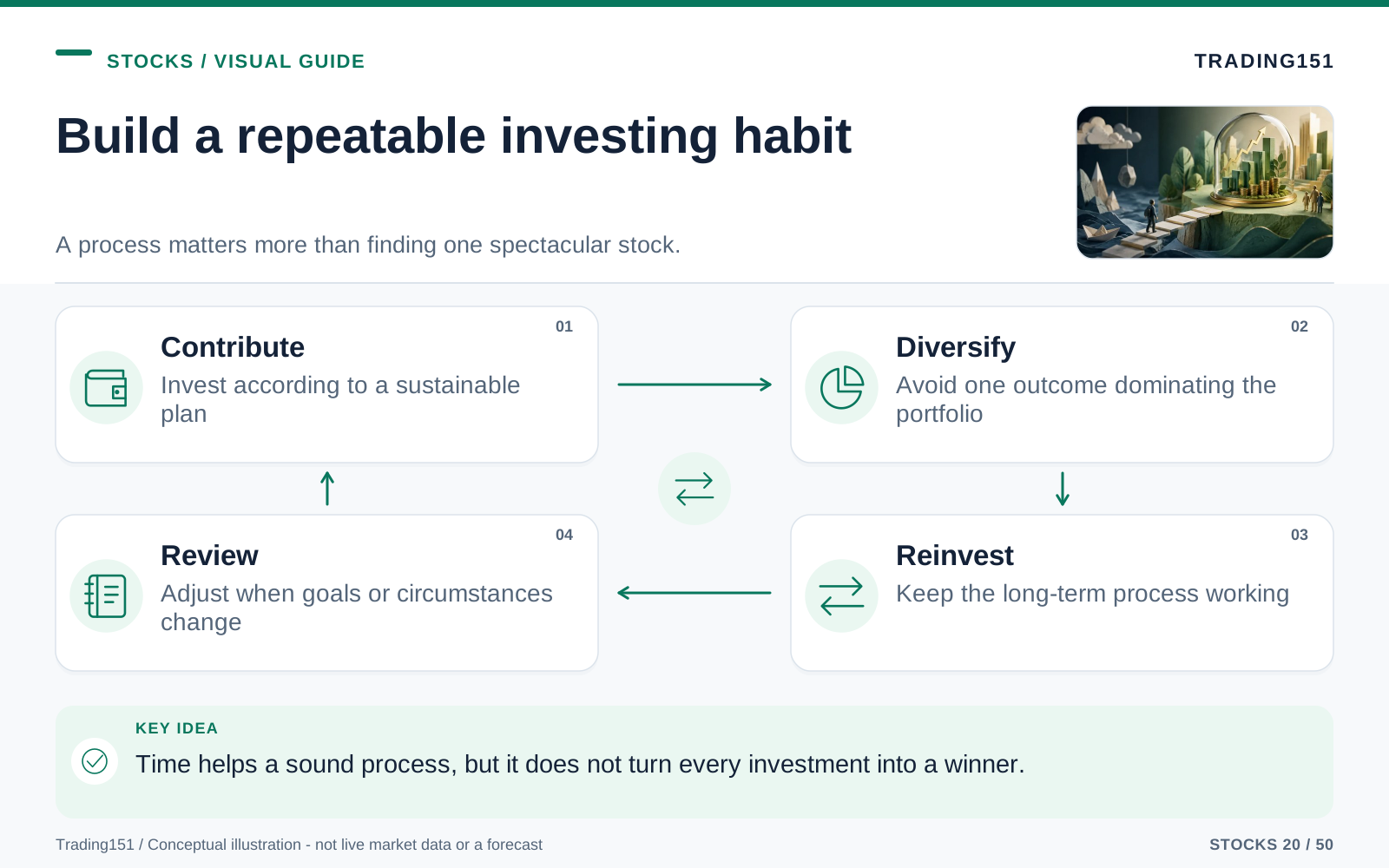
Read this diagram as text
- Contribute
- Invest according to a sustainable plan
- Diversify
- Avoid one outcome dominating the portfolio
- Reinvest
- Keep the long-term process working
- Review
- Adjust when goals or circumstances change
Part 2: Why Time Matters So Much
The secret sauce in all of this isn’t having a genius eye for stock picks. It’s compounding. Time is your best friend here, working its magic in two ways: your returns start generating their own returns, and your steady deposits buy into the market through all its natural ups and downs. When you first start out, how much you save matters way more than your investment returns, simply because your account is small. But later on? The returns take the wheel. Both phases require consistency, but the engine driving Don't worry about the past; just focus on making your future self more secure than they would be if you did nothing at all.
Part 3: Know What You Are Buying
Investing gets a whole lot less scary once you realize you don't need to learn a whole new language to do it. You can skip the Wall Street jargon. For most of us, there’s really just one big distinction you need to understand: buying individual stocks versus buying funds.
Individual stocks are exactly what they sound like—a share of one specific company. If you buy shares in a big tech firm or your favorite retailer, your success relies almost entirely on how well that one business performs, and how everyone else feels about it.
Sure, individual stocks can make people a lot of money. Sometimes a small company explodes into an industry giant. But they can also bomb. A company might take on too much debt, get crushed by a competitor, or just sell a product people stop wanting. Even a fantastic company can be a lousy investment if you buy it when the price is completely inflated.
Does that mean you should never buy a single share of a company you like? Not necessarily. It just means you should be careful. Recognizing a brand name isn't the same as understanding their balance sheet, their competitive edge, or their real-world risks. For most everyday investors, it’s much safer to keep individual stocks as a fun side-project rather than the bedrock of your financial future.
Mutual funds, on the other hand, take money from thousands of investors and pool it together to buy a huge basket of different investments. Instead of putting all your chips on one company, you get tiny pieces of dozens, hundreds, or even thousands of companies at once. This instantly spreads out your risk.
Now, some mutual funds are actively managed, meaning a highly paid professional is sitting in an office trying to pick the very best stocks to beat the market. Sounds great in theory, but these funds usually charge high fees. And year after year, it turns out that even the smartest pros have a really hard time consistently beating the market once you factor in those fees.
Index funds and ETFs are generally the sweet spot for regular, long-term investors. Instead of paying a guy in a suit to guess which stocks will win, an index fund just buys all the stocks in a specific market category. An S&P 500 index fund, for example, just tracks the 500 largest US companies. A total market fund buys pretty much everything.
ETFs (Exchange-Traded Funds) are super similar to index funds. The main difference is just how they're traded behind the scenes—ETFs trade throughout the day like stocks, while mutual funds settle up at the end of the day. Honestly? Either one works brilliantly for a long-term plan. What really matters is what's inside the fund, how much it costs you in fees, and whether it fits your overall strategy.
The magic of a broad index fund is that it completely removes the stress of having to pick the "right" stock. You aren't betting your retirement on one CEO's behavior or a single earnings report. You own a large slice of the entire economy. Some of those companies will fail. Some will absolutely crush it. Over time, the winners generally drag the whole basket upward.
Part 4: Diversification Is Your Safety Net
"Diversification" is one of those fancy finance terms that just means, "Don't put all your eggs in one basket."
If you bet everything on a single stock, your life savings are completely at the mercy of that one company. Bet on one industry, and you go down if that industry goes down. Diversification spreads your money across different companies, different industries, and even different countries.
Being diversified doesn’t make you bulletproof. If the global economy takes a hit, a diversified portfolio will still lose value. But what it does do is prevent one terribly run company from wiping you out entirely.
For most of us, a super simple setup of broad index funds is all we need. We're talking maybe a US stock fund, an international stock fund, and—depending on your age—maybe some bonds. You absolutely do not need twenty different funds to be diversified. In fact, owning too many funds usually just creates a messy portfolio filled with overlapping stocks.
The most crucial thing is making sure your investments match your timeline. Any cash you're going to need in the next few years—for rent, a wedding, a house down payment, or emergencies—doesn't belong in the stock market. Stocks are fantastic for the long haul, but they are flaky short-term storage.
But long-term money? That’s a different story. If you're putting away cash for a retirement that's twenty years away, you can afford to shrug off the market's mood swings. That long runway is exactly what lets the stock market do its heavy lifting.
Part 5: Get Your Financial Base in Place First
Investing is important, but it shouldn’t be built on a shaky foundation. Before you start pouring money into the market, you need to get your basic financial house in order. Investing aggressively while carrying toxic debt or having zero emergency savings is like putting a fresh coat of paint on a house with a collapsing roof.
Build an emergency fund first. Life is messy, and emergencies rarely have the courtesy to wait until the stock market is doing well. Tires pop. Roofs leak. Layoffs happen. Having a stash of cash turns a full-blown financial crisis into a temporary annoyance.
A good rule of thumb is saving three to six months of basic living expenses in a regular, easy-to-access savings account. If you’re single with a super stable job, you might lean toward three. If you have a family, a house, or irregular income, aim closer to six. The point is to ensure you never have to sell your investments at a loss just to pay the electric bill.
Crush your high-interest debt. Credit card debt is a wealth killer. If you’re paying 20% interest on a balance, paying that off is essentially a guaranteed 20% return on your money. No stock market strategy on earth can reliably beat that.
Now, I’m not saying you need to be 100% debt-free before you buy your first stock. A mortgage, a reasonable student loan, or a low-interest car loan can comfortably live right alongside your investing habits. But high-interest consumer debt? Get rid of it as fast as you can.
Know where your money goes. You don't need a psychotic color-coded spreadsheet, but you do need to know roughly what comes in and what goes out. Figure out what you can realistically invest without making yourself miserable. A modest investing plan that you can stick to is infinitely better than an aggressive one you quit after three months.
Part 6: Choose the Right Account
Think of investment accounts like buckets. You need to pick the right bucket before you decide what to put inside it. Using the right type of account can save you a large amount of money in taxes over the years.
Employer retirement plans (like a 401(k) in the US) are usually the absolute best place to start. If your boss offers to match your contributions, do whatever it takes to get that full match. It’s free money. Leaving it on the table is like voluntarily giving back part of your paycheck.
Individual Retirement Accounts (IRAs) are the next logical step. Depending on the rules where you live and how much you make, IRAs come with fantastic tax perks. Some let you deduct your contributions now; others let you pull your money out tax-free when you retire. It’s definitely worth looking up the specific rules for your area.
Taxable brokerage accounts are your standard, everyday investing accounts. They don’t have special tax perks, but they also don’t have all the strict retirement rules. You can pull the money out whenever you want, making them great for goals you want to hit before you're in your sixties.
The "perfect" account depends entirely on your income, your goals, and where you live. But please, don't let decision paralysis hold you back. For most people, the playbook is simple: get your employer match first, look into an IRA second, and use a regular brokerage account for anything left over.
Part 7: Make Investing Automatic
Want to know one of the biggest secrets to building wealth? Get out of your own way.
It sounds counterintuitive, right? We naturally assume that if we micromanage something, it’ll perform better. But with long-term investing, the exact opposite is true. If you manually transfer money every month, you give yourself a dozen chances a year to second-guess the market, get scared by the news, or just spend the cash on something else.
Make it automatic. Set up a recurring transfer from your checking account to your investment account on payday. Even better, if you have a workplace plan, have the money pulled directly from your paycheck before you ever even see it.
Pick a simple destination for that cash—like a broad index fund or a target-date retirement fund. Target-date funds are hands-off; they automatically shift to safer investments as you get older. They aren't flawless, but they are a fantastic "set it and forget it" option.
When you're just starting out, building the habit is way more important than the dollar amount. If you can only swing $50 a month, start with $50. If you can comfortably do $500, do that. You just want to build a machine that keeps humming away in the background, even when you're busy or unmotivated.
A great mental hack is to increase your investing rate every time you get a raise. Before you get used to that bigger paycheck and let lifestyle creep eat it all, funnel a chunk of it straight into your investments. You still get to enjoy the extra money today, but your future self gets a raise, too.
Part 8: Use Dollar-Cost Averaging to Stay Consistent
A huge fear for beginners is picking the exact wrong time to invest. It’s a completely valid fear! Nobody wants to drop a chunk of cash into the market on a Tuesday only to watch the whole economy tank on a Wednesday.
"Dollar-cost averaging" is the cure for this anxiety. It’s just a fancy way of saying you invest a set amount of money on a regular schedule, regardless of whether the market is up, down, or sideways. Let's say you automate $200 on the 1st of every month.
- When the market is booming, your $200 naturally buys fewer shares.
- When the market is crashing, everything is on sale, so your $200 buys a lot more shares.
- Over time, it all averages out, completely removing the stress of trying to time the market.
It’s not a magic spell that prevents losses, but it works wonders for your sanity. You never have to stand on the sidelines biting your nails, wondering if today is the "right" day to buy. You just stick to the routine.
If you suddenly come into a large lump sum of money, math says you should usually just invest it all at once. But human psychology is trickier than math. If spreading that lump sum out over six months helps you sleep at night, do it. The best strategy is always the one you won't abandon when things get scary.
Part 9: Reinvest Dividends
A lot of companies regularly pay out a slice of their profits directly to their shareholders. These are called dividends. If you own an index fund, you’ll likely see these dividend payouts hit your account every few months.
It’s super tempting to look at that cash as fun money. But if you're trying to build long-term wealth, the smartest thing you can do is automatically reinvest them. This just means using those payouts to instantly buy slightly more of the fund you already own.
This puts compounding into overdrive. Now, it’s not just your paycheck feeding the account; your investments are buying more of themselves.
Almost every brokerage platform has a little toggle switch for this—often called DRIP (Dividend Reinvestment Plan). Flipping that switch takes about two seconds, but it can make a large difference to your bottom line over the decades.
Part 10: Understand Risk Before It Tests You
Everyone loves the idea of their money growing. Far fewer people enjoy the rollercoaster ride it takes to get there.
Volatility is completely normal, but it feels awful. Over a thirty-year investing timeline, you are guaranteed to live through recessions, political nightmares, wars, weird interest rate hikes, and news cycles that make it seem like the financial world is ending.
I'm not being negative; that is just the reality of owning stocks.
The problem isn’t that the market drops. The real danger is how we react to it. People have a terrible habit of making permanent decisions based on temporary panic. They watch their portfolio drop, sell everything to "stop the bleeding," wait for the news to sound positive again, and then buy back in after prices have already gone back up. That cycle is a guaranteed way to destroy your wealth.
The trick is to decide how you’re going to act before the market crashes. Write yourself a note if you have to. Remind yourself that a red number on a screen doesn't mean your plan is broken. If you're properly diversified and investing for the long term, big market drops are uncomfortable, but they're entirely expected.
Think about it like owning a house. If Zillow told you your house was suddenly worth 15% less this month, you wouldn't panic, sell it at a loss, and sleep on the street that night. You’d just keep living in it, trusting that the value would eventually bounce back. You need to treat your investment portfolio with that exact same level of chill.
That being said, don't ignore large, glaring flaws. If your portfolio is 90% invested in one sketchy tech startup, or you're gambling with next month's rent money, you probably should panic a little and fix it. But if you have a boring, diversified portfolio and the market is just throwing a tantrum? Close the app and go for a walk.
Part 11: Avoid the Traps That Derail Investors
Winning at the investing game isn't just about making good choices; it’s largely about avoiding the really stupid ones that interrupt your compounding.
Don’t chase the hype. Every couple of years, there’s a new financial craze. A meme stock, a new crypto coin, or a buzzy tech company that everyone swears is the future. Yes, a few people will get rich off these. Most won't. The danger is that by the time you're hearing about it from your neighbor, the price is usually completely inflated. Hype plays on your Fear Of Missing Out. But remember, the people bragging online about their large wins are suspiciously quiet about all their large losses. Don't risk your future on trends.
Skip the day trading. Buying and selling stocks all day feels exciting. It makes you feel like a Wall Street genius. But it is sharply difficult to win at. You are competing against algorithms, large institutions, and people who have supercomputers and billions of dollars at their disposal. More importantly, day trading turns investing into gambling. You win, you get cocky. You lose, you try to win it back. It’s an emotional trap.
Watch out for hidden fees. A 1% management fee sounds completely harmless, right? But 1% taken out of your account every year, regardless of whether the fund makes or loses money, will eat an astonishing amount of your wealth over a few decades. This is why low-cost index funds are so popular—they let you keep your own money.
Stop waiting for the "perfect" time. There will always be a perfectly logical reason not to invest today. The economy is weird, an election is coming up, interest rates are high, the market feels too expensive, a recession might be looming. If you wait for the stars to align and the news to be 100% positive, you will never invest a dime. You don't need a perfect economy; you just need a solid plan and the grit to stick with it through the messy times.
Part 12: Build a Plan You Can Live With
You really don't need a complex financial plan. The simpler it is, the more likely you are to follow it.
Sit down and answer a few basic questions:
- What exactly am I saving for?
- When will I need to spend this money?
- How much cash can I part with every month without stressing out?
- If my account lost 30% of its value tomorrow, how would I truly react?
- What is my action plan when the market eventually crashes?
Be direct with yourself. If you're 25 and saving for retirement, you can afford to go heavy on stocks because you have 40 years to bounce back from any crashes. If you’re retiring in five years, you want a much safer mix of stocks and bonds. Saving for a house down payment next year? Keep that cash completely out of the stock market.
Figuring out your risk tolerance isn't about how brave you feel when the market is breaking records. It's about how you behave when the TV is reporting on a financial collapse and your account is bleeding cash. It is always better to build a slightly more conservative portfolio that you can stick with for thirty years, rather than a hyper-aggressive one that causes you to panic-sell at the first sign of trouble.
Once you have a plan, stick it on your fridge or save it on your phone. You don't need to stare at it every day, but it’s there to protect your money from your mood swings.
Part 13: Increase Your Contributions Over Time
We obsess over investment returns, but your savings rate is just as critical. Especially in your first few years, the amount of cash you scrape together to invest will grow your account much faster than whatever the market is doing. Try to trick yourself into saving more as time goes on. Got a promotion? Paid off your car? Commit a portion of that new freed-up money to your investments before you get used to spending it. It is so much easier to gradually bump up your contributions than it is to try and radically change your lifestyle overnight.
If you are starting from absolutely nothing, do not beat yourself up. Small starts are perfectly fine. Every large portfolio started with a small deposit. The only rule is that you have to challenge yourself to increase that number as your life allows.
You might commit to raising your contribution by just 1% every year. Or maybe you decide that every time you get a tax refund or a bonus, half of it goes straight into your brokerage account. Those little bursts of extra cash act like fast-forward buttons for your financial goals.
And please, remember that the goal here isn't to live like a miserable penny-pincher today just so you can be rich when you're 80. Depriving yourself of everything fun usually just leads to burnout. Go out to dinner. Take the vacation. Buy the things that bring you joy. Just make sure that not every dollar you make slips through your fingers.
Part 14: Check Your Portfolio Without Obsessing Over It
Yes, you need to check on your investments occasionally. No, you do not need to check on them while you're drinking your morning coffee every day.
Staring at your portfolio too often turns totally normal market hiccups into large emotional events. If you're investing for a retirement that's thirty years away, who cares what the market did on a random Thursday in October? The more you look, the more likely you are to see a temporary loss, simply because markets fluctuate constantly.
For most of us, checking in once or twice a year is plenty. When you do check in, just ask yourself a few maintenance questions: Am I still investing enough? Are my fees still low? Does this setup still match my long-term goals? Do I need to rebalance?
Rebalancing just means getting your account back to your original game plan. Say you wanted an 80% stock and 20% bond mix. If stocks have an incredible year, they might suddenly make up 90% of your account. Rebalancing just means selling a few stocks and buying a few bonds to get back to that 80/20 split. It’s a beautifully boring, systematic way to force yourself to "buy low and sell high."
Treat your portfolio check-ups like rotating the tires on your car—it’s just standard maintenance. Your investment account isn’t a scoreboard for your self-worth. It’s just a tool. Treat it like one.
Part 15: What Wealth Really Buys
When we talk about investing, it’s so easy to get fixated on the numbers. But a high score isn't really the point. The true value of wealth isn't the money itself; it's the options the money gives you. When you tie your portfolio to the life you want to live—rather than just an abstract desire to be rich—it makes riding out those scary market crashes a whole lot easier.
What most of us are really after is just breathing room.
Breathing room means the washing machine breaking is an annoying errand, not a financial disaster. It means losing your job is stressful, but it doesn't mean you're going to lose your house next week. It means you have the power to walk away from a boss who treats you terribly. It means you can take care of your aging parents without bankrupting yourself. It means your older self gets to live life on their own terms, all because your younger self made a few smart, boring decisions.
The stock market isn't the only way to build wealth, and it certainly isn't risk-free. But it is undeniably one of the most accessible ways for regular, everyday people to build a secure future. You don't need a million dollars to start. You don't need to flip real estate or invent the next big app. With a basic account and a steady habit, you can own tiny slices of the most profitable companies on earth.
That is an powerful opportunity. All it requires from you is a little humility, a lot of consistency, and the patience to let it grow.
Make the contribution plan survive an ordinary bad year
Start with the amount you could keep investing through a less comfortable year. A plan based on overtime, a bonus, or unusually low expenses may look impressive in a projection and fail at the first interruption. A smaller sustainable contribution can be more useful than a larger promise that repeatedly forces withdrawals.
Separate money by purpose. An investment account intended for a distant goal should not quietly become the reserve for next month's bills. Cash held for emergencies has a different job from stocks held for growth. Calling cash inefficient misses the value of being able to meet an expense without selling shares during a decline.
Projections need honest labels. For example, contributing $200 each month for ten years means depositing $24,000 before any investment result. A calculator can then illustrate outcomes under different assumed returns, but those returns are scenarios, not a schedule the market has agreed to follow. Include fees, inflation, and taxes where they affect the decision.
Review progress against the household's goal rather than against someone else's portfolio screenshot. A pay rise may support a higher contribution; a new responsibility may call for more accessible savings. Neither decision requires a market forecast. Building wealth through stocks is partly an investment exercise and partly the work of making a plan durable enough to keep using.
An interrupted contribution plan can still be useful
A saving plan should survive ordinary life. Income can fall, expenses can rise, and contributions may need to pause. Model a less favorable path rather than assuming uninterrupted deposits and a steady return every year.
This helps distinguish a durable plan from one that depends on perfect conditions. Keeping an emergency reserve or reducing a contribution temporarily may support the long-term goal by preventing an expensive forced sale. The aim is not to maximize the amount invested in every month regardless of circumstances. It is to build a pattern that can continue across changing conditions without putting essential spending at risk. Progress should be measured against that realistic plan, not a smooth projection that no household could reliably follow. 1, 2, 3
Begin Small, Build the System, Keep Going
Building wealth in the stock market isn't about being the smartest person in the room. It’s just about doing a handful of perfectly sensible things for a very long time.
Spend less than you make. Keep a pile of emergency cash. Run from high-interest debt. Use tax-advantaged accounts. Buy broad, low-cost index funds. Automate your deposits. Reinvest your dividends. Ignore the loud people on the internet. Bump up your savings rate when you get a raise. Don’t panic when the market takes a dive. And most importantly, let time do the heavy lifting for you.
Does any of that sound glamorous or flashy? Nope. And that’s exactly why it works. Flashy strategies are great for cocktail party stories. Boring strategies quietly build millionaires in the background.
You don't need to predict the future to win. You just need to claim your little corner of the global economy and persistently fund it over time. Sometimes the growth will come from the market soaring, and other times it'll come simply because you relentlessly kept adding money during a slump. Both count.
Stop measuring your success against what the S&P 500 did this week, and start measuring it against the life you're trying to build. Remember: this isn't a game. This is your future flexibility. It's your peace of mind, your time with family, your security during an emergency, and your ability to finally call the shots.
Start with whatever amount you can afford today, put it on autopilot, and slowly increase it as life gets better. Keep your fees low, understand the risks, and keep your plan simple enough that you won't abandon it when the economy gets rocky. Regular people build extraordinary wealth all the time. They don't do it by outsmarting the market—they do it by giving their money the time and discipline it needs to grow.
Sources and further reading
Editorial revision: 7 October 2026. Numerical scenarios are hypothetical unless identified as historical. References support the added explanations and selected corrections; rules and product terms should be checked again before acting.