
Momentum investing favors securities with relatively strong recent performance under a defined set of rules. It does not mean buying anything that has just risen, and it does not remove the risk of a sharp reversal. The approach needs a ranking method, a holding or review schedule, and a plan for turnover and concentration. Without those details, momentum can become a label for chasing recent winners.
What Exactly Is Momentum Investing?
At its core, momentum investing is betting that recent winners will keep winning in the near term, while recent losers will keep struggling. In plain English: you're looking for stocks flexing their muscles and trying to ride their coattails before they run out of breath.
A great way to wrap your head around momentum is to look at its total opposite: value investing.
Value investors are the bargain hunters. They dig for companies that look cheap compared to their actual worth—maybe their earnings are solid, but the market just hates them right now. A value investor loves buying an unloved stock, confident the crowd has it wrong. They are patient, contrarian, and thrive on market pessimism.
Momentum investors? They couldn't care less about finding a bargain. They want proof that the crowd is already moving in a specific direction. A stock that just doubled in price might still catch a momentum investor's eye if it’s still beating the market, pulling in heavy trading volume, and breaking new highs. To them, price strength isn't a warning sign; it's vital information.
This doesn't mean the underlying business is garbage. Large momentum usually starts because of something very real: rising rapidly earnings, a disruptive new product, or an entire industry suddenly catching fire. The difference is that a momentum investor doesn't care about being the first person to spot the trend. They just want to see the market validate the story through price action.
Price is the ultimate truth-teller for a momentum trader. Is the stock making higher highs? Is it leaving its competitors in the dust? Are buyers rushing in on every minor dip? These footprints matter because they show what investors are doing with their money, not just what they're talking about on financial TV.
In a lot of ways, momentum investing is humble. It admits that no one has a crystal ball. So, instead of arrogantly predicting where a stock should be priced, momentum investors simply follow where the money is already flowing.
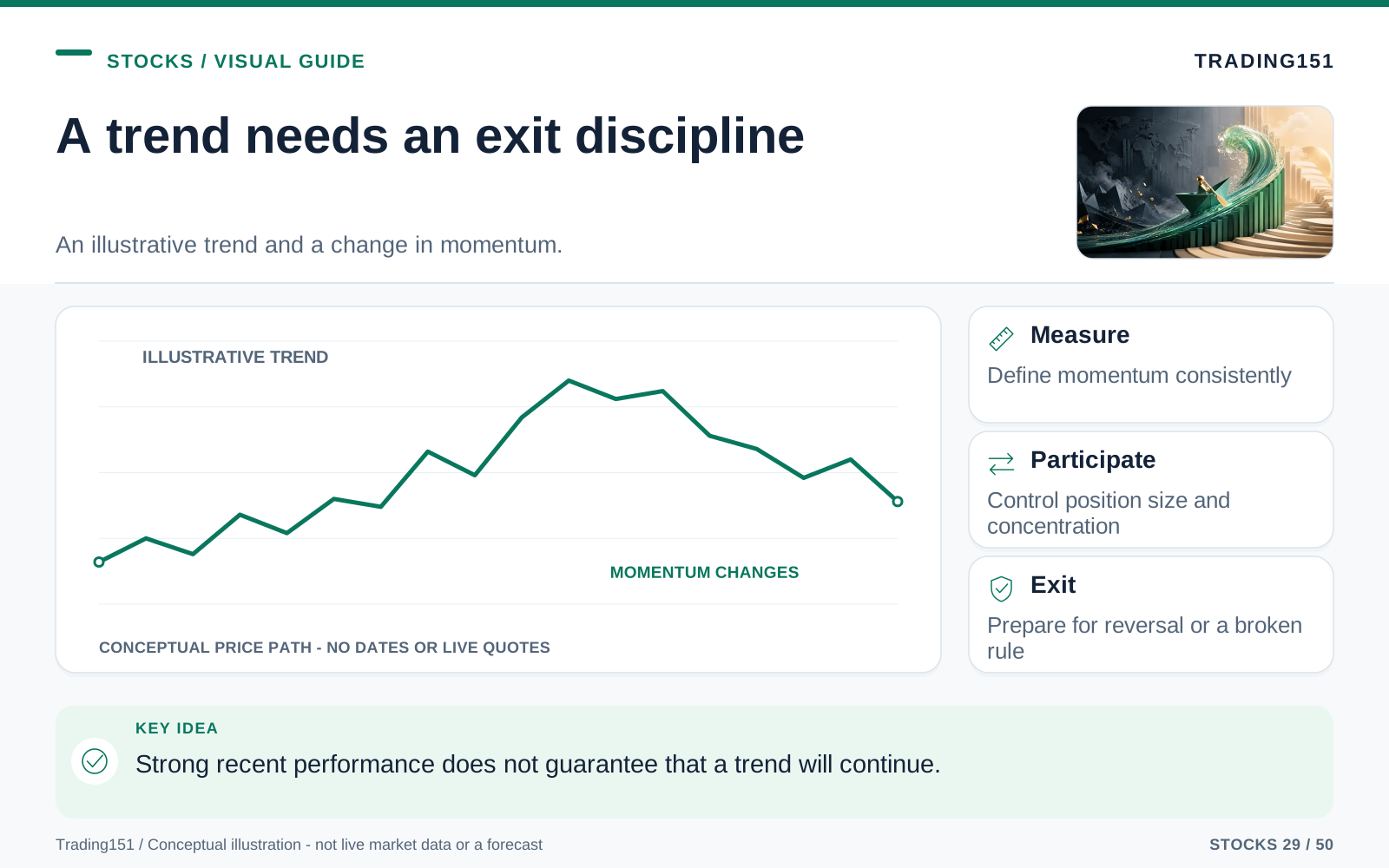
Read this diagram as text
- Measure
- Define momentum consistently
- Participate
- Control position size and concentration
- Exit
- Prepare for reversal or a broken rule
The Psychology Behind Momentum
Momentum works because markets aren't run by perfectly rational, cold-blooded calculators. They are driven by crowds. You've got hedge funds, day traders, algorithms, and millions of regular people making choices with flawed information. Prices move because people act, and people are deeply emotional.
Two classic emotions rule the markets: fear and greed. Momentum sets up camp right in the middle of them.
1. FOMO Turns Interest Into Demand
Imagine a company crushes its earnings report, and the stock starts climbing. At first, it's under the radar. Then, analysts upgrade it. Wall Street starts buzzing. Your buddy brags about buying it last month. The stock keeps climbing. Suddenly, people who thought it was too expensive start sweating.
Fear of missing out (FOMO) is a substantially powerful force. Nobody wants to sit on the sidelines while everyone else gets rich. As the latecomers finally cave and buy in, the price pushes even higher, triggering yet another wave of attention. Momentum investors don't judge this cycle—they just profit from it.
2. Good News Often Takes Time to Be Priced In
Markets are fast, but they aren't always perfectly efficient. If a company has an amazing quarter, a lot of investors will write it off as a one-time fluke. But then the next quarter is even better. Forward guidance goes up. Big institutional funds start quietly accumulating shares. This entire repricing process can take months.
This slow-motion adjustment is exactly why trends last so long. A stock rarely teleports to its "correct" price overnight because human beings change their minds slowly. Some wait for more data; some are legally restricted on when they can buy. This staggering of buyers creates a sustained wave that momentum traders can ride.
3. Investors Hate Admitting Mistakes
Our egos dictate a lot of our financial decisions. We love selling our winners early because taking a profit feels fantastic. We also refuse to sell our losers, because hitting the "sell" button means admitting we were wrong. Behavioral economists call this the disposition effect.
Momentum strategies forcefully counter this instinct. They demand that you let your winners run and ruthlessly cut your losers. It sounds easy, but emotionally, it's severe. It means buying a stock that looks terrifyingly "expensive" and accepting that it can still go up, while ditching a stock that looks "cheap" before it drags your portfolio down.
4. Institutions Can Reinforce the Trend
Big mutual funds and pension plans don't buy their entire position on a random Tuesday morning. If a large institution decides they need to own a stock, they accumulate it slowly over weeks or months. That relentless buying pressure acts like a floor for the trend.
There's also a heavy dose of career preservation at play. Fund managers are constantly compared to market benchmarks. If five large tech stocks are carrying the entire market, a manager who doesn't own them is going to look foolish to their clients. That peer pressure forces even skeptical professionals to buy into the trend, pouring more gas on the fire.
The Two Main Types of Momentum
Momentum isn’t a one-size-fits-all concept. Most strategies generally fall into two buckets: absolute and relative. You can use them on their own, but the magic often happens when you combine them.
Absolute Momentum
Absolute momentum is basically comparing an investment to its own past self. The core question is: is this stock trading higher today than it was a few months ago?
For example, you might have a rule that you only buy a stock if it’s currently priced higher than it was six months ago, or if it's trading above its 200-day moving average. If it is, great—it has positive momentum. If it isn’t, you stay away or sit in cash.
The real beauty of absolute momentum is defense. It acts like a circuit breaker, keeping you from holding the bag during a grueling bear market. It's not a magic shield against all losses, and you'll get some false alarms, but it enforces a vital rule: never try to surf a wave that has already crashed into the shore.
Relative Momentum
Relative momentum, on the other hand, is a popularity contest. Instead of asking, "Is this stock going up?" it asks, "Is this stock beating everything else?"
You might rank the entire S&P 500 based on the last six months of returns and only buy the top 10%. Or you might look at different market sectors and constantly rotate your money into the hottest one. The goal is simple: own the leaders, ditch the stragglers.
This approach is inherently competitive. It assumes your money should always be working in the strongest pockets of the market. If tech is leading the charge, you’re in tech. When the tide turns to energy or healthcare, you pack up and follow the strength.
What Momentum Investors Look For
True momentum isn't just a stock having three good days in a row. A high-quality setup usually has a few specific traits lining up at once. No single metric is flawless, but together, they paint a compelling picture.
- Persistent price strength: The stock has been on a solid upward trajectory for a medium-term stretch—usually anywhere from three to twelve months.
- Relative strength: It’s leaving its peers in the dust, easily beating its sector or a broader index like the S&P 500.
- Healthy volume: Upward spikes are backed by heavy trading volume, which tells you big money is buying in.
- Constructive pullbacks: When the stock naturally dips, it doesn't fall off a cliff. Buyers eagerly step in to scoop it up before the trend breaks.
- Clear leadership: There's an actual, understandable reason why the company or sector is getting so much love from Wall Street.
- Defined exit points: You know exactly at what price you'll admit you were wrong, before you even hit the buy button.
That last bullet is crucial. Momentum investing isn't about getting emotionally attached to a cool company. It’s about dating a trend while it's attractive and breaking up the second things get ugly.
Building a Momentum Strategy: A Practical Framework
You don't need a sprawling Wall Street trading desk or a Ph.D. in math to pull this off. What you absolutely need, though, are rules. Without a strict playbook, momentum investing quickly devolves into throwing money at whatever ticker is trending online.
Step 1: Choose Your Universe
First, draw a fence around what you're willing to trade. Are you focusing on large-cap U.S. stocks? Sector ETFs? The S&P 500? Setting boundaries keeps the chaos to a minimum.
For everyday investors, it’s best to stick to a smaller sandbox filled with highly liquid assets. Popular stocks and ETFs are easier to buy and sell without getting crushed by wide bid-ask spreads or weird price manipulation. Momentum is inherently risky; don't make it harder by trading obscure penny stocks.
Step 2: Pick a Look-Back Period
Momentum strategies usually care about the medium term. Looking back three, six, or twelve months is standard. If your window is too short, you'll get jerked around by daily market noise. Too long, and you'll be the last one to the party when market leadership flips. Many seasoned traders ignore the most recent month of data to avoid the trap of short-term hype reversals. The trick is to pick a time frame that makes logical sense, not just one that looks pretty on a backtested chart.
A six- or twelve-month window is usually the sweet spot. It filters out the daily static while keeping you locked onto genuine trends. Remember, you aren't trying to catch the absolute bottom. You're trying to jump onto a train that's already moving fast.
Step 3: Rank the Candidates
Once you have your universe and time frame, line everything up. Who are the winners over your chosen period? Which ETFs are dominating? You have to decide if you're looking at raw returns or risk-adjusted returns. Raw returns might point you toward substantially unstable stocks that just got lucky on a single news event. Adjusting for risk keeps things smoother, but might accidentally stuff your portfolio with boring, low-volatility names. Always look under the hood to see what your ranking system is buying.
Ranking forces you to be objective. Instead of agonizing over "Do I believe in this company's vision?" you're simply asking, "Is this stock dominating right now?" That mindset shift is large. You're trading observable reality, not your personal feelings.
Step 4: Add a Trend Filter
Even the best ranking system can trick you into buying the "least bad" stocks during a savage bear market. That’s why you need a trend filter.
It can be as simple as requiring a stock to trade above its 200-day moving average, or insisting it has positive returns over the last year. If a stock sits at the top of your ranking but fails the trend filter, you pass on it. This simple rule stops you from buying an anchor while the ship is sinking.
Step 5: Decide How Many Positions to Hold
Holding a highly concentrated portfolio can make you look like a genius when you're right, but it will absolutely wreck you when you're wrong. Five momentum stocks will give you a wild ride; thirty will smooth things out. More positions equal a safety net, while fewer positions amplify your wins and losses.
There isn't a magic number. It comes down to your personal stomach for risk, the size of your account, and how much time you have to babysit your trades. Just pick a number before you start, so you aren't making impulsive choices on the fly.
Step 6: Rebalance on a Schedule
This isn’t a set-it-and-forget-it retirement fund. Leadership constantly shifts. Once-hot trends fizzle out, and new darlings take the stage.
Most momentum traders review their portfolios monthly or quarterly. When review day comes, you check if your stocks still meet your strict criteria. If yesterday's star has lost its shine, you sell it and replace it with a fresh leader. This is where your discipline is truly tested. The whole machine falls apart if you stubbornly hold onto a stock just out of nostalgia.
Helpful Indicators, Without Getting Lost in the Weeds
Charts and technical indicators are great, but don't turn your screen into a confusing laser show. The best tools are usually the simplest, especially if you have a day job.
- Moving averages: These lines smooth out the frantic daily price action. The 50-day and 200-day averages are the gold standards. Generally speaking, a stock sitting comfortably above a rising 200-day line is in much better shape than one buried underneath it.
- Relative strength: This just measures how a stock is doing compared to its peers. If a stock is climbing while the rest of the market is sinking, it’s waving a large "look at me" flag.
- New highs: A stock hitting a 52-week high can feel scary to buy, but it proves that demand is relentless. For a momentum trader, a new high isn't a red flag—it's a green light.
- Volume: If a price jumps and trading volume explodes, big institutional money is likely involved. A price jump on tiny volume? That's a flimsy rally you probably shouldn't trust.
- RSI: The Relative Strength Index gauges how fast the price is moving. Traditional value guys might see a high RSI and yell "overbought!" but a true momentum stock can stay overbought a lot longer than skeptics think is possible.
Don't clutter your charts trying to look like a Wall Street wizard. Just try to answer a few basic questions: Is the trend still unbroken? Is the demand real? And at what price do I admit this trade is dead?
The Risk Nobody Should Ignore: Momentum Crashes
Momentum is incredible when trends are strong, but it has one concerning Achilles' heel. When the market flips unexpectedly, momentum strategies can take a severe beating. This usually happens coming out of a deep market crash. Suddenly, all the toxic, heavily-shorted stocks that were crushed start bouncing back with explosive force, while the steady stocks that held up well get ignored. If your system was playing defense, you might find yourself on the painfully wrong side of a sudden rally.
This is the notorious momentum crash. It isn’t a slow, gentle decline. It feels like someone pulled the fire alarm. Positions that looked bulletproof suddenly reverse, and stocks you thought were left for dead suddenly skyrocket.
The takeaway here isn't that momentum is a broken strategy. It just means momentum has seasons. When the weather is good, it's amazing. But when the seasons change, it will sharply punish anyone who fell asleep at the wheel.
Other Ways Momentum Can Go Wrong
Whipsaws in Choppy Markets
Momentum thrives on clear direction. When the market is bouncing around aimlessly, this strategy will drive you insane. A stock breaks out, you buy it. Two days later, it tanks, and your rules force you to sell. The next week? It breaks out again. Death by a thousand paper cuts.
This is getting whipsawed, and it's the annoying tax you pay for being disciplined. The same rule that saves you from a large crash will occasionally trick you into selling a stock right before it recovers. No system is immune to this.
Buying Too Late
You already know you aren't going to catch the very bottom, and that's totally fine. But the real danger is jumping in when a trend is completely exhausted, the hype is deafening, and everyone has already bought in.
Just because a stock is strong doesn't mean it's a smart buy today. Patience is huge. Sometimes the smartest move is to wait for the stock to take a breather, pull back slightly, and base out, rather than chasing a chart that looks like a vertical line.
Ignoring Position Size
Even the greatest trade idea can blow up your account if you bet the farm on it. Momentum stocks are inherently jumpy. They can easily gap down 15% overnight because of a bad earnings call, a sketchy headline, or a broad market panic.
Position sizing is the unsung hero of investing. It’s what keeps a normal losing trade from becoming a financial disaster. Decide exactly how many dollars you're willing to lose before you enter the ticker, and size the position based on math—not on how excited you are.
Forgetting Taxes and Costs
Because momentum requires jumping in and out of trends, you're going to trade a lot more than a long-term investor. That means more bid-ask spreads, more chances to let your emotions take over, and—crucially—more taxes.
Depending on where you live and what kind of account you trade in, short-term capital gains can take a large bite out of your profits. A strategy that looks like a money-printer on a spreadsheet might look pretty mediocre once the tax authorities takes his cut.
Risk Management: The Part That Makes the Strategy Survivable
People are drawn to momentum because of the flashy gains. But they survive because of risk management. If you don't have a plan for selling, you aren't trading—you're just telling yourself stories.
Use Exit Rules Before You Need Them
Never buy a stock without knowing exactly how you'll get out. Maybe it's a percentage drop, a break below a key moving average, or just a scheduled monthly portfolio cleanse. The specific method matters way less than the fact that you have one.
The absolute worst time to figure out your exit strategy is while you're watching a stock bleed out on your screen. At that point, your brain is panicking. You'll make excuses, negotiate with yourself, and hold onto a loser. Pre-planning your exit takes the emotion right out of it.
Let Winners Breathe
Yes, you have to cut your losers, but you also have to give your winners some room to jog. Momentum stocks naturally swing around substantially. If your stop-loss is too tight, you'll get bucked off the horse during a perfectly normal dip, right before the stock runs up another 40%.
It’s a delicate balancing act. You want to protect your cash without choking out a good trade. That's why a lot of traders use trailing stops or moving averages—they naturally shift upward as the stock moves in your favor, locking in gains while giving the stock room to breathe.
Avoid All-or-Nothing Thinking
You don't have to pledge allegiance to momentum and abandon every other way of investing. In fact, smart investors usually use momentum as just one tool in the shed. They might keep the bulk of their wealth in a boring, diversified core portfolio, and carve out a smaller chunk specifically for aggressive momentum plays.
It’s a healthy way to admit that no single strategy wins in every market environment. Diversifying how you invest is just as important as diversifying what you invest in.
Momentum ETFs: A Simpler Route for Everyday Investors
If the idea of running screens, staring at charts, and manually rebalancing your portfolio sounds exhausting, momentum ETFs are a fantastic shortcut. These funds basically do the heavy lifting for you, mechanically tracking an index of high-flying stocks based on their own internal algorithms. But don't just blindly buy a ticker that has the word "momentum" in the title. Some look at six months of data, others look at twelve. Some adjust for volatility, while others only update their holdings twice a year. Read the fine print to see what you're paying for.
The upside is obvious: it's convenient. The downside? You are handing over the steering wheel. You're stuck with their rules, their timing, and their fees. And if the market abruptly rotates, you just have to hold on and hope the ETF's formula corrects itself before the damage gets too severe.
The Core-and-Satellite Approach
A highly practical way to incorporate momentum is the "core-and-satellite" method. Think of the core as your financial bedrock—boring index funds, steady ETFs, and long-term holds that let you sleep at night. The satellite is a smaller, more aggressive bucket where you actively hunt for momentum.
You might put 80% or 90% of your money into the safe, long-term stuff, and use the remaining piece to trade momentum. The exact split is up to you. The goal is to make sure a high-octane trading strategy never accidentally blows up your retirement.
Psychologically, this is brilliant. If your momentum trades hit a rough patch, your core is still steady. If your momentum trades knock it out of the park, it juices your overall returns. Either way, you avoid the sheer panic that leads to terrible financial decisions.
Common Mistakes New Momentum Investors Make
- Chasing headlines instead of trends: A stock going viral on social media is absolutely not the same thing as having real, mathematically proven momentum.
- Buying without an exit: Anyone can click "buy." Knowing exactly when to click "sell" is what separates the pros from the amateurs.
- Confusing a great company with a great stock: A company can have brilliant management and an amazing product, but if the stock price is lagging, it’s a terrible momentum trade.
- Overtrading: Constantly flipping stocks out of boredom will bleed your account dry through taxes and mental fatigue.
- Ignoring the broader market: Even the most resilient stock will eventually crack if the entire market is melting down around it.
- Getting emotionally attached: Your loyalty belongs to your trading system, not to a ticker symbol.
Who Momentum Investing May Suit
Momentum investing isn't for everyone. It works best for people who are rigorously disciplined, comfortable with price swings, and perfectly fine buying a stock that looks completely overpriced to traditional value investors. Above all, you have to be okay with being wrong. Momentum systems generate a lot of small losing trades. It's simply the cost of doing business.
If you're the kind of investor who wants to buy an index fund and look at it once a decade, or if you only feel safe buying beaten-down bargains, momentum will drive you crazy. It's also a nightmare for anyone who panic-sells during normal market dips or checks their portfolio every ten minutes.
The best momentum traders aren't adrenaline junkies. They are cold, calculated trend followers. They know they won't be right every time. Their entire objective is to keep their losses tiny, ride the genuine winners for all they're worth, and never, ever argue with the market.
A Simple Example
Let's say you want to build a bare-bones relative momentum system using sector ETFs. On the first of every month, you rank all eleven market sectors based on their performance over the last six months. You buy the top three. But here's the catch: you only buy them if they are trading above their 200-day moving average. If a sector drops out of the top three next month, or slips below that moving average, you ruthlessly sell it and swap it for the new leader.
This isn’t financial advice, but it illustrates exactly how robotic the process should be. You aren't watching the news and trying to guess if Tech or Healthcare will win this month. You're simply looking at the scoreboard to see who is already winning, and following your rules.
You could do the same thing with a basket of liquid large-cap stocks. Rank them, buy the strongest ones, use a trend filter, manage your risk, and rebalance on a schedule. The flavors change, but the recipe stays the same.
Decide what a trend reversal means before it happens
Define the comparison group and measurement period in advance. Ranking a stock against its sector can produce a different decision from ranking it against an entire market. A return measured over one month can also disagree with a return measured over a year. None of these choices is self-evidently correct; each creates a strategy that needs to be evaluated on its own terms.
Watch the portfolio that emerges from the rules. Several high-ranking stocks may share the same industry, interest-rate sensitivity, or investor enthusiasm. Owning many names does not necessarily protect against a common reversal. Exposure limits can reduce that concentration, although they also change the results of the original strategy.
Turnover belongs in the calculation from the start. Frequent replacement of holdings can add dealing costs, spreads, and taxable realizations. A model using closing prices may also assume fills that are difficult to obtain at scale or during volatility. Test the actual implementation rather than only the ranking idea.
The hardest period may be a sudden change in leadership, when former winners fall and previously weak stocks rebound. Decide whether exits follow a ranking change, a time schedule, a risk limit, or another explicit rule. A process cannot prevent every reversal, but it can stop a losing momentum position from being quietly reclassified as a long-term value investment simply because selling feels uncomfortable.
Turnover can consume a promising signal
A momentum rule may identify strong relative performance while trading too often to preserve the apparent advantage. Include spreads, commissions, market impact where relevant, and taxes in the comparison. Examine how much of the result depends on immediate execution at a price that would have been difficult to obtain.
A less frequent rule may sacrifice some responsiveness while reducing costs. Whether that trade-off helps is an empirical question for the specific strategy, not a reason to assume either faster or slower is always better. Evaluate the implementable result rather than the most attractive frictionless chart. 1, 2, 3
Follow the Trend With Rules, Not Excitement
The ultimate appeal of momentum investing is that it's based on reality, not guesswork. You don't have to pretend you know what a company's balance sheet will look like five years from now. You don't have to arrogantly tell the market that it’s wrong. You simply spot the strength, hitch a ride while it lasts, and step off the ride when it slows down.
It requires you to trust the data over your own feelings. That means buying strength that feels absurdly expensive and dumping weakness that looks like an absolute steal. The secret sauce is consistency, not coming up with a clever narrative for every stock you buy.
Remember to respect the risks. Use diversification, enforce position limits, stick to a rebalancing schedule, and keep a defensive filter in place to save yourself during a market meltdown. Keep an eye on taxes and trading fees so your paper profits don't vanish in the real world.
Momentum can be a phenomenal tool, especially alongside a boring, steady core portfolio. But it is never a license to gamble. Learn to read the signals, accept that false alarms will happen, and never bet more than you can afford to lose. A trend is an helpful piece of information, but the market never makes any promises.
Sources and further reading
- CFTC: Eight things to know before trading forex
- TradingView Pine Script Documentation: Strategies
- Investor.gov: Asset Allocation
Editorial revision: 7 October 2026. Numerical scenarios are hypothetical unless identified as historical. References support the added explanations and selected corrections; rules and product terms should be checked again before acting.