
Global economic conditions can affect Bitcoin through interest rates, funding costs, exchange rates, investor risk appetite, and access to capital. Those relationships are neither fixed nor exclusive. Bitcoin can trade alongside other risky assets in one period and respond to a crypto-specific event in another. A useful explanation identifies a plausible channel and leaves room for competing influences rather than assuming one macro variable controls the price.
The Irony of Bitcoin’s Birth
Bitcoin wasn't created in a vacuum; it was born out of a very specific, painful moment in economic history. The 2008 financial crisis broke the public's trust in banks, regulators, rating agencies, and the political promises that were supposed to keep everything stable. While governments and central banks rushed to bail out large financial institutions, everyday people watched their savings, homes, and retirements evaporate.
When Satoshi Nakamoto mined the very first Bitcoin block in January 2009, he left a message hidden in the code that’s now part of crypto folklore: “The Times 03/Jan/2009 Chancellor on brink of second bailout for banks.”
This wasn’t some slick marketing slogan. It was a timestamp, a protest, and a heavy-handed clue. Bitcoin wasn’t just a neat new way to send money online. It was a direct response to a broken system where money could be printed out of thin air, reckless banks got rescued, and regular savers were left holding the bag.
Bitcoin offered a completely different set of rules. There would only ever be 21 million coins. No central banker could wake up and decide to print more. No government could quietly tweak the supply. No single CEO could pause the network. For a generation that had lost faith in the old system, that was an powerful idea.
In the early days, Bitcoin felt like an island. Its price was dictated by hobbyists, cypherpunks, early adopters, Reddit forums, miners, and internal network events like halvings. Traditional finance guys either ignored it entirely, laughed at it, or dismissed it as a weird internet experiment.
But then the experiment grew too big to ignore. Hedge funds started trading it. Publicly traded companies put it on their balance sheets. Payment processors integrated it. Eventually, Bitcoin crept from the shadowy edges of finance right into the mainstream portfolios, risk models, and trading desks of the exact institutions it was originally meant to bypass.
And that’s where the irony kicks in. The more legitimate Bitcoin became, the more sensitive it grew to macroeconomic weather. It didn’t stop being decentralized. Its supply cap stayed exactly the same. The blocks kept ticking. But its market fundamentally changed. Once institutional money flooded in, Bitcoin started reacting to the very things institutional capital cares about.
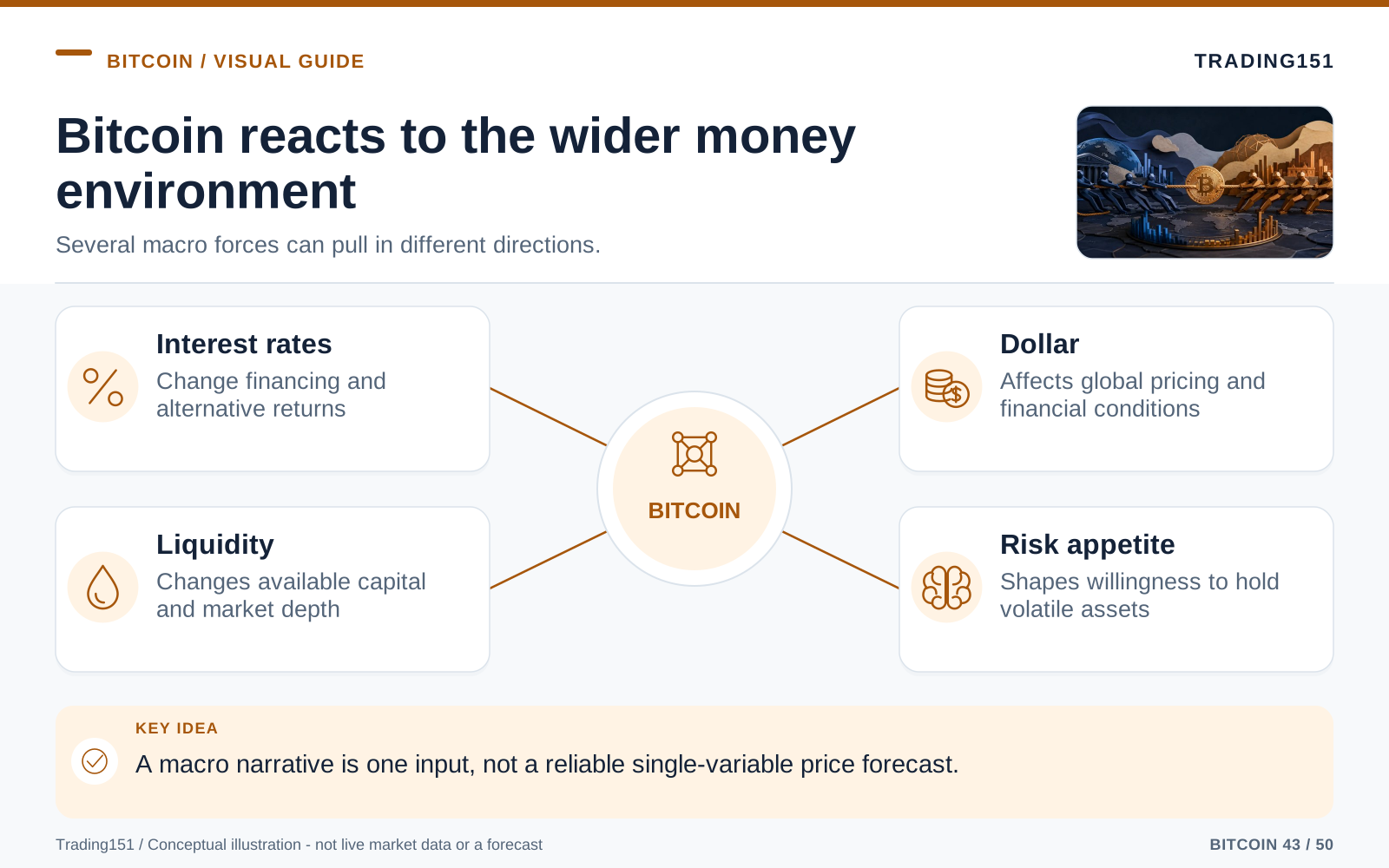
Read this diagram as text
- Interest rates
- Change financing and alternative returns
- Dollar
- Affects global pricing and financial conditions
- Liquidity
- Changes available capital and market depth
- Risk appetite
- Shapes willingness to hold volatile assets
Bitcoin Isn't Priced in a Vacuum
It’s tempting to think Bitcoin’s price is just driven by Bitcoin news. A large network upgrade should be bullish. A halving should be bullish. More wallets, more miners, more headlines—all of that should logically push the price up. Sometimes it does. But markets rarely move in straight lines.
Bitcoin trades inside a large, interconnected global financial ecosystem. Investors are constantly weighing it against everything else they could possibly buy: government bonds, cash, tech stocks, real estate, gold, and commodities. When conditions make people hungry for risk, Bitcoin looks like the most exciting thing on the menu. But when things get scary and investors get defensive, it’s often one of the first things they dump.
This is why you constantly hear Bitcoin called a “risk-on” asset. In a risk-on environment, investors feel invincible. Money is cheap to borrow, the economy is humming, cash is everywhere, and people are eager to chase high returns. In that kind of world, an unusually volatile asset with large upside looks highly attractive. Bitcoin thrives on optimism, cheap money, and the belief that tomorrow will be better than today.
But flip the switch to a risk-off environment, and the psychology completely changes. Investors stop asking, “How much money can I make?” and start asking, “How much money could I lose?” They dump volatile assets, stockpile cash, buy short-term government bonds, and shed anything that might crash. Because Bitcoin is highly liquid and trades 24/7, it often becomes a giant ATM during market panics.
Does that mean Bitcoin failed as an independent monetary network? Not at all. It just means the market price is still driven by real human beings and institutions living in the real economy. The network itself might be completely decentralized, but the people buying and selling the coins still have to worry about paychecks, borrowing costs, inflation, bond yields, and portfolio targets.
Interest Rates: The Bouncer at the Crypto Party
If there’s one macroeconomic force that pulls the strings more than any other, it’s interest rates. Specifically, the rates set by major central banks, like the US Federal Reserve. Rates ripple through everything. Higher yields make boring cash and bonds suddenly attractive. They make borrowing expensive, tighten lending, and make investors think twice about risky bets. Lower rates do the exact opposite, assuming people still feel confident enough to borrow. Bitcoin doesn't have cash flows or earnings reports, but the people trading it are absolutely paying attention to the cost of money.
Interest rates sound boring, but they dictate almost every aspect of financial life. They affect mortgage payments, business loans, credit card debt, bank deposits, stock valuations, and how investors behave. They are the ultimate dial that decides whether money feels cheap and abundant or expensive and scarce.
Think of the global market as a large party. When the Fed cuts rates down to zero, the vibe loosens up. Borrowing is practically free. Cash sitting in a bank account earns next to nothing, and government bonds offer pathetic returns. So, investors go looking for action elsewhere. They pile into growth stocks, fund risky startups, and suddenly, they take a very serious look at Bitcoin.
In that kind of environment, risk doesn’t feel dangerous. It feels like an opportunity you can't miss.
That’s a huge reason why Bitcoin went on an absolute tear during the ultra-loose money era of 2020 and 2021. Central banks slashed rates, governments pumped trillions in stimulus, and the markets were practically drowning in liquidity. Investors had plenty of cash, irrational confidence, and nowhere safe to earn a decent yield. Bitcoin, with its hard-capped supply and explosive price history, became a giant magnet for all that money.
Now, picture the exact opposite. Inflation runs hot. Central banks start panicking. Rates shoot up. Suddenly, you can earn a very comfortable, risk-free yield just by sitting in cash or short-term government bonds. Borrowing hurts. Speculative assets stop looking thrilling and start looking reckless.
That is the moment the bouncer walks into the party, flips on the harsh overhead lights, and tells everyone it’s time to go home.
For Bitcoin, high rates are a double-edged sword. First, they make boring, safe assets real competition. Why stomach Bitcoin’s 20% weekend drops when a money market fund pays a guaranteed 5%? Second, higher rates suck liquidity right out of the system. Leveraged traders get squeezed, institutions rebalance their portfolios, and the easy-money fuel that propelled Bitcoin upward simply evaporates.
This is why crypto traders watch Fed speeches and inflation reports like hawks. The market doesn’t wait for a rate cut to happen; it tries to guess what the Fed will do six months from now. A single word from the Fed chair can send Bitcoin soaring or falling because traders are constantly recalibrating their bets on the cost of money.
The TL;DR is simple: Bitcoin loves falling rates, easy money, and a relaxed central bank. It struggles when rates are climbing, cash is tight, and policymakers are determined to hit the brakes on the economy.
The Inflation Paradox: Why the “Inflation Hedge” Story Gets Messy
For years, one of the biggest selling points for Bitcoin was that it was the ultimate inflation hedge. The pitch was simple: Governments can print infinite amounts of fiat currency, but no one can print more Bitcoin. Dollars, euros, and yen rely on politicians and bankers. Bitcoin relies on math, consensus, and a hard-coded supply limit.
On paper, that sounds like the perfect defense against inflation. If traditional money loses its purchasing power, a scarce, decentralized asset should naturally become more valuable. And to be fair, a lot of Bitcoiners still deeply believe this plays out over the long run.
The short run, however, is a lot messier.
When inflation spikes, Bitcoin doesn’t always rally alongside it. In fact, it often dumps. Why? Because the market isn't reacting to the inflation itself—it’s reacting to what the central banks are going to do about it. High inflation almost always triggers tighter monetary policy. Tighter policy means higher interest rates, less liquidity, and a sudden hatred for risk. That nasty combination can crush Bitcoin in the short term, even if the long-term case for scarce digital money remains intact.
This is the inflation paradox. Bitcoin might protect against currency debasement over a ten-year horizon, but it can still take a large hit on the day a CPI report comes in hotter than expected. Traders see the bad inflation number, brace for the Fed to hike rates, and smash the sell button on risk assets before the policy even kicks in.
It’s also important to remember that not all inflation is created equal. There’s the inflation caused by printing too much money. Then there’s inflation caused by wars, supply chain breakdowns, energy spikes, or labor shortages. The market’s reaction to Bitcoin depends heavily on what kind of inflation we’re dealing with—and whether central banks have the tools to fight it.
If investors think inflation will force the Fed to crush the economy, Bitcoin is probably going to sell off. But if people believe governments will just keep printing money to deal with large debts and weak growth, Bitcoin’s scarcity narrative comes roaring back to life. The same headline can be bullish or bearish depending entirely on the broader economic context.
That’s why the smart money doesn’t just stare at the inflation rate. They look at real yields, wage data, bond market reactions, and central bank rhetoric. Bitcoin isn’t just asking, “Is inflation high today?” It’s asking, “What does this mean for the money supply tomorrow?”
Real Yields: The Hidden Pressure Point
If there’s one macro metric that doesn't get enough attention in the crypto space, it’s real yields. A real yield is simply the return you get on an investment after subtracting inflation. If a bond pays 5% but inflation is 3%, your real yield is 2%. But if that bond pays 2% and inflation is 6%, your real yield is deeply negative—you are losing purchasing power by playing it safe.
Why does this matter for Bitcoin? Because Bitcoin doesn’t pay a dividend or yield interest. Neither does physical gold. Assets like these only look super attractive when traditional, "safe" investments are getting eaten alive by inflation. If holding cash guarantees you're losing money, holding a hard, non-yielding asset suddenly makes a lot of sense.
But when real yields rise, Bitcoin faces stiff competition. If investors can lock in a solid, inflation-beating return from a government bond, the urgency to gamble on something as volatile as Bitcoin drops significantly. Conversely, when real yields plunge into negative territory, Bitcoin’s scarcity and large upside start looking appealing.
This dynamic perfectly explains why Bitcoin and gold often move together during major macro shifts. Both shine when people lose faith in fiat currency. But Bitcoin is far more volatile—it's younger, smaller, and heavily tethered to the broader appetite for risk.
The US Dollar: Bitcoin’s Arch Nemesis
Another crucial signal to watch is the strength of the US dollar, usually tracked by the DXY index. A strong dollar generally reflects a global scramble for liquidity and safety—two things that historically put heavy pressure on dollar-priced assets like Bitcoin. This isn't a flawless, mechanical relationship. Bitcoin can absolutely rally alongside the dollar during isolated crises, but more often than not, they move like a seesaw.
When the dollar spikes, Bitcoin usually feels the pain. When the dollar weakens, Bitcoin gets room to run.
Part of this is just simple math. Bitcoin is priced in dollars. If the dollar itself gets stronger, it takes fewer of them to buy a Bitcoin, making the price drop. But the underlying reality is really about global fear and liquidity.
The US dollar is the undisputed king of global finance. When things get scary, everyone scrambles for dollars. Corporations need them to pay debt. Countries need them for trade. Traders need them for collateral. In times of immense stress, the demand for greenbacks rises sharply.
That rush to safety is almost always bad news for Bitcoin. A surging dollar tells you that global liquidity is drying up and investors are getting highly defensive. They aren’t looking to get rich; they just want to survive.
A weakening dollar tells the exact opposite story. It signals that money is flowing freely, the global economy is breathing easier, and investors are ready to take chances again. In that kind of environment, capital floods out of cash and into risk assets. Bitcoin loves this, because it sits at the absolute edge of the risk curve and explodes higher when people feel adventurous.
So, if Bitcoin suddenly dumps for no apparent reason, check the DXY chart. Nothing might be wrong with crypto at all—the dollar might just be flexing its muscles.
Global Liquidity: The Tide That Lifts the Boats
"Liquidity" is one of those annoying finance buzzwords that gets thrown around constantly but rarely explained. Put simply, it just means how easily money and credit are sloshing around the global system. When liquidity is high, money moves fast. People can borrow easily, trade aggressively, and take big swings. When liquidity dries up, everyone tightens their belts.
Bitcoin is hyper-sensitive to liquidity because it sits right at the chaotic intersection of tech, money, and pure speculation. When the world is drowning in cash, Bitcoin acts like a sponge. But when the taps get turned off, it drops fast because the marginal buyers vanish, and over-leveraged traders get liquidated.
Think back to the days of quantitative easing, when central banks were essentially printing money to buy bonds. This pushed large amounts of liquidity into the system, lifting the price of virtually everything. In crypto circles, this era gave birth to the legendary meme: "money creation go brrr."
It’s a funny meme, but the mechanics behind it are dead serious. When fresh liquidity enters the market, it doesn’t just sit in a checking account. It aggressively hunts for yield. First, it pumps up bonds and blue-chip stocks. Then it spills over into real estate and growth stocks. Eventually, it cascades all the way down into the most speculative, high-risk assets on the planet. Bitcoin has historically been one of the biggest winners when that wave of money reaches the edge of the financial system.
But the tide goes out, too. When central banks pull money out of the system, government debt piles up, or banks stop lending, that liquidity vanishes. Assets that relied on that easy money start to buckle. Because Bitcoin is traded 24/7 and reacts instantly to emotion, it often takes the hit first.
This is why macro analysts look at Bitcoin as a real-time barometer for global liquidity. It might not tell you everything about the economy, but it will absolutely tell you if investors are feeling flush with cash or scared out of their minds.
Debt, Deficits, and the Ultimate Bitcoin Bull Case
If you look past the day-to-day noise of inflation prints and Fed meetings, there’s a much larger, darker macro story that keeps long-term Bitcoiners holding on: the global debt spiral.
Major governments are drowning in trillions of dollars of debt. Between aging populations, large defense budgets, crumbling infrastructure, and a political refusal to ever cut spending, these debt loads are mathematically difficult to pay off. When debt grows faster than the actual economy, you eventually have to start asking really uncomfortable questions about the future value of the money itself.
Governments really only have a few ways out of a large debt trap. They can slash spending and raise taxes (political suicide), default on the debt (economic suicide), or just quietly let inflation erode the value of the money they owe. That last option is always the favorite because it’s a stealth tax. The public feels the pain slowly, over years, rather than all at once.
This is where the long-term thesis for Bitcoin shines brightest. A digital asset with a mathematically enforced, unchangeable supply limit looks appealing when you realize every major fiat currency is managed by politicians under immense fiscal pressure. This doesn't mean Bitcoin will just go straight up forever. But it does mean the macro backdrop makes a very compelling case for holding it.
For the true believers, Bitcoin isn’t a short-term gamble on next week's CPI data. It’s a large, long-term bet that the traditional system will inevitably keep printing money, debasing the currency, and bailing out the economy every time it gets into trouble.
Geopolitics and the Safe-Haven Debate
How Bitcoin behaves during a geopolitical crisis is notoriously tricky, mostly because it has a bit of a split personality.
On one hand, it acts like a high-beta tech stock. When a war starts, a large bank collapses, or a global pandemic hits, Wall Street's instinct is to sell everything and ask questions later. They dump anything risky and hoard cash. During that initial wave of sheer panic, Bitcoin almost always plummets right alongside the stock market.
But on the other hand, Bitcoin is entirely borderless, unseizeable, and doesn't rely on a bank to function. You can cross an international border with millions of dollars of Bitcoin memorized in your head—try doing that with gold bars or briefcases of cash. Your self-custodied wallet can’t be frozen by a panicked government. For people living through a currency collapse, authoritarian crackdowns, or a failing banking system, these aren't just cool theoretical features. They are literal lifelines.
This duality perfectly explains why Bitcoin often crashes during the first 48 hours of a crisis, only to violently rebound days later as people remember its actual utility. It dumps like a risk asset, then recovers like an escape hatch.
The debate over whether Bitcoin is a true "safe haven" won't be settled anytime soon. Gold has thousands of years of historical proof. Bitcoin has barely been around for 15. Every new global shock is just another stress test, forcing the market to decide if Bitcoin is a speculative tech play, a monetary lifeboat, or some weird, chaotic mix of both.
The Wall Street Era Changed the Rhythm
In its infancy, Bitcoin’s market was entirely driven by retail guys, rogue miners, shady offshore exchanges, and ideological true believers. A fake rumor on Reddit could tank the price. A whale moving a few thousand coins could send crypto Twitter into a full-blown meltdown.
That wild west still exists, but it’s no longer the main event.
When institutional money finally arrived, Bitcoin grew up—for better or worse. It’s now sitting in the same portfolio models as foreign exchange, emerging markets, and tech stocks. Professional money managers don’t look at Bitcoin in a vacuum. They stare at bond yields, ETF flows, options data, and central bank policy, and they trade Bitcoin accordingly.
The launch of spot Bitcoin ETFs in the US was the final nail in the coffin for the old era. It gave boomers, pension funds, and large wealth managers a frictionless way to buy Bitcoin without ever having to remember a seed phrase or touch a crypto exchange. This unlocked billions in new demand, but it also tethered Bitcoin directly to the heartbeat of traditional finance.
This institutionalization brings deep liquidity and large legitimacy, but it also means Bitcoin is now subject to Wall Street's knee-jerk reflexes. When a large fund decides to de-risk its portfolio because of a bad jobs report, they are going to sell their Bitcoin alongside their Tesla stock. They aren't selling because they hate Bitcoin; they're selling because it's just another line item in a spreadsheet.
Put simply: Wall Street didn’t just bring its billions to crypto. It brought its baggage, too.
The Halving Still Matters, But It’s Not Magic
You can’t talk about Bitcoin’s price without bringing up the halving. Roughly every four years, the reward given to Bitcoin miners is slashed in half. This chokes off the new supply of coins entering the market, hardwiring scarcity directly into the code.
Historically, these halvings have triggered absolutely large bull runs. Because of this, a lot of people treat the halving like a guaranteed magic money button. They think: Supply goes down, price must go up. Period.
But the reality is a lot more nuanced. The halving is an incredible supply shock, but you still need demand to show up to the party. If the macro environment is looking great—falling rates, high liquidity, strong ETF inflows—the halving acts like pouring gasoline on a fire. But if the economy is struggling, liquidity is dry, and investors are scared, a supply cut alone isn't going to magically force the price to all-time highs.
Think of the halving as setting the stage. It makes the supply mechanics bullish, but the macroeconomic weather dictates whether anyone shows up to buy.
Why Bitcoin Moves Before the News Even Drops
One of the most maddening things about trading Bitcoin is that it almost always moves before the average person figures out why. By the time a mainstream article gets published explaining a price drop, the market has already moved on.
This happens because markets are inherently forward-looking. Pro traders don’t sit around waiting for the Fed to officially announce a rate cut. If the data suggests a cut is coming, they buy today. They don't wait for inflation to be entirely defeated; they buy the very first sign of it cooling off. They trade the expectation, not the event.
Because Bitcoin never closes, it prices in these large macro shifts faster than traditional markets ever could. A wild bond market swing on a Friday afternoon, a surprise political statement, or a sudden spike in the dollar will show up in Bitcoin's price chart almost instantaneously.
This also perfectly explains the classic "sell the news" phenomenon. Why does Bitcoin sometimes dump on great news? Because everyone already knew the good news was coming. The traders who bought the rumor take their profits the second the news hits the wire.
Bitcoin is emotional, chaotic, and volatile, but it is rarely stupid. It spends every second of the day ruthlessly repricing the future.
A Macro Cheat Sheet for Bitcoiners
You absolutely don't need a PhD in economics to understand Bitcoin. But building a basic macro dashboard will give you a large edge over people who only read crypto Twitter. You don't need a hundred indicators. Just watch a few core metrics, understand the trend, and you'll know exactly what kind of economic weather you're standing in.
1. Interest Rates: This is the baseline. Bitcoin cares deeply about where rates are going, not just where they are today. Rate cuts on the horizon? Bullish. Rates staying higher for longer? Bearish.
2. Inflation: It's all about how the market interprets the data. Hot inflation that forces the Fed to hike rates will crush Bitcoin. Cooling inflation that lets the Fed relax is rocket fuel.
3. The US Dollar: Watch the DXY. A roaring dollar means the world is scared and liquidity is tight. A weak dollar means investors are ready to party.
4. Real Yields: When traditional, safe investments pay a decent return after inflation, Bitcoin struggles to compete. When real yields go negative, hard assets shine.
5. Global Liquidity: Follow the money. When central banks are printing and credit is flowing, speculative assets rip higher. When the money creation turns off, things get ugly.
6. Market Structure: Macro sets the broader trend, but crypto-specific plumbing dictates the volatility. Keep an eye on ETF flows, leverage in the derivatives market, and stablecoin supply.
Macro tells you if a storm is coming; market structure tells you how much damage it's going to do.
Trace the economic channel instead of matching two charts
Consider a rise in interest rates. It can increase the appeal of some yield-bearing assets, raise financing costs, and change the willingness to hold volatile positions. But the market may already have expected the rise, and a separate development in Bitcoin custody or regulation may matter more that day. The mechanism helps frame a question; it does not determine the price response by itself.
Dollar-denominated prices introduce another distinction. Bitcoin's dollar price can change alongside exchange rates, so an investor measuring wealth in euros or another currency may experience a different return. Be explicit about the currency and period when comparing performance with inflation, liquidity, or an equity index.
Correlations depend on the sample. A relationship measured over a short window can change when the market regime changes or when an unusual event dominates the observations. Repeatedly choosing the window that best supports a narrative produces an explanation that is difficult to use prospectively.
Build scenarios instead of a single mechanical forecast. Describe what tighter funding, weaker economic activity, or a market-specific disruption could mean for demand and leveraged positions. Then consider whether the intended exposure remains affordable across those outcomes. Macro analysis is valuable when it improves the understanding of risk, not when it turns a complicated market into a promise that one line on a central-bank chart predicts another.
Explain the mechanism before the correlation
Bitcoin can move alongside another asset during one period and diverge during another. A correlation describes a sample; it does not establish a permanent relationship or reveal the cause. Before using a macro variable as a signal, explain how it is expected to affect demand, financing, liquidity, or risk appetite. Then test whether that relationship survives different periods and reasonable measurement choices rather than assuming it will remain stable. 1, 2, 3
Bitcoin Trades in the Real World
Bitcoin isn’t just a tech stock. It isn’t just a new currency. It isn’t just a speculative casino. It’s all of those things wrapped into one chaotic, fascinating package.
The code guarantees its scarcity. The decentralized network guarantees its survival. The die-hard community guarantees its conviction. But its actual price is negotiated every second in a large, messy global marketplace driven by interest rates, inflation, debt, fear, greed, and human psychology.
When money is basically free, liquidity is everywhere, the dollar is weak, and investors feel bold, Bitcoin rips higher with concerning speed. When rates spike, the dollar flexes, and the world gets scared, it crashes just as fast. The same digital coin can act like pristine digital gold in the winter and a highly leveraged tech startup in the spring.
That doesn’t mean Bitcoin is broken. It means it’s painfully honest. Very few assets reflect the raw, unfiltered emotional state of global finance as perfectly as Bitcoin does. It never sleeps, it trades everywhere, and it instantly digests every tiny shift in the global economy.
The ultimate irony of Bitcoin is this: It was invented to be an escape hatch from the traditional fiat system, yet its day-to-day price has become the single most accurate mirror of that system’s chaos, stress, and contradictions.
So, the next time Bitcoin violently crashes or shoots to the moon, don't ask, "What just happened to the code?" or "What is crypto Twitter arguing about today?"
Ask yourself: "What just happened to money itself?"
Sources and further reading
- Bank of England: Money Creation in the Modern Economy
- BIS: April 2025 FX turnover, September 2025 preliminary release
- Investor.gov: Asset Allocation
Editorial revision: 7 October 2026. Numerical scenarios are hypothetical unless identified as historical. References support the added explanations and selected corrections; rules and product terms should be checked again before acting.