
Bitcoin derivatives let traders take price exposure without making the same transaction as a direct bitcoin purchase. They can be used to hedge, speculate, or manage cash. They also introduce contract terms that matter as much as the price forecast: margin, settlement, expiry, funding, and liquidation. Understanding those terms comes before deciding whether the trade looks attractive.
Part 1: What Is a Derivative?
At its core, a derivative is just a financial contract that gets its value from an underlying asset. That asset could be anything—gold, oil, wheat, a stock index, or in our case, Bitcoin. The contract itself isn't the asset; it’s an agreement based on the asset's price.
Think of it like a concert ticket. The ticket itself isn’t the concert, but its value is entirely dependent on the show. If the band blows up and becomes super famous, that ticket is suddenly worth a lot more. If the lead singer gets sick and the show is canceled, the ticket becomes worthless. No one cares about the piece of paper or the digital barcode—they care about the event it represents.
Bitcoin derivatives operate on the same logic. When you trade one, you aren’t necessarily getting actual Bitcoin sent to your wallet. You’re trading a contract that reacts to Bitcoin’s price movements. Depending on what exactly you’re trading, the contract might settle in cash, stablecoins, or real Bitcoin.
This is a big step away from the spot market, where you buy Bitcoin directly and can move it to your own wallet. Spot ownership is straightforward: you bought the coin, you own the coin. Derivatives add a layer: you own a position in a contract.
So why even bother with that extra layer? Because these contracts let you do things that standard spot Bitcoin simply can't handle very easily.
- Hedging: A miner, hedge fund, or long-term investor can protect themselves against a sudden price crash without having to sell their Bitcoin.
- Shorting: Traders can place a bet that Bitcoin’s price is going to fall, rather than just hoping it goes up.
- Leverage: You can control a large position with a relatively small amount of upfront cash.
- Capital efficiency: Big players can manage their market exposure without constantly shuffling coins around and paying network fees.
- Price discovery: The market can signal its expectations about future prices, volatility, and overall sentiment much faster.
These perks are exactly why derivatives have taken over so much of the crypto space. But they’re also the reason the market can get shaky when too many people pile on leverage in the same direction.
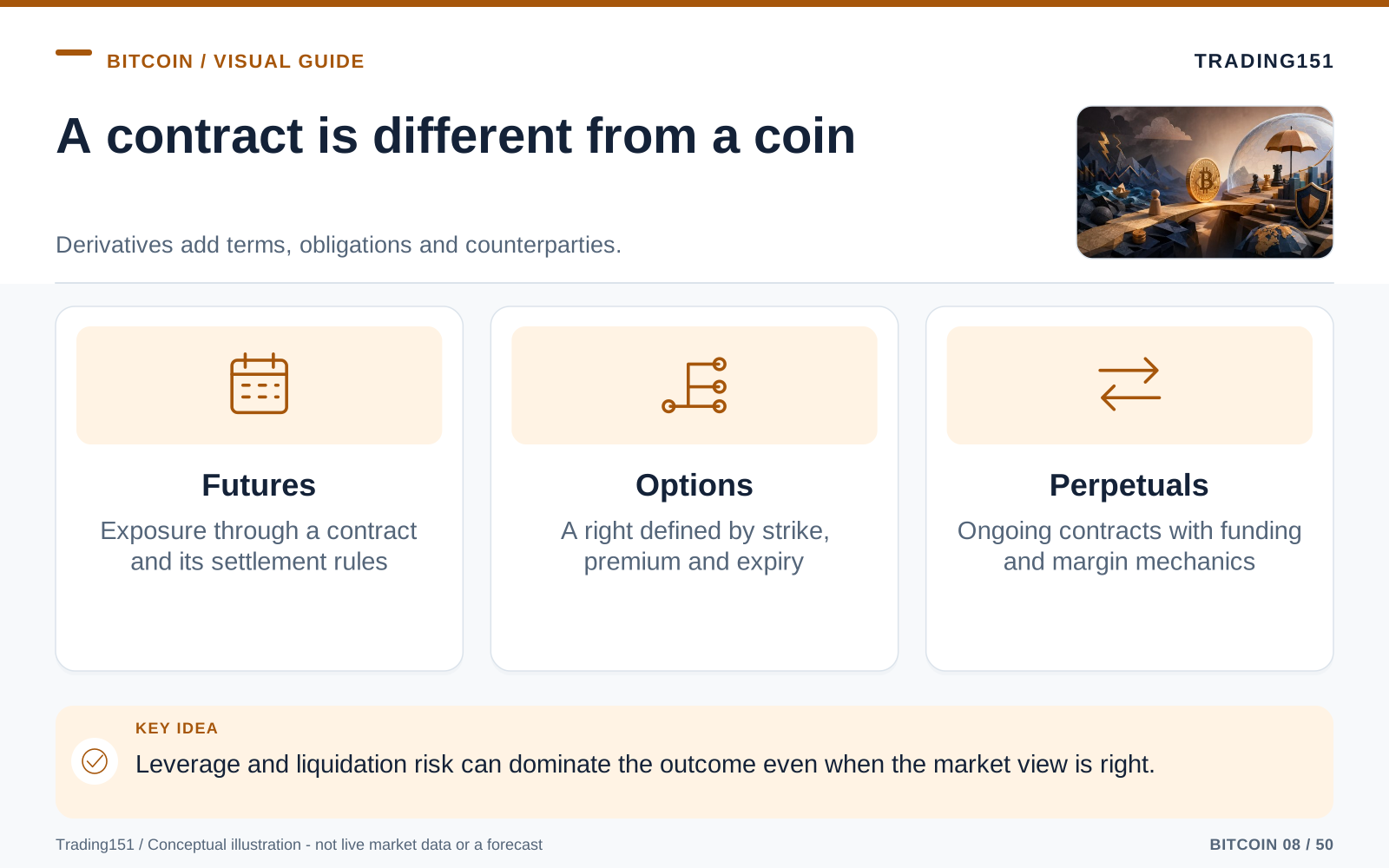
Read this diagram as text
- Futures
- Exposure through a contract and its settlement rules
- Options
- A right defined by strike, premium and expiry
- Perpetuals
- Ongoing contracts with funding and margin mechanics
Part 2: Bitcoin Futures — Agreeing on Tomorrow’s Price Today
A futures contract is exactly what it sounds like: an agreement to buy or sell something at a specific price on a specific date in the future. The price is locked in today, but the actual transaction happens later. Futures are great because they allow two people to swap risks perfectly. A miner might sell futures to lock in their revenue and pay their electricity bills, while an investor buys them to get exposure to Bitcoin without dealing with wallets. The risk doesn't disappear; it just changes hands. Sure, speculators step in to provide liquidity and take the other side of the trade, but the very tool that keeps a business stable can also multiply a day trader's losses. Calling futures "dangerous" kind of misses the point—it really just depends on how you use them and how much cash you have backing your play.
Let’s look at a practical example. Say Bitcoin is sitting at $60,000 in September. A mining company expects to dig up a bunch of Bitcoin over the next few months, but they have real-world bills to pay: electricity, rent, payroll, hardware maintenance. The miners are terrified that by December, Bitcoin might tank to $45,000, which wouldn't cover their operating costs.
To sleep better at night, the miner sells Bitcoin futures. In normal terms, they are locking in a guaranteed selling price for the future. If December rolls around and Bitcoin has crashed, their futures contract makes money, offsetting the fact that their mined coins are now worth less. It might not be a flawless hedge, but it gives the business a predictable budget.
On the flip side of that trade is someone who thinks Bitcoin is going to the moon. They’re thrilled to take the miner’s deal because they expect the price in December to be way higher than the contract price. The miner gets protection; the trader gets an opportunity. The futures market simply matches them up.
That’s the easiest way to look at futures: they take risk away from someone who doesn’t want it, and hand it to someone who does.
Longs and Shorts
In the futures world, going long means you want the price to go up. Going short means you’re betting the price will fall.
If you buy a Bitcoin futures contract at $60,000 and the price climbs to $70,000 by settlement day, you made money. If it dumps to $50,000, you lost money. If you sold (shorted) that exact same contract, the math flips.
The beauty of futures is that they let you play both sides of the field. When most people start in crypto, they only know one direction: buy and pray it goes up. Futures open up a second lane. If you think the market is getting too hot, overpriced, or due for a nasty correction, you can put your money where your mouth is.
Cash-Settled vs. Physically Delivered Futures
Not every Bitcoin futures contract wraps up the same way.
With cash-settled futures, nobody is handing over any Bitcoin when the contract ends. The exchange just looks at the difference between your contract price and the final market price, and then shifts cash from the loser’s account to the winner’s account. It’s purely about the price action, not the actual coins.
With physically delivered futures, real Bitcoin moves. The buyer gets Bitcoin deposited, and the seller has to hand it over based on the agreed terms.
Wall Street loves cash settlement because it’s a lot less of a headache. Huge institutions don't want to mess around with seed phrases, hardware wallets, and blockchain confirmations just to bet on a price. Physically delivered contracts are for the purists—the folks who want to hold the asset when the dust settles.
Basis, Contango, and Backwardation
Sometimes you’ll notice that futures contracts are trading at a slightly different price than standard spot Bitcoin. That gap is known as the basis.
When futures are more expensive than the current spot price, the market is in contango. This usually happens when traders are feeling super bullish and demand for long leverage is sharply higher. On the flip side, if futures are trading cheaper than spot, you’re in backwardation. This is usually a giant red flag that the market is stressed, fearful, or desperately loading up on downside protection.
These terms definitely sound like jargon designed to confuse you, but they really just describe whether the futures market is leaning overly optimistic or pessimistic compared to today's price. Savvy traders constantly watch the basis because it’s a great mood ring for the market. A large premium means people are greedy and over-leveraged; a deep discount means everyone is panicking.
Part 3: Bitcoin Options — Paying for Flexibility
While futures are a firm commitment—once you’re in, you’re in, unless you close the trade—options play by a different set of rules. They give you the right, but not the obligation, to make a move.
Read that twice, because it’s important. As an option buyer, you have a choice. If the market goes your way, you exercise the option and take your profits. If the market goes against you, you just walk away. The catch? To get that kind of flexibility, you have to pay a non-refundable upfront fee called a premium.
Let’s use a real-estate analogy. Imagine you want to buy a house for $500,000, but you need a month to get your mortgage approved. You give the seller $5,000 to hold the house for you. If you get the loan, great—you buy the house at the agreed price. If you find out the foundation is sinking and change your mind, you can just walk away. You lose your $5,000 deposit, but you avoid buying a money pit.
Bitcoin options work exactly like that.
- Call options give you the right to buy Bitcoin at a set price. You buy a call when you think the price is going to shoot up.
- Put options give you the right to sell Bitcoin at a set price. You buy a put when you want protection against a crash, or if you want to bet against the market.
The price you agree on is the strike price. The day the contract ends is the expiration date. And the fee you pay to play the game is the premium.
A Simple Call Option Example
Let’s say Bitcoin is at $60,000. You buy a call option that lets you buy Bitcoin at $65,000 one month from now, and you pay a premium for that privilege.
If Bitcoin suddenly rockets to $80,000, you look like a genius. Your option is hugely valuable because you get to buy in way below market value. But if Bitcoin just hovers around $60,000, your option expires worthless. You lose your premium, but as a buyer, that’s the absolute worst-case scenario.
This built-in safety net is why a lot of smart traders love options. You know exactly what your maximum loss is before you even enter the trade. The downside is that options can be pricey, a bit confusing, and if you start using crazy, complex strategies, they can blow up in your face.
A Simple Put Option Example
Now, let’s say you already own a good chunk of Bitcoin. You don’t want to sell it, but you have a bad feeling about the next few weeks. You can buy a put option. If Bitcoin crashes below your strike price, the put option spikes in value, cushioning the blow to your portfolio. If Bitcoin pumps instead, your main stash gains value, and the option just expires.
In this way, puts act just like car insurance. You pay for it hoping you never have to use it, but when a wreck happens, you’re glad you have it.
Buying Options vs. Selling Options
Everything we just talked about applies to buying options. Selling them (often called writing options) is a completely different beast.
When you buy an option, your risk is capped at whatever you paid for the premium. But when you sell an option, you are the one collecting that premium—and taking on the risk. If you sell a call option and Bitcoin goes completely parabolic, you are still on the hook to deliver at the agreed-upon lower price. Your losses can be theoretically unlimited.
Selling options is how the market makers and heavy hitters generate steady income. They collect premiums from smaller traders and rely on the fact that most options expire totally worthless. It’s a profitable strategy right up until a large, unexpected market swing clears them out.
Part 4: Perpetual Swaps — The Crypto-Native Power Tool
If futures were borrowed from traditional Wall Street and options evolved from centuries of financial history, perpetual swaps are 100% crypto-native. Around here, everyone just calls them perps.
A perpetual swap behaves almost exactly like a futures contract, but with one large twist: it never expires. There’s no settlement date on the calendar. You can keep your trade open for as long as you want, provided you have enough cash (margin) in your account to keep it alive.
That single design tweak is why perps took over the crypto world. Normal futures expire every month or quarter, which means if you want to keep your bet going, you have to awkwardly close out your old contract and buy into a new one. Perps completely eliminate that headache. You open a trade, manage your risk, and hold it for ten minutes, ten days, or ten months. It’s totally up to you.
But that creates a weird problem. If a contract never expires, what forces its price to stay tethered to the actual, real-world price of Bitcoin?
The answer is the funding rate.
How Funding Rates Keep Perps in Check
The funding rate is basically a small fee constantly traded between the buyers (longs) and sellers (shorts). The exchange isn't pocketing this money—the traders are paying each other.
- When the perp price is higher than spot Bitcoin, the funding rate turns positive. Longs have to pay shorts. This makes holding a long position annoying and expensive, while rewarding people for going short.
- When the perp price dips below spot Bitcoin, funding turns negative. Shorts have to pay longs. Suddenly, it’s expensive to bet against the market, and attractive to go long.
Think of it like a thermostat. When the market gets overly euphoric in one direction, the funding rate makes staying on that side of the trade increasingly uncomfortable. It naturally pushes the perp price back in line with the spot price.
Funding is also an incredible cheat code for reading market sentiment. If funding stays sky-high for days, it usually means everyone is heavily leveraged and betting on the price going up. If it turns deeply negative, everyone is terrified. It won't tell you the future, but it definitely tells you how the crowd is positioned.
Why Perps Dominate Crypto
Perpetual swaps became the undisputed king of crypto trading because they’re fast, deeply flexible, and conceptually pretty simple. You can go long, you can go short, you can crank up your leverage, and you never have to stress about expiration dates. For day traders, it’s a dream setup.
It also perfectly matches the chaotic, 24/7 pulse of crypto. There’s no closing bell, no weekends off, and no market holidays. A trading vehicle with no expiry and constant real-time pricing just makes sense in a market that never sleeps.
But here’s the catch: because perps are so buttery smooth to use, they make it dangerously easy to overtrade. The line between a calculated hedge and a pure, degenerate gamble gets very blurry very fast.
Part 5: Margin, Leverage, and Liquidations
All of these tools get infinitely more dangerous the second you introduce leverage. Leverage basically speeds up the clock—it shortens the gap between a normal market dip and you losing everything. A 10% swing in Bitcoin is just another Tuesday, but if you’re using 10x leverage, that same swing will vaporize your account before your trade even has time to play out. The exchange’s liquidation engine doesn't care that you think it’s "just a dip" and the price will bounce back. It simply sells your collateral based on cold, hard math.
Leverage allows you to control a stack of money much bigger than what you own. If you have $1,000 and use 10x leverage, you’re suddenly swinging around a $10,000 position. If the price moves 5% in your favor, you earn a large profit compared to your initial cash. But if it moves 5% against you? You’re in deep trouble.
Leverage isn’t free money. It’s borrowed risk. The exchange lets you take these large positions only because they know they can ruthlessly close you out the second your losses eat through your initial deposit.
That forced closure is what we call a liquidation.
A liquidation triggers when your account no longer has enough cash to safely back up your trade. The exchange's algorithm steps in, closes your position, and takes your collateral to cover the loss. In a slow market, it’s a harsh but necessary safety net. During a flash crash, it feels like getting shoved out of a speeding car.
Why Small Moves Create Big Disasters
Let’s say you open a 10x long position. If Bitcoin goes up 10%, you double your money. Amazing. But if Bitcoin drops 10%, your collateral is wiped out. If you step it up to 20x or 50x leverage, your margin for error practically ceases to exist.
Bitcoin doesn’t even need to crash for high-leverage traders to lose their shirts. A totally normal, everyday price swing can do the trick.
This is why veterans treat leverage like a loaded weapon. They might use it, but they respect the hell out of it. Amateurs always look at a trade and ask, "How much money can I make?" Pros look at a trade and ask, "How fast can this blow up in my face?"
The Liquidation Cascade
Getting liquidated sucks for one trader. But when thousands of traders get liquidated at the same time, it moves the entire market.
Imagine thousands of people are heavily leveraged, betting Bitcoin will go up. Suddenly, a piece of bad news drops, and the price dips. The guys with the highest leverage get liquidated first. To close their trades, the exchange is forced to aggressively sell their Bitcoin into the market. All that automated selling pushes the price even lower.
That lower price triggers the next batch of liquidations. And then the next. And then the next.
This violent chain reaction is a liquidation cascade. It’s the main reason Bitcoin occasionally flashes down 20% in an hour for seemingly no reason. The first tiny drop might have been a news headline, but the large sharp sell-off that followed was just the mechanical plumbing of leverage violently unwinding.
In crypto slang, this is called getting rekt. It sounds funny on Twitter, but there's nothing funny about watching leverage turn a small mistake into a zero balance.
Part 6: What Derivatives Tell Us About the Bitcoin Market
Even if you never plan to touch a leveraged trade in your life, you should still pay attention to derivatives data. It’s a cheat sheet for the market. It shows you what traders are expecting, where danger is quietly building up, and whether a price move is backed by real money or just inflated by reckless leverage. It won’t tell you the future, but it will show you where the pressure is.
Open Interest
Open interest is simply the total number of open contracts right now. If open interest is climbing, new money and new bets are entering the market. If it’s falling, people are closing their trades and cashing out.
On its own, open interest isn't bullish or bearish; it just tells you how crowded the casino is. If Bitcoin's price is climbing while open interest is also climbing, it means fresh capital is driving the rally. If Bitcoin is climbing but open interest is falling, it might just be short-sellers scrambling to buy back their losing bets. And if open interest gets dangerously high, buckle up—the market is probably about to violently correct in one direction or the other.
Funding Rates
As we covered earlier, funding rates show who is paying who in the perpetual swap market. Extremely positive funding means the long side is overcrowded. Extremely negative funding means the short side is overcrowded.
Traders love using extreme funding rates as a contrarian signal. If everybody and their mother is paying a premium to bet on Bitcoin going up, it’s usually a pretty good time to expect a drop. It’s not a magic crystal ball—markets can stay irrational longer than you expect—but when funding gets heavily skewed, it’s a sign that the boat is tipping too far to one side.
Options Implied Volatility
The options market gives away its secrets through something called implied volatility. Essentially, this is the market’s best guess at how crazy Bitcoin’s price is going to get over a certain timeframe. When traders expect large turbulence, options get expensive. When they expect boring, sideways action, options get cheap.
High implied volatility doesn’t automatically mean a crash or a rally is coming. It just means traders are paying a premium because they know something big is about to happen.
Think of these indicators like a weather app. A barometer doesn't cause a thunderstorm, but it definitely lets you know when the atmospheric pressure is dropping.
Part 7: Why the Market Needs Derivatives
It’s really easy to look at crypto derivatives and dismiss them as degenerate gambling layered on top of an already chaotic asset. And a lot of the time, that criticism is totally valid. There are absolutely products designed purely for casino-style dopamine hits rather than responsible investing.
But derivatives also serve a large, completely legitimate economic purpose. Without them, Bitcoin would be a clunky, illiquid, and difficult market for serious players to navigate.
1. Real-world hedging: Bitcoin miners, crypto lenders, and payment companies all have to deal with large price swings. Derivatives let them stabilize their businesses and lock in profits without having to constantly sell off their actual Bitcoin.
2. Better liquidity: A healthy derivatives market brings in large players. More money means tighter spreads, deeper order books, and smoother trading for everybody else.
3. Lightning-fast price discovery: Futures, options, and perps process new information fast. They let traders instantly express their views on price, timing, and risk, which keeps the broader market efficient.
4. The Wall Street bridge: Multi-billion-dollar institutions can’t just log onto a shady offshore exchange, buy Bitcoin, and stick it on a Trezor in a desk drawer. They have strict compliance, custody rules, and risk management limits. Regulated derivatives give them a familiar, legally safe way to invest.
5. Moving risk around: Markets thrive when risk can be passed from someone who can’t handle it to someone who can. A mining company wants boring stability; a day trader wants high-risk exposure. Derivatives allow them to swap those exact needs.
Part 8: The Real Risks People Underestimate
Obviously, the biggest risk in trading Bitcoin derivatives is that the price goes the wrong way and you lose money. But the most dangerous traps are the ones you don't see coming.
Leverage risk: High leverage shrinks the breathing room between a minor dip and a total liquidation. You don’t even have to be wrong about the long-term trend; you just have to be wrong for five minutes to lose everything.
Exchange risk: If you trade on a centralized exchange, you are entirely at the mercy of their servers, their matching engine, and their solvency. Making a million-dollar trade doesn't matter if the exchange goes bankrupt or freezes withdrawals when you try to cash out.
Liquidity risk: In a fast-moving market, the price you see on the screen isn’t always the price you get. "Slippage" can instantly turn a small, planned loss into an absolute massacre.
Funding risk: You could be totally right about Bitcoin going up, but if you’re holding a perp position for months and the funding rate is fighting you the whole time, the fees alone will bleed your account dry.
Emotional risk: Derivatives move at lightspeed. Making money too fast turns you into an arrogant, careless trader. Losing money too fast makes you desperate and prone to revenge-trading. Neither is a good state of mind for making financial decisions.
The market doesn’t care if you didn't fully understand the fine print. It just coldly enforces the math.
Part 9: Centralized, Regulated, and DeFi Derivatives
Not all derivatives are traded in the same sandbox. Where you trade is almost as important as what you trade.
Centralized crypto exchanges (CEXs) usually have the deepest liquidity, the best user interfaces, and the easiest access to perps. The downside? You don't hold the keys to your coins. You have to blindly trust the exchange not to run away with your collateral.
Regulated venues (like the CME) are built for institutions and pros who need strict legal frameworks. The leverage is lower and the rules are tighter, but it’s the safest environment for traditional finance.
DeFi derivatives try to bring futures and options on-chain using smart contracts. The large upside is transparency and self-custody—you keep your own keys. The downside? You’re exposed to smart-contract hacks, oracle glitches, thinner liquidity, and user interfaces that feel like you need an engineering degree to understand.
Part 10: A Beginner’s Safety Checklist
For 99% of people, the best move isn't to trade derivatives—it's simply to understand them so you know why the market is moving. But if you do decide to dip your toes in, follow a few basic ground rules so you don't instantly incinerate your portfolio.
- Know what you're buying. A futures contract, a put option, and a perpetual swap are totally different animals. Don’t trade them if you don't know the mechanics.
- Start with zero or ultra-low leverage. Your only goal on day one is survival. Maximizing your first win doesn't matter if your second trade wipes you out.
- Do the liquidation math beforehand. Know exactly what price triggers a liquidation, understand your margin requirements, and know how fast you can bail out if things go south.
- Know the difference between hedging and gambling. A proper hedge reduces your overall portfolio risk. Throwing 50x leverage on a random coin just because you’re bored is straight-up gambling.
- Keep an eye on funding rates and open interest. They’ll tell you when the trade you're in is getting dangerously crowded.
- Never trade with rent money. Groceries, savings, emergency funds, and definitely borrowed money have absolutely no business anywhere near a leveraged crypto trade.
- Keep your sizing boring. If your trade is keeping you up at 3 AM staring at a 1-minute chart, your position is way too big. Trade sizes that let you sleep.
Part 11: Where Bitcoin Derivatives Are Heading
The derivatives market has come a long way from the Wild West era of shady offshore exchanges. Everything is moving toward more professional infrastructure: better regulation, safer custody, advanced risk tools, and an all-out war for volume between centralized giants and DeFi upstarts.
As Bitcoin gets further tangled up in traditional Wall Street finance, derivatives are only going to get bigger. Hedge funds will use futures to rapidly adjust their exposure. Financial advisors will use options to protect their clients' portfolios. Miners will hedge their operations, and market makers will keep everything flowing smoothly behind the scenes.
But the crypto-native world won’t stop innovating, either. Perpetual swaps were a large breakthrough simply because they made sense for a 24/7 digital market. We’ll undoubtedly see new, substantially creative products hit the market as on-chain liquidity and smart contracts get better.
The only catch? In finance, innovation and danger usually show up holding hands. The easier it gets to access complex financial tools, the easier it gets for rookies to accidentally blow themselves up.
The margin balance is not the size of the bet
Consider a hypothetical linear futures position with $10,000 of bitcoin exposure and $2,000 posted as margin. A 5% adverse price move produces a $500 trading loss before fees: 5% of the exposure, not 5% of the margin. That is already a quarter of the posted amount. Maintenance requirements can force action before the margin balance is exhausted.
Now change the collateral. If it is itself a volatile crypto asset, the value supporting the position may fall while the trade loses money. The risk is no longer just the movement in one quoted contract. Cross-margin arrangements can connect it with other positions in the account, whereas isolated margin is intended to contain the collateral allocated to a particular position under the venue's rules. Neither label removes the need to read those rules.
A hedge needs matching as well. Holding bitcoin and selling an equivalent futures exposure may reduce directional risk, but it can introduce basis changes, margin calls, and a timing mismatch. The spot holding might remain valuable while the derivatives account needs additional collateral immediately. Economic offset and cash-flow timing are not the same thing.
Write down a plain-language account of the contract before trading: what changes its value, what you owe, when cash can be demanded, and how the position ends. A forecast can be broadly correct and the trade still fail because the account could not survive the path taken to get there.
Expiry changes the trade
A dated futures position has a calendar attached to it. Keeping similar exposure beyond expiry may require closing one contract and opening another. The two prices can differ, and commissions, spreads, and the timing of the roll affect the result. A strategy based only on Bitcoin's spot price therefore may not describe what the futures account experiences.
Perpetual contracts create a different set of questions, including funding payments and the venue's liquidation rules. They should not be treated as ordinary dated futures with the expiry removed. Identify the contract, settlement method, margin currency, and the price used for liquidation before comparing opportunities.
A hedge also needs a size check as prices move. A position that matched the value of a holding at entry may not remain a close match if the contract design, collateral value, or underlying quantity changes. The useful comparison is the combined portfolio after costs, not the derivative's profit considered in isolation. 1, 2
Useful Tools, Expensive Mistakes
Bitcoin futures, options, and perps might look like intimidating Wall Street sorcery from the outside, but they all boil down to one beautifully simple concept: people agreeing today on how to handle the price of something tomorrow.
Futures let you lock in a price for a later date. Options let you buy the flexibility to change your mind. Perpetual swaps give you non-stop exposure without ever worrying about an expiration date. Every one of these tools has a highly specific purpose. And every one of them has sharp edges.
When used responsibly, derivatives are exactly what help the Bitcoin market grow up. They give businesses a way to plan, institutions a way to manage risk, and the broader market a way to express its opinions instantly. When used recklessly, they turn normal volatility into a deadly trap.
Don't look at derivatives as purely evil casino games or as a magical money creation. They are just tools. A master carpenter can build a house with a power saw. A careless amateur is just going to lose some fingers.
Bitcoin is already fast, emotional, and completely unpredictable. Derivatives just bolt a large engine onto that machine. Before you even think about touching the accelerator, make sure you know exactly where the brakes are.
Sources and further reading
Editorial revision: 7 October 2026. Numerical scenarios are hypothetical unless identified as historical. References support the added explanations and selected corrections; rules and product terms should be checked again before acting.