
Trading Bitcoin involves more than forecasting its price. The product, venue, custody arrangement, and funding method all affect the risk. Buying unleveraged bitcoin is different from trading a perpetual contract or a listed fund, even when each position responds to the same underlying market. Start by identifying exactly what the account will hold and what could force the trade to end.
Chapter 1: Trading vs. Investing (Yes, They're Different)
You’ll hear a lot of people say they’re “trading crypto,” when what they really mean is they bought some Bitcoin and are just praying the price goes up. There’s absolutely nothing wrong with that, but you really need to know which game you’re playing.
Investing is all about the long haul. You buy Bitcoin because you believe it’ll be worth a lot more down the road. Investors think in terms of years, not hours. They expect the wild roller coaster rides. They know the price might crash, slowly climb back up, crash again, and then do absolutely nothing for months. They don’t panic over the latest news headlines; their entire strategy is just to hold on through the chaos.
In the crypto world, this stubborn, long-term holding is famously called HODLing. It started as a typo in a forum years ago, but it stuck because it perfectly captures the mindset: hold on for dear life, even when the market looks concerning.
Trading, on the other hand, is a completely different beast. Traders are trying to squeeze profit out of price movements over shorter timeframes. That could mean holding a position for a few weeks, days, hours, or even just minutes. They aren't asking, “Will Bitcoin replace fiat currency in ten years?” Instead, they're asking, “Is there a good setup right now? Where should I buy in? Where do I get out? And what’s my plan if I’m totally wrong?”
That last question is the kicker. A real trader isn’t just hunting for profits. A real trader is managing risk.
When you trade, you can basically bet on two directions:
If you’re just getting your feet wet, keep it simple. Get comfortable with how buying and selling works. Figure out the different order types. Learn how to manage a tiny position before you even let yourself think about shorting, using leverage, or diving into futures—things that sound super exciting but can vaporize your account before you know what hit you.
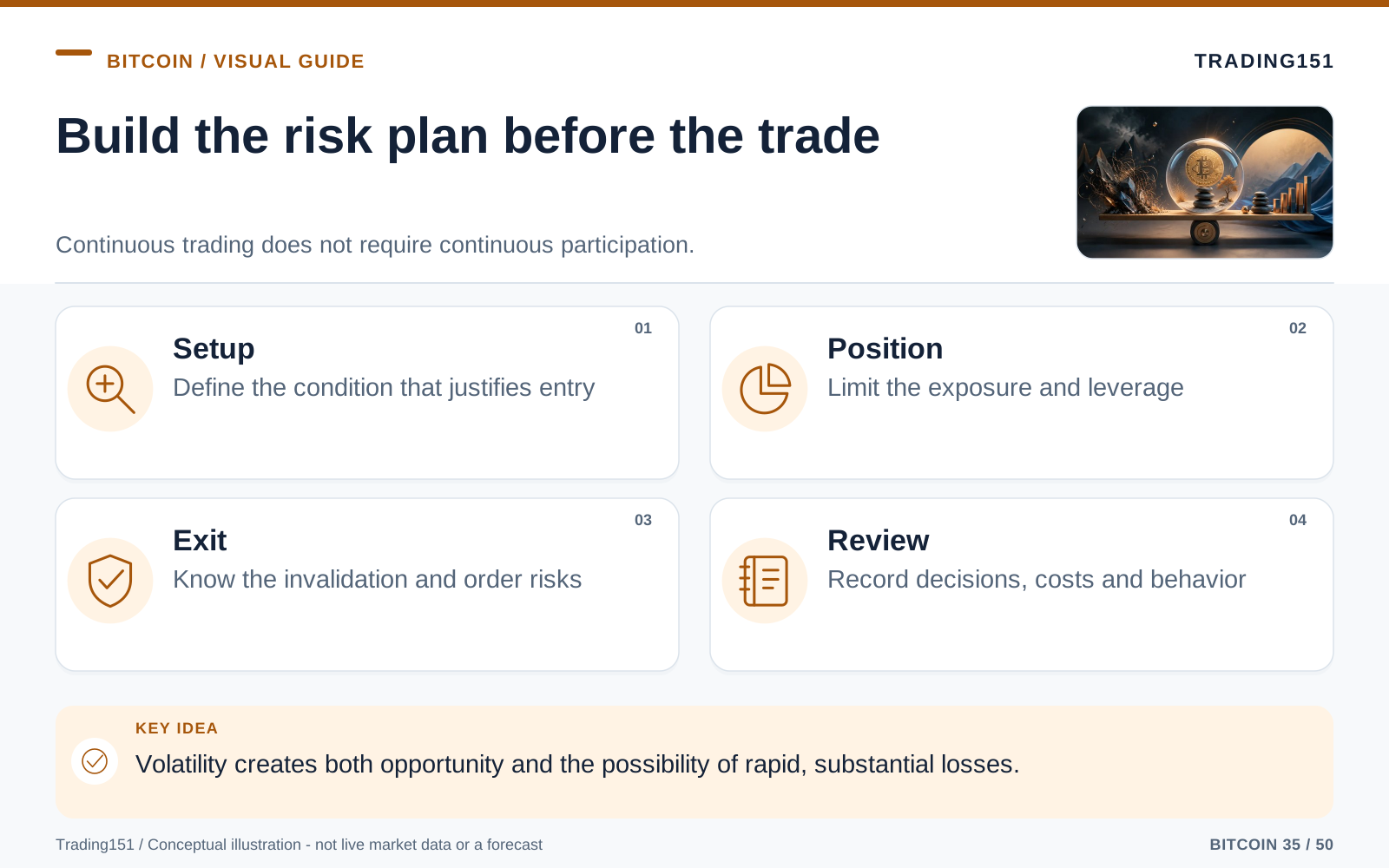
Read this diagram as text
- Setup
- Define the condition that justifies entry
- Position
- Limit the exposure and leverage
- Exit
- Know the invalidation and order risks
- Review
- Record decisions, costs and behavior
Chapter 2: The Mindset That Will Save Your Account
Bitcoin moves so fast it can feel personal. When the price rises sharply and you’re not in on it, it feels like everyone else is getting rich while you’re left in the dust. And when it tanks the second after you finally buy, it feels like the market was just waiting for you to jump in before pulling the rug. But trading is just playing the odds, not an IQ test. Good setups fail all the time, terrible trades occasionally get lucky, and a profitable week can easily mask stupid habits. You’ll learn a lot faster if you separate your decisions from the final results: Did you plan the entry? Did you know your risk? Did you stick to your exit plan? Did the trade size make sense for your account? Thinking this way stops a lucky win from inflating your ego, and keeps a standard loss from feeling like the end of the world. The market doesn't care how certain you felt.
The market doesn't even know you exist. But it sure knows how to push all your emotional buttons.
That’s exactly why your mindset isn’t just some motivational fluff—it’s a core trading skill. Most beginners waste all their energy searching for the perfect chart indicator and spend zero time preparing for the very real stress of risking their own money. The second the market takes a sharp turn, their entire plan flies out the window.
Start with these ground rules:
1. Never trade money you need. Rent, groceries, emergency funds, student loans—none of that belongs in a trading account. If losing the money would stress you out in real life, you’re trading way too much. Starting small isn’t embarrassing; it’s just plain smart. Treat those early, small losses as your market tuition.
2. Make your decisions before you trade, not while you're panicking. The absolute worst time to figure out your game plan is when the price is nosediving. Before you click buy, you should already know exactly where you’re entering, where you’ll take profit, and at what price you’ll admit defeat and cut your losses. If you can’t explain your trade in one sentence, you don't have a trade—you just have a gut feeling.
3. Accept that small losses are just part of the job. Rookies treat every lost trade like a personal tragedy. Pros just see them as the cost of doing business. The goal isn’t to win every time—that’s impossible. The real goal is to keep your losses so small that one bad call doesn’t wipe out the profits from ten good ones.
4. Don’t mistake adrenaline for an opportunity. A substantially jumping chart makes every price look super important. Twitter and YouTube only make it worse, with influencers constantly screaming that the “biggest move ever” is happening right now. Honestly? The best trades usually feel pretty boring. They happen because you waited for a setup you understand, not because you were terrified of missing out.
5. Protect your screen time. Bitcoin never sleeps, but you have to. Staring at charts 24/7 will just make you crazy and lead to terrible decisions. You’ll start seeing patterns that aren't there, or you'll enter trades just because you're bored. Pick specific times to look at the market, and when there's nothing to do, just walk away.
Chapter 3: Setting Up Shop
To trade Bitcoin, you’re going to need an exchange. This is basically the digital marketplace where buyers and sellers get together to do business.
If you're a beginner, the best exchange isn’t the one with the most flashing lights and complicated features. It’s the one you can easily understand, secure tightly, and use without accidentally hitting the wrong button.
Choosing an Exchange
When you're picking a platform, keep an eye out for a few practical things:
Big names like Coinbase, Kraken, and Binance are usually pretty safe bets for beginners.
Locking Down Your Account
Once you've picked an exchange, your immediate next step is security.
Use a substantially complicated password that you don't use anywhere else. Turn on two-factor authentication using an app like Google Authenticator—do not just use SMS text messages, as those can be easily hacked.
Setting up security might feel like a chore when you're itching to buy your first fraction of a Bitcoin, but you want your security to be so boring that it quietly prevents disasters without you even noticing.
Funding Your Account
Now that your account is locked down like Fort Knox, you can fund it via bank transfer, credit card, or whatever method they support. Start way smaller than your ego wants you to. Your first trades are just practice runs to learn how orders, spreads, and your own emotions work. You really don't need a large stack of cash to learn those lessons.
A great trick is to mentally (or physically) separate your funds into two buckets: your long-term investments and your active trading stash. Mixing them up is a recipe for disaster. You'll end up panic-selling your long-term holdings, or stubbornly holding onto a terrible day-trade because you suddenly decided you're a “long-term investor.”
Chapter 4: Wallets, Exchanges, and Who Holds Your Coins
You’ll probably hear the phrase “not your keys, not your coins” a lot in the crypto space. It sounds a bit dramatic, but it’s a crucial concept. When your Bitcoin is sitting on an exchange, they hold the private keys. You just have a balance on a screen; the exchange has custody of the money.
That doesn't mean you should run away from exchanges entirely. They’re super convenient for active trading. But you do need to understand the difference between leaving your coins on a platform versus holding them in your own personal wallet.
If you’re just casually trading small amounts, leaving it on a trusted exchange is fine. But if you start building a serious, long-term stash, you really need to learn self-custody. Just take it slow. Sending crypto to the wrong address or losing your backup phrase is permanent. Always do a tiny test transfer before moving the big bucks.
Chapter 5: Order Types You Need to Know
Before you buy anything, you need to understand how you're buying it. The interface might look simple, but hitting the wrong type of order can ruin your day. Order labels aren't just suggestions. A market order prioritizes speed, meaning if the market is thin, you might get a terrible price. A limit order guarantees your price, but it might never actually fill. Stop orders can trigger at way worse prices if the market is crashing. Look at the spread and the volume before you click anything. The button is easy to push, but the market behind it is complex.
Market orders are tempting, but do yourself a favor and learn limit orders early on. They force you to think about the price you want, rather than just clicking “buy” because the chart looks exciting. Stop-losses are equally critical. They aren't flawless—especially in a crazy market—but they stop a bad trade from becoming a total catastrophe.
A solid trading plan sounds like this: “I’ll buy if Bitcoin drops to this level. If it falls past this lower line, I'll cut my losses and get out. If it bounces up to here, I'll take my profit.” That is a million times better than, “I dunno, it looks like it's going up.”
Chapter 6: How Do Traders Know When to Buy?
Let's get one thing straight: nobody on earth knows exactly what Bitcoin is going to do next. Anyone promising you a sure thing is either a scammer or delusional. Trading is entirely about probabilities. You gather clues, build a logical case, define how much you're willing to risk, and accept that the market might still prove you wrong.
Most traders rely on two main toolkits: fundamental analysis and technical analysis.
Fundamental Analysis: The Big Picture
Fundamentals are the big, real-world forces driving Bitcoin's value. We’re talking about government regulations, global economics, huge companies buying in, and major shifts in the crypto industry itself.
For instance, if a major country announces they're embracing Bitcoin, buyers usually flood in. If a large exchange collapses or governments announce a crackdown, people panic sell. Bitcoin also has a built-in event called the halving, where the amount of new Bitcoin created is cut in half. Traders watch this closely because a drop in supply often sparks long-term price runs.
Fundamentals explain why the market is moving. But they’re pretty useless for telling you exactly when to buy. Good news often drops after the price has already pumped, and bad news hits after the crash has started. That’s why we need charts.
Technical Analysis: Reading the Chart
Technical analysis is just staring at price action. Instead of asking what Bitcoin should be worth, you look at what buyers and sellers are doing right now. Are buyers always stepping in at $40,000? Is the price constantly failing to break $45,000? Is the momentum dying out?
The standard tool is the candlestick chart. Each “candle” shows the price movement for a specific timeframe (like an hour, a day, or a week).
Two concepts show up on every chart:
A smart beginner might wait for Bitcoin to drop to a known support level, see if buyers show up, and only then make a move. Another might wait for the price to smash through resistance before buying the breakout. Neither way is perfect, but they both do one important thing: they stop you from making random, panicked bets.
Volume: The Secret Sauce
Volume tells you how much money is backing up a move. A large price spike with low volume is sketchy; it doesn't take much to move an empty market. But if Bitcoin breaks through a huge resistance level with large trading volume, it means serious money is involved, and the move is much more likely to last.
Chapter 7: Finding a Trading Style That Doesn't Ruin Your Life
The fastest way to hate trading is to pick a style that totally clashes with your real life. If you have a demanding full-time job and three kids, you shouldn't be trying to furiously day-trade on your lunch break.
Day Trading
Day traders open and close their trades on the same day. They’re hunting for tiny price movements and might make dozens of trades in a few hours.
Swing Trading
Swing traders hang onto their positions for days or weeks, trying to ride a larger trend. They don't obsess over 1-minute charts. They set their plan, place their orders, and go live their lives while the trade plays out.
Position Trading
Position traders hold for months or even years. This is basically a hybrid of trading and investing. You’re looking for large, long-term trends and completely ignoring the daily noise.
Nobody hands out medals for choosing the most exhausting trading style. Pick the one that lets you sleep at night.
Chapter 8: Risk Management (A.K.A. How Not to Go Broke)
Amateurs constantly ask, “How much money can I make on this trade?” Pros ask, “How much money am I going to lose?” Your trade size should be based purely on the amount of risk you can stomach, not the imaginary profits dancing in your head. Figure out where the trade is officially a failure (your stop-loss), and size your bet so that hitting that stop only costs you a tiny, manageable fraction of your total account. Amateurs do the opposite: they throw a large chunk of money into a trade, and then frantically try to find a place to put their stop-loss. Don't do that. No fancy chart pattern can save an account that risks 50% on a single guess. You have to survive to get good at this.
Risk management isn’t sexy. It won't get you likes on Instagram. But it is the literal difference between a trader who makes it and a trader who quietly uninstalls the app in shame after three weeks.
Position Sizing
This just means deciding how much of your overall account to put on the line. A classic golden rule is to risk a maximum of 1% to 2% of your account per trade. If you have $500, risking 1% means you lose a grand total of $5 if you're wrong. Sounds boring? That's exactly the point. Small losses keep you in the game.
Remember, risk and position size aren't the same. You could buy $100 of Bitcoin, but set a tight stop-loss so you only lose $5 if it drops. Your risk is $5, not $100.
Risk-to-Reward Ratio
Before you place the trade, weigh your potential loss against your potential gain. If you’re risking $10 to make $10, that’s a 1:1 ratio. If you risk $10 to make $30, that’s 1:3.
You don't even have to be right half the time if your winning trades are three times bigger than your losing ones. But this only works if you plan your exits.
Stop Moving Your Stop-Loss!
This is the ultimate rookie trap. You enter a trade with a smart stop-loss. The price starts dropping towards it. Panic sets in, and you convince yourself it’s “just a temporary dip,” so you drag the stop-loss lower. Then lower. What started as a perfectly manageable loss is suddenly a devastating disaster—all because you traded discipline for blind hope.
If your original reason for taking the trade is busted, just take the small L and walk away.
Chapter 9: The Boring Stuff: Fees, Spreads, and Taxes
Trading isn't just about calling the market perfectly; the boring logistics will eat your lunch if you aren't careful.
Fees are the tolls you pay the exchange for doing anything. If you're frantically day-trading, those tiny fees will snowball and destroy your profits. A strategy that looks like a winner on paper can easily be a loser once the exchange takes its cut.
The Spread is the gap between the current buy price and sell price. On large coins like Bitcoin, it's usually pennies, but it's still there. If you spam market orders during a chaotic spike, the spread can cost you dearly.
Taxes are the final boss. Depending on where you live, every time you sell or swap crypto, you might owe the tax authorities. Don't wait until tax season to figure this out. Just keep a simple spreadsheet noting what you bought, when, for how much, and your fees. You will thank yourself later.
Chapter 10: The Classic Rookie Mistakes
Every veteran trader has a few war stories. Some lessons you just have to learn the hard way. But you can skip a lot of the pain if you know what the traps look like.
Mistake 1: Buying the Hype
By the time your local barista is giving you Bitcoin tips, the large price surge has probably already happened. FOMO (Fear Of Missing Out) makes people buy without a plan, totally ignore risk, and assume a chart that goes straight up will simply never come down.
If you feel a burning, desperate need to buy right this second, close your laptop. Take a walk. Missing a trade isn't a loss, and the market will always give you another setup.
Mistake 2: Playing with Leverage
Leverage lets you trade with borrowed money, controlling a much larger position than you can afford. Yes, it multiplies your wins, but it viciously multiplies your losses.
For new traders, leverage is just a fast-track to bankruptcy. If you can't make a profit with your own money, borrowing someone else's won't magically make you a better trader.
Mistake 3: Chasing “Pump and Dumps”
Seeing some random coin jump 400% in a day is intoxicating. But by the time you notice it, the insiders who bought it early are already dumping their bags onto you. You become their exit liquidity.
Bitcoin moves plenty fast on its own. You don't need to go gambling on dog-themed tokens to make a profit.
Mistake 4: Overtrading
Clicking buttons doesn't mean you're learning. Sometimes it just means you're making the same stupid mistake twenty times in an afternoon. Overtrading is usually driven by boredom, a desire to “win back” a recent loss, or the false idea that a real trader is always in a trade.
Sitting on your hands is a valid strategy. Sometimes the most profitable move is doing absolutely nothing.
Mistake 5: The Strategy Carousel
You watch one video on moving averages and try it on Monday. You lose, so on Tuesday you switch to the RSI indicator. On Wednesday you're drawing Fibonacci lines, and by Friday you're paying a guy on Telegram for signals.
You will never learn anything this way. Pick one simple, boring strategy. Stick with it long enough to figure out if the strategy is bad, or if you just suck at following it.
Chapter 11: Build a Routine
A routine takes the chaos out of trading. It gives you an actual process to improve, rather than just winging it every time you open a chart.
Here's a straightforward beginner routine:
This review process is everything. You don't need a fancy journaling app. Just take a screenshot, jot down why you took the trade, how you felt, and the result. Over time, you'll see your own flaws. Maybe you take terrible trades when you're tired, or maybe you constantly buy too early. That data is pure gold.
Chapter 12: The Crypto Dictionary
You don't need to be fluent in crypto-slang, but knowing the basics will keep you from feeling completely lost.
Plan the transfer and exit before opening the position
Map the complete route from funding to withdrawal. Check the supported payment method, trading pair, fees, withdrawal network, and any holding period applied to a new deposit. A price opportunity is not useful if the money cannot reach the venue in time or the proceeds cannot be withdrawn under the account's current restrictions.
For derivatives, read the liquidation and funding rules before sizing the trade. A perpetual contract can incur recurring funding payments, and its liquidation process may depend on a reference or mark price rather than the last trade displayed on a chart. A correct broad market view can still lose money if the position cannot survive the route prices take.
Test the operational details with an amount you can afford to lose. Confirm that the selected network and receiving address are compatible, and verify the actual withdrawal charge. Moving native bitcoin is not the same as moving a token that represents bitcoin on another chain. Those distinctions become expensive when discovered after a transfer.
An exit plan should cover more than a price target. Decide what to do if the venue suspends withdrawals, the intended hedge is unavailable, or a trade remains open longer than expected. Keep tax and transaction records as the activity occurs. A trade is not operationally complete merely because the platform shows a profit; the proceeds, obligations, and remaining exposures still need to be understood.
Keep the trade separate from the storage decision
Buying Bitcoin and deciding where to hold it are related but distinct choices. A venue may be convenient for execution without being the preferred long-term custodian. Moving the asset afterward introduces its own fees and operational risks.
Plan the route before placing the trade: how the account is funded, which product is being bought, whether withdrawals are supported, and how the destination wallet will be verified. Confirm whether the purchase creates a claim on a platform, a fund share, or directly withdrawable bitcoin. The same price exposure can sit inside very different legal and operational arrangements, so the ticker or app balance should not be the only thing checked. 1, 2, 3
Survival is the Ultimate Goal
Trading Bitcoin is not a cheat code for free money. It’s a completely real, often severe skill that takes time to learn. You are going to read charts wrong. You’re going to sell too early and buy too late. You will absolutely have moments where you stare at your screen and whisper, “Why did I just do that?”
It happens to everyone. The goal isn't to be a flawless trading god on day one. The goal is simply to keep your inevitable mistakes small enough that you can afford to learn from them.
Start with pocket change. Get comfortable with your exchange. Lock your accounts down with 2FA. Don't confuse investing with day-trading. Look at charts without assuming every little bump is a life-changing event. Keep a journal, respect your stop-loss, and stay a million miles away from leverage. Above all, don't let the screaming, chaotic noise of the internet force you into bad decisions.
Bitcoin isn't going anywhere. The market is open 24/7/365, which means you never, ever have to force a trade just because the screen is glowing. Patience isn't a weakness; it's practically a superpower.
Trade carefully, use your head, and guard your money. The people who last in this game aren't the loudest influencers or the luckiest gamblers. They're just the people who learned how to survive first.
Sources and further reading
- SEC Investor Bulletin: Crypto Asset Custody Basics for Retail Investors
- BIS: April 2025 FX turnover, September 2025 preliminary release
- SEC Investor Bulletin: Exchange-Traded Products Providing Exposure to Bitcoin and Ether
Editorial revision: 7 October 2026. Numerical scenarios are hypothetical unless identified as historical. References support the added explanations and selected corrections; rules and product terms should be checked again before acting.