
HODLing is a decision to hold through market noise rather than trade each move. It can reduce unnecessary activity, but it does not make an investment thesis permanently correct or eliminate the need for liquidity. A durable holding plan includes custody, position size, review conditions, and the possibility that life will change before the market does.
What HODLing Really Means
HODLing isn't just stubbornly refusing to sell. A lot of people freeze up and don't sell simply because they're terrified, confused, or way too emotionally attached to their bags. That’s not a strategy. That’s just paralysis.
True HODLing is intentional. It’s making a conscious choice to hold your Bitcoin over a long time horizon because you believe its future potential easily outweighs whatever crazy price swings happen today. It means looking at a market that can be totally irrational, euphoric, and utterly cruel—sometimes all in the same week—and deciding ahead of time that you aren't going to let every price jump dictate your actions.
A real HODLer isn't trying to perfectly time the bottom, dump at the exact top, or aggressively rotate their portfolio into whatever coin is trending on Twitter. They're making a completely different bet: that patience, deep conviction, and solid security will ultimately beat out frantic, hyperactive trading.
You see the difference when things get real. HODLing isn't laziness, ignorance, or pretending that large volatility doesn't exist. It’s actively building an investment approach that doesn't rely on you making flawless emotional choices while everyone else is panicking.
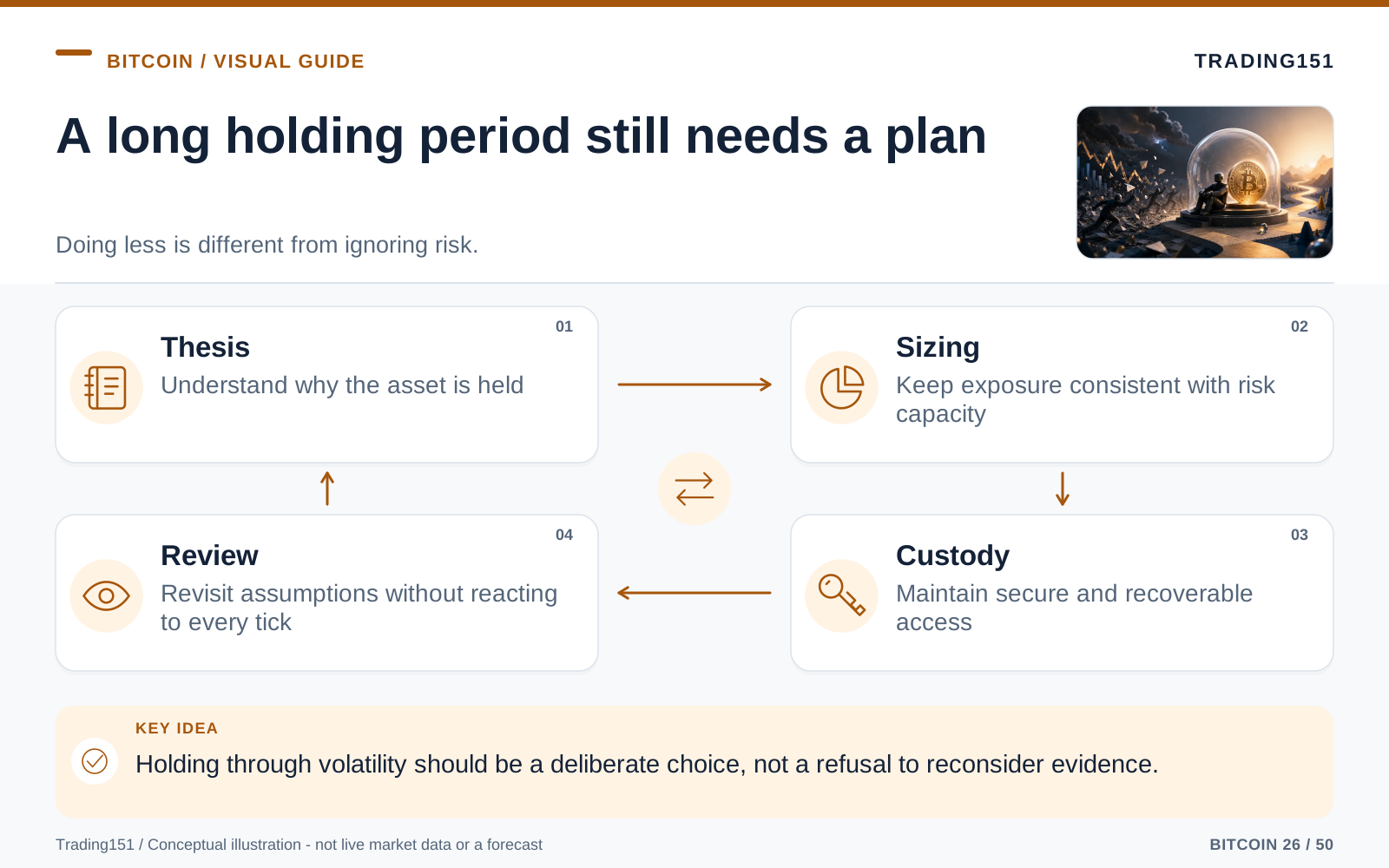
Read this diagram as text
- Thesis
- Understand why the asset is held
- Sizing
- Keep exposure consistent with risk capacity
- Custody
- Maintain secure and recoverable access
- Review
- Revisit assumptions without reacting to every tick
The Problem HODLing Is Trying to Solve
To really get why HODLing caught on, you have to look at what it’s fighting against: the large delusion that average people can successfully trade Bitcoin’s chaotic swings.
Crypto practically begs you to trade it. The market never closes. Prices go crazy at 3 AM. The screens are always flashing red and green. Every time you open social media, someone is bragging about a trade that supposedly changed their life. A coin you never heard of last week just pumped 300%, while another one is bleeding out live. The entire ecosystem is designed to make you feel like you are always just one smart trade away from making it big.
That feeling is dangerous.
Most people are terrible at short-term trading. They buy in because they're terrified of missing the boat, and they sell because they're terrified of losing it all. They get arrogant after one lucky win and dial up their risk, and when they inevitably take a hit, desperation kicks in and they abandon whatever plan they had. Then they have the nerve to call it a "strategy."
Bitcoin makes all of this ten times harder because it is notoriously wild. A price drop that would send traditional stock investors jumping out of windows feels like just another Tuesday in crypto. A large rally can make you feel like a genius millionaire before you've locked in a single dime, and a sudden crash can make your meticulously researched investment thesis feel completely stupid by breakfast.
HODLing takes the single most destructive question out of the equation: What should I do right now?
Instead of agonizing over that every time the chart moves, a HODLer already answered it. If the plan was always to hold for five years, today's scary red candle doesn't require action. It's just a candle.
Why Investors Choose the HODL Strategy
There’s a good reason HODL grew past its meme origins. For a lot of Bitcoin investors, it brings real, practical benefits that are super easy to overlook—until you've learned things the hard way.
1. Time in the Market Can Matter More Than Perfect Timing
Almost everyone dreams of buying the exact bottom and selling the absolute top. Almost nobody pulls it off consistently. Time works in your favor, but only if your underlying bet is solid. Holding onto a scarce, valuable asset through the noise makes sense; holding onto a dead project for five years doesn't magically make you a genius just because time passed. That’s why a real HODL strategy requires you to occasionally step back—without the emotion—and look at the network, your security, regulations, your own life finances, and why you bought in the first place. This shouldn't be a knee-jerk reaction to a bad day in the market. You need to ask yourself if the actual facts have changed, not just the general vibe. Patience is great, but only when you're still paying attention.
Bitcoin's biggest moves usually happen in the blink of an eye. A boring, sideways market can suddenly explode in a matter of days. A large rally can kick off while everyone on Twitter is still deeply depressed. By the time the general public finally feels "safe" enough to buy back in, they've usually missed a huge chunk of the gains.
HODLing means accepting that you aren't going to time these moments perfectly. So, instead of trying to jump in and out, you just stay planted in the asset you believe in. Sure, you'll have to sit through some severe crashes, but you also avoid the absolute classic blunder: panic-selling at a loss, only to watch from the sidelines as the market roars back to life without you.
This doesn't mean holding is a guaranteed win, and it definitely doesn't mean Bitcoin only goes up. It just means you're opting for a long-term position over trying to play fortune teller. The bet isn't "I know exactly what's going to happen next week." The bet is "I think this long-term story is so strong that I refuse to risk trading myself out of my position."
2. It Reduces Emotional Decision-Making
The market has a concerning knack for finding your deepest emotional weakness.
When prices are rising rapidly, it taps straight into your greed. You start running the math on your imaginary profits. You start wondering if you should take out a loan, buy more, risk more. It’s dangerously easy to confuse a rising market with your own personal brilliance.
When prices tank, it finds your fear. You second-guess everything. You actively hunt for bad news to justify the pain you're feeling. You picture the worst-case scenario and convince yourself that hitting the sell button is the only way you'll ever sleep again.
HODLing doesn't magically erase these feelings. But it strips them of their power. Having a crystal-clear plan puts a solid wall between how you feel and what you do. You can be absolutely terrified without selling. You can be bouncing off the walls with excitement without recklessly buying the top. That little bit of breathing room is where the best investment decisions are made.
3. It Keeps the Strategy Understandable
A huge chunk of investing mistakes happen simply because people overcomplicate things. When you're actively trading, you're constantly sweating over moving averages, resistance levels, macroeconomics, sentiment indicators, and breaking news alerts. You have to nail the entry, perfectly time the exit, and know exactly when to cut a loss. Every one of those choices is a trapdoor for a potential mistake.
HODLing rips away all that complexity. It boils your strategy down to three things: buy, secure, and wait. That simplicity isn’t a flaw; it’s the whole point. It means you don’t have to waste your life glued to a monitor just to be part of the Bitcoin ecosystem. You can buy it, lock it down in cold storage, and go live your life. Go outside, hang out with your kids, focus on your actual job. Your investment just sits there doing its thing in the background without screaming for your attention all day.
The Bitcoin Thesis Behind HODLing
Nobody should be HODLing Bitcoin just because a funny internet meme told them to. The people who succeed at this are anchoring their strategy to a very specific, long-term belief.
At its core, Bitcoin is engineered to be scarce. There will only ever be 21 million coins, and the rate that new ones enter the market is baked into the code. There isn’t a central bank, CEO, or political committee on earth that can just wake up and print more Bitcoin because the economy looks shaky or because it’s politically convenient.
That absolute scarcity is the heartbeat of the HODL mindset. Believers view Bitcoin as the ultimate digital asset for a world that is moving completely online. The argument is that money that is decentralized, borderless, and impossible to censor holds immense value exactly because nobody is pulling the strings behind the curtain.
But let's be clear: believing in this doesn’t magically erase the risks. Bitcoin still has to navigate insane volatility, government crackdowns, technical hurdles, people losing their own passwords, market manipulation, and constant competition for the public's attention. This isn't some free ticket to get rich quick. It’s an asset driven by a large, disruptive idea, trading in a market that will absolutely crush you if you're careless.
A smart HODLer sees both sides of the coin. They aren’t holding because they live in a fantasy world where nothing goes wrong. They’re holding because they’ve weighed the real risks and decided that the large potential upside is well worth the unsettling volatility.
Why HODLing Is Simple but Not Easy
The hardest part about HODLing isn’t grasping the concept. Any five-year-old can understand "buy and hold." The difficult part is living with the real-world consequences of that choice once the market decides to test you.
The Pain of Drawdowns
In the stock market, a 20% drop is a full-blown crisis that dominates the evening news. In Bitcoin? A 20% drop is just bad weather—annoying, sure, but nothing to write home about. But a percentage on a chart hits totally differently when it suddenly threatens your rent, your family’s plans, or just your ego because you don't want to look like an idiot to your friends. Deep drawdowns can easily outlast the initial hype that made you buy in the first place.
This is where position sizing makes or breaks you. It’s the difference between a nice theory about patience and being able to pull it off. If your bag is small enough that it doesn't wreck your daily life, it’s a lot easier to ignore the chaos. But if you’ve bet the farm and constantly need the chart to validate you, you're going to break. Holding isn’t some magical personality trait; it usually just comes down to not desperately needing that cash back by a certain date.
Historically, Bitcoin has dragged investors through some savage bear markets, dropping more than 70% from its all-time highs. Reading that statistic in an article is one thing. Watching it happen to your own hard-earned money is a totally different beast.
Picture it: you buy in with real savings, feel like a genius for a few months, and then watch your net worth get sliced in half. And then cut in half again. Your confidence drains out of you. You start second-guessing every choice you ever made. You wonder if all those critics calling it a scam were right. You dread how embarrassing it’s going to be if the price never bounces back.
That is the exact moment HODLing stops being a fun slogan. Holding when your portfolio is glowing green is effortless. Holding when you're deeply underwater, the vibes are horrendous, and the internet is relentlessly mocking you? That’s where you find out what you’re made of.
The Exhaustion of Bad News
Every Bitcoin bear market comes with its own depressing soundtrack: country-wide bans, large lawsuits, exchange hacks, bankruptcies, outright frauds, and loud, confident experts swearing that this time, Bitcoin is dead for good.
Some of it is just desperate clickbait. But some of it is real. A seasoned HODLer has to figure out how to tell the difference.
Just plugging your ears and ignoring every bad headline isn't mental fortitude; it’s just being reckless. On the flip side, panicking over every scary tweet is a fast track to letting the crowd manage your wealth. The real trick is staying informed without letting the news completely hijack your nervous system.
You have to constantly circle back to your core beliefs. Did your long-term thesis break, or is the market just having a panic attack? Is this news about a flaw in Bitcoin, or is it just about greedy companies, over-leveraged idiots, and bad actors blowing themselves up? Are you learning something useful, or are you just doom-scrolling at 2 AM?
Those distinctions matter. HODLing isn't an excuse to stop thinking. It's a refusal to let the crowd’s momentary panic make your choices for you.
The Temptation to Chase Faster Gains
Crashes are severe, but bull markets can be way more toxic.
When Bitcoin starts ripping upward, the rest of the crypto market turns into an absolute circus. Suddenly, every guy you know has a "can't-miss" tip. Tiny, absurdly named coins are putting up 1,000% gains. Screenshots of people making life-changing money overnight are everywhere. People who didn't know what a blockchain was six months ago are suddenly acting like Wall Street veterans.
This is when a lot of dedicated Bitcoin holders lose their minds. Sure, Bitcoin is up nicely, but some random dog coin just did a 50x. That little voice creeps into your head: Maybe I should just move a little bit of my stack over there, just for a quick flip.
And yeah, sometimes people get lucky. But usually, they show up to the party late, end up being someone else's exit liquidity, and accidentally turn their solid, multi-year investment plan into a messy casino bender.
A HODLer has to fight off greed just as aggressively as fear. Fear screams at you to sell when you should be serious out. Greed whispers that you should ditch a strong plan because a new token is pumping harder. Either one will completely wreck you.
The Loneliness of Being Early or Out of Step
There are large stretches of time where HODLing is just painfully boring, lonely, and frankly, a bit embarrassing. The market goes flat. The public stops caring. Your friends stop asking how your crypto is doing. The news cycle completely moves on. Your investment just sits there, looking like a dud, while everyone else is getting rich off some new tech stock or real estate trend.
That boredom is part of the test.
Most people desperately want their investments to feel "active." They want momentum, validation, excitement, and the feeling that they are actively outsmarting the world. HODLing demands the exact opposite. It asks you to sit in total silence. It requires you to stick to your guns even when absolutely nobody is cheering you on.
That quiet, unglamorous patience is way harder than anyone gives it credit for.
The HODL Playbook: How to Do It Responsibly
HODLing really only works when you have a system. If your master plan is simply, "I really hope I don't panic-sell," you don't have a plan. You have a wish.
Here’s a realistic playbook to approach the HODL strategy with way more discipline and a lot less unnecessary drama.
Rule 1: Decide Why You Are Buying Before You Buy
Before you throw a single dollar at Bitcoin, write down exactly why you want it.
And I don't mean some lazy excuse like "I want the number to go up." Give yourself a real reason. Maybe you believe it’s the ultimate long-term store of value. Maybe you just want a piece of a truly scarce digital network. Maybe you see it as an insurance policy against a fragile banking system. Or maybe you just want a tiny, high-risk moonshot in a mostly boring portfolio.
The specific reason doesn't matter nearly as much as the clarity. If you can't clearly articulate why you bought it, you're not going to know if that reason still holds true when the price dumps 40%. You’ll just be making impulsive choices based on fear, greed, or whatever the internet is reporting on that morning.
A written thesis gives you an anchor when the emotional waves get huge.
Rule 2: Use Dollar-Cost Averaging to Remove the Drama
Trying to perfectly snipe the absolute bottom of a dip sounds thrilling, but it's mostly just a great way to drive yourself insane.
Dollar-cost averaging (DCA) is a way calmer alternative. You just pick a set amount of money and blindly buy Bitcoin on a strict schedule—like every Friday, or the first of every month—totally ignoring whatever the price is doing.
When the market is pumping, your cash just buys a little less Bitcoin. When the market is in the gutter, that same cash scoops up a lot more. Over the long run, this completely smooths out the mental torture of trying to time the market. You never have to agonize over whether today is the "right" time to jump in. If it’s your designated DCA day, you buy. If it’s not, you don't.
It transforms investing from a stressful, high-stakes casino game into a deeply boring, automated habit. And if you want to survive as a HODLer, boring is exactly what you want.
Rule 3: Take Self-Custody Seriously
There’s a mantra in the Bitcoin world you’ve probably heard: "Not your keys, not your coins."
If you buy Bitcoin and just leave it sitting on an exchange, you don't own Bitcoin. You own a digital IOU from a corporation. If that exchange goes belly up, gets hacked, or gets shut down by regulators, your entire HODL journey ends right there—no matter how strong your diamond hands are. The spectacular implosions of platforms like FTX, Celsius, and Mt. Gox violently proved this point.
True HODLing means taking possession of your own wealth. Usually, that means shifting your Bitcoin offline into a hardware wallet—a physical device that locks down the cryptographic keys protecting your funds.
Self-custody completely eliminates the risk of some reckless CEO gambling away your money. But the trade-off is large personal responsibility. If you lose your keys, screw up your backup, or get scammed, there is absolutely no customer support hotline to bail you out.
Rule 4: Stop Checking the Price
If your actual plan is to sit on this asset for the next five or ten years, intensely staring at the price chart every two hours is practically self-sabotage.
Obsessively checking the price creates this fake, adrenaline-fueled sense of urgency. It makes completely normal daily volatility feel like a breaking news emergency. It tricks your brain into believing that just because the ticker is moving, you urgently need to do something.
A lot of the most successful HODLers go as far as deleting crypto ticker apps off their phones entirely. They only look at the market when they’re making a scheduled buy. It takes some serious willpower to break the habit, but detoxing from the charts is hands-down the best way to protect your sanity. If your core belief in the asset hasn't changed, a random red candle on a Tuesday doesn't deserve your attention. You are entirely allowed to just close the app and walk away.
Rule 5: Protect Your Recovery Phrase Like It Is the Asset
People obsess over elite hackers stealing their crypto, but they often ignore a far more common tragedy: accidentally locking themselves out of their own money.
Your recovery phrase (or seed phrase) is not a "Forgot Password" hint. It is absolutely not something you take a quick photo of, email to yourself, toss in an iCloud note, or casually type into a website. That phrase is the literal master key to your wealth. Anyone who finds it can drain your wallet instantly. And if you lose it while your physical wallet breaks? Your coins are likely gone forever.
Write it down offline. Keep it safe and durable. You need to think about fires, floods, sketchy roommates, and your own terrible memory. Once your stack gets big enough to matter, you have to start thinking about backup plans and how your family would access it if something happened to you.
Bragging about holding for ten years sounds noble. Losing your seed phrase in year two isn't noble. It’s just a gut-wrenching tragedy.
Rule 6: Define What Would Make You Sell
There’s a weird subculture that talks about HODLing as if hitting the sell button is some kind of moral failure. That is a deeply toxic way to view your finances.
Money is simply a tool, and Bitcoin is an asset. The whole point of investing isn't to take a digital high score to your grave just to prove you have discipline. The goal is to improve your life, secure your family's future, and hit real-world milestones.
Before the next large, blinding bull market takes off, sit down and figure out exactly what would justify cashing some out. Maybe it's completely paying off your house. Maybe it's seed money for a business, covering your kid's tuition, or ensuring you can comfortably retire. Or maybe your Bitcoin stack just grew so large that it's irresponsibly unbalanced compared to the rest of your life, and you need to lock in some security.
Having an exit strategy doesn't mean you have "weak hands." It just means you’re deciding how your story ends before pure greed decides for you.
Rule 7: Size the Position So You Can Sleep
There is absolutely no one-size-fits-all rule for how much Bitcoin you should own. What’s totally reasonable for your buddy might be financially suicidal for you.
The perfect portfolio size is the exact amount you can hold through a severe market crash without turning into an anxious nightmare to be around. If seeing your portfolio drop by 50% would ruin your life, you own too much. If a standard crypto crash makes it impossible for you to sleep, focus at work, or talk to your spouse without snapping, you are massively over-invested.
HODLing entirely relies on emotional endurance. Keeping your position size reasonable is how you purchase that endurance ahead of time.
Common Mistakes That Break HODLers
Even the most die-hard Bitcoin believers manage to completely sabotage themselves. The core strategy couldn't be simpler, but there are landmines everywhere.
Mistake 1: Confusing HODLing With Never Reassessing
Strong conviction is a superpower. Blind stubbornness is just a great way to go broke. Reevaluating your investment doesn’t mean you have to try and predict the next big price movement. It’s often as boring as verifying that your hardware wallet still works, making sure your family knows how to access the funds if you vanish, or realizing your crypto is now 90% of your net worth and maybe you should chill out. Skimming some profits to balance your life isn't a betrayal of the cause, and holding onto a sinking ship doesn't make you a hero. Real discipline means following an actual financial plan instead of using a Twitter meme as your wealth manager.
A smart HODLer doesn't pivot their entire worldview every week, but they absolutely refuse to stay ignorant. If new, undeniable facts come to light that completely wreck your original thesis, you have to be willing to adapt. The goal isn’t to stick your head in the sand and ignore evidence; the goal is to stop letting temporary noise manipulate you.
Try setting a schedule to check in with yourself. Look at your thesis once or twice a year instead of every time a green candle flashes. That gives you the breathing room to be rational without treating every news cycle like an existential threat.
Mistake 2: Taking on Leverage
Trading with leverage is easily the fastest way to turn a confident, long-term believer into a totally wrecked, forced seller.
Borrowing money to buy crypto completely warps the emotional and financial reality of your position. You could be 100% correct about where Bitcoin will be in five years, but a random Tuesday flash crash will still completely wipe you out today. Bitcoin is notoriously volatile enough to obliterate anyone who gets cocky and assumes they can safely margin trade just because their macro thesis is solid.
HODLing and leverage are fundamentally incompatible. One is built entirely around infinite patience; the other creates stressful deadlines, liquidation targets, and intense pressure. For 99% of people, mixing the two is absolute financial poison.
Mistake 3: Bragging Too Much
Flexing your crypto bags in public just invites chaos into your life that you really don't need.
For starters, it puts a large target on your back for scammers and hackers. But mentally, it also traps you. When you brag online, your ego gets deeply attached to being the smartest guy in the room. If life happens and you need to quietly sell some off, or if you decide to change your strategy, it suddenly feels humiliating because you're worried about looking like a hypocrite.
Being a silent millionaire is underrated. You do not need to prove your diamond hands to a bunch of anonymous strangers on the internet.
Mistake 4: Ignoring the Rest of Your Financial Life
Bitcoin is a rush, and it can easily make traditional personal finance feel notably boring. But those boring basics will save your life.
Crushing high-interest credit card debt still matters. Having an emergency cash fund still matters. Diversifying, paying your taxes, getting insurance, and growing your career income—all of that still matters. Bitcoin might end up being the rocket ship of your financial future, but it’s absolutely not an excuse to let the rest of your life fall apart.
The absolute most strong HODLers usually aren't the ones screaming the loudest online. They are the ones with stable, well-managed financial lives. Because they aren't drowning in debt or living paycheck to paycheck, they're never forced to panic-sell their crypto just to keep the lights on.
The Mental Side of HODLing
Eventually, every HODLer has to look uncertainty in the eye and make peace with it.
You are never going to know exactly what’s going to happen next. You will definitely not perfectly snipe the bottom, and you will miss the exact top. You will constantly look back at your chart and see a dozen things you wish you had done differently. That is just part of the game.
The goal isn't to craft a flawless strategy, because that doesn't exist. The real goal is to build a plan sturdy enough to protect you from your own self-destructive instincts.
That’s exactly why veterans rely on strict routines. They heavily restrict how often they look at the price. They completely ban themselves from trading when they're angry, sad, or euphoric. They meticulously document their trades, lock down their security, and stay aware of the news without drowning in it. And they make sure to talk to critical thinkers who will challenge their ideas, rather than just circling up with moon-boys who feed them endless hype.
Above all, they realize that patience isn't just sitting there doing nothing. Patience is an active, deliberate choice that you have to make quietly, over and over again, usually when absolutely nobody is watching.
Is HODLing Right for Everyone?
Honestly? No.
HODLing Bitcoin isn't some ultimate test of your character, and it’s certainly not a mandatory requirement for being smart with your money. Frankly, some people should not touch Bitcoin at all. Some should just keep a tiny, speculative bag. Plenty of people are far better off focusing on index funds, cash-flowing real estate, building a business, or just getting a basic savings account going before throwing money into one of the most volatile assets on earth.
Bitcoin can build incredible wealth, but it takes no prisoners. It demands that you tolerate large ambiguity, handle technical headaches, shrug off relentless public skepticism, and stomach violent price drops. If dealing with that would damage your life or your mental health, the smartest, most responsible move is to either walk away or keep your exposure small.
The HODL strategy really only works for people who have put in the hours to understand what they're buying, respect the risks, use money they don't need to touch for a decade, and have the patience to measure their progress in years, not hours.
Holding patiently still requires an exit plan
Imagine a person who intends to hold bitcoin for ten years but has no separate reserve for an unexpected bill. A market decline and a household emergency can force a sale at the same time. The problem is not a failure of conviction; it is a mismatch between the holding plan and the need for accessible money.
Distinguish a review from a price prediction. A scheduled review can check custody, concentration, tax records, and whether the original reason for owning the asset still makes sense. It need not ask whether next month's price will be higher. This gives patience an operating structure rather than turning it into refusal to examine new evidence.
Plan for a large gain as well as a large loss. A small speculative allocation can become a dominant holding without another purchase. Decide in advance how you would assess that concentration, taking account of taxes and the rest of the portfolio. Selling some exposure is not automatically a rejection of the technology.
An exit plan can also concern inheritance or incapacity rather than market timing. Someone else may need to locate the records and follow the recovery instructions. Holding for years increases the importance of those arrangements. Patience is most useful when it is supported by practical resilience, not when every foreseeable difficulty is answered with an instruction never to sell.
Decide how the holding fits a withdrawal
A long-term investor eventually needs a plan for using the money. That could mean selling gradually, funding a specific purchase, or leaving the asset to someone else. The intended use affects custody, tax records, and the tolerance for a large decline near the withdrawal date.
'Holding forever' may express conviction, but it does not answer a practical cash-flow question. Write down the circumstances under which some exposure would be reduced, including changes in household needs or excessive concentration. A sale does not have to imply a verdict on Bitcoin's entire future. It can simply reflect that the money now has a different job and that the original level of risk no longer fits it. 1, 2
The Philosophy Behind the Meme
The funniest thing about HODL is that it started as a drunken internet typo and somehow morphed into a legitimately profound financial strategy.
Right beneath that spelling mistake is a deeply honest admission of human limitation. GameKyuubi’s legendary forum post didn't come from a place of slick Wall Street sophistication. It was sloppy, emotional, and raw. He was essentially just screaming: I know I’m not the genius trader I wish I was, so I’m just going to stop pretending.
There is a shocking amount of humility in that. And if there’s one thing that is almost extinct in financial markets, it’s humility.
HODLing is the realization that you don’t need to win every short-term skirmish to ride a large long-term wave. You don’t have to out-trade hedge funds, perfectly forecast interest rates, read complex technical whitepapers, perfectly time the halving cycles, or quit your day job to stare at charts. And you definitely don’t have to YOLO your entire net worth into one volatile coin to make it.
At its absolute best, HODLing is a highly disciplined reaction to an entirely undisciplined market. It’s a conscious choice to stop letting random price fluctuations boss you around. It’s the profound realization that sometimes, sitting on your hands and doing absolutely nothing requires infinitely more strength than frantically clicking buttons.
You are going to have days where Bitcoin craters and you feel like the biggest idiot on earth. You’re going to have days where it pumps 15% and you feel like a financial god. Do yourself a favor and try not to buy into either of those feelings. They’re both fleeting.
If you are going to take the HODL path, do it with your eyes wide open. Buy within your means. Take your security seriously. Know exactly why you’re stubbornly holding on, and know exactly what it would take for you to finally sell. Give yourself the financial breathing room to afford to be patient. And then, step back and let time do the heavy lifting that frantic, stressed-out trading almost never can.
So the next time the market is drowning in red, the news headlines feel apocalyptic, and everyone on the internet is screaming at you to do something... Just think back to that messy, whiskey-fueled typo that accidentally started a revolution.
Take a deep breath. Close the laptop. And HODL.
Sources and further reading
- SEC Investor Bulletin: Crypto Asset Custody Basics for Retail Investors
- Investor.gov: Asset Allocation
Editorial revision: 7 October 2026. Numerical scenarios are hypothetical unless identified as historical. References support the added explanations and selected corrections; rules and product terms should be checked again before acting.