
Bitcoin, Ethereum, and other crypto networks differ in what they are designed to do, how they agree on transactions, and what users must trust. Their tokens differ as investments too. A network can attract activity without creating a sound investment case for every asset associated with it. Understanding the connection between usage and the token is an important part of comparing them.
Before We Compare Them, What Is Crypto Really Trying to Do?
At its core, cryptocurrency is just trying to move value around the internet without relying entirely on banks, credit card networks, or governments. Instead of a single company keeping track of who owns what, a blockchain spreads that record across a huge network of computers. Everyone can see the history, code enforces the rules, and no single person has the power to suddenly rewrite the ledger. But under that umbrella, you'll find projects with substantially different goals. Bitcoin asks if digital money can work without a central bank. Ethereum asks if a shared network can run open apps. Stablecoins usually lean on traditional banking assets, while other tokens might just exist to fund speculation rather than act like money at all. Comparing them purely by their market cap is like trying to compare a payment network, an operating system, and a casino chip just because they all have a price tag.
It might sound a bit abstract, but it's a huge idea. For the first time, you could have digital cash that isn’t just an entry in some bank’s database. You own it. You can send it across the globe in minutes. You can verify the total supply yourself. And you can plug into a financial system that never sleeps or closes for holidays.
Naturally, the dream doesn't always match reality. Crypto can be clunky to use. Fees can be absurdly high. Wallets are often confusing, and prices swing like crazy. Some projects are brilliant, while others are just clever marketing disguised as a token. That’s exactly why we need to separate these major categories rather than lumping all cryptocurrencies into one big, confusing pile.
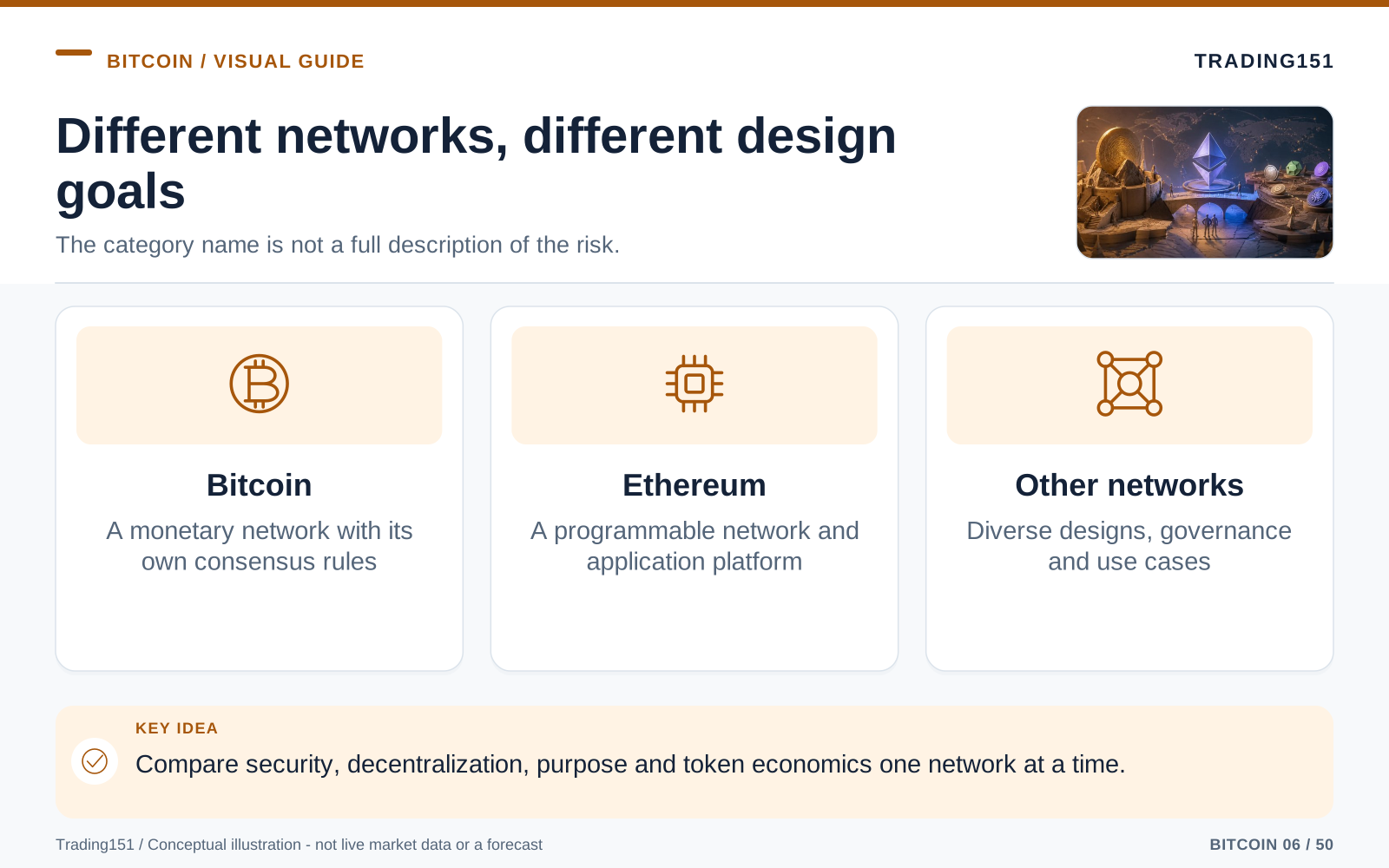
Read this diagram as text
- Bitcoin
- A monetary network with its own consensus rules
- Ethereum
- A programmable network and application platform
- Other networks
- Diverse designs, governance and use cases
1. Bitcoin (BTC): The Original Digital Asset
Bitcoin is the one name practically everyone knows. It was the first, carries the most cultural clout, and still dictates the mood of the entire market. When Bitcoin rallies, optimism spreads. When it tanks, the rest of the crypto world usually feels the pain.
The Origin Story
Bitcoin popped up in 2008, right when the traditional financial system was imploding and trust in banks was hitting rock bottom. An anonymous person (or group) named Satoshi Nakamoto published a paper proposing a new kind of electronic money—one you could send directly to someone else without needing a bank to process the transaction.
The big breakthrough wasn't just that it was digital. We already had digital money—PayPal, bank apps, and so on. The real genius was solving a large technical headache: how do you stop someone from spending the same digital coin twice without a central boss checking the math?
Bitcoin’s answer was the blockchain. Every transaction gets recorded publicly, double-checked by a network of users, and locked down by a system called "proof of work." Instead of trusting a bank, you trust the network's rules and the math keeping it all secure.
What Bitcoin Is For
Early on, plenty of people thought Bitcoin would become everyday internet cash. You've probably heard the legendary story of the guy who spent 10,000 BTC on two pizzas—a story we now look back on with a mix of awe and pain given what those coins are worth today.
But over time, Bitcoin’s main identity shifted. Sure, it’s still used for payments, especially across borders or in places where banking is a luxury. But for most investors, its real job is acting as a store of value. It's scarce, easy to move around, and entirely independent of any single government.
That scarcity is the whole point. There will only ever be 21 million Bitcoins. That hard cap doesn't automatically make it valuable, but it does make it fundamentally different from traditional currencies that governments can print endlessly. Fans see this fixed supply as a shield against inflation and political meddling. Skeptics, on the other hand, argue that scarcity alone doesn't mean much, especially when the price can still fluctuate substantially.
Why People Trust It
Bitcoin’s superpower isn't speed or flexibility—it's trust through sheer simplicity. It doesn’t try to be everything to everyone. It moves slowly and rarely changes. That might annoy people who want constant updates and flashy features, but it’s a large part of its appeal. Bitcoin’s entire reputation is built on being hard to change, censor, or fake.
It’s also gotten much easier for regular investors to get involved. With spot Bitcoin exchange-traded funds (ETFs) and similar products hitting the market, Bitcoin has wormed its way into normal brokerage accounts and retirement portfolios. That doesn't erase the risks, but it proves Bitcoin has officially graduated from being just a weird internet experiment.
The Trade-Off
Bitcoin’s biggest selling point is also its main target for criticism. The "proof of work" system requires large amounts of computing power, which means it burns a lot of energy. Defenders argue that this energy secures a global financial network and point out that miners are increasingly using renewable or leftover power. Critics just see a large waste of electricity, especially when you compare it to newer blockchains.
Bitcoin is also limited on purpose. While developers are finding ways to build around it, the base layer isn't designed to run complex applications like Ethereum is. Think of Bitcoin more like an secure vault, not a booming app store.
Pros of Bitcoin:
- Strong recognition: It's the biggest name in the room and the easiest for people to grasp.
- Scarce supply: That 21 million hard cap is a large part of why people value it.
- Decentralized security: It has the longest track record of staying secure without a central boss.
- Growing adoption: It’s increasingly accepted by traditional finance and big institutions.
Cons of Bitcoin:
- High volatility: Even as the market leader, its price can swing dramatically.
- Energy consumption: The mining process is famously energy-intensive.
- Limited flexibility: It's just not built to handle complex smart contracts or apps out of the box.
- Slow network: Base-layer transactions can be sluggish and pricey during busy times.
2. Ethereum (ETH): The Programmable Blockchain
If Bitcoin is digital gold, Ethereum is a global computer. It launched in 2015 with a completely different philosophy. Instead of just creating a ledger for money, Ethereum’s founders wanted a network that could run actual code.
The Origin Story
Vitalik Buterin, one of Ethereum’s co-founders, realized that blockchain tech could do so much more than just track coins. He proposed a platform where developers could write "smart contracts"—little pieces of code that automatically execute when certain conditions are met, no middleman required.
This simple tweak changed everything. Suddenly, you didn’t need to build a whole new blockchain to launch a project. You could just build an app on top of Ethereum.
What Ethereum Is For
Ethereum is the backbone for most of the stuff you hear about in crypto today beyond basic trading. Decentralized finance (DeFi), NFTs, Web3 games, and decentralized autonomous organizations (DAOs)—the vast majority of this ecosystem was born on Ethereum.
When you buy ETH, you aren't just buying digital money. You're buying the fuel needed to use the network. Every time you move a token, interact with a smart contract, or buy an NFT, you have to pay a "gas fee" in ETH. If Ethereum’s network gets busier and more valuable, the demand for ETH usually goes up.
The Trade-Off
Ethereum’s biggest problem has always been its own popularity. When the network gets crowded, it slows down, and gas fees can skyrocket to absurd levels. There have been times when paying a simple $50 transaction cost over $100 in fees.
To fix this, Ethereum went through a large upgrade to change how it secures the network (moving from proof of work to proof of stake, drastically cutting energy use). It’s also leaning heavily on "layer two" networks—side roads built on top of Ethereum to handle transactions faster and cheaper while still using the main network for security. But this makes the whole experience significantly more complicated for average users, who now have to figure out how to move funds across different layers just to do basic stuff.
Pros of Ethereum:
- Large developer base: It has more builders, apps, and value locked up than any competing platform.
- Programmability: Smart contracts make Ethereum versatile.
- Deflationary mechanics: Network upgrades mean ETH can sometimes be destroyed faster than it’s created, reducing supply.
- Energy efficient: Moving to proof of stake cut its energy consumption by over 99%.
Cons of Ethereum:
- High fees: During peak times, the main network can be expensive to use.
- Complexity: Using layer twos adds friction and confusion for regular users.
- Stiff competition: Faster, cheaper networks are constantly trying to steal its thunder.
- Regulatory uncertainty: Because of how it operates and handles staking, regulators are keeping a very close eye on it.
3. Altcoins: The Experimental Edge of Crypto
"Altcoin" just means "alternative coin." Technically, anything that isn’t Bitcoin is an altcoin, though many people now view Ethereum in its own separate category.
The altcoin market is large, chaotic, and unpredictable. Some of these projects are serious efforts to solve major problems. Some are half-baked science experiments. And others only exist because a catchy ticker symbol and an aggressive community can pump a price for a few weeks.
The best way to make sense of altcoins is to look at what they’re trying to achieve.
A. The Ethereum Challengers
Some altcoins want to be the next big smart contract platform. Their sales pitch is usually pretty straightforward: Ethereum is great, but it’s slow and expensive, so come build on us instead.
- Solana (SOL): Built for blistering speed and tiny fees. It’s a favorite for traders, NFTs, and consumer apps. The catch? It has a history of network outages and critics argue it sacrifices decentralization for speed.
- Cardano (ADA): Takes a slow, academic, heavily-researched approach. Fans love its steady pace; critics think it moves way too slowly compared to its rivals.
- Avalanche (AVAX): Focuses on speed and the ability to spin up customizable, specialized blockchains.
- Near Protocol (NEAR): Aims to make crypto extremely user-friendly and scalable for developers.
These platforms are in a severe knife-fight for the same things: developers, users, money, and hype.
B. Utility Tokens and Infrastructure Projects
Some altcoins aren't trying to replace money or beat Ethereum. They just exist to help run a specific service.
- Chainlink (LINK): Blockchains are practically blind—they can’t naturally see real-world info like stock prices or weather data. Chainlink brings that outside data onto the blockchain so smart contracts can use it.
- Filecoin (FIL): Think of this as decentralized cloud storage. It lets people rent out their unused hard drive space directly to others via a crypto network.
- The Graph (GRT): This helps organize the large amounts of data on blockchains, acting like a search engine so apps can find what they need instantly.
- Render (RNDR): Need heavy graphics processing? Render lets you tap into a global network of idle GPUs to power rendering jobs.
These projects are much easier to understand when you think of them as infrastructure. They aren't trying to be the entire city; they just want to be the roads, the power lines, or the data feeds that the rest of the crypto world relies on.
C. Stablecoins
Stablecoins absolutely deserve a shoutout because they're arguably the most used assets in crypto, even though nobody buys them hoping to get rich.
A stablecoin is just a digital token pegged to the value of something stable—usually the U.S. dollar. People use them to trade without constantly cashing out to a bank account, to send money globally in seconds, or to play around in DeFi. It's about having a digital dollar that natively understands crypto rails.
But "stable" doesn't mean bulletproof. Stablecoins rely on the company backing them holding enough cash reserves. If that backing turns out to be sketchy, or if the market panics, a stablecoin can lose its peg to the dollar. The big ones are generally treated as essential pillars of the crypto economy, but they still demand your attention and due diligence.
D. Governance Tokens
Some tokens give you voting rights on how a crypto project operates, basically acting like shareholder votes. In theory, this lets the actual community decide on software upgrades, fee structures, and treasury budgets.
In reality, governance is messy. Whales (people with huge amounts of tokens) easily dominate the votes, everyday users usually ignore the polls entirely, and half the time the decisions are way too technical for a casual holder to understand. Still, it's a fascinating experiment in digital democracy and proves crypto is about more than just swapping money.
E. Meme Coins
Meme coins are the most absurd part of the crypto universe, yet strangely, they are also the most honest. They usually start as inside jokes, viral internet trends, or cute dog pictures with absolutely zero technological ambition. Dogecoin and Shiba Inu are the heavyweights, but every new market cycle vomits up thousands of fresh meme coins.
It’s very easy to dismiss them as garbage, and nine times out of ten, you’d be right. Most have zero actual use. Their price completely relies on hype, celebrity tweets, and the fragile hope that a greater fool will buy your bag at a higher price.
But meme coins do prove one crucial thing: community matters. People don't always invest strictly by the numbers. Sometimes they throw money at something just because it's hilarious, they want to feel part of a tribe, or they see a crowd forming and want in. It leads to lottery-ticket gains, but also spectacular, severe crashes.
Pros of Altcoins:
- High growth potential: A tiny project with a low market cap can multiply its value much faster than a giant like Bitcoin.
- Innovation: This is where the bleeding edge of gaming, decentralized finance, and scaling tech is happening.
- Specialized use cases: Many tokens are laser-focused on solving one specific problem instead of trying to boil the ocean.
- Community energy: A rabid fanbase can keep a project alive and push it into the mainstream.
Cons of Altcoins:
- Extreme risk: The vast majority of altcoins will eventually trend to zero and stay there forever.
- Scams and rug pulls: The total lack of oversight makes it terrifyingly easy for scammers to steal your money.
- Low liquidity: If the market tanks, you might find it impossible to sell your obscure tokens.
- Unclear value: Just because a project has cool tech doesn’t mean the token attached to it will ever go up in price.
Bitcoin vs. Ethereum vs. Altcoins: The Simple Comparison
The best way to keep these straight is to just ask what job they're trying to do.
Bitcoin is the money. Its entire narrative is built on scarcity, decentralization, and acting as a long-term digital vault. People buy it because they want money that no central bank can inflate or control.
Ethereum is the platform. Its narrative is all about programmability. People buy ETH because they believe the future of finance, apps, and digital ownership will run on decentralized networks.
Altcoins are the high-risk innovation lab. The story totally depends on the coin. Some want to dethrone Ethereum. Some want to provide background infrastructure. Some are just dog pictures. You have to judge each one on its own merits.
Which One Is Right for You?
There is no perfect answer here. What you buy completely depends on how much risk you can stomach, how long you plan to hold, and how much time you want to spend staring at charts. A busy person who just wants long-term exposure shouldn’t be buying the same wacky micro-cap tokens as someone who practically lives on crypto Twitter.
If you want the most battle-tested asset: Bitcoin is the logical starting point. It’s got the clearest narrative, the longest track record, and everyone knows its name. It’s definitely still risky, but in the crypto world, it’s basically the blue-chip stock.
If you believe blockchain apps are the future: Ethereum is probably more up your alley. When you hold ETH, you're betting on a sprawling, living ecosystem of developers, second-layer networks, and decentralized finance. You're betting on internet infrastructure, not just a digital gold bar.
If you’re swinging for the fences: Altcoins are where the crazy money gets made. But that sword cuts both ways. A great altcoin can make you rich, but a bad one will evaporate your money faster than you can blink. You need to do serious research and keep your ego in check.
If you can’t handle large drops: crypto might not be for you—at least not a large chunk of your portfolio. Even Bitcoin and Ethereum regularly experience severe crashes. Altcoins fall even harder. It’s easy to feel brave during a bull market, but it’s a whole different story when your portfolio drops 60% and all the crypto influencers suddenly stop posting.
How to Think About a Crypto Portfolio
A smart crypto portfolio starts with a deeply unsexy question: how much money are you entirely okay with losing? It sounds dramatic, but it’s the only way to survive. Crypto violently punishes overconfidence.
Most seasoned investors use a "core and satellite" strategy. Your "core" is made up of the heavyweights (Bitcoin and Ethereum) that you plan to hold long-term. Your "satellites" are much smaller bets on high-risk, high-reward altcoins.
A simple breakdown might look something like this:
- Core holdings: The heavy hitters like Bitcoin and Ethereum. Yes, they’re still volatile, but they have deep liquidity, global recognition, and have survived multiple market cycles.
- Selective altcoins: These are promising projects that have real usage, strong developer teams, and a reason to exist beyond just pure hype.
- Speculative bets: This is your play money. Think tiny early-stage projects, weird niche narratives, or meme coins. Treat this money as if you've already lost it at a casino.
There's no magic ratio here. Some people want 90% Bitcoin. Others heavily prefer Ethereum. Some refuse to touch meme coins with a ten-foot pole. The only thing that matters is having a solid plan before the market goes crazy and emotions take over.
How to Research a Coin Without Getting Fooled
Crypto massively rewards curious people, but it ruthlessly punishes lazy ones. Before you throw money at a new altcoin, you need to ask a few blunt questions. Look at the boring stuff: how are new tokens released, who holds the treasury wallets, has the code been audited, and what rights does holding the token give you? Dive into the criticism before you join the project's echo chamber, and figure out if the "active users" are real people or just bots farming incentives. A cool product doesn't mean it's a good investment, and clever tech doesn't guarantee the token will go up. Your goal isn't to prove a coin is going to the moon; it's to find the red flags that prove it belongs in the trash.
- What problem does it solve? If their explanation is just a word salad of buzzwords like "synergistic AI blockchain," run away.
- Who is using it? Real developers, actual transactions, and live integrations matter infinitely more than Twitter hype.
- What does the token do? A brilliant project can still have a totally useless token that captures zero value.
- Who controls the supply? Watch out for large insider wallets, aggressive token unlocks, or a tiny group of people who can dump their bags and tank the price.
- Is the code audited? An audit doesn't mean it's 100% safe, but launching without one is a large red flag.
- Where is the yield coming from? If a project promises you magical 50% returns, you are the product. They are paying you with risks you don't understand yet.
- Can you sell it? Making a 10x return on paper means nothing if there isn't enough liquidity to cash out.
You don't need to be paranoid, you just need to slow down. The worst decisions in crypto always happen when you feel rushed, terrified of missing out, or high on the hype.
Common Mistakes New Crypto Investors Make
The number one mistake is buying something simply because the green candle is going up. A rising chart makes every project look like a genius investment. It doesn't mean it has lasting value.
The second mistake is confusing a great story with a smart investment. Crypto is stuffed with incredible narratives: "banking the unbanked," "owning your data," "rebuilding Wall Street," "the metaverse," "AI on the blockchain." Some of these might happen, but a good story still needs flawless execution.
The third mistake is taking security lightly. In crypto, you are your own bank. That sounds empowering right up until the moment you lose your seed phrase, click a phishing link, sign a bad smart contract, or leave all your money on a shady exchange that suddenly freezes withdrawals. Good security habits are mandatory, not optional.
The fourth mistake is going all in. Markets move in large, severe cycles. Hype explodes, completely vanishes, and then returns a few years later wearing a new mask. Keeping some cash on the sidelines, taking profits when you're up, and avoiding leverage might sound boring, but it's usually what keeps you alive long enough to catch the next wave.
Security Basics Everyone Should Know
You don't need to be a hacker to survive in crypto, but you do need to respect the environment. A few basic habits will save you from 99% of beginner disasters.
- Use strong, unique passwords: Stop reusing your Netflix password for your crypto exchange.
- Turn on two-factor authentication (2FA): Use an authenticator app, not SMS (which is easy for hackers to hijack).
- Guard your seed phrase: Write it down on physical paper and lock it up. Do not save it in your Apple Notes, email, cloud drive, or take a screenshot of it.
- Beware of fake links: Scammers are good at cloning exchange sites, wallet apps, and Twitter support accounts.
- Always send a test transaction: Before you send a large chunk of money, send $5 first to make absolutely sure it arrives in the right place.
- Think before you connect: Don't randomly connect your wallet to sketchy websites just because they promise a free airdrop.
In the normal banking world, a mistake can often be reversed by calling customer service. In crypto, mistakes are permanent. That’s the price of total financial freedom.
The Future: Competition or Coexistence?
People love tribalism. They want crypto to be a winner-take-all deathmatch. Bitcoin maximalists will scream that everything else is a scam. Ethereum fans will insist that programmable money is all that matters. And altcoin communities will aggressively shill their network as the ultimate Ethereum killer.
The reality is probably much more boring: they will all coexist. Think about the real world—we have room for physical gold, tech stocks, government bonds, risky startups, banking apps, and large software platforms. Crypto is likely heading the same way. Bitcoin will be the strong monetary vault, Ethereum will be the bustling settlement layer for global finance, and altcoins will fill every weird, specialized, and highly speculative niche in between.
Some of these projects will change the world. Most of them will quietly die. A few will seem obvious when we look back in ten years. But that's exactly how new technology works: it's chaotic, it's messy, it's full of dead ends, and it's completely transformative.
A useful network does not guarantee a valuable token
Imagine a network that doubles its transaction count while cutting the fee paid per transaction by 90%. Activity has grown, but that fact alone says little about the income, scarcity, or demand associated with its token. Some activity may also come from incentives rather than users willing to pay for a service. A busy network and an attractive token valuation are related questions, not interchangeable conclusions.
Ask what holding the token actually provides. It might pay transaction fees, serve as collateral, participate in governance, or be required for a validation role. None of those functions automatically gives the holder a legal claim on a company's profits. The rights must be established from the design and the relevant documents, not inferred from language borrowed from stock investing.
Supply deserves the same attention as demand. Future issuance, unlocks, treasury holdings, and large early allocations can affect an investor's share of the total. A fixed maximum supply says something different from low circulating supply, and a low price per token says little without knowing how many tokens exist.
A useful comparison sheet can fit on one page: purpose, consensus mechanism, token function, supply rules, concentration, and major dependencies. Leave a space for what remains unclear. The exercise is more revealing than ranking coins by recent performance, because it forces the investment argument to survive without a rising chart doing most of the persuading.
A useful network is not automatically a good purchase
The case for a technology and the case for buying its token are separate. Ask how demand for the service translates into demand for the asset, who receives the economic benefit, and what the current price assumes. A network can become more useful while competition, issuance, or an expensive entry price limits the holder's return. Start with that connection rather than ranking projects by enthusiasm alone. 1, 2
Different Networks, Different Jobs
Bitcoin, Ethereum, and altcoins aren't just three different things to gamble your money on. They are three fundamentally different visions for what the future of the internet might look like.
Bitcoin is betting that digital scarcity is the ultimate prize. Ethereum is betting that open, programmable finance is the real revolution. Altcoins are betting that the next large breakthrough hasn't even been fully invented yet.
None of this is guaranteed, and all of it is risky. But once you understand the actual differences, the whole space feels a lot less intimidating. You don’t need to day-trade every token, understand the math behind every protocol, or panic at every news headline. You just need a solid framework, a healthy dose of skepticism, and the patience to learn before you put your hard-earned money on the table.
Crypto is thrilling precisely because it lives right at the intersection of tech, finance, culture, and pure speculation. But that's also what makes it a minefield. Treat it with curiosity, not cult-like faith. Do your own homework. Lock down your security. Ignore anybody promising guaranteed returns. And seriously, never invest money that you can't afford to lose.
The future of crypto is still being written. Bitcoin, Ethereum, and altcoins are all crucial characters in that story, but they are absolutely not the same chapter. Once that clicks, the chaos finally starts to make sense.
Sources and further reading
- Ethereum.org: Energy consumption
- SEC Investor Bulletin: Crypto Asset Custody Basics for Retail Investors
Editorial revision: 7 October 2026. Numerical scenarios are hypothetical unless identified as historical. References support the added explanations and selected corrections; rules and product terms should be checked again before acting.