
A Bitcoin fork is a change or divergence in the rules used to judge the network's history. Some changes tighten existing rules; others make previously incompatible rules possible. Whether a lasting split develops depends on adoption and disagreement, not merely on the word "fork." For holders, the practical questions concern software, custody, and the safety of any action they are asked to take.
What Is a Blockchain Fork?
At its core, Bitcoin is just software. That might sound obvious, but it’s easy to forget when we constantly talk about it as digital gold, a payment network, a political movement, or a groundbreaking financial invention. Under the hood, it’s a computer program following a strict set of rules.
Those rules dictate everything: what counts as a legitimate transaction, how blocks get added, the total supply of coins, how mining difficulty adjusts, and what kind of cryptographic signatures work. Every full node on the network verifies new transactions and blocks against this rulebook. If a block breaks a rule, the node tosses it out.
This shared rulebook is the glue holding Bitcoin together. Thousands of people can run the software independently because they’re all checking against the same standard. You don't have to trust a central server; the rules do the heavy lifting.
A fork kicks in when that shared path suddenly splits.
Think of a blockchain as a large, public ledger that keeps growing block by block. As long as everyone agrees on the rules, they all keep adding to the same shared history. But if a new software version tweaks those rules, the network is forced to answer a tough question: will everyone stay together, or will some people go one way while the rest go another?
It’s kind of like playing a large game of Monopoly. Picture thousands of people playing the same game in different rooms all over the world. It only works because everyone agrees on how the game is played. Now, imagine someone suggests a new rule: passing "GO" should pay out $400 instead of $200.
If every player adopts the new rule, the game just keeps going under the new standard. If everyone rejects it, nothing changes. But if one group loves the idea and another hates it, the game splits in two. Both groups might argue they’re playing the "real" Monopoly, but from that moment on, they’re playing two different games.
That’s essentially what a blockchain fork is—a split in how the rules are enforced. The main issue is whether the new rules can peacefully coexist with the old ones. And that’s exactly what separates a soft fork from a hard fork.
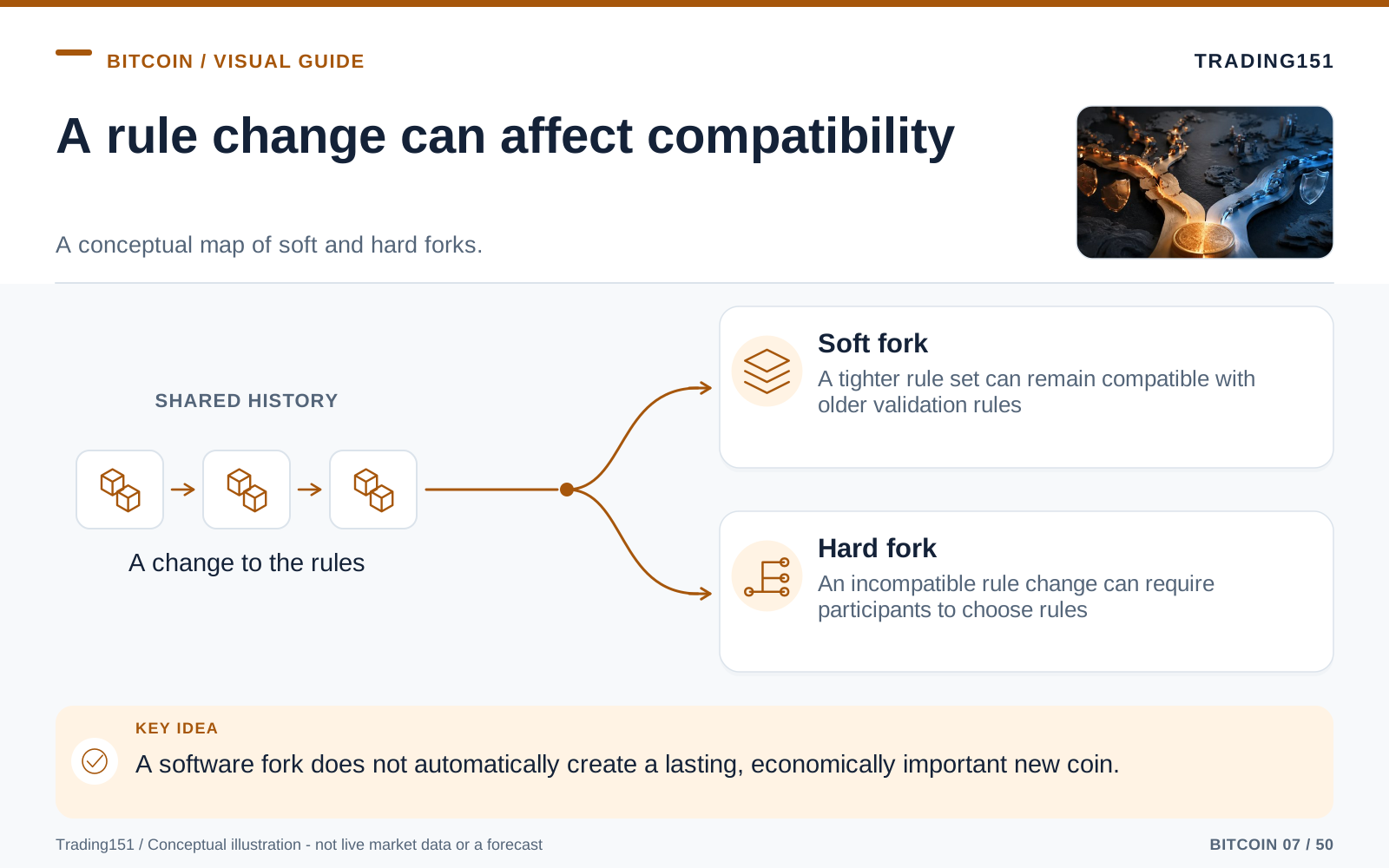
Read this diagram as text
- Soft fork
- A tighter rule set can remain compatible with older validation rules
- Hard fork
- An incompatible rule change can require participants to choose rules
Soft Forks: A Stricter Rulebook That Keeps the Chain Together
A soft fork is a backward-compatible upgrade. In plain English, that means upgraded nodes start following new, stricter rules, but older nodes still recognize the new blocks as valid. This backward compatibility is a neat trick: older nodes keep accepting the new blocks even if they don't fully understand the new restrictions the upgraded nodes are enforcing. It’s a powerful but slightly awkward setup. An old node can stay on the network, but it’s blind to some of the newer policies protecting it. Because of this, rolling out a soft fork isn't just about flawless code. Developers, miners, and businesses have to coordinate carefully to prevent a messy enforcement split. A soft fork only keeps the chain unified if the social transition is handled well.
The operative word here is stricter.
Soft forks rarely expand what’s allowed on the network. Instead, they tighten things up. A soft fork basically says, "Hey, the blocks that used to be valid are still fine, but now they also need to meet this extra condition." Older software might not grasp the new condition, but it won't reject the blocks because they still technically follow the old rules.
Imagine a highway where the speed limit is 60 mph. Everyone knows the rule. Then, the city drops the limit to 50 mph. Drivers who saw the new signs will keep it under 50. Drivers who missed the memo still think it’s 60, but when they see a car doing 50, they don’t care—going 50 was always perfectly legal under the old 60 mph rule anyway.
That’s the basic mechanics of a soft fork. The new rules are tighter, but the blocks created under them still look perfectly fine to nodes that haven't updated yet.
This approach is useful for a decentralized system like Bitcoin. It lets the network upgrade without demanding that every user update their software at the same time. Older nodes won't get to use the new features, but they won't get kicked off the chain either.
Why Bitcoin Often Prefers Soft Forks
Bitcoin is stubbornly conservative by design. That doesn't mean it's stuck in the past; it just means changes are handled with extreme caution. After all, a single bug could compromise a network holding billions of dollars and relying entirely on public trust.
Soft forks align perfectly with this cautious mindset. They allow developers to roll out new features, patch up limitations, and boost efficiency without risking a catastrophic community split. The network can grow without needing every wallet, exchange, and miner to flawlessly coordinate an upgrade overnight.
That said, soft forks aren't a walk in the park. They still demand wide consensus. Developers have to write and audit the code. Node runners have to decide if they trust the update. Miners have to build blocks that follow the new rules, and businesses have to prep their backend systems. A soft fork might be backward-compatible on paper, but in reality, it still relies heavily on social consent.
The main difference is that, to an outsider, a successful soft fork is completely quiet. For the average user, nothing really happens. Their wallet opens normally. Their coins haven't moved. Transactions go through just fine. But under the hood, the network might have just leveled up significantly.
SegWit: A Soft Fork With a Big Impact
One of the most famous soft forks in Bitcoin's history was SegWit (Segregated Witness), which rolled out in 2017.
SegWit fundamentally reorganized how transaction data—specifically the signature data—was stored. This freed up space in blocks and fixed an annoying, long-standing bug called transaction malleability, where certain transaction details could be altered without changing the payment itself. Fixing that bug paved the way for advanced layer-two systems, most notably the Lightning Network.
For everyday users, SegWit wasn't a flashy event. Wallets adopted it slowly over time. Some folks stuck to the old wallet formats for years. The network didn't split into two competing coins. Instead, Bitcoin just quietly absorbed the upgrade and kept going.
Taproot: A Quieter Upgrade With Long-Term Consequences
Another large soft fork was Taproot, which went live in 2021.
Taproot gave Bitcoin the ability to process complex spending conditions more cleanly and privately. In simple terms, it made complicated smart-contract-style transactions look exactly like standard payments on the blockchain. This was a huge win for privacy, efficiency, and future development.
Taproot wasn't the kind of update that made users gasp in awe when they opened their apps. Its value is much more subtle. It handed developers a much better toolkit, vastly expanding what people can build on Bitcoin in the long run.
That’s usually how soft forks play out. They rarely make a large splash for end-users. Instead, they reinforce the foundation.
Hard Forks: A Rule Change the Old Network Can’t Accept
A hard fork is an entirely different beast. It’s an upgrade that is strictly not backward-compatible.
In a hard fork, the upgraded nodes adopt rules that the old nodes flat-out reject. The new software might introduce larger block sizes, totally new transaction formats, or a different supply schedule. Whatever the tweak is, the old nodes look at the new blocks and basically say, “Nope. That breaks the rules I know.”
Let's go back to the highway analogy. If a soft fork is lowering the speed limit from 60 to 50, a hard fork is declaring that everyone has to start driving on the opposite side of the road. If every driver switches sides at the same moment, the traffic keeps flowing. But if half the drivers follow the new rule and the other half stick to the old one, you've got a large pileup. They simply can’t share the same road anymore.
This is why hard forks are so dangerous and dramatic. They force a hard choice: upgrade and accept the new rules, or stay behind and run the old software.
When a Hard Fork Is Peaceful
Not all hard forks end in a civil war. In plenty of blockchain communities, hard forks are just routine, scheduled upgrades. The date is set, the community agrees, and the old version of the software is simply left behind to die. The chain moves forward under the new rules, and the "split" is basically just theoretical.
In those cases, a hard fork is just a coordinated migration rather than a messy divorce. It carries some risk, but it isn't inherently toxic.
Bitcoin, however, has a culture that is famously hostile to hard forks. The logic is simple: a hard fork requires getting absolutely everyone on board at the same time. In a network that lacks a central leader, that's a monumental ask. If a stubborn group of users refuses to budge, the chain can easily split permanently.
When a Hard Fork Becomes a Split
A contentious hard fork breaks out when the community simply cannot agree on the network's future. Once both sets of rules attract a dedicated base of users, the disagreement births two separate assets that happen to share the same past. Every coin you owned before the fork now exists on both chains. Exchanges start handing out new ticker symbols, wallets pick sides, and the free market starts pricing the two competing visions. There's no tech support team to declare which chain gets to keep the original name. Hash rate, market liquidity, developer backing, node counts, brand recognition, and sheer social stubbornness all come into play. A fork gives people the option to exit, but it also forces the community to realize just how fragile their consensus was.
At the exact block where the split happens, both sides share a perfectly identical transaction history. But from that block onward, their paths diverge. One chain keeps running the old rules. The other runs the new ones. They share a past, but they no longer share a future.
- Path A stubbornly sticks to the original rules.
- Path B adopts the new rules brought in by the hard fork.
If both paths have enough die-hard supporters, both will survive. And just like that, an existing cryptocurrency gives birth to a brand new one.
This is easily one of the wildest things about blockchain technology. A technical dispute over software parameters can trigger a large financial event. Exchanges rush to list the new coin. Wallet companies have to figure out if they want to support it. Everyday users suddenly wake up to find their private keys control assets on two totally different networks.
The “Free Coins” Effect
When a hard fork results in a new chain, your balances are mirrored at the moment of the split. So, if you held 5 BTC before the fork, your private keys will suddenly give you access to 5 units of the new forked coin.
It feels like a magical airdrop of free money, and during crypto bull runs, people absolutely treat it like one. But reality is a lot messier.
Those new coins are only worth something if the broader market decides they have value. Plus, to claim them, you have to control your own private keys—or pray that the exchange holding your crypto decides to credit your account. Claiming forked coins also carries heavy technical risks. You might accidentally expose yourself to replay attacks, get confused by identical address formats, download fake wallet software, or fall for phishing scams pushed by opportunistic hackers.
So sure, hard forks can hand you new coins. But they also hand you a lot of chaos. If you're dealing with a forked asset, you need patience, extreme caution, and a healthy dose of skepticism toward anyone promising you a quick payday.
Bitcoin Cash: The Hard Fork That Made the Debate Impossible to Ignore
The most legendary hard fork in Bitcoin's history went down on August 1, 2017, when Bitcoin Cash broke away from the main network.
The tension had been brewing for years. Bitcoin was blowing up in popularity, and the blocks were getting congested. As demand surged, transaction fees skyrocketed and confirmation times crawled to a halt. Everyone knew there was a problem, but they violently disagreed on how to fix it.
One side believed Bitcoin needed larger blocks. If a block could fit more transactions, fees would drop and Bitcoin could function as cheap, everyday digital cash. To them, refusing to increase the block size was destroying Bitcoin's utility for normal people.
The opposing side argued that big blocks came with a fatal trade-off. Larger blocks take more computing power and storage to process. If running a full node gets too expensive, regular people will stop doing it. And if regular people stop running nodes, the network's power shifts entirely to large data centers and mining corporations. To this camp, decentralization wasn't just a nice buzzword—it was the entire reason Bitcoin existed.
This wasn't just a squabble over a few megabytes. It was a battle for Bitcoin’s soul.
- The big-block view: Bitcoin needs to be a fast, cheap payment network, even if we have to massively increase the block size to make it happen.
- The small-block view: Bitcoin needs to remain heavily decentralized and impossible to control, keeping the base layer small and scaling up through off-chain layers instead.
SegWit was the solution for one camp: a soft fork that boosted efficiency without tearing the network apart. Bitcoin Cash was the answer for the other: a hard fork that jacked up the block size and committed to a completely different vision for the future.
When the split finally happened, the original chain kept ticking as Bitcoin (BTC). The breakaway chain became Bitcoin Cash (BCH). They share the same history up until August 1, 2017. After that, they evolved into totally separate networks with different communities, different price tags, and fiercely different philosophies.
Bitcoin ultimately kept the lion's share of the market cap, developer talent, and cultural relevance. But Bitcoin Cash carved out its own niche and survived. The fork didn't magically resolve the debate, but it proved an amazing point: in a decentralized world, large disputes don't end in courtrooms or corporate boardrooms. They end in open-source code, free markets, and user choice.
Hard Forks vs. Soft Forks: The Simple Difference
If you only take away one thing, make it this: a soft fork keeps the old and new software playing together by tightening the rules, while a hard fork changes the rules so drastically that the old software simply rejects them.
Backward compatibility:
- Soft fork: Totally backward-compatible. Old nodes still recognize the blocks made by the new rules.
- Hard fork: Not backward-compatible. Old nodes will reject the new blocks until they update.
Type of rule change:
- Soft fork: Usually tightens things up and makes the rules stricter.
- Hard fork: Generally expands the rules or completely rewrites them.
Network outcome:
- Soft fork: Keeps the blockchain together as a single network, assuming people support it.
- Hard fork: Can permanently split the blockchain into two competing networks if both sides refuse to back down.
User experience:
- Soft fork: Usually goes completely unnoticed by the average person.
- Hard fork: Can be a chaotic mess where users, exchanges, and miners are forced to pick a side.
The vibe:
- Soft fork: A careful, quiet home renovation.
- Hard fork: A fork in the road—sometimes it's a mutual parting of ways, sometimes it's a bitter public divorce.
Why Forks Matter to Ordinary Bitcoin Users
It’s easy to dismiss forks as technical drama meant for developers and Twitter debaters. But forks matter to regular holders, because they strike at the core of what your coins are.
When you own Bitcoin, you aren't holding a physical coin. You just hold private keys that give you the right to spend balances recognized by the network. That recognition relies entirely on the rules everyone agrees on. If those rules fracture, your balance gets complicated.
During a soft fork, you really don't have to do much. It’s always smart to keep your wallet software up to date so you can access better fees or new features, but you aren't going to wake up to find your coins duplicated.
If a highly controversial hard fork hits, you need to pay attention. Before you move any crypto, you need to know exactly which chain your wallet is talking to, whether your coins are safe from replay attacks, how your exchange handles the split, and whether that new wallet software you're about to download is legit.
The best thing you can do during a messy fork is the most boring thing possible: just wait. Sit on your hands, let the dust settle, and let the major wallets and exchanges figure out their game plans. Scammers always expose themselves by moving too fast—don't join them.
The Human Side of Forks
People love to talk about forks like they’re purely technical problems, but the most fascinating part is always the human element. The debates might revolve around block sizes, cryptographic signatures, or obscure lines of code, but the real war is almost always about values. One faction wants fast, cheap payments; another wants extreme decentralization; someone else wants rapid innovation; and another just wants the system to be bulletproof against government control. The code just narrows down the possibilities; it doesn't choose the final path. That’s why these arguments get so personal. People aren't just defending software updates—they’re defending their core belief of what Bitcoin is supposed to be. The final code just reflects the messy human fight that happened beforehand.
When we say Bitcoin has no boss, it isn't just a marketing gimmick. It means that every major upgrade has to survive a severe social gauntlet. Developers can write code, but they can't force you to run it. Miners can process blocks, but your node can reject them. Exchanges can list new coins, but you get to decide if you want to buy them. Big influencers can shout all day long, but they can't dictate network policy the way a CEO dictates company policy.
That is exactly why fork debates get so fierce. People are fighting over deeply held beliefs.
Should Bitcoin prioritize being a cheap payment app today, or focus on surviving as a decentralized fortress for the next century? Should the foundation be upgraded quickly, or move at a glacial, ultra-safe pace? Should we tolerate more complex code to get better efficiency? Should developers fiercely protect Bitcoin’s simplicity, or should they build out tools for complex financial smart contracts?
A compiler can't answer those questions. They are political, economic, and deeply philosophical. The code is important, but it’s really only half the story.
Forks as a Safety Valve
In the traditional financial world, your ability to disagree is pretty limited. If you hate what the central bank is doing, you can complain on the internet, vote for a different politician, buy gold, or move to a different country if things get bad enough. But you can't just copy the US Dollar, rewrite the Federal Reserve's rulebook, and ask the free market to decide which currency is better.
Open-source blockchains let you do that.
A hard fork is the ultimate "opt-out" button. If a faction of users feels the network is heading toward disaster, they can copy the code, tweak the rules, and launch a rival network. The rest of the world is perfectly free to ignore it, trade it, build businesses on it, or watch it burn.
From the outside, this looks like pure chaos. And yeah, sometimes it is. But it’s also the ultimate defense mechanism. It guarantees that no single group can hold the network hostage. If developers push a toxic update, users can just refuse to install it. If miners try to bully the network, nodes can block them. If a community wants a different future badly enough, they can fork the code and try to prove the market wrong.
Forks aren't a bug in decentralization. They are the immune system.
A fork is also an operational event
A public discussion of a fork can create confusion before anything changes on-chain. Wallet providers, exchanges, and other services may adopt different naming conventions or pause certain operations. An account balance on a custodial platform reflects that provider's policies as well as the underlying network. Do not assume that every platform will support every resulting asset or use the same ticker.
The most dangerous requests often arrive disguised as urgent instructions to claim new coins. A legitimate change in network rules does not require entering your existing recovery phrase into an unfamiliar website. Giving a new program access to the same keys can expose the original funds, even when the extra asset has little value. Evaluate the security of the tool before considering the value of the claim.
Replay protection is another issue to understand rather than assume. In some chain splits, a transaction intended for one network may also be valid on the other unless the designs or the spending procedure prevent it. That is a technical detail worth checking in the relevant project's documentation before moving funds.
There is rarely a good reason to act while confused. Record which wallet and backup you use, read the provider's official notices, and distinguish a proposal from an activated change. A fork can be politically dramatic without requiring an immediate transaction from every holder. Waiting for a clear, supported procedure is different from ignoring the event.
Treat a forked-coin claim as a separate security decision
An offer to help claim coins from a historical fork can turn an old holding into a new security risk. The proposed claim may require unfamiliar software, disclosure of wallet information, or use of keys that also control more valuable funds. The possible proceeds should be weighed against that exposure, not treated as money that must be collected at any cost.
First establish whether the relevant coins existed at the fork's snapshot and whether the custody arrangement gave you any entitlement. An exchange balance and a self-custodied output are not the same situation. Then examine the proposed procedure independently. A website using a familiar project's name can still be fraudulent, and a download can be malicious even when the fork itself was real.
Do not type a current seed phrase into a claim page or send it to someone who promises to do the work for you. A legitimate entitlement does not require surrendering unrelated holdings. Where the process cannot be understood and verified safely, leaving a small claim untouched may be a more sensible choice than exposing a larger wallet to an avoidable mistake. 1, 2
Consensus Is the Real Product
Forks highlight the beautiful, messy reality of a financial system that belongs to everyone and no one all at once.
Soft forks prove that Bitcoin can evolve without losing its identity. They allow for slow, cautious upgrades that add cool new features without shattering the community. Upgrades like SegWit and Taproot show that Bitcoin can get better without alienating the people who rely on it.
Hard forks prove the exact opposite. They show that absolutely nobody owns Bitcoin’s future. If an update is too radical, too divisive, or too far removed from what users want, the network simply fractures. It can be a severe process, but it’s substantially honest. The disagreement is laid bare for everyone to see, and the users get to vote with their wallets.
That’s why forks are so fascinating to watch. They aren't just obscure drama for cryptographers. They are the moments when Bitcoin’s core promise is put to the test: the idea that the rules are more important than the rulers, and that nobody can force you to participate.
We are so used to money being controlled from the top down by governments, large banks, and faceless institutions. Bitcoin flips that script. It proves that money can be run by a global network of volunteers who agree to follow a transparent set of rules, verify the math for themselves, and flat-out reject anything they don't like.
That kind of consensus doesn't just happen by default. It has to be fought for and earned, over and over again.
So the next time you read a headline about a looming Bitcoin fork, don't just write it off as a technical glitch or community drama. Recognize it for what it is: a rare, powerful moment where a large decentralized system turns to its users and asks them one simple question: Which rules do you want to live by?
That constant questioning is exactly what makes Bitcoin so hard to change. And it's exactly what makes it so revolutionary.
Sources and further reading
Editorial revision: 7 October 2026. Numerical scenarios are hypothetical unless identified as historical. References support the added explanations and selected corrections; rules and product terms should be checked again before acting.