
"Bitcoin layer 2" is used for systems with quite different designs and trust requirements. Some use payment channels; others rely on separate networks, custodians, or groups of signers. The label alone does not establish how funds are secured. A better starting point is to ask what you hold, who can move it, and how you can leave the system.
Why Bitcoin Needs More Than One Layer
Bitcoin wasn’t built to function like PayPal or Venmo. It was designed to be the internet's hard money—scarce, resistant to censorship, and nearly impossible for any government or corporation to hijack. Those core priorities influenced almost every major design choice the network made.
In the crypto space, you’ll often hear about the blockchain trilemma: the constant struggle to balance security, decentralization, and scalability. A network can be secure. It can be widely decentralized. It can be lightning-fast. But maximizing all three at the same time is famously difficult.
Bitcoin chose to lean heavily into security and decentralization. Its base layer is famously conservative. The block size is strictly limited, and nodes are designed to be lightweight enough that regular people can run them at home. Changing the protocol is a slow, grueling process that requires widespread consensus. In a tech world obsessed with moving fast and breaking things, that can feel frustrating. But it’s also the exact reason Bitcoin is still here while thousands of other crypto projects have crashed and burned.
The obvious trade-off, though, is throughput. Bitcoin’s main chain can only process a handful of transactions per second. It simply isn’t designed to record every coffee purchase, micro-transaction, NFT mint, and global remittance directly on the base layer. When too many people try to cram into that limited block space, fees skyrocket and wait times drag on.
So, why not just make the blocks bigger to handle more transactions? Well, that creates a much deeper issue. Bigger blocks mean a heavier, more bloated chain that is expensive to verify. If running a node becomes too costly, fewer people will do it. That leads to centralization. And if Bitcoin loses its decentralized resilience, the whole experiment loses its point.
Because of this, Bitcoin’s scaling roadmap isn’t just "make the main chain bigger." It’s much more like how a major city develops. You don’t force every retail purchase through the Federal Reserve’s central vault. You build out cash registers, credit card networks, banking apps, and settlement layers around it. The most secure layer remains slow and definitive, while the layers built on top of it handle the speed, convenience, and specialized tasks.
Bitcoin Layer 2s operate on that exact logic. They take the high-frequency, everyday activity off the main chain, process it, and then use Bitcoin as the ultimate anchor. When done right, this setup lets Bitcoin keep its strong foundation while offering users faster, cheaper, and way more flexible ways to use their money.
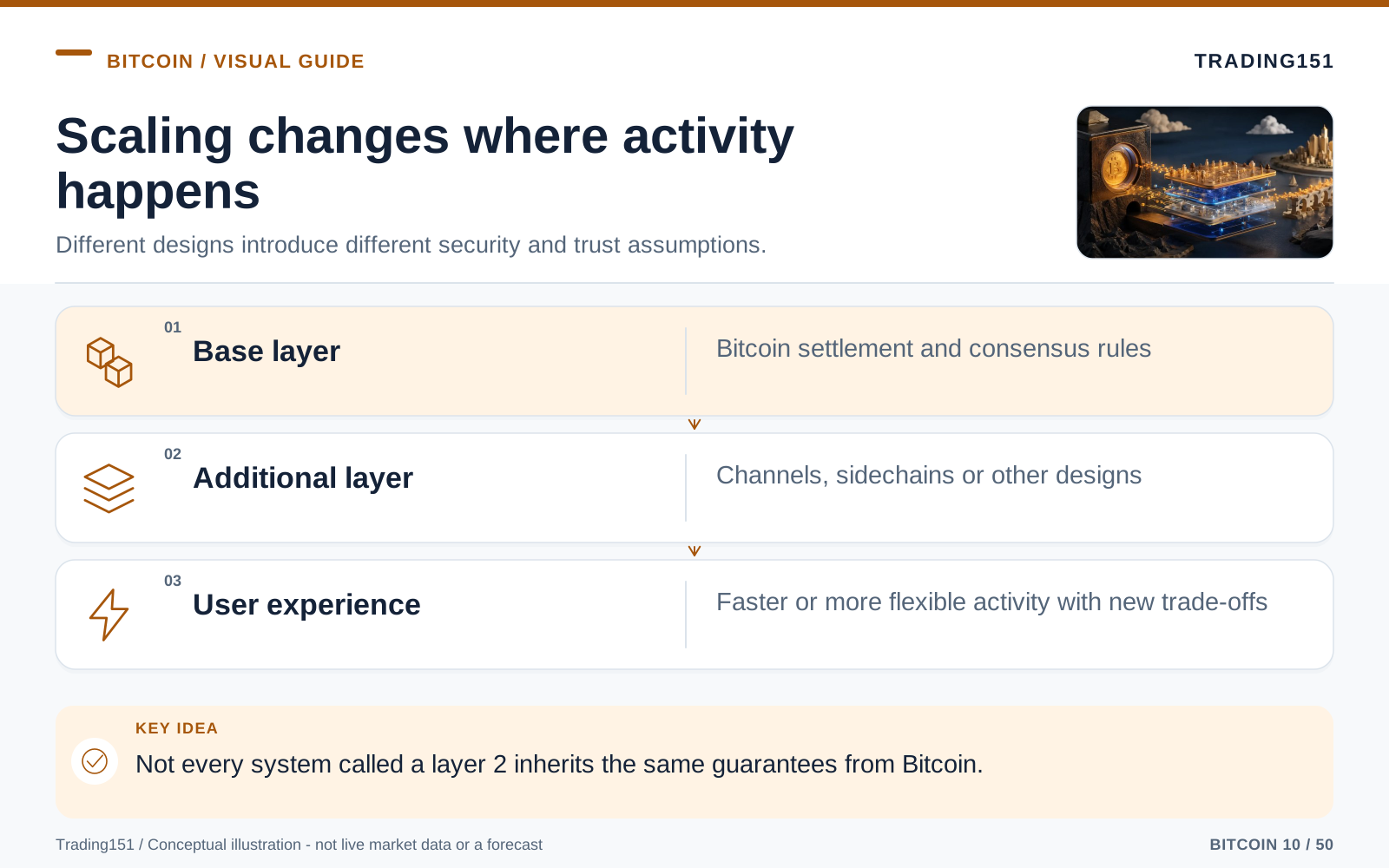
Read this diagram as text
- Base layer
- Bitcoin settlement and consensus rules
- Additional layer
- Channels, sidechains or other designs
- User experience
- Faster or more flexible activity with new trade-offs
What a Bitcoin Layer 2 Does
At its core, a Layer 2 is just a network or protocol built on top of Bitcoin to handle activity outside the main blockchain. Rather than recording every move on Bitcoin directly, users interact on this secondary layer, and only the most critical settlement data eventually gets committed to the base chain. It's worth noting that people throw the term "Layer 2" around a lot, implying every project inherits Bitcoin's pure security. They don't. Some use Bitcoin transactions to directly enforce rules, some rely on bridges or federations, and others just connect their economy to BTC in a looser way. What really matters is the exit path: if the people running the Layer 2 fail or try to pull a fast one, can you get your funds back to Bitcoin on your own?
The actual designs vary substantially. Some Layer 2s use payment channels, while others rely on sidechains. Some are custom-built for smart contracts, some target institutional players, and others try to recreate an Ethereum-like experience directly on top of Bitcoin. Some exist almost exclusively to facilitate instant, dirt-cheap payments.
But they all share one overarching goal: take the pressure off Bitcoin’s limited block space while still tapping into its security, liquidity, and large credibility. The best Layer 2 networks don’t ask you to ignore the base layer—they use it as their bedrock.
Of course, none of this is magic. Every Layer 2 comes with trade-offs. Some are decentralized; others sacrifice decentralization for a smoother user experience. Some work flawlessly for buying a coffee but fall apart if you try to build a complex DeFi app on them. It’s important not to pretend they are all doing the same thing. The Bitcoin Layer 2 ecosystem is rapidly evolving into a large toolbox, with different tools designed for completely different jobs.
1. The Lightning Network: Bitcoin for Everyday Payments
Whenever someone brings up Bitcoin scaling, the Lightning Network is almost always the first thing mentioned. That’s because Lightning tackles the most glaring issue: Bitcoin is simply too slow and expensive for small, everyday transactions.
The easiest way to wrap your head around Lightning is to think of it like opening a tab at a bar. If you had to swipe your credit card every time a friend ordered a drink, the bartender would hate you, and the night would drag on forever. Instead, you hand over your card once, order whatever you want all night, and settle the final bill when you leave.
Lightning essentially does this using payment channels. Two people open a channel by locking up some Bitcoin on the main chain. Once that channel is live, they can send funds back and forth thousands of times almost instantly and for fractions of a penny. The main Bitcoin blockchain doesn’t see any of this back-and-forth action until they finally close the channel and settle the final balance.
The real magic of Lightning, though, is how these channels connect. You don’t need a direct channel with the coffee shop to buy a latte. If you have a channel open with Alice, and Alice has a channel with Bob, and Bob has a channel with the coffee shop, the Lightning Network automatically routes your payment through them. It’s a web of interconnected tabs.
Why it matters: Lightning proves that Bitcoin can function as a medium of exchange without forcing the base layer to change. It enables tipping on social media, micro-transactions in video games, instant cross-border remittances, and actual, viable retail payments. You get the speed of Visa with the finality of Bitcoin.
Lightning's payment channels are themselves built from Bitcoin scripts and conditional payment contracts. What Lightning does not provide is a general-purpose execution environment comparable to Ethereum. Its practical constraints include channel liquidity, routing, fees, and the need to manage or outsource channel monitoring. A fast payment can still fail when a suitable route or sufficient liquidity is unavailable.
2. Stacks: Bringing Smart Contracts to Bitcoin
While Lightning is laser-focused on payments, Stacks tackles a totally different challenge: what if Bitcoin could support a large ecosystem of apps without having to alter the Bitcoin protocol itself?
For a long time, Ethereum completely dominated the conversation around smart contracts, DeFi, NFTs, and on-chain apps. Bitcoin, on the other hand, was viewed as rigid and conservative. That simplicity was a feature, not a bug. Most Bitcoiners had zero interest in clogging up the base layer with untested code, messy apps, and constant protocol upgrades.
But the demand for that kind of utility never went away. People holding Bitcoin still wanted to borrow against their BTC, trade assets, and interact with DeFi protocols. Developers wanted to tap into Bitcoin’s large liquidity. The question was how to introduce programmability without turning Bitcoin into Ethereum.
Stacks solves this by acting as a smart contract layer that connects directly to Bitcoin. It uses a unique consensus mechanism called Proof of Transfer (PoX). Essentially, Stacks blocks are anchored to Bitcoin blocks, tying the network's history directly to Bitcoin’s settlement layer while giving developers a completely separate sandbox to build in.
Stacks also uses its own programming language called Clarity. It’s designed specifically to make smart contract behavior predictable and completely transparent. In the crypto world, a tiny bug in a smart contract can result in a multimillion-dollar exploit. By focusing heavily on readability and safety, Stacks hopes to make building apps around Bitcoin much less concerning.
Why it matters: Stacks gives Bitcoin a back door into the world of decentralized apps without forcing those apps onto the main chain. Decentralized exchanges, lending markets, and NFT platforms can be built using Bitcoin as the core asset, rather than having to rely on an entirely different token ecosystem.
The pitch for Bitcoin holders is compelling: your BTC doesn't have to sit in a vault doing nothing. It can be used as productive collateral in financial apps, while still ultimately resting on the most secure network in the world.
The catch: Stacks is fundamentally more complicated than just sending a Lightning payment. You have to navigate new wallets, smart contracts, and the inherent risks that come with DeFi. It also features its own token (STX) and economic model, so it doesn't inherit Bitcoin's security in a 1:1, pure way. It’s intimately tied to Bitcoin, but transacting on Stacks is not the same thing as transacting on the Bitcoin base layer.
3. Rootstock: Ethereum-Style Apps, Powered by Bitcoin
Rootstock (or RSK) takes a slightly different approach to unlocking Bitcoin's programmability. Instead of forcing developers to learn an entirely new language and ecosystem, Rootstock is fully compatible with the Ethereum Virtual Machine (EVM). In simple terms: if a developer knows how to build apps on Ethereum, they already know how to build apps on Rootstock.
This was a remarkably pragmatic choice. Ethereum boasts the largest developer community in crypto. Its tools, wallets, and code libraries are industry standards. By making Rootstock EVM-compatible, the network essentially rolled out the red carpet for Ethereum developers who want to experiment with Bitcoin without starting from scratch.
Rootstock functions as a sidechain. If you want to use it, you lock up your BTC on the main chain, which mints an equivalent amount of RBTC on Rootstock. You then use that RBTC to pay for gas fees and interact with smart contracts. It’s designed to perfectly mirror the value of Bitcoin within the Rootstock ecosystem.
Rootstock uses merged mining, which lets participating miners reuse proof-of-work effort while mining Bitcoin. That does not mean operating the additional software and infrastructure consumes no resources. Nor does merged mining eliminate the separate risks involved in moving bitcoin through Rootstock's bridge.
Why it matters: Rootstock brings the familiar DeFi toolkit right to Bitcoin’s doorstep. Developers can spin up stablecoins, lending protocols, and decentralized exchanges while keeping BTC as the central asset. If you love Ethereum’s app ecosystem but believe Bitcoin is the superior underlying money, Rootstock bridges those two worlds.
The catch: Sidechains come with vastly different trust assumptions than the Bitcoin base layer. Moving your funds back and forth through the bridge requires trusting the infrastructure running it. Plus, smart contract risk is unavoidable. Even if a network is deeply connected to Bitcoin, poorly written code on the sidechain can still get hacked.
Rootstock’s superpower isn’t that it magically transforms Bitcoin into Ethereum. It’s that it gives people an environment to build Ethereum-style apps using the Bitcoin they already own.
4. The Liquid Network: High-Speed Institutional Settlement
Not every scaling issue involves buying a cup of coffee or trading NFTs. A lot of the friction in Bitcoin happens at the institutional level. Large exchanges, trading desks, and large "whale" holders frequently need to move huge amounts of Bitcoin fast, and ideally, in private. Waiting around for multiple base-layer confirmations is agonizingly slow. Furthermore, broadcasting the exact details of a large transfer on a public ledger is a nightmare for professional traders who want to keep their strategies quiet.
The Liquid Network, built by Blockstream, was designed specifically to solve this problem. It’s a sidechain tailored for high-speed settlement, issuing digital assets, and keeping transactions confidential.
Liquid is a federated sidechain rather than a proof-of-work chain. Its functionaries produce blocks and operate the Bitcoin peg. Under the intended design, users lock BTC to obtain L-BTC and later redeem through the peg-out process. Transfers are not instantaneous, and access to redemption depends on the federation, software, and operating status.
Liquid's Confidential Transactions conceal transaction amounts and asset types from public observers, but they do not make every aspect of a transfer private. Addresses and other activity can still expose relationships, and counterparties or service providers may hold identifying records. Confidential amounts should not be described as absolute anonymity.
Liquid also allows companies to issue custom assets. Businesses can spin up stablecoins, tokenized securities, or digital bonds while keeping everything contained within a Bitcoin-centric environment.
The trade-off includes federation control, software risk, and reliance on a functioning peg. These are not merely theoretical concerns: Blockstream's 23 September 2026 assessment describes a 6 September exploit that created roughly 4,000 unbacked L-BTC and enabled withdrawals from the Bitcoin reserve. Operations were interrupted during recovery. Check current official incident notices and redemption availability before sending funds; a design description is not confirmation that a service is operating normally.
Different users need different settlement arrangements, but institutional branding does not establish safety. The useful comparison is between actual transaction costs, privacy properties, withdrawal conditions, and the consequences of a failure.
Why Ordinals Changed the Conversation
For years, the debate over how to scale Bitcoin was pretty theoretical. Most activity was financial—people were just buying, holding, or sending BTC. But in early 2023, everything changed with the explosion of Ordinals and Inscriptions.
Ordinals essentially found a clever loophole in Bitcoin’s code, allowing users to permanently attach data—like images, text, and even simple video games—directly to individual satoshis (the smallest unit of a Bitcoin). Suddenly, people were minting NFTs right on the Bitcoin base layer. Not long after, developers introduced the BRC-20 standard, allowing people to launch meme coins and custom tokens directly on Bitcoin.
The network went absolutely crazy. Blocks filled up. Fees skyrocketed. For miners, it was an absolute gold rush. For people just trying to send normal payments, it was a frustrating, expensive nightmare. Some hardcore Bitcoiners hated it, calling it spam that was bloating the chain. Others celebrated it, arguing that miners need fee revenue to keep the network secure long-term, and people should be free to pay for block space however they want.
But regardless of how you felt about people putting JPEGs on Bitcoin, it proved one thing undeniably: people desperately want to use Bitcoin for more than just sending money. The demand for block space is real, and it is large.
This is why the push for Layer 2s has suddenly become so urgent. Bitcoin's future is going to involve payments, complex financial apps, savings, digital assets, and a dozen other things no one has even thought of yet. Trying to cram all of that onto Layer 1 is a recipe for disaster. Layer 2s give the ecosystem the breathing room it needs to evolve without compromising the bedrock that makes Bitcoin special.
The Next Frontier: Rollups, BitVM, and Beyond
We are still early in the Bitcoin Layer 2 story. While Lightning, Stacks, Rootstock, and Liquid are the heavyweights right now, they are just the beginning. Developers are already pushing the envelope, exploring advanced concepts like rollups and borrowing heavily from Ethereum’s scaling playbook.
Rollups are designed to batch thousands of transactions together, compress the data, and publish the mathematical proof back to the base layer. This has been the dominant scaling strategy on Ethereum because it allows large amounts of activity to happen off-chain while still drawing security directly from the main network.
Bringing rollups to Bitcoin, however, is a large technical headache. Bitcoin’s scripting language is notoriously rigid. It can't natively verify the complex cryptographic proofs that other blockchains handle with ease. This limitation is a feature of Bitcoin's conservative design, but it makes building advanced Layer 2s difficult.
That’s exactly why concepts like BitVM are generating so much hype. BitVM is a highly experimental framework designed to enable complex, Turing-complete computations on Bitcoin without requiring a large, contentious overhaul of the protocol. It’s far from a finished product, but it has sparked a large wave of optimism that Bitcoin might eventually support powerful scaling systems without sacrificing its core stability.
If these technologies mature, Bitcoin could one day host Layer 2s with vastly superior security models, minimized trust assumptions, and the capacity to run large applications. Naturally, a lot of these projects will fail. Crypto is notorious for hyping up ambitious whitepapers that never see the light of day. But the shift in mentality is undeniable: developers have stopped treating Bitcoin as a museum piece and started treating it as an engine.
The Trade-Offs You Can't Ignore
Layer 2s are amazing, but they aren't magic. Every design choice solves one problem while creating another. Scaling inherently means moving the computation and verification away from the decentralized army of Bitcoin nodes, which means someone—or some mechanism—has to handle that workload. Faster settlement might require trusting a small group of signers. Complex smart contracts might rely on a vulnerable bridge or an external sequencer. Lower fees might mean dealing with liquidity issues or withdrawal delays. These aren't reasons to abandon Layer 2s; they are just the cost of doing business. The real danger is when marketing teams pretend their new Layer 2 has the same security guarantees as the Bitcoin base layer, hiding the large risks in the fine print.
Lightning introduces channel and routing constraints. Stacks and Rootstock add their own execution environments and bridge or token-related risks. Liquid depends on a federation and a working peg. None should be treated as interchangeable with holding bitcoin directly on the base layer.
None of this means Layer 2s are fundamentally flawed. It just means they represent honest engineering. Every financial system on earth uses layers, and every layer requires trust. Swiping a debit card is not the same thing as possessing physical cash. Holding a stock on Robinhood is not the same as holding a paper stock certificate. Convenience always requires a back-end structure.
Bitcoin's base layer and the systems built around it make different trade-offs. Assess the specific design: who validates transactions, who can interrupt service, how an exit works, and which failures could prevent recovery. A familiar name or a connection to Bitcoin does not answer those questions.
Ultimately, the best-case scenario for Bitcoin isn't one monolithic Layer 2 network that does everything. It’s an ecosystem where different layers serve totally different purposes, allowing users to pick the exact blend of security, speed, and privacy that fits what they are trying to do.
What This Means for Bitcoin’s Future
The explosion of Layer 2 solutions represents a large shift in the way we fundamentally view Bitcoin. For the longest time, the narrative was straightforward: Bitcoin is a digital store of value. You buy it, you lock it up, you protect your keys, and you let time do the heavy lifting.
Moving forward, Bitcoin is starting to look less like a single, universal computer and more like the ultimate settlement bedrock supporting a sprawling ecosystem of specialized networks. Buying coffee, trading digital art, transferring millions privately, and locking up DeFi collateral do not require the same speed, cost, or security assumptions. Users will bounce between different layers for different tasks, always relying on the main chain for large, high-value finality.
This evolution is going to be messy. Rival standards will fight for dominance, some bridges will inevitably get hacked, and plenty of heavily-funded experiments will fade to zero. The projects that survive will be the ones that deliver value while keeping their risks transparent long after the initial hype dies down.
The "digital gold" narrative still matters. In fact, it remains the strongest, most compelling argument for Bitcoin’s existence. But it’s no longer the entire story.
Thanks to Layer 2s, Bitcoin can act as a high-speed payment rail for the developing world, a settlement engine for Wall Street, a foundation for decentralized finance, and a launchpad for digital assets. It can stay radically conservative at its core while embracing wild experimentation on the fringes. That deliberate separation between the base layer and the layers above it might turn out to be Bitcoin’s absolute greatest superpower.
Other blockchains constantly try to do everything all at once on a single layer: payments, data storage, governance, NFT minting, gaming, and DeFi. Sure, that can lead to incredible speed in the short term, but it almost always results in a fragile, overly complicated protocol. Bitcoin is taking a much slower, more modular path. It keeps the foundation simple, secure, and unchangeable, while letting developers run wild on the layers built above it.
It’s not as flashy as launching a brand-new token with large promises. It’s quieter, messier, and takes a lot more time. But historically, that’s how durable infrastructure is built. Bitcoin doesn’t need to transform into every other blockchain. It just needs to become a much stronger, more capable version of itself: impregnable at the base, useful at the edges, and entirely open for whoever wants to build on top of it.
Ask how you get back to the base chain
Imagine using a service for inexpensive bitcoin payments. Day to day, it works well. The meaningful test comes when the operator disappears or refuses a withdrawal. Can you recover through a transaction you control? Must you wait for a timelock? Do you need a particular backup, an available counterparty, or cooperation from a federation? Those details define the exit, and therefore much of the risk.
Different systems make different bargains. A payment channel can provide a protocol-defined route to settlement, but users still need to understand liquidity, monitoring, and recovery. A federated sidechain has a different withdrawal arrangement. A custodial balance may simply be a promise by a company. Describing all three as equally secured by Bitcoin conceals more than it explains.
Costs also need to be measured over the whole lifecycle. Cheap transfers inside a system may be accompanied by opening, closing, bridging, or liquidity costs. For someone making many small payments, that can be a reasonable trade. For someone moving funds only once, the same arrangement may offer little benefit.
Before committing a meaningful amount, document the exact product and its recovery instructions. Test a small round trip where practical, while remembering that one successful withdrawal does not prove future reliability. The right scaling solution is one whose normal use and failure conditions you can both explain, not merely one with the lowest advertised fee.
Faster is only one dimension
A payment layer can improve speed or reduce some transaction costs while adding new operational requirements. Compare the full route: entering the system, making the payment, handling a failure, and leaving again. A low quoted transfer fee may exclude the cost of establishing liquidity or returning funds to the base chain.
The same care applies to the term 'Bitcoin layer 2.' Different projects use different validation, custody, and exit arrangements. Ask what happens if the operator stops responding or the service becomes unavailable. Can the user recover independently, and what information is needed? A convincing answer describes the actual mechanism and its limitations rather than relying on the label to imply that all Bitcoin-based systems provide identical security. 1, 2, 3
Scaling Without Rewriting the Rules
Comparing Bitcoin to gold has always made sense. Gold is valuable because it's scarce, it lasts forever, and you can't easily fake it. Bitcoin took all of those properties and digitized them, throwing in the ability to settle globally and hold your own keys.
But a functioning economy can't run on gold bars alone. People need credit cards, checking accounts, banking apps, privacy tools, and high-speed settlement rails. They need a way to use their wealth without having to lug a vault door into the coffee shop every time they want a latte.
That is exactly the void Bitcoin Layer 2s are starting to fill.
The Lightning Network acts as the bustling, street-level economy, moving small payments around at the speed of light. Stacks and Rootstock serve as the financial districts, where developers build DeFi apps, marketplaces, and smart contracts. Liquid operates like a private, high-speed highway for large institutions. And in the future, advanced rollups and BitVM systems will likely add entirely new cities to the map.
Through all of this, Bitcoin’s base layer doesn't change. It remains the absolute bedrock. It doesn’t need to be fast, and it doesn't need to be flashy. It just needs to be trustworthy, completely neutral, and impossible to corrupt. The layers above it can move fast and break things, but the foundation stays intact. By embracing this multi-layered approach, Bitcoin is finally proving that it can scale to meet the demands of the entire world—without ever compromising the exact qualities that made it valuable in the first place.
Sources and further reading
- Lightning Labs: The Lightning Network
- Liquid Network: How Liquid Works
- SEC Investor Bulletin: Crypto Asset Custody Basics for Retail Investors
- Blockstream: Liquid Network Security Incident Assessment, 23 September 2026
Editorial revision: 7 October 2026. Numerical scenarios are hypothetical unless identified as historical. References support the added explanations and selected corrections; rules and product terms should be checked again before acting.