
The Lightning Network enables Bitcoin payments through channels whose balances can be updated without recording every payment directly on the base chain. It can make suitable payments faster and cheaper, but it introduces liquidity, routing, and wallet-management considerations. A custodial Lightning balance also differs from a channel controlled by the user. The payment experience depends on which arrangement is actually being used.
Bitcoin's Scaling Problem Starts With Its Strengths
Bitcoin wasn't built to be slow by accident. It was built to be practically impossible to tamper with.
On the main network—often called Layer 1—transactions are bundled into blocks, which are added to the blockchain every ten minutes or so. Thousands of independent computers globally keep their own copies of this ledger. They verify new transactions and toss out anything that doesn't follow the rules.
That’s Bitcoin’s magic trick: you don’t have to trust a bank, a fintech company, or a government to know who owns what. The network polices itself. But reaching that kind of global consensus takes work. Space in each block is limited, so when lots of people want to transact at once, users have to pay higher fees to jump to the front of the line.
If you’re moving millions of dollars across international borders, this trade-off is a no-brainer. Waiting ten minutes and paying a small fee beats the slow, expensive traditional banking system any day. But for a $4.50 coffee? It’s completely absurd.
Think of it like this: imagine buying a pack of gum, but to finalize the sale, the cashier has to yell your purchase over a megaphone to the entire city, and everyone has to write it down in their personal notebook. The record would be bulletproof, but it’s a unexpectedly inefficient way to buy gum.
That’s the compromise Bitcoin chose. It prioritized security and decentralization above all else. The issue isn't that Bitcoin can't move money—it's that using the base layer for tiny transactions is like using an armored truck to deliver a handful of pennies.
Some critics argued Bitcoin should just process more transactions on its main blockchain. Bigger blocks, faster blocks, more capacity. But that approach has hidden costs. If the blockchain gets too large, everyday people won't be able to run nodes. Fewer independent nodes means more centralization, which chips away at the very foundation of what makes Bitcoin valuable.
The Lightning Network goes a different route. Instead of cramming every coffee purchase onto the main blockchain, it lets users make thousands of tiny, rapid off-chain payments, settling the final tally on the main network only when necessary.
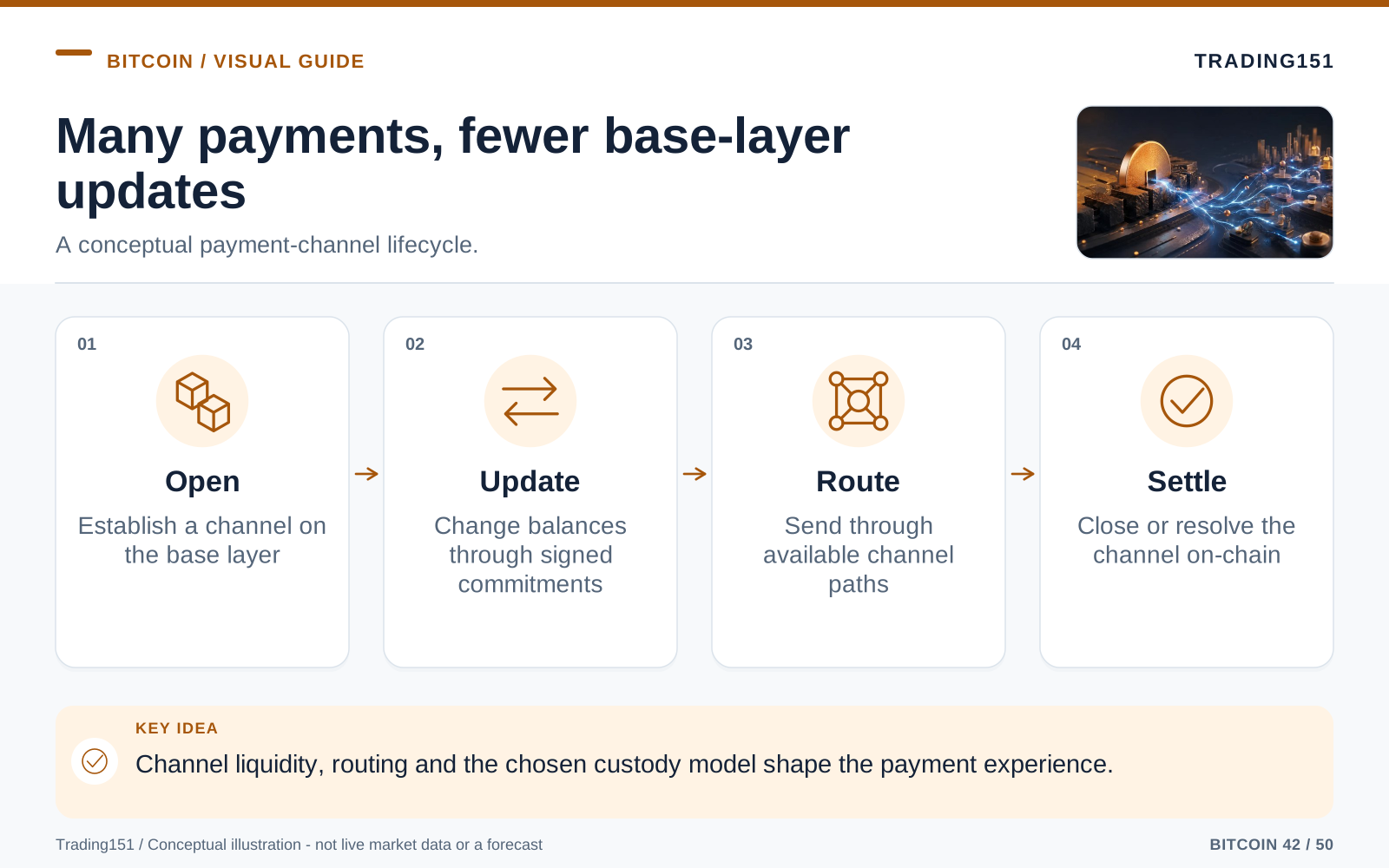
Read this diagram as text
- Open
- Establish a channel on the base layer
- Update
- Change balances through signed commitments
- Route
- Send through available channel paths
- Settle
- Close or resolve the channel on-chain
The Simple Idea Behind Layer 2
The Lightning Network is what’s known as a Layer 2 solution. That just means it’s built on top of Bitcoin, rather than altering the base blockchain itself.
Layer 2 systems are everywhere. The internet has layers. Finance has layers. Credit cards sit on top of banks, and apps like Venmo or Cash App sit on top of the credit networks. You don’t notice the layers when you check out at a store, but they’re humming along behind the scenes.
Lightning essentially does the same thing for Bitcoin. It lets people transact instantly while relying on Bitcoin as the bedrock of security.
The easiest way to wrap your head around it is to think of a bar tab.
Imagine walking into a crowded bar on a Friday. You could swipe your debit card every time you order a beer, but that’s a hassle for you, slows down the bartender, and clutters up your bank statement. So, you open a tab instead. The bartender tracks your orders. You buy a drink, then maybe a round of shots for your friends. None of these individual updates hit your bank right away.
When you’re ready to leave, you close the tab. One single charge goes to your bank for the total amount.
Your bank only sees one transaction. The bar gets paid. You cover your bill. All the back-and-forth in the middle didn't require separate, tedious bank settlements.
Lightning works the same way. Two people can open a payment channel, zip money back and forth as much as they want, and eventually close the channel by posting just the final, netted-out balance to the main Bitcoin blockchain.
That’s the core philosophy: keep Bitcoin's base layer slow and hyper-secure, shift everyday spending to a high-speed layer, and only involve the blockchain when you're opening an account, closing one, or settling a dispute.
Payment Channels: The Heart of the Lightning Network
Let’s ground this with a real-world example using our usual suspects, Alice and Bob. A Lightning channel is essentially built from real Bitcoin transactions, but most of the updates never see the public blockchain. Every time a payment is made, it replaces the old balance with a new, mutually signed agreement. The clever part? It's mathematically designed so neither person can try to cheat by publishing an old balance. This lets them transact at lightning speed while keeping the main blockchain as a backup court of law. The blockchain doesn't micromanage every payment; it just stands by to finalize the outcome or resolve a fight. Lightning gets its speed by keeping routine stuff off the global ledger without sacrificing Bitcoin’s ultimate security.
Let’s say Alice grabs coffee from Bob's shop every morning. She loves paying in Bitcoin, but broadcasting a new transaction to the main network every day is a hassle and expensive. Bob, meanwhile, doesn't want to make her stand there waiting for confirmations before he hands over her latte. So, they open a Lightning payment channel.
Step 1: Opening the Channel
To kick things off, Alice and Bob create a special Bitcoin transaction. Alice locks up, say, $100 worth of Bitcoin in the channel. Bob might put some in too, or he could start at zero. Because this initial transaction goes on the main Bitcoin blockchain, it still requires the usual network fee and confirmation time.
Once it’s open, however, the magic starts. Alice and Bob can now update the balance between them endlessly without touching the blockchain.
Think of it as a shared mini-ledger. Initially, it shows Alice has $100 and Bob has $0. When Alice buys her $5 coffee, the ledger simply updates: Alice $95, Bob $5. Tomorrow, she buys another coffee, and it updates again. If Bob needs to refund her for something, they just adjust the balance backward.
None of these updates require a ten-minute wait. They happen practically instantly because Alice and Bob are just swapping out their old agreement for a new one.
Step 2: Updating the Balance
A Lightning payment isn’t just an IOU written on a napkin. Every balance update is backed by hard cryptography and Bitcoin’s underlying rules. Alice can’t try to cheat by pretending an older balance is still the real one, and Bob can’t just reach in and grab more than his share. The system is rigged so that if anyone tries to broadcast a dishonest state, they get financially punished.
You don’t need a degree in computer science to get the gist. The main takeaway is that Lightning channels aren’t built on blind trust. They’re built so the main Bitcoin blockchain can step in like a judge if anyone misbehaves.
This is why Lightning is often described as "fast payments backed by slow security." Most of the time, everything moves at light speed. But in the rare event of a dispute, the base layer is always there to enforce the rules.
Step 3: Closing the Channel
Let's say a month goes by and Alice moves to a new city. She won’t be visiting Bob’s shop anymore, so they decide to close the channel. The final tally might be Alice $20, Bob $80. Only that final, netted-out state gets published to the Bitcoin blockchain, and the funds settle permanently.
The main network only ever saw two transactions: opening the channel and closing it. Meanwhile, inside that channel, Alice and Bob could have made dozens, or even thousands, of tiny payments.
That’s the beauty of it. Lightning doesn’t force Bitcoin to have bigger blocks; it just makes exponentially better use of the space it already has.
Routing: Why You Do Not Need a Channel With Everyone
Having a private channel with Bob is great, but it brings up an obvious question: Do you have to open a separate channel for every coffee shop, online store, and friend you want to pay?
Thankfully, no.
The real genius of the Lightning Network is routing. You don’t need a direct channel with the end recipient. You just need a path to them.
Suppose Alice wants to buy a book from Charlie. She doesn't have a channel with Charlie, but she does have one with Bob. And Bob, as it turns out, has a channel with Charlie. The network can seamlessly route Alice's payment through Bob to reach Charlie.
From Alice's point of view, it’s entirely frictionless. She scans Charlie's invoice, hits pay, and she’s done. Under the hood, her wallet software finds the path: Alice to Bob, Bob to Charlie. Bob forwards the funds and might collect a tiny fraction of a cent as a routing fee for his trouble.
On a larger scale, a payment might bounce through three, four, or five different nodes. But as a user, you don’t even notice. The wallet does the heavy lifting.
This is where Lightning stops looking like a private bar tab and starts looking like a global payment network. Every channel is a road, and every node is an intersection. Build enough roads, and money can travel anywhere on the map.
Crucially, the middlemen can’t steal the money while it’s en route. Lightning uses smart contracts—specifically something called Hash Time-Locked Contracts (HTLCs)—to guarantee the payment either reaches its destination perfectly or fails safely. The money never just sits in a middleman’s pocket.
In plain English: the system guarantees that everyone in the routing chain only gets paid if the final destination gets paid. If the connection breaks halfway, the transaction just cleanly unwinds instead of vanishing into the ether.
Why Lightning Feels So Different From On-Chain Bitcoin
The first time you use a well-designed Lightning wallet, it feels almost weird. Bitcoin, which most people associate with waiting and hefty fees, suddenly behaves exactly like Venmo, Cash App, or Apple Pay. Scan, tap, done.
This vibe shift is large. Payments are as much about rhythm as they are about technology. An impressive payment rail is useless if it awkwardly pauses your life. No one wants to hear a lecture about settlement finality while they’re just trying to buy a sandwich.
Lightning successfully brings Bitcoin up to the speed of everyday life.
Speed That Matches Real Life
Lightning transactions usually settle in seconds, if not milliseconds. At a busy checkout counter, that’s the difference between a novelty concept and a tool people will use.
This speed matters online, too. Fans can tip creators instantly. Apps can charge microscopic amounts without you having to dig out a credit card. Friends can split a bill without waiting three business days for a bank transfer. Sending money internationally suddenly feels less like filing paperwork and more like sending a text message.
Fees Small Enough to Change What Is Possible
Legacy payment systems are fundamentally hostile to tiny transactions. Credit card networks and processors usually charge a base fee plus a percentage. That’s fine for a $100 pair of shoes, but it makes a two-cent payment completely impossible.
Because Lightning transactions don’t compete for scarce space on the main blockchain, the fees are usually fractions of a penny. That unlocks a whole new world of micro-payments that previously made zero economic sense.
Instead of locking yourself into a $15 monthly subscription for a news site, you could pay two cents for a single article. Instead of platforms holding creators' money hostage until payday, fans could stream micro-payments directly to them per minute of video watched. Instead of the internet being completely reliant on invasive ads, developers could finally experiment with direct, tiny payments.
Will all of these ideas catch on? Probably not. Some will just be gimmicks. But Lightning makes these experiments possible in the first place.
Global Payments Without the Usual Friction
It’s still shockingly painful to send money across borders. Banks close for the weekend. Wire transfers take days. You often have no idea what the final fees will be until the money lands. For expats or migrant workers supporting families back home, this friction is a miserable reality.
Lightning offers a completely different model. Bitcoin is global, and Lightning makes it fast. In some modern apps, users might not even realize they’re using Bitcoin at all. They might send dollars, pesos, or euros, while Lightning quietly operates as the high-speed rail system in the background.
This is arguably the most practical vision for the network: everyday people shouldn't have to become Bitcoin experts. They just want payments that are faster, cheaper, and work seamlessly across borders.
Invoices, QR Codes, and the User Experience
In day-to-day use, a Lightning payment usually starts with an invoice. A merchant or an app creates a payment request (usually a QR code). You scan it, your wallet checks the details, finds a route through the network, and fires off the money.
On your end, it feels as smooth as Apple Pay. Under the hood, however, your wallet is working furiously. It has to decode the invoice, calculate the fees, hunt down a route with enough funds to act as a bridge, and execute the payment before the invoice expires.
This hidden complexity is exactly why Lightning has taken a while to go mainstream. The underlying tech is brilliant, but payment networks are unforgiving. Users don’t want to manage channels, rebalance liquidity, or troubleshoot routing errors. They just want to buy their coffee.
The best Lightning apps today hide all that technical baggage. Some wallets are fully custodial, meaning a company manages the channels and holds the funds for you. Others are self-custodial, giving you total control but asking you to take on more responsibility. There are even hybrid models trying to strike a balance between ease of use and personal sovereignty.
This tension is the central struggle of Lightning's growth: how do you make the network foolproof for regular people without turning it into just another walled garden of trusted financial companies?
Custodial vs. Self-Custodial Lightning
The most critical choice you make when using Lightning is deciding who controls the money. Custodial wallets feel effortless because the provider handles all the messy stuff—channels, backups, routing, and liquidity. It’s perfect for beginners or small tips, but your balance is just an IOU from a company. Self-custodial wallets preserve your independence but demand more from you and your software. Some newer apps blur this line, outsourcing the hard tasks while letting you keep your own keys. The real question isn't which approach is ideologically purer; it’s about who has the power to freeze your funds or block your access.
With a custodial wallet, a company holds your hand. The UX is slick, setup is instant, and you don’t have to learn a thing about liquidity. The downside? You’re trusting a third party. If they get hacked, shut down, or decide they don't like your transactions, your money is stuck.
With a self-custodial wallet, you are your own bank. That aligns perfectly with Bitcoin's original ethos, but it comes with a learning curve. You might have to actively manage channel capacity, worry about inbound liquidity, and properly back up your device.
Neither is perfect for everyone. If you’re just tipping someone $2, a custodial app is fine. If you’re a business or a hardcore Bitcoiner, you’ll probably want self-custody. The ultimate goal is for self-custodial wallets to become so user-friendly that we don’t have to default back to trusting centralized companies.
The Liquidity Problem, Explained Without the Headache
Lightning channels have limits, which creates one of the network's most stubborn logistical headaches. Channel capacity is directional. You might have plenty of Bitcoin to send, but absolutely no room to receive any, or vice versa. Furthermore, routing a payment requires a clear path where every channel along the way has enough juice in the right direction. While wallets are getting better at hiding this through automated rebalancing and swap services, someone still has to manage the plumbing. Think of it like a network of pipes: a path might exist on the map, but it won't help if one of the pipes is clogged.
Let's go back to Alice and Bob. If Alice has $100 on her side of the channel and Bob has $0, Alice can easily send money to Bob. But Bob cannot send $50 to Alice through that same channel because there’s no balance on his side to move. The channel exists, but the money is piled up on the wrong end.
This is what we call liquidity. For a payment to route successfully, every link in the chain needs enough available liquidity pointing in the right direction. If just one channel falls short, the payment fails, and your wallet has to quickly search for an alternate route.
For a $3 coffee, this is rarely an issue. For larger transfers, it gets much trickier. While routing algorithms have vastly improved, this liquidity bottleneck is why Lightning is currently much better suited for small, everyday purchases rather than moving large sums.
This isn’t a bug; it’s a feature of the multi-layered design. Bitcoin’s base layer is the heavy-duty rail for large, final settlements. Lightning is the nimble courier for your pocket change.
Privacy: Better in Some Ways, Not Perfect
Lightning offers a large privacy upgrade over regular Bitcoin transactions because every tiny purchase isn’t permanently etched onto a public ledger. When Alice buys coffee from Bob over Lightning, there is no permanent, public receipt of that specific transaction broadcast to the entire world.
The routing system also keeps middlemen in the dark. A node forwarding a payment only knows who handed them the money and who they are passing it to next. They don’t know the payment's origin, its final destination, or what it's for.
That being said, Lightning isn’t a magical invisibility cloak. The wallet you choose matters immensely. Custodial services can still see everything you do. Network analysis is still a threat. If absolute privacy is a matter of life or death, you still have to be deliberate about the tools you use.
The most accurate way to frame it is this: Lightning makes your daily spending much more private than Layer 1 Bitcoin, but it’s not completely anonymous.
What Lightning Makes Possible
The most thrilling part of Lightning isn't just that it makes Bitcoin cheaper to use. It’s that it completely redefines how small a payment can be.
When you can instantly send a fraction of a cent across the globe for free, entirely new business models emerge.
Creator Payments Without Waiting for Platforms
Musicians, writers, streamers, and developers can now get paid directly by their audience without having to wait for ad payouts, platform cuts, or arbitrary withdrawal limits. A listener could stream tiny payments directly to a podcaster for every minute they listen. A reader could drop a few cents on a great article. An open-source developer could be tipped seamlessly for their code.
A few cents might not sound like much. But at scale, it’s game-changing. Most importantly, it cuts out the middlemen and builds a direct financial bridge between creators and the people who value their work.
Machine-to-Machine Payments
Lightning also opens the door to payments between machines. Imagine a connected device automatically paying a tiny fraction of a cent for bandwidth, cloud storage, computing power, or API access. Instead of dealing with clunky monthly invoices and minimum account balances, software could just pay as it goes.
We’re still in the early days, and a lot of these ideas are highly experimental. But Lightning is the perfect rail for this: it handles rapid, microscopic, automated transfers with almost zero overhead.
Better Cross-Border Remittances
For families sending money internationally, tiny differences in fees and speed can be life-changing. A payment that arrives in three seconds instead of three days isn’t just a nice perk. It’s the difference between paying an emergency medical bill on time or going without food.
Lightning doesn’t magically fix every remittance issue. People still have to convert local currency to Bitcoin and navigate complex local regulations. But purely as a technology for moving value, it is a large upgrade over the slow, expensive legacy systems we currently rely on.
More Flexible Online Business Models
For decades, the internet has been completely dependent on advertising because processing small payments was simply too expensive. If paying a few cents becomes frictionless, websites won't be forced to rely on intrusive ads, data tracking, aggressive paywalls, or monthly subscriptions.
Maybe you pay a nickel for a single article. Maybe you pay a dime to watch a video. Maybe an AI tool charges you a fraction of a cent per query. Maybe video games can charge tiny amounts for optional cosmetics without locking players into predatory subscription bundles.
Obviously, not every business should pivot to micro-payments. No one wants to feel like they’re being charged by the second just for browsing the web. But Lightning finally gives builders the option.
The Roadblocks Nobody Should Ignore
The Lightning Network is incredible, but it’s not a finished consumer product like a toaster. It is still actively being developed, and some of the growing pains are very real.
The User Experience Still Has Rough Edges
For Lightning to reach mass adoption, it has to become boring. Wallets need to handle channel management, routing, backups, and liquidity entirely in the background, so the user never has to think about them.
We’ve made large strides, but the UX is still hit-or-miss. Some apps are beautifully simple, but only because they’re completely custodial. Some self-custodial apps give you total freedom but require a manual. The industry is still hunting for that perfect middle ground.
Receiving Payments Can Be Harder Than Sending Them
On the main Bitcoin network, receiving money is brain-dead simple: you post your address, and someone can send you funds even if your phone is off. Lightning, however, is interactive. Historically, your wallet had to be online and actively participating to receive a payment.
Developers are rolling out brilliant workarounds, like asynchronous payments and improved wallet architectures. But historically, receiving money on Lightning has been clunkier than people expect.
Liquidity Requires Planning
If you're a merchant and you want to receive a lot of Lightning payments, you need inbound liquidity. If you want to send huge amounts, you need outbound liquidity. These concepts make perfect sense for a network engineer, but they are unintuitive for a normal person.
Great wallets can abstract a lot of this away, but liquidity isn’t just a minor detail. It remains one of the core engineering hurdles of the network.
Custodial Convenience Can Recreate Old Problems
There is a very real danger that regular people will only ever use custodial Lightning apps because they’re the easiest. That makes Lightning highly convenient, but it essentially rebuilds the exact system Bitcoin was trying to escape: a world of trusted middlemen, frozen accounts, corporate surveillance, and gatekeepers.
The ideal future of Lightning is a diverse ecosystem where beginners can onboard instantly, advanced users can self-custody safely, businesses can run reliably, and no single corporation holds the keys.
Lightning and Bitcoin's Bigger Role
It’s time to stop thinking of Bitcoin as a single monolith that has to do absolutely everything.
The base blockchain is phenomenal at being a secure, scarce, decentralized settlement layer. It is terrible at directly processing every cup of coffee purchased on Earth. That doesn't make it a failure; it just means it needs layers.
This is how all major technologies evolve. The internet didn’t take over the world because everyone suddenly learned how to write TCP/IP protocols. It won because engineers built layers on top of it: websites, email clients, streaming platforms, and social media apps. Most of us never interact with the plumbing.
Bitcoin is following the same trajectory. The base layer acts as the ultimate anchor. Lightning operates as the high-speed transit system for daily spending. Other specialized layers will likely emerge as well. The endgame isn’t one network doing one job, but a stack of interconnected technologies.
This layered approach isn’t a betrayal of Bitcoin's original vision. In fact, it might be the only realistic way to scale the network globally without compromising what makes it valuable in the first place.
What a Lightning Payment Looks Like in the Real World
Despite all the brilliant engineering under the hood, the end goal is beautifully simple.
You pull out your phone. The cashier shows you a QR code. You scan it, hit confirm, and the register instantly chimes. No 16-digit credit card numbers. No banks declining the charge. No multi-day settlement windows. No international wire forms. No worrying about whether the transaction went through after hours.
That is the reality Lightning is building.
Sometimes you’ll know you’re spending Bitcoin. Sometimes, an app might use Lightning entirely behind the scenes while you just see dollars or euros on your screen. Sometimes it’ll be a tip to a podcaster, a remittance to family overseas, or a machine quietly paying for a server request without a human ever pressing a button.
The point isn't that everyone on earth is going to buy their morning coffee with Bitcoin tomorrow. The point is that Bitcoin finally has a legitimate, workable path for everyday payments—without sacrificing the bulletproof security of its base layer.
A fast payment still needs a viable route and usable balances
A channel has capacity and a distribution of funds between its participants. Having capacity is not the same as having the balance available in the right direction for a payment. Sending and receiving require appropriate liquidity, and a route across several channels must satisfy the payment's requirements along the way.
That is why a small payment can succeed while a larger one fails, even when both are addressed correctly. Routing conditions and balances change. Wallets may manage channels or provide services that hide much of this complexity, but the economic and operational work still exists somewhere in the system.
Understand the custody trade-off. A custodial service can provide a simple interface while controlling the underlying funds and applying its own withdrawal or account rules. A self-custodial implementation gives the user different responsibilities, including secure backups and attention to the software's recovery model. The same Lightning logo can therefore describe materially different trust arrangements.
Allow for the base chain when planning channel operations. Opening, closing, or resolving a channel can involve on-chain fees and timing, depending on the situation and implementation. Lightning is useful because it changes how many payments are handled, not because it abolishes every cost or dependency. Evaluate it with the payment size, reliability needs, and custody preferences that matter to the actual user.
A payment route needs usable liquidity
A Lightning balance is not enough to describe every payment the wallet can make or receive. The direction and placement of liquidity, the available routes, fees, and wallet design affect what is possible. A failed payment does not necessarily mean the underlying bitcoin is lost, but it does require understanding the wallet's state and recovery options. Learn those mechanics with a small amount before relying on the system for a time-sensitive payment. 1, 2, 3
Payments Grow One Channel at a Time
For years, critics have pointed to Bitcoin's sluggish main blockchain and declared it entirely unfit for daily commerce. And if we were strictly talking about Layer 1, they had a point. The main blockchain simply wasn't designed for buying lattes, tipping bloggers, and settling every microscopic transaction in real time.
But that was never the endgame.
Bitcoin is maturing into a multi-layered financial system. The base layer provides the unshakeable foundation. The Lightning Network acts as the agile, high-speed rail that moves small amounts of money instantly and practically for free. Together, they create a financial tool infinitely more powerful than either could be on its own.
Lightning isn’t flawless yet. It still wrestles with UX headaches, liquidity bottlenecks, and complex custody debates. Anyone claiming it's a finished, perfect product is selling you a fantasy. But it has undeniably fundamentally shifted the narrative around Bitcoin. It proves that Bitcoin doesn't have to choose between ultimate security and daily usability. It can maintain a highly conservative base layer while pushing rapid, everyday commerce to a faster secondary layer.
That’s the true power of the Lightning Network. It transforms Bitcoin from an asset you just sit on into currency you can spend. It turns the old "you can't buy coffee with Bitcoin" joke into an outdated punchline.
So the next time someone claims Bitcoin is too slow to buy a cappuccino, you don't need to get into a debate about block sizes. You just point to Lightning and tell them: the future of payments is already here, and it's being built one channel at a time.
Sources and further reading
- Lightning Labs: The Lightning Network
- Bitcoin.org: Securing your wallet
- Bitcoin Developer Guide: Transactions
Editorial revision: 7 October 2026. Numerical scenarios are hypothetical unless identified as historical. References support the added explanations and selected corrections; rules and product terms should be checked again before acting.