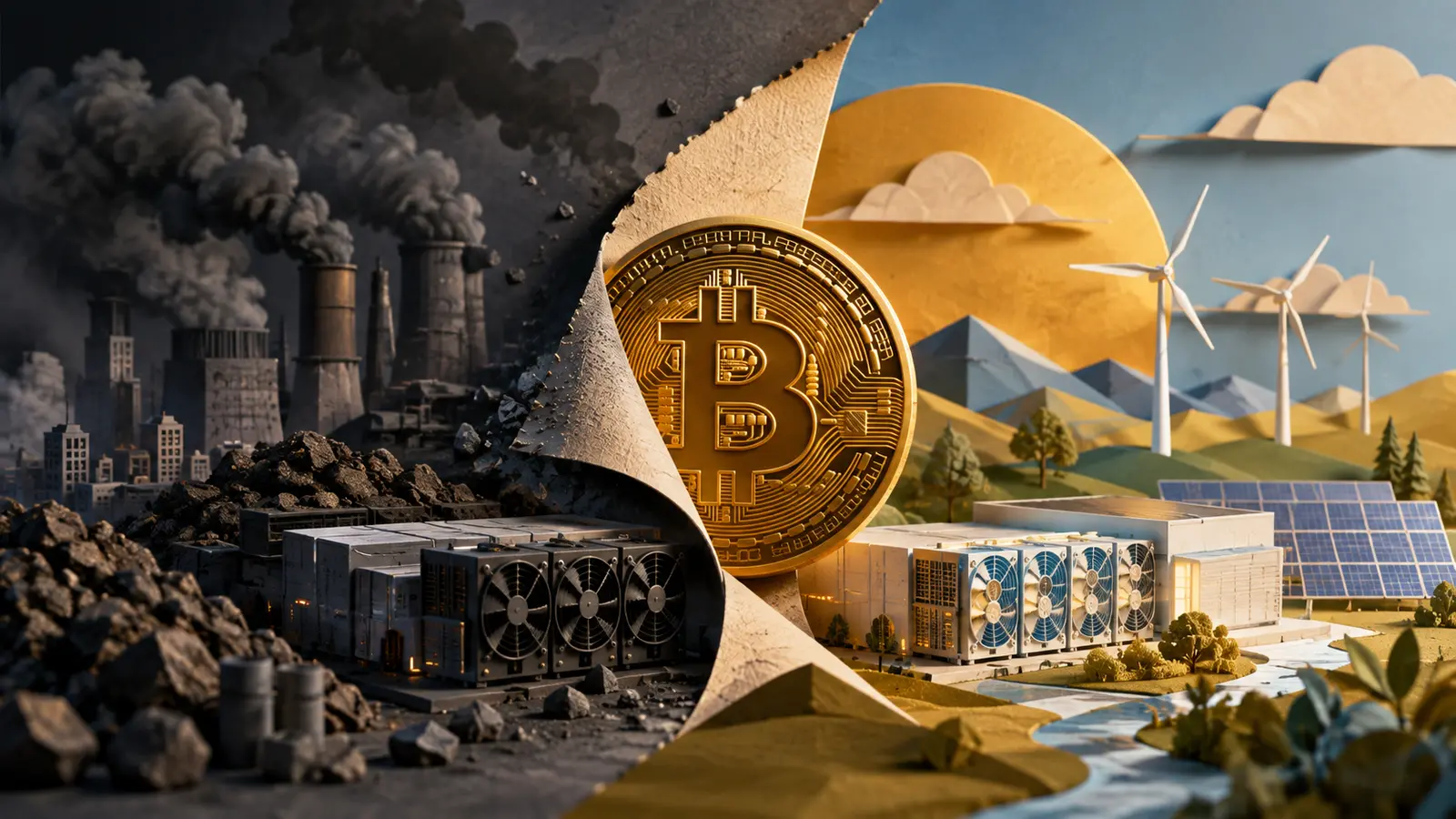
Bitcoin mining uses electricity to compete for the right to add blocks, and its environmental effects depend on how that electricity is produced and what else the operation changes. Electricity use, carbon emissions, water demand, noise, and equipment waste are different measures. A serious assessment keeps them separate and states the assumptions behind the numbers.
What "Mining" Looks Like
Calling it "mining" kind of throws people off. Nobody is swinging a pickaxe or hauling carts out of a tunnel. The metaphor just stuck because you have to spend resources to extract something valuable.
Because there's no central bank or corporate headquarters managing Bitcoin, the network relies on a sprawling, decentralized web of participants to verify who owns what. They agree on the state of the ledger using a system called Proof of Work.
Miners assemble candidate blocks and repeatedly hash their headers, looking for a result below the network's target. A miner that finds an acceptable result can broadcast the block. Other nodes still check that it follows the rules before accepting it; finding the hash does not give the miner permission to include invalid transactions.
The reward combines a block subsidy with transaction fees. Bitcoin targets an average block interval of about ten minutes, not a fixed schedule. Difficulty normally adjusts every 2,016 blocks, so a sudden change in mining power can alter block timing before the next adjustment.
Proof of work makes rewriting confirmed history costly, but it is not a blanket defense against every kind of attack. A majority of hash power can create serious double-spending and censorship risks without gaining the ability to forge another user's signature or make honest nodes accept coins that violate the rules.
But that exact defense mechanism is what creates the environmental nightmare. Proof of Work uses a lot of energy by design. It uses electricity as a physical barrier to protect the network. When Bitcoin's price rises sharply, the rewards get juicier, which motivates miners to buy more machines and burn more power. You end up with a security model that inherently demands endless energy consumption.
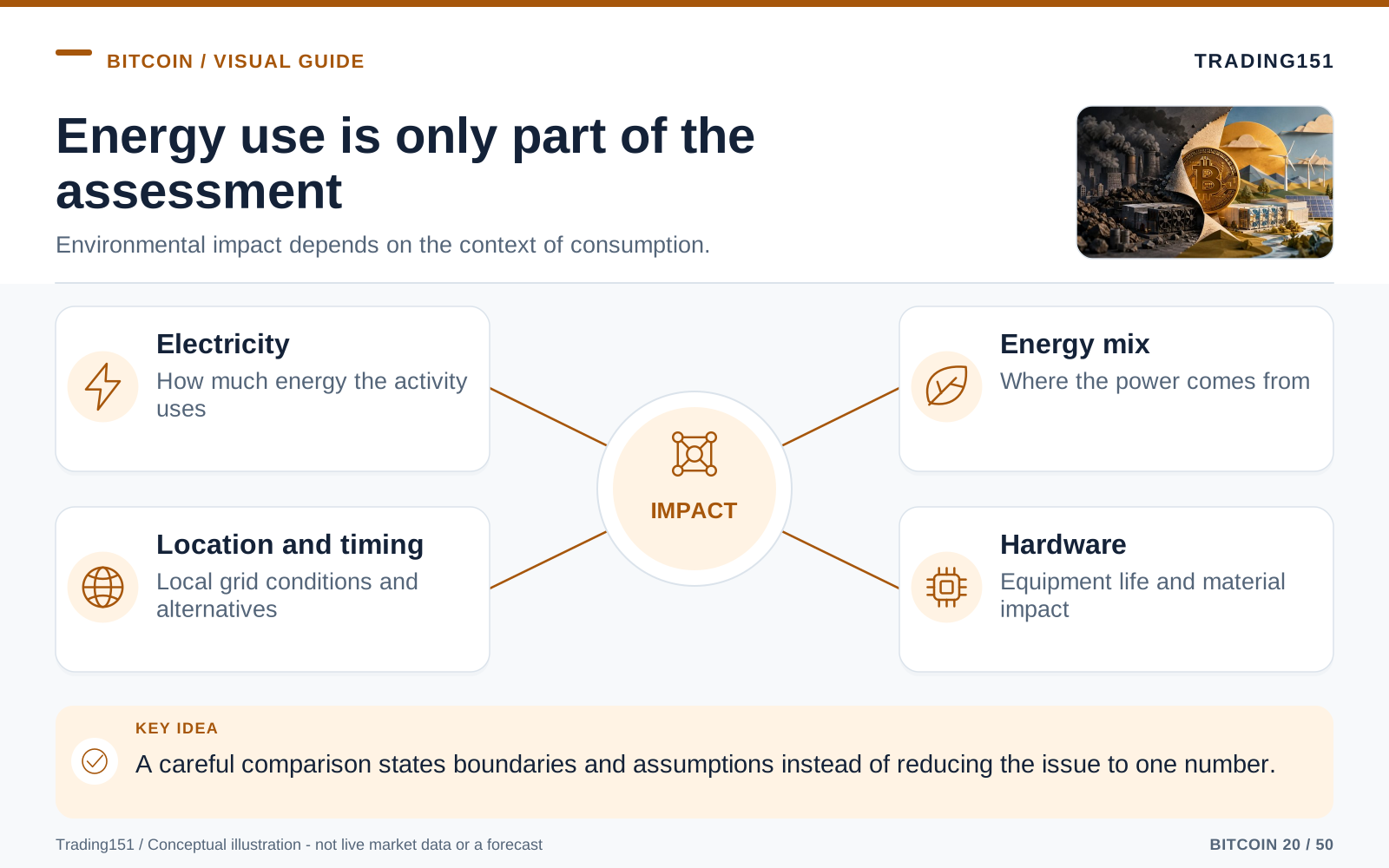
Read this diagram as text
- Electricity
- How much energy the activity uses
- Energy mix
- Where the power comes from
- Location and timing
- Local grid conditions and alternatives
- Hardware
- Equipment life and material impact
A Country-Sized Power Bill
It's hard to wrap your head around how much juice Bitcoin uses, mostly because the numbers are large and constantly shifting. Power consumption swings substantially based on the price of the coin, the efficiency of new hardware, local utility rates, and government crackdowns. Even so, the experts generally agree: Bitcoin uses as much electricity as a mid-sized nation. Now, power consumption and carbon emissions aren't exactly the same thing. A miner running on a dirty coal grid leaves a very different footprint than one running on excess hydroelectricity, nuclear power, or captured landfill gas. Plus, timing matters. Is a facility soaking up surplus energy at 2 AM, or is it drawing power during a blistering heatwave when the grid is already gasping? A fair look at the impact has to factor in where the power is coming from and what it could have been used for instead.
Cambridge's April 2025 mining report estimated annual electricity use at 138 terawatt-hours. Its survey covered 49 firms representing approximately 48% of global mining activity. That is a dated estimate based on a stated sample and methodology, not a real-time meter for the entire network. Comparisons with older estimates need to account for changes in hardware assumptions, coverage, and measurement dates.
We don't really use "terawatt-hours" in everyday conversation. It's a metric meant for entire countries. That's why you always hear those comparisons—depending on the year, Bitcoin burns through about as much power as Argentina, Greece, or the Netherlands. The exact country changes, but the takeaway is the same: this isn't some tiny background app running quietly on a server. It's an absolute behemoth of an industrial load.
Most of Bitcoin's electricity demand comes from mining rather than from the marginal work needed to relay and validate one extra payment. Dividing total mining consumption by transaction count gives an allocation, not a measurement of the extra energy caused by that transaction. Transaction fees can nevertheless affect miners' revenue and, over time, their incentive to operate.
Understanding that technical nuance is important, but it doesn't excuse the large power draw. A system can be misunderstood by the public while still being a large drain on resources.
The Efficiency Trap
Crypto defenders love to point out that mining rigs are constantly getting more efficient, which is absolutely true. The latest generation of ASIC miners can crunch way more numbers per watt than the old rigs. If the network just kept doing the same amount of work with better hardware, energy use would plummet. But mining isn't a fixed chore—it's an economic free-for-all. When machines get more efficient, or when the price of Bitcoin jumps, operators just buy more rigs until their profit margins thin out again. The network simply absorbs the extra processing power instead of saving electricity. Better gear just means miners can squeeze more guesses out of the same amount of power, but it doesn't put a cap on overall consumption. The hunger for energy scales right alongside the value of the coin.
It's not like upgrading your fridge to a modern, energy-star model that just sits there quietly saving you money on your electric bill. In the mining game, efficiency shifts the entire economic landscape. If rigs get better, mining gets more profitable. The higher the profits, the more people jump into the industry. When more people jump in, the network's algorithm cranks up the difficulty, and the race gets even more intense.
This endless loop is the core of the problem. You can make an individual machine efficient, but that won't shrink the network's large footprint. As long as the financial reward for mining a block is high enough, companies will keep plugging in more hardware until it barely makes financial sense anymore.
That's why people call it an arms race. Miners aren't competing to do something socially useful. A warehouse packed with humming servers isn't curing diseases, rendering the next Pixar movie, predicting hurricanes, or storing family videos. Its one and only job is to furiously guess random numbers to win crypto.
Die-hard fans will tell you this is the whole point—the network is backed by cold, hard physics that nobody can fake. But when critics look at the same setup, they see a giant engine designed to turn perfectly good electricity into artificial scarcity.
The Carbon Reality: It's Not All Green or Black
Just looking at a power bill doesn't give you the full environmental picture. A large server farm running off excess wind power is totally different from one burning cheap coal. The big question isn't just how much juice Bitcoin uses, but where it's getting it.
Miners are obsessed with cheap electricity because it's their biggest expense. They'll go anywhere to find it. Sometimes that pushes them toward renewable energy that nobody else wants. Other times, it pushes them into places with zero environmental oversight, dirty grids, or failing power plants that were desperate for a lifeline.
For a long time, the vast majority of mining happened in China. Some of those operators set up near large dams to use cheap seasonal hydro power, but plenty of others tapped into grids running almost entirely on coal. When the Chinese government banned crypto mining in 2021, the network didn't suddenly get clean. The miners just packed up and left. A bunch moved to Kazakhstan, leaning heavily on their coal plants. Others flooded into the US, turning places like Texas, New York, and Georgia into the new crypto capitals.
The situation in the US perfectly captures why this is such a messy fight. On paper, the American grid looks cleaner and is adding a lot of solar and wind. But in the real world, dumping a large new mining operation onto the grid often means firing up fossil fuel plants to handle the extra load, especially when these facilities run 24/7 or intentionally set up next to dirty, underused power plants simply because the power is inexpensive.
A new mining customer can affect whether a power plant remains commercially viable. The environmental result depends on the plant's fuel, its alternative customers, and what would have happened without the mining demand. Assess that counterfactual rather than assuming every mining facility either rescues renewable energy or prolongs fossil-fuel generation.
There's also a serious human cost that gets glossed over when we only talk about global carbon charts. Burning fossil fuels pumps out nasty particulate matter that drifts into surrounding communities. A recent look at large crypto mines in the US found they were heavily reliant on fossil fuels, directly increasing the amount of toxic air pollution breathed in by people living downwind.
When you look at it that way, the environmental toll stops feeling like an abstract math problem. You can see it in the smog, hear it in the noise, feel it in the local water supply, and pay for it on your monthly utility bill.
The Neighborhood Impact: Heat, Noise, and Stressed Grids
If you drove past a Bitcoin mine, you probably wouldn't look twice. A lot of them are just plain metal shipping containers, drab warehouses, or non-descript buildings sitting next to power substations or wind farms. But talk to the people living nearby, and they'll tell you these places are impossible to ignore.
Mining rigs generate an absurd amount of heat, and keeping them from melting down requires large industrial fans. Those fans create a relentless, droning mechanical roar that cuts right through rural landscapes and quiet neighborhoods. Residents in mining towns constantly complain about the noise. It doesn't fade into the background at night because the machines never, ever stop. To a day trader, a Bitcoin mine is just numbers on a screen, but to the locals, it's a constant, headache-inducing buzz.
Then there's the sheer strain on the local power grid. A single large facility can suck up as much electricity as an entire town. When you drop that kind of demand into an area already dealing with heatwaves, severe storms, or aging power lines, it's a large gamble.
The downsides are pretty obvious: you need to generate more power, the power lines get stressed, and everyone's electricity bill can shoot up. But miners argue there's a silver lining. Unlike a factory or a hospital, a crypto mine can shut off in seconds. In places like Texas, miners claim they're helping stabilize the grid. They buy power when nobody else needs it, and they power down when the grid is maxed out.
The catch is that this only works in theory. It entirely depends on how the financial incentives are set up. If mining companies get paid millions of dollars to briefly turn off their machines during a winter storm—after artificially inflating the area's base power demand all year—locals have every right to be furious. If a mine funds the construction of a new solar farm, great. If it just keeps a coal plant burning, that's a completely different story. The reality is always in the fine print.
Mountains of E-Waste
Everyone talks about carbon emissions, but Bitcoin has a large physical garbage problem, too.
Today's mining is entirely run by ASICs—custom-built computers designed to do exactly one thing: mine Bitcoin. They are totally useless for anything else. When they inevitably become obsolete, you can't install Windows on them, you can't donate them to a local school, and you can't use them to play video games. They're basically just expensive space heaters.
This hyper-specialization makes the tech turnover wasteful. As manufacturers push out faster, more efficient rigs, the older models quickly become unprofitable to run, especially if the price of crypto dips. Some get shipped overseas where power is cheaper. Some get stripped for spare parts. But eventually, they all become garbage.
Experts estimate that the Bitcoin network generates tens of thousands of metric plenty of electronic waste every year. The exact numbers are heavily debated depending on how long you think a machine lasts, but the core issue is undeniable. These aren't just empty metal boxes; they're packed with complex circuit boards, rare metals, plastics, and chips that took a large amount of energy to manufacture in the first place.
This is a topic where both sides need a reality check. Critics sometimes act like every machine is tossed into a landfill after six months, which isn't true—there's a large secondary market for older rigs. But the crypto industry also loves to pretend this isn't an issue at all. The entire network is built to reward whoever has the newest, fastest hardware, which guarantees an endless cycle of manufacturing and trashing specialized electronics.
A completely digital currency creates a shockingly physical trail of trash: dead microchips, busted fans, fried power supplies, and mountains of metal that the world has to figure out how to recycle.
The Hidden Water Drain
You rarely hear anyone bring up water when talking about crypto, but it's a large piece of the puzzle.
Because mining rigs run so hot, you have to cool them down somehow. Some places just use giant fans, but others dunk the machines in specialized cooling fluids or use large water-evaporation systems. Depending on the setup and the climate, a facility can chew through a shocking amount of direct water.
Electricity production can also use water, depending on the generation technology, cooling system, and location. Thermal power plants, including nuclear facilities, may require cooling water; uranium is used in nuclear fission, not burned as a conventional fuel. Hydroelectric reservoirs can have evaporation impacts as well. An environmental assessment should distinguish direct mine use from water associated with its electricity supply.
Some recent studies suggest Bitcoin's global water footprint is in the billions of gallons a year. People argue over the exact math, but the bottom line is clear: heavy computing requires heavy water usage. In places already fighting over water rights, battling droughts, and trying to keep local farms alive, pumping millions of gallons into crypto mining is a tough pill to swallow.
For the people living near these places, it's not just a theoretical debate. It's totally fair for them to ask why their shrinking local reservoir is being drained to cool down servers that are just guessing random numbers. The industry's usual response is that they're developing better cooling tech and finding cleaner power. That's a nice sentiment, but the companies should be the ones proving they aren't doing harm, rather than forcing the locals to just deal with it.
Can Bitcoin Go Green?
The crypto crowd isn't entirely wrong when they say the environmental story is complicated. There are legitimately interesting experiments happening out there that could reduce emissions or even solve weird energy problems. We shouldn't just roll our eyes at these ideas, but we need to look at them closely.
1. Burning waste gas: When companies drill for oil, they often hit pockets of natural gas. If there's no pipeline nearby to transport it, they just light it on fire right there at the well. It's wasteful, and because it rarely burns perfectly, it vents raw methane straight into the atmosphere. Lately, some crypto companies have been hauling mining rigs out to these oil fields, capturing that wasted gas, and using it to power their machines.
Miners argue this is a large win because it burns the methane much cleaner than an open flare. In some specific cases, they're right. The problem is the bigger picture. Critics point out that if you give oil companies a way to make extra money off their waste, you're just making fossil fuel extraction more profitable. Finding a clever way to use pollution isn't the same thing as shifting the world toward clean energy.
2. Using otherwise-curtailed renewable output: Wind and solar production vary by time and location, and sometimes exceed what a grid can use or transmit. Flexible mining demand may purchase part of that surplus. Wind does not only blow at night, nor does solar production universally coincide with low demand; the relevant generation and load profiles must be measured for the actual location.
This is one of the industry's best arguments. Having a guaranteed buyer can make it financially viable to build large solar farms in the middle of nowhere. But again, context is everything. If the miners are only sipping surplus power, that's fantastic. But if they're competing with local homes and businesses for clean energy—forcing the grid to rely on coal to make up the difference—then the whole "green" argument falls apart.
3. Acting as the grid's shock absorber: Because a crypto mine can be unplugged in an instant, they can play a unique role in grid management. When a severe storm hits and everyone turns on their heaters, the grid operators can ask the miners to shut down, instantly freeing up large amounts of power for hospitals and homes.
That kind of flexibility is useful. But about it: shutting off during an emergency is great, but running at maximum capacity the other 364 days of the year still drastically increases the area's base power demand. You have to look at the net impact. Are these guys making the grid cheaper and more reliable, or are they just getting paid to temporarily pause the large strain they created?
4. Tapping into stranded energy: There's a lot of potential clean energy trapped out in the middle of nowhere. Think remote waterfalls, isolated geothermal vents, or wind-swept plains that are just too far from any major city to justify building power lines. Because crypto miners just need an internet connection, they can drop a shipping container anywhere and turn that isolated energy into digital money.
It sounds elegant, and sometimes it works beautifully. But energy isn't always going to be stranded. Eventually, those regions might need that power to build local industries, run water desalination plants, or power new towns. Crypto mining might be a great temporary band-aid, but it shouldn't become a permanent excuse for governments to avoid building actual power infrastructure that benefits real people.
The Ethereum Flip: Proof That Things Can Change
The harshest criticism of Bitcoin's large energy appetite comes from inside the crypto community itself.
Back in September 2022, Ethereum—the second-biggest cryptocurrency—pulled off a large software update nicknamed The Merge. They completely ripped out their energy-hungry Proof of Work system and swapped in something called Proof of Stake. Instead of a bunch of machines burning electricity to secure the network, users just lock up their own crypto as collateral to vouch for new transactions.
Ethereum's transition to proof of stake in September 2022 was estimated to reduce its energy consumption by about 99.95%. That is evidence of a substantial change in the consensus mechanism's energy requirements, not proof that the network has no operational, financial, or security risks. Whether Bitcoin should adopt a different mechanism is a separate design and governance question.
Naturally, everyone started asking: If Ethereum can pull the plug on mining, why the hell can't Bitcoin?
The answer is a little bit technical, but mostly it's just pure ideology. The hardcore Bitcoin community views Proof of Work as a sacred, non-negotiable feature. They firmly believe that anchoring the digital currency to physical electricity is the only way to keep it truly decentralized, secure, and immune to government meddling. To them, Proof of Stake just hands control of the network over to whoever already holds the most money, completely destroying the level playing field.
And let's not forget the financial reality. Mining companies have sunk billions of dollars into large warehouses, specialized ASIC chips, and iron-clad energy contracts. If Bitcoin switched off Proof of Work, all of that infrastructure would become worthless overnight. Since Bitcoin doesn't have a CEO or a board of directors, forcing a change like that would require a large consensus among developers, miners, and users. There is absolutely zero chance of that happening anytime soon.
So, while Ethereum proved that a large blockchain doesn't have to burn the planet to function, Bitcoin isn't going to follow suit. For the true believers, the sheer amount of energy the network consumes isn't a bug—it's the entire point.
Are We Being Unfair to Bitcoin?
If we're going to talk about environmental damage, let's not pretend the traditional banking system is innocent. Wall Street runs large data centers, keeps glass skyscrapers lit up all night, and manages global ATM networks. And don't even get started on gold mining, which rips the earth open, poisons rivers with harsh chemicals, and burns large amounts of diesel. Creating and moving money has never been perfectly clean.
Crypto fans love throwing this in the faces of their critics, and they make a fair point. If Bitcoin wants to replace gold or challenge traditional banking, it's totally fair to put their environmental footprints side by side. It's also worth asking if Bitcoin offers something uniquely valuable to society—like letting people bypass corrupt governments, protecting savings from hyperinflation, or just giving folks a way to send money overseas without getting gouged by fees.
But pointing fingers isn't an excuse. Just because a gold mine in Nevada dumps chemicals into a river doesn't mean a crypto mine in Texas gets a free pass to burn coal. Slapping the label "banking is worse" on a debate doesn't magically justify Bitcoin's power draw. If a new technology claims to be the future, it should be held to a higher standard.
The real question we should be asking isn't simply, "Does Bitcoin use power?" Everything uses power. The real question is, "Is the juice worth the squeeze? Who is benefiting, who is getting stuck with the bill, and isn't there a smarter way to do this?"
What a Grown-Up Mining Industry Would Look Like
Even if Bitcoin is permanently stuck with Proof of Work, the damage it does isn't set in stone. The environmental toll completely depends on where miners set up, how they get their power, and whether regulators force them to behave. A mature industry wouldn't just churn out PR campaigns about being "green"—it would prove it.
Better disclosure would make the debate more useful. Mining operators can report electricity use, location, energy procurement, and the methods used to estimate emissions. Those records should distinguish measured operating data from modeled estimates. One renewable-powered facility cannot establish the mix of the entire network, just as one coal-powered facility cannot represent every miner.
Local decisions should consider grid capacity, household and industrial demand, emissions, noise, water use, and the opportunity cost of the electricity. A flexible load can have a different effect from an inflexible one, but claims about grid benefits need evidence from the specific site. Subsidies and connection terms also belong in the assessment.
We also need to talk about the hardware. If we're going to keep using hyper-specialized ASIC rigs, the manufacturers and the mining companies need to be legally responsible for their trash. You can't run around calling yourself a revolutionary tech pioneer while treating thousands of plenty of toxic e-waste like it's somebody else's problem. We need strict rules for repairing, recycling, and disposing of this gear.
Most importantly, the people living near these facilities need a seat at the table. Mining companies love to roll into town promising endless jobs and tax revenue, but the reality is that a large warehouse full of computers barely employs anyone once it's built. Locals deserve to know exactly how loud the fans will be, how much water will be drained, and what will happen to their electric bills before the first shovel hits the dirt.
Ask what would have happened without the mine
Imagine a mining site buying power from a hydroelectric plant. Calling that electricity renewable is a description of the source, not a complete assessment of the mine's effect. Would the power otherwise have been curtailed, exported, stored, or used by homes and businesses? The comparison changes depending on the answer. This is the counterfactual: what would likely have happened without the mining load.
Timing matters as well as location. A site that reduces demand during a grid emergency is behaving differently from one that runs through the peak. A contract claiming renewable supply is not the same evidence as hourly information about the generation meeting the site's demand. Neither distinction automatically proves a project beneficial or harmful; it identifies what needs measuring.
Avoid attributing all mining electricity to a single payment by dividing network consumption by transaction count. Mining supports the chain as a whole, and electricity use is not mechanically proportional to the number of transactions in a block. That simple division can be an accounting ratio, but it is not the marginal energy caused by one extra payment.
For any estimate, record the year, geographic coverage, hardware assumptions, and uncertainty. Cambridge's 2025 industry report offered newer survey-based evidence than the older estimates often repeated in this debate, while still relying on incomplete industry coverage. Treat a published number as an estimate with a method, not a permanent fact. The best comparison explains both the scale of the load and the real-world alternatives against which it is being judged.
Keep annual estimates in their proper context
A network-wide electricity estimate is not a meter reading from every miner. Models rely on assumptions about hardware, efficiency, utilization, and location. Survey results can add useful detail but also have sampling limits. When comparing two figures, check the period, method, and coverage before concluding that energy use changed by the full difference. Reporting a range or a dated estimate can be more honest than presenting a single number as permanently exact. 1, 2
Moving Past the Bumper Stickers
Talking about Bitcoin is always a headache because it scrambles together finance, tech, environmentalism, and hardcore libertarian ideology. To the true believers, it's a miraculous invention: money that can't be inflated, censored, or controlled by corrupt politicians. To the skeptics, it's just a large, planet-burning casino built for tech bros. The funny thing is, both of those views have a grain of truth.
But what we can't do is pretend the environmental impact isn't real. The power plants are real. The smog is real. The deafening fans, the dying microchips, and the drained water tables are real. Even when a mining operation tries its best to use clean power, it's still sucking up resources in a world that is absolutely desperate for green energy to run homes, cars, and hospitals.
Mining's environmental effects vary by location and operating model. Some projects may purchase otherwise-curtailed generation or provide a flexible load; others may increase fossil-fuel demand or compete for constrained capacity. The useful question is what changes because the mine exists, supported by data rather than a favorable example chosen to stand for the whole industry.
Ultimately, Bitcoin's legacy isn't going to be defined purely by its price tag, how many ETFs Wall Street launches, or the hype around the latest halving event. It's going to be judged by the physical toll it takes on the real world. How much electricity is it acceptable for a decentralized currency to burn? Can that power ever truly be clean? Who gets stuck dealing with the noise and the pollution? And is the security of Proof of Work really worth the enormous price tag?
Bitcoin started as a completely radical concept: money that doesn't ask for permission. Now it faces a totally different, vastly more practical challenge. It has to prove that a financial system designed to exist entirely outside the rules of banks and governments can still be a good neighbor on the planet we all have to share.
Sources and further reading
- Cambridge: Sustainable energy use in Bitcoin mining, 2025 survey
- Ethereum.org: Energy consumption
- Bitcoin Developer Guide: Block Chain
- Bitcoin Developer Guide: Mining
Editorial revision: 7 October 2026. Numerical scenarios are hypothetical unless identified as historical. References support the added explanations and selected corrections; rules and product terms should be checked again before acting.